
Topic: Road accidents and first aid · Nº 573 / 626
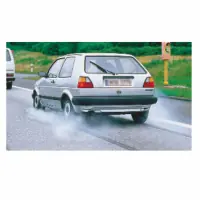
Ante una frenada de emergencia, ¿cómo debe actuar?
How should you act in an emergency stop?
- ADe diferente manera si mi vehículo tiene frenos convencionales o dispone de ABS.Differently, depending on whether my vehicle has conventional brakes or ABS.
- BDe igual manera si mi vehículo tiene frenos convencionales o dispone de ABS.In the same way, whether my vehicle has conventional brakes or ABS.
- CNo pisando el embrague en ningún momento de la frenada, en cualquier caso.By never pressing the clutch at any point while braking, in all cases.
Show answer
Correct answer
- ADe diferente manera si mi vehículo tiene frenos convencionales o dispone de ABS.Differently, depending on whether my vehicle has conventional brakes or ABS.
What you do in an emergency stop is not the same with conventional brakes as with ABS. If our vehicle has ABS, we must press the brake fully and the clutch at the same time so that the transmission does not interfere with braking. It is important not to release the brake pedal until the vehicle has come to a complete stop. Without ABS, keep constant pressure on the brake, lifting your foot when you feel the wheels lock. Then brake again smoothly and firmly once you regain control of the vehicle, repeating this as many times as necessary and without pressing the pedal all the way down.
Independent app: not affiliated with or endorsed by the DGT (Spain's Directorate-General for Traffic) or the Ministry of the Interior. The official exam is booked with the DGT and taken at its test centres. The questions here are practice material; the DGT's official question bank is not public.