
DGT test · 270 questions
Vehicle controls and equipment · Page 5 of 6
The controls and equipment of a car — mirrors, wipers, dashboard, warning lights — and the rules for using them.
Questions in this topic, with answers
270 questions, 50 per page, with the correct answer and the explanation. Page 5 of 6.
Como norma general, ¿cuál es la forma más adecuada de actuar sobre el mando del acelerador de su motocicleta?
As a general rule, what is the best way to use your motorcycle's throttle control?
- ADe forma suave y progresiva.Smoothly and gradually.
- BAcelerar al mismo tiempo que se desembraga la motocicleta.Accelerating at the same time as releasing the clutch.
- CPresionando el pedal correspondiente de forma suave y progresiva.Pressing the relevant pedal smoothly and gradually.
ExplanationThe best way to use a motorcycle's throttle control is smoothly and gradually. Accelerating suddenly can make the engine respond abruptly and make the vehicle harder to control. Doing it smoothly and gradually gives more controlled acceleration and avoids unnecessary bursts of speed.
En los motores diésel se recomienda realizar el cambio de marchas...
In diesel engines, it is recommended to change gear...
- Aentre las 1500 y 2000 rpm.between 1,500 and 2,000 rpm.
- Bentre las 2000 y 2500 rpm.between 2,000 and 2,500 rpm.
- Centre las 3000 y 3500 rpm.between 3,000 and 3,500 rpm.
ExplanationIn a diesel engine it is recommended to change gear between 1,500 and 2,000 revolutions per minute, and in petrol engines between 2,000 and 2,500.
¿Para qué sirve el carenado en la motocicleta?
What is the fairing on a motorcycle for?
- ASolo para mejorar la estética de la moto.Only to make the motorcycle look better.
- BPara proteger al conductor del viento y de las inclemencias de tiempo.To protect the rider from the wind and bad weather.
- CPara que la moto sea más manejable a baja velocidad.To make the motorcycle easier to handle at low speed.
ExplanationThe fairing on a motorcycle is the outer covering that includes the windscreen and the side panels. It is designed to protect the rider from the wind and bad weather in general.
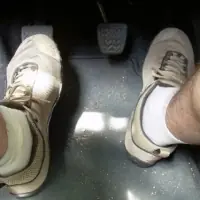
¿Que puede ocurrir si al iniciar la marcha se aprieta hasta el fondo el pedal acelerador?
What can happen if you press the accelerator pedal all the way down when moving off?
- AQue el coche tire hacía atrásThe car may roll backwards
- BPuede darse una aceleración fluidaSmooth acceleration may happen
- CPuede darse una aceleración en vacíoThe engine may rev without the car moving
ExplanationWhen we move off after being stopped, we must press the accelerator pedal gently, because if we press it suddenly all the way down, the engine may rev without the car moving, which will damage the vehicle.
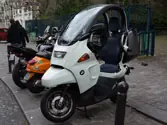
¿Cuántos espejos retrovisores tiene que llevar instalados una motocicleta con estructura de autoprotección?
How many mirrors must a motorcycle with a protective structure have fitted?
- AObligatoriamente dos, uno en cada lado, independientemente de la velocidad máxima que pueda alcanzar.Two compulsory, one on each side, whatever maximum speed it can reach.
- BUno interior y otro exterior izquierdo.One interior and one left exterior.
- CUno si su velocidad máxima no supera los 100 km/h.One, if its maximum speed does not exceed 100 km/h.
ExplanationMotorcycles, with or without a sidecar, with a maximum speed of no more than 100 km/h must have at least one exterior mirror on the left side. When their maximum speed is over 100 km/h, they must have one on the left side and another on the right side.
¿Cuántos retrovisores son obligatorios en un cuadriciclo que no esté equipado de carrocería?
How many rear-view mirrors are compulsory on a quadricycle without bodywork?
- ALos dos exteriores.The two exterior ones.
- BUno interior y otro exterior izquierdo.One interior and one left exterior.
- CUno interior y otro exterior derecho.One interior and one right exterior.
ExplanationUnder Annex III of the General Vehicle Regulations (RGV), quadricycles without bodywork that fully or partly covers the driver must have two exterior mirrors, left and right. Light quadricycles without bodywork, on the other hand, only need the left one.
¿Qué se entiende por ángulo muerto?
What is meant by the blind spot?
- AEs una posición del cambio de velocidad en la que no hay ninguna marcha engranada.A position of the gear lever in which no gear is engaged.
- BEs una zona al lado del vehículo que no la vemos a través de los espejos retrovisores.An area beside the vehicle that we cannot see in the mirrors.
- CEs la parte anterior izquierda del vehículo.The front left part of the vehicle.
ExplanationThe blind spot is an area beside our vehicle that cannot be seen in the mirrors, even when they are correctly adjusted.
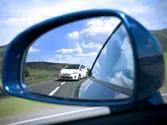
El reglaje del espejo retrovisor exterior izquierdo será correcto...
The left exterior mirror is correctly adjusted...
- ACuando desde el asiento del conductor y moviendo un poco la cabeza veamos ligeramente el lado del vehículo y el máximo de calzada.when, from the driver's seat and moving your head slightly, you see a little of the side of the vehicle and as much of the carriageway as possible.
- BCuando desde el asiento del conductor y sin desviar la cabeza veamos ligeramente el lado del vehículo y el máximo de calzada.when, from the driver's seat and without moving your head, you see a little of the side of the vehicle and as much of the carriageway as possible.
- CCuando desde el asiento del conductor y sin mover la cabeza veamos la mayor parte del lateral del vehículo y una parte pequeña de la calzada.when, from the driver's seat and without moving your head, you see most of the side of the vehicle and a small part of the carriageway.
ExplanationTo adjust the left exterior mirror, we do not move our head from the normal driving position, and we should see in the mirror a small part of the side of the vehicle and a large part of the carriageway.
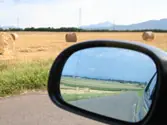
Cada cuanto debemos de mirar los retrovisores:
How often should we look in the mirrors?
- AEn zona urbana y carreteras con tráfico cada 5/10 segundos.In urban areas and on roads with traffic, every 5–10 seconds.
- BEn carreteras sin tráfico y autopistas/autovías cada 5/10 segundos.On roads with no traffic and on motorways (autopistas) or dual carriageways (autovías), every 5–10 seconds.
- CEn zona urbana y carreteras con tráfico cada 10/15 segundos.In urban areas and on roads with traffic, every 10–15 seconds.
ExplanationTo drive more safely and gather all the information about your surroundings, you need to look in the mirrors constantly. How often: on urban roads and roads with traffic, every 5–10 seconds; on roads with no traffic and on motorways (autopistas) or dual carriageways (autovías), every 10–15 seconds.
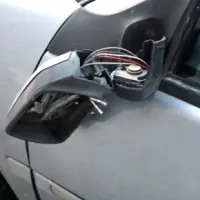
El retrovisor exterior izquierdo se ha roto. ¿Está permitido circular así?
The left exterior mirror is broken. Are you allowed to drive like this?
- ASí, cuando tiene el retrovisor exterior derecho y el interior.Yes, when the car has the right exterior mirror and the interior mirror.
- BSí, cuando tiene el retrovisor exterior derecho.Yes, when the car has the right exterior mirror.
- CNo, porqué el retrovisor exterior izquierdo es imprescindible.No, because the left exterior mirror is essential.
ExplanationOn cars, the left exterior mirror (the one on the driver's side) is always compulsory and must be accompanied by the right mirror and the interior mirror, or at least one of them. So if the left mirror is broken, we must repair or replace it so that we can drive safely.
¿Para qué sirve el freno de mano?
What is the handbrake for?
- APara inmovilizar el vehículo cuando lo estaciono.To keep the vehicle stationary when I park it.
- BPara frenar el vehículo en la ciudad.To brake the vehicle in town.
- CPara frenar el vehículo cuando circulo cuesta abajo.To brake the vehicle when I am driving downhill.
ExplanationThe handbrake or parking brake keeps the vehicle stationary when it is stopped or parked, especially on a slope. To reduce speed in town or when going downhill, you use the service brake and engine braking, not the handbrake.
¿Qué función cumple el sistema ADAS, conocido como RCTA (Alerta de trafico cruzado)?
What does the ADAS system known as RCTA (Rear Cross Traffic Alert) do?
- AAyuda al conductor a mantenerse dentro del carril por el que circula.It helps the driver stay in the lane they are driving in.
- BAvisa al conductor con una señal visual y/o sonora, cuando, al hacer marcha atrás, detecta algún usuario que se acerque por detrás del vehículo de forma transversal.It warns the driver with a visual and/or sound signal when, while reversing, it detects a road user approaching from the side behind the vehicle.
- CAvisa al conductor de que el vehículo que le precede frena bruscamente.It warns the driver that the vehicle in front is braking sharply.
ExplanationRCTA, or rear cross traffic alert, watches for traffic approaching from the side when the vehicle is reversing out, for example from an angled or perpendicular parking space, and warns the driver with a sound or visual signal if it detects a vehicle approaching.
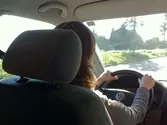
Si nos sentamos muy cerca del volante...
If we sit very close to the steering wheel...
- ASerá la posición más cómoda para conducir.It will be the most comfortable driving position.
- BNo tendremos movilidad y la conducción será más cansada.We will not be able to move freely and driving will be more tiring.
- CTendremos mayor control del volante en las curvas.We will have better control of the steering wheel on bends.
ExplanationTo adjust the driver's seat correctly, the arms should be slightly bent. If we put the seat very close to the steering wheel, we will not be able to move freely and driving will be more strained.
¿Cuándo avisa al conductor el sistema avanzado de ayuda a la conducción llamado RCTA (Alerta de tráfico cruzado)?
When does the advanced driver assistance system called RCTA (Cross traffic alert) warn the driver?
- ACuando detecta un vehículo que se aproxima por el lateral en la próxima intersección y hay riesgo de colisión.When it detects a vehicle approaching from the side at the next junction and there is a risk of collision.
- BCuando detecta, al salir marcha atrás de un hueco de estacionamiento, que se aproxima un vehículo por el lateral.When, while reversing out of a parking space, it detects a vehicle approaching from the side.
- CCuando, al realizar un adelantamiento, detecta que se aproxima un vehículo en sentido contrario.When, while overtaking, it detects a vehicle approaching from the opposite direction.
ExplanationThe RCTA system (Cross traffic alert) warns the driver when it detects a vehicle approaching from the side while reversing out of a parking space. This is important because, during this manoeuvre, the driver's view is limited and they may not see the approaching vehicle, which increases the risk of collision. According to the General Traffic Regulations, driver assistance systems aim to improve road safety, especially in critical situations like this.
¿Cuál de los siguientes sistemas ADAS se conoce como «Alerta de tráfico cruzado»?
Which of the following ADAS systems is known as 'Cross traffic alert'?
- AACTACT
- BLDWLDW
- CRCTARCTA
ExplanationThe RCTA (Rear Cross Traffic Alert) system is a driver assistance system that warns of cross traffic when reversing out. It uses radar sensors to detect approaching vehicles, cyclists or pedestrians, helping to avoid collisions in car parks or when leaving garages. Example: when leaving a parking space with poor visibility, RCTA will warn the driver of a vehicle approaching from the side.
¿Es aconsejable utilizar un cojín en el asiento del conductor?
Is it advisable to use a cushion on the driver's seat?
- ASí, pues se conducirá más cómodamente.Yes, because driving will be more comfortable.
- BSí, sobretodo en viajes largos.Yes, especially on long journeys.
- CNo.No.
ExplanationIt is not advisable, because it can cause what is called submarining, where the body slides under the lap part of the seat belt.
Circular con seguridad, depende fundamentalmente...
Driving safely depends mainly...
- Adel conductor, no del vehículo.on the driver, not the vehicle.
- Bdel estado del vehículo, no del conductor.on the condition of the vehicle, not the driver.
- Cdepende del conductor y del buen estado del vehículo.on the driver and on the vehicle being in good condition.
ExplanationDriving safely depends on the driver of the vehicle and their skills at the wheel, on the vehicle being in good condition and on it having been properly maintained.
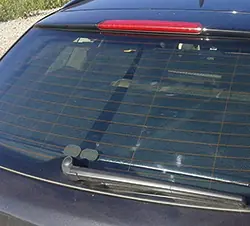
A un turismo, ¿le está permitido circular con láminas adhesivas o cortinillas contra el sol en las ventanillas traseras?
Is a car allowed to be driven with adhesive films or sun blinds on the rear windows?
- ANo, en ningún caso.No, never.
- BSí, en todo caso.Yes, in all cases.
- CSolo si el vehículo lleva dos espejos retrovisores exteriores.Only if the vehicle has two exterior mirrors.
ExplanationFilms or blinds on the rear windows are only allowed if the vehicle has two exterior mirrors, which make up for the loss of rear visibility.
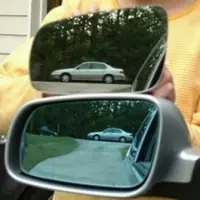
¿Como se puede evitar el deslumbramiento en el espejo retrovisor interior?
How can you avoid dazzle in the interior mirror?
- APoniendo la mano frente a élBy putting your hand in front of it
- BModificando 90 grados el retrovisor hacía el lado izquierdoBy turning the mirror 90 degrees to the left
- CDesplazando bruscamente la cabezaBy moving your head suddenly
ExplanationWhen lights on the road dazzle us in the interior mirror, we should put our hand in front of it as a precaution, so that the reflections do not affect our visibility. We can also move our head slightly to keep the reflections out of our eyes.
Las motocicletas obligadas a llevar dos espejos retrovisores, uno a la derecha y otro a la izquierda, serán las que...
The motorcycles that must have two mirrors, one on the right and one on the left, are those that...
- APuedan superar los 100 km/h.can exceed 100 km/h.
- BPuedan superar los 120 km/h.can exceed 120 km/h.
- CLas que tengan más de 125 cc.have an engine capacity over 125 cc.
ExplanationAll motorcycles that can exceed 100 km/h must have two mirrors.
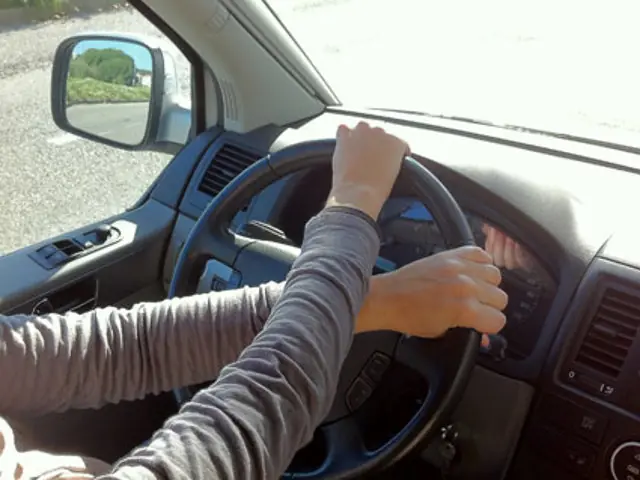
¿Este conductor tiene las manos bien colocadas en el volante?
Are this driver's hands correctly placed on the steering wheel?
- ASí, si está girando a la derecha.Yes, if they are turning right.
- BSí, si está girando a la izquierda.Yes, if they are turning left.
- CNo.No.
ExplanationThe correct position of the hands on the steering wheel is essential to keep proper control of the vehicle. According to the traffic rules, the driver must make sure their hands are placed so that they can manoeuvre effectively and keep their attention on the road. If the hands are not correctly placed, the driver could lose control of the vehicle, which is dangerous. The fact that the right hand is on the gear lever means it is not in the best position to control the steering wheel, so the correct answer is 'No'.
Para poder ver los vehículos que se encuentran en el ángulo muerto...
To see the vehicles that are in the blind spot...
- Agraduaremos correctamente el retrovisor.we will adjust the mirror correctly.
- Bpondremos un retrovisor panorámico.we will fit a panoramic mirror.
- Cgiraremos un poco la cabeza.we will turn our head slightly.
ExplanationEven with correctly adjusted mirrors there can be blind spots. To deal with them, we have to make a small head movement.
¿Es correcto circular en paralelo con una motocicleta?
Is it correct to drive alongside a motorcycle?
- ASí.Yes.
- BNo.No.
- CSólo en poblado y cuando hay mucha densidad de tráfico.Only in built-up areas when there is heavy traffic.
ExplanationMirrors leave an area at the side that cannot be seen, known as the blind spot. To avoid the danger of not being seen by other drivers, it is advisable not to drive alongside another vehicle.
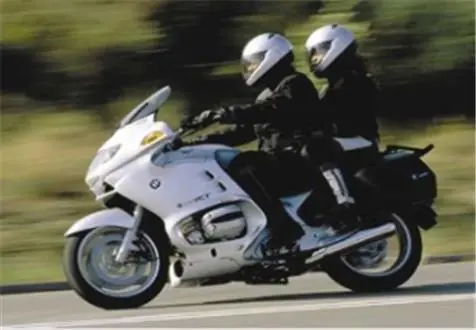
Si realiza con su motocicleta un giro muy cerrado a una velocidad lenta, ¿qué precaución debe tener?
If you make a very sharp turn at low speed on your motorcycle, what precaution should you take?
- AA esa velocidad tan lenta no es necesario tomar ninguna precaución.At such a low speed no precaution is needed.
- BDebe compensar el efecto giroscópico con el peso del cuerpo.You must counteract the gyroscopic effect with your body weight.
- CNo frenar con el freno delantero porque la rueda puede bloquearse y producirse una caída.Do not brake with the front brake, because the wheel may lock and you may fall.
ExplanationWhen riding a motorcycle at low speed and making a very sharp turn, if we have to brake and use the front brake, the wheel may lock and we may fall.
Si una motocicleta dispone de un sólo espejo retrovisor, ¿dónde deberá estar situado?
If a motorcycle has only one mirror, where must it be?
- AEn el lado derecho.On the right side.
- BEn el lado izquierdo.On the left side.
- CEn el lado derecho o en el izquierdo indistintamente.On the right or the left side, either one.
ExplanationThe correct answer is that on a motorcycle with only one mirror, the mirror must be on the left side. This is because, under the rules, if the motorcycle's maximum speed does not exceed 100 km/h, only a mirror on the left side is required. However, if the maximum speed is over 100 km/h, a mirror is required on both the left and the right side.
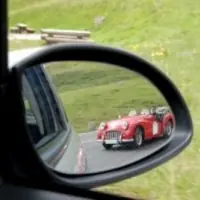
¿A qué ayudan los espejos retrovisores?
What do mirrors help with?
- AA mejorar la visión trasera y lateralImproving rear and side vision
- BA mejorar la visión frontal y traseraImproving front and rear vision
- CA mejorar la visión interior, trasera y lateralImproving interior, rear and side vision
ExplanationA vehicle's exterior and interior mirrors help the driver see better to the sides and rear of the vehicle. They never help the driver see better to the front, because that is what the windscreen is for.
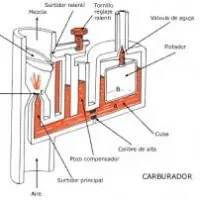
¿Con qué parte del cuerpo se acciona el estrangulador?
Which part of the body do you use to operate the choke?
- ACon los piesThe feet
- BCon las rodillasThe knees
- CCon las manosThe hands
ExplanationThe choke is a cold-start device operated from inside the vehicle by pulling a knob with your hand, which moves a cam and activates it.
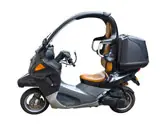
¿Dónde lleva esta motocicleta el mando del acelerador?
Where is the throttle control on this motorcycle?
- AEn el puño derecho.On the right handgrip.
- BEn el pedal de la derecha.On the right pedal.
- CEn la maneta de la derecha.On the right lever.
ExplanationOn all motorcycles the throttle control is on the right handgrip; on cars, lorries, coaches, etc., it is the right pedal.
Un ciclo o bicicleta será accionado...
A cycle or bicycle is powered...
- ASolo por un motor eléctrico.Only by an electric motor.
- BPor el esfuerzo muscular de la persona, normalmente mediante pedales.By the muscular effort of the rider, usually by means of pedals.
- CPor una cuerda.By a rope.
ExplanationA cycle, such as a bicycle, is a vehicle powered exclusively or mainly by the muscular effort of the people riding it, usually by means of pedals. Pedal-assisted bicycles are also cycles, because the motor only helps with pedalling.
¿Cómo se llama la distancia recorrida desde que percibimos un obstáculo hasta que pisamos el pedal del freno?
What is the distance travelled from the moment we see an obstacle until we press the brake pedal called?
- ADistancia de frenado.Braking distance.
- BDistancia de reacción.Reaction distance.
- CDistancia de detención.Stopping distance.
ExplanationFrom the moment we see something until we react, for example by pressing the brake, a period of time passes called 'reaction time'. The distance we travel during that time is known as 'reaction distance'.
Los ciclomotores de dos ruedas deben llevar...
Two-wheeled mopeds must have...
- Ados espejos retrovisores exteriores obligatorios, uno al lado izquierdo y otro al lado derecho.two compulsory exterior mirrors, one on the left side and one on the right side.
- Bes obligatorio el del lado izquierdo y optativo el del lado derecho.the left-hand mirror compulsory and the right-hand one optional.
- Ces optativo el del lado izquierdo y obligatorio el del lado derecho.the left-hand mirror optional and the right-hand one compulsory.
ExplanationMopeds must have a mirror on the left side; the right side is optional.
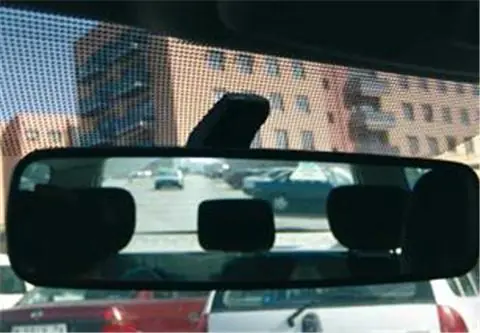
¿Qué es el ángulo muerto?
What is the blind spot?
- AEs la zona sin visibilidad que tiene el conductor al tomar una curva.The area the driver cannot see when taking a bend.
- BEs una zona alrededor del vehículo que no se ve con los retrovisores.An area around the vehicle that cannot be seen with the mirrors.
- CEs una parte de los coches que puede producir accidentes.A part of cars that can cause accidents.
ExplanationIn closed vehicles there are always areas on both sides that cannot be seen, because the vehicle's own bodywork blocks the view. These areas are known as blind spots. Even when the mirrors are correctly adjusted, it is difficult to remove these blind spots completely.
Si la motocicleta que conducimos debe estar provista de un solo espejo retrovisor, ¿en qué lado deberá estar situado?
If the motorcycle we ride has to have only one mirror, on which side must it be?
- AEn el lado izquierdo.On the left side.
- BEn el lado derecho o en el izquierdo, indistintamente.On the right or the left side, either one.
- CEn el lado derecho.On the right side.
ExplanationThe correct answer is that on a motorcycle with a maximum speed of no more than 100 km/h, the mirror must be on the left side.
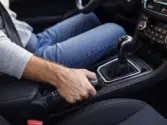
Utilizar el freno de mano de forma habitual durante la conducción, ¿es correcto?
Is it correct to use the handbrake regularly while driving?
- ASí, siempre que el vehículo tenga ABS.Yes, as long as the vehicle has ABS.
- BSí, se recomienda en curvas cerradas.Yes, it is recommended on sharp bends.
- CNo, sólo debe emplearse para inmovilizar el vehículo.No, it should only be used to keep the vehicle stationary.
ExplanationThe handbrake is designed to keep the vehicle still, not to brake while moving. Using it while moving can lock the rear wheels, cause loss of control and wear the system unnecessarily. So while driving you should use only the main brakes (the brake pedal), and keep the handbrake for holding the vehicle still, for example when parking on a slope.
¿Cuántos espejos retrovisores deberá llevar una motocicleta?
How many mirrors must a motorcycle have?
- ACon un retrovisor en el lado izquierdo es siempre suficiente.One mirror on the left side is always enough.
- BSi la motocicleta puede superar los 100 km/h deberá llevar dos espejos retrovisores.If the motorcycle can exceed 100 km/h, it must have two mirrors.
- CEn los ciclomotores siempre un retrovisor y en las motocicletas siempre dos.Mopeds always one mirror, and motorcycles always two.
ExplanationMotorcycles that can exceed 100 km/h must have mirrors on both sides.
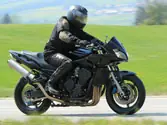
En una motocicleta, generalmente, ¿con qué pie se acciona el freno trasero?
On a motorcycle, which foot usually operates the rear brake?
- ACon el pie izquierdo.The left foot.
- BCon el pie derecho.The right foot.
- CEl freno trasero no se acciona con el pie, se acciona con la mano izquierda.The rear brake is not operated with the foot; it is operated with the left hand.
ExplanationMotorcycles usually have separate brakes for each wheel. The front brake is operated with a lever on the right of the handlebars, and the rear brake with a pedal that we press with the right foot.
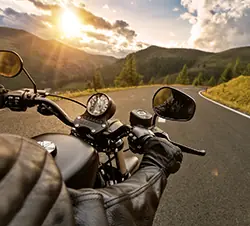
En una motocicleta con mandos independientes para cada uno de los frenos, ¿dónde se acciona generalmente el freno delantero?
On a motorcycle with separate controls for each brake, where is the front brake usually operated?
- AEn el manillar, con la mano derecha.On the handlebar, with the right hand.
- BEn el manillar, con la mano izquierda.On the handlebar, with the left hand.
- CEn un pedal, con el pie izquierdo.On a pedal, with the left foot.
ExplanationIn the usual layout of motorcycle controls, the front brake is the lever on the right side of the handlebar and is operated with the right hand. The rear brake is operated with the right foot, while the clutch is operated with the left hand and the gear change with the left foot.
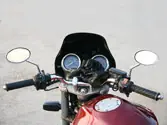
En una moto automática, con la maneta de la izquierda se accionará...
On an automatic motorcycle, the left-hand lever operates...
- Ael freno delantero.the front brake.
- Bel embrague.the clutch.
- Cel freno trasero.the rear brake.
ExplanationAutomatic motorcycles, like most scooters, have no clutch and no brake pedal. That is why the left-hand lever on the handlebar operates the rear brake, while the right-hand lever still operates the front brake.
Si el equipaje dificulta la visibilidad a través de la ventanilla posterior, ¿qué espejos son obligatorios?
If the luggage makes it difficult to see through the rear window, which mirrors are compulsory?
- ALos dos exteriores, uno a cada lado.Both exterior mirrors, one on each side.
- BUno interior panorámico, y el exterior derecho.A panoramic interior mirror and the right exterior mirror.
- CUno interior panorámico y el exterior izquierdo.A panoramic interior mirror and the left exterior mirror.
ExplanationOn cars, the left mirror and the interior mirror are compulsory; the right one is optional. When the interior mirror does not give a view, the right exterior mirror must be fitted. In that case, the interior mirror becomes optional.
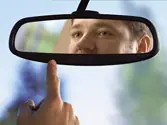
Mirarse en el espejo retrovisor mientras se conduce, ¿puede aumentar el riesgo de accidente?
Can looking at yourself in the mirror while driving increase the risk of an accident?
- ASí, porque el tiempo que se mira al espejo no se presta atención a la conducción.Yes, because while you are looking in the mirror you are not paying attention to driving.
- BSí, pero solamente de noche.Yes, but only at night.
- CNo, porque es posible mirarse al espejo y conducir a la vez.No, because you can look at yourself in the mirror and drive at the same time.
ExplanationLooking at yourself in the mirror while driving takes the driver's attention, so for a while they are not paying attention to driving, and this puts us at particular risk of having an accident.
Si hay gravilla en la calzada, ¿qué se debe hacer para evitar que se rompa el parabrisas?
If there is loose gravel on the road, what should you do to stop the windscreen breaking?
- ANada, porque si el parabrisas está limpio, el riesgo de rotura por gravilla disminuye.Nothing, because if the windscreen is clean, the risk of it breaking from gravel is lower.
- BAumentar la distancia respecto a los vehículos que circulan delante.Increase the distance from the vehicles in front.
- CAumentar la velocidad para reducir las consecuencias del impacto.Increase speed to reduce the consequences of the impact.
ExplanationThe correct answer is to increase the distance from the vehicles in front. This is important because keeping more distance reduces the chance that gravel thrown up by the wheels of the vehicle in front will hit our windscreen. According to the General Traffic Regulations, when driving on a slippery surface or in situations where material such as gravel may be thrown up, you must increase the safe distance. This not only helps protect the windscreen but also makes driving safer in general.
¿Cómo accionaremos el mando del acelerador en una motocicleta?
How will we operate the throttle control on a motorcycle?
- ACon la mano izquierda.With the left hand.
- BCon la mano derecha.With the right hand.
- CCon el pie derecho.With the right foot.
ExplanationOn motorcycles, both automatic ones and those with gears, the throttle control is on the right handgrip of the handlebars.
El espejo retrovisor izquierdo está roto. ¿Está permitido circular así?
The left-hand rear-view mirror is broken. Is it allowed to drive like that?
- ASí, cuando tiene espejo exterior derecho.Yes, if it has a right-hand exterior mirror.
- BSí, cuando tiene el espejo exterior derecho y el interior.Yes, if it has a right-hand exterior mirror and an interior mirror.
- CNo, porque el espejo exterior izquierdo es imprescindible.No, because the left-hand exterior mirror is essential.
ExplanationAccording to Annex III of the General Vehicle Regulations (Reglamento General de Vehículos), the left-hand exterior mirror is compulsory on cars and other motor cars. A right-hand or interior mirror does not replace it, so with the left one broken you cannot drive until it is repaired.
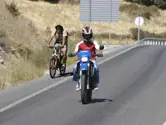
Si circula con una motocicleta.¿Con qué mano accionará el freno trasero?
If you are riding a motorcycle, which hand do you use to operate the rear brake?
- ACon la mano izquierda.The left hand.
- BCon la mano derecha.The right hand.
- CLo accionaré con el pie derecho.I operate it with my right foot.
ExplanationOn a motorcycle with a manual gearbox, the rear brake is operated with the pedal on the right-hand side, that is, with the right foot. On the handlebar, the right hand operates the front brake and the left hand the clutch.
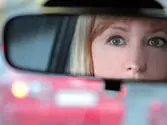
¿Se podrá sustituir el espejo retrovisor exterior por uno interior panorámico?
Can the exterior mirror be replaced by a panoramic interior mirror?
- ASí, por el exterior derecho.Yes, the right exterior mirror.
- BSí, por el exterior izquierdo.Yes, the left exterior mirror.
- CNo.No.
ExplanationThe left mirror is always compulsory and cannot be replaced by a panoramic interior mirror. The same applies to the right exterior mirror: when it is compulsory, it cannot be replaced.
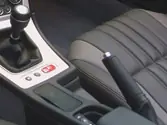
El freno de mano, ¿para qué sirve?
What is the handbrake for?
- APara dejar inmovilizado el vehículo cuando estaciono.To keep the vehicle still when I park.
- BPara frenar el vehículo en ciudad.To brake the vehicle in town.
- CPara frenar el vehículo cuando circulo cuesta abajo.To brake the vehicle when I am going downhill.
ExplanationThe handbrake, or parking brake, usually works by braking the vehicle's rear wheels, and it is used to keep the vehicle still when parked.
Si el equipaje impide ver por la ventanilla trasera, ¿qué espejos son obligatorios?
If the luggage blocks the view through the rear window, which mirrors are compulsory?
- ALos dos exteriores, uno a cada lado.Both exterior mirrors, one on each side.
- BUn retrovisor interior panorámico y el retrovisor exterior derecho.A panoramic interior mirror and the right-hand exterior mirror.
- CUn retrovisor interior panorámico y el retrovisor exterior izquierdo.A panoramic interior mirror and the left-hand exterior mirror.
ExplanationUnder Annex III of the General Vehicle Regulations, if the interior mirror does not give a view of the road behind, for example because luggage blocks the rear window, it is no longer compulsory and the car must have a second exterior mirror on the right-hand side, as well as the left-hand one.
¿Se permite conducir con láminas adhesivas o cortinillas para el sol?
Are you allowed to drive with adhesive films or sun blinds?
- ASí, solo durante el día.Yes, only during the day.
- BNo, en ningún caso.No, never.
- CSí, en las ventanillas traseras si el vehículo tiene dos espejos retrovisores exteriores.Yes, on the rear windows if the vehicle has two exterior rear-view mirrors.
ExplanationArticle 19.1 of the General Traffic Regulations only allows adhesive films or sun blinds on the rear windows, and only if the vehicle has two exterior rear-view mirrors that meet the technical specifications.
Para evitar el angulo muerto existente cuando observamos a través del retrovisor...
To avoid the blind spot that exists when we look in the mirror...
- Atenemos que disponer de 2 espejos, uno exterior y uno interior.we must have 2 mirrors, one exterior and one interior.
- Bgiraremos la cabeza como máximo 45º en los desplazamientos laterales.we will turn our head no more than 45° when moving sideways.
- Cpondremos un retrovisor interior panorámico.we will fit a panoramic interior mirror.
ExplanationThe blind spot, the area that the mirrors leave unseen, causes many accidents. To avoid them, you should turn your head about 45° at most when moving sideways.
En una motocicleta con cambio de marchas, ¿cómo se acciona el freno posterior?
On a motorcycle with gears, how is the rear brake operated?
- ACon la maneta de la derecha del manillar.With the right lever on the handlebars.
- BCon el pedal de la izquierda.With the left pedal.
- CCon el pedal de la derecha.With the right pedal.
ExplanationOn motorcycles with gears, we operate the rear brake with the right pedal and the front brake with the right lever. The left lever is the clutch and the left pedal is the gear change.
All topics
- Definitions
- Documents and penalty points
- The driver's condition
- Duties of drivers and pedestrians
- Vehicle safety devices
- Vehicle lights and horn
- Traffic signs, markings and signals
- The road and its lanes
- Speed and distances
- Manoeuvres
- Right of way
- Carrying passengers and loads
- Driving safely in difficult conditions
- Vehicle mechanics and maintenance
- Road accidents and first aid
- Defensive and eco-driving
Independent app: not affiliated with or endorsed by the DGT (Spain's Directorate-General for Traffic) or the Ministry of the Interior. The official exam is booked with the DGT and taken at its test centres. The questions here are practice material; the DGT's official question bank is not public.
Basado en datos de la Agencia Estatal Boletín Oficial del Estado (https://www.boe.es). Textos consolidados de carácter meramente informativo. La AEBOE no patrocina ni respalda este sitio.
Parte de las preguntas procede de los tests de la revista «Tráfico y Seguridad Vial» de la DGT, reproducidos con indicación de la fuente.