
DGT test · 574 questions
Carrying passengers and loads
Passengers, children, loads and trailers: what you may carry and how it must be secured and marked.
20 random questions
Loading questions…
Questions in this topic, with answers
574 questions, 50 per page, with the correct answer and the explanation. Page 1 of 12.
¿Cuántas plazas ocupa un menor de 12 años si viaja en un turismo?
How many seats does a child under 12 take up when travelling in a car?
- AMedia plaza, siempre que no se supere el 50% de las plazas del vehículo, sin contar al conductor.Half a seat, as long as 50% of the vehicle's seats, not counting the driver, is not exceeded.
- BUna plaza.One seat.
- CMedia plaza, siempre que no tenga más de 7 años.Half a seat, as long as the child is no older than 7.
ExplanationUnder Article 9 of the General Traffic Regulations (RGC), the number of people carried may not exceed the number of authorised seats. Only in school transport and transport of minors is there a special count set by their own regulations; in a car, each child takes up a whole seat.
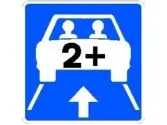
¿Un turismo con remolque puede utilizar un carril VAO?
May a car towing a trailer use an HOV lane (VAO)?
- ASí, si va ocupado por un número mínimo de personas.Yes, if it carries a minimum number of people.
- BNo.No.
- CSí, si el remolque es ligero.Yes, if the trailer is light.
ExplanationHOV lanes (VAO) may only be used by motorcycles, cars and convertible dual-purpose vehicles with the minimum number of occupants set, as well as some buses. They are prohibited for vehicle combinations, including cars towing trailers, whatever the number of occupants (Article 35.2, as worded by RD 518/2026).
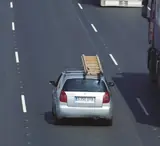
En los vehículos no destinados exclusivamente al transporte de mercancías, ¿puede sobresalir una carga indivisible por la parte posterior?
On vehicles not used exclusively to carry goods, may an indivisible load stick out at the back?
- ANo.No.
- BSí, hasta un 10 por ciento de la longitud del vehículo.Yes, up to 10 per cent of the vehicle's length.
- CSí, hasta un 15 por ciento de la longitud del vehículo.Yes, up to 15 per cent of the vehicle's length.
ExplanationUnder Article 15 of the General Traffic Regulations, on vehicles not used exclusively to carry goods, the load may stick out at the back by up to 10% of the vehicle's length and, if it is indivisible, by up to 15%. It may not stick out at the front.
En los casos en que la carga pueda sobresalir lateralmente del remolque...
When the load may stick out at the sides of the trailer...
- AEl ancho total no será superior a 2,55 metros.the total width must not be more than 2.55 metres.
- BEl ancho total no será superior a 2,90 metros.the total width must not be more than 2.90 metres.
- CEl ancho total no será superior a 3,20 metros.the total width must not be more than 3.20 metres.
ExplanationWhen the smallest dimension of an indivisible load is wider than the goods vehicle, it may stick out by up to 0.40 metres on each side, as long as the total width does not exceed 2.55 metres (Article 15.2 of the General Traffic Regulations, RGC).
En una motocicleta, ¿qué hay que tener en cuenta respecto al equipaje que se transporta?
On a motorcycle, what must you bear in mind about the luggage you carry?
- AQue no sobresalga por la parte trasera.That it does not stick out at the rear.
- BQue no sobresalga por los lados.That it does not stick out at the sides.
- CQue esté colocado y sujeto de forma que no afecte la estabilidad de la moto.That it is placed and secured so that it does not affect the motorcycle's stability.
ExplanationLuggage on a motorcycle must be placed and secured so that it cannot fall or move and does not affect the vehicle's stability, as Article 14 of the General Traffic Regulations requires for any load. Within certain limits it may stick out at the rear or at the sides.
¿Cómo debe estar colocada la carga que transporta un vehículo?
How must the load carried by a vehicle be placed?
- AEstibada y bien distribuida.Stowed and well distributed.
- BSin atar y distribuida.Untied and distributed.
- CEstibada y concentrada en el centro de gravedad.Stowed and concentrated at the centre of gravity.
ExplanationWhen you carry a heavy load in your vehicle, it must always be well tied down and stowed with straps or similar, and well distributed in the available space, without concentrating all the weight at the vehicle's centre of gravity.
Cuando en un camión la carga sobresalga por la parte delantera, ¿deberá señalizarse de alguna forma?
When a lorry's load sticks out at the front, must it be marked in any way?
- ANo, solamente deberá señalizarse la carga que sobresalga por la parte posterior.No, only loads that stick out at the back must be marked.
- BDurante el día y en condiciones normales de visibilidad no será necesario señalizarla.During the day and in normal visibility, it does not need to be marked.
- CSí, tanto las que sobresalgan por la parte delantera como por la trasera.Yes, loads that stick out both at the front and at the back must be marked.
ExplanationIn normal visibility during the day, a load that sticks out at the front does not need to be marked. At night, however, it must be marked with a white light.
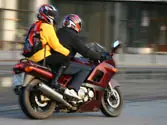
Llevando un pasajero en la motocicleta tendremo en cuenta que...
When carrying a passenger on a motorcycle, we must bear in mind that...
- ALa distancia de detención será menor, porque la motocicleta pesa más.The stopping distance will be shorter, because the motorcycle weighs more.
- BLa distancia de frenado será mayor.The braking distance will be longer.
- CEs más fácil que se bloqueen las ruedas al frenar.The wheels are more likely to lock when braking.
ExplanationIf we carry a passenger on the motorcycle, it carries more weight, so it will be harder to brake and the braking distance will be longer.
Todas las unidades de transporte de mercancías peligrosas, ¿estarán obligadas a llevar extintores con la misma capacidad de agente extintor?
Must all transport units carrying dangerous goods carry fire extinguishers with the same capacity of extinguishing agent?
- ATodos los vehículos no están obligados a llevar extintores.Not all vehicles are required to carry fire extinguishers.
- BSí, el adr marca el mínimo de capacidad que será igual para todos los vehículos.Yes, the ADR sets a minimum capacity that is the same for all vehicles.
- CNo, la cantidad variará en función de la mma del vehículo.No, the amount varies according to the MAM of the vehicle.
ExplanationThe amount of fire extinguishers required in vehicles carrying dangerous goods varies according to the maximum authorised mass (MAM) of the vehicle. So not all vehicles are required to carry fire extinguishers with the same capacity of extinguishing agent.
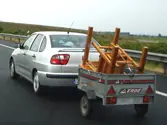
¿Cómo considera el Reglamento general de vehículos a un turismo que arrastra un remolque?
How do the General Vehicle Regulations classify a car towing a trailer?
- AUn vehículo especial.As a special vehicle.
- BUn vehículo articulado.As an articulated vehicle.
- CUn tren de carretera.As a road train.
ExplanationA motor vehicle coupled to a trailer is considered a road train. If it were coupled to a semi-trailer, it would be an articulated vehicle.
¿Cómo colocaremos la carga y los pasajeros en un turismo?
How should we place the load and the passengers in a car?
- ADa igual, siempre que no se supere la M.M.A. del vehículo.It does not matter, as long as the vehicle's maximum authorised mass is not exceeded.
- BDe forma que no impida la visión del conductor.So that they do not block the driver's view.
- CCon la carga más pesada en la parte superior del maletero.With the heaviest load at the top of the boot.
ExplanationThe load and the people carried must not block the view to the rear through the interior mirror. If they do, the vehicle must have a right-hand exterior mirror.
¿Cómo se debe señalizar, de día y con tiempo claro, la carga que sobresale por la parte posterior de un turismo?
How must a load sticking out from the back of a car be marked by day in clear weather?
- ANo es necesario señalizarla.It does not need to be marked.
- BCon una luz roja.With a red light.
- CPor medio de un panel pintado con franjas diagonales alternas de color rojo y blanco.With a panel painted with alternating red and white diagonal stripes.
ExplanationA load sticking out from the back of a car must always be marked with the V-20 panel, with red and white diagonal stripes, placed at its end. A red light is added at night or in poor visibility; it does not replace the panel.
¿Cómo se denomina la masa efectiva del vehículo y de su carga, incluida la del personal de servicio y los pasajeros?
What is the name for the actual mass of the vehicle and its load, including the crew and the passengers?
- AMasa en carga.Laden mass.
- BTara.Unladen weight (tare).
- CMasa máxima autorizada.Maximum authorised mass.
ExplanationThe General Vehicle Regulations call the actual mass of the vehicle and its load, including the crew and passengers, the laden mass. The unladen weight (tare) is the mass of the vehicle without occupants or load, and the MAM is the maximum limit allowed for travelling on the road.
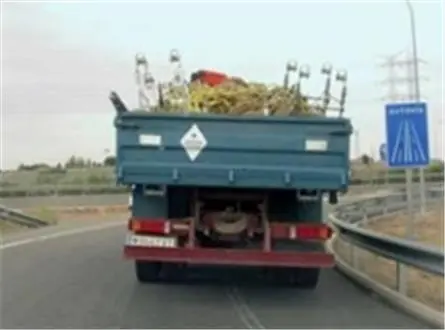
Relativo a la disposición de la carga en un vehículo, ¿cómo es obligatorio transportar siempre las materias que produzcan polvo o puedan caer?
Regarding how the load is arranged in a vehicle, how must materials that produce dust or may fall always be carried?
- AEn vehículos totalmente cerrados.In fully enclosed vehicles.
- BCubriéndolas total y eficazmente.Fully and effectively covered.
- CEn pequeños contenedores.In small containers.
ExplanationUnder Article 14 of the General Traffic Regulations, materials that produce dust or may fall, such as sand, gravel or rubble, must always be carried fully and effectively covered, so that they do not dirty the road or endanger other road users.

El conductor, ¿está obligado a hacer que los pasajeros mantengan la posición adecuada?
Is the driver obliged to make passengers keep a suitable position?
- ANo.No.
- BSí.Yes.
- CNo, solo está obligado a cuidar la colocación de los objetos.No, they are only obliged to take care of how objects are placed.
ExplanationThe driver of the vehicle is responsible for making the other passengers keep a suitable position, and for the correct placement of any objects or animals carried.
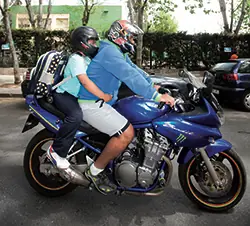
¿Cuál es la edad mínima para viajar como acompañante en una motocicleta conducida por alguien distinto a los padres o al tutor del menor, o por una persona mayor de edad autorizada?
What is the minimum age to travel as a passenger on a motorcycle ridden by someone who is not the child's parent or guardian or an adult authorised by them?
- A7 años.7 years.
- B12 años.12 years.
- C14 años.14 years.
ExplanationThe general minimum age to travel as a passenger on a motorcycle is 12. It is lowered to 7 only when the rider is the child's father, mother or guardian, or an adult authorised by them.
¿En qué lugar del interior del vehículo es más seguro instalar el dispositivo de seguridad para menores?
Where in the vehicle is it safest to fit the child restraint system?
- AEn el asiento del acompañante y en sentido contrario al de la marcha.On the front passenger seat, facing backwards.
- BEn los asientos posteriores, en un lateral.On the rear seats, at one side.
- CEn los asientos posteriores, en la parte central.On the rear seats, in the middle.
ExplanationThe safest place to fit the child restraint system (child seat) is in the middle of the rear seat, because it is better protected there in side impacts.
En los vehículos de anchura inferior a un metro, ¿la carga podrá sobresalir por la parte posterior?
On vehicles less than one metre wide, may the load stick out at the back?
- ASí, como máximo 0,25 metros.Yes, by 0.25 metres at most.
- BNo.No.
- CSí, un tercio de la longitud del vehículo.Yes, by one third of the vehicle's length.
ExplanationOn vehicles less than one metre wide, the load may stick out at the back by 0.25 metres at most, and at the sides by 0.50 metres measured from the vehicle's longitudinal axis.
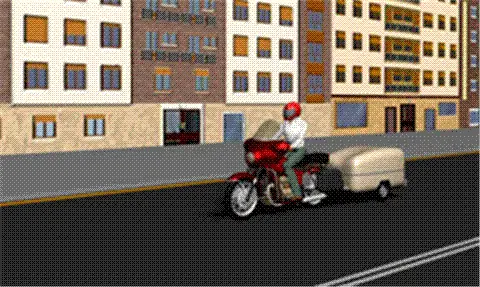
Entre la puesta y la salida del sol, ¿está permitido conducir una motocicleta que arrastra un remolque?
Between sunset and sunrise, is it allowed to ride a motorcycle towing a trailer?
- ANo.No.
- BSí, como a cualquier otra hora del día.Yes, as at any other time of day.
- CSí, si se hace a una velocidad un 10 por ciento por debajo de la genérica de la vía.Yes, if you ride 10 per cent below the general speed limit of the road.
ExplanationAccording to Article 12.3 of the General Traffic Regulations (RGC), a motorcycle may only tow a trailer during the day and in conditions that do not reduce visibility. Between sunset and sunrise it is prohibited, even if you reduce speed.
¿Cuánto puede sobresalir por la parte trasera la carga de un turismo?
How far may a car's load stick out at the back?
- AEl 20% de la longitud del vehículo.20% of the vehicle's length.
- BEl 15% de la longitud del vehículo.15% of the vehicle's length.
- C1/3 de la longitud del vehículo.1/3 of the vehicle's length.
ExplanationAccording to the General Traffic Regulations (RGC), on vehicles not used only for carrying goods, the load may stick out at the back by up to 10% of the vehicle's length. However, if the load is indivisible, it may stick out by up to 15% of the vehicle's length. So the correct option is 15% of the vehicle's length, as this refers to an indivisible load, which matches the rules.
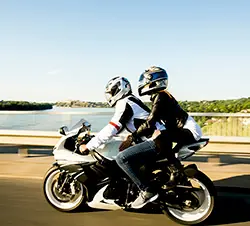
Si lleva a un pasajero en una motocicleta, al frenar...
If you are carrying a passenger on a motorcycle, when braking...
- Aes más difícil que se bloquee la rueda trasera.the rear wheel is less likely to lock.
- Bel peso se desplaza hacia la parte trasera de la motocicleta.the weight shifts towards the rear of the motorcycle.
- Ces conveniente no soltar el acelerador y accionar sólo el freno trasero.it is advisable to keep the throttle open and use only the rear brake.
ExplanationThe passenger's weight loads the rear of the motorcycle, and when braking that wheel keeps more contact with the road and more grip, so the rear wheel is less likely to lock. Even so, braking distances increase with a heavier load.
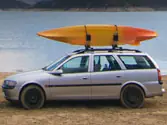
La carga de un turismo, ¿puede sobresalir por la parte trasera?
May a car's load stick out at the back?
- ANo.No.
- BSí, hasta 1/3 de la longitud del vehículo.Yes, up to 1/3 of the vehicle's length.
- CSí, hasta un 15% de la longitud del vehículo.Yes, up to 15% of the vehicle's length.
ExplanationIn a car, the load may stick out at the back by up to 10 per cent of the vehicle's length or, if it is indivisible, 15 per cent.
En un turismo, ¿cuánta distancia puede sobresalir la carga por la parte delantera?
In a car, how far may the load stick out at the front?
- A2 metros.2 metres.
- B1/3 de la longitud del vehículo.1/3 of the vehicle's length.
- CNada.Not at all.
ExplanationIn a car, the load may only stick out at the back: 10% of the vehicle's length if the load is divisible and 15% if it is indivisible.
Durante el proceso de carga/descarga...
During loading/unloading...
- ASe puede fumar.Smoking is allowed.
- BEl conductor permanecerá en la cabina.The driver will stay in the cab.
- CNo se pueden hacer reparaciones.No repairs may be carried out.
ExplanationDuring loading/unloading no repairs may be carried out, because no activity is allowed that could make the vehicle unstable or cause damage to the load or to other road users.
Un camión arrastra un remolque no ligero. ¿Debe suscribirse un contrato de seguro para el remolque?
A lorry is towing a trailer that is not light. Must an insurance contract be taken out for the trailer?
- ANo, bastará con el seguro del camión.No, the lorry's insurance is enough.
- BSí.Yes.
- CNo.No.
ExplanationA trailer that is not light must have its own insurance contract, because its maximum authorised mass is over 750 kg. So it is compulsory to take out insurance for the trailer.
¿Qué indica exactamente la Masa Máxima Autorizada (MMA) de un vehículo?
What exactly does a vehicle's maximum authorised mass (MAM) mean?
- ALa suma de las masas del vehículo de motor y del remolque arrastrado.The sum of the masses of the motor vehicle and the trailer it tows.
- BLa masa del vehículo.The mass of the vehicle.
- CLa masa máxima con la que el vehículo puede circular cargado por las vías públicas.The maximum mass at which the vehicle may travel laden on public roads.
ExplanationThe maximum authorised mass is the maximum mass for using the vehicle laden on public roads (General Vehicle Regulations). It is not the mass of the empty vehicle or the sum with the trailer: it is the legal limit with occupants and load.
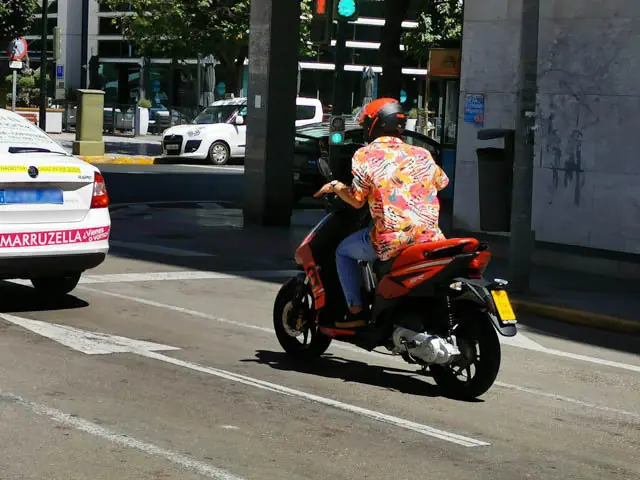
A los ciclomotores, ¿les está permitido circular arrastrando un remolque?
Are mopeds allowed to tow a trailer?
- ASí, cumpliendo ciertas condiciones.Yes, if certain conditions are met.
- BSí, siempre que circulen de noche y no lleven pasajeros en el remolque.Yes, as long as they are travelling at night and not carrying passengers in the trailer.
- CNo, está prohibido.No, it is prohibited.
ExplanationUnder Article 12.3 of the General Traffic Regulations (RGC) (as worded by RD 518/2026), motorcycles, three-wheeled vehicles and mopeds may tow a trailer or semi-trailer that does not exceed 50% of the unladen mass of the towing vehicle, provided they travel in daylight and in conditions that do not reduce visibility, with their speed reduced by 10%, and without carrying people in the towed vehicle.
En una autopista o autovía de más de dos carriles destinados al mismo sentido de circulación, si Ud. conduce un turismo con remolque de más de siete metros de longitud, ¿por qué carril de la calzada debe circular?
On a motorway (autopista) or dual carriageway (autovía) with more than two lanes in the same direction, if you are driving a car with a trailer more than seven metres long, which lane of the carriageway must you use?
- ASiempre por el carril de la derecha.Always in the right-hand lane.
- BNecesariamente por alguno de los dos más próximos al borde derecho de la calzada.Necessarily in one of the two lanes nearest the right edge of the carriageway.
- CPor el carril de la derecha o centrales, dejando el izquierdo para poder realizar adelantamientos a otros.In the right-hand lane or the centre lanes, leaving the left-hand lane free for overtaking others.
ExplanationThis option is correct because it states that a car with a trailer more than seven metres long must use one of the two lanes nearest the right edge of the carriageway. Longer vehicles, such as those with trailers, must use the lanes that let them travel more safely and smoothly, without obstructing other traffic.
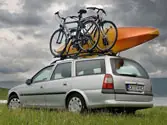
La carga que sobresalga por detrás en un turismo, ¿deberá ser señalizada?
Must a load that sticks out at the back of a car be marked?
- ASí, y cuando sea necesario también la señalizaremos con una luz roja.Yes, and when necessary we will also mark it with a red light.
- BNo, en los turismos no hace falta señalizar la carga.No, loads do not need to be marked on cars.
- CNo deberá señalizarse si la carga sobresale menos de un 10%.It does not need to be marked if it sticks out less than 10%.
ExplanationIf the load sticks out at the back of a car, during the day, in clear weather and with normal visibility, it must be marked with a 50 by 50 centimetre panel painted with alternating red and white diagonal stripes, placed at the rear end of the load so that it always stays at right angles to the vehicle's axis. If the load sticks out at the back between sunset and sunrise, or in weather or conditions that noticeably reduce visibility, it must be marked with the panel or panels described above, which are reflective, and with a red light.
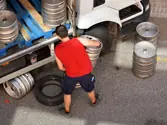
¿Es correcto depositar objetos en la vía mientras se realizan operaciones de carga y descarga ?
Is it correct to leave objects on the road while loading and unloading?
- ANo, ya que no se pueden depositar mercancías en la vía.No, because goods may not be left on the road.
- BSí, si se realiza por el lado más próximo al borde de la calzada.Yes, if it is done on the side nearest the edge of the carriageway.
- CSí, siempre que no cause molestias.Yes, as long as it does not cause a nuisance.
ExplanationLoading and unloading must be done off the road. It is forbidden to leave goods on the carriageway, the hard shoulder or pedestrian areas.
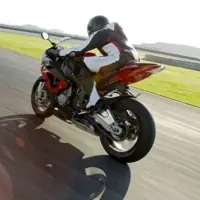
¿Cómo debe sentarse un pasajero en una motocicleta?
How must a passenger sit on a motorcycle?
- ADe cualquier maneras siempre que vaya cómodo.In any way, as long as they are comfortable.
- BA horcajadas y con los pies apoyados en los reposapiés laterales, sólo cuando circule por vías urbanas.Astride, with the feet on the side footrests, only when riding on roads in built-up areas.
- CA horcajadas y con los pies apoyados en los reposapiés laterales, tanto dentro como fuera de poblado.Astride, with the feet on the side footrests, both inside and outside built-up areas.
ExplanationArticle 12.1 of the General Traffic Regulations requires a motorcycle passenger to sit astride, with the feet on the side footrests, on the seat behind the rider. The rule applies on all types of road, inside and outside built-up areas.
Para poder llevar un pasajero en su ciclomotor es indispensable que este dato conste en...
To carry a passenger on your moped, this must be stated in...
- ALa factura de compra.The purchase invoice.
- BEl permiso de circulación.The vehicle registration certificate.
- CEl permiso de conducción.The driving licence.
ExplanationThe vehicle registration certificate is the document that authorises the vehicle to be used on the road, so this is the document that must state that the moped may carry a passenger.
¿Podrá sobresalir la carga indivisible en vehículos de longitud superior a 5 metros?
May an indivisible load stick out on vehicles more than 5 metres long?
- ASí.Yes.
- BNo.No.
- CSí, pero solo por la parte delantera.Yes, but only at the front.
ExplanationAn indivisible load may stick out on vehicles more than 5 metres long. In this case, the load may stick out 2 metres at the front of the vehicle and 3 metres at the rear.
¿Le está permitido transportar en su turismo carga que no sea equipaje?
May you carry a load other than luggage in your car?
- ASí, siempre que sea una carga adecuada al turismo y esté bien colocada, que no comprometa la estabilidad del mismo y esté correctamente señalizada, en su caso.Yes, as long as the load is suitable for the car, is properly placed, does not affect its stability and is properly marked where necessary.
- BNo, porque está prohibido.No, because it is forbidden.
- CSí, pero sólo si se trata de elementos para hacer deporte.Yes, but only if it is sports equipment.
ExplanationYou may carry a load in a car as long as it is suitable for the vehicle, is properly placed and does not affect the car's stability. In addition, if the load is large or sticks out, it must be properly marked to warn other drivers. This keeps driving safe and within the rules.
¿Puede un ciclomotor arrastrar un remolque entre la puesta y la salida del sol?
May a moped tow a trailer between sunset and sunrise?
- ASí.Yes.
- BSí, si lleva encendido el alumbrado de corto alcance.Yes, if it has its dipped headlights on.
- CNo.No.
ExplanationA moped may not tow a trailer between sunset and sunrise, nor when weather or environmental conditions require lights to be used.
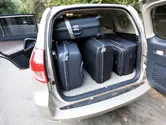
¿Está permitido llevar las puertas o el maletero abiertos para aumentar la capacidad de carga?
May you drive with the doors or the boot open to carry more load?
- ALas puertas no, pero sí el maletero si está sujeto de forma que no pueda caer la carga.Not the doors, but the boot is allowed if it is secured so that the load cannot fall.
- BNo, excepto en los vehículos destinados al transporte de mercancías.No, except in vehicles intended for carrying goods.
- CNo.No.
ExplanationIt is forbidden to drive with the vehicle's doors open, or to open them before the vehicle has come to a complete stop.
Si la carga transportada en un camión sobresale del mismo por delante y por detrás, entre el ocaso y la salida del sol, ¿debe levar alguna luz de señalización?
If the load carried on a lorry sticks out at both the front and the rear, between sunset and sunrise, must it have any marker lights?
- ASí, una luz blanca delante y una luz roja detrás.Yes, a white light at the front and a red light at the rear.
- BSí, sólo una luz roja detrás.Yes, only a red light at the rear.
- CNo, basta con la placa reflectante reglamentaria.No, the regulation reflective panel is enough.
ExplanationBetween sunset and sunrise, a load sticking out at the front is marked with a white light and one sticking out at the rear with a red light, as well as the rear V-20 panel (Article 15 of the General Traffic Regulations). The reflective panel alone is not enough at night.
¿Cuál es la masa por eje máxima permitida de un eje simple de un semirremolque?
What is the maximum mass allowed on a single axle of a semi-trailer?
- A10,5 toneladas.10.5 tonnes.
- B10 toneladas.10 tonnes.
- C11 toneladas.11 tonnes.
ExplanationThe maximum mass allowed on a single axle of a semi-trailer is 10 tonnes. This means that the load pressing on the ground and passed through the wheels on that axle may not exceed 10 tonnes.
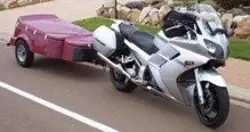
¿Está permitido que las bicicletas o las motocicletas arrastren remolques?
Are bicycles or motorcycles allowed to tow trailers?
- ASí, cuando disminuyan su velocidad en un 20%.Yes, when they reduce their speed by 20%.
- BSí, en determinadas circunstancias.Yes, in certain circumstances.
- CSí, siempre.Yes, always.
ExplanationBicycles and motorcycles may tow trailers under certain conditions. Motorcycles, for example, may only do so in daylight, with a trailer of up to 50% of their unladen mass, without carrying people in it and with their maximum speeds reduced by 10%.
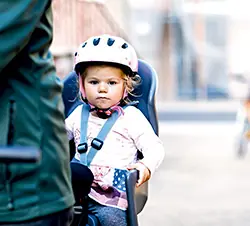
Una persona mayor de edad, ¿puede transportar a un pasajero en una bicicleta que, por construcción, no pueda ser ocupada por más de una persona?
Can an adult carry a passenger on a bicycle that, by design, cannot be used by more than one person?
- ASólo si el conductor pedalea levantado y el pasajero va sentado en el sillín.Only if the rider pedals standing up and the passenger sits on the saddle.
- BSí, a un menor de hasta 22 kg en un asiento adicional.Yes, a child weighing up to 22 kg in an additional seat.
- CNo, está prohibido.No, it is prohibited.
ExplanationAccording to Article 154 of the General Traffic Regulations (as worded by RD 518/2026), if the rider is an adult, bicycles that by design cannot be used by more than one person may carry children weighing up to 22 kg who are able to sit up on their own, in additional seats.
¿Podrá un turismo arrastrar un remolque ligero?
May a car tow a light trailer?
- ASí, en todo caso.Yes, in all cases.
- BNo puede, será necesario el permiso B+E.No, it cannot; a B+E licence is needed.
- CSí, siempre que la MMA del conjunto no sobrepase los 3.500 kg.Yes, as long as the MAM of the combination does not exceed 3,500 kg.
ExplanationA car may tow a trailer with a MAM of no more than 750 kg without any restriction as far as the B licence is concerned.
¿Le está permitido circular con una carga si esta sobresale por las ventanillas laterales de su vehículo, como una escalera?
Are you allowed to drive with a load that sticks out of your vehicle's side windows, such as a ladder?
- ANo.No.
- BSí, señalizando debidamente la carga.Yes, if the load is properly marked.
- CSolo si la carga no sobresale mas de 40 cm.Only if the load does not stick out more than 40 cm.
ExplanationIn a car the load may not stick out at the sides, and carrying objects sticking out of the windows is prohibited even if they are marked. The load may only stick out at the rear, within the limits of Article 15 of the General Traffic Regulations.
Un taxi, transporta un pasajero adulto en el asiento delantero que lleva en brazos un menor de 2 años de edad. ¿Es correcto?
A taxi is carrying an adult passenger in the front seat who is holding a child under 2 years old in their arms. Is this correct?
- ASí.Yes.
- BSí, si el taxi circula en tráfico urbano.Yes, if the taxi is in urban traffic.
- CNo.No.
ExplanationA child may not travel in an adult's arms. Under Article 119 of the General Traffic Regulations (as worded by RD 518/2026), a taxi in urban traffic may carry people shorter than 135 cm without a child restraint system only if they sit in a rear seat, not in the front seat.
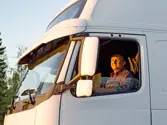
En un camión de 5 metros de longitud una carga indivisible no podrá sobresalir por delante más de...
On a lorry 5 metres long, an indivisible load must not stick out at the front more than...
- A5 metros.5 metres.
- B2 metros.2 metres.
- C1/3 de la longitud del vehículo.1/3 of the vehicle's length.
ExplanationOn a lorry up to 5 metres long, the load may stick out at the front by 1/3 of the vehicle's length. If the lorry were longer than 5 metres, the load could stick out at the front by 2 metres at most.
En las motocicletas, además del conductor, podrá viajar un pasajero que...
On motorcycles, as well as the rider, a passenger may travel who...
- APodrá ir de lado o a horcajadas, siempre que vaya bien sujeto.May sit sideways or astride, as long as they hold on well.
- BIrá a horcajadas y con los pies apoyados en los reposapiés laterales.Sits astride, with their feet on the side footrests.
- CIrá de lado y agarrado a la cintura del conductor.Sits sideways, holding the rider round the waist.
ExplanationA motorcycle passenger must sit astride with their feet on the side footrests. This position gives more stability and safety during the journey. Sitting sideways or holding the rider round the waist is not a safe position and can increase the risk of falling or being injured in an accident.
¿Pueden viajar personas, en los vehículos de transporte de mercancías, en el lugar reservado a la carga?
May people travel in the load area of goods vehicles?
- ASí, sin ninguna limitación.Yes, without any limits.
- BSí, en las condiciones establecidas.Yes, under the conditions laid down.
- CNo, nunca.No, never.
ExplanationAccording to Article 10 of the General Traffic Regulations, people may travel in the load area of vehicles carrying goods or things, but only under the conditions set by the rules on this matter.
En un vehículo no destinado exclusivamente al transporte de mercancías, ¿cuánto podrá sobresalir la carga por la parte delantera?
In a vehicle not designed exclusively for carrying goods, how far may the load stick out at the front?
- AUn 10% si es divisible.10% if it is divisible.
- BUn 15% si es indivisible.15% if it is indivisible.
- CNada.Not at all.
ExplanationIn vehicles not designed exclusively for carrying goods, Article 15 of the General Traffic Regulations (RGC) only allows the load to stick out at the back: up to 10% of the vehicle's length, or 15% if it is indivisible. It may not stick out at all at the front.
En una motocicleta con una anchura inferior a 1 metro, ¿cuánto podrá sobresalir la carga por la extremidad anterior y posterior?
On a motorcycle less than 1 metre wide, how far may the load stick out at the front and at the rear?
- ANada por la extremidad anterior, ni más de 0,25 metros por la posterior.Not at all at the front, and no more than 0.25 metres at the rear.
- B0,25 metros, como máximo , tanto por delante como por detrás.0.25 metres at most, both at the front and at the rear.
- CNada.Not at all.
ExplanationUnder Article 15 of the General Traffic Regulations, on vehicles less than one metre wide, such as a motorcycle, the load may not stick out at all at the front and at most 0.25 metres at the rear. At the sides it may stick out up to 0.50 metres on each side of the axis.
¿Cuánto puede sobresalir, como máximo, la carga en un turismo de menos de 5 metros de longitud?
What is the most the load may stick out on a car less than 5 metres long?
- ANada por delante y un 15% como máximo por detrás.Nothing at the front and at most 15% at the back.
- B2 metros por delante y 3 metros por detrás.2 metres at the front and 3 metres at the back.
- C1/3 por delante y 1/3 por detrás.1/3 at the front and 1/3 at the back.
ExplanationHow far the load may stick out on a car does not depend on the car's length but on whether the load is divisible or indivisible. If it is divisible, it may stick out by at most 10%, and if it is indivisible, by 15%, only at the back.
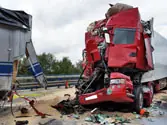
Durante la marcha, parte de la carga de su vehículo cae a la calzada, ¿debe pararse a señalizarlo?
While you are driving, part of your vehicle's load falls onto the carriageway. Must you stop and mark it?
- ANo, no es necesario si puede retirar la carga de inmediato.No, it is not necessary if you can remove the load immediately.
- BSí, empleando el dispositivo de preseñalización de peligro.Yes, using the hazard warning device.
- CNo.No.
ExplanationAnyone who has created an obstacle or danger on the road must remove it as soon as possible, and meanwhile take the necessary measures so that it can be seen and does not obstruct traffic. Until the road is clear, the driver must place the hazard warning device to warn of the obstacle. The V-16 hazard warning device is an approved amber flashing light with geolocation, powered by its own battery. It must be placed on the highest part of the stopped vehicle so that it is as visible as possible. Currently, the V-16 is the only legal option for marking a stopped vehicle or an obstacle on the road; warning triangles are no longer used.
All topics
- Definitions
- Documents and penalty points
- The driver's condition
- Duties of drivers and pedestrians
- Vehicle safety devices
- Vehicle controls and equipment
- Vehicle lights and horn
- Traffic signs, markings and signals
- The road and its lanes
- Speed and distances
- Manoeuvres
- Right of way
- Driving safely in difficult conditions
- Vehicle mechanics and maintenance
- Road accidents and first aid
- Defensive and eco-driving
Independent app: not affiliated with or endorsed by the DGT (Spain's Directorate-General for Traffic) or the Ministry of the Interior. The official exam is booked with the DGT and taken at its test centres. The questions here are practice material; the DGT's official question bank is not public.
Basado en datos de la Agencia Estatal Boletín Oficial del Estado (https://www.boe.es). Textos consolidados de carácter meramente informativo. La AEBOE no patrocina ni respalda este sitio.
Parte de las preguntas procede de los tests de la revista «Tráfico y Seguridad Vial» de la DGT, reproducidos con indicación de la fuente.