
DGT test · 534 questions
The road and its lanes
Carriageway, lanes, hard shoulder and road types: where you drive and how lanes are used on motorways, dual carriageways and streets.
20 random questions
Loading questions…
Questions in this topic, with answers
534 questions, 50 per page, with the correct answer and the explanation. Page 1 of 11.
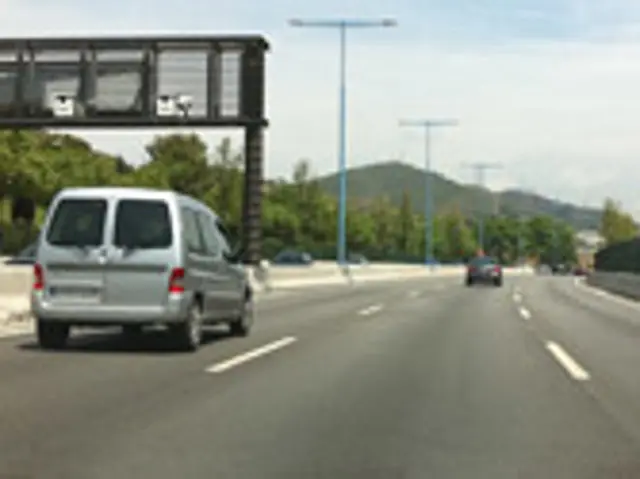
En una autopista con tres carriles en el mismo sentido, ¿qué carril debes usar normalmente?
On a motorway (autopista) with three lanes in the same direction, which lane should you normally use?
- ACualquier carril.Any lane.
- BEl central o el derecho, indistintamente.The centre or the right-hand lane, either one.
- CEl carril derecho.The right-hand lane.
ExplanationOn a motorway (autopista) with three lanes, the rules state that vehicles must normally use the right-hand lane. The regulations say that outside built-up areas, on carriageways with more than one lane in each direction, you must mainly use the right-hand lane, keeping the other lanes for manoeuvres such as overtaking. So the correct answer is «The right-hand lane».
En un carril VAO, ¿puede circular un turismo con un remolque cuya MMA (masa máxima autorizada) sea inferior a 750 kg?
Can a car towing a trailer with a MAM (maximum authorised mass) of less than 750 kg use an HOV lane (VAO)?
- ANo.No.
- BSí, pero solo de día.Yes, but only during the day.
- CSí, siempre.Yes, always.
ExplanationAccording to Article 35.2.a of the General Traffic Regulations (RGC), as worded by RD 518/2026, the HOV lane (VAO) is limited to motorcycles, cars and convertible dual-purpose vehicles, and is prohibited for all other vehicles and vehicle combinations, including cars towing trailers, whatever the mass of the trailer.
¿Por qué carril se circulará en una autopista?
Which lane should you use on a motorway (autopista)?
- APor el carril central, normalmente.The middle lane, normally.
- BPor el carril que mejor convenga a nuestro destino.The lane that best suits our destination.
- CPor el carril de la derecha, como norma general.The right-hand lane, as a general rule.
ExplanationOn roads outside built-up areas, as a general rule, you should use the right-hand lane, and you may use the other lanes to overtake or when circumstances make it advisable.
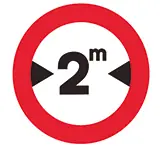
¿Qué vehículos no pueden circular por esta calzada?
Which vehicles may not use this carriageway?
- ALos camiones, únicamente.Only lorries.
- BSólo los turismos de anchura superior a 2 metros.Only cars wider than 2 metres.
- CLos vehículos de anchura superior a 2 metros, incluída la carga.Vehicles wider than 2 metres, including their load.
ExplanationThis is the sign prohibiting entry to vehicles wider than the width shown. It applies to any vehicle, whether a car, a lorry or any other type, that is more than 2 metres wide including its load. It is not limited to lorries.
Si tiene una avería en la autopista y va muy despacio sin obstaculizar el tráfico, ¿por dónde debe circular?
If you have a breakdown on the motorway (autopista) and are going very slowly without obstructing traffic, where must you drive?
- APor el arcén derecho y salir por la primera salida que encuentre.On the right-hand hard shoulder, and leave at the first exit you come to.
- BPor el carril derecho y salir por la primera salida que encuentre.In the right-hand lane, and leave at the first exit you come to.
- CPor el arcén derecho, sin necesidad de salir por la primera salida.On the right-hand hard shoulder, with no need to leave at the first exit.
ExplanationIn the event of a breakdown on a motorway, a driver travelling at an abnormally low speed must use the right-hand lane and leave the road at the first available exit. The rules prohibit driving on the hard shoulder except in emergencies (such as a complete stop due to a breakdown). Driving in the right-hand lane reduces the risk of collisions, as it allows other vehicles to overtake without breaking the rules.
¿Cómo debemos circular por un carril reversible?
How must we drive in a reversible lane?
- ACon la luz de corto alcance y velocidad máxima de 80 km/h y mínima de 60 km/h.With dipped headlights, at a maximum speed of 80 km/h and a minimum of 60 km/h.
- BCon la luz de corto alcance.With dipped headlights.
- CLlevando una velocidad máxima de 80 km/h y mínima de 60 km/h.At a maximum speed of 80 km/h and a minimum of 60 km/h.
ExplanationWhen we drive in a reversible lane, we must use dipped headlights, and the speed limit is the general one for the road.
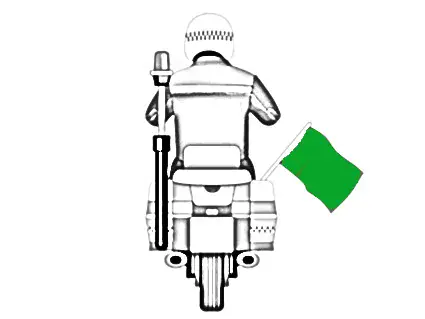
En la cola de una carrera ciclista, el conductor de un vehículo de policía lleva una bandera de color verde, ¿qué está indicando a los conductores?
At the rear of a cycle race, the driver of a police vehicle is showing a green flag. What does this tell drivers?
- AQue los usuarios de la vía deben extremar la atención.That road users must take extra care.
- BQue la vía queda cerrada temporalmente.That the road is temporarily closed.
- CQue la vía queda de nuevo abierta al tráfico.That the road is open to traffic again.
ExplanationThe green flag means that the road is open to traffic again: after a red flag, the green flag shows that the carriageway is open to traffic once more.
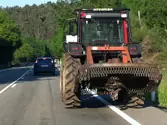
¿El vehículo de la imagen circula correctamente?
Is the vehicle in the picture being driven correctly?
- ANo, porque está utilizando parte del arcén.No, because it is using part of the hard shoulder.
- BNo, porque está utilizando parte de la calzada.No, because it is using part of the carriageway.
- CSí.Yes.
ExplanationSpecial vehicles with a maximum authorised mass of no more than 3,500 kilos must drive on the hard shoulder on their right if it is usable and wide enough. If it is not, they will use only as much of the carriageway as they need.
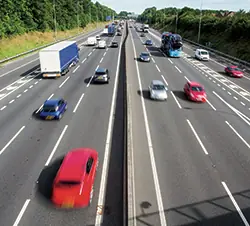
Como norma general, en vías de tres calzadas se utilizarán las de los laterales...
As a general rule, on roads with three carriageways, the side carriageways will be used...
- AEn sentido único, si bien se podrá habilitar algún carril para el sentido contrario.In one direction only, although a lane may be opened for the opposite direction.
- BEn ambos sentidos.In both directions.
- CEn sentido único, siempre que el tráfico sea fluido.In one direction only, as long as traffic is flowing.
ExplanationOn roads with three carriageways, the side carriageways are, as a general rule, for one-way traffic, although the authority may open a lane on them for the opposite direction.
¿Podrá un turismo ocupado con 4 personas y que arrastra un remolque ligero utilizar un carril VAO?
May a car with 4 people on board that is towing a light trailer use an HOV lane (VAO)?
- ASí.Yes.
- BNo.No.
- CSolo si el turismo lleva la señal V-15.Only if the car displays the V-15 sign.
ExplanationUnder Article 35.2.a of the General Traffic Regulations (RGC), combinations of vehicles, including cars with a trailer, may not use the HOV lane (VAO), even if they carry the required number of occupants. Only motorcycles, cars and adaptable mixed-use vehicles may use it, and buses under the set conditions.
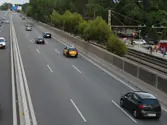
En esta autopista, ¿por qué carril debe circular?
On this motorway (autopista), which lane should you drive in?
- APor el carril que más convenga a su destino.The lane that best suits your destination.
- BPor el carril de la izquierda.The left-hand lane.
- CPor el carril de la derecha normalmente.Normally the right-hand lane.
ExplanationOn motorway (autopista) and dual carriageway (autovía) carriageways with two or more lanes in the same direction, drivers must normally use the lane furthest to the right, and may use the others when traffic or road conditions make it advisable, but always provided they do not obstruct the vehicles behind them.
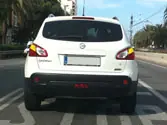
El conductor de un vehículo que circula por un carril adicional, deberá...
The driver of a vehicle travelling in an additional lane must...
- ACircular con el alumbrado de cruce únicamente.Drive with the dipped headlights only.
- BÚnicamente circular a una velocidad mínima de 60 km/h y máxima de 80 km/h.Only drive at a minimum speed of 60 km/h and a maximum of 80 km/h.
- CCircular con el alumbrado de cruce o corto alcance y a una velocidad mínima de 60 km/h y máxima de 80 km/h.Drive with the dipped headlights and at a minimum speed of 60 km/h and a maximum of 80 km/h.
ExplanationAccording to Article 42.1 of the General Traffic Regulations, those travelling in a temporary additional lane or on hard shoulders opened to traffic must have at least the dipped headlights on, by day and by night, and drive at a maximum of 80 km/h and a minimum of 60 km/h, unless lower speeds are signposted.
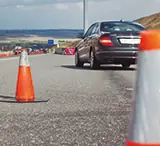
En un carril reversible...
In a reversible lane...
- ANo debe cambiar nunca de carril salvo para adelantar.You must never change lanes except to overtake.
- BDebe circular como máximo a 100 km/h y como mínimo a 60 km/hYou must drive at a maximum of 100 km/h and a minimum of 60 km/h
- CDebe llevar encendida la luz de cruce.You must have the dipped headlights on.
ExplanationDuring the day, dipped headlights must be switched on by motorcycles on any road, urban or outside built-up areas, and by all vehicles travelling in: - A reversible lane. - A temporary additional lane, and also vehicles using the hard shoulders as lanes. - A lane opened for traffic in the opposite direction to the usual one, whether it is a lane reserved exclusively for them or one opened to traffic in that direction as an exception. - A lane with the normal direction of traffic next to a lane opened for traffic in the opposite direction to the usual one.
Dentro de poblado, por una calzada de dos carriles en nuestro sentido, ¿por cuál de ellos circularemos?
In a built-up area, on a carriageway with two lanes in our direction, which of them will we drive in?
- APor el de la derecha, siempre.Always the right-hand one.
- BPor el que más convenga a nuestro destino, si están delimitados.Whichever best suits our destination, if they are marked.
- CPor el que podamos circular con mayor fluidez.Whichever lets us drive most smoothly.
ExplanationIn built-up areas, if the lanes are marked, we will drive in the one that best suits our destination. When the lanes are not marked, we will drive in the right-hand lane.
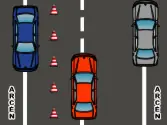
El vehículo rojo del centro de la imagen está circulando por...
The red vehicle in the centre of the picture is travelling in...
- AUn carril reversible.A reversible lane.
- BUn carril en sentido contrario al habitual.A lane in the opposite direction to the usual one.
- CUn carril adicional circunstancial de circulación.A temporary additional lane.
ExplanationA temporary additional lane means that, by using both hard shoulders, there are two lanes in one direction and one lane in the other, with proper signs and markings.
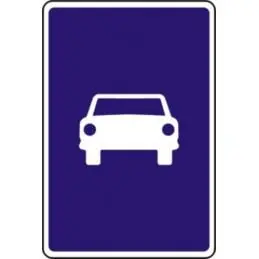
Una motocicleta, ¿puede circular por una vía para automóviles?
May a motorcycle use a road reserved for motor vehicles (vía para automóviles)?
- ASí.Yes.
- BNo.No.
- CSi, cuando supere la velocidad de 60 km/h.Yes, when it goes faster than 60 km/h.
ExplanationThis sign marks a road reserved for motor vehicles (vía para automóviles), closed to pedestrians, animals, bicycles and mopeds. A motorcycle is legally a motor car (automóvil), so it may use this road with no special speed condition.
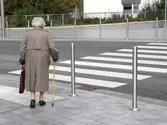
Las personas mayores pueden tener problemas para cruzar la calzada porque...
Elderly people may have problems crossing the carriageway because...
- Acaminan demasiado deprisa.they walk too fast.
- Bno conocen las normas.they do not know the rules.
- Cno distinguen bien los colores de los semáforos.they do not see the colours of traffic lights clearly.
ExplanationIn many cases, elderly people, especially on very wide carriageways, may have problems because they do not see the colours of traffic lights clearly.
¿Qué obligaciones tendrán los conductores que circulen por un carril reversible?
What must drivers do when using a reversible lane?
- ALlevar encendida al menos la luz de corto alcance.Have at least the dipped headlights on.
- BLlevar encendida al menos la luz de corto alcance y circular a una velocidad máxima de 80 km/h.Have at least the dipped headlights on and drive at no more than 80 km/h.
- CLlevar encendida al menos la luz de corto alcance, circular a una velocidad máxima de 80 km/h y mínima de 60 km/h.Have at least the dipped headlights on, and drive at no more than 80 km/h and no less than 60 km/h.
ExplanationDrivers using a reversible lane must have at least the dipped headlights on, both by day and by night. There is no specific speed restriction.
Con una motocicleta, ¿está permitido circular por un carril VAO?
Is a motorcycle allowed to use an HOV lane (VAO)?
- ASí, cuando esté ocupada por el número de personas fijado para cada tramo de vía.Yes, when it carries the number of people set for each stretch of road.
- BNo.No.
- CSí, cuando esté ocupada por dos personas.Yes, when it carries two people.
ExplanationUnder Article 35.2 of the RGC, HOV (VAO) lanes may be used by motorcycles, cars and adaptable mixed-use vehicles carrying the number of people that the traffic authority sets for each stretch of road. Not just any occupancy will do: the minimum for that stretch must be met.

Un autobús que mide 10 metros de longitud, ¿por qué carriles tiene permitido circular en esta vía fuera de poblado con tres carriles para el mismo sentido de la marcha?
A bus that is 10 metres long is on this road outside a built-up area with three lanes in the same direction. Which lanes is it allowed to use?
- APor el que más convenga a su destino.Whichever best suits its destination.
- BPor el derecho pudiendo utilizar el resto si las condiciones de la vía lo aconsejan.The right-hand lane, and it may use the others if road conditions make it advisable.
- CPor el derecho pudiendo utilizar únicamente el siguiente cuando las circunstancias del tráfico o la vía lo aconsejen.The right-hand lane, and it may use only the next lane when traffic or road conditions make it advisable.
ExplanationBuses, even if they are more than 7 metres long, are not subject to the specific rule to keep to the right-hand lane that applies to lorries, special vehicles and combinations of vehicles. So a bus normally drives in the right-hand lane, but may also use the next lane or other lanes when road or traffic conditions make it advisable, always driving safely and without obstructing other vehicles.
En una autovía está prohibido circular...
On a dual carriageway (autovía) the following may not be driven:
- Aciclomotores.mopeds.
- Bvehículos especiales.special vehicles.
- Ccoches con remolque.cars with a trailer.
ExplanationArticle 38.1 of the General Traffic Regulations forbids mopeds, animal-drawn vehicles and vehicles for people with reduced mobility on motorways (autopistas) and dual carriageways (autovías). Cars with a trailer are allowed, and so are special vehicles if they can exceed 60 km/h on the flat (Article 38.3).
¿Un camión podrá circular por un carril en sentido contrario del habitual?
Can a lorry use a lane opened for traffic in the opposite direction to the usual one?
- ANo, en ningún caso.No, under no circumstances.
- BSí, cuando su MMA sea inferior a 3500 kg.Yes, when its MAM is less than 3,500 kg.
- CSí, si está habilitado motivo de obras.Yes, if the lane has been opened because of roadworks.
ExplanationA lorry may only use a lane opened for traffic in the opposite direction to the usual one if it has been opened because of roadworks.
¿Los ciclomotores podrán circular por el arcén en columna de a dos?
May mopeds ride two abreast on the hard shoulder?
- ANo, está prohibido que circulen en posición paralela.No, they are not allowed to ride side by side.
- BSí, excepcionalmente, cuando el arcén sea transitable y suficiente.Yes, exceptionally, when the hard shoulder is passable and wide enough.
- CSí, siempre que no invadan la calzada.Yes, as long as they do not go onto the carriageway.
ExplanationUnder Article 36.2 of the General Traffic Regulations (RGC) (as worded by RD 518/2026), vehicles that are required to use the hard shoulder, including mopeds, are not allowed to ride side by side. Only bicycles may ride two abreast; the old exception that allowed mopeds to ride two abreast on the hard shoulder no longer exists.
Fuera de poblado, deben de circular por la calzada y no por el arcén todos los automóviles y...
Outside built-up areas, the vehicles that must drive on the carriageway and not on the hard shoulder are all motor vehicles and...
- Alos vehículos especiales con MMA no superior a 3.500Kg.special vehicles with a MAM of no more than 3,500 kg.
- Blos vehículos especiales con MMA superior a 3.500Kg.special vehicles with a MAM over 3,500 kg.
- Ctodos los vehículos especiales.all special vehicles.
ExplanationOutside built-up areas, all motor vehicles and special vehicles with a maximum authorised mass over 3,500 kg must drive on the carriageway and not on the hard shoulder, because they are large, heavy vehicles and using the hard shoulder could be dangerous or damage the road. On the other hand, the vehicles that must use the hard shoulder are smaller or slower ones, such as bicycles, mopeds, vehicles for people with reduced mobility, animal-drawn vehicles, special vehicles with a MAM of no more than 3,500 kg and vehicles accompanying cyclists. These vehicles must use the hard shoulder whenever there is one, unless road or traffic conditions indicate otherwise.
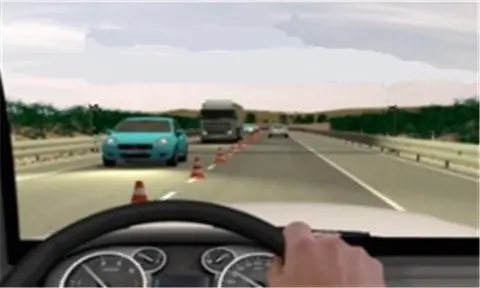
Los camiones de MMA que no excedan de 3.500 kg ¿pueden utilizar un carril abierto a la circulación en sentido contrario al normal?
May lorries with an MAM not over 3,500 kg use a lane opened for traffic in the opposite direction to normal?
- ANo, Nunca.No, never.
- BSí, cuando el carril se ha abierto por obras en la calzada.Yes, when the lane has been opened because of roadworks on the carriageway.
- CSí, siempre que circulen con la luz de cruce encendida.Yes, as long as they drive with dipped headlights on.
ExplanationNormally, lanes opened for traffic in the opposite direction to normal may only be used by cars and motorcycles. But when they are opened because of roadworks on the carriageway, all vehicles allowed on that road may use them, including lorries, unless this is expressly prohibited.
¿Está permitida la circulación de ciclomotores por autopistas?
Are mopeds allowed on motorways (autopistas)?
- ANo, porque está prohibido.No, because it is forbidden.
- BSí, cuando el ciclomotor pueda desarrollar una velocidad de 60 kilómetros por hora.Yes, when the moped can reach a speed of 60 kilometres per hour.
- CSí, por el arcén.Yes, on the hard shoulder.
ExplanationArticle 38.1 of the General Traffic Regulations prohibits animal-drawn vehicles, bicycles, mopeds and vehicles for people with reduced mobility on motorways (autopistas) and dual carriageways (autovías). The ban does not depend on the moped's speed, and it does not allow the use of the hard shoulder.
En calzadas de doble sentido de circulación y tres carriles separados por líneas longitudinales discontinuas, ¿podemos circular con nuestra motocicleta por el situado más a la izquierda?
On two-way carriageways with three lanes separated by broken longitudinal lines, may we ride our motorcycle in the lane furthest to the left?
- ASí, para cambiar de dirección a la izquierda.Yes, to turn left.
- BNo.No.
- CSí, para adelantar.Yes, to overtake.
ExplanationNo, you may not ride your motorcycle in the lane furthest to the left on two-way carriageways with three lanes separated by broken longitudinal lines.
¿Un vehículo que transporta a cuatro personas y arrastra un remolque ligero podrá circular por un carril VAO?
Can a vehicle carrying four people and towing a light trailer use an HOV lane (VAO)?
- ANo.No.
- BSí.Yes.
- CSí, porque el número de ocupantes es suficiente.Yes, because the number of occupants is enough.
ExplanationUse of HOV lanes (VAO) is limited to motorcycles, cars and convertible dual-purpose vehicles, so it is prohibited for all other vehicles and vehicle combinations, including cars towing trailers, and for pedestrians, cycles, mopeds, animal-drawn vehicles and animals.
Un vehículo está circulando por un carril habilitado en sentido contrario. ¿Puede pasar al carril normal?
A vehicle is driving in a lane opened for traffic in the opposite direction to normal. May it move into the normal lane?
- ASí, siempre que no derribe los conos que delimitan el carril.Yes, as long as it does not knock over the cones that mark the lane.
- BNo, ni siquiera para adelantar.No, not even to overtake.
- CSí, pero sólo para adelantar.Yes, but only to overtake.
ExplanationA vehicle using a lane opened for traffic in the opposite direction to normal may not move sideways into the lanes for the normal direction, not even to overtake (Article 41.1 of the General Traffic Regulations). As a general rule, only motorcycles and cars may use these lanes, with dipped headlights on.
En una vía interurbana un ciclomotor circulará por...
On an interurban road, a moped must ride on...
- ALa calzada.the carriageway.
- BEl arcén.the hard shoulder.
- CLos ciclomotores no pueden circular por las vías interurbanas.Mopeds may not use interurban roads.
ExplanationWhen there is no road specially intended for them, the following vehicles must use the hard shoulder, as long as it is passable and wide enough: - Cycles. - Mopeds. - Vehicles for people with reduced mobility. - Animal-drawn vehicles. - Special vehicles with a MAM of no more than 3,500 kg.
¿La circulación de un ciclista está permitida en una autopista?
Are cyclists allowed on a motorway (autopista)?
- ASí.Yes.
- BNo, excepto si el ciclista tiene más de 14 años.No, unless the cyclist is over 14 years old.
- CNoNo
ExplanationCyclists may not ride on motorways (autopistas), whatever their age. Cyclists over 14 may only ride on the hard shoulder of dual carriageways (autovías), unless a sign forbids it.
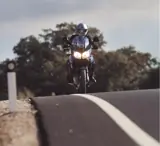
¿Por dónde se debe circular en un cambio de rasante de reducida visibilidad?
Where should you drive on the brow of a hill with reduced visibility?
- ADejando completamente libre la mitad de la calzada que corresponda a los que pueden circular en sentido contrario.Leaving completely free the half of the carriageway that belongs to traffic coming in the opposite direction.
- BPor la izquierda, aunque se invada parte del centro de la calzada.On the left, even if this means encroaching on part of the centre of the carriageway.
- CPor donde más convenga a mi destino.Wherever best suits my destination.
ExplanationYou must drive on the right of the carriageway, as close as possible to its right-hand edge, keeping enough lateral clearance to pass oncoming vehicles safely. This applies especially on bends and brows of hills with reduced visibility, even when there are no signs or markings dividing the carriageway: there you must leave free the half of the carriageway that belongs to traffic that may come in the opposite direction.
En una vía urbana, un camión de 3.500 kg. de MMA, ¿por dónde debe circular?
On an urban road, which lane must a lorry with a maximum authorised mass of 3,500 kg use?
- APor el carril derecho y puede utilizar el resto de carriles para adelantar.The right-hand lane, and it may use the other lanes to overtake.
- BPor el carril que más convenga a su destino.The lane that best suits its destination.
- CPor el carril derecho, pudiendo utilizar el inmediato para adelantar.The right-hand lane, and it may use the next lane to overtake.
ExplanationUnder Article 33 of the General Traffic Regulations, in built-up areas, on carriageways with at least two lanes in each direction marked by road markings, the driver of a motor vehicle, including a lorry, may use the lane that best suits their destination, without obstructing others.
En una carretera interurbana observamos a un grupo de ciclistas circulando en columna de dos. Éstos podrán circular…
On a road outside built-up areas we see a group of cyclists riding two abreast. They may ride…
- ATanto por el arcén como por la calzadaBoth on the hard shoulder and on the carriageway
- BSolo por la calzadaOnly on the carriageway
- CSolo por el arcénOnly on the hard shoulder
ExplanationOn roads outside built-up areas cyclists may ride two abreast on the hard shoulder and, if there is none or it is not usable and wide enough, on the part of the carriageway that is strictly necessary. They must ride in single file on stretches with no visibility, at night or in poor visibility, and when they hold up traffic.
Las autopistas y autovías respecto a las carreteras convencionales son...
Compared with conventional roads, motorways (autopistas) and dual carriageways (autovías) are...
- AMenos seguras porque se alcanza mayor velocidad.Less safe, because higher speeds are reached.
- BIgual de seguras.Equally safe.
- CMás seguras.Safer.
ExplanationMotorways and dual carriageways have a separate carriageway for each direction, no level junctions and no access to adjoining roads, so they are safer than conventional roads.
¿Podrá un turismo con remolque ligero circular por un carril habilitado en sentido contrario al habitual?
May a car with a light trailer use a lane opened in the opposite direction to usual?
- ASí, si lleva encendido el alumbrado de corto alcance.Yes, if it has its dipped headlights on.
- BSí.Yes.
- CNo.No.
ExplanationOnly cars without a trailer and motorcycles may use a lane opened in the opposite direction to usual. If the reason for opening the lane in the opposite direction is not shown, we assume it is to keep traffic flowing.
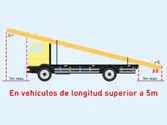
Si circulamos fuera de poblado en una calzada con tres carriles para el mismo sentido, con un turismo que arrastra un remolque, y la longitud del conjunto es de 7,50 m, ¿por qué carril circularemos?
Outside a built-up area, on a carriageway with three lanes in the same direction, we are driving a car towing a trailer, and the combination is 7.50 m long. Which lane should we use?
- APor cualquiera de los tres.Any of the three.
- BExclusivamente por el de la derecha.Only the right-hand lane.
- CNormalmente por el derecho, aunque podemos usar el inmediato cuando las circunstancias del tráfico lo aconsejen.Normally the right-hand lane, although we may use the next lane when traffic conditions make it advisable.
ExplanationWhen driving outside a built-up area on a carriageway with 3 or more lanes in the same direction, with a combination of vehicles more than 7 metres long, we normally drive in the lane furthest to our right. We may use the next lane when traffic or road conditions make it advisable.
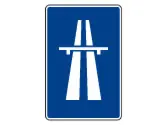
¿Podremos efectuar una detención circulando por una autopista?
May we come to a halt while driving on a motorway (autopista)?
- ANo, en la autopista no podremos detenernos en ningún caso.No, we may never halt on a motorway (autopista).
- BSí, pero deberemos usar las áreas especialmente habilitadas para ello.Yes, but we must use the areas specially provided for this.
- CSí.Yes.
ExplanationA halt (detención) is when the vehicle comes to a standstill not by the driver's choice, because of an emergency, because of traffic, or to obey rules or signs. So it is indeed possible to halt on a motorway (autopista), for example if we come across a traffic jam, our vehicle breaks down, or we feel unwell.
Conduce su coche por una vía que cruza un carril bici. ¿Debe ceder el paso a los ciclistas?
You are driving your car along a road that crosses a cycle lane. Must you give way to cyclists?
- ANo. Los ciclistas no tienen prioridad sobre los vehículos a motor.No. Cyclists do not have right of way over motor vehicles.
- BSí, siempre.Yes, always.
- CSólo cuando los ciclistas se aproximen por su derecha.Only when the cyclists are approaching from your right.
ExplanationUnder Article 64.2 of the General Traffic Regulations, cyclists have right of way over other vehicles when they are riding on a properly signed cycle lane, cycle crossing or hard shoulder. If your road crosses the cycle lane, you must give way to them even if they come from the left.
Cuando circulen por un carril reversible los conductores...
When driving in a reversible lane, drivers...
- ADeberán llevar encendida al menos la luz de cruce y circularán como máximo a 80 km/h.Must have at least the dipped headlights on and drive at 80 km/h at most.
- BDeberán llevar encendida al menos la luz de cruce.Must have at least the dipped headlights on.
- CDeberán llevar encendida al menos la luz de cruce y circularán como máximo a 80 km/h y como mínimo a 60 km/h .Must have at least the dipped headlights on and drive at 80 km/h at most and 60 km/h at least.
ExplanationDrivers in a reversible lane must have at least the dipped headlights on, by day and by night. The maximum speed at which they may drive is the general maximum set for the road. The minimum speed of 60 km/h and the maximum of 80 km/h apply to lanes opened in the opposite direction to the usual one.
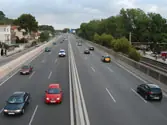
En autopista, ¿cómo debe circular?
How should you drive on a motorway (autopista)?
- AA velocidad adaptada a la circulación y sin rebasar los 120Km/h.At a speed suited to the traffic and not exceeding 120 km/h.
- BSiempre a la velocidad máxima permitida.Always at the maximum permitted speed.
- CA 110 Km/h y a más velocidad para adelantar.At 110 km/h, and faster when overtaking.
ExplanationAll drivers must respect the speed limits; on motorways (autopistas) and dual carriageways (autovías) the limit is 120 km/h. You must also take into account the characteristics and condition of the road, the weather, environmental and traffic conditions and, in general, all the circumstances at any given moment, in order to adapt the vehicle's speed to them, so that you can always stop within your field of vision and in front of any obstacle that may appear.
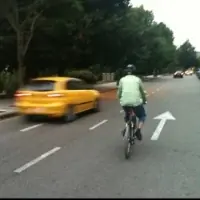
¿Por qué lugar de la calzada deben circular los usuarios de la vía?
Where on the carriageway must road users travel?
- APisando la raya que separa los diferentes carrilesOn the line separating the lanes
- BPor su izquierdaOn their left
- CPor su derechaOn their right
ExplanationAs a general rule, vehicles travel on the right of the carriageway and as close as possible to its edge, keeping enough side distance to pass oncoming vehicles safely (Article 29.1 of the General Traffic Regulations). Driving on the left or on the markings between lanes is not correct.
En una calle urbana de sentido único, si los carriles no están marcados en la calzada, ¿por dónde debe circular el conductor de un coche?
In a one-way urban street, if the lanes are not marked on the carriageway, where must a car driver drive?
- APor el carril que mejor convenga a su destino.In whichever lane best suits their destination.
- BPor el centro de la calzada.In the centre of the carriageway.
- CPor el carril derecho; puede usar los demás cuando las circunstancias lo requieran.In the right-hand lane; they may use the others when circumstances require.
ExplanationArticle 33 of the General Traffic Regulations only allows you to choose the lane that best suits your destination on carriageways in built-up areas with lanes marked by longitudinal lines. If they are not marked, the general rule applies: keep to the right and use the other lanes when circumstances require.
Para abandonar una autopista deberá de circular ...
To leave a motorway (autopista), you must drive...
- APor el carril derecho.In the right-hand lane.
- BPor el carril derecho o central indistintamente.In either the right-hand or the central lane.
- CPor el carril más próximo a la salida.In the lane nearest the exit.
ExplanationTo leave a motorway, dual carriageway or any other road, drivers must move well in advance into the lane nearest the exit and enter the deceleration lane, if there is one, as soon as possible.
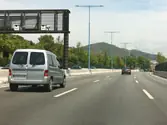
En esta vía, como norma general, ¿está permitido mantenerse en el carril de la izquierda?
On this road, as a general rule, is it permitted to stay in the left-hand lane?
- ASí, porque la vía no está saturada.Yes, because the road is not congested.
- BNo, debe cambiarse al carril de la derecha.No, you must move over to the right-hand lane.
- CSí, si no entorpece la marcha de otros vehículos.Yes, if it does not obstruct other vehicles.
ExplanationOn carriageways outside built-up areas with more than one lane for your direction of travel, you must normally use the lane furthest to the right. You may use the other lanes in that direction when traffic or road conditions make it advisable, provided you do not obstruct a vehicle following you. With three or more lanes, lorries, vans and special vehicles with a maximum authorised mass over 3,500 kg, and combinations of vehicles longer than 7 metres, must use the right-hand lane; they may use the next lane in exceptional cases, but never the others.
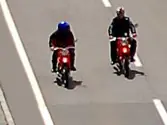
¿Los ciclomotores pueden circular en paralelo?
May mopeds ride side by side?
- ANo, está prohibido en todo caso.No, it is prohibited in all cases.
- BSí, cuando el arcén sea suficiente y transitable, sin invadir la calzada.Yes, when the hard shoulder is wide enough and passable, without going onto the carriageway.
- CSí, siempre que no generen aglomeraciones de tráfico.Yes, as long as they do not cause traffic congestion.
ExplanationUnder Article 36.2 of the General Traffic Regulations (RGC) (as worded by RD 518/2026), vehicles that are required to use the hard shoulder, including mopeds, are not allowed to ride side by side. Only bicycles may ride two abreast; the old exception that allowed mopeds to ride two abreast on the hard shoulder no longer exists.
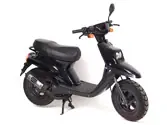
¿Por dónde circulará un ciclomotor en una carretera convencional?
Where must a moped ride on a conventional road?
- APor la parte imprescindible de la calzada.On the part of the carriageway that is strictly necessary.
- BPor el arcén.On the hard shoulder.
- CNo podrá circular por las carreteras.It may not be ridden on roads.
ExplanationMopeds must use the right-hand hard shoulder if it is passable and wide enough, and only if it is not, the part of the carriageway that is strictly necessary (Article 36 of the General Traffic Regulations (RGC)). They may use conventional roads; what they may not use are motorways (autopistas) and dual carriageways (autovías).
Si la vía es de tres calzadas, la lateral estará destinada a la circulación en...
If a road has three carriageways, the side carriageway is for traffic travelling...
- AUn solo sentido.In one direction only.
- BEn los dos sentidos de la marcha o en un único sentido.In both directions or in one direction only.
- CUna vía nunca podrá tener tres calzadas, como máximo podrá tener dos.A road can never have three carriageways; it can have two at most.
ExplanationIf a road has three carriageways, the centre one may be for traffic in both directions or in one direction only, and the side carriageways are only for traffic in one direction.
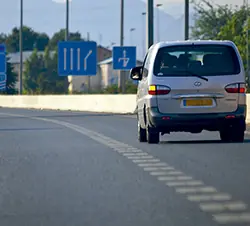
Si quiere abandonar una autovía, ¿en qué momento debe entrar en el carril de deceleración?
If you want to leave a dual carriageway (autovía), when should you move into the deceleration lane?
- ALo antes posible.As soon as possible.
- BEs indiferente, en cualquier momento mientras la línea sea discontinua.It does not matter; at any point while the line is broken.
- CLo más tarde posible.As late as possible.
ExplanationTo leave a dual carriageway (autovía), you must move into the deceleration lane as soon as possible and slow down there, not in the main lanes, where braking would put those behind you at risk.
¿Podrán las motocicletas circular en paralelo?
May motorcycles ride side by side?
- ASí, por el arcén.Yes, on the hard shoulder.
- BNo.No.
- CNo, si entorpecen la circulación.No, if they hold up traffic.
ExplanationMotorcycles may not ride side by side. Under Article 36.2 of the General Traffic Regulations (RGC) (as worded by RD 518/2026), of the vehicles that use the hard shoulder, only bicycles may ride two abreast; mopeds may not. Even on stretches of hard shoulder opened for motorcycles (Article 36.3), riding is only allowed in single file.
All topics
- Definitions
- Documents and penalty points
- The driver's condition
- Duties of drivers and pedestrians
- Vehicle safety devices
- Vehicle controls and equipment
- Vehicle lights and horn
- Traffic signs, markings and signals
- Speed and distances
- Manoeuvres
- Right of way
- Carrying passengers and loads
- Driving safely in difficult conditions
- Vehicle mechanics and maintenance
- Road accidents and first aid
- Defensive and eco-driving
Independent app: not affiliated with or endorsed by the DGT (Spain's Directorate-General for Traffic) or the Ministry of the Interior. The official exam is booked with the DGT and taken at its test centres. The questions here are practice material; the DGT's official question bank is not public.
Basado en datos de la Agencia Estatal Boletín Oficial del Estado (https://www.boe.es). Textos consolidados de carácter meramente informativo. La AEBOE no patrocina ni respalda este sitio.
Parte de las preguntas procede de los tests de la revista «Tráfico y Seguridad Vial» de la DGT, reproducidos con indicación de la fuente.