
DGT test · 982 questions
Manoeuvres
Joining traffic, overtaking, turning, U-turns, reversing, stopping and parking: how and where to do them and when they are forbidden.
20 random questions
Loading questions…
Questions in this topic, with answers
982 questions, 50 per page, with the correct answer and the explanation. Page 1 of 20.
¿Podrán realizarse advertencias acústicas para advertir al conductor de otro vehículo el propósito de adelantarlo?
Can audible warnings be used to warn the driver of another vehicle that you intend to overtake them?
- ANo, porque está prohibido.No, because it is prohibited.
- BSí, es una excepción.Yes, it is an exception.
- CSí, pero sólo fuera de poblado.Yes, but only outside built-up areas.
ExplanationYou may warn the driver in front that you intend to overtake them with audible signals, but only when driving outside built-up areas.
En una intersección, ¿está permitido adelantar?
Is overtaking permitted at a junction?
- ANo, como norma general.No, as a general rule.
- BSí, en todas las intersecciones.Yes, at all junctions.
- CNo, está prohibido en cualquier caso.No, it is prohibited in all cases.
ExplanationAs a general rule, overtaking at and near junctions is prohibited, except: - At a roundabout. - When overtaking must be done on the right of vehicles that are stopping or turning left, and in the case of trams running in the centre. - When the carriageway on which you are overtaking has priority at the junction and a specific sign shows this. - When overtaking two-wheeled vehicles.
Si estaciona su turismo en terreno llano, ¿qué tendrá que hacer?
If you park your car on level ground, what must you do?
- ADejar puesta la marcha atrás.Leave it in reverse gear.
- BDejar puesta la primera velocidad.Leave it in first gear.
- CApagar el motor y dejar el freno de estacionamiento.Switch off the engine and leave the parking brake on.
ExplanationWhen we park our vehicle on level ground, we must switch off the engine and leave the parking brake applied. If we park on an uphill slope, we must also leave it in first gear, and in reverse gear on a downhill slope.
Los agentes de la Autoridad de Tráfico, ¿cuándo podrán proceder a la inmovilización de una motocicleta?
When may traffic authority officers immobilise a motorcycle?
- ACuando su conductor no lleve puesto el casco.When its rider is not wearing a helmet.
- BCuando el pasajero de la misma circule sin el casco.When its passenger is riding without a helmet.
- CEn ningún caso.Never.
ExplanationUnder Article 118.1 of the General Traffic Regulations (RGC), as worded by RD 518/2026, motorcycle riders and passengers must wear an approved helmet that meets UNECE Regulation R22, properly fastened, on all types of road. If the rider is not wearing one, officers can immobilise the motorcycle; if it is the passenger, it is enough for the passenger to get off.
¿Está prohibida la parada en las intersecciones y sus proximidades de las vías interurbanas?
Is stopping prohibited at and near junctions on interurban roads?
- ASí, en cualquier vía.Yes, on any road.
- BNo.No.
- CSí, cuando se genere peligro por falta de visibilidad.Yes, when it creates danger due to lack of visibility.
ExplanationStopping and parking are prohibited at and near junctions if this makes it difficult for other vehicles to turn, or, on interurban roads, if it creates danger due to lack of visibility.
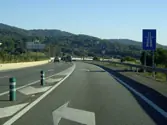
Un conductor que se incorpora a una vía utilizando un carril de aceleración, ¿debe cerciorarse previamente de que puede hacerlo sin peligro?
A driver joining a road using an acceleration lane: must they first make sure they can do so safely?
- ANo, porque tiene prioridad de paso.No, because they have right of way.
- BSí, y no iniciar la maniobra hasta estar seguro.Yes, and they must not start the manoeuvre until they are sure.
- CNo, porque los demás conductores deben facilitarle la incorporación.No, because other drivers must make it easier for them to join.
ExplanationOn roads with an acceleration lane, a driver who intends to use it to join the carriageway must make sure, at the start of that lane, that they can do so without danger to other users travelling on the carriageway, taking into account their position, path and speed, and even stopping if necessary. They will then accelerate to reach a suitable speed at the end of the acceleration lane in order to join the traffic on the carriageway. Although other drivers should make it easier for us to join as far as possible, they are the ones who have priority over us.
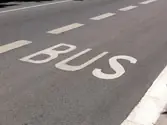
¿Podemos efectuar una parada en un carril BUS con nuestro turismo?
May we stop our car in a BUS lane?
- ASí, siempre que sea inferior a los 2 minutos.Yes, as long as it is for less than 2 minutes.
- BNo.No.
- CSí, para descargar pasajeros.Yes, to let passengers out.
ExplanationStopping is prohibited in lanes for the exclusive use of urban public transport, such as a BUS lane, even for a moment or to let passengers out (article 94.1 of the General Traffic Regulations). Doing so gets in the way of buses using the lane.
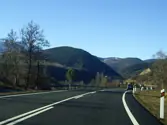
En una carretera, ¿está permitido cambiar el sentido de la marcha?
On a road, is making a U-turn permitted?
- ASí, en cualquier lugar.Yes, anywhere.
- BNo, está siempre prohibido.No, it is always prohibited.
- CSí, en los lugares adecuados.Yes, in suitable places.
ExplanationMaking a U-turn on a road is permitted as long as we do it in a suitable place. It is prohibited in any situation that prevents us from checking that we will not endanger or obstruct other road users, for example on bends and brows of hills with reduced visibility, or in fog or heavy rain. U-turns are also prohibited: - On level crossings (it is not prohibited near them). - In tunnels, underpasses and stretches of road covered by the 'Tunnel' sign. - On motorways (autopistas) and dual carriageways (autovías), except at places provided for this. - On one-way carriageways and stretches of road. - On all stretches of road where overtaking is prohibited, unless the U-turn is expressly authorised.
¿Podemos aparcar en doble fila?
May we double-park?
- ASí, si no hay sitio cerca.Yes, if there is no space nearby.
- BNo, está prohibido.No, it is prohibited.
- CSólo por menos de 2 minutos y usando las luces de emergencia.Only for less than 2 minutes and with the hazard warning lights on.
ExplanationUnder Article 94.2.g of the RGC, double parking is prohibited, even if there is no space nearby, it is only for a short time or you switch on the hazard warning lights. In addition, double parking without the driver present counts as parking that seriously obstructs traffic.
En una vía con mucho tráfico, ¿cómo realizaremos un cambio de carril?
On a road with heavy traffic, how will we change lanes?
- ALo más rápidamente posible para no molestar.As quickly as possible so as not to bother anyone.
- BAdvirtiéndolo con la suficiente antelación.Signalling it sufficiently in advance.
- CNo podremos cambiar de carril en esta situación.We cannot change lanes in this situation.
ExplanationWe will make the sideways movement to change lanes progressively and gradually, signalling it sufficiently in advance and respecting the priority of those already travelling in that lane.
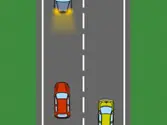
Después de iniciar el adelantamiento comprueba que se acerca un vehículo de frente, ¿qué debe hacer?
After starting to overtake, you see a vehicle coming towards you. What should you do?
- AReducir la marcha y volver a su carril, si no puede terminar la maniobra con seguridad.Slow down and return to your lane, if you cannot finish the manoeuvre safely.
- BMantenerse en el centro de la calzada.Stay in the centre of the carriageway.
- CTocar el claxon y encender las luces para que el otro vehículo aminore su velocidad.Sound the horn and switch on your lights so that the other vehicle slows down.
ExplanationThe driver who is overtaking must abandon the manoeuvre if, once it has started, they notice circumstances that may make it difficult to finish without causing risks. In these cases, they will slow down and return to their lane, warning those behind with the right indicator.
En una calzada con doble sentido de circulación, ¿se podrá parar o estacionar en el lado izquierdo?
On a two-way carriageway, can you stop or park on the left-hand side?
- ASí por una llamada urgente.Yes, for an urgent phone call.
- BSí para conectar el GPS.Yes, to connect the GPS.
- CNo, en ningún caso.No, never.
ExplanationOn a two-way carriageway we cannot stop or park on the left-hand side under any circumstances. If the carriageway were one-way, then we could park on the left-hand side.
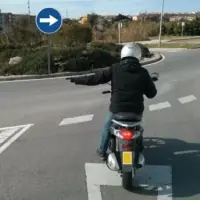
¿Está permitido advertir con el brazo de la intención de realizar una maniobra?
Is it permitted to signal your intention to make a manoeuvre with your arm?
- ANo, porque los brazos no se deben sacar fuera del turismo.No, because arms must not be put outside the car.
- BNo, debe advertirlo también con los intermitentes.No, it must also be signalled with the indicators.
- CSí, cuando la señal sea perceptible para los demás usuarios.Yes, when the signal can be seen by other road users.
ExplanationWhenever we want to signal our intention to make a manoeuvre, as an exception we may use audible signals and arm signals to warn other road users, as long as they can perceive them. Arm signals take precedence over audible and light signals and cancel any other contradictory visual signal.
Al estacionar en una pendiente descendente un camión de 3.500 kg que lleva enganchado un remolque, su conductor, si no dispone de calzos, está obligado…
When parking a 3,500 kg lorry towing a trailer on a downhill slope, if the driver has no wheel chocks, they must…
- AA utilizar como calzos elementos naturales.Use natural objects as chocks.
- BÚnicamente a dejar engranada la primera velocidadOnly leave it in first gear
- CA apoyar una de las ruedas delanteras en el bordillo, orientada hacia fuera de la calzada.Rest one of the front wheels against the kerb, turned towards the outside of the carriageway.
ExplanationVehicles over 3,500 kg and combinations of vehicles must be chocked when parked on a noticeable slope. If there are no chocks, one front wheel is rested against the kerb, turned towards the outside of the carriageway on a downhill slope. Stones or other objects cannot be used as chocks.
¿Podemos realizar la maniobra de marcha atrás al estacionar?
May we reverse when parking?
- ANo, está prohibido.No, it is prohibited.
- BSí, siempre y cuando no recorramos más de 15 metros ni invadamos un cruce de vías.Yes, as long as we do not reverse more than 15 metres or enter a junction.
- CSí, si no recorremos más de 50 metros.Yes, if we do not reverse more than 50 metres.
ExplanationAs a general rule, reversing is prohibited, but it is allowed as a manoeuvre to complete stopping, parking or joining traffic, as long as we do not reverse more than 15 metres and do not enter a junction.
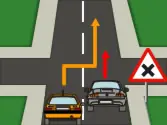
¿El vehículo amarillo podrá adelantar al gris en las proximidades de esta intersección?
Can the yellow vehicle overtake the grey one near this junction?
- ASí, respetando la norma general de prioridad.Yes, respecting the general priority rule.
- BNo, por no tener prioridad de paso en la misma.No, because it does not have right of way at the junction.
- CSí, teniendo la suficiente visibilidad.Yes, if it has enough visibility.
ExplanationAs a general rule, overtaking at and near junctions is prohibited, except: - At a roundabout. - When overtaking must be done on the right of vehicles that are stopping or turning left, and in the case of trams running in the centre. - When the carriageway on which you are overtaking has priority at the junction and a specific sign shows this. - When overtaking two-wheeled vehicles.
¿Se podrá efectuar un cambio de dirección a la izquierda sin señal expresa que lo indique, ni lugar acondicionado para ello?
Can you turn left where there is no sign expressly indicating it and no place specially prepared for it?
- ANo.No.
- BSí, pero solo en vías urbanas.Yes, but only on urban roads.
- CSí, si hay visibilidad.Yes, if there is visibility.
ExplanationTo turn left, there does not need to be a specific sign indicating it, and the place does not need to be specially prepared. You may not turn left when there is not enough visibility or when there are signs prohibiting it.
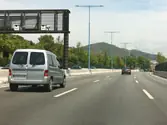
Circulando por una autopista se realizarán los adelantamientos...
When driving on a motorway (autopista), you will overtake…
- APor el lado derecho.On the right.
- BPor el lado izquierdo.On the left.
- CIndistintamente por el lado derecho o izquierdo.Either on the right or on the left.
ExplanationAs a general rule, overtaking must be done on the left of the vehicle you intend to overtake.
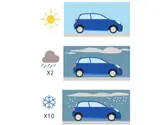
¿Dónde no es aplicable la distancia d separación respecto al vehículo que nos precede, para permitir que otro nos adelante con seguridad?
Where does the separation distance from the vehicle in front, which allows another vehicle to overtake us safely, not apply?
- ADonde esté prohibido el adelantamiento.Where overtaking is prohibited.
- BEn carreteras convencionales.On conventional roads.
- CEn vías interurbanas de doble sentido y dos carriles.On two-way, two-lane interurban roads.
ExplanationIt is enough to keep a distance that avoids a collision (there is no need to leave space for others to overtake us): - In built-up areas. - Where overtaking is prohibited. - Where there is more than one lane in the same direction. - When traffic is congested. - When you intend to overtake.
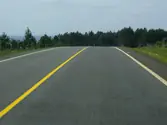
¿Está prohibido parar y estacionar en los cambios de rasante?
Is stopping and parking prohibited on brows of hills?
- ASí, siempre.Yes, always.
- BSí, cuando son cambios de rasante de visibilidad reducida.Yes, when they are brows of hills with reduced visibility.
- CParar no está prohibido, estacionar sí.Stopping is not prohibited, but parking is.
ExplanationOn bends and brows of hills with reduced visibility, or near them, both stopping and parking are prohibited.
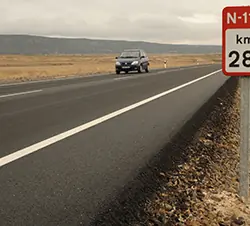
En esta vía interurbana, podrá parar su vehículo en la parte transitable del arcén...
On this interurban road, you may stop your vehicle on the usable part of the hard shoulder…
- APara subir o bajar personas.To let people get in or out.
- BPara descargar objetos, siempre que la parada dure menos de 2 minutos.To unload objects, as long as the stop lasts less than 2 minutes.
- CPor razones de emergencia.For emergency reasons.
ExplanationThe usable hard shoulder must be kept clear for pedestrians, cycles and slow vehicles that are required to use it; that is why only an emergency justifies stopping the vehicle there, properly signalling it.
¿Cuándo un agente de la autoridad puede inmovilizar un vehículo?
When may a law enforcement officer immobilise a vehicle?
- ACuando se superen los índices permitidos de gases.When the permitted levels of gas emissions are exceeded.
- BCuando el vehículo tenga más de diez años de antigüedad.When the vehicle is more than ten years old.
- CCuando al arrancar el vehículo salga humo por el tubo de escape.When smoke comes out of the exhaust pipe as the vehicle is started.
ExplanationVehicles may emit polluting gases within limits set by the authorities. If the vehicle goes over those limits, it may be immobilised.
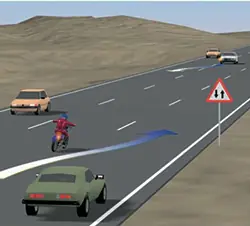
En las calzadas con dos sentidos y tres carriles, cuando quiera girar a la izquierda, ¿dónde debe colocarse?
On carriageways with two directions of traffic and three lanes, where must you position yourself when you want to turn left?
- AEn el carril central.In the centre lane.
- BEn el arcén derecho.On the right-hand hard shoulder.
- CEn el carril izquierdo.In the left-hand lane.
ExplanationOn two-way carriageways with three lanes, the centre lane is reserved for overtaking and turning left: this is where a driver who is going to make that turn must move to in advance.
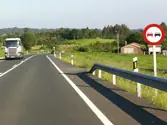
¿Se podrá efectuar un cambio de sentido antes de la curva?
Can a U-turn be made before the bend?
- ASí, si tengo suficiente visibilidad.Yes, if I have enough visibility.
- BNo, por ser una curva sin visibilidad.No, because it is a blind bend.
- CNo, al existir la señal que prohíbe adelantar.No, because there is a sign prohibiting overtaking.
ExplanationU-turns are prohibited everywhere overtaking is prohibited, so, given the signs, we cannot make a U-turn.
Para estacionar, ¿está permitido circular marcha atrás atravesando una intersección?
To park, may you reverse across a junction?
- ASí.Yes.
- BSí, si no recorre más de 15 metros.Yes, if you do not reverse more than 15 metres.
- CNo.No.
ExplanationAs a general rule, reversing is prohibited, except in the following cases, exceptionally and always over the shortest distance necessary: 1. As a manoeuvre to complete stopping, parking or joining traffic. In this case you may not reverse more than 15 metres or go into a junction. 2. When it is not possible to go forwards or to turn or make a U-turn. In this case there is no limit on the distance you may reverse, and you may even go into a junction if necessary. Reversing is prohibited on dual carriageways and motorways.
¿Es necesario calzar correctamente las ruedas de un vehículo que remolca un remolque ligero al aparcar en una pendiente?
Must the wheels of a vehicle towing a light trailer be properly chocked when parking on a slope?
- ASí, es obligatorio.Yes, it is compulsory.
- BSolo cuando se aparque en una pendiente ascendente.Only when parking on an uphill slope.
- CNo, no es necesario.No, it is not necessary.
ExplanationUnder Article 92.3.d of the General Traffic Regulations (RGC), when a combination of vehicles, such as a car with a trailer, stops or parks on a noticeable slope, it must be properly chocked, with suitable chocks or by resting one of the steering wheels against the kerb.
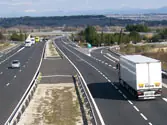
¿En una autopista está prohibido cambiar el sentido de la marcha?
Is it forbidden to make a U-turn on a motorway (autopista)?
- ANo, si la circulación es escasa.No, if there is little traffic.
- BSí, siempre.Yes, always.
- CSí, salvo en los pasos habilitados al efecto.Yes, except at crossings provided for this purpose.
ExplanationOn motorways (autopistas) and dual carriageways (autovías), U-turns are forbidden except at places provided for this purpose. If there is an open gap in the central reservation, it must not be used to turn round unless it has been specially provided and signed for this.
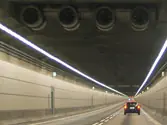
En un túnel con un carril para cada sentido de circulación, ¿está permitido adelantar?
In a tunnel with one lane in each direction, is overtaking permitted?
- ASí, cuando no haya señales que lo prohíban.Yes, when there are no signs prohibiting it.
- BNo.No.
- CSí, si hay suficiente visibilidad.Yes, if there is enough visibility.
ExplanationIn two-way tunnels or underpasses, overtaking is prohibited unless there is more than one lane in your direction, in which case you may overtake without entering the opposite direction. On the other hand, overtaking is always prohibited in tunnels, underpasses and stretches of road covered by the 'Tunnel' sign where there is only one lane in the direction of the vehicle that intends to overtake.
Para rebasar un obstáculo, ¿se puede cambiar al carril contiguo?
May you move into the next lane to pass an obstacle?
- ASí, siempre que el carril no esté ocupado.Yes, as long as the lane is not occupied.
- BNo, en ningún caso.No, never.
- CSí, aunque el otro carril esté ocupado.Yes, even if the other lane is occupied.
ExplanationTo pass an obstacle you may move into the next lane, but every lane change must respect the priority of those already travelling in that lane (Article 74.2 of the General Traffic Regulations). If that lane is occupied, you must wait.
Se considera que estacionar obstaculiza gravemente la circulación cuando se hace en...
Parking is considered to seriously obstruct traffic when it is done...
- Auna zona señalizada para uso exclusivo de personas con discapacidad.in an area marked for the exclusive use of people with disabilities.
- Buna calle de sentido único, junto al borde izquierdo.on a one-way street, next to the left-hand edge.
- Cmedio de la calzada.in the middle of the carriageway.
ExplanationArticle 91.2 of the General Traffic Regulations lists the types of parking that seriously obstruct traffic, and one of them is parking in the middle of the carriageway. On one-way streets, however, parking on the left-hand side is also allowed.
En una vía interurbana de doble sentido y tres carriles separados por líneas discontinuas, ¿dónde se situará el conductor de un turismo para cambiar de dirección a la izquierda?
On a two-way interurban road with three lanes separated by broken lines, where will a car driver position themselves to turn left?
- AEn el carril central.In the centre lane.
- BEn el carril situado a la izquierda de la calzada.In the lane on the left of the carriageway.
- CEn el carril de su derecha, como norma general.In the lane on their right, as a general rule.
ExplanationOn two-way carriageways with three lanes separated by broken longitudinal markings, you drive in the right-hand lane and never in the far-left lane. On these carriageways, the centre lane is only used for necessary overtaking and for turning left, taking extreme care.
Si circula usted conduciendo su turismo por una calzada de doble sentido de circulación y tres carriles separados por líneas longitudinales discontinuas, ¿dónde deberá colocarse para efectuar un cambio de dirección a la izquierda?
If you are driving your car on a two-way carriageway with three lanes separated by broken longitudinal lines, where must you position yourself to turn left?
- AEn el carril derecho.In the right-hand lane.
- BEn el carril central.In the centre lane.
- CEn el carril izquierdo.In the left-hand lane.
ExplanationOn a two-way carriageway with three lanes separated by broken lines, the centre lane is used for overtaking and for turning left. To turn left you must move into it in advance; the left-hand lane belongs to the opposite direction.
Si realiza una parada, ¿cuántos metros dejará, como mínimo entre su vehículo y el borde opuesto de la calzada sin ser un obstáculo?
If you stop, what is the minimum distance you must leave between your vehicle and the opposite edge of the carriageway so as not to cause an obstruction?
- A3 metros.3 metres.
- B3 metros y medio.3.5 metres.
- C4 metros.4 metres.
ExplanationUnder Article 91 of the General Traffic Regulations, stopping or parking causes a serious obstruction if it leaves less than 3 metres between the vehicle and the opposite edge of the carriageway or a marking that may not be crossed. You must leave at least 3 metres so that others can get past.
Al incorporarnos a la circulación saliendo desde un estacionamiento, ¿deberemos señalizarlo?
When pulling out into traffic from a parking space, must we signal it?
- ASolo si hay otros vehículos circulando cerca.Only if there are other vehicles moving nearby.
- BNo, si no es necesario.No, if it is not necessary.
- CSí, pues se trata de una maniobra.Yes, because it is a manoeuvre.
ExplanationJoining the traffic is a manoeuvre, so it must be signalled following the steps: observe, signal and carry out.
El conductor de un conjunto de vehículos de más de 3.500 kg de MMA que circula por un túnel y no pretende adelantar debe dejar con el vehículo que le precede una separación de al menos…
The driver of a combination of vehicles with a maximum authorised mass (MAM) of more than 3,500 kg, driving through a tunnel and not intending to overtake, must leave a gap to the vehicle in front of at least…
- A100 metros.100 metres.
- B150 metros.150 metres.
- C50 metros.50 metres.
ExplanationUnder Article 95 of the General Traffic Regulations (RGC), in tunnels, vehicles and combinations of vehicles over 3,500 kg that are not going to overtake must keep at least 150 metres or 6 seconds from the vehicle in front.
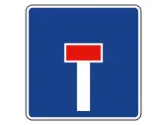
Si nos encontramos en una calle sin salida y necesitamos efectuar marcha atrás para salir de ella, ¿cómo efectuaremos dicha maniobra?
If we are in a dead-end street and need to reverse to get out of it, how will we do it?
- ARecorriendo como máximo 15 metros.Reversing 15 metres at most.
- BRecorriendo la distancia necesaria pero sin invadir un cruce de vías.Reversing the necessary distance, but without entering a junction.
- CRecorriendo la distancia mínima imprescindible e invadiendo incluso un cruce de vías.Reversing the minimum distance necessary, even entering a junction.
ExplanationAs a general rule, reversing is prohibited, except in the following cases, as an exception and always over the minimum distance necessary: 1. As a manoeuvre that complements stopping, parking or joining traffic. In this case, you may not reverse more than 15 metres or enter a junction. 2. When it is not possible to move forwards or to change direction or make a U-turn. In this case there is no limit on the reversing distance, and you may even enter a junction if necessary. Reversing is prohibited on dual carriageways (autovías) and motorways (autopistas).
Al dar marcha atrás, debe tener en cuenta que...
When reversing, you must bear in mind that…
- ADebe hacerlo con mucha precaución. Puede haber personas detrás del vehículo.You must do it very carefully. There may be people behind the vehicle.
- BTiene prioridad sobre los peatones.You have priority over pedestrians.
- CNo debe recorrer más de 10 metros.You must not reverse more than 10 metres.
ExplanationUnder Article 81 of the General Traffic Regulations (RGC), reversing must be done slowly and with the greatest care, stopping the vehicle immediately if you notice a person or animal nearby. Visibility behind the vehicle is limited and there may be pedestrians.
El conductor del turismo con remolque observa que va a ser adelantado en condiciones seguras, ¿cómo debe comportarse?
The driver of a car towing a trailer sees that they are going to be overtaken in safe conditions. How should they behave?
- ADebe apartarse obligatoriamente hacia la derecha e indicar con la mano que puede adelantarlo.They are obliged to move over to the right and signal by hand that the other driver can overtake.
- BDebe disminuir la velocidad para facilitar la maniobra.They must reduce speed to make the manoeuvre easier.
- CNo debe aumentar la velocidad ni realizar maniobras que dificulten el adelantamiento.They must not increase speed or make manoeuvres that make overtaking difficult.
ExplanationThe driver of the car with a trailer must not speed up or make manoeuvres that hinder the overtaking, so that it can be done safely. Increasing speed or making such manoeuvres could endanger other road users. It is important that the driver of the car with a trailer does not obstruct the manoeuvre and allows the vehicle that wants to overtake to do so smoothly.
¿Está prohibido cambiar de sentido en autopistas y autovías?
Is it prohibited to make a U-turn on motorways (autopistas) and dual carriageways (autovías)?
- ASí, excepto en los lugares habilitados para ello.Yes, except at places provided for it.
- BNo.No.
- CSí, siempre.Yes, always.
ExplanationUnder Article 79.1 of the General Traffic Regulations, U-turns are prohibited on motorways and dual carriageways, except at places provided for that purpose. Elsewhere, to change direction you must take an exit and use the interchanges.
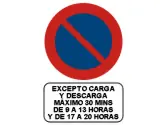
¿Puede estacionar en esta zona?
Can you park in this area?
- ASí, si existe espacio suficiente.Yes, if there is enough space.
- BSí, siempre que sea por un tiempo inferior a 2 minutos.Yes, as long as it is for less than 2 minutes.
- CNo, excepto para la carga y descarga dentro del horario.No, except for loading and unloading during the set hours.
ExplanationThe sign in the question prohibits parking, except for loading and unloading during the set hours. Outside those hours, parking is not allowed in general.
Estamos detenidos en el carril de la derecha ante un semáforo en rojo y se enciende una flecha verde hacia la derecha. Si los vehículos que nos siguen pretenden girar a la derecha, deberemos...
We are stopped in the right-hand lane at a red traffic light and a green arrow pointing right comes on. If the vehicles behind us want to turn right, we must...
- AApartarnos hacia el carril contiguo para dejarles pasar.Move over into the next lane to let them through.
- BEsperar a que el semáforo cambie a verde.Wait for the traffic light to turn green.
- CCambiar de dirección hacia la derecha.Turn right.
ExplanationWhen a green arrow comes on, the vehicle in the lane that must be used for that movement has to move off in the direction shown, with care, letting pedestrians who are crossing go first. Staying stopped or moving aside would block those who want to turn.
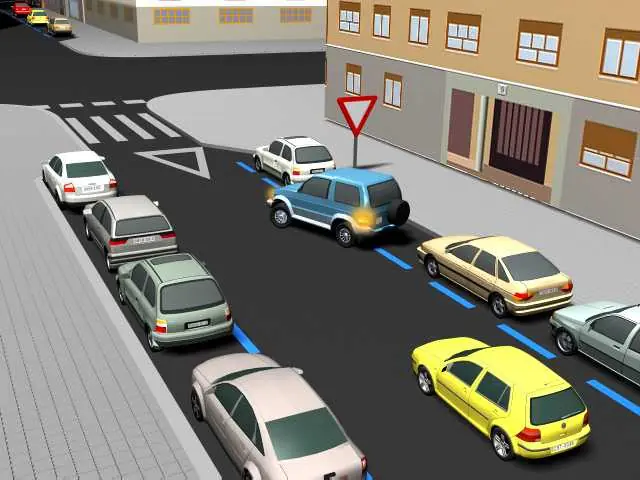
¿Qué debe hacer el vehículo amarillo?
What must the yellow vehicle do?
- ADebe ceder el paso al vehículo azul, pero sin pararse.It must give way to the blue vehicle, but without stopping.
- BDebe facilitar la incorporación del vehículo azul.It must make it easier for the blue vehicle to join the traffic.
- CDebe pararse para que se incorpore el vehículo azul.It must stop so that the blue vehicle can join the traffic.
ExplanationThe blue vehicle is leaving its parking space to join the traffic. It must give way, but Article 73 of the General Traffic Regulations (RGC) asks other drivers to make this manoeuvre easier as far as possible, without requiring them to stop.
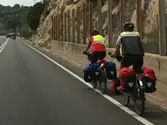
En esta situación, ¿está permitido adelantar a los ciclistas?
In this situation, is overtaking the cyclists permitted?
- ASí, aunque para ello haya que invadir el carril de sentido contrario.Yes, even if you have to enter the lane for the opposite direction.
- BSólo si al adelantar no se invade el carril de sentido contrario.Only if you do not enter the lane for the opposite direction when overtaking.
- CNo, porque la señalización prohíbe el adelantamiento.No, because the signs prohibit overtaking.
ExplanationUnder Article 88.2 of the General Traffic Regulations (RGC), as worded by RD 518/2026, on a stretch where overtaking is prohibited you may overtake cyclists, mopeds, personal mobility vehicles, pedestrians, animals, animal-drawn vehicles and special agricultural vehicles, even if you have to occupy the opposite direction, if they are travelling at a speed that allows you to do so without risk. Under Article 85.4, you must leave a safety gap of at least 1.5 metres and, outside built-up areas, reduce your speed by at least 20 km/h below the road's speed limit.
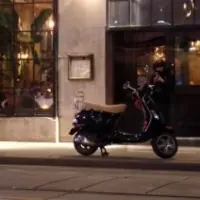
¿Se puede estacionar este vehículo sobre la acera?
Can this vehicle be parked on the pavement?
- ANo, en ningún caso.No, never.
- BSí, en cualquier acera, si no hay afluencia de peatones.Yes, on any pavement, if there are not many pedestrians.
- CSolo si lo permite la ordenanza municipal y no se entorpece a los peatones.Only if the municipal by-law allows it and pedestrians are not obstructed.
ExplanationUnder Article 156.2 of the General Traffic Regulations (RGC), as worded by RD 518/2026, local councils may, by municipal by-law, regulate the stopping and parking of two-wheeled vehicles on pavements, promenades and other pedestrian areas, as long as pedestrian traffic is not harmed or obstructed. Without that authorisation, parking on the pavement is prohibited.
Como norma general, la marcha atrás es una maniobra...
As a general rule, reversing is a manoeuvre that is...
- AProhibida.Prohibited.
- BPermitida.Permitted.
- CPermitida solo en poblado.Permitted only in built-up areas.
ExplanationAs a general rule, driving backwards is prohibited. It is only allowed when it is not possible to go forwards or to turn or change direction, and as part of another manoeuvre that requires it, always over the shortest distance necessary (Article 80.1 of the General Traffic Regulations, RGC).
Si durante el adelantamiento se produce una situación que entrañe peligro, ¿es correcto que el vehículo adelantado disminuya la velocidad?
If a dangerous situation arises during overtaking, is it correct for the vehicle being overtaken to slow down?
- ASí, está obligado a ello.Yes, it is obliged to.
- BNo, porque la responsabilidad es del vehículo que adelanta.No, because the responsibility lies with the overtaking vehicle.
- CNo tiene que reducir la velocidad, sólo lo hará el que adelanta o el que se acerca de frente.It does not have to slow down; only the overtaking vehicle or the one approaching from the front will do so.
ExplanationIf a dangerous situation arises during overtaking, the vehicle being overtaken is obliged to slow down, unless the overtaking vehicle abandons its intention to overtake; in that case, it must make it easier for that vehicle to return to its lane by increasing its speed.
Siempre que el recorrido hacia atrás no supere 15 metros ni invada un cruce de vías, se puede circular marcha atrás ...
As long as the distance does not exceed 15 metres and you do not enter a junction, you may reverse...
- Aen autovías y autopistas que atraviesen zonas urbanas.on dual carriageways (autovías) and motorways (autopistas) that pass through urban areas.
- Bcomo maniobra complementaria a la parada.as part of stopping.
- Ccuando no sea posible cambiar de dirección o sentido.when it is not possible to change direction or make a U-turn.
ExplanationReversing as part of stopping, parking or joining traffic may not exceed 15 metres or enter a junction (Article 80.2 of the General Traffic Regulations (RGC)). On motorways and dual carriageways it is always prohibited.
Circulando marcha atrás como maniobra complementaria de un estacionamiento, ¿está permitido invadir un cruce de vías?
When reversing as a manoeuvre supplementary to parking, is it allowed to enter a junction?
- ANo, está prohibido.No, it is prohibited.
- BSí, mientras no recorra más de 15 metros.Yes, as long as you do not travel more than 15 metres.
- CSí, en cualquier caso.Yes, in any case.
ExplanationWhen reversing is supplementary to stopping, parking or joining traffic, the distance must not exceed 15 metres and you must not enter a junction (Article 80.2 of the General Traffic Regulations, RGC). Travelling less than 15 metres does not make it allowed.
En una vía de doble sentido, ¿dónde debe colocarse con su vehículo para girar a la izquierda?
On a two-way road, where must you position your vehicle to turn left?
- ACerca del borde derecho de la calzada.Near the right-hand edge of the carriageway.
- BJunto al borde izquierdo de la calzada.Next to the left-hand edge of the carriageway.
- CJunto a la línea longitudinal que separa los sentidos.Next to the longitudinal line separating the two directions.
ExplanationUnder Article 75.1.b of the RGC, to turn left on a two-way carriageway you must keep close to the longitudinal marking that separates the two directions or, if there is none, to the centre of the carriageway, without entering the side for oncoming traffic. The left-hand edge is only used on one-way carriageways.
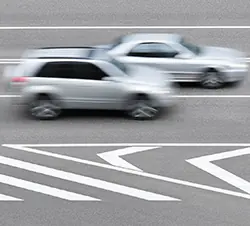
Siempre que exista espacio suficiente y adoptando las máximas precauciones, está permitido adelantar por la derecha...
As long as there is enough space and you take the greatest care, overtaking on the right is permitted…
- Aen vías interurbanas, en las intersecciones y sus proximidades.on interurban roads, at and near junctions.
- Ben autopistas y autovías que discurran exclusivamente dentro de poblado.on motorways (autopistas) and dual carriageways (autovías) that run entirely within built-up areas.
- Cen vías urbanas con dos o más carriles delimitados por líneas longitudinales.on urban roads with two or more lanes marked by longitudinal lines.
ExplanationOn urban roads with two or more lanes in the same direction marked by road markings, overtaking on the right is permitted, with care and enough space: in towns, the lanes work as independent flows of traffic.
All topics
- Definitions
- Documents and penalty points
- The driver's condition
- Duties of drivers and pedestrians
- Vehicle safety devices
- Vehicle controls and equipment
- Vehicle lights and horn
- Traffic signs, markings and signals
- The road and its lanes
- Speed and distances
- Right of way
- Carrying passengers and loads
- Driving safely in difficult conditions
- Vehicle mechanics and maintenance
- Road accidents and first aid
- Defensive and eco-driving
Independent app: not affiliated with or endorsed by the DGT (Spain's Directorate-General for Traffic) or the Ministry of the Interior. The official exam is booked with the DGT and taken at its test centres. The questions here are practice material; the DGT's official question bank is not public.
Basado en datos de la Agencia Estatal Boletín Oficial del Estado (https://www.boe.es). Textos consolidados de carácter meramente informativo. La AEBOE no patrocina ni respalda este sitio.
Parte de las preguntas procede de los tests de la revista «Tráfico y Seguridad Vial» de la DGT, reproducidos con indicación de la fuente.