
DGT test · 200 questions
Duties of drivers and pedestrians · Page 4 of 4
The general duties of people driving and walking on the road: due care, phones and headphones, how pedestrians must behave.
Questions in this topic, with answers
200 questions, 50 per page, with the correct answer and the explanation. Page 4 of 4.

Un peatón que transita durante el día por el arcén de una vía interurbana, ¿deberá llevar el chaleco reflectante?
Must a pedestrian walking during the day on the hard shoulder of a road outside built-up areas wear the reflective vest?
- ASí, siempre llevará el chaleco, tanto de día como de noche.Yes, they must always wear the vest, both by day and by night.
- BSí, pero solo si camina por la calzada.Yes, but only if walking on the carriageway.
- CNo, sólo lo llevará durante la noche o en condiciones que disminuyan la visibilidad.No, they only wear it at night or in conditions that reduce visibility.
ExplanationPedestrians walking on roads outside built-up areas between sunset and sunrise, or in conditions that reduce visibility, must carry a luminous or retroreflective item visible from at least 150 m. Groups of pedestrians must also carry the lights needed to show their position and size: white or yellow facing forwards and red facing backwards. When walking during the day or on urban roads, they do not need a reflective vest.
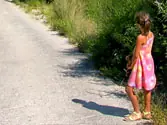
Cuando por razones del tráfico, se vea obligado a circular cerca de peatones deberá….
When, because of traffic, you have to drive close to pedestrians, you must...
- Aextremar la precaución, reduciendo la velocidad, llegando incluso a detenerme.take extra care, reducing speed and even stopping.
- Bacelerar para pasar lo más rápido posible, para no ponerlos en peligro.accelerate to get past as quickly as possible, so as not to put them in danger.
- Cdetenerme en todo caso, para dejarles pasar.stop in all cases, to let them pass.
ExplanationDrivers must drive at a moderate speed and, if necessary, stop when traffic, road or visibility conditions require it, and specifically when there are pedestrians on the part of the road being used or it can reasonably be foreseen that they may step into it, especially children, elderly people, blind people or people with obvious disabilities.
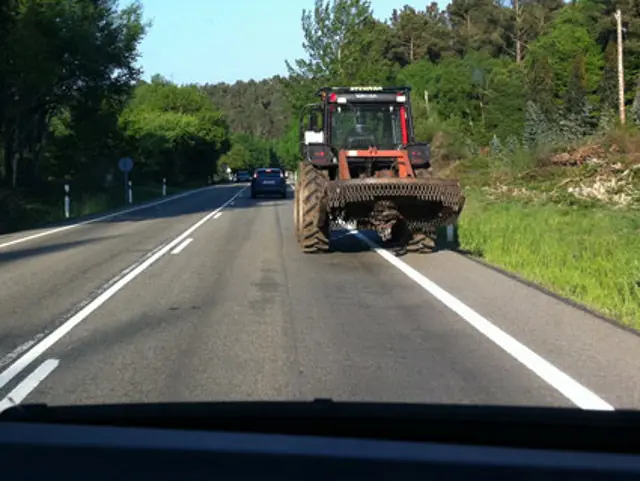
¿El tractor agrícola de la fotografía, con MMA inferior a 3500 kg, circula correctamente?
Is the agricultural tractor in the photograph, with a MAM of less than 3,500 kg, being driven correctly?
- ANo, debe usar el carril derecho.No, it must use the right-hand lane.
- BSí.Yes.
- CNo, puede ocupar cualquier parte de la calzada.No, it may use any part of the carriageway.
ExplanationSpecial vehicles with a maximum authorised mass of up to 3,500 kg must use the hard shoulder on their right if it is driveable and wide enough; if it is not, they use the part of the carriageway that is strictly necessary (Article 36.1 of the General Traffic Regulations (RGC)), as the tractor in the picture is doing.
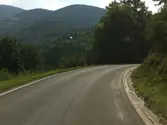
En una vía interurbana que no dispone de zona peatonal, ¿por qué lado deben circular los peatones?
On an interurban road with no pedestrian area, on which side must pedestrians walk?
- APor su derecha.On their right.
- BIndistintamente, por cualquiera de los dos lados.On either side, it makes no difference.
- CPor su izquierda.On their left.
ExplanationUnder Article 122.1 of the General Traffic Regulations (RGC), as worded by RD 518/2026, when there is no usable pedestrian area, pedestrians must walk on the left-hand hard shoulder or, if there is none, on the carriageway, and only exceptionally on the right-hand side when there are safety reasons that justify it.
¿Por qué lado de la calzada circulará un rebaño si no hay una vía pecuaria?
On which side of the carriageway must a herd travel if there is no livestock track?
- APor el lado derecho.On the right-hand side.
- BPor el lado izquierdo.On the left-hand side.
- CIndistintamente por la derecha o por la izquierda.On either the right or the left.
ExplanationIf there is no livestock track, the herd must be looked after by a person. It must use an alternative road with little traffic and keep to the right-hand side of the carriageway.
¿Puede circular por la calzada de una vía urbana con un vehículo de movilidad personal?
Can you ride a personal mobility vehicle (PMV) on the carriageway of an urban road?
- ANo, en ningún caso.No, never.
- BSí, en las vías que autorice el municipio, salvo travesías y túneles urbanos.Yes, on the roads the local council authorises, except travesías and urban tunnels.
- CNo, debo circular por la acera a paso de persona.No, I must ride on the pavement at walking pace.
ExplanationUnder Article 155.1 of the General Traffic Regulations (as worded by RD 518/2026), the local authority decides which roads and areas personal mobility vehicles may use. They may not be ridden on pavements (Article 152.1), and Article 38.4 prohibits them in travesías (stretches of road through a town) and in urban tunnels, unless these are cycle paths or roads closed to motor vehicles.
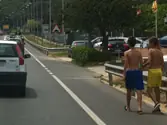
¿Por dónde estarán obligados a transitar los peatones en una vía fuera de poblado?
Where are pedestrians required to walk on a road outside built-up areas?
- APor la calzada.On the carriageway.
- BPor el arcén.On the hard shoulder.
- CPor la zona peatonal.In the pedestrian area.
ExplanationPedestrians must walk in the pedestrian area. When there is none or it cannot be used, they must walk on the hard shoulder or, if there is none, on the carriageway.
¿Por dónde debe circular un peatón que empuja un vehículo de dos ruedas?
Where must a pedestrian pushing a two-wheeled vehicle walk?
- APor la derecha, por la calzada o por el arcén, según el sentido de la marcha.On the right, on the carriageway or on the hard shoulder, in their direction of travel.
- BPor la izquierda, por la calzada o por el arcén, según el sentido de la marcha.On the left, on the carriageway or on the hard shoulder, in their direction of travel.
- CPor la derecha o por la izquierda, indistintamente.On the right or on the left, either way.
ExplanationUnder Article 122.2 of the General Traffic Regulations (as worded by RD 518/2026), anyone pushing or pulling a cycle, a two-wheeled moped or a personal mobility vehicle must always keep to the right, on the hard shoulder or on the carriageway, keeping as close as possible to its outer edge.
Todo vehículo tendrá que estar dotado de...
Every vehicle must be fitted with...
- ASilenciador.A silencer.
- BExtintor de incendios.A fire extinguisher.
- CHerramientas para arreglar el motor.Tools to repair the engine.
ExplanationEvery motor vehicle must be fitted with an effective silencer for the noise of the engine's explosions.
¿Por qué parte de la vía circulará un peatón que empuja un ciclomotor con ruedas?
Which part of the road will a pedestrian pushing a moped on its wheels use?
- APor la acera.The pavement.
- BPor su derecha, por el arcén o por la calzada.Their right-hand side, on the hard shoulder or on the carriageway.
- CPor su izquierda, según su sentido de la marcha.Their left-hand side, in relation to their direction of travel.
ExplanationSomeone pushing a two-wheeled cycle or moped is a pedestrian, but must keep to the right, on the hard shoulder or, if there is none, on the carriageway. They cannot use the pavement with it, and unlike other pedestrians they do not walk on the left.
¿Se podrá circular con el llamado "escape libre"?
May you drive with a so-called "open exhaust"?
- ASí, fuera de poblado.Yes, outside built-up areas.
- BNo fuera de poblado, sí dentro de poblado.Not outside built-up areas, but yes in built-up areas.
- CNo.No.
ExplanationDriving with an open exhaust is prohibited both in and outside built-up areas.
¿Se puede circular con el vehículo emitiendo más humo del permitido?
Can you drive a vehicle that gives off more smoke than is allowed?
- ASí, si es temporal.Yes, if it is temporary.
- BNo.No.
- CSolo en ciudad.Only in town.
ExplanationYou cannot drive a vehicle that gives off more smoke than is allowed, because this points to a fault in the exhaust or emissions system and is a risk to health and the environment. Driving in these conditions is prohibited on any road, whether it is temporary or not, and whether in town or on the open road. Keeping the vehicle in good condition and within the emission limits is compulsory under traffic and road safety rules.
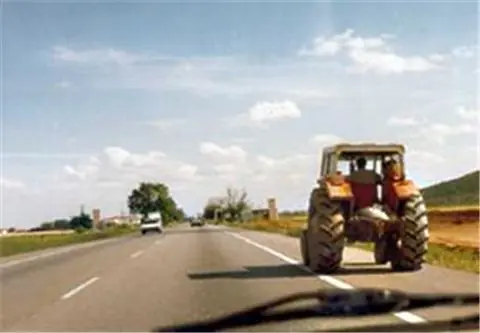
¿Circula correctamente el tractor agrícola de 2500 kg de MMA?
Is the 2,500 kg MAM agricultural tractor being driven correctly?
- ASí, porque al no superar los 3.500 kg de MMA. debe circular por el arcén.Yes, because as its MAM does not exceed 3,500 kg, it must use the hard shoulder.
- BNo, porque estos vehículos deben circular siempre por la calzada.No, because these vehicles must always use the carriageway.
- CSí, pero sólo si está averiado.Yes, but only if it has broken down.
ExplanationSpecial vehicles with a maximum authorised mass of no more than 3,500 kg, like this agricultural tractor, must use the right-hand hard shoulder if it is driveable and wide enough. If it is not, they use the part of the carriageway that is strictly necessary.
¿Qué vehículos se consideran prioritarios?
Which vehicles are considered priority vehicles?
- ALos vehículos especiales de obras y servicios.Special works and service vehicles.
- BLos vehículos de protección civil y salvamento.Civil protection and rescue vehicles.
- CLos autobuses de transporte público.Public transport buses.
ExplanationPolice, fire, civil protection and rescue, and ambulance service vehicles are priority vehicles.

Un rebaño de ovejas en una carretera, ¿por qué arcén debe circular?
A flock of sheep is on a road. Which hard shoulder must it use?
- APor el arcén del lado izquierdo.The left-hand hard shoulder.
- BPor el arcén del lado derecho.The right-hand hard shoulder.
- CEs indiferente, puede circular por el de la derecha o el de la izquierda.It makes no difference; it may use either the right or the left one.
ExplanationIf there is no livestock route, a herd of animals must move along the right-hand hard shoulder. If it has to use the carriageway, it must keep as close as possible to the right-hand edge.
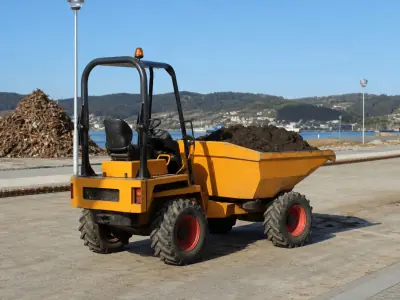
¿Están los vehículos especiales sometidos en su construcción a las normas sobre masas y dimensiones máximas para circular?
In their construction, are special vehicles subject to the rules on maximum masses and dimensions in order to travel on the road?
- ANoNo
- BÚnicamente los vehículos especiales de tipo agrícolaOnly agricultural special vehicles
- CSí, todos ellosYes, all of them
ExplanationBecause of their purpose, special vehicles, such as farm or construction machines, may be exempt from the rules on maximum masses and dimensions that apply to ordinary vehicles. That is why some of them need special authorisation to travel on the road.
¿Un vehículo podrá circular con el silenciador del tubo de escape roto?
Can a vehicle be driven with a broken exhaust silencer?
- ASí, pero solo en vías fuera de poblado.Yes, but only on roads outside built-up areas.
- BLas motocicletas sí, los turismos no.Motorcycles can, cars cannot.
- CNo.No.
ExplanationMotor vehicles must have a silencer fitted in the exhaust pipe so that they do not cause noise pollution.
¿Está permitido circular con auriculares puestos?
Is it allowed to drive wearing earphones?
- ANo, está prohibido salvo dispositivos manos libres integradosNo, it is prohibited, except for built-in hands-free devices
- BSolo si es un oídoOnly in one ear
- CSolo en ciudadOnly in town
ExplanationIt is prohibited to drive with earphones, except for built-in hands-free devices.
¿Puede circular con su vehículo si emite un ruido que supera los límites permitidos?
May you drive your vehicle if it makes noise above the permitted limits?
- ASí, porque el ruido no es peligroso.Yes, because noise is not dangerous.
- BSí, siempre que no se deba a una avería.Yes, as long as it is not caused by a fault.
- CNo, está prohibido.No, it is prohibited.
ExplanationArticle 7.1 of the General Traffic Regulations prohibits driving vehicles whose noise emissions exceed the set limits, whether or not this is caused by a fault. Police officers can even immobilise the vehicle (Article 7.2).
¿Puede el conductor de un vehículo de movilidad personal, circular por las aceras?
May the rider of a personal mobility vehicle (PMV, e-scooter) ride on the pavement?
- ANo, deberán circular por la calzada.No, they must ride on the carriageway.
- BNo, deberán hacerlo siempre por el carril bici.No, they must always ride in the cycle lane.
- CSi, siempre que no supere la velocidad del paso de un peaton.Yes, as long as they do not go faster than walking pace.
ExplanationUnder Article 152.1 of the General Traffic Regulations (RGC) (as worded by RD 518/2026), pavements are reserved for pedestrians and no type of vehicle may be ridden on them. The local authority decides which roads and areas personal mobility vehicles may use (Article 155.1).
Como norma general en vías interurbanas, ¿por dónde circularán los peatones?
As a general rule, on roads outside built-up areas, on which side will pedestrians walk?
- APor la izquierda.On the left.
- BPor la derecha.On the right.
- CIndistintamente por la derecha o la izquierda.On either the right or the left.
ExplanationOn roads outside built-up areas that have no pedestrian area, pedestrians walk on their left, so that they can see vehicles coming towards them and are not taken by surprise.
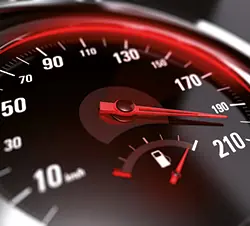
¿Está permitida la circulación de vehículos cuyo nivel de emisión de ruidos supere los límites establecidos?
Are vehicles whose noise emissions exceed the established limits allowed on the road?
- ASí.Yes.
- BNo.No.
- CSolo está permitida su circulación por vías urbanas.Only on urban roads.
ExplanationIt is prohibited to drive a vehicle whose noise emissions exceed the legal limits: this is a technical requirement for the vehicle on all types of roads, including urban roads.
La celebración de marchas ciclistas organizadas, ¿Requieren autorización previa?
Do organised cycling rides require prior authorisation?
- ANo.No.
- BSí, siempre que el número de participantes sea superior a 50.Yes, whenever the number of participants is over 50.
- CSólo las que se celebran en días festivos.Only those held on public holidays.
ExplanationYes. Organised cycling rides, which are those with more than 50 cyclists, must meet the authorisation requirements that Annex II of the General Traffic Regulations sets for sporting events, whatever day they are held on.
¿Qué puede indicar un humo negro abundante en el escape?
What can a lot of black smoke from the exhaust mean?
- AExceso de combustible en la combustión.Too much fuel in the combustion.
- BFalta de líquido refrigerante.Lack of coolant.
- CDesgaste de los frenos.Worn brakes.
ExplanationA lot of black smoke from the exhaust pipe is usually linked to poor combustion in the engine. It generally means that the air-fuel mixture is not right, with too much fuel compared to air. This causes incomplete combustion and the release of soot particles, seen as black smoke. It has nothing to do with the cooling system or the condition of the brakes. It is a sign of a possible problem with the engine's fuel supply or injection.
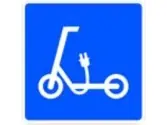
¿Pueden los peatones circular por una vía así señalizada?
May pedestrians use a road with this sign?
- ASí, los peatones pueden circular libremente.Yes, pedestrians may walk there freely.
- BSolo si no hay mucha densidad de vehículos de movilidad personal.Only if there are not many personal mobility vehicles.
- CNo, la vía está reservada exclusivamente para vehículos de movilidad personal.No, the road is reserved only for personal mobility vehicles.
ExplanationThe sign shows that the road is reserved only for personal mobility vehicles (PMVs). For safety, pedestrians may not use this road, because it is not designed for them.
Está prohibido arrojar objetos en la vía...
It is forbidden to throw objects onto the road...
- Asolo si pueden dificultar el paso de vehículos o personas.only if they could obstruct the passage of vehicles or people.
- Bque puedan deteriorar la vía o sus instalaciones.that could damage the road or its installations.
- Csolo si pueden dañar la vía.only if they could damage the road.
ExplanationIt is forbidden to throw, leave or abandon on the road any objects that could obstruct traffic, make it dangerous or damage the road or its installations (Article 4.2 of the General Traffic Regulations). So it is not only when they obstruct the way or only when they damage the road.
Con un vehículo que emite más ruido del permitido...
A vehicle that makes more noise than is allowed...
- ASolo se permite circular por carreteras.May only be driven on roads outside towns.
- BSe permite circular por carreteras, pero no por travesías.May be driven on roads outside towns, but not on travesías (stretches of road through a town).
- CNo está permitido circular.May not be driven.
ExplanationAccording to Article 7.1 of the General Traffic Regulations, vehicles that make noise above the set limits may not be driven on any road: not on roads outside towns, not on travesías and not on streets. In addition, police officers can immobilise them.
¿Un peatón podrá circular de noche por la calzada de una vía fuera de poblado?
Can a pedestrian walk at night on the carriageway of a road outside built-up areas?
- ANo, está totalmente prohibido.No, it is completely prohibited.
- BSí, con un chaleco reflectante.Yes, wearing a reflective vest.
- CSí, pero deberá llevar obligatoriamente una luz de color blanco o amarillo.Yes, but they must carry a white or yellow light.
ExplanationWhen a pedestrian walks on the carriageway or hard shoulder of a road outside built-up areas at night, they must carry an approved luminous or retroreflective item that can be seen from at least 150 metres away.
¿Por dónde circulará un peatón que arrastra un ciclo o ciclomotor de dos ruedas fuera de poblado?
Outside built-up areas, where must a pedestrian walk when pulling a two-wheeled cycle or moped?
- AIndistintamente por la derecha o por la izquierda.On either the right or the left.
- BPor la derecha.On the right.
- CPor la izquierda.On the left.
ExplanationAs a general rule, outside built-up areas pedestrians walk on the left, but those pulling or pushing a cycle or moped must walk on the right.
Circula de noche con las luces largas encendidas y ve peatones en el arcén. ¿Debe cambiar las luces largas por las cortas?
You are driving at night with main beam on and see pedestrians on the hard shoulder. Must you switch from main beam to dipped headlights?
- ANo es necesario.It is not necessary.
- BSí, pero solo en tramos rectos.Yes, but only on straight stretches.
- CSí, para no deslumbrar.Yes, so as not to dazzle them.
ExplanationUnder Article 102.1 of the General Traffic Regulations, main beam must be replaced by dipped headlights as soon as there is a possibility of dazzling other road users, and pedestrians walking on the hard shoulder are road users too.
En una carretera convencional, ¿se permite que un peatón camine por la calzada?
On a conventional road, is a pedestrian allowed to walk on the carriageway?
- ANo.No.
- BSí, cuando no hay arcén o éste no es transitable.Yes, when there is no hard shoulder or it cannot be used.
- CSí, cuando arrastra (o empuja) un vehículo.Yes, when they are pulling (or pushing) a vehicle.
ExplanationUnder Article 122.1 of the General Traffic Regulations (as worded by RD 518/2026), when there is no usable pedestrian area, pedestrians must walk on the left-hand hard shoulder, if there is one and it is usable, or, if not, on the carriageway, as far as possible from vehicle traffic.

¿Puede un peatón circular por la calzada de una vía interurbana?
May a pedestrian walk on the carriageway of an interurban road?
- ASí, incluso en autovías y autopistas.Yes, even on dual carriageways (autovías) and motorways (autopistas).
- BSí, si no dispone de arcén o zona peatonal.Yes, if there is no hard shoulder or pedestrian area.
- CNo, sólo puede circular por el arcén.No, they may only walk on the hard shoulder.
ExplanationUnder Article 122.1 of the General Traffic Regulations (RGC) (as worded by RD 518/2026), when there is no usable pedestrian area, pedestrians must walk on the left-hand hard shoulder if there is one and it can be used or, if not, on the carriageway. They may not walk on motorways (autopistas) or dual carriageways (autovías), except in the cases and under the conditions of Article 130 (Article 125.1).
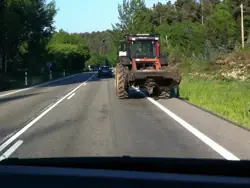
El tractor agrícola de la fotografía, de MMA inferior a 3.500 kg., ¿Circula correctamente?
Is the farm tractor in the photograph, with a MAM of less than 3,500 kg, being driven correctly?
- ANo, pues debe utilizar el carril derecho.No, because it must use the right-hand lane.
- BNo.No.
- CSí.Yes.
ExplanationSpecial vehicles of up to 3,500 kg, such as this tractor, must use the hard shoulder if it is usable and wide enough. Here the hard shoulder is very narrow, so it is being driven correctly on the part of the carriageway that is strictly necessary, as far to the right as possible.
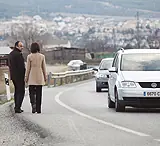
Al cruzarse con el peatón, la distancia lateral que debe dejar el vehículo es...
When passing a pedestrian coming the other way, the lateral distance the vehicle must leave is...
- A1,50 metros, al menos.At least 1.50 metres.
- B1 metro, al menosAt least 1 metre
- C2 metros, al menos.At least 2 metres.
ExplanationWhen passing pedestrians walking along the edge of the road, you must leave a lateral distance of at least 1.5 metres and slow down, because they are vulnerable road users and may move unexpectedly. If there is not enough space, you must wait.
¿Podrán los animales circular por las vías públicas?
May animals travel on public roads?
- ASí, excepto por autopistas y autovías.Yes, except on motorways (autopistas) and dual carriageways (autovías).
- BNo, siempre tendrán que circular por una vía pecuaria y si no existe, no podrán circular.No, they must always use a livestock track and, if there is none, they may not travel.
- CSí, por todas las vías excepto autopistas.Yes, on all roads except motorways (autopistas).
ExplanationAnimals may travel on public roads when there is no livestock track. They must always be looked after by a person. Animals are prohibited in all cases on motorways (autopistas) and dual carriageways (autovías).
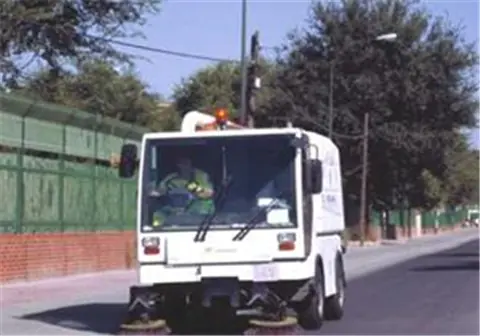
¿Cuándo están obligados a señalizar su presencia los vehículos especiales?
When must special vehicles signal their presence?
- AÚnicamente cuando circulen de día.Only when driving during the day.
- BÚnicamente cuando circulen de noche.Only when driving at night.
- CCuando circulen tanto de día como de noche por un lugar público.When driving on a public road, both day and night.
ExplanationSpecial vehicles must signal their presence with the yellow V-2 rotating light, day and night, when travelling on public roads at no more than 40 km/h. If that light fails, they must use dipped headlights and the hazard warning lights.
¿Puedes conducir con auriculares puestos?
May you drive wearing earphones?
- ASí, con volumen bajoYes, at low volume
- BNo, está prohibidoNo, it is prohibited
- CSolo en autopistaOnly on a motorway (autopista)
ExplanationIt is prohibited to drive with earphones connected to sound equipment. They reduce your hearing and your attention.

El conductor de un vehículo de movilidad personal debe saber que …
The rider of a personal mobility vehicle must know that...
- ANo puede llevar a ningún pasajero.They may not carry any passengers.
- BPuede circular de noche por autovías si dispone de alumbrado.They may ride on dual carriageways (autovías) at night if the vehicle has lights.
- CPuede circular por travesías.They may ride on travesías (stretches of road through a town).
ExplanationPersonal mobility vehicles have only one seat, so they may not carry passengers. In addition, according to Article 38.4 of the General Traffic Regulations (as worded by RD 518/2026), it is prohibited to ride them on motorways (autopistas), dual carriageways (autovías) and travesías, and on interurban roads and urban tunnels, unless these are cycle paths or roads closed to motor vehicles; nor may they be ridden on pavements (Article 152.1).
En una vía interurbana, ¿por qué lado circulará un peatón?
On an interurban road, on which side must a pedestrian walk?
- APor el lado derecho.On the right-hand side.
- BPor el lado izquierdo.On the left-hand side.
- CLos peatones no pueden circular por las carreteras.Pedestrians may not walk on roads.
ExplanationOn interurban roads, pedestrians must walk on the left-hand hard shoulder and, if there is none, on the smallest necessary part of the carriageway.
¿Puede circular un rebaño de animales por una carretera convencional?
May a herd of animals travel along a conventional road?
- ANo, bajo ningun concepto.No, under no circumstances.
- BSi, cuando no exista vía pecuaria.Yes, when there is no livestock track.
- CSí, siempre.Yes, always.
ExplanationDraught, pack or riding animals and single head of livestock, droves or herds are only allowed on the road when there is no usable route along a livestock track, and as long as they are looked after by at least one person over 18. They must not go into the pedestrian area and must travel on the right-hand hard shoulder; if they have to use the carriageway, they must keep as close as possible to its right-hand edge. As an exception, a single animal may be led along the left-hand edge if this is safer. Animals led in droves or herds must go at walking pace, as close as possible to the right-hand edge of the road and never taking up more than the right-hand half of the carriageway, split into groups of moderate length, each with at least one person leading it, and far enough apart to hold up traffic as little as possible. They may cross roads only at authorised crossings signposted for this, or at other places that are safe enough. Animals and animal-drawn vehicles are prohibited on motorways (autopistas) and dual carriageways (autovías).
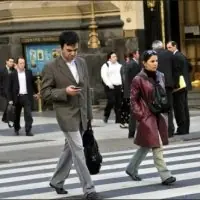
Para evitar atropellos a peatones hay que tener especial cuidado...
To avoid hitting pedestrians, you must take special care...
- Aen las autopistas.on motorways (autopistas).
- Ben todas las maniobras.in all manoeuvres.
- Cal dar marcha atrás.when reversing.
ExplanationAmong the most frequent crashes on roads in built-up areas are pedestrians being hit by a reversing vehicle, especially when entering or leaving private garages. That is why you must take extreme care in these circumstances: the view through the interior and side mirrors is not enough to see a pedestrian passing behind, and you could run them over.
Un vehículo expulsa más humo del permitido, ¿puede seguir circulando?
A vehicle gives off more smoke than is allowed. May it keep driving?
- ASí, porque el humo no es nocivo ni contamina.Yes, because smoke is not harmful and does not pollute.
- BNo.No.
- CSí, siempre que circule fuera de poblado.Yes, as long as it is driven outside built-up areas.
ExplanationGiving off electromagnetic interference, noise, gases, smoke and other pollutants above the set limits is prohibited. In general, if we give off noise, smoke or gases above the set limits, police officers may immobilise the vehicle as well as imposing the appropriate fine.
Para evitar atropellar a peatones, ¿qué debe hacer al salir de un garaje si tiene que cruzar la acera para incorporarse al tráfico?
To avoid hitting pedestrians, what must you do when leaving a garage if you have to cross the pavement to join traffic?
- AParar siempre el vehículo y avisar con el claxon.Always stop the vehicle and sound the horn.
- BReducir la velocidad por si hay peatones cruzando.Reduce speed in case pedestrians are crossing.
- CAumentar la velocidad para alejarse lo antes posible.Speed up to get away as soon as possible.
ExplanationUnder Article 65 of the General Traffic Regulations (as worded by RD 518/2026), pedestrians have right of way on pavements and other pedestrian areas, and when vehicles cross them at the places provided for this, drivers must let the pedestrians on them go first. That is why, when crossing the pavement to leave a garage, you must slow down and take extra care.
Un peatón empujando un ciclomotor, ¿por qué lado de la calzada circulará fuera de poblado?
Outside a built-up area, which side of the carriageway must a pedestrian pushing a moped use?
- APor el lado izquierdo, como todos los peatones.The left side, like all pedestrians.
- BPor el lado derecho, como los demás vehículos.The right side, like other vehicles.
- CIndistintamente por el lado derecho o izquierdo.Either the right or the left side.
ExplanationBoth inside and outside built-up areas, pedestrians pushing a moped must do so on the right-hand side.
¿Está permitido conducir un patinete eléctrico con auriculares conectados a un reproductor de sonido o sujetando el teléfono móvil con la mano?
Is it allowed to ride an e-scooter with earphones connected to a sound player, or while holding a mobile phone in your hand?
- ANo, está prohibido.No, it is prohibited.
- BSí, pero solo en aceras.Yes, but only on pavements.
- CSí, si circula a menos de 10 km/h.Yes, if you ride at less than 10 km/h.
ExplanationRiders of e-scooters, like drivers of any vehicle, may not ride with earphones connected to sound players or use a mobile phone while holding it in their hand (Article 18.2 of the General Traffic Regulations). Only communication without using the hands and without earphones is allowed.
Un tractor agrícola con una MMA (masa máxima autorizada) de 3000 kg, una bicicleta y un ciclomotor circulan por el arcén. ¿Es correcto?
An agricultural tractor with a MAM (maximum authorised mass) of 3,000 kg, a bicycle and a moped are travelling on the hard shoulder. Is this correct?
- ANo. Sólo la bicicleta debe circular por el arcén.No. Only the bicycle must use the hard shoulder.
- BSí, todos deben circular por el arcén.Yes, all of them must use the hard shoulder.
- CSí, excepto el tractor, que debe circular por la calzada.Yes, except the tractor, which must use the carriageway.
ExplanationAccording to Article 36.1 of the General Traffic Regulations (RGC), as worded by RD 518/2026, drivers of special vehicles with a maximum authorised mass of no more than 3,500 kg (such as this 3,000 kg tractor), of cycles and of mopeds must, if there is no road or part of a road specially set aside for them, use the hard shoulder on their right if it is driveable and wide enough; if not, the part of the carriageway that is strictly necessary.
¿Está permitido conducir escuchando la radio con los auriculares puestos?
Is it allowed to drive while listening to the radio with earphones in?
- ASí.Yes.
- BSí, si solo lleva puesto un auricular.Yes, if you only wear one earphone.
- CNo.No.
ExplanationNo. Using earphones connected to sound devices while the vehicle is moving is completely forbidden.
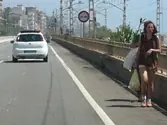
Cuando no existe zona peatonal o ésta no es practicable, los peatones...
When there is no pedestrian area, or it cannot be used, pedestrians...
- Apueden transitar por el arcén.may walk on the hard shoulder.
- Bdeben transitar por la calzada.must walk on the carriageway.
- Cno pueden transitar por las carreteras.may not walk on roads.
ExplanationAccording to Article 122.1 of the General Traffic Regulations (as worded by RD 518/2026), when there is no usable pedestrian area, pedestrians must walk on the left-hand hard shoulder, if there is one and it is usable, or otherwise on the carriageway, as far as possible from vehicle traffic.
¿Qué usuarios de la vía se consideran vulnerables?
Which road users are considered vulnerable?
- AConductores de coches.Car drivers.
- BPeatones, ciclistas y usuarios de vehículos de dos ruedas y de movilidad personal.Pedestrians, cyclists and users of two-wheeled vehicles and personal mobility vehicles.
- COcupantes de vehículos a motor.Occupants of motor vehicles.
ExplanationVulnerable road users include pedestrians, cyclists, motorcyclists and users of personal mobility vehicles (such as e-scooters). They are more likely to be injured in an accident because they do not have the protection of a car body. Spanish law requires drivers to take extra care with them, especially at pedestrian crossings, on cycle lanes and in narrow streets. For example, a driver must give way to a pedestrian crossing at a zebra crossing, even if there are no traffic lights.
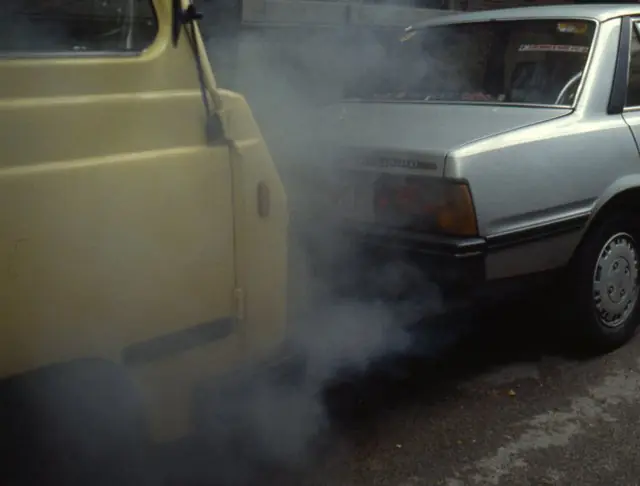
Un vehículo echa más humo del permitido. ¿Es correcto que circule?
A vehicle gives off more smoke than is allowed. Is it correct for it to be driven?
- ASolo en vías fuera de un poblado.Only on roads outside built-up areas.
- BSí. Porque el humo no es malo ni contamina.Yes. Because smoke is not harmful and does not pollute.
- CNo.No.
ExplanationArticle 7 of the General Traffic Regulations prohibits driving vehicles that give off gases or smoke above the set limits or that reduce the visibility of other drivers. Police officers can immobilise the vehicle, both in and outside built-up areas.
All topics
- Definitions
- Documents and penalty points
- The driver's condition
- Vehicle safety devices
- Vehicle controls and equipment
- Vehicle lights and horn
- Traffic signs, markings and signals
- The road and its lanes
- Speed and distances
- Manoeuvres
- Right of way
- Carrying passengers and loads
- Driving safely in difficult conditions
- Vehicle mechanics and maintenance
- Road accidents and first aid
- Defensive and eco-driving
Independent app: not affiliated with or endorsed by the DGT (Spain's Directorate-General for Traffic) or the Ministry of the Interior. The official exam is booked with the DGT and taken at its test centres. The questions here are practice material; the DGT's official question bank is not public.
Basado en datos de la Agencia Estatal Boletín Oficial del Estado (https://www.boe.es). Textos consolidados de carácter meramente informativo. La AEBOE no patrocina ni respalda este sitio.
Parte de las preguntas procede de los tests de la revista «Tráfico y Seguridad Vial» de la DGT, reproducidos con indicación de la fuente.