
DGT test · 247 questions
Driving safely in difficult conditions · Page 2 of 5
Driving in rain, fog, snow, ice, wind and at night, and how to adapt to risky situations on the road.
Questions in this topic, with answers
247 questions, 50 per page, with the correct answer and the explanation. Page 2 of 5.
De noche, en un tramo con muchas curvas señalizadas como «curvas peligrosas», ¿se permite usar la luz antiniebla delantera?
At night, on a stretch with many bends signposted as ‘dangerous bends’, may you use the front fog lights?
- ASí. Usarla siempre junto con las luces de posición.Yes. Always use them together with the sidelights.
- BNo. Solo con condiciones meteorológicas adversas.No. Only in bad weather.
- CSí. En vías estrechas.Yes. On narrow roads.
ExplanationUnder Article 106.2 of the General Traffic Regulations (RGC), the front fog lights may be used in fog, heavy rain or other conditions that reduce visibility and, in addition, on narrow stretches of road, with a carriageway 6.50 m wide or less, signposted with a series of bends.
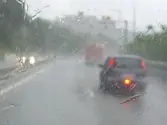
¿Cuándo se producirá aquaplaning?
When will aquaplaning occur?
- ASolo cuando la calzada esté cubierta de hielo.Only when the carriageway is covered with ice.
- BCuando con lluvia circulemos con el dibujo del neumático un poco gastado.When we drive in the rain with slightly worn tyre tread.
- CCuando circulemos a mucha velocidad con lluvia, aunque el dibujo del neumático esté en buen estado.When we drive at high speed in the rain, even if the tyre tread is in good condition.
ExplanationOne of the most dangerous effects of rain is what is known as aquaplaning. It can happen when driving at a certain speed over stretches of carriageway where water has built up. The job of the tyre tread is to push the water out to the sides of the wheel, clearing the contact area, which is what gives the vehicle its grip. When the tyre tread cannot clear the amount of water that has built up, the tyre loses contact with the road surface and slides, floating on the water, and the driver loses control of the vehicle. Whether aquaplaning happens depends on how much water the tyres can clear, which is measured in litres per second, and on the speed we are driving at. The higher the speed, the less time the tyres have to clear the water from the carriageway, and the more likely aquaplaning becomes. The best way to prevent aquaplaning is to reduce speed.
En un tramo de fuerte pendiente descendente con curvas, ¿podrá una bicicleta abandonar el arcén y circular por la calzada?
On a steep downhill stretch with bends, may a bicycle leave the hard shoulder and ride on the carriageway?
- ANo, tendrá que circular siempre por el arcén.No, it must always ride on the hard shoulder.
- BSí, por la derecha de la calzada.Yes, on the right-hand side of the carriageway.
- CSí, pudiendo invadir toda la calzada.Yes, and it may use the whole carriageway.
ExplanationOn long descents with bends, cyclists may leave the hard shoulder and ride on as much of the right-hand part of the carriageway as they need, except on dual carriageways (autovías), where they may only use the hard shoulder.
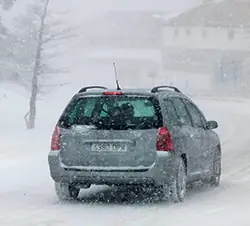
¿Se puede mejorar la adherencia del vehículo en una zona en la que exista hielo en la calzada?
Can the vehicle's grip be improved in an area where there is ice on the carriageway?
- ASí, usando cadenas o neumáticos de clavos.Yes, by using chains or studded tyres.
- BSolo usando cadenas pero nunca neumáticos de clavos, ya que está prohibidos.Only by using chains, never studded tyres, as they are prohibited.
- CNo, está prohibido circular cuando existe hielo en la calzada.No, driving is prohibited when there is ice on the carriageway.
ExplanationOn ice or snow you may improve grip with anti-skid devices: chains or studded tyres, which increase the tyre's grip on the icy surface.
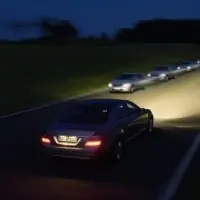
¿Como se evita el deslumbramiento nocturno?
How is dazzle avoided at night?
- ASustituyendo el alumbrado de carretera por el de cruceBy switching from main beam to dipped headlights.
- BReduciendo la velocidad para evitar una colisiónBy reducing speed to avoid a collision.
- CEvitando en lo posible conducir de nocheBy avoiding driving at night as far as possible.
ExplanationTo avoid dazzling other drivers at night, whenever we are driving with the main beam on and meet an oncoming vehicle, we must switch to dipped headlights so that the other driver is not blinded by our lights.
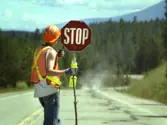
En una zona de obras un operario le indica que tiene que detener su vehículo, ¿está obligado a obedecerle?
In a roadworks area, a worker signals to you that you must stop your vehicle. Must you obey?
- ANo, sólo los agentes de circulación están autorizados a regular la circulación.No, only traffic officers are authorised to direct traffic.
- BNo, el personal de obras en la vía sólo puede advertir la necesidad de extremar la atención.No, road workers can only warn that extra care is needed.
- CSí, en ausencia de agentes de circulación, el personal de obras en la vía está autorizado a regular la circulación.Yes, when there are no traffic officers, road workers are authorised to direct traffic.
ExplanationRoad users must follow the instructions of roadworks staff assigned to control the passage of vehicles.
Cuando se va a conducir por lugares en los que existe hielo o nieve, el uso de cadenas o neumáticos con clavos, ¿puede favorecer a la conducción?
When you are going to drive where there is ice or snow, can using chains or studded tyres help your driving?
- ASí, porque mejora la adherencia a la calzada.Yes, because it improves grip on the road.
- BSí, porque se puede circular más rápido.Yes, because you can drive faster.
- CNo, porque se pierde adherencia.No, because grip is lost.
ExplanationYes. Chains and studded tyres improve grip on ice or snow, and so reduce the risk of skidding and the braking distance. They do not let you drive faster: with chains you must drive slowly and remove them when the road is clear.
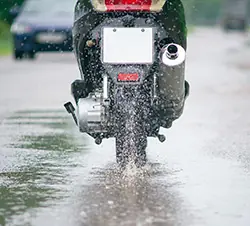
¿Qué debe hacer si empieza a llover con intensidad mientras conduce una motocicleta?
What should you do if it starts to rain heavily while you are riding a motorcycle?
- AModerar la velocidad, e incluso detenerse si fuera necesario.Reduce speed, and even stop if necessary.
- BCircular pegado a los vehículos pesados para protegerse de la lluvia.Ride close behind heavy vehicles to shelter from the rain.
- CAumentar la velocidad para llegar antes al destino.Speed up to reach your destination sooner.
ExplanationIn heavy rain a motorcycle's grip and visibility are drastically reduced: reduce speed and, if the situation requires it, stop in a safe place. Riding close to heavy vehicles or speeding up greatly increases the risk.
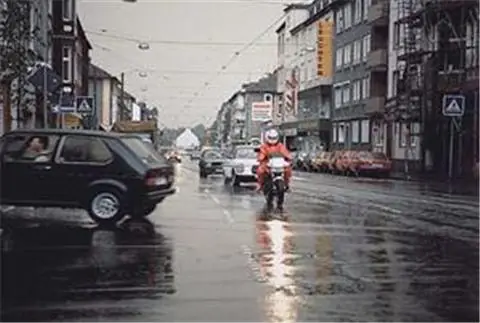
Si llueve y la calzada está húmeda, en los pasos para peatones los conductores de motocicletas procurarán...
If it is raining and the road is wet, at pedestrian crossings motorcyclists should try to…
- Acircular por la zona pintada, porque tiene mayor agarre.ride on the painted area, because it has better grip.
- Bno circular por la zona pintada, porque puede ser muy deslizante.avoid riding on the painted area, because it can be very slippery.
- Caumentar la velocidad, para circular con mayor seguridad.speed up, so as to ride more safely.
ExplanationOn a wet road, the paint of road markings, such as the stripes of pedestrian crossings, becomes very slippery. To avoid losing grip, the rider should avoid riding over them, especially when braking, accelerating or leaning the motorcycle.
Circulando por una pendiente descendente, ¿cuándo frenará peor nuestro automóvil?
Driving downhill, when will our vehicle brake worse?
- AIgual, la carga no influye en la frenada.The same, the load does not affect braking.
- BCuando circule cargado.When it is loaded.
- CCuando circule sin carga.When it is not loaded.
ExplanationIf the vehicle is loaded, it weighs more, so the force of gravity and the kinetic energy built up in the vehicle are greater, and it is harder to brake than when it is not loaded.
Si sólo disponemos de dos cadenas, ¿en qué ruedas las colocaremos?
If we only have two chains, on which wheels will we fit them?
- AEn las ruedas delanteras.On the front wheels.
- BEn las ruedas traseras.On the rear wheels.
- CEn las ruedas motrices.On the driving wheels.
ExplanationChains are fitted on the driving wheels. On some vehicles these are the rear wheels and on others the front wheels.
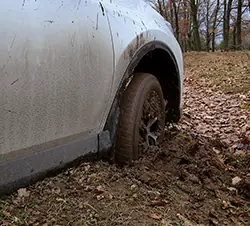
Queda atascado con su turismo en una zona de barro donde patinan las ruedas motrices. ¿Cuál es la forma más adecuada de actuar para seguir circulando?
Your car is stuck in mud and the driving wheels are spinning. What is the best way to act to be able to move on?
- APisar a fondo el pedal acelerador para conseguir mayor tracción en las ruedas y así lograr mayor adherenciaPress the accelerator fully to get more traction on the wheels and so more grip.
- BPreparar un terreno estable colocando el material adecuado cerca de las ruedas motrices para que estas tengan la adherencia suficiente.Prepare stable ground by placing suitable material near the driving wheels so that they have enough grip.
- CEmpujar el vehículo por uno de los laterales hacia una mejor superficie con adherencia.Push the vehicle from one side towards a surface with better grip.
ExplanationThe right thing is to give the driving wheels grip by placing stable material (branches, sand, floor mats) in front of them. Accelerating hard only makes the wheels spin and sinks the vehicle deeper into the mud.
¿Cómo se tendrá que circular por una vía nevada?
How should you drive on a snowy road?
- AEmpleando una relación de marchas lo más corta posible.Using the lowest gear possible.
- BEmpleando una relación de marchas lo más alta posible.Using the highest gear possible.
- CNo circular por las rodaduras de otros vehículos, cuando la capa de nieve es gruesa.Not driving in the tracks of other vehicles when the snow is deep.
ExplanationWhen there is snow on the carriageway, among other things, we must drive smoothly, without sudden steering, braking or acceleration, and use the highest gear possible that is compatible with safety.
Cuando llueve se forma una capa de agua sobre la calzada. ¿Por qué aumenta el peligro?
When it rains, a layer of water forms on the carriageway. Why does the danger increase?
- ANo aumenta: el agua enfría los neumáticos y se frena mejor.It does not increase: the water cools the tyres and you brake better.
- BPor la posible pérdida de adherencia de los neumáticos con el pavimento.Because of the possible loss of grip between the tyres and the road surface.
- CPor el sobrecalentamiento de los frenos al mojarse.Because the brakes overheat when they get wet.
ExplanationThe layer of water comes between the tyre and the road surface and reduces grip; if it is thick and you are driving fast, it can cause aquaplaning and total loss of control. That is why in the rain you must reduce your speed and increase your safe distance.
¿Cómo se recomienda arrancar con un coche cuando la carretera está cubierta de nieve?
How is it recommended to move off in a car when the road is covered in snow?
- AEmpezar en una marcha baja, normalmente la primera.Start in a low gear, usually first.
- BUsar la marcha más alta posible, segunda o tercera.Use the highest possible gear, second or third.
- CUsar la marcha atrás para mayor suavidad.Use reverse gear for smoother movement.
ExplanationThe correct option is to use the highest possible gear, usually second or third, when moving off on a snow-covered carriageway. Higher gears give better traction and control of the vehicle, reducing the risk of skidding. According to the General Traffic Regulations, in adverse conditions such as snow, smooth and controlled driving is recommended, which is achieved by avoiding low gears, as they can cause a sudden increase in power and so make the wheels slip.
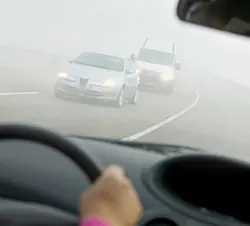
Hay poca visibilidad por niebla. ¿Qué debe hacer?
Visibility is poor because of fog. What should you do?
- ADejar más distancia de seguridad con el vehículo de delante.Leave a greater safe distance from the vehicle in front.
- BLlevar el pie siempre en el pedal del freno.Always keep your foot on the brake pedal.
- CCircular a la velocidad mínima de la vía.Drive at the minimum speed for the road.
ExplanationIn fog, visibility is reduced and the road surface loses grip: increasing the safe distance gives you more margin to brake if anything suddenly appears.
¿Cómo debe conducir con nieve?
How should you drive in snow?
- ACon las luces de emergencia encendidas.With the hazard warning lights on.
- BFrenando y acelerando con suavidad.Braking and accelerating gently.
- CPor el arcén.On the hard shoulder.
ExplanationWhen driving on ice or snow, there is a risk that the vehicle will slide. In low gears there is too much power and the wheels will just spin on the ice or snow. In high gears the wheels do not spin as much, because they do not get too much power. To move off in snow, use second or third gear to stop the wheels spinning. When driving, try to use the highest gear possible, accelerating and braking very gently. Remember that in these situations the braking distance increases considerably, so drive carefully and adapt your safe distance accordingly.
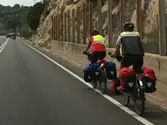
En los descensos prolongados con curvas, ¿podrán los conductores de bicicletas abandonar el arcén y circular por la calzada?
On long descents with bends, may cyclists leave the hard shoulder and ride on the carriageway?
- ANo.No.
- BSí, por la parte derecha de la calzada.Yes, on the right-hand side of the carriageway.
- CSí, invadiendo toda la calzada.Yes, using the whole carriageway.
ExplanationOn roads with long descents, cyclists may depart from the general rule of using the hard shoulder and, in these cases, leave it and ride on the right-hand side of the carriageway.
¿En qué ruedas colocaremos las cadenas para nieve?
On which wheels will we fit snow chains?
- AUna en cada lado del mismo eje.One on each side of the same axle.
- BEn las ruedas directrices.On the steering wheels.
- CEn las ruedas motrices.On the driving wheels.
ExplanationWe will fit snow chains on the driving wheels, which are the ones that receive the power from the engine.
Conduciendo de noche, ¿se pueden usar gafas de sol para combatir el deslumbramiento producido por las luces de otros vehículos?
When driving at night, can you wear sunglasses to combat the dazzle from other vehicles' lights?
- ASí, en vías interurbanas.Yes, on roads outside built-up areas.
- BSí.Yes.
- CNo.No.
ExplanationSunglasses reduce the light reaching your eyes, and at night this stops you seeing the road and obstacles properly. To reduce dazzle, look towards the right-hand edge of the carriageway and reduce your speed.
Estás circulando por una calzada que, debido a la niebla, está húmeda y resbaladiza. ¿Cómo debes conducir?
You are driving on a carriageway that is wet and slippery because of fog. How should you drive?
- ADe forma dinámica y a alta velocidad para evitar que las ruedas patinen.Dynamically and at high speed, to stop the wheels from skidding.
- BCon suavidad, sin movimientos bruscos, aumentando la distancia de seguridad y reduciendo la velocidad.Smoothly, without sudden movements, increasing the safe distance and reducing speed.
- CIgual que cuando la calzada está seca, ya que los neumáticos no pierden adherencia.The same as on a dry carriageway, as the tyres do not lose grip.
ExplanationWhen the carriageway is wet and slippery from fog, tyres grip less and braking distance increases. You must reduce speed, increase your safe distance and drive smoothly, avoiding sudden braking, acceleration or steering that could cause a skid.
Cuando exista nieve en la calzada, ¿cómo se debe iniciar la marcha para evitar que las ruedas patinen y se hundan?
When there is snow on the carriageway, how should you move off to stop the wheels spinning and sinking?
- ACon la marcha más alta que sea posible, que normalmente será la segunda.In the highest possible gear, which will usually be second.
- BPisando a fondo el acelerador para aumentar la fuerza motriz de las ruedas.Pressing the accelerator fully to increase the driving force of the wheels.
- CCon la primera marcha engranada y soltando rápidamente el pedal de embrague.In first gear, releasing the clutch pedal quickly.
ExplanationWhen there is snow on the carriageway, to move off without the vehicle losing grip and skidding, we must use the highest gear possible (2nd or 3rd), with the wheels straight, releasing the clutch slowly and accelerating gently and evenly. In this situation 1st gear will make the vehicle skid, because it transmits too much force to the wheels.
En las curvas de visibilidad reducida está prohibido...
On bends with reduced visibility, it is prohibited to...
- AEstacionar.Park.
- BParar y estacionar.Stop and park.
- CDetenerse por circunstancias del tráfico.Stop because of traffic conditions.
ExplanationStopping and parking are prohibited on bends with reduced visibility and near them.
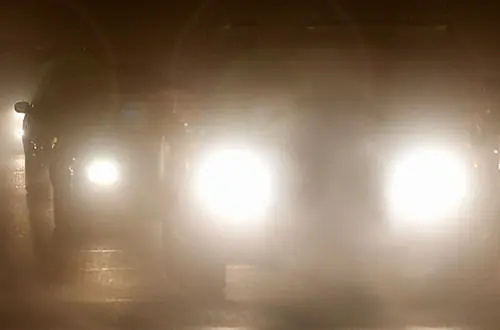
¿Qué se debe hacer para evitar el deslumbramiento?
What should you do to avoid the effects of dazzle?
- ADetenernos siempreAlways stop.
- BPoner las luces de carretera y detenernos.Switch on the main beam and stop.
- CReducir la velocidad e incluso detenernos si fuese necesario.Reduce speed and even stop if necessary.
ExplanationUnder Article 102 of the General Traffic Regulations, a dazzled driver must reduce speed as much as necessary, even stopping, so as not to run into vehicles or pedestrians. Switching on the main beam in response only makes the danger worse.
En las curvas el vehículo tiende a salirse de la calzada (por la fuerza centrífuga). ¿Cómo se puede evitar?
On bends the vehicle tends to leave the carriageway (because of centrifugal force). How can this be avoided?
- AReduciendo la velocidad antes de la curva y acelerando suavemente al salir.By reducing speed before the bend and accelerating gently when coming out of it.
- BFrenando en la curva.By braking on the bend.
- CAcelerando antes de entrar en la curva.By accelerating before entering the bend.
ExplanationCentrifugal force pushes us to keep going in a straight line, that is, towards the outside of the bend. Centrifugal force must be counteracted by reducing speed.
Si el calor en el habitáculo del vehículo es excesivo, ¿puede influir en la conducción?
If it is too hot inside the vehicle, can this affect driving?
- ASí, produciendo somnolencia.Yes, by causing drowsiness.
- BSí, haciendo la conducción más confortable.Yes, by making driving more comfortable.
- CNo, no influye para nada.No, it has no effect at all.
ExplanationIf it is too hot inside the vehicle, it can cause drowsiness and sleepiness.
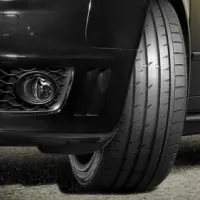
¿Qué consecuencia puede traer el bloqueo de las ruedas?
What can happen if the wheels lock?
- ALa no transmisión de la energía de la bateríaThe battery's energy is not transmitted.
- BLa pérdida del control y derrapeLoss of control and skidding.
- CLa parada del vehículoThe vehicle stops.
ExplanationWhen the wheels lock, they stop turning and slide over the road surface: they lose grip, the vehicle no longer responds to the steering and it may skid. That is why braking until the wheels lock does not stop the vehicle sooner, but it does cause loss of control.
En la autopista, ¿se permite conducir muy despacio cuando hay niebla espesa?
On a motorway (autopista), may you drive very slowly when there is thick fog?
- ANo, porque la autopista es una vía de alta seguridad.No, because the motorway is a high-safety road.
- BSí.Yes.
- CSí, si el tráfico es escaso; no, si está denso.Yes, if traffic is light; no, if it is heavy.
ExplanationOn a motorway you may drive at an abnormally low speed in adverse weather, such as thick fog, as long as the reduction is necessary for safety. Spanish rules state that, because of traffic or weather conditions, you may drive below the minimum speed limits, as long as this does not create a risk for traffic. According to the rules, in dense fog it is crucial to adjust your speed to stay safe, which justifies driving slowly in this situation.
Cuando hay viento lateral fuerte...
When there is a strong side wind...
- ASe debe reducir la velocidad y corregir las pequeñas desviaciones de la trayectoria.You should reduce speed and correct small deviations from your path.
- BSe debe aumentar la velocidad para compensar la fuerza del viento.You should increase speed to compensate for the force of the wind.
- CDisminuye el riesgo de accidente, ya que el viento impide que el vehículo se desvíe de su trayectoria.The risk of an accident decreases, as the wind stops the vehicle drifting from its path.
ExplanationIn a strong side wind, the driver must reduce speed and correct any deviation in direction. The wind can affect the vehicle's stability, making it harder to keep control and increasing the risk of accidents. The rules state that drivers must adapt their driving to the weather and road conditions to keep all road users safe.
Para tomar una curva con seguridad transportando a un pasajero en la motocicleta, le indicaremos que...
To take a bend safely when carrying a passenger on the motorcycle, we will tell them to...
- ASe anticipe siempre a la inclinación y posición del conductor.Always lean before the rider does, anticipating the rider's position.
- BSe incline hacia el lado contrario del que se inclina el conductor para contrarrestar la fuerza centrífuga.Lean to the opposite side from the rider to counteract centrifugal force.
- CAdopte la misma posición e inclinación que el conductor.Take the same position and lean as the rider.
ExplanationThe correct answer is “Take the same position and lean as the rider”, because by doing this the passenger helps keep the motorcycle balanced through the bend. By leaning in the same direction as the rider, the weight is distributed properly and centrifugal force is counteracted, which gives more stability and safety on the bend.
Por la noche, para evitar el deslumbramiento, ¿es aconsejable usar gafas de sol?
At night, is it advisable to wear sunglasses to avoid dazzle?
- ASi, porque descansa la vista,.Yes, because they rest your eyes.
- BNo, porque disminuye la visión.No, because they reduce your vision.
- CSí, porque evitan el deslumbramiento.Yes, because they prevent dazzle.
ExplanationSunglasses reduce the amount of light reaching your eyes. At night, when there is little light, they make your vision worse in general, so they should not be used to avoid dazzle. The right thing is to reduce speed and look at the right-hand edge of the road.
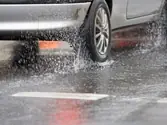
Para evitar acuaplaning en caso de lluvia intensa...
To avoid aquaplaning in heavy rain...
- ADebe usar neumáticos especiales.You must use special tyres.
- BDebe disminuir la velocidad.You must reduce your speed.
- CDebe circular con una presión de los neumáticos inferior para aumentar la superficie en contacto con el pavimento.You must drive with lower tyre pressure to increase the area in contact with the road surface.
ExplanationWhether aquaplaning occurs depends on how much water the tyres can clear, measured in litres per second, and on the speed we are driving at. The higher the speed, the less time the tyres have to clear the water from the carriageway, which makes aquaplaning more likely. The best way to prevent aquaplaning is to reduce your speed.
¿Cuándo hay más probabilidad de salirse en una curva?
When is a vehicle more likely to leave the road on a bend?
- ACuando su radio sea grande.When the bend has a large radius.
- BCuando su radio sea pequeño.When the bend has a small radius.
- CCuando la curva sea de un sólo carril.When the bend has only one lane.
ExplanationIf the radius of the bend is small, the centrifugal force pushing us towards the outside of the bend will be greater, so the vehicle is more likely to leave the road on the bend. To prevent this, reduce your speed.
¿La niebla puede afectar a la pérdida de adherencia?
Can fog contribute to loss of grip?
- ASí, puesto que la niebla humedece el asfalto.Yes, because fog makes the road surface damp.
- BNo, la niebla afecta solo a la falta de visibilidad.No, fog only affects visibility.
- CNo, nunca.No, never.
ExplanationFog sharply reduces visibility, and it also reduces grip by making the road surface damp. So it is important to increase the safe distance and adapt your speed to your field of vision and to the grip.
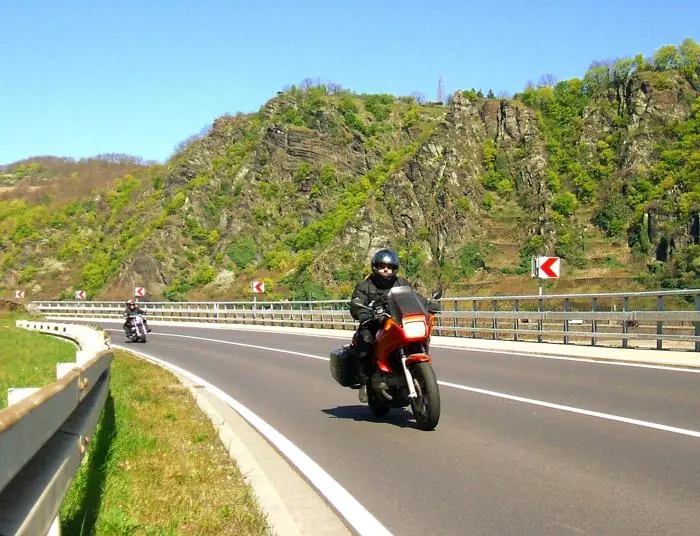
Conduciendo una motocicleta, ¿cuándo es especialmente peligroso el viento?
When riding a motorcycle, when is wind especially dangerous?
- ACuando sopla de frente, porque puede frenar la marcha.When it blows head-on, because it can slow you down.
- BCuando sopla de costado.When it blows from the side.
- CCuando sopla desde atrás, porque aumenta la velocidad.When it blows from behind, because it increases your speed.
ExplanationSide wind is the most dangerous for traffic, depending on its strength. Two-wheeled vehicles are the most vulnerable to wind. To control the vehicle and avoid being pushed sideways or falling, they must be ridden very slowly.
Las cadenas para la nieve las montaremos en las ruedas...
We will fit snow chains on the...
- Adirectrices.steering wheels.
- Bmotrices.driving wheels.
- Ctraseras.rear wheels.
ExplanationWe will fit snow chains on the driving wheels, the ones that receive the power from the engine. They may be the front or the rear wheels, depending on the vehicle model.
Si en la calzada hay gravilla, hojas caídas, grasa... ¿como será la adherencia?
If there is gravel, fallen leaves, grease... on the carriageway, what will the grip be like?
- ALa adherencia será mejor.The grip will be better.
- BLa adherencia será peor.The grip will be worse.
- CLa adherencia no variará.The grip will not change.
ExplanationWhen the road surface is dry and clean, the grip is much better than when it is wet or dirty with gravel, fallen leaves, etc.
¿Qué debe hacer un conductor cuando lo deslumbran las luces?
What should a driver do when dazzled by lights?
- AApartarse hacia la derecha y detenerse en el arcén.Move to the right and stop on the hard shoulder.
- BReducir la velocidad, incluso detenerse si fuera necesario.Reduce speed, even stopping if necessary.
- CEncender las luces largas.Switch on the main beam.
ExplanationIf you are dazzled, Article 102 of the General Traffic Regulations requires you to reduce speed as much as necessary, even stopping completely, so as not to run into other vehicles or pedestrians. This is required to ensure road safety and prevent accidents caused by dazzle.
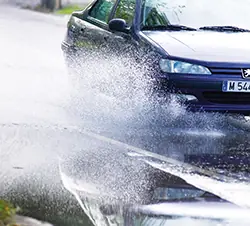
Si hay charcos de agua en la calzada…
If there are puddles on the carriageway...
- ANo es aconsejable tomar ninguna precaución.It is not advisable to take any precautions.
- BDebe moderar la velocidad.You must reduce your speed.
- CDebe acelerar para atravesarlos lo antes posible.You must accelerate to get through them as quickly as possible.
ExplanationOn puddles the tyre may lose contact with the road surface (aquaplaning): reducing speed lets the tread clear the water and helps you keep control of the steering and brakes.
El conductor de una motocicleta, ¿qué precauciones debe tomar si empieza a llover intensamente?
What precautions must a motorcycle rider take if it starts to rain heavily?
- AMantenerse muy cerca de los vehículos de grandes dimensiones para que le protejan de la lluvia.Stay very close to large vehicles so that they shelter the rider from the rain.
- BReducir la velocidad, deteniéndose si fuera necesario.Reduce speed, stopping if necessary.
- CAumentar la velocidad para llegar cuanto antes a su destino.Speed up to reach the destination as soon as possible.
ExplanationHeavy rain reduces visibility and grip, and standing water can cause aquaplaning. The rider must reduce speed and, if they cannot ride safely, stop in a suitable place. Getting close to large vehicles only adds spray and turbulence.
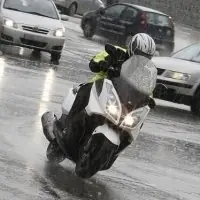
En un día de frío y lluvia, circula conduciendo su motocicleta. En estas circunstancias...
You are riding your motorcycle on a cold, rainy day. In these conditions…
- Ala conducción será más cómoda y segura si la motocicleta dispone de carenado.riding will be more comfortable and safer if the motorcycle has a fairing.
- Bal frenar, la distancia de detención es siempre menor, sobre todo si la motocicleta dispone de frenos de tambor.when braking, the stopping distance is always shorter, especially if the motorcycle has drum brakes.
- Cconviene tomar algún estimulante o bebida alcohólica para combatir el frío.it is a good idea to take a stimulant or an alcoholic drink to fight the cold.
ExplanationThe fairing protects the rider from wind, cold and rain, so in bad weather it makes riding more comfortable and reduces fatigue, which also improves safety. In the rain the stopping distance increases, and alcohol never helps to fight the cold.
Con hielo o nieve, es aconsejable conducir...
On ice or snow, it is advisable to drive...
- Ausar la marcha más baja posible.using the lowest gear possible.
- Bfrenando bruscamente en las curvas.braking sharply on bends.
- Cusar la marcha más alta posible.using the highest gear possible.
ExplanationOn ice or snow, it is essential to adapt your driving for safety. Using the highest possible gear helps you keep control of the vehicle and avoid skidding. Driving in low gears can make the wheels spin, while high gears give smoother movement and better grip on the road. This is in line with the General Traffic Regulations, which stress the duty of drivers to adapt their speed and driving technique to the road conditions.
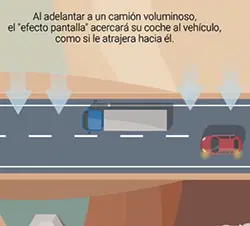
Cuando se aprecia fuerte viento lateral...
When there is a strong side wind...
- ASe deberá reducir la velocidad y corregir las ligeras desviaciones de la dirección.You must reduce speed and correct slight changes of direction.
- BSe deberá aumentar la velocidad para compensar la fuerza del viento.You must increase speed to compensate for the force of the wind.
- CDisminuye el riesgo de accidente, ya que el viento evita que el vehículo se desvíe de su trayectoria.The risk of an accident decreases, as the wind stops the vehicle drifting from its path.
ExplanationIn a strong side wind, reduce speed and hold the steering wheel firmly, gently correcting small deviations from your path. The higher the speed, the less control you have and the greater the risk of leaving your lane.
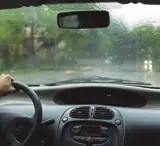
Con la lluvia se forma una capa de agua que crea un mayor peligro por...
Rain forms a layer of water that creates greater danger because of...
- ALa posible falta de adherencia de los neumáticos al pavimento.The possible lack of grip between the tyres and the road surface.
- BEl calentamiento de los frenos al mojarse.The brakes heating up when they get wet.
- CNo se crea ningún peligro por que el agua refrigera los neumáticos y frenan mejor.It does not create any danger, because the water cools the tyres and they brake better.
ExplanationOn a wet carriageway the tyres lose grip, increasing the distance needed to stop (the braking distance can double), so we will reduce speed and increase the safe distance. Always brake gently to avoid locking the wheels. Take extra care at high speed, as aquaplaning can occur (the tyres cannot clear the layer of water on the carriageway and lose grip).
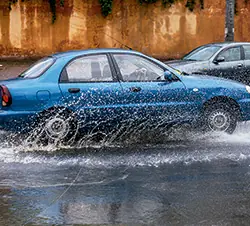
La lluvia, ¿afecta al agarre de las ruedas del vehículo a la calzada?
Does rain affect the grip of the vehicle's wheels on the carriageway?
- ANo, el agarre es el mismo que cuando la calzada está seca.No, grip is the same as when the carriageway is dry.
- BSí, se agarran más a la calzada.Yes, they grip the road more.
- CSí, se agarran menos.Yes, they grip the road less.
ExplanationWater forms a film between the tyre and the road surface that reduces friction: the wheels grip less and the braking distance increases, and there is even a risk of aquaplaning.
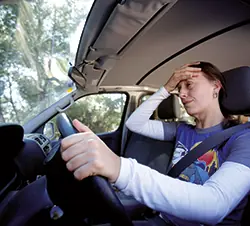
Las altas temperaturas pueden suponer un riesgo para la seguridad durante la conducción. ¿Debe circular adoptando medidas preventivas?
High temperatures can be a safety risk while driving. Should you drive taking preventive measures?
- ASí, por lo que debe conducir durante la noche, ya que la temperatura al ser inferior permite al conductor un tiempo de reacción mayor.Yes, so you should drive at night, because the lower temperature allows the driver a longer reaction time.
- BSí, el conductor debe extremar las precauciones y realizar los descansos y paradas recomendados, para evitar la fatiga y el sueño.Yes, the driver must take extra care and take the recommended breaks and stops to avoid tiredness and sleepiness.
- CNo, siempre que en el interior del vehículo no se alcancen temperaturas superiores a 20 grados.No, as long as the temperature inside the vehicle does not go above 20 degrees.
ExplanationIntense heat makes tiredness and drowsiness at the wheel set in sooner. So you must take extra care and take the recommended breaks and stops (stopping roughly every 2 hours or 200 km).
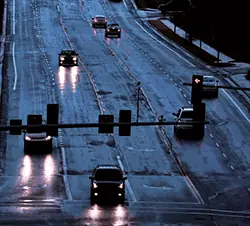
La lluvia, ¿exige al conductor tomar más precauciones de las habituales?
Does rain require the driver to take more precautions than usual?
- ASí, ya que los neumáticos pueden perder su adherencia.Yes, as the tyres may lose grip.
- BNo, porque mejora la visibilidad al limpiar el parabrisas.No, because it improves visibility by cleaning the windscreen.
- CSolo mientras caen las primeras gotas, luego no es necesario tomar precauciones.Only while the first drops are falling; after that no precautions are needed.
ExplanationWater forms a film that reduces tyre grip, especially with the first drops, which mix with the dust and grease on the road surface. Rain requires a greater safe distance and a lower speed.
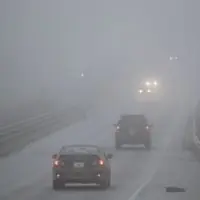
Circular con niebla, ¿influye en la pérdida de adherencia?
Does driving in fog contribute to loss of grip?
- ASí, puesto que la niebla humedece el asfaltoYes, because fog makes the road surface damp.
- BNo, la niebla afecta solo a la falta de visibilidad.No, fog only affects visibility.
- CNo, nunca.No, never.
ExplanationFog also reduces the grip of the tyres on the carriageway, as it makes the road surface damp. On a wet carriageway the tyres lose grip, increasing the distance needed to stop, so we will reduce speed and increase the safe distance. Always brake gently to avoid locking the wheels.
¿Qué restricciones se aplican a la circulación de vehículos en un puerto de montaña señalizado con nivel verde?
What restrictions apply to vehicles on a mountain pass signposted with the green level?
- ALos vehículos de mercancías de más de 3500kg de MMA no podrán adelantar.Goods vehicles with a MAM over 3,500 kg may not overtake.
- Blos vehículos de mercancías de más de 3500kg de MMA no podrán circular.Goods vehicles with a MAM over 3,500 kg may not drive.
- Clos vehículos de mercancías deberán llevar cadenas.Goods vehicles must carry chains.
ExplanationThe green level prohibits goods vehicles with a MAM over 3,500 kg from overtaking.
En condiciones meteorológicas que reduzcan considerablemente la visibilidad...
In weather conditions that considerably reduce visibility...
- Aes obligatorio usar las luces.it is compulsory to use the lights.
- Bsolo es obligatorio usar la luz antiniebla trasera.only the rear fog light is compulsory.
- Cno es obligatorio usar las luces, a menos que la señalización indique lo contrario.it is not compulsory to use the lights, unless signs indicate otherwise.
ExplanationUnder Article 106 of the General Traffic Regulations, in fog, heavy rain, snowfall, smoke or dust that noticeably reduce visibility, you must have your lights on: the front fog light or the dipped headlights or main beam. The rear fog light is added only in especially unfavourable conditions.
All topics
- Definitions
- Documents and penalty points
- The driver's condition
- Duties of drivers and pedestrians
- Vehicle safety devices
- Vehicle controls and equipment
- Vehicle lights and horn
- Traffic signs, markings and signals
- The road and its lanes
- Speed and distances
- Manoeuvres
- Right of way
- Carrying passengers and loads
- Vehicle mechanics and maintenance
- Road accidents and first aid
- Defensive and eco-driving
Independent app: not affiliated with or endorsed by the DGT (Spain's Directorate-General for Traffic) or the Ministry of the Interior. The official exam is booked with the DGT and taken at its test centres. The questions here are practice material; the DGT's official question bank is not public.
Basado en datos de la Agencia Estatal Boletín Oficial del Estado (https://www.boe.es). Textos consolidados de carácter meramente informativo. La AEBOE no patrocina ni respalda este sitio.
Parte de las preguntas procede de los tests de la revista «Tráfico y Seguridad Vial» de la DGT, reproducidos con indicación de la fuente.