
DGT test · 403 questions
Right of way · Page 2 of 9
Who goes first at junctions, roundabouts, narrow stretches and pedestrian crossings, and the priority of emergency vehicles.
Questions in this topic, with answers
403 questions, 50 per page, with the correct answer and the explanation. Page 2 of 9.
Con su turismo se aproxima a una intersección en la que existe un semáforo encendido con luz amarilla intermitente. ¿Debe ceder el paso a los vehículos que se aproximen por la vía transversal?
In your car, you are approaching a junction with a traffic light showing a flashing amber light. Must you give way to vehicles approaching on the crossing road?
- ASí, porque debo extremar la precaución y ceder el paso, si es necesario, tanto a los vehículos que se aproximen por la derecha como por la izquierda.Yes, because I must take extreme care and give way, if necessary, to vehicles approaching from both the right and the left.
- BSí, pero únicamente cuando junto al semáforo haya una señal vertical que me obligue a ceder el paso.Yes, but only when there is a road sign next to the traffic light requiring me to give way.
- CNo porque el semáforo me indica que debo extremar la precaución y en caso necesario a ceder el paso, únicamente, a los vehículos que se aproximen por la derecha.No, because the traffic light tells me to take extreme care and, if necessary, to give way only to vehicles approaching from the right.
ExplanationThe correct option says that when approaching a traffic light with a flashing amber light, the driver must take extreme care. This means watching for vehicles approaching on the crossing road and giving way to them if necessary, both to those coming from the right and to those coming from the left. A flashing amber light warns you to drive carefully, but it does not free you from the duty to give way when necessary.
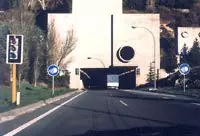
En caso de que se produzca un incendio de un vehículo en el interior de un túnel.¿Qué debe de hacer?
If a vehicle catches fire inside a tunnel, what should you do?
- AEntraré en el túnel sin entorpecer a los operarios que realizan las tareas de contraincendios.I will enter the tunnel without getting in the way of the firefighting staff.
- BEntraré en el túnel y pararé en su interior para preguntar a los operarios si necesitan ayuda.I will enter the tunnel and stop inside to ask the staff whether they need help.
- CNo entraré en el túnel.I will not enter the tunnel.
ExplanationIf there is a fire inside a tunnel, you must not enter: smoke and heat are very dangerous, and vehicles going in get in the way of the emergency services. You must stop outside and follow the instructions of traffic lights, message signs and traffic officers.
Si en un estrechamiento sin señalizar se encuentran por un lado un turismo con remolque y por el otro un camión, ¿cuál tendrá prioridad?
If a car with a trailer on one side and a lorry on the other meet at a narrowing without signs, which one has right of way?
- AEl turismo con remolque.The car with a trailer.
- BEl camión.The lorry.
- CEl que tenga que recorrer más distancia hacia atrás.The one that would have to reverse a longer distance.
ExplanationThe order of priority between the different types of vehicles when one of them has to reverse on a narrow stretch without signs is: 1. Special vehicles and special transport that exceed the masses or dimensions set in vehicle regulations. 2. Combinations of vehicles, except those in point 4. 3. Animal-drawn vehicles. 4. Cars towing trailers with a MAM of up to 750 kg, and motorhomes. 5. Vehicles for the public transport of passengers. 6. Lorries, tractor units and vans. 7. Cars and car-derived vehicles. 8. Special vehicles that do not exceed the masses or dimensions set in vehicle regulations, quadricycles and light quadricycles. 9. Three-wheeled vehicles, motorcycles with sidecars and three-wheeled mopeds. 10. Motorcycles, two-wheeled mopeds and bicycles. So in this case the car with a trailer has right of way over the lorry.
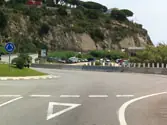
En las plazas y glorietas, los vehículos circularán…
In squares and roundabouts, vehicles must travel...
- Adejando a su izquierda el centro de las plazas y las glorietas.keeping the centre of squares and roundabouts on their left.
- Bdejando a su derecha el centro de las plazas y a su izquierda el de las glorietas.keeping the centre of squares on their right and the centre of roundabouts on their left.
- Cen el sentido de las agujas del reloj.clockwise.
ExplanationIn squares and roundabouts, we must keep the centre on our left, going round the obstacle on its right-hand side.
Si dos vehículos se encuentran de frente en un tramo de gran pendiente y están obligados a cederse el paso, ¿cuál de los dos tiene prioridad?
If two vehicles meet head-on on a steep stretch of road and one of them has to give way, which one has right of way?
- AEl que circula en sentido ascendente.The one going uphill.
- BEl que circula en sentido descendente.The one going downhill.
- CEl más pesado.The heavier one.
ExplanationOn a steep stretch, with a gradient of at least 7%, the vehicle going uphill has right of way.
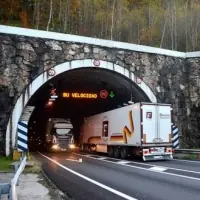
¿Qué debe hacer si su vehículo tiene una avería en un túnel?
What must you do if your vehicle breaks down in a tunnel?
- ASi la avería permite la circulación del vehículo, debe continuar hasta salir del túnel o hasta llegar a una zona reservada para emergencias.If the vehicle can still be driven, carry on until you are out of the tunnel or reach an area reserved for emergencies.
- BEncender las luces de largo alcance para que se vea mejor y hacer que todos los ocupantes bajen del vehículo.Switch on the main beam so that you can be seen better, and get all the occupants out of the vehicle.
- CDetener el vehículo en cualquier lugar del túnel para evitar el peligro, aunque la avería permita la circulación del vehículo.Stop the vehicle anywhere in the tunnel to avoid danger, even if the vehicle can still be driven.
ExplanationIf the vehicle can still be driven, you must carry on until you are out of the tunnel or reach the nearest emergency area, so as not to become an obstacle inside the tunnel. Stopping anywhere without need increases the risk of being hit from behind.
En un paso para ciclistas, ¿tienen los ciclistas prioridad sobre otros vehículos?
At a cycle crossing, do cyclists have right of way over other vehicles?
- ANo.No.
- BSí, siempre.Yes, always.
- CSí, pero solo si vienen por la derecha.Yes, but only if they come from the right.
ExplanationCyclists have right of way over other vehicles when they are riding on a cycle lane, a cycle crossing or a hard shoulder that is properly signed (Article 64.2.a of the General Traffic Regulations). At a signed cycle crossing you must always give way to them.
Si en un paso a nivel las barreras se están moviendo...
If the barriers at a level crossing are moving...
- ASe puede entrar antes de que las barreras cierren el paso.You may go onto the crossing before the barriers close.
- BNo se debe entrar.You must not go onto the crossing.
- CNo se debe entrar, salvo que las barreras estén levantándose y haya espacio suficiente.You must not go onto the crossing, unless the barriers are rising and there is enough room.
ExplanationUnder Article 96.1 of the General Traffic Regulations, nobody may go onto a level crossing whose barriers or half-barriers are across the road or moving, whether they are coming down or going up. You must wait until the crossing is clear.
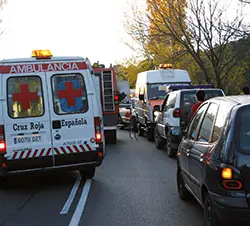
Los vehículos prioritarios, ¿tienen prioridad de paso sobre el resto de los usuarios de la vía?
Do priority (emergency) vehicles have right of way over all other road users?
- ASí, siempre.Yes, always.
- BNo, nunca.No, never.
- CSolo cuando circulen en servicio de urgencia.Only when they are on an emergency call.
ExplanationUnder Article 67 of the General Traffic Regulations, emergency vehicles, public or private, only have right of way when they are on an emergency call and show this with their light and sound signals. When not on an emergency call, they travel like any other vehicle.
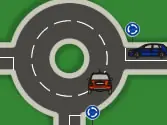
¿Qué vehículo tendrá prioridad?
Which vehicle has right of way?
- AEl vehículo rojo.The red vehicle.
- BEl vehículo azul.The blue vehicle.
- CEl que haya llegado primero a la glorieta.Whichever reached the roundabout first.
ExplanationAt roundabouts, vehicles already driving on the circular carriageway have right of way over those trying to enter it. So the blue vehicle, which is about to enter, must give way to the red one, which is already on the roundabout.
Si los motociclistas respetan la prioridad de paso, ¿puede eso evitar accidentes?
If motorcyclists respect right of way, can that prevent accidents?
- ASí.Yes.
- BNo, porque no dificultan la visibilidad.No, because they do not block visibility.
- CNo, porque ocupan poco espacio en la calzada.No, because they take up little space on the carriageway.
ExplanationYes. Many motorcycle accidents happen at junctions because someone does not respect right of way or does not see the other vehicle in time. If motorcyclists respect right of way and do not assume that others have seen them, many collisions are avoided.
¿Qué vehículos tienen que tener suscrito el seguro obligatorio?
Which vehicles must have taken out compulsory insurance?
- ATodo vehículo apto para circular por las vías públicas.Every vehicle fit to be driven on public roads.
- BVehículos a motor y remolques de más de 3.500 kg solamente.Only motor vehicles and trailers of more than 3,500 kg.
- CVehículos de motor y ciclomotores.Motor vehicles and mopeds.
ExplanationMotor vehicles and mopeds must have compulsory insurance. So the answer "only motor vehicles and trailers of more than 3,500 kg" is wrong, because it leaves out mopeds.
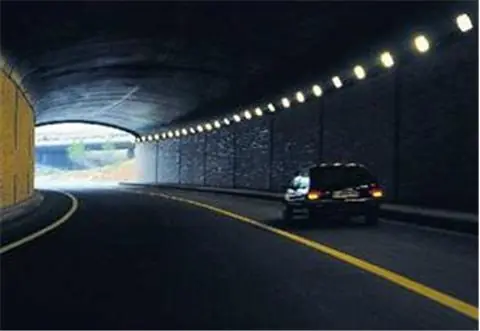
Si por emergencia queda inmovilizado en un túnel, deberá...
If your vehicle is brought to a standstill in a tunnel because of an emergency, you must...
- Adejar el vehículo cerrado y salir del túnel cuanto antes.leave the vehicle locked and get out of the tunnel as soon as possible.
- Bapagar el motor, conectar la señal de emergencia y mantener encendida las luces de posición.switch off the engine, switch on the hazard warning lights and keep the sidelights on.
- Capagar todas las luces si el túnel está iluminado y solicitar auxilio a través del teléfono móvilswitch off all the lights if the tunnel is lit, and call for help on your mobile phone.
ExplanationIf the vehicle is brought to a standstill in a tunnel because of an emergency, you must switch off the engine, switch on the hazard warning lights and keep the sidelights on, call for help from the emergency point and go to the nearest shelter or exit. Switching off all the lights would stop others from seeing it.
Si queda detenido dentro de un túnel durante más de dos minutos, ¿qué debe hacer?
If you are held up inside a tunnel for more than two minutes, what must you do?
- AApagar el motor y las luces.Switch off the engine and the lights.
- BApagar el motor.Switch off the engine.
- CEncender solo la señal de emergencia.Switch on only the hazard warning lights.
ExplanationArticle 115.2 of the General Traffic Regulations (RGC) requires anyone who is held up in a tunnel for more than two minutes to switch off the engine. The lights are not switched off: the sidelights must stay on, and the hazard warning lights alone are not enough.
En los estrechamientos con mucha pendiente, si no hay señalización, tendrá preferencia el vehículo que circule en sentido...
At steep narrow sections with no signs, priority goes to the vehicle travelling...
- Aascendente, salvo que pudiera llegar antes a un apartadero.uphill, unless it could reach a passing place first.
- Bascendente, en todos los casos.uphill, in all cases.
- Cdescendente, salvo que pudiera llegar antes a un apartadero.downhill, unless it could reach a passing place first.
ExplanationUnder Article 63.1 of the General Traffic Regulations, in a narrow section with a steep gradient the vehicle going uphill has priority, unless it can reach a passing place provided for this purpose first; in that case, it is the one that pulls in to let the vehicle going downhill pass.
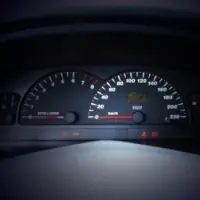
¿Qué vehículos deben estar dotados de un velocímetro?
Which vehicles must be fitted with a speedometer?
- AAquellos que en pendiente puedan sobrepasar los 45 km/hThose that can exceed 45 km/h on a slope.
- BAquellos que en llano puedan sobrepasar los 40 km/hThose that can exceed 40 km/h on level ground.
- CAquellos que en llano puedan sobrepasar los 60 km/hThose that can exceed 60 km/h on level ground.
ExplanationUnder Article 11.11 of the General Vehicle Regulations (Reglamento General de Vehículos), any motor vehicle that can reach a speed of more than 40 km/h on level ground must have a speed indicator in kilometres per hour, that is, a speedometer.
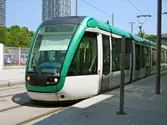
En una intersección sin señalizar, ¿cuándo tendrá preferencia un tranvía?
At a junction without signs, when does a tram have priority?
- ASolamente cuando se aproxime por la derecha.Only when it approaches from the right.
- BSolamente cuando lo indican las señales reglamentarias.Only when the official signs indicate so.
- CComo norma general, en ausencia de señalización los vehículos que circulen sobre raíles tendrán prioridad de paso.As a general rule, when there are no signs, vehicles running on rails have right of way.
ExplanationWhen there are no signs, trams have right of way under the general priority rule, because they are vehicles running on rails.
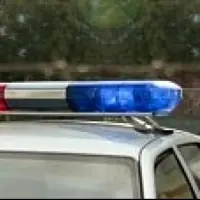
¿Está prohibido el uso de sirenas para los vehículos no prioritarios?
Is the use of sirens prohibited for non-priority vehicles?
- ANo, puede llevarlas instaladas cualquier vehículo y usarlas como un claxonNo, any vehicle may have them fitted and use them like a horn
- BSi, siempreYes, always
- CNo, se pueden utilizar en caso de emergenciaNo, they may be used in an emergency
ExplanationThe use of sirens or other sound devices used by priority vehicles is completely prohibited for vehicles that are not priority vehicles, whether they are providing a public or a private service.
En los tramos de vía en los que por su estrechez es imposible o muy difícil el paso simultáneo de dos vehículos que circulen en sentido contrario, ¿qué vehículo tendrá preferencia de paso si no hay señalización expresa?
On stretches of road so narrow that it is impossible or very difficult for two vehicles travelling in opposite directions to pass at the same time, which vehicle has right of way if there are no specific signs?
- AEl vehículo de mayor masa máxima autorizada.The vehicle with the greater maximum authorised mass.
- BEl vehículo que haya entrado primero.The vehicle that entered first.
- CEl vehículo de mayor longitud.The longer vehicle.
ExplanationOn narrow stretches of road where there are no signs, the vehicle that arrived first has right of way. This helps to avoid confusion and accidents, because a logical order of traffic is followed.
Circula Ud. por un túnel suficientemente iluminado y, en un lugar donde se ensancha el arcén, para su vehículo. ¿Es correcto su comportamiento?
You are driving through a well-lit tunnel and you stop your vehicle at a place where the hard shoulder is wider. Is this correct?
- ANo.No.
- BSí, porque está prohibido estacionar, pero no parar.Yes, because parking is forbidden, but stopping is not.
- CSí, porque en el arcén de un túnel está permitido parar y estacionar.Yes, because stopping and parking are allowed on the hard shoulder of a tunnel.
ExplanationArticle 94.1.a of the General Traffic Regulations prohibits stopping in tunnels, underpasses and stretches of road covered by the «Tunnel» sign, and where stopping is prohibited, parking is also prohibited. A wider section of hard shoulder does not make that spot a place where you may stop.
En una intersección sin señalizar, ¿cederemos el paso a un tranvía?
At a junction without signs, shall we give way to a tram?
- ASólo en el caso que se aproxime por nuestra derecha.Only if it is approaching from our right.
- BNo.No.
- CSí.Yes.
ExplanationAt junctions without signs, vehicles running on rails, such as trams, have right of way over other road users.
Si su vehículo queda detenido en un túnel por necesidades del tráfico, ¿qué medidas debe tomar?
If your vehicle is brought to a stop in a tunnel because of traffic conditions, what must you do?
- ADar media vuelta y salir del túnel.Turn round and leave the tunnel.
- BApagar el motor y encender las luces de posición.Switch off the engine and switch on the sidelights.
- CSalir del vehículo y esperar fuera hasta que se reanude la circulación.Get out of the vehicle and wait outside until traffic starts moving again.
ExplanationUnder Article 97.3 of the General Traffic Regulations, if your vehicle is brought to a stop in a tunnel because of traffic conditions, you must switch off the engine and keep the sidelights on. The driver and passengers must not leave the vehicle, and turning round in a tunnel is prohibited.
En caso de retención en un túnel, debes:
If traffic is held up in a tunnel, you must:
- ASalir del coche para ver qué pasaGet out of the car to see what is happening
- BMantener una distancia de al menos 5 metros con el vehículo de delante y apagar el motor si es prolongadoKeep a distance of at least 5 metres from the vehicle in front and switch off the engine if the stop is long
- CTocar el claxonSound the horn
ExplanationIf there is congestion in a tunnel, keep a distance of at least 5 metres, switch off the engine if the stop is long, and stay in the vehicle waiting for instructions.
Si dos vehículos del mismo tipo se encuentran en un estrechamiento y no se sabe quién tiene preferencia, ¿cuál debe ceder el paso?
If two vehicles of the same type meet on a narrow stretch of road and it is not clear who has right of way, which one must give way?
- AEl vehículo que tenga que retroceder una menor distancia.The vehicle that has to reverse the shorter distance.
- BEl vehículo que sea más ancho o largo.The vehicle that is wider or longer.
- CEl vehículo que deba retroceder una mayor distancia.The vehicle that has to reverse the longer distance.
ExplanationOn a narrow stretch with no signs, the vehicle that entered first goes first; if in doubt, the one that finds it harder to manoeuvre, following the order in Article 62.1 of the General Traffic Regulations. Between vehicles of the same type, right of way goes to the one that would have to reverse the longer distance, so the one that has to reverse less gives way.
Los ciclistas tienen prioridad frente a los vehículos a motor...
Cyclists have priority over motor vehicles...
- Aen zonas peatonales señalizadas.in signed pedestrian areas.
- Ben todas las intersecciones.at all junctions.
- Ccuando crucen por un paso para bicicletas.when they cross at a cycle crossing.
ExplanationCyclists have right of way over motor vehicles when they are riding on a properly signed cycle lane, cycle crossing or hard shoulder, as set out in Article 64 of the General Traffic Regulations (RGC). This means that in these specific situations cyclists' right to pass must be respected, which improves road safety and encourages the use of the bicycle as a means of transport. The other options, pedestrian areas and all junctions, do not give cyclists a general right of way.
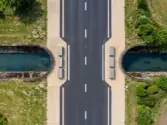
¿Cuál es el orden de prioridad en un estrechamiento?
What is the order of priority at a narrowing?
- AEl que entre primero, atendiendo a la señalización, mayor dificultad de maniobra, mayor distancia hacia atrás.The one that enters first, then the signs, then greater difficulty in manoeuvring, then greater distance to reverse.
- BAtendiendo a la señalización, el que entre primero, mayor dificultad de maniobra y mayor distancia a recorrer marcha atrás.The signs, then the one that enters first, then greater difficulty in manoeuvring, then greater distance to reverse.
- CAtendiendo a la señalización, el vehículo de mayor tamaño, el que entre primero y el que tenga menor distancia a recorrer marcha atrás.The signs, then the larger vehicle, then the one that enters first, then the one with the shorter distance to reverse.
ExplanationAt narrowings, the order of priority is decided by these criteria: first, the signs, if there are any, which take precedence over any other rule; second, when there are no specific signs, the vehicle that entered the narrowing first has priority; third, greater difficulty in manoeuvring, which favours the vehicle that finds it harder to reverse or manoeuvre (there is a list of vehicles); fourth, greater distance to reverse, so that if one vehicle has to reverse, it will be the one with the shorter distance to cover. If the reversing distances are equal, priority goes to the vehicle with the greater width, length or maximum authorised mass.
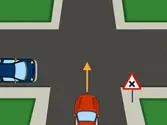
¿Ha de ceder el paso en la intersección el vehículo de color rojo?
Must the red vehicle give way at the junction?
- ASí, a los vehículos que se acerquen por su derecha.Yes, to vehicles approaching from its right.
- BNo, a ningún vehículo.No, to no vehicle.
- CSi, a los vehículos que se acerquen por su izquierda.Yes, to vehicles approaching from its left.
ExplanationThe junction in the picture is marked with the warning sign "Junction with priority to the right". It warns of a nearby junction where the general right-of-way rule applies, so you must give way to vehicles approaching from the right.
En una intersección sin señalizar, ¿qué vehículos tendrán preferencia?
At a junction without signs, which vehicles have priority?
- ALos que circulen por un carril reservado a determinados vehículos sobre el resto de vehículos que circulan por los carriles de normal circulación.Those in a lane reserved for certain vehicles, over the other vehicles in the normal traffic lanes.
- BLos vehículos que pretendan incorporarse a una autopista sobre los que ya circulan por ella.Vehicles wanting to join a motorway, over those already driving on it.
- CLos vehículos que circulan por una glorieta sobre los que pretenden acceder a ella.Vehicles driving on a roundabout, over those wanting to enter it.
ExplanationAt junctions where no sign controls priority, we must give way to vehicles approaching from the right. We always apply this rule except in the following cases: - Vehicles on a paved road have priority over those coming from an unpaved road. - Vehicles running on rails, such as trams, have right of way over all other road users. - Vehicles already driving on a roundabout have right of way over those wanting to enter it. - Vehicles on a motorway or dual carriageway have priority over those wanting to join it.
La vista necesita un tiempo para adaptarse al entrar en un túnel oscuro desde el exterior soleado; por ello:
Your eyes need time to adjust when you enter a dark tunnel from bright sunshine outside; so:
- AConviene reducir la velocidad al acceder al túnel.It is advisable to reduce speed when entering the tunnel.
- BHay que acelerar para salir antes.You should speed up to get out sooner.
- CNo pasa nada, la vista es inmediata.Nothing happens; your eyes adjust instantly.
ExplanationYour eyes do not adjust to darkness instantly; when entering a tunnel it is advisable to slow down and have your lights on.
En un estrechamiento sin señales de prioridad se encuentran un autobús y un turismo con remolque, ¿Qué vehículo cede el paso?
At a narrowing with no priority signs, a bus and a car towing a trailer meet. Which vehicle gives way?
- AEl autobús.The bus.
- BEl turismo que arrastra el remolque.The car towing the trailer.
- CEl que tenga que dar marcha atrás más distancia.The one that would have to reverse further.
ExplanationAt a narrowing without signs, the vehicle that entered first has right of way; if in doubt and one of them has to reverse, the order in Article 62 of the General Traffic Regulations applies. In that order cars towing trailers come before buses, so the bus reverses.
Hay mucho tráfico y prevé que se va a quedar detenido en el paso de peatones. ¿Debe entrar en el paso de peatones?
There is heavy traffic and you expect to end up stopped on the pedestrian crossing. Should you drive onto the pedestrian crossing?
- ASí.Yes.
- BSí, cuando el semáforo esté en verde.Yes, when the traffic light is green.
- CNo, porque obstaculiza el paso de los peatones.No, because it blocks the way for pedestrians.
ExplanationAccording to Article 59.1 of the General Traffic Regulations, even if you have priority or the traffic light is green, no driver may enter a pedestrian crossing if, because of the traffic, they are likely to end up stopped on it, as this would block pedestrians.
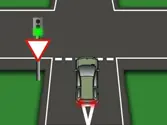
Si el vehículo de la imagen pretende continuar de frente...
If the vehicle in the picture wants to go straight on...
- APasará con prioridad.It will go through with right of way.
- BPasará cediendo el paso.It will go through, giving way.
- CPasará cediendo el paso sólo a los vehículos que se acerquen por su derecha.It will go through, giving way only to vehicles approaching from its right.
ExplanationA steady (non-flashing) green light means that you may go through with right of way, except when the traffic situation means you are likely to be stopped in a position that blocks cross traffic.
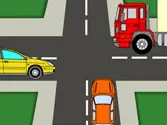
¿Qué vehículo pasara primero en esta intersección?
Which vehicle will go first at this junction?
- AEl turismo amarillo.The yellow car.
- BEl camión.The lorry.
- CEl turismo rojo.The red car.
ExplanationWhen there are no signs controlling right of way, the driver must give way to vehicles approaching from their right.
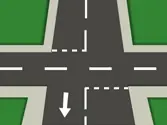
Si en una intersección sin señalizar se acerca por nuestra izquierda un ciclista, ¿debemos cederle el paso?
If a cyclist approaches from our left at a junction without signs, must we give way to them?
- ASí.Yes.
- BNo, porque rige la norma de prioridad a la derecha.No, because the rule of priority to the right applies.
- CSí, porque los ciclistas son usuarios vulnerables.Yes, because cyclists are vulnerable road users.
ExplanationAt a junction without signs, priority to the right also applies to a cyclist, so the one approaching from the left must give way to us. The cyclist would only have right of way in the cases listed in Article 64 of the General Traffic Regulations (RGC), such as a group whose first cyclist has already started to cross.
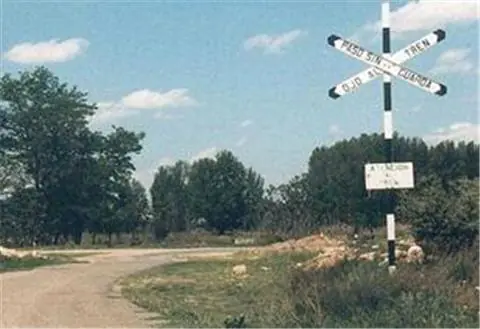
El cruce de un paso a nivel debe realizarse...
Crossing a level crossing must be done...
- Asin demora y comprobar que no hay riesgo de quedarse detenido en la vía del tren.without delay, checking that there is no risk of being left stopped on the railway track.
- Bmuy despacio y con la luz de cruce encendida para que nos vea el conductor del tren.very slowly and with dipped headlights on so the train driver can see us.
- Cmuy rápidamente para no coincidir con el tren.very quickly so as not to meet the train.
ExplanationYou must only cross a level crossing when you are sure that no train is approaching and that there is enough space on the other side so you are not left stopped on the tracks. It is essential to avoid stopping anywhere on the level crossing, because this is very dangerous. The manoeuvre must be done without delay, but always with care. Before crossing, you must check the situation visually and obey any signs. The priority is safety and not blocking the track.
Un animal está en una cañada (paso de ganado) debidamente señalizada. ¿Debe usted cederle el paso?
An animal is on a properly signed livestock route (cañada). Must you give way to it?
- ASí.Yes.
- BNo, porque es un animal.No, because it is an animal.
- CSí, porque ya está cruzando la vía.Yes, because it is already crossing the road.
ExplanationAccording to Article 66.1.a of the General Traffic Regulations, drivers have priority over animals except on properly signed livestock routes (cañadas). On a cañada you must give way to livestock simply because they are on it, not because they have already started to cross.
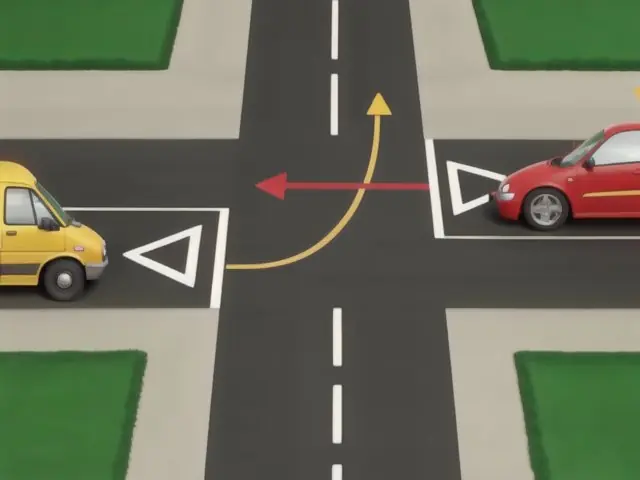
En esta intersección, ambos vehículos se encuentran frente a una señal de "ceda el paso". ¿Quién pasará primero?
At this junction, both vehicles are facing a "give way" sign. Who will go first?
- AEl conductor del vehículo rojo, porque tiene prioridad de paso.The driver of the red vehicle, because they have right of way.
- BEl conductor del vehículo amarillo, porque tiene mayor dificultad para maniobrar.The driver of the yellow vehicle, because it is harder for them to manoeuvre.
- CEl conductor del vehículo amarillo, porque se aplica la norma general de prioridad de paso.The driver of the yellow vehicle, because the general priority rule applies.
ExplanationBoth vehicles are at the same give way sign and face each other, so the rule of giving way to vehicles from the right does not apply. The yellow vehicle is going to turn left and crosses the path of the red one, which is going straight on; under Article 74.1 of the RGC, a driver who turns must make sure that vehicles coming from the opposite direction allow them to do so without danger.
Ante esta situación, ¿qué harás?
In this situation, what will you do?
- AContinuar la marcha.Carry on.
- BDetenerme y esperar a que crucen los peatones.Stop and wait for the pedestrians to cross.
- CPasar rápidamente para no entorpecer a los peatones.Pass quickly so as not to get in the pedestrians' way.
ExplanationWe must stop because pedestrians have priority on a pedestrian crossing.
Si un vehículo queda detenido dentro de un túnel por necesidades de la circulación, su conductor debe...
If a vehicle comes to a stop inside a tunnel because of traffic conditions, its driver must...
- AAbandonar rápidamente el vehículo.Leave the vehicle quickly.
- BConectar la señal de emergencia, mantener encendidas las luces de posición y apagar el motor.Switch on the hazard warning lights, keep the sidelights on and switch off the engine.
- CColocar sobre la calzada los dispositivos de preseñalización de peligro.Place the hazard warning devices on the carriageway.
ExplanationWhen stopped inside a tunnel because of traffic conditions, you must switch on the hazard warning lights to warn other drivers, keep the sidelights on, switch off the engine and keep your distance from the vehicle in front.
Un niño de 12 años que mide más de 1.50 metros de alto,¿Qué asientos puede ocupar en un turismo?
A 12-year-old child is more than 1.50 metres tall. Which seats may they occupy in a car?
- AEl delantero, con preferencia sobre los asientos traseros.The front seat, in preference to the rear seats.
- BTanto el delantero como los traseros.Both the front and the rear seats.
- CSólo los traseros.Only the rear seats.
ExplanationThe requirement to use a child restraint system and travel in the back depends on height (135 cm or less), not on age (Article 117 of the General Traffic Regulations). A 12-year-old child who is more than 1.50 m tall may occupy any seat using the seat belt, with no preference for the front seat.
En una intersección sin señalizar se encuentran por un lado un ciclista, por otro un camión y por el otro lado un turismo, ¿cuál de ellos tendrá prioridad de paso?
At a junction without signs, a cyclist arrives from one side, a lorry from another and a car from the other. Which of them has right of way?
- AEl camión por tener mayor dificultad de paso.The lorry, because it has more difficulty getting through.
- BEl turismo por ser más rápido.The car, because it is faster.
- CEl vehículo que se encuentre su derecha libre.The vehicle that has its right-hand side clear.
ExplanationAt junctions without signs, priority goes to the vehicle whose right-hand side is clear, whatever type of vehicle it is.
Debido a un atasco, se encuentra detenido en el interior de un túnel por más de dos minutos, por lo que ha apagado el funcionamiento del motor, ¿debe tomar alguna otra precaución?
Because of a traffic jam, you have been stopped inside a tunnel for more than two minutes, so you have switched off the engine. Must you take any other precautions?
- ASí, apagar todas las luces.Yes, switch off all the lights.
- BSí, desconectar la radio.Yes, switch off the radio.
- CSí, conectar la señal de emergencia temporalmente para advertir a otros conductores que circulen detrás, mantener encendidas las luces de posición y detenerse lo más lejos posible del vehículo que me precede.Yes, switch on the hazard warning lights for a short time to warn drivers behind, keep the sidelights on and stop as far as possible from the vehicle in front of me.
ExplanationSwitching on the hazard warning lights is essential to warn other drivers that you are stopped, which helps to prevent accidents. Keeping the sidelights on is also very important so that your vehicle can be seen. In addition, stopping as far as possible from the vehicle in front helps you keep a safe distance and makes a possible collision less dangerous.
Al cruzar un arcén por donde pasan peatones, ¿qué debe hacer?
When crossing a hard shoulder where pedestrians are walking, what must you do?
- ACederles el paso si no hay zona peatonal.Give way to them if there is no pedestrian area.
- BAdvertirles con la bocina para que se aparten.Warn them with the horn so that they move aside.
- CCederles el paso solo cuando formen un grupo.Give way to them only when they are in a group.
ExplanationUnder Article 65.1.c of the General Traffic Regulations (as worded by RD 518/2026), pedestrians have right of way when a vehicle crosses a hard shoulder on which pedestrians are walking and there is no pedestrian area for them.
En una glorieta, ¿qué vehículos tienen prioridad?
At a roundabout, which vehicles have priority?
- ALos vehículos que se aproximan por la izquierda.Vehicles approaching from the left.
- BLos vehículos que se aproximan por la derecha.Vehicles approaching from the right.
- CLos vehículos que ya están circulando dentro de la glorieta.Vehicles already driving on the roundabout.
ExplanationUnder Article 57.1.c of the RGC, at roundabouts vehicles already on the circular carriageway have priority over those wishing to enter. Priority to the right is the rule for unsigned junctions, but roundabouts are an exception.
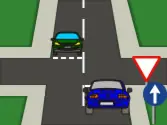
¿Qué hará el vehículo azul al llegar a la intersección?
What will the blue vehicle do when it reaches the junction?
- ASeguir de frente.Go straight on.
- BDetenerse.Stop.
- CDetenerse y seguir de frente.Stop and go straight on.
ExplanationWhen it reaches the junction in the picture, the blue vehicle finds two signs. The first requires it to go straight on in all cases and the second to give way. A give way sign only requires you to stop when necessary, not always. The sign that always requires you to stop is the STOP sign.
Durante una detención, debida a congestión de la circulación, en el interior de un túnel suficientemente iluminado, dentro de poblado, ¿se debe dejar alguna luz encendida?
When stopped because of traffic congestion inside a sufficiently lit tunnel in a built-up area, must any light be left on?
- ASí, el alumbrado de largo alcance.Yes, the main beam.
- BSí, como mínimo, la luz de posición.Yes, at least the sidelights.
- CNo, pueden apagarse todas las luces.No, all lights may be switched off.
ExplanationIf traffic stops inside a tunnel, the occupants must stay in the vehicle and the driver must switch off the engine and leave at least the sidelights on, so that the vehicle stays visible even though the tunnel is lit.
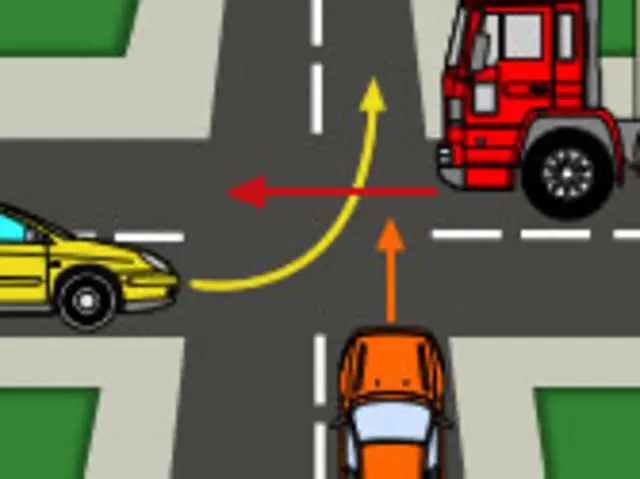
¿Qué vehículo cruzará la intersección en último lugar?
Which vehicle will cross the junction last?
- AEl camión.The lorry.
- BEl turismo naranja.The orange car.
- CEl turismo amarillo.The yellow car.
ExplanationWith no signs, priority to the right applies (Article 57.1 of the General Traffic Regulations). The lorry has nobody on its right and goes first; the orange car had the lorry on its right and goes next; the yellow car has the orange car on its right, so it crosses last.
Usar gafas de sol al conducir de noche o en un túnel:
Wearing sunglasses when driving at night or in a tunnel:
- AEs recomendable para descansar la vista.Is advisable to rest your eyes.
- BEs peligroso porque reduce aún más la visibilidad.Is dangerous, because it reduces visibility even further.
- CEs obligatorio.Is compulsory.
ExplanationSunglasses at night or in tunnels reduce the little light available and harm your vision.
En un tramo muy inclinado donde sea difícil o imposible que dos vehículos que circulan en sentido contrario pasen al mismo tiempo, ¿qué vehículo tiene prioridad?
On a very steep stretch where it is difficult or impossible for two vehicles travelling in opposite directions to pass each other, which vehicle has right of way?
- AEl vehículo que sube.The vehicle going uphill.
- BEl vehículo que baja.The vehicle going downhill.
- CEl que tenga más dificultades para pasar.The one that has more difficulty getting through.
ExplanationOn steep stretches (a gradient of at least 7%) that are too narrow for vehicles to pass each other, the vehicle going uphill has right of way, unless it can reach a passing place first (Article 63.1 of the General Traffic Regulations (RGC)). If in doubt, the order in Article 62 applies.
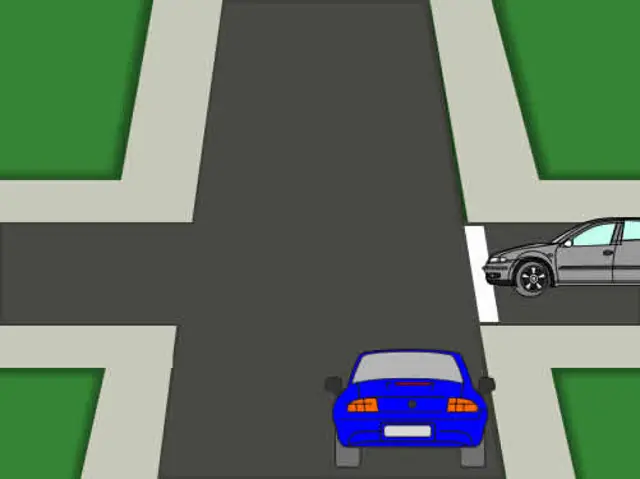
¿Qué vehículo tiene prioridad en esta intersección?
Which vehicle has priority at this junction?
- AEl vehículo gris que viene por la derecha, según la regla general.The grey vehicle coming from the right, under the general rule.
- BEl que llegue primero a la intersección.The one that reaches the junction first.
- CEl vehículo azul que viene por la izquierda, porque el vehículo gris tiene una línea de detención continua.The blue vehicle coming from the left, because the grey vehicle has a solid stop line.
ExplanationWhen there is no sign regulating priority, you give way to vehicles approaching from the right (Article 57.1 of the General Traffic Regulations). The solid transverse line only marks where to stop if another sign requires it, such as a STOP sign; there is none here, so the grey car goes first.
All topics
- Definitions
- Documents and penalty points
- The driver's condition
- Duties of drivers and pedestrians
- Vehicle safety devices
- Vehicle controls and equipment
- Vehicle lights and horn
- Traffic signs, markings and signals
- The road and its lanes
- Speed and distances
- Manoeuvres
- Carrying passengers and loads
- Driving safely in difficult conditions
- Vehicle mechanics and maintenance
- Road accidents and first aid
- Defensive and eco-driving
Independent app: not affiliated with or endorsed by the DGT (Spain's Directorate-General for Traffic) or the Ministry of the Interior. The official exam is booked with the DGT and taken at its test centres. The questions here are practice material; the DGT's official question bank is not public.
Basado en datos de la Agencia Estatal Boletín Oficial del Estado (https://www.boe.es). Textos consolidados de carácter meramente informativo. La AEBOE no patrocina ni respalda este sitio.
Parte de las preguntas procede de los tests de la revista «Tráfico y Seguridad Vial» de la DGT, reproducidos con indicación de la fuente.