
DGT test · 403 questions
Right of way · Page 3 of 9
Who goes first at junctions, roundabouts, narrow stretches and pedestrian crossings, and the priority of emergency vehicles.
Questions in this topic, with answers
403 questions, 50 per page, with the correct answer and the explanation. Page 3 of 9.
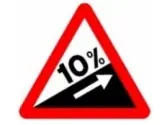
En un tramo de gran pendiente en el que sea muy difícil o imposible el paso simultáneo de dos vehículos que circulen en sentido contrario, ¿qué vehículo tendrá preferencia de paso?
On a steep stretch where it is very difficult or impossible for two vehicles travelling in opposite directions to pass each other, which vehicle has right of way?
- AEl vehículo que circula en sentido ascendente.The vehicle going uphill.
- BEl vehículo que circula en sentido descendente.The vehicle going downhill.
- CEl que tenga mayor dificultad de paso.The one that has more difficulty getting through.
ExplanationOn steep stretches (a gradient of at least 7%), priority goes to the vehicle going uphill, unless it can reach a passing place provided for this purpose before they meet.
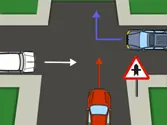
El vehículo rojo, ¿está obligado a ceder el paso en la intersección?
Must the red vehicle give way at the junction?
- ASí, a los vehículos que se aproximen por la derecha.Yes, to vehicles approaching from the right.
- BSí, a todos los vehículos.Yes, to all vehicles.
- CNo.No.
ExplanationIn the picture, the red vehicle has a “junction with priority” sign, which warns of an upcoming junction with a road whose users must give way to it. So the red vehicle does not have to give way to either of the other two vehicles.
Los conductores de vehículos deben ceder el paso a los peatones...
Drivers must give way to pedestrians...
- AEn todo caso.In all cases.
- BEn los pasos de peatones debidamente señalizados.At properly signposted pedestrian crossings.
- CSiempre que sus trayectorias se corten.Whenever their paths cross.
ExplanationAs a general rule, drivers have priority over pedestrians, except at properly signposted pedestrian crossings, when turning and there are pedestrians crossing, in pedestrian areas and when pedestrians are getting off a bus.
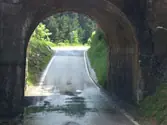
En los estrechamientos en tramos de gran pendiente, si no hay señalización expresa a tal efecto, tendrá la preferencia de paso el vehículo que circule en sentido...
On narrow stretches with a steep gradient, if there are no specific signs, right of way goes to the vehicle travelling...
- ADescendente, salvo si pudiera llegar antes a un apartadero.downhill, unless it could reach a passing place first.
- BAscendente, salvo si pudiera llegar antes a un apartadero.uphill, unless it could reach a passing place first.
- CAscendente, en todo caso.uphill, in all cases.
ExplanationOn steep stretches without right-of-way signs, where two vehicles cannot pass each other because the road is too narrow, right of way goes to the vehicle travelling uphill, unless it could reach a passing place provided for this purpose first. Steep stretches are those with a gradient of at least 7 per cent.
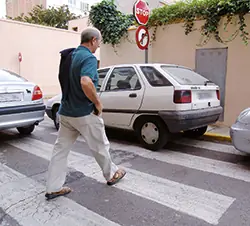
En un paso para peatones sin semáforos que lo regule, ¿cuándo tienen preferencia los peatones?
At a pedestrian crossing without traffic lights, when do pedestrians have priority?
- ASolo cuando el paso esté situado en una travesía.Only when the crossing is on a travesía (stretch of road through a town).
- BSiempre.Always.
- CSolo cuando los peatones hayan iniciado el cruce.Only when the pedestrians have started crossing.
ExplanationAt pedestrian crossings not controlled by traffic lights, the pedestrian always has priority: the driver must slow down and stop if necessary to give way.
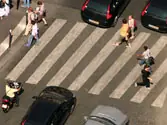
Hay muchos vehículos circulando y prevé que va a quedar detenido en el paso para peatones. ¿Debe entrar en el paso?
There is a lot of traffic and you expect to be left stopped on the pedestrian crossing. Should you enter the crossing?
- ASí.Yes.
- BSí, cuando el semáforo está verde.Yes, when the light is green.
- CNo, porque corto el paso a los peatones.No, because I would block the pedestrians' way.
ExplanationEven with right of way, no driver may enter a junction or a pedestrian crossing if the traffic situation is such that they are likely to be left stopped in a way that blocks or obstructs crossing traffic.
Los conductores de bicicletas tendrán prioridad de paso respecto a los vehículos de motor...
Cyclists have right of way over motor vehicles...
- ASolo cuando una señal lo indique.Only when a sign says so.
- BCuando crucen la calzada por un paso de peatones.When they cross the carriageway at a pedestrian crossing.
- CCuando circulando en grupo el primero hay iniciado ya el cruce o haya entrado en una glorieta.When they are riding in a group and the first one has already started crossing or has entered a roundabout.
ExplanationWhen cyclists ride in a group, they are treated as a single moving unit for right of way purposes. Cyclists have right of way over motor vehicles: - When they are on a properly signposted cycle lane, cycle crossing or hard shoulder. - When the motor vehicle is turning right or left to enter another road, where this is allowed, and there is a cyclist nearby. - When they are riding in a group and the first one has already started crossing or has entered a roundabout. In all other cases, the general right of way rules between vehicles apply.
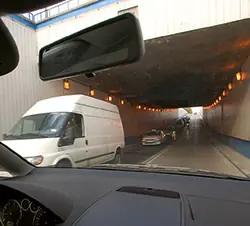
Cuando prevea que va a quedar detenido dentro del túnel más de dos minutos, ¿qué debe hacer?
When you expect to be stopped inside a tunnel for more than two minutes, what must you do?
- AApagar el motor.Switch off the engine.
- BApagar las luces.Switch off the lights.
- CDar media vuelta con cuidado.Carefully turn round.
ExplanationIn a tunnel, if you will be stopped for more than two minutes, you must switch off the engine so that toxic gases do not build up in an enclosed space; the sidelights are kept on.
Circulando observa que se aproxima una ambulancia en servicio urgente. Debe tener en cuenta que...
While driving, you see an ambulance approaching on an emergency call. You must bear in mind that...
- Adebe facilitarle el paso apartándose a la derecha o deteniéndose si fuera preciso.you must let it through by moving over to the right or stopping if necessary.
- Bpuede saltarse algún semáforo para dejar pasar a la ambulancia.you may go through a traffic light to let the ambulance pass.
- Cdeberá circular a mayor velocidad para abrirle paso.you must drive faster to clear the way for it.
ExplanationYou must take suitable steps to let vehicles on an emergency call pass, depending on the circumstances of the moment and the place. Sometimes you will need to move the vehicle close to the right-hand edge of the carriageway, and other times to stop. Priority vehicles show they are on an emergency call with the flashing light and the siren. As an exception, they may use the flashing light alone when not using the siren is no danger to other road users. (With the flashing light alone they already have priority.)
¿Qué vehículos deben tener concertado el Seguro Obligatorio?
Which vehicles must have compulsory insurance?
- ALos vehículos a motor y ciclomotores.Motor vehicles and mopeds.
- BTodos los vehículos que circulen por las vías públicas.All vehicles travelling on public roads.
- CTodos los vehículos a motor, excepto los ciclomotores.All motor vehicles, except mopeds.
ExplanationCompulsory third-party liability insurance is required for motor vehicles normally kept in Spain, including mopeds. It does not apply to every vehicle on the road: a bicycle, for example, does not have to be insured.
Si en un estrechamiento sin señalizar se encuentran un camión y un turismo que arrastra un remolque de hasta 750 kg, no sabiendo cuál entró primero, ¿quién tendrá preferencia de paso?
If a lorry and a car towing a trailer of up to 750 kg meet at a narrowing without signs, and it is not known which one entered first, who has right of way?
- AEl camión.The lorry.
- BEl turismo con remolque.The car with a trailer.
- CEl más grande y pesado.The bigger and heavier one.
ExplanationIn the order of priority, the car with a trailer is in point 4 and the lorry in point 6, so the car with a trailer has right of way.
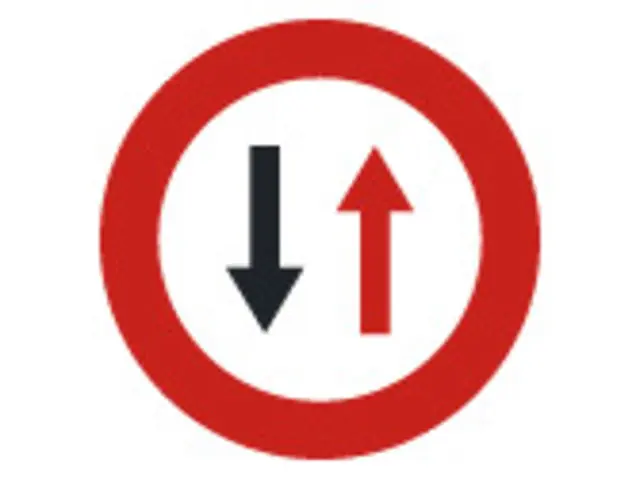
Si entramos en un estrechamiento con esta señal en nuestro sentido y no podemos pasar al mismo tiempo que los vehículos que vienen en sentido contrario, ¿qué vehículo debe retroceder?
If we enter a narrow section with this sign in our direction and cannot pass at the same time as vehicles coming the other way, which vehicle must reverse?
- AEl que ha recorrido menos distancia.The one that has travelled the shorter distance.
- BEl más ligero.The lighter one.
- CNosotros.Our vehicle.
ExplanationThe ‘priority to oncoming traffic’ sign requires you to let oncoming vehicles through. If two vehicles meet in the narrow section and cannot pass each other, the one that entered from the end with this sign must reverse (Article 61.2 of the General Traffic Regulations (RGC)), that is, our vehicle.
Si se encuentran dos vehículos en un paso que no permite el paso simultáneo, ¿cuál tendrá prioridad?
If two vehicles meet at a passage where they cannot pass at the same time, which one has right of way?
- AEl vehículo que entró primero.The vehicle that entered first.
- BEl vehículo que llegó primero.The vehicle that arrived first.
- CEl vehículo con mayor dificultad de maniobra.The vehicle that has more difficulty manoeuvring.
ExplanationAt a narrow passage where two vehicles cannot pass each other, the vehicle that entered first has right of way. If this is not clear, the vehicle that has more difficulty manoeuvring goes first.
Los ciclistas tienen prioridad de paso…
Cyclists have right of way…
- ASiempre que circulen por el arcén.Whenever they are riding on the hard shoulder.
- BCuando circulen por un carril bici o un paso para ciclistas debidamente señalizado.When they are riding on a properly signed cycle lane or cycle crossing.
- CEn las vías urbanas.On urban roads.
ExplanationCyclists have right of way when they are riding on a properly signed cycle lane, cycle crossing or hard shoulder, and in other specific cases in Article 64 of the General Traffic Regulations. They do not always have it just for being on any hard shoulder or on an urban road.
Al acercarse a un paso a nivel, debe...
When approaching a level crossing, you must...
- Apasar, aunque las barreras se muevan.cross even if the barriers are moving.
- Basegurarse, antes de cruzarlo, de que no hay peligro.make sure there is no danger before crossing it.
- Ccruzarlo rápidamente.cross it quickly.
ExplanationAccording to Article 95 of the General Traffic Regulations, when approaching a level crossing you must take extra care and slow down; if the barrier is down or moving, you must stop, and you only cross after making sure there is no risk of getting stuck on the crossing.
En una intersección entre una vía pavimentada y otra sin pavimentar, ¿quién tiene la prioridad?
At a junction between a paved road and an unpaved one, who has priority?
- ALos vehículos que circulen por la vía más ancha.Vehicles on the wider road.
- BLos vehículos que se aproximen por la derecha.Vehicles approaching from the right.
- CLos vehículos que circulen por la vía pavimentada.Vehicles on the paved road.
ExplanationVehicles on a paved road have priority over those coming from an unpaved one; the width of the road does not matter. This is an exception to the general priority rule.
En una intersección que carece de señalización que regule la preferencia de paso, si observa que se aproxima un ciclista por su derecha, ¿cómo debe actuar?
At a junction with no signs or markings controlling right of way, if you see a cyclist approaching from your right, what should you do?
- ACederle el paso porque viene por la derechaGive way, because the cyclist is coming from the right
- BDarle prioridad solo si hay paso ciclistaGive priority only if there is a cycle crossing
- CNo cederle el paso porque va en biciNot give way, because it is a bicycle
ExplanationThe correct answer is to give way. Under the general priority rule in the General Traffic Regulations, at junctions with no signs or markings (such as a Stop or Give Way) controlling right of way, you must give way to vehicles approaching from the right. Remember that cyclists are drivers of vehicles and so follow this same general rule. Riding a bicycle does not take away their priority over a motor vehicle if the right-hand rule favours them.
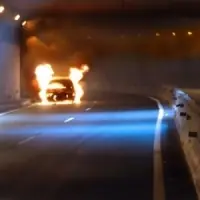
¿Qué tiene que hacer si se encuentra detenido en el interior de un túnel y se inicia un incendio?
What must you do if you are stopped inside a tunnel and a fire breaks out?
- AApartarse al lado derecho, apagar el motor e ir a la salida más próxima.Pull over to the right, switch off the engine and go to the nearest exit.
- BEsperar en el interior del vehículo a la llegada del equipo de salvamento.Wait inside the vehicle for the rescue team to arrive.
- CConducir marcha atrás hasta la entrada del túnel.Reverse to the tunnel entrance.
ExplanationUnder Article 97 of the General Traffic Regulations, if there is a fire in a tunnel you must pull the vehicle over to the right, switch off the engine, leave the key in the ignition and walk to the nearest exit or emergency shelter, away from the fire. Do not stay in the car or reverse.
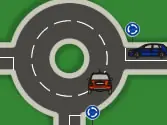
El vehículo que circula dentro de una glorieta, ¿debe ceder el paso a un vehículo que quiere entrar por la derecha?
Must a vehicle already on a roundabout give way to a vehicle wishing to enter from the right?
- ASí, cuando no hay señales de prioridad.Yes, when there are no priority signs.
- BSí, porque el que entra tiene prioridad.Yes, because the vehicle entering has priority.
- CNo, porque tiene preferencia de paso.No, because it has right of way.
ExplanationAccording to Article 57.1.c of the General Traffic Regulations, on roundabouts, vehicles already on the roundabout have priority over those wishing to enter it. A vehicle already travelling on the roundabout does not give way to one entering, even if it comes from its right.
La llamada "visión de túnel" es especialmente peligrosa...
So-called "tunnel vision" is especially dangerous…
- AEn las autopistas y autovías.On motorways (autopistas) and dual carriageways (autovías).
- BEn las intersecciones.At junctions.
- CEn los adelantamientos.When overtaking.
ExplanationTunnel vision is the narrowing of the field of vision caused by speed, tiredness or alcohol. It is especially dangerous at junctions, because it prevents you from seeing in time the vehicles and pedestrians approaching from the sides.
En una intersección donde es probable que tenga que detenerse, ¿qué debe hacer si tiene prioridad de paso?
At a junction where you are likely to have to stop, what must you do if you have right of way?
- APasar porque tiene prioridad.Go through, because you have right of way.
- BPasar y apartarse si obstruye la circulación.Go through and move aside if you are blocking traffic.
- CNo entrar en la intersección.Not enter the junction.
ExplanationEven if they have right of way, no driver may enter a junction if, because of the traffic, they are likely to end up stopped there and block the crossing traffic (Article 59.1 of the General Traffic Regulations). You must wait outside it.
En una zona de obras donde la calzada se estrecha, ¿qué vehículo tiene preferencia si no hay ninguna señal que lo indique?
In a roadworks area where the carriageway narrows, which vehicle has right of way if there is no sign to say so?
- AEl que entró primero.The one that entered first.
- BEl que tenga el estrechamiento a su derecha.The one that has the narrowing on its right.
- CEl que no tenga que cambiar de carril para entrar en el estrechamiento.The one that does not have to change lane to enter the narrowing.
ExplanationOn narrow stretches, including those at roadworks, where two vehicles going in opposite directions cannot pass at the same time and there are no signs, right of way goes to the one that entered first (Article 60.1 of the General Traffic Regulations). If in doubt, it goes to the one that has more difficulty manoeuvring (Article 62).
Si se acerca a un peatón que quiere cruzar la calzada, ¿qué debe hacer?
If you are approaching a pedestrian who wants to cross the carriageway, what must you do?
- AModerar la velocidad y detenerse si es necesario.Slow down and stop if necessary.
- BSeguir circulando, ya que el vehículo tiene prioridad.Keep going, since the vehicle has right of way.
- CTocar el claxon y continuar a la misma velocidad.Sound the horn and continue at the same speed.
ExplanationUnder Article 121.1 of the General Traffic Regulations (as worded by RD 518/2026), anyone driving any type of vehicle must take special care not to endanger the physical safety of pedestrians. When a pedestrian wants to cross, you must slow down and stop if necessary.
Si llega a una intersección congestionada y prevé que quedará detenido obstaculizando el cruce, debe:
If you reach a congested junction and expect that you will be stopped in a position that blocks it, you must:
- AAvanzar si tiene prioridad.Go ahead if you have right of way.
- BNo entrar en la intersección hasta poder atravesarla completamente.Not enter the junction until you can cross it completely.
- CAvanzar solo si es taxi o transporte público.Go ahead only if you are a taxi or public transport.
ExplanationIf you reach a congested junction and expect that you could be stopped in a position that blocks it, you must not enter the junction until you are sure you can cross it completely. This prevents blockages that get in the way of other vehicles and pedestrians. It does not matter whether you have right of way, because going ahead in these conditions could cause congestion or accidents. Being a taxi or public transport does not allow you to go ahead either: all drivers must follow this rule to keep traffic flowing safely.
Si dos vehículos se encuentran en un estrechamiento y no pueden cruzar a la vez, ¿cuál pasará primero?
If two vehicles meet at a narrowing and cannot pass each other, which one goes first?
- AEl que tenga mayor dificultad de maniobra.The one that has more difficulty manoeuvring.
- BEl que haya entrado primero.The one that entered first.
- CEl que tenga que retroceder mayor distancia.The one that would have to reverse a longer distance.
ExplanationWhen two vehicles cannot pass each other at a narrowing, the one that entered first has right of way. If they entered at the same time, the one that has more difficulty manoeuvring has right of way, and if the difficulty is the same, the one that would have to reverse a longer distance.
¿Dónde debemos detenernos cuando llegamos a una intersección?
Where must we stop when we reach a junction?
- AComo mínimo 5 metros antes de la intersección.At least 5 metres before the junction.
- BAntes de la intersección.Before the junction.
- CEn medio de la intersección.In the middle of the junction.
ExplanationTo give way at a junction, we must stop before entering the junction, at a point where we can see well enough.
¿Cuándo tendrán prioridad de paso los peatones respecto de los vehículos?
When do pedestrians have right of way over vehicles?
- ALos peatones siempre gozan de prioridad de paso.Pedestrians always have right of way.
- BLos peatones solo tendrán prioridad cuando crucen la calzada por un paso de peatones señalizado.Pedestrians only have right of way when they cross the carriageway at a marked pedestrian crossing.
- CLos peatones tendrán prioridad en las zonas peatonales o cuando un vehículo vaya girar y se cruce con ellos, entre otros.Pedestrians have right of way in pedestrian zones or when a vehicle is going to turn and crosses their path, among other cases.
ExplanationPedestrians have right of way: on properly marked pedestrian crossings; when a vehicle is going to turn into another road and crosses their path; when a vehicle crosses a hard shoulder along which pedestrians are walking; when pedestrians are going to get on or off a public transport vehicle and the vehicle is between the pedestrian and the nearest traffic island; when pedestrians are walking in school lines, troops in formation or organised processions.
¿En una intersección que no tiene señal de preferencia, como norma general, cuándo debe ceder el paso a un vehículo de tracción animal?
At a junction with no priority sign, as a general rule, when must you give way to an animal-drawn vehicle?
- ASiempre, porque tienen preferencia en todos los cruces.Always, because they have priority at all junctions.
- BCuando entre por mi derecha.When it comes from my right.
- CNunca, porque no es un vehículo de motor.Never, because it is not a motor vehicle.
ExplanationAt junctions with no sign regulating right of way, we must give way to vehicles approaching from the right. We will always apply this rule, except in the following cases: vehicles on a paved road have right of way over those coming from an unpaved road; vehicles on rails, such as trams, have right of way over all other road users; vehicles already on a roundabout have right of way over those wanting to enter it; vehicles on a motorway (autopista) or dual carriageway (autovía) have right of way over those wanting to join it. So for an animal-drawn vehicle, we will apply the general rule of priority to the right.
¿Cómo debemos actuar para ceder el paso?
What must we do to give way?
- AParar y comprobar si los otros usuarios tienen prioridad.Stop and check whether other road users have priority.
- BDetenerse en todo caso en las intersecciones si se acerca otro vehículo.Always stop at junctions if another vehicle is approaching.
- CNo obligar al vehículo que tiene prioridad a modificar bruscamente su trayectoria o velocidad.Do not force the vehicle that has priority to suddenly change its path or speed.
ExplanationAt a give way sign, we must show approaching vehicles that we intend to respect their priority, by not forcing them to suddenly change their path or speed.
Si nuestro vehículo cruza el arcén de una vía no señalizada como cañada por la que están circulando animales, ¿debemos cederles el paso?
If our vehicle crosses the hard shoulder of a road that is not signed as a livestock route, and animals are moving along it, must we give way to them?
- ASí.Yes.
- BSolo si se trata de un rebaño.Only if it is a herd.
- CNo, porque no tienen cañada.No, because there is no livestock route for them.
ExplanationIf we cross the hard shoulder of a road that has no livestock route and animals are moving along it, we must give way to them. We must also give way to them if we turn to enter another road and there are animals crossing it, even if there is no specific crossing for them.
Un 'túnel', a efectos de circulación, es:
For traffic purposes, a 'tunnel' is:
- AUn tramo de vía cubierto que exige normas específicas (luces, distancias, prohibición de parar).A covered stretch of road that requires specific rules (lights, distances, no stopping).
- BCualquier tramo con curvas peligrosas.Any stretch with dangerous bends.
- CUn puente sobre un río.A bridge over a river.
ExplanationA tunnel is an underground or covered passage; its own rules apply, such as driving with dipped headlights and keeping a safe distance.
En una intersección en la que en el centro hay una glorieta, ¿cómo realizaremos un cambio de sentido?
At a junction with a roundabout in the middle, how shall we make a U-turn?
- ANo podremos realizarlo.We cannot make it.
- BRodeando la glorieta por la derecha.By going round the roundabout by the right.
- CRodeando la glorieta por la izquierda.By going round the roundabout by the left.
ExplanationWe must always drive round roundabouts keeping their centre on our left. In other words, we go round them by the right, so the centre stays on our left.
Si se queda detenido en un túnel debido al tráfico, ¿qué debe hacer?
If you are held up in a tunnel because of traffic, what must you do?
- AMantener encendidas las luces de posición y detenerse lo más lejos posible del vehículo que le precede.Keep the sidelights on and stop as far as possible from the vehicle in front.
- BEncender solamente las luces de emergencia.Switch on the hazard warning lights only.
- CDetenerse lo más cerca posible del vehículo que circula delante.Stop as close as possible to the vehicle in front.
ExplanationIf a vehicle is held up in a tunnel because of traffic, the driver must keep the sidelights on and stop as far as possible from the vehicle in front. This is essential for the safety of everyone in the vehicle and of other drivers, as it reduces the risk of collisions. According to the General Traffic Regulations (RGC), particularly the articles dealing with vehicles stopped in tunnels, while a vehicle is stopped the hazard warning lights and the sidelights must be kept on to warn other drivers.
Si en un estrechamiento sin señalizar se encuentran dos vehículos del mismo tipo y no pueden cruzarse a la vez, ¿cuál de los dos pasará primero?
If two vehicles of the same type meet at a narrowing without signs and cannot pass each other at the same time, which of the two goes first?
- AEl que tenga que dar marcha atrás mayor distancia.The one that would have to reverse a longer distance.
- BEl que tenga que dar marcha atrás menor distancia.The one that would have to reverse a shorter distance.
- CEl que sea más ancho.The wider one.
ExplanationAt a narrowing without priority signs, the vehicle that entered first has right of way. If it is not clear, the vehicle that has more difficulty manoeuvring has right of way, and when they are of the same type, the one that would have to reverse a longer distance has right of way.
Si en un estrechamiento se encuentran un vehículo de tracción animal y un turismo, sin que se puedan cruzar a la vez, ¿cuál tendrá prioridad de paso?
If an animal-drawn vehicle and a car meet at a narrowing and cannot pass each other at the same time, which one has right of way?
- AEl turismo, por ser más ágil.The car, because it is more agile.
- BEl vehículo de tracción animal.The animal-drawn vehicle.
- CEl vehículo que hubiese entrado primero.The vehicle that entered first.
ExplanationIf the narrowing has no signs, the vehicle that entered first has right of way, whatever type it is.
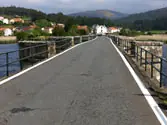
En un estrechamiento sin señalizar, un turismo se encuentra con un camión que circula en sentido contrario. Si no pueden pasar a la vez y no se sabe cuál entró primero, ¿qué vehículo deberá retroceder?
On a narrow stretch of road with no signs, a car meets a lorry coming the other way. If they cannot pass at the same time and it is not known which one entered first, which vehicle must reverse?
- AEl camión.The lorry.
- BEl turismo.The car.
- CEl que haya recorrido más distancia.The one that has travelled the greater distance.
ExplanationOn a narrow stretch with no signs, the vehicle that entered first goes first; if in doubt, right of way goes to the vehicle that finds it harder to manoeuvre (Article 60.1 of the General Traffic Regulations). In the order of Article 62.1, lorries come before cars, so the car reverses.
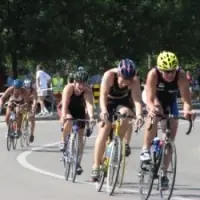
¿En una glorieta en la que circula un grupo de ciclistas y el primero ya ha comenzado a incorporarse quien tiene preferencia?
At a roundabout where a group of cyclists is riding and the first one has already started to enter, who has right of way?
- ALos vehículos a motor en todos los casosMotor vehicles in all cases
- BLos ciclistasThe cyclists
- CLos vehículos a motor a no ser que sean más de 3 los ciclistas que ya hayan entradoMotor vehicles, unless more than 3 cyclists have already entered
ExplanationCyclists have right of way over motor vehicles when they are riding in a group and the first one has already started to cross or has already entered a roundabout.
Si se encuentra detenido dentro de un túnel deberá...
If you are stopped inside a tunnel, you must...
- AMantener la luz encendida de largo alcance o cruce y apagar el motor.Keep the main beam or dipped headlights on and switch off the engine.
- BDejar encendida la luz de posición y apagar el motor.Leave the sidelights on and switch off the engine.
- CDejar encendida la luz de posición, la luz de emergencia y apagar el motor.Leave the sidelights and the hazard warning lights on and switch off the engine.
ExplanationIf you are brought to a standstill inside a tunnel, even because of traffic, you must keep the sidelights on together with the hazard warning lights, and switch off the engine.
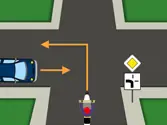
En esta intersección, ¿qué vehículo tendrá prioridad de paso?
At this junction, which vehicle will have right of way?
- AEl turismo.The car.
- BEl que llegue primero a la intersección.The one that reaches the junction first.
- CLa motocicleta.The motorcycle.
ExplanationThe sign tells the motorcyclist that they are on a carriageway with priority, and the additional panel shows the route that has priority.
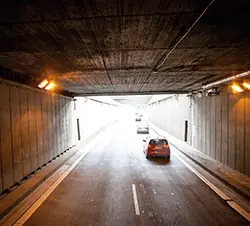
¿Qué debe hacer el conductor de un vehículo que, por motivos de emergencia, quede inmovilizado dentro de un paso inferior?
What must the driver of a vehicle do if, because of an emergency, the vehicle comes to a stop inside an underpass?
- APermanecer en el interior del vehículo.Stay inside the vehicle.
- BInmovilizar el vehículo lo más cerca posible del borde izquierdo de la calzada.Stop the vehicle as close as possible to the left-hand edge of the carriageway.
- CSolicitar auxilio a través del poste de socorro más próximo, si existiese.Call for help from the nearest emergency post, if there is one.
ExplanationIn tunnels and underpasses, if the vehicle stops because of an emergency, you must call for help from the nearest emergency (SOS) post if there is one: this pinpoints the exact location and activates the tunnel's own emergency resources.
¿Cómo debe comportarse al ceder el paso?
How should you behave when giving way?
- ADetenerse en las intersecciones si se acerca otro vehículo.Stop at junctions if another vehicle is approaching.
- BParar y mirar si otro vehículo tiene prioridad.Stop and look to see whether another vehicle has priority.
- CNo obligar al vehículo que tiene prioridad a modificar bruscamente su trayectoria o velocidad.Not force the vehicle with priority to change its path or speed suddenly.
ExplanationUnder Article 58 of the RGC, a driver who must give way may not start or continue driving or manoeuvring until they are sure they will not force the vehicle with priority to change its path or speed suddenly.
Si en un estrechamiento sin señalizar se encuentran un turismo con remolque y un camión, no pudiendo cruzarse a la vez, ¿qué vehículo tendrá prioridad de paso?
If a car with a trailer and a lorry meet at a narrowing without signs and cannot pass each other at the same time, which vehicle has right of way?
- AEl camión.The lorry.
- BEl turismo con remolque.The car with a trailer.
- CEl que tenga que recorrer más distancia hacia atrás.The one that would have to reverse a longer distance.
ExplanationIf there are no signs regulating who goes first, the vehicle that entered first has right of way. If it is not clear, the one that has more difficulty has right of way, in this case the car with a trailer.
En un tramo de vía muy estrecho, sin señales, donde no puedan pasar dos vehículos a la vez, tendrá preferencia...
On a very narrow stretch of road without signs, where two vehicles cannot pass at the same time, right of way goes to...
- Ael que tenga más dificultad para maniobrar.the one that has more difficulty manoeuvring.
- Bel que tenga que retroceder una mayor distancia.the one that has to reverse the longer distance.
- Cel que entró primero en el estrechamiento.the one that entered the narrow stretch first.
ExplanationOn a narrow stretch without signs where two vehicles cannot pass at the same time, right of way goes to the one that entered first (Article 60.1 of the General Traffic Regulations). Only when in doubt do you look at how hard each vehicle is to manoeuvre, following the order in Article 62.
Conduciendo su turismo por una vía fuera de poblado, llega a una intersección en la que no está señalizada la preferencia de paso. ¿Debe dejar pasar a un grupo de ciclistas que se aproxima por su derecha?
You are driving your car on a road outside built-up areas and come to a junction where right of way is not signposted. Must you let a group of cyclists approaching from your right go first?
- ASí, pero sólo al primero de los ciclistas del grupo, es decir, al primer vehículo.Yes, but only the first cyclist in the group, that is, the first vehicle.
- BNo, porque a efectos de prioridad se debe entender que cada ciclista con su bicicleta son vehículos independientes.No, because for right-of-way purposes each cyclist with their bicycle is a separate vehicle.
- CSí, porque a efectos de prioridad de paso se debe considerar al grupo como una única unidad móvil.Yes, because for right-of-way purposes the group must be treated as a single moving unit.
ExplanationThe group of cyclists is treated as a single moving unit. This means that, at the junction, the driver must let all the cyclists in the group go first, because their safety and the flow of traffic come first. This helps to avoid dangerous situations and keeps traffic flowing more safely.
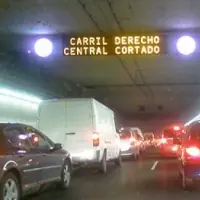
¿Qué hay que hacer si el vehículo queda detenido en un túnel durante más de dos minutos?
What must you do if the vehicle is stopped in a tunnel for more than two minutes?
- AMantener en marcha el motor y poner en funcionamiento los dispositivos de advertencia del peligro.Keep the engine running and switch on the hazard warning devices.
- BApagar el motor, conectar la señal de emergencia y mantener encendidas las luces de posición.Switch off the engine, switch on the hazard warning lights and keep the sidelights on.
- CMantener en marcha el motor y encender la luz de emergencia.Keep the engine running and switch on the hazard warning lights.
ExplanationIf you have to remain stopped in a tunnel for more than two minutes, you must switch off the engine so that exhaust gases do not build up, switch on the hazard warning lights for a while to warn those coming behind, and keep the sidelights on, under Articles 97 and 115 of the General Traffic Regulations.
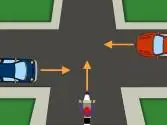
¿ Qué vehículo pasará el último en la situación de la imagen?
Which vehicle will go last in the situation in the picture?
- AEl vehículo azul.The blue vehicle.
- BLa motocicleta.The motorcycle.
- CEl vehículo rojo.The red vehicle.
ExplanationWhen there are no signs giving right of way at a junction, the general rule applies: vehicles coming from your right have right of way. In the picture, the red vehicle goes first, because there is no one on its right, so it does not have to give way to anyone. The motorcycle goes second, and the blue vehicle goes last.
¿Qué haremos si se nos aproxima por detrás una ambulancia en servicio de urgencia?
What should we do if an ambulance on an emergency call is coming up behind us?
- ADetenernos inmediatamente.Stop immediately.
- BNormalmente apartarnos a la derecha y detenernos si es preciso.Normally move over to the right and stop if necessary.
- CAcelerar para no entorpecer la marcha de la ambulancia.Speed up so as not to hold up the ambulance.
ExplanationAs soon as you notice the signals announcing that a priority (emergency) vehicle on an emergency call is approaching, you must take all suitable measures, depending on the circumstances, to let it through. Normally this means moving over to the right and stopping if necessary.
¿Cómo se debe dejar señalizado el vehículo, al realizar una detención de emergencia en el interior de un túnel suficientemente iluminado?
How must the vehicle be marked when you make an emergency stop inside a sufficiently lit tunnel?
- ACon la luz de emergencia es suficiente.The hazard warning lights are enough.
- BCon la luz de emergencia, la luz de posición y el dispositivo luminoso de preseñalización de peligro.With the hazard warning lights, the sidelights and the illuminated hazard warning device.
- CCon la luz de emergencia y la luz de posición, sin colocar el dispositivo de preseñalización por estar en un túnel.With the hazard warning lights and the sidelights, without placing the hazard warning device because you are in a tunnel.
ExplanationUnder Article 97.3 of the General Traffic Regulations, if the vehicle is immobilised inside a tunnel because of an emergency, you must switch on the hazard warning lights, keep the sidelights on, and place and activate the illuminated hazard warning device.
En un cruce con el tráfico congestionado, ¿se puede pasar cuando la luz está en verde?
At a junction with congested traffic, may you go through when the light is green?
- ASí, pero debo esperar hasta poder pasar sin bloquearlo.Yes, but I must wait until I can go through without blocking it.
- BSí, pero debo ceder el paso a los vehículos de la derecha.Yes, but I must give way to vehicles on the right.
- CSí, siempre, porque tengo preferencia.Yes, always, because I have priority.
ExplanationUnder Article 59.1 of the RGC, even if the light is green and you have priority, you must not enter a junction if, given the traffic situation, you are likely to be stopped inside it, blocking cross traffic. You must wait until there is space to get out.
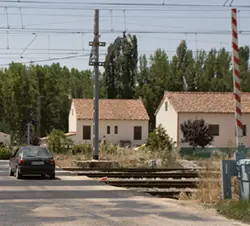
Si un vehículo queda detenido por avería en un paso a nivel, el conductor debe adoptar en primer lugar las medidas necesarias para...
If a vehicle breaks down and is stopped on a level crossing, the driver must first take the necessary measures to...
- Aque todos los ocupantes abandonen el vehículo.get all the occupants out of the vehicle.
- Bdesconectar los bornes de la batería del vehículo.disconnect the vehicle's battery terminals.
- Ccolocar el triángulo de preseñalización de peligro en la vía.place the warning triangle on the road.
ExplanationAccording to Article 97 of the General Traffic Regulations, if a vehicle is stopped on a level crossing, the first thing to do is to get the occupants out quickly and then try to clear the crossing. People's lives come before the vehicle.
All topics
- Definitions
- Documents and penalty points
- The driver's condition
- Duties of drivers and pedestrians
- Vehicle safety devices
- Vehicle controls and equipment
- Vehicle lights and horn
- Traffic signs, markings and signals
- The road and its lanes
- Speed and distances
- Manoeuvres
- Carrying passengers and loads
- Driving safely in difficult conditions
- Vehicle mechanics and maintenance
- Road accidents and first aid
- Defensive and eco-driving
Independent app: not affiliated with or endorsed by the DGT (Spain's Directorate-General for Traffic) or the Ministry of the Interior. The official exam is booked with the DGT and taken at its test centres. The questions here are practice material; the DGT's official question bank is not public.
Basado en datos de la Agencia Estatal Boletín Oficial del Estado (https://www.boe.es). Textos consolidados de carácter meramente informativo. La AEBOE no patrocina ni respalda este sitio.
Parte de las preguntas procede de los tests de la revista «Tráfico y Seguridad Vial» de la DGT, reproducidos con indicación de la fuente.