
DGT test · 403 questions
Right of way · Page 6 of 9
Who goes first at junctions, roundabouts, narrow stretches and pedestrian crossings, and the priority of emergency vehicles.
Questions in this topic, with answers
403 questions, 50 per page, with the correct answer and the explanation. Page 6 of 9.
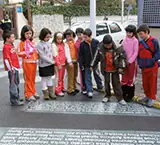
Una fila de escolares está cruzando la calzada. ¿Debe cederles el paso?
A line of schoolchildren is crossing the carriageway. Must you give way to them?
- ASolamente en los pasos para peatones.Only at pedestrian crossings.
- BNo, cuando no llevan paleta de STOP.No, if they are not carrying a STOP paddle.
- CSí.Yes.
ExplanationYou must always give way to a line of schoolchildren crossing the carriageway, whether or not they have an adult with a sign. Pedestrians who are already crossing have priority, and children are particularly vulnerable road users.
Si cree que puede quedarse detenido en una intersección, ¿qué debe hacer?
If you think you may end up stopped inside a junction, what must you do?
- APasar por la intersección rápidamente.Go through the junction quickly.
- BDetener el vehículo sólo si no tiene prioridad.Stop the vehicle only if you do not have priority.
- CDetener el vehículo antes de entrar en la intersección.Stop the vehicle before entering the junction.
ExplanationEven if they have priority, no driver may enter a junction if, because of the traffic, they may end up stopped there and block the crossing traffic (Article 59.1 of the General Traffic Regulations). You must wait before entering, not cross quickly.
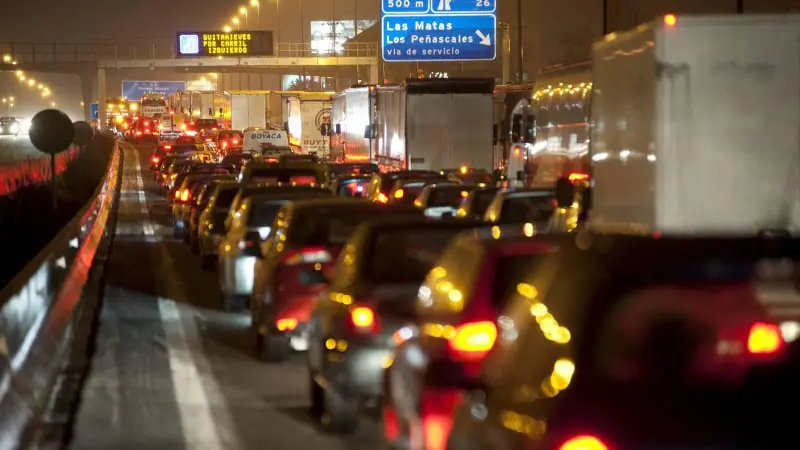
Si queda detenido en un túnel por necesidades de la circulación, ¿qué debe hacer?
If you are stopped in a tunnel because of traffic, what must you do?
- AMantener encendidas las luces de posición, y detenerse lo más lejos posible del vehículo que le preceda.Keep the sidelights on and stop as far as possible from the vehicle in front.
- BEncender, solamente, el alumbrado de emergencia.Switch on only the hazard warning lights.
- CDetenerse lo más cerca posible del vehículo que circula delante.Stop as close as possible to the vehicle in front.
ExplanationIf a vehicle is brought to a standstill inside a tunnel or underpass because of traffic: - The driver and passengers must not leave the vehicle. - In this case, the hazard warning lights must be switched on for a while to warn drivers behind. - The sidelights must be kept on. - The engine must be switched off. - The vehicle must be kept as far as possible from the vehicle in front.
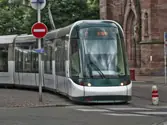
En una intersección sin señalizar, ¿está obligado un turismo a ceder el paso a un tranvía?
At a junction without signs, must a car give way to a tram?
- ANo.No.
- BSólo si se aproxima por mi derecha.Only if it approaches from my right.
- CSí.Yes.
ExplanationAt junctions where no sign controls priority, we must give way to vehicles approaching from the right, except that: - Vehicles on a paved road have priority over those coming from an unpaved road. - Vehicles running on rails, such as trams, have right of way over all other road users. - Vehicles already driving on a roundabout have right of way over those wanting to enter it. - Vehicles on a motorway or dual carriageway have priority over those wanting to join it. So in this question we must give way to the tram, whether it approaches from the right or from the left.
¿En qué circunstancias hay que ceder el paso a los ciclistas?
In what circumstances must you give way to cyclists?
- APaso de peatones.At a pedestrian crossing.
- BPaso de ciclistas.At a cycle crossing.
- CAl salir de la glorieta.When leaving the roundabout.
ExplanationAccording to Article 64.2 of the General Traffic Regulations (RGC), as worded by Royal Decree 518/2026, cyclists have right of way over other vehicles: when they are riding in a properly signed cycle lane, cycle crossing or hard shoulder; when a motor vehicle or moped turns to enter another road and there is a cyclist nearby; and when, riding in a group, the first cyclist has already started crossing or has entered a roundabout.
Al entrar en un túnel usaremos como mínimo...
When entering a tunnel, we will use at least...
- AEl alumbrado de corto alcance o cruce.The dipped headlights.
- BEl alumbrado de posición.The sidelights.
- CEl alumbrado de largo alcance.The main beam.
ExplanationWhen entering a tunnel we must use at least the dipped headlights. It is not allowed to drive through a tunnel using only the sidelights, or only the main beam.
Al averiarse un vehículo dentro de un túnel, su conductor debe…
When a vehicle breaks down inside a tunnel, its driver must…
- AAbandonar el vehículo dentro del túnel y dirigirse al refugio o salida más próximos.Leave the vehicle inside the tunnel and go to the nearest emergency shelter or exit.
- BSolicitar el auxilio de otros conductores aunque para ello tenga que transitar por la calzada.Ask other drivers for help, even if this means walking on the carriageway.
- CEsperar dentro del túnel a que venga la asistencia mecánica.Wait inside the tunnel for breakdown assistance to arrive.
ExplanationUnder Article 97 of the General Traffic Regulations, if a vehicle is immobilised by a breakdown inside a tunnel, the driver and passengers must leave it and go to the nearest emergency shelter or exit, without walking on the carriageway. If the vehicle can still move after the breakdown, you must drive out of the tunnel.
Si nos detenemos en un túnel por un atasco, ¿qué debemos hacer?
If we have to stop in a tunnel because of a traffic jam, what should we do?
- AEncender las luces de emergencia y dejar encendidas las luces de posición.Switch on the hazard warning lights and keep the sidelights on.
- BDejar encendidas las luces de cruce y apagar el motor.Keep the dipped headlights on and switch off the engine.
- CApagar el motor y las luces porque se nos agotará la batería.Switch off the engine and the lights, because otherwise the battery will run down.
ExplanationUnder Article 97.3 of the General Traffic Regulations, if the vehicle comes to a standstill inside a tunnel because of the traffic, you must switch on the hazard warning lights for a short time, keep the sidelights on and switch off the engine, without leaving the vehicle.
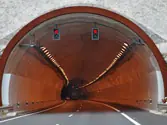
¿Qué debe hacer en esta situación?
What must you do in this situation?
- ANo entrar en el túnel.Not enter the tunnel.
- BCircular con precaución.Drive with care.
- CUtilizar el carril que está libre.Use the lane that is clear.
ExplanationNo road user may enter a tunnel or underpass when there is a red traffic light at its entrance, except emergency services, breakdown services and road maintenance crews while doing their work.
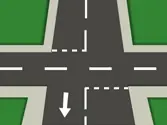
En una intersección sin señalizar, ¿deberá ceder el paso a un ciclista?
At a junction without signs, must you give way to a cyclist?
- ASí, cuando se aproxime por la derecha.Yes, when they approach from the right.
- BSí, cuando se aproxime por la izquierda.Yes, when they approach from the left.
- CSí, en las intersecciones siempre tienen prioridad los ciclistas.Yes, cyclists always have priority at junctions.
ExplanationPriority with respect to a cyclist on the carriageway is decided by applying the priority-to-the-right rule. If cyclists are riding in a group, we must treat the group as a single unit, so once the first cyclist has passed, we wait until the last one has passed before moving on. Cyclists have right of way over motor vehicles: - When they are on a properly signposted cycle lane, cycle crossing or hard shoulder. - When the motor vehicle is turning right or left to enter another road, where this is allowed, and there is a cyclist nearby. - When they are riding in a group and the first cyclist has already started crossing or has entered a roundabout.
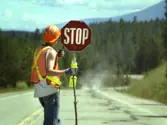
En un paso estrecho con personal de obras señalizando, ¿quién pasará primero?
At a narrow passage where road workers are directing traffic, who will go first?
- AEl que haya entrado antes.Whoever entered first.
- BEl que indique el personal de obras.Whoever the road workers indicate.
- CEl que tenga más dificultades de paso.Whoever has more difficulty getting through.
ExplanationIf there are road workers, they may control the movement of vehicles, so we must follow their instructions.
Si piensa que va a quedar detenido en el túnel más de dos minutos, ¿qué debe hacer?
If you think you will be stopped in the tunnel for more than two minutes, what must you do?
- ADar media vuelta con cuidado.Turn round carefully.
- BApagar el motor.Switch off the engine.
- CApagar las luces.Switch off the lights.
ExplanationAccording to Article 115.2 of the General Traffic Regulations, anyone who has to remain stopped in a tunnel or enclosed place for more than two minutes must switch off the engine until they can move on, keeping the sidelights on. Turning round in a tunnel is prohibited.
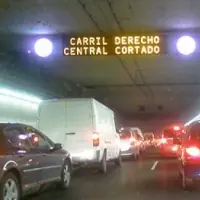
¿Qué hay que hacer si nuestro vehículo queda detenido en un túnel durante más de dos minutos?
What must you do if your vehicle is held up in a tunnel for more than two minutes?
- AApagar el motor y dejar encendido el alumbrado de posición.Switch off the engine and leave the sidelights on.
- BMantener en marcha el motor y poner en funcionamiento los dispositivos de advertencia del peligro.Keep the engine running and switch on the hazard warning devices.
- CMantener en marcha el motor y encender la luz de emergencia.Keep the engine running and switch on the hazard warning lights.
ExplanationUnder Article 115 of the General Traffic Regulations (RGC), if you have to remain stopped in a tunnel for more than two minutes, you must switch off the engine, so that fumes do not build up, and keep the sidelights on so that the vehicle can be seen.
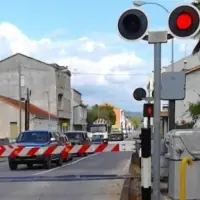
Los conductores de los vehículos que lleguen a un paso a nivel cerrado…
Drivers of vehicles arriving at a closed level crossing...
- ATienen que avisar al resto de conductores con las luces de emergencia.must warn other drivers with the hazard warning lights.
- BSe tienen que detener uno detrás de otro en el carril que corresponda.must stop one behind the other in the appropriate lane.
- CTienen que cambiar el sentido de la marcha y buscar un itinerario alternativo.must turn round and find another route.
ExplanationAll drivers who arrive at a level crossing and find it closed, or with the barrier or half-barrier moving, must stop one behind the other in the appropriate lane so that, once the barrier opens, they can continue on their usual path. It is not necessary to warn other road users that the barrier is closed by using our vehicle's hazard warning lights.
Con mi automóvil en los túneles y pasos inferiores, si dispone de más de un carril para cada sentido...
With my car in tunnels and underpasses, if there is more than one lane in each direction...
- AEstá prohibido adelantar y también parar.Overtaking is prohibited, and so is stopping.
- BEstá prohibido parar pero no adelantar.Stopping is prohibited, but overtaking is not.
- CEstá prohibido adelantar pero no parar.Overtaking is prohibited, but stopping is not.
ExplanationIn tunnels and underpasses stopping is always prohibited. Overtaking, on the other hand, is prohibited only when there is a single lane in your direction, under Article 87 of the General Traffic Regulations; with more than one lane in each direction, you may overtake.
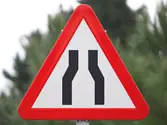
Si en un estrechamiento se encuentran un autobús y un camión no pudiendo cruzarse al mismo tiempo, ¿cuál tendrá prioridad de paso?
If a bus and a lorry meet at a narrowing and cannot pass each other at the same time, which one has right of way?
- AEl autobús.The bus.
- BEl camión.The lorry.
- CEl de mayor tamaño.The larger one.
ExplanationThe bus has right of way, because this is what the order of priority of vehicles, based on how difficult it is for them to get through, says.

Un vehículo circula por una carretera pavimentada y se encuentra en un cruce, con un vehículo que se acerca por la derecha procedente de una vía sin pavimentar. A falta de señalización, ¿qué vehículo tendrá preferencia?
A vehicle travelling on a paved road reaches a junction, where another vehicle is approaching from the right from an unpaved road. If there are no signs, which vehicle has right of way?
- AEl vehículo que circula por la vía sin pavimentar ya que viene por la derecha.The vehicle on the unpaved road, because it is coming from the right.
- BEl vehículo que circula por la vía sin pavimentar pero sólo si se trata de un vehículo de motor.The vehicle on the unpaved road, but only if it is a motor vehicle.
- CEl vehículo que circula por la carretera pavimentada.The vehicle on the paved road.
ExplanationAt junctions with no sign regulating right of way, we must give way to vehicles approaching from the right. We always apply this rule, except in the following cases: - Vehicles on a paved road have right of way over those coming from an unpaved road. - Vehicles running on rails, such as trams, have right of way over other road users. - Vehicles already on a roundabout have right of way over those wanting to enter it. - Vehicles on a motorway (autopista) or dual carriageway (autovía) have right of way over those wanting to join it.
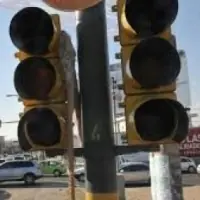
En una intersección en la que no funciona el semáforo, ¿Qué debe hacer?
At a junction where the traffic light is not working, what must you do?
- ACeder el paso a los vehículos que venga por la derecha, y extremar la precaución.Give way to vehicles coming from the right, and take extra care.
- BDetenerse porqué está prohibido el paso.Stop, because entry is prohibited.
- CPasar porque se entiende que el semáforo está en verde.Go through, because the light is taken to be green.
ExplanationWhen there are no signs or signals controlling right of way, the driver must follow the general priority rule, that is, give way to vehicles approaching from the right.
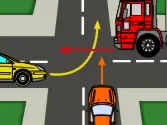
Dada la situación representada en la imagen, ¿cuál de los vehículos será el último en atravesar la intersección?
In the situation shown in the picture, which vehicle will be the last to cross the junction?
- AEl camión.The lorry.
- BEl turismo naranja.The orange car.
- CEl turismo amarillo.The yellow car.
ExplanationWithout signs, you give way to vehicles coming from the right. The lorry has no one on its right, so it goes first; then the orange car. The yellow car has the orange car on its right and, in addition, when turning left it must give way to the lorry coming from the opposite direction, so it goes last.
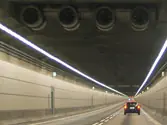
Si realizamos una detención en un paso inferior de más de 2 minutos, tendremos que...
If we stop in an underpass for more than 2 minutes, we must...
- Amantener el motor encendido y apagar las luces de posición.keep the engine running and switch off the sidelights.
- Bmantener el motor encendido y mantener las luces de posición.keep the engine running and keep the sidelights on.
- Capagar el motor y mantener encendidas las luces de posición.switch off the engine and keep the sidelights on.
ExplanationWhen stopped in a tunnel for more than 2 minutes, we must switch off the engine to avoid excess pollution and keep the sidelights on so that other vehicles can see us.
En un túnel, ¿debes encender la radio en la frecuencia indicada?
In a tunnel, must you tune the radio to the frequency shown?
- ANo, es opcionalNo, it is optional
- BSí, cuando esté señalizado, para recibir mensajes de emergenciaYes, when signposted, to receive emergency messages
- CSolo en túneles largosOnly in long tunnels
ExplanationIn tunnels where this is shown, you must tune in to the radio frequency given, so that you can receive any emergency warnings or instructions from the tunnel control centre.
¿Qué debes hacer en un cruce señalizado con una señal de STOP?
What must you do at a junction with a STOP sign?
- ADetenerse solo si se aproximan vehículos por la derecha.Stop only if vehicles are approaching from the right.
- BDetenerse y ceder el paso a todos los vehículos que se aproximen por ambos lados.Stop and give way to all vehicles approaching from either side.
- CDetenerse solo si se aproximan vehículos por la izquierda.Stop only if vehicles are approaching from the left.
ExplanationThe mandatory stop sign, or STOP sign, requires you to come to a complete stop and give way to vehicles on the priority road, whichever side they are approaching from (Article 56.5 of the General Traffic Regulations).
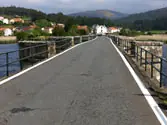
Si en un estrechamiento sin señalizar se encuentran un turismo con remolque de hasta 750 kg y un camión, no pudiéndose cruzar a la vez, ¿qué vehículo pasará primero?
If a car with a trailer of up to 750 kg and a lorry meet at a narrowing without signs and cannot pass each other at the same time, which vehicle goes first?
- AEl camión.The lorry.
- BEl turismo con remolque.The car with a trailer.
- CEl de más masa máxima autorizada.The one with the greater maximum authorised mass.
ExplanationIf 2 vehicles meet at a narrowing without signs and it is not known which one entered first, the order of priority gives a car with a trailer right of way ahead of a lorry. It is important to memorise this order of priority so you can answer these exam questions.
Circula por poblado y entra en un túnel suficientemente iluminado. ¿Debe llevar alguna luz encendida?
You are driving in a built-up area and enter a sufficiently lit tunnel. Must you have any lights on?
- ANo, no es necesario.No, it is not necessary.
- BSí, las luces de posición solamente.Yes, only the sidelights.
- CSí, las luces de posición y cruce.Yes, the sidelights and dipped headlights.
ExplanationAccording to Article 101.1 of the General Traffic Regulations, at any time of day, when driving through sufficiently lit tunnels, underpasses and stretches covered by the 'Tunnel' sign, you must have your sidelights and your dipped (short-range) headlights on. It makes no difference that you are in a built-up area or that the tunnel is well lit.
Si en un estrechamiento sin señalizar se encuentran por un lado un turismo y por el otro una motocicleta, no pudiendo pasar a la vez, ¿cuál tendrá prioridad de paso?
If a car on one side and a motorcycle on the other meet at a narrowing without signs and cannot pass at the same time, which one has right of way?
- ALa motocicleta.The motorcycle.
- BEl turismo.The car.
- CEl vehículo que tenga mayor facilidad de paso.The vehicle that can get through more easily.
ExplanationIf there are no signs regulating who goes first and it is not known whether one of them entered first, the vehicle that has more difficulty getting through has right of way, in this case the car.
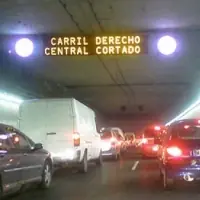
Si queda detenido en el interior de un túnel más de dos minutos…
If you are stopped inside a tunnel for more than two minutes...
- ADebe encender las luces de emergencia.You must switch on the hazard warning lights.
- BDebe apagar el motor y las luces.You must switch off the engine and the lights.
- CDebe apagar el motor y dejar el alumbrado de posición encendido.You must switch off the engine and leave the sidelights on.
ExplanationIf the vehicle is stopped in a tunnel for more than two minutes, you must switch off the engine until you can move on and keep the sidelights on (Article 115 of the General Traffic Regulations). Switching off all the lights would stop others from seeing it.
¿Qué debe hacer el conductor si su vehículo queda inmovilizado en un paso inferior por una emergencia?
What must the driver do if their vehicle is brought to a standstill in an underpass because of an emergency?
- APermanecer en el interior del vehículo.Stay inside the vehicle.
- BInmovilizar el vehículo lo más cerca posible del borde izquierdo de la calzada.Bring the vehicle to a standstill as close as possible to the left-hand edge of the carriageway.
- CSolicitar auxilio desde el poste de socorro más cercano, si existe.Call for help from the nearest SOS post, if there is one.
ExplanationAccording to Article 97.3 of the General Traffic Regulations (RGC), if you are brought to a standstill by an emergency in a tunnel or underpass, you must call for help without delay from the nearest SOS post, if there is one. The vehicle is stopped next to the right-hand edge, and the occupants leave it and go to the shelter or exit.
Si su vehículo se avería dentro de un túnel…
If your vehicle breaks down inside a tunnel…
- Aesperará dentro del vehículo en todo caso.you will wait inside the vehicle in all cases.
- Bsolicitará ayuda a los conductores.you will ask other drivers for help.
- Cabandonará el vehículo y se dirigirá al refugio más próximo.you will leave the vehicle and go to the nearest emergency shelter.
ExplanationIf the breakdown prevents you from continuing inside a tunnel, after stopping the vehicle, marking it and calling for help from the SOS post, the occupants must leave it and go to the nearest emergency shelter or exit. If the breakdown still allows you to drive, you must carry on until you are out of the tunnel.
En las glorietas, ¿qué vehículos tendrán prioridad de paso?
At roundabouts, which vehicles have right of way?
- ALos vehículos que acceden a ella.Vehicles entering it.
- BLos vehículos que se hallen dentro de la vía circular.Vehicles already on the circular carriageway.
- CLos vehículos que tengan su derecha libre.Vehicles that have a clear right-hand side.
ExplanationVehicles already travelling round a roundabout have priority over those that want to enter it.
Si estamos circulando por una pendiente descendente y en un estrechamiento nos encontramos con otro vehículo que sube, ¿quien pasará primero?
If we are driving downhill and meet another vehicle coming uphill at a narrowing, who goes first?
- ANosotros.We do.
- BEl vehículo que sube.The vehicle coming uphill.
- CEl vehículo que tenga mayor dificultad de paso.The vehicle that has more difficulty getting through.
ExplanationOn steep stretches, when 2 vehicles cannot pass each other at the same time, the vehicle going uphill has right of way.
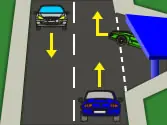
Al salir de un garaje a la vía pública, ¿a qué vehículos debemos ceder el paso?
When coming out of a garage onto a public road, which vehicles must we give way to?
- ASólo a los que se acerquen por la derecha.Only to those approaching from the right.
- BSólo a los que se acerquen por la izquierda.Only to those approaching from the left.
- CA los que se acerquen tanto por la derecha como por la izquierda.To those approaching both from the right and from the left.
ExplanationWhenever a driver comes out onto a public road from a purely private road, from a service area or from an adjoining property, they must make sure they can do so without danger and do it at a speed that allows them to stop at once, giving way to vehicles travelling on that road, whichever direction they are travelling in. So a vehicle joining the traffic from a garage must give way both to the right and to the left.
Si por necesidades de la circulación un vehículo queda detenido en un túnel durante más de 2 minutos, su conductor deberá...
If, because of traffic, a vehicle is stopped in a tunnel for more than 2 minutes, its driver must...
- ADejar encendida la señal de emergencia.Leave the hazard warning lights on.
- BDejar encendida la señal de emergencia junto con las luces de posición.Leave the hazard warning lights on, together with the sidelights.
- CDejar encendida la señal de emergencia junto con las luces de posición, y además apagar el motor.Leave the hazard warning lights on, together with the sidelights, and also switch off the engine.
ExplanationIf, because of traffic, a vehicle is brought to a standstill in a tunnel, the driver must switch on the hazard warning lights, keep the sidelights on and switch off the engine.
Si pongo el intermitente, ¿siempre tengo prioridad para hacer una maniobra?
If I switch on my indicator, do I always have priority to make a manoeuvre?
- ASí, pero debo hacer la maniobra rápidamente.Yes, but I must make the manoeuvre quickly.
- BNo.No.
- CSí, porque he avisado.Yes, because I have given a warning.
ExplanationSwitching on the indicator does not automatically give you priority to make a manoeuvre. Under Article 108 of the General Traffic Regulations, drivers must signal their manoeuvres, but this does not mean they have priority over other road users. You must give way and make manoeuvres safely: the indicator only shows your intention to change direction or make a manoeuvre, and it does not free you from checking that the road is clear to do it.
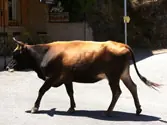
Este animal dispone de cañada, ¿debe cederle el paso?
This animal has a livestock route (cañada). Must you give way to it?
- ASí.Yes.
- BNo, porque es un animal.No, because it is an animal.
- CSí, porque ya está cruzando la vía.Yes, because it is already crossing the road.
ExplanationAs a general rule, drivers have right of way over animals, except in the following cases: - On properly signposted livestock routes (cañadas). - When drivers are turning to enter another road and there are animals crossing it, even if there is no crossing for them. - When the vehicle crosses a hard shoulder on which animals are moving and there is no livestock route for them. General livestock routes or crossings are signposted with additional panels saying CAÑADA, placed under the domestic animals warning sign. In this question, it is stated explicitly that there is a livestock route, so the animal clearly has priority.
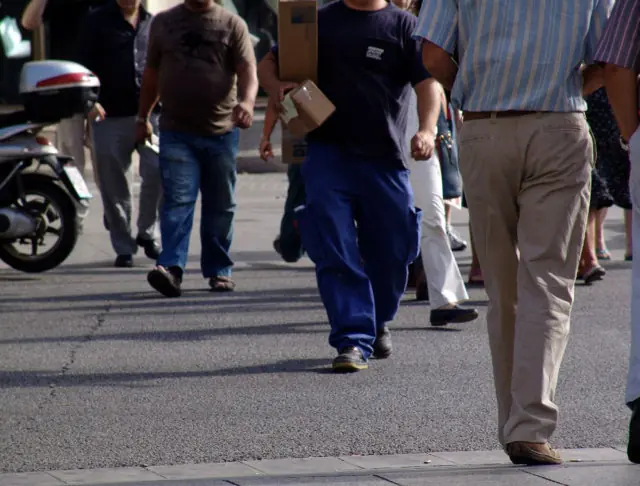
¿Cuándo tienen preferencia los peatones?
When do pedestrians have priority?
- ACuando bajan de cualquier vehículo.When they get out of any vehicle.
- BEn las vías urbanas.On urban roads.
- CEn las zonas peatonales.In pedestrian zones.
ExplanationPedestrians have priority in pedestrian zones, on marked pedestrian crossings and on pavements. When getting out of a vehicle, they only have it if it is a public transport vehicle stopped at a marked stop, not when getting out of any vehicle.
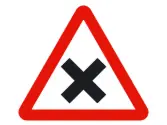
En una intersección así señalizada...
At a junction with this sign...
- ATendremos prioridad de paso.we will have right of way.
- BCederemos el paso tanto a los vehículos que vengan por la derecha como por la izquierda.we will give way to vehicles coming both from the right and from the left.
- CCeder el paso a los vehículos que vengan por la derecha.we will give way to vehicles coming from the right.
ExplanationThe sign in the question warns of a junction ahead where the general priority rule applies, so vehicles coming from the right have priority and we must give way to them.
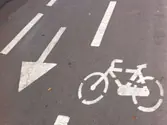
Circula con su turismo por una vía que se cruza con un carril-bici;¿debe ceder el paso a los ciclistas?
You are driving your car on a road that crosses a cycle lane. Must you give way to cyclists?
- ANo.Los ciclistas no tienen prioridad de paso frente a los vehículos de motor.No. Cyclists do not have right of way over motor vehicles.
- BSí, siempre.Yes, always.
- CSólo cuando los ciclistas se aproximen por su derecha.Only when the cyclists are approaching from your right.
ExplanationCyclists have right of way over motor vehicles: - When they are riding on a properly signed cycle lane, cyclist crossing or hard shoulder. - When a vehicle turns right or left to enter another road, where this is allowed, and there is a cyclist nearby. - When riding in a group, if the first cyclist has already started crossing or has entered a roundabout. When cyclists ride in a group, they are treated as a single moving unit for right of way purposes. In all other cases the general right of way rules between vehicles apply.
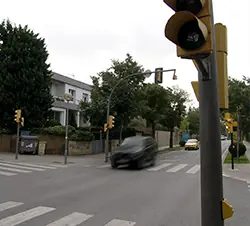
En este paso para peatones, si no funciona el semáforo, ¿es obligatorio ceder el paso a los peatones que intenten cruzar?
At this pedestrian crossing, if the traffic light is not working, is it compulsory to give way to pedestrians trying to cross?
- ASí, porque los peatones tienen prioridad de paso.Yes, because pedestrians have right of way.
- BNo, porque los vehículos tienen prioridad de paso.No, because vehicles have right of way.
- CSólo si quien intenta cruzar es una fila de escolares.Only if those trying to cross are a line of schoolchildren.
ExplanationIf the traffic light is not working, the pedestrian crossing still applies: at properly marked crossings pedestrians have priority and drivers must give way to them.
Al salir a la vía pública desde un garaje particular, ¿a qué vehículos cederemos el paso?
When coming out of a private garage onto a public road, which vehicles must we give way to?
- ASólo a los vehículos que se aproximen por la derecha.Only to vehicles approaching from the right.
- BSólo a los vehículos que se aproximen por la izquierda.Only to vehicles approaching from the left.
- CTanto a los vehículos que se aproximen por la derecha como por la izquierda.To vehicles approaching both from the right and from the left.
ExplanationWhen joining a public road we must give way to vehicles approaching both from the right and from the left.
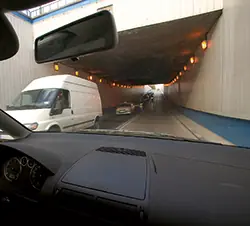
Circulando por un paso inferior, su vehículo sufre una avería que no le impide continuar la marcha; ¿qué debe hacer?
While driving through an underpass, your vehicle has a breakdown that does not stop you from continuing. What should you do?
- AApagar el motor y conectar las luces de emergencia.Switch off the engine and switch on the hazard warning lights.
- BDetener el vehículo, salir de él y dirigirse a la salida del paso inferior.Stop the vehicle, get out and walk to the exit of the underpass.
- CContinuar circulando hasta salir del paso inferior, siempre que sea posible.Keep driving until you are out of the underpass, whenever possible.
ExplanationIf the breakdown allows you to continue, the safest thing is to leave the underpass before stopping: inside there is little visibility and space, and a stopped vehicle creates a serious risk of a rear-end collision.
Se facilitará el paso a un vehículo prioritario que circula en servicio de urgencia...
You should make way for a priority vehicle on an emergency call...
- ATomando las medidas adecuadas según las circunstancias.by taking the appropriate measures according to the circumstances.
- BApartándose siempre hacia la derecha de la calzada.by always pulling over to the right of the carriageway.
- CDeteniendo siempre el vehículo en el lado izquierdo de la calzada.by always stopping the vehicle on the left of the carriageway.
ExplanationUnder Article 69 of the General Traffic Regulations, on noticing the signals of a priority vehicle, other drivers take the appropriate measures according to the circumstances to let it through: normally moving to the right or stopping if necessary, but not always in the same way.
Si en un túnel nos vemos obligados a abandonar nuestro vehículo a causa de un incendio, ¿cómo lo haremos?
If we have to leave our vehicle in a tunnel because of a fire, how should we do it?
- ACerraremos el vehículo dejando las luces encendidas.We lock the vehicle and leave the lights on.
- BArrimaremos el vehículo a la derecha de la calzada dejando el motor en marcha.We pull over to the right of the carriageway and leave the engine running.
- CApagaremos el motor, dejaremos las llaves puestas y las puertas abiertas.We switch off the engine, leave the keys in and the doors open.
ExplanationIf there is a fire in a tunnel, we pull over to the right, switch off the engine, leave the keys in and the doors open, and go to the nearest emergency shelter or exit.
Si por necesidades de la circulación, por ejemplo debido a una congestión de tráfico, su vehículo queda inmovilizado en el interior de un túnel o paso inferior, Ud. debe...
If, because of traffic conditions such as a traffic jam, your vehicle is brought to a standstill inside a tunnel or underpass, you must...
- AApagar el motor y todas las luces del vehículo.Switch off the engine and all the vehicle's lights.
- BAbandonar el vehículo así como también los pasajeros que viajen en el mismo.Leave the vehicle, and so must the passengers travelling in it.
- CApagar el motor, mantener encendidas las luces de posición, conectar temporalmente la señal de emergencia para avisar a otros conductores que circulen detrás y detenerse lo más lejos posible del vehículo que le precede.Switch off the engine, keep the sidelights on, briefly switch on the hazard warning lights to warn drivers behind, and stop as far as possible from the vehicle in front.
ExplanationSwitching off the engine, keeping the sidelights on and switching on the hazard warning lights is correct because it lets other drivers see your vehicle and know that there is a problem. This helps prevent accidents. Stopping as far as possible from the vehicle in front is also important, to keep a safe distance and avoid collisions.
Si por necesidades de la circulación se queda detenido por tiempo prolongado en el interior de un túnel, deberá….
If, because of traffic, you are held up for a long time inside a tunnel, you must…
- AApagar el motor, dejando encendidas las luces de posición y de emergencia.Switch off the engine, leaving the sidelights and hazard warning lights on.
- BApagar el motor y las luces.Switch off the engine and the lights.
- CAbandonar el vehículo.Leave the vehicle.
ExplanationIf you are held up for a long time in a tunnel because of congestion, you must switch off the engine and keep the sidelights on, as well as the hazard warning lights to warn those arriving behind you. You must not leave the vehicle.
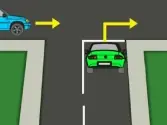
¿Qué vehículo tendrá prioridad en esta intersección?
Which vehicle has right of way at this junction?
- AEl que llegue primero a la intersección.Whichever reaches the junction first.
- BEl vehículo azul.The blue vehicle.
- CEl vehículo verde.The green vehicle.
ExplanationUnder the general right-of-way rule, the vehicle with a clear right-hand side goes first. In this case the green vehicle has nobody on its right, so the blue vehicle must give way to it. Do not be misled by the solid stop line: unless it comes with a STOP sign, a traffic light or a give way sign, it does not change the general right-of-way rule at all. It only shows us where to stop if we have to.
Si en un paso estrecho se encuentran un vehículo de tracción animal y un turismo, ¿cuál de ellos tendrá preferencia de paso?
If an animal-drawn vehicle and a car meet at a narrow passage, which of them has right of way?
- AEl turismo por tener más facilidad de maniobra.The car, because it can manoeuvre more easily.
- BEl vehículo de tracción animal por tener más dificultad de maniobra.The animal-drawn vehicle, because it has more difficulty manoeuvring.
- CEl vehículo que haya recorrido más distancia dentro del estrechamiento.The vehicle that has travelled further inside the narrowing.
ExplanationAccording to the order of priority between vehicles at a narrowing, the animal-drawn vehicle has right of way over the car, because it is considered to have more difficulty manoeuvring.
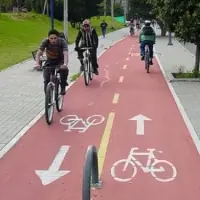
Los conductores de bicicletas tienen prioridad de paso respecto de los vehículos de motor...
Cyclists have right of way over motor vehicles…
- AEn todas las intersecciones.At all junctions.
- BCuando circulan por un paso para ciclistas.When they are riding on a cycle crossing.
- CEn las zonas de peatones debidamente señalizadas.In properly signed pedestrian zones.
ExplanationCyclists have right of way over motor vehicles when they are riding on a properly signed cycle lane, cycle crossing or hard shoulder; when a vehicle is turning into another road and there is a cyclist nearby; and when they are riding in a group and the first cyclist has already started to cross (Article 64 of the General Traffic Regulations).
En una intersección sin señalización, ¿está obligado un turismo a ceder el paso a un tranvía?
At an unmarked junction, must a car give way to a tram?
- ANo.No.
- BSolo si se aproxima por la derecha.Only if it is approaching from the right.
- CSí.Yes.
ExplanationAt an unmarked junction, Article 57 of the General Traffic Regulations states that vehicles must give way to vehicles approaching from the right, with some exceptions. However, vehicles running on rails, such as trams, always have priority over other vehicles. So in this situation a car must give way to a tram, which makes the correct answer «Yes».
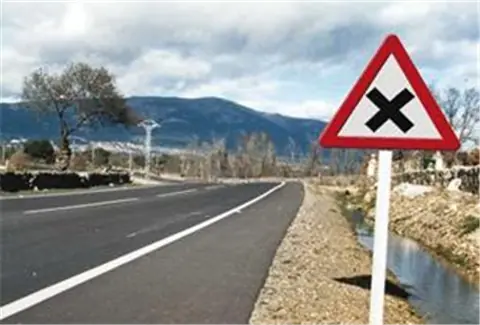
En la próxima intersección y según la señal, ¿debe ceder el paso?
According to the sign, must you give way at the next junction?
- ANo, la señal indica que tiene prioridad en el cruce.No, the sign shows that you have priority at the junction.
- BSí, a los vehículos que se aproximen tanto por la derecha como por la izquierda.Yes, to vehicles approaching from both the right and the left.
- CSí, a los vehículos que se aproximen por la derecha.Yes, to vehicles approaching from the right.
ExplanationThis sign warns of a junction where the general priority rule applies: you must give way to vehicles approaching from the right. It does not mean that you have priority, nor does it require you to give way to those coming from the left.
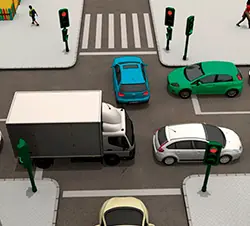
¿Debe entrar en una intersección en una situación en la que el tráfico esté tan saturado que, al detenerse, posiblemente obstaculice la circulación transversal?
Should you enter a junction when traffic is so congested that, if you stop, you will probably block cross traffic?
- ASólo si conduce un vehículo de servicio público, como un taxi.Only if you are driving a public service vehicle, such as a taxi.
- BSí, siempre que tenga prioridad de paso.Yes, as long as you have right of way.
- CNo, aunque tenga prioridad de paso.No, even if you have right of way.
ExplanationEven if you have right of way, it is prohibited to enter a junction if the traffic situation will force you to stop inside it and block cross traffic: right of way does not entitle you to block the junction.
All topics
- Definitions
- Documents and penalty points
- The driver's condition
- Duties of drivers and pedestrians
- Vehicle safety devices
- Vehicle controls and equipment
- Vehicle lights and horn
- Traffic signs, markings and signals
- The road and its lanes
- Speed and distances
- Manoeuvres
- Carrying passengers and loads
- Driving safely in difficult conditions
- Vehicle mechanics and maintenance
- Road accidents and first aid
- Defensive and eco-driving
Independent app: not affiliated with or endorsed by the DGT (Spain's Directorate-General for Traffic) or the Ministry of the Interior. The official exam is booked with the DGT and taken at its test centres. The questions here are practice material; the DGT's official question bank is not public.
Basado en datos de la Agencia Estatal Boletín Oficial del Estado (https://www.boe.es). Textos consolidados de carácter meramente informativo. La AEBOE no patrocina ni respalda este sitio.
Parte de las preguntas procede de los tests de la revista «Tráfico y Seguridad Vial» de la DGT, reproducidos con indicación de la fuente.