
DGT test · 574 questions
Carrying passengers and loads · Page 10 of 12
Passengers, children, loads and trailers: what you may carry and how it must be secured and marked.
Questions in this topic, with answers
574 questions, 50 per page, with the correct answer and the explanation. Page 10 of 12.
¿Qué requisitos debe reunir todo conductor de transporte de menores?
What requirements must every driver of vehicles carrying children meet?
- ASer titular del permiso de conducción correspondiente al vehículo y figurar inscrito en un registro especial.Hold the driving licence for the vehicle and be entered in a special register.
- BSer titular del permiso de conducción correspondiente al vehículo y de la autorización de transporte pertinente.Hold the driving licence for the vehicle and the relevant transport authorisation.
- CLlevar debidamente formalizados el permiso de circulación y el seguro obligatorio de viajeros, además de figurar inscrito en el registro de conductores e infractores.Carry the vehicle registration certificate and the compulsory passenger insurance, properly completed, and be entered in the register of drivers and offenders.
ExplanationA driver of vehicles carrying children must hold the driving licence for the vehicle and be entered in a special register. This is needed to make sure the driver meets the legal and safety requirements for this type of transport.
Un vehículo que supera la masa máxima autorizada (MMA), ¿tiene permitida la circulación?
Is a vehicle that exceeds its maximum authorised mass (MAM) allowed on the road?
- ANo, porque es peligroso.No, because it is dangerous.
- BSí, pero solo cuando transporte equipaje y personas dentro de poblado.Yes, but only when carrying luggage and people in a built-up area.
- CSí, cuando el vehículo esté destinado al transporte de mercancías.Yes, when the vehicle is intended for carrying goods.
ExplanationNo vehicle may be driven above its maximum authorised mass, which is the highest mass at which it can travel safely. Excess weight lengthens braking, overloads the tyres and suspension and reduces stability, and it is penalised.
¿Qué altura máxima tendrá un autobús?
What is the maximum height of a bus?
- A4 metros, incluida la carga.4 metres, including the load.
- B4 metros, exceptuando la carga.4 metres, not including the load.
- C4,55 metros.4.55 metres.
ExplanationThe maximum height of a bus is 4 metres, including the load. Going above this height can make the vehicle less stable and cause traffic problems. It is important to keep to this limit for road safety.
¿Puede la carga de un turismo sobresalir por los laterales?
Can a car's load stick out at the sides?
- ASí, si el ancho total del vehículo cargado no supera 2,55 m.Yes, if the total width of the loaded vehicle is not more than 2.55 m.
- BSí, hasta 0,40 m por cada lateral.Yes, up to 0.40 m on each side.
- CNo.No.
ExplanationArticle 15 of the General Traffic Regulations prohibits the load from sticking out beyond the vehicle's outline seen from above. In vehicles not used exclusively for carrying goods, such as a car, the load may only stick out at the rear (10%, or 15% if it is indivisible), never at the sides.
Antes de proceder a la carga y descarga del vehículo...
Before loading or unloading the vehicle...
- AÉste debe estar correctamente inmovilizado, utilizando calzos en las ruedas si fuera necesario.It must be properly immobilised, using wheel chocks if necessary.
- BÚnicamente debe estar apagado el motor.Only the engine must be switched off.
- CÚnicamente debe estar inmovilizado el vehículo.Only the vehicle must be immobilised.
ExplanationWhen loading or unloading the vehicle, it must be properly immobilised for safety. This means using wheel chocks if necessary, as well as switching off the engine and disconnecting the ignition.
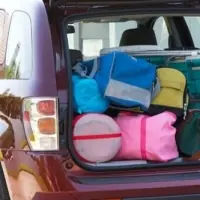
¿Está permitido dejar abiertos las puertas o el maletero para aumentar la capacidad de carga?
Is it allowed to leave the doors or the boot open to increase the load capacity?
- ALas puertas no, pero el maletero sí, si se mantiene tan cerrado que la carga no pueda caer fuera.Not the doors, but the boot yes, if it is kept closed enough that the load cannot fall out.
- BNo, excepto en los vehículos que están destinados al transporte de mercancías.No, except on vehicles intended for carrying goods.
- CNo.No.
ExplanationIt is prohibited to drive with the doors or the tailgate open, because the load could fall out and the vehicle becomes less safe (Article 114 of the General Traffic Regulations). If the load does not fit, you must use a suitable means, such as a trailer or a roof rack.
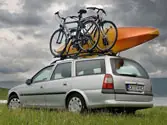
En un turismo, la carga podrá sobresalir por detrás como máximo...
In a car, the load may stick out at the back by at most...
- Aun 20% de la longitud del vehículo.20% of the vehicle's length.
- Bun 15% de la longitud del vehículo.15% of the vehicle's length.
- C1/3 de la longitud del vehículo.1/3 of the vehicle's length.
ExplanationIn a car, the load may stick out at the back by at most 10% if it is divisible, or 15% if it is indivisible.
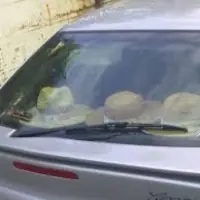
¿Es recomendable llevar objetos sueltos en la bandeja trasera?
Is it advisable to carry loose objects on the rear parcel shelf?
- ASi, excepto en los vehículos de gran tonelaje dónde esta desaconsejadoYes, except in heavy vehicles, where it is not advised
- BNo, está totalmente desaconsejadoNo, it is strongly advised against
- CSi, siempre que no superen los 2 kg o los 5 objetosYes, as long as they weigh no more than 2 kg or there are no more than 5 objects
ExplanationCarrying loose objects on the rear parcel shelf of any type of vehicle is strongly advised against, whatever their weight, because in a sharp turn they can fly forward and hit the driver or passengers. All objects and packages we carry should be placed in the boot, or on the roof rack if there is no space.
¿Puede sobresalir la carga por la parte anterior en un turismo?
Can the load stick out at the front of a car?
- ANo, está prohibido.No, it is prohibited.
- BSí, un 10 % de la longitud del vehículo si la carga es divisible.Yes, by 10% of the vehicle's length if the load is divisible.
- CSí, un 10% de la longitud de la carga si la carga es divisible.Yes, by 10% of the load's length if the load is divisible.
ExplanationIn vehicles not intended exclusively for carrying goods, such as a car, Article 15 of the General Traffic Regulations only allows the load to stick out at the rear. It may never stick out at the front.
Si usted conduce un turismo con remolque, ¿tendrá que llevar el seguro del remolque?
If you drive a car with a trailer, must the trailer be insured?
- ASí, si el remolque es de hasta 750 kg de M.M.A.Yes, if the trailer's MAM is up to 750 kg.
- BNo, si el remolque es de hasta 750 kg de M.M.A.No, if the trailer's MAM is up to 750 kg.
- CNo.No.
ExplanationLight trailers, with a MAM of up to 750 kg, do not have to be insured. If the trailer's MAM is more than 750 kg, it must be insured.
¿Cuántos extintores suplementarios deberá llevar un vehículo dedicado al transporte de mercancías peligrosas cuya MMA es superior a 7,5 toneladas?
How many additional fire extinguishers must a vehicle carrying dangerous goods with a MAM of more than 7.5 tonnes carry?
- AUno o varios extintores con polvo abc, con una capacidad mínima total de 8 kg, de los que al menos uno deberá tener una capacidad mínima de 6 kg.One or more ABC powder extinguishers with a minimum total capacity of 8 kg, at least one of which must have a minimum capacity of 6 kg.
- BUno o varios extintores, adaptados a las clases de inflamabilidad abc con una capacidad mínima total de 12 kg de polvo, si son varios, al menos, uno será de 6 kg.One or more extinguishers suitable for fire classes A, B and C with a minimum total capacity of 12 kg of powder; if there are several, at least one must hold 6 kg.
- CUno o varios extintores de polvo abc, con una capacidad mínima de 6 kg de polvo.One or more ABC powder extinguishers with a minimum capacity of 6 kg of powder.
ExplanationA vehicle carrying dangerous goods with a MAM of more than 7.5 tonnes must carry one or more extinguishers suitable for fire classes A, B and C with a minimum total capacity of 12 kg of powder. If there are several extinguishers, at least one of them must have a minimum capacity of 6 kg.
Si en un vehículo que transporta explosivos se produce un incendio que no afecta a la carga...
If a fire breaks out on a vehicle carrying explosives and it does not affect the load...
- ANo se debe intervenir en ningún caso.You must not intervene in any case.
- BSe debe intervenir si existen posibilidades de apagarlo.You must intervene if there is a chance of putting it out.
- CSe deben utilizar extintores de agua, nunca de polvo seco.You must use water extinguishers, never dry powder.
ExplanationYou must intervene if there is a chance of putting the fire out: on a vehicle carrying explosives it is important to act to stop the fire from spreading and causing an explosion. However, you must first assess the situation and make sure you have the right means to put out the fire safely.
En un ciclomotor, ¿cuánto podrá sobresalir la carga lateralmente?
On a moped, how far may the load stick out at the sides?
- A0,50 metros a cada lado de su eje longitudinal.0.50 metres on each side of its longitudinal axis.
- B0,25 metros a cada lado de su eje longitudinal.0.25 metres on each side of its longitudinal axis.
- C0,40 a cada lado de su eje longitudinal.0.40 on each side of its longitudinal axis.
ExplanationOn vehicles less than 1 metre wide, the load may stick out 0.50 metres on each side of the longitudinal axis, not at all at the front, and 0.25 m at the back.
Si una carga sobresale por la parte trasera de un coche, ¿debe señalizarse?
If a load sticks out at the back of a car, must it be signalled?
- ASí, tanto de día como de noche.Yes, both by day and by night.
- BSí, pero solo de noche o cuando haya condiciones meteorológicas que reduzcan notablemente la visibilidad.Yes, but only at night or when weather conditions noticeably reduce visibility.
- CNo, porque no es un vehículo destinado exclusivamente al transporte de mercancías.No, because it is not a vehicle used only for carrying goods.
ExplanationAccording to the General Traffic Regulations (RGC) in Spain, when a load sticks out at the back of a car or any other vehicle, it must be properly signalled both by day and by night. This is to ensure road safety and to make sure that other drivers can clearly see the size of the vehicle and react properly to it on the road.
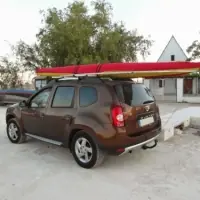
En un vehículo no destinado exclusivamente al transporte de mercancías, la carga puede sobresalir por la parte posterior...
On a vehicle not intended exclusively for carrying goods, the load may stick out at the rear…
- AHasta un 10 % de la longitud del vehículo, y si la carga es indivisible, hasta un 15 %.By up to 10% of the vehicle's length, and if the load is indivisible, by up to 15%.
- BHasta un 15 % de la longitud del vehículo, siempre.By up to 15% of the vehicle's length, always.
- CHasta un 10 % de la anchura del vehículo.By up to 10% of the vehicle's width.
ExplanationUnder Article 15 of the General Traffic Regulations, on vehicles not intended exclusively for carrying goods, such as a car, the load may stick out at the rear by up to 10% of the vehicle's length, or 15% if it is indivisible.
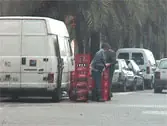
¿Es correcto que un conductor deposite la carga en la calzada, para organizar su traslado al punto de destino?
Is it correct for a driver to put the load on the carriageway to organise moving it to its destination?
- ANo, depositar la carga en la calzada, o en la acera, está prohibido.No, putting the load on the carriageway or the pavement is prohibited.
- BSí, mientras no interrumpa la circulación..Yes, as long as it does not interrupt traffic.
- CSí, pero durante un tiempo inferior a dos minutos.Yes, but for less than two minutes.
ExplanationNo. Loading and unloading must be done off the road and, if it is unavoidable to do it on the road, it is prohibited to put the goods on the carriageway, the hard shoulder or pedestrian areas (Article 16 of the General Traffic Regulations), even for a moment.
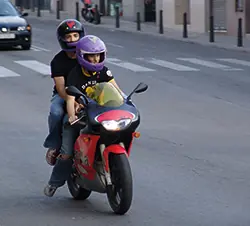
¿Cómo debe sentarse el pasajero de una motocicleta?
How must a motorcycle passenger sit?
- ADe cualquier forma, siempre que vaya cómodo.In any way, as long as they are comfortable.
- BA horcajadas y con los pies apoyados en los reposapiés laterales.Astride, with their feet on the side footrests.
- CA horcajadas entre la persona que conduce y el manillar de dirección.Astride, between the rider and the handlebars.
ExplanationThe Regulations require a motorcycle passenger to sit astride, behind the rider, with their feet on the side footrests: this way they do not interfere with the riding or unbalance the vehicle.
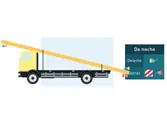
En cuanto a las condiciones de la carga, esta deberá estar dispuesta de forma que...
Regarding how a load is carried, it must be arranged so that...
- AOcupe el menor espacio posible.It takes up as little space as possible.
- BNo sobresalga en ningún caso.It never sticks out.
- CQue quede correctamente distribuida en el vehículo, y sujeta, de forma que se evite su desplazamiento.It is properly distributed in the vehicle and secured so that it cannot shift.
ExplanationAmong other conditions, a vehicle's load must be properly distributed according to the vehicle's characteristics and secured so that it cannot shift or fall off, fully or partly.
Un vehículo de hasta 3.500 kg de MMA dedicado al transporte de mercancías pasará la primera ITV...
A goods vehicle with a MAM of up to 3,500 kg must have its first vehicle inspection (ITV)...
- AA los dos años.At two years.
- Ba los cuatro años.At four years.
- CA los cinco años.At five years.
ExplanationGoods vehicles of up to 3,500 kg have their first ITV at two years. The next ITV is two years later, and the third also two years after that. After that, every year once the vehicle is more than six years old, and every six months once it is more than ten years old.
¿Cuánto podrá sobresalir la carga por la parte delantera en un vehículo mixto adaptable?
How far may the load stick out at the front of an adaptable mixed-use vehicle?
- A1/3 de la longitud del vehículo.1/3 of the vehicle's length.
- B2 metros.2 metres.
- CNada.Not at all.
ExplanationIn an adaptable mixed-use vehicle, the load must not stick out at the front; it may only stick out at the back, by a maximum of 15%.
Un turismo transporta una carga indivisible. ¿Puede sobresalir por la parte trasera?
A car is carrying an indivisible load. May it stick out at the rear?
- ASí, hasta un 10% de la longitud del vehículo como máximo.Yes, by up to 10% of the vehicle's length at most.
- BSí, hasta un 15% de la longitud del vehículo.Yes, by up to 15% of the vehicle's length.
- CNo, en los turismos no puede sobresalir la carga,No, on cars the load may not stick out,
ExplanationIn a car, an indivisible load, such as a pipe or a ladder, may stick out at the rear by up to 15% of the vehicle's length; a divisible one, only 10%. It must also be marked with the V-20 panel.
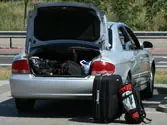
Si no podemos colocar la totalidad del equipaje en el maletero, ¿podemos hacerlo en el interior del habitáculo?
If we cannot fit all the luggage in the boot, may we put it inside the passenger compartment?
- ASí, pero teniendo en cuenta que no moleste a los viajeros, reste libertad de movimientos o disminuya el campo de visión del conductor y además vaya bien sujeto.Yes, but it must not disturb the passengers, restrict the driver's freedom of movement or reduce the driver's field of vision, and it must also be well secured.
- BSí, sólo en el caso que sean cajas pequeñas, de poco peso y no haya ocupantes en el asiento trasero.Yes, only if it is small, light boxes and there is no one in the rear seat.
- CNo, el equipaje sólo podrá colocarse en el maletero, la baca o en un remolque pequeño.No, luggage may only go in the boot, on the roof rack or in a small trailer.
ExplanationIf the load does not fit in the boot, it may go inside the vehicle, as long as it does not interfere with the driver's view or movements. We must also remember that if the vehicle hits a rigid object, it will stop suddenly, but a load that is not properly secured will keep moving at the speed the vehicle had before the impact, with harmful consequences for the occupants.
Si no usas la baca del coche, ¿es recomendable quitarla?
If you are not using your car's roof rack, is it advisable to remove it?
- ANo, la baca aumenta la estabilidad del coche.No, the roof rack increases the car's stability.
- BSí, porque sin la baca se ahorra combustible.Yes, because without the roof rack you save fuel.
- CDa igual, la baca no influye en el consumo.It makes no difference, the roof rack does not affect fuel consumption.
ExplanationAn empty roof rack increases the vehicle's aerodynamic drag and, with it, fuel consumption and noise. So if you are not going to use it, it is advisable to remove it; it does not improve the car's stability.
¿Hay que señalizar la carga si cae en la calzada?
Must the load be signalled if it falls onto the carriageway?
- ANo.No.
- BNo, solo se señaliza el vehículo cuando está averiado.No, only the vehicle is signalled when it has broken down.
- CSí, con el dispositivo de preseñalización de peligro.Yes, with the hazard warning device.
ExplanationThe correct answer is «Yes, with the hazard warning device» because, according to Article 130 of the General Traffic Regulations (RGC), if the load falls onto the road, the obstacle must be properly signalled to prevent accidents. This means using a hazard warning device that warns other drivers of the obstruction on the road.
Si llevas a un pasajero en la motocicleta, al frenar...
If you carry a passenger on your motorcycle, when braking...
- Ala distancia de frenado será menor.the braking distance will be shorter.
- Bes más difícil que la rueda trasera se bloquee.it is harder for the rear wheel to lock.
- Cel peso se desplaza hacia la parte trasera.the weight shifts towards the rear.
ExplanationWhen braking, the weight shifts forwards, but with a passenger the rear wheel carries much more load. That is why it is harder for it to lock and the rear brake can be used harder; the greater mass, however, makes the braking distance longer.
Si conducimos denoche un camión en el que transportamos una carga indivisible la cuál sobresale 1 metro por delante, y 2 metros por detrás. ¿Cómo debe señalizar el camión dicha carga?
If we are driving a lorry at night carrying an indivisible load that sticks out 1 metre at the front and 2 metres at the rear, how must the lorry mark this load?
- Acon un catadrióptico por delante y por detrás.with a reflector at the front and at the rear.
- Buno solo catadrióptico por detrás.with a single reflector at the rear.
- Ccon una luz blanca por delante y una roja por detrás acompañado del catadrióptico correspondiente.with a white light at the front and a red one at the rear, together with the corresponding reflector.
ExplanationAt night, a load sticking out at the front is marked with a white light, and one sticking out at the rear with a red light, as well as the reflective V-20 sign at its rear end. A simple reflector is not enough.
¿Cuánto podrá sobresalir por detrás la carga de su turismo?
How far may the load stick out at the rear of your car?
- AHasta un 10 % de su longitud, o un 15 % si es indivisible.Up to 10% of its length, or 15% if it is indivisible.
- BHasta un tercio de su longitud, sea cual sea la carga.Up to one third of its length, whatever the load.
- CNada, ni por delante ni por detrás.Not at all, neither at the front nor at the rear.
ExplanationOn vehicles not intended exclusively for carrying goods, such as cars, the load may stick out at the rear by up to 10% of the vehicle's length, and 15% if it is indivisible (Article 15.3 of the General Traffic Regulations). It may not stick out at the front or at the sides.
Un remolque está considerado como un vehículo…
A trailer is considered to be a vehicle…
- ADe motorWith an engine
- BDe transporteFor transport
- CSin motorWithout an engine
ExplanationA trailer is a vehicle without an engine, not self-propelled, designed to be towed by a motor vehicle. That is why it cannot move on its own.
En una motocicleta de menos de 1 metro de ancho, la carga no debe sobresalir...
On a motorcycle less than 1 metre wide, the load must not stick out...
- Amás de 0,25 metros a cada lado del eje longitudinal.more than 0.25 metres on each side of the centre line.
- Bmás de 0,20 metros por la parte trasera.more than 0.20 metres at the back.
- Cmás de 0,50 metros a cada lado del eje longitudinal.more than 0.50 metres on each side of the centre line.
ExplanationOn vehicles less than one metre wide, such as motorcycles, the load may not stick out sideways more than 0.50 metres on each side of the centre line; at the back, no more than 0.25 metres; and at the front, not at all (Article 15.4 of the General Traffic Regulations (RGC)).
En un camión de longitud superior a 5 metros, una carga indivisible no podrá sobresalir más de…
On a lorry more than 5 metres long, an indivisible load may not stick out more than…
- A2 metros por delante y 3 metros por detrás.2 metres at the front and 3 metres at the rear.
- B3 metros por delante y 2 metros por detrás.3 metres at the front and 2 metres at the rear.
- CUn tercio de la longitud del vehículo por delante y un tercio por detrás.One third of the vehicle's length at the front and one third at the rear.
ExplanationUnder Article 15 of the General Traffic Regulations, on goods vehicles more than 5 metres long, indivisible loads such as beams or pipes may stick out up to 2 metres at the front and 3 metres at the rear. On those 5 metres long or less, one third of their length at each end.
¿Cuánto podrá sobresalir la carga en una motocicleta?
How far may the load stick out on a motorcycle?
- A0,25 metros como máximo a cada lado de su eje longitudinal.At most 0.25 metres on each side of its centre line (longitudinal axis).
- BNo podrá sobresalir más de 0,50 metros de la extremidad posterior.No more than 0.50 metres beyond the rear end.
- CNo podrá sobresalir más de 0,25 metros por la extremidad posterior.No more than 0.25 metres beyond the rear end.
ExplanationIn vehicles less than 1 metre wide, the load must not stick out to the side more than 0.50 metres from the vehicle's centre line (longitudinal axis), and no more than 0.25 metres beyond the rear end.
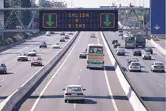
¿Puede circular por el carril VAO un turismo que transporta cuatro ocupantes y un remolque?
May a car carrying four occupants and towing a trailer use the HOV lane (VAO)?
- ASí, si el remolque es ligero.Yes, if the trailer is light.
- BSí.Yes.
- CNo.No.
ExplanationHOV (VAO) lanes may only be used by motorcycles, cars and adaptable mixed-use vehicles with the minimum occupancy set; they are prohibited for other vehicles and vehicle combinations, including cars towing a trailer, whatever the number of occupants (Article 35.2.a of the RGC).
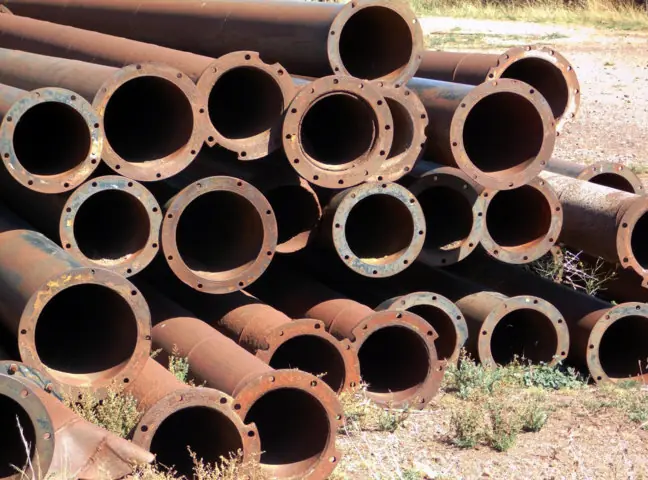
Un tubo de longitud indivisible, ¿puede sobresalir por la parte delantera del vehículo?
May a pipe of indivisible length stick out at the front of the vehicle?
- ASí, en cualquier tipo de vehículo.Yes, in any type of vehicle.
- BNo, excepto si se trata de un transporte especial.No, except in the case of special transport.
- CSí, pero solo en vehículos destinados exclusivamente al transporte de mercancías.Yes, but only in vehicles used exclusively for carrying goods.
ExplanationIn vehicles used exclusively for carrying goods, where the load is indivisible and the conditions for stowing and securing it are met, the load may stick out as follows. For beams, posts, pipes or other loads of indivisible length: 1) in vehicles more than five metres long, two metres at the front and three metres at the rear; 2) in vehicles five metres long or less, one third of the vehicle's length at each end, front and rear. If the smallest dimension of the indivisible load is greater than the width of the vehicle, it may stick out up to 0.40 metres on each side, as long as the total width is not more than 2.55 metres. In other vehicles, not used exclusively for carrying goods, the load may stick out at the rear by up to 10% of the vehicle's length, or 15% if the load is indivisible. In vehicles less than one metre wide, the load must not stick out sideways more than 0.50 metres on each side of the vehicle's longitudinal axis. It must not stick out at the front at all, nor more than 0.25 metres at the rear.
De día y suficiente visibilidad, circula con una motocicleta a la que ha enganchado un remolque, ¿puede transportar alguna persona en el remolque?
In daylight and with good visibility, you are riding a motorcycle towing a trailer. May you carry anyone in the trailer?
- ANo, en ningún caso.No, never.
- BSí, pero sólo si se trata de un menor y el conductor sea su tutor o persona autorizada.Yes, but only if it is a child and the rider is their guardian or an authorised person.
- CSí, siempre que no se sobrepase los 3.500 kilogramos.Yes, as long as 3,500 kilograms is not exceeded.
ExplanationNo, never: people may not be carried in the trailer under any circumstances.
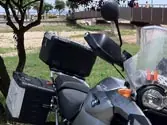
En un vehículo con anchura inferior a 1 metro, la carga podrá sobresalir...
In a vehicle less than 1 metre wide, the load may stick out...
- Anada por delante y 0,50 metros por detrás.nothing at the front and 0.50 metres at the back.
- Bnada por delante y 0,25 metros por detrás.nothing at the front and 0.25 metres at the back.
- Cno puede sobresalir nada.nothing at all.
ExplanationIn a vehicle less than 1 metre wide, the load may not stick out at all at the front; it may stick out 0.50 metres at the sides, measured from the vehicle's centre line, and 0.25 metres at the back.
Si un vehículo tiene menos de un metro de ancho, ¿puede la carga sobresalir por delante o por detrás?
If a vehicle is less than one metre wide, can the load stick out at the front or back?
- ASí, hasta 25 centímetros por delante y por detrás.Yes, up to 25 centimetres at the front and at the back.
- BNo, en ningún caso.No, under no circumstances.
- CSólo por detrás, hasta 25 centímetros.Only at the back, up to 25 centimetres.
ExplanationAccording to Article 15 of the General Traffic Regulations (RGC), on a vehicle less than one metre wide the load may not stick out at the front, while at the back it may stick out by up to 25 centimetres. This is to avoid danger on the road and ensure the safety of all road users. So the correct option is that the load may only stick out at the back, by up to 25 centimetres.
Si su motocicleta lleva como pasajero a un menor de edad, este debe...
If your motorcycle is carrying a passenger who is under 18, they must...
- AUtilizar un sistema de retención infantil homologado.Use an approved child restraint system.
- BIr con los pies apoyados en los reposapiés laterales.Keep their feet on the side footrests.
- CIr sentado a horcajadas entre el conductor y el manillar.Sit astride between the rider and the handlebar.
ExplanationUnder Article 12.1 of the General Traffic Regulations, a motorcycle passenger, whether under 18 or not, must sit astride behind the rider, with their feet on the side footrests. They may never sit between the rider and the handlebar.
Circular con una carga sin distribuir correctamente afecta a la conducción porque:
Driving with a load that is not properly distributed affects driving because:
- AMejora la adherencia de todos los neumáticos.It improves the grip of all the tyres.
- BAltera el equilibrio y la estabilidad, especialmente en curvas y frenadas.It upsets the balance and stability, especially on bends and when braking.
- CReduce la distancia de frenado del vehículo.It reduces the vehicle's braking distance.
ExplanationA badly distributed load unbalances the vehicle and makes it less stable on bends and when braking.
Si transportamos un pasajero de cierto peso en nuestra motocicleta, a la hora de frenar debemos tener en cuenta que...
If you carry a fairly heavy passenger on your motorcycle, when braking you must bear in mind that...
- AEl peso se desplazará hacia la rueda trasera al frenar.The weight will shift towards the rear wheel when braking.
- BEl peso provocará que la distancia de frenado disminuya.The weight will make the braking distance shorter.
- CSe podrá utilizar el freno trasero con mayor intensidad ya que existe menos riesgo de bloqueo de la rueda trasera.You can use the rear brake harder, as there is less risk of the rear wheel locking.
ExplanationWith a passenger, the rear wheel carries more load, so it is less likely to lock and you can brake harder with it. When braking, the weight still shifts forwards, and the greater mass makes the braking distance longer.
Si Ud. conduce un turismo al que lleva enganchado un remolque cuya masa máxima autorizada no excede de 750 kilogramos, ¿qué placa de matrícula deberá llevar éste en su parte posterior?
If you drive a car towing a trailer whose maximum authorised mass does not exceed 750 kilograms, what number plate must the trailer carry at the rear?
- AÚnicamente la placa de matrícula del turismo.Only the car's number plate.
- BLa placa de matrícula del turismo y la del remolque.Both the car's and the trailer's number plates.
- CÚnicamente la placa de matrícula del remolque.Only the trailer's number plate.
ExplanationThe correct option reflects that a trailer does not need its own registration if its maximum authorised mass does not exceed 750 kilograms. In this case, the trailer may carry just the number plate of the car it is attached to. This keeps the rules simpler and avoids the need for the trailer to have an extra registration, as long as it meets this weight requirement.

En una vía urbana, las operaciones de carga y descarga se realizarán...
On an urban road, loading and unloading will be carried out...
- Adepositando la mercancía en la calzada o en zonas peatonales.by placing the goods on the carriageway or in pedestrian areas.
- Brespetando las disposiciones que dicten las autoridades municipales.in accordance with the rules set by the municipal authorities.
- Cpor el lado del vehículo más alejado del borde de la calzada.on the side of the vehicle furthest from the edge of the carriageway.
ExplanationOn an urban road, loading and unloading is subject to the rules set by the municipal authorities (times, reserved areas), and must be done without creating danger and without placing goods on the carriageway.

¿Cómo deberá de señalizar la carga que sobresale por delante, si es de noche?
How must you mark a load that sticks out at the front if it is night-time?
- ACon una luz amarilla o blanca.With a yellow or white light.
- BCon una luz blanca.With a white light.
- CCon un panel de señalización de carga.With a load marker panel.
ExplanationUnder Article 15 of the General Traffic Regulations, at night or in poor visibility a load that sticks out at the front is marked with a white light. The V-20 panel is used for a load that sticks out at the rear.
Si en su vehículo pretende transportar una carga que no cabe en el interior del maletero, ¿podrá circular con el portón abierto?
If you want to carry a load in your vehicle that does not fit inside the boot, may you drive with the tailgate open?
- ASí.Yes.
- BNo.No.
- CSí, si la carga no sobresale más de un 10%.Yes, if the load does not stick out more than 10%.
ExplanationYou are not allowed to drive with the tailgate open. When the load cannot go in the boot of your car, remember: - Only light, small objects may go in the passenger compartment, because they can be thrown around and injure the occupants. - Heavy, bulky objects on the roof rack can make the vehicle unstable and may even make it overturn. They also increase fuel consumption. If the load cannot be carried in the boot, the passenger compartment or on the roof rack, it may not be carried.
Es conveniente que la ropa del conductor o del pasajero de una motocicleta sea...
It is advisable for the clothing of a motorcycle rider or passenger to be...
- Ade piel u otro material similar que proteja de lesiones en caso de accidente.leather or another similar material that protects against injury in an accident.
- Bpoco vistosa y de colores apagados, para no distraer a los demás conductores.plain and in dull colours, so as not to distract other drivers.
- Cmuy amplia y suelta, porque lo más importante es la estética y la comodidad.very wide and loose, because appearance and comfort are what matter most.
ExplanationLeather or other tough clothing protects against burns and grazes in a fall. Article 118.1 of the General Traffic Regulations (RGC), as worded by RD 518/2026, requires motorcycle riders and passengers to wear an approved helmet, protective gloves on roads outside built-up areas and closed footwear, but it does not require any specific type of clothing.
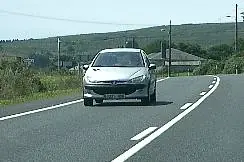
En un turismo de 5 plazas viajan 5 adultos y un niño de 5 años que va al cuidado de uno de los adultos, ¿es correcta la ocupación de este vehículo?
In a 5-seat car there are 5 adults and a 5-year-old child in the care of one of the adults. Is this vehicle's occupancy correct?
- ASí, si el trayecto es por vía urbana.Yes, if the journey is on urban roads.
- BSí, porque el niño no ocupa plaza al ir al cuidado de un adulto.Yes, because the child does not take up a seat when in the care of an adult.
- CNo, ya que se supera el número de plazas autorizadas del vehículo.No, because it exceeds the vehicle's authorised number of seats.
ExplanationThe number of people carried may not exceed the vehicle's authorised number of seats, and children also take up a seat. Five adults and a child in a five-seat car exceed that number, even if the child is in the care of an adult.
¿Puede un menor viajar en una motocicleta?
May a minor travel on a motorcycle?
- ANo, hasta que sea mayor de edad.No, not until they are 18.
- BSí, a partir de los 7 años, sea quien sea el conductor.Yes, from the age of 7, whoever the rider is.
- CSí, a partir de los 12 años como pasajero.Yes, from the age of 12, as a passenger.
ExplanationUnder Article 12 of the General Traffic Regulations (as worded by RD 518/2026), a passenger over twelve years old may travel on a motorcycle; as an exception, children over seven may do so, but only if the rider is their father, mother or guardian, or an adult authorised by them.
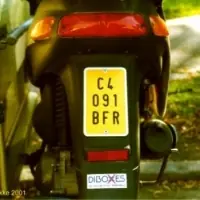
¿De qué color es el fondo de las placas de ciclomotores?
What colour is the background of moped number plates?
- AVerdeGreen
- BBlancoWhite
- CAmarilloYellow
ExplanationThe background of a moped's number plate is retroreflective and yellow. The embossed letters and numbers are painted black.
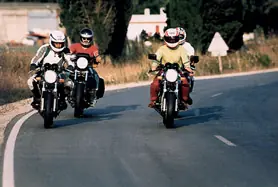
Cuando llevamos un pasajero en una motocicleta, si frenamos...
When you are carrying a passenger on a motorcycle, if you brake…
- AHay mayor desequilibrio.There is more imbalance.
- BEs más difícil que se bloquee la rueda trasera.The rear wheel is less likely to lock.
- CEl peso de nuestros cuerpos tiende a desplazarse hacia la parte trasera.The weight of your bodies tends to shift towards the rear.
ExplanationWhen you brake, inertia shifts the weight towards the front and the load on the rear wheel is reduced, which is why it tends to lock. With a passenger there is more weight on that wheel, so it is less likely to lock, although the braking distance increases.
¿Se puede conducir una furgoneta con las puertas traseras entreabiertas y la carga sobresaliendo un 10% de la longitud del vehículo?
Can you drive a van with the rear doors partly open and the load sticking out 10% of the vehicle's length?
- ASí, siempre que la carga esté bien sujeta y señalizada.Yes, as long as the load is well secured and marked.
- BNo.No.
- CSí, pero solo dentro de poblado.Yes, but only in built-up areas.
ExplanationNo. Article 114 of the General Traffic Regulations prohibits driving with the vehicle's doors open. In addition, a goods van may only carry a load that sticks out if it is indivisible (Article 15), so leaving the doors partly open to fit the load in is not allowed.
Las motocicletas que arrastren un remolque, entre otras condiciones, deberán...
Motorcycles towing a trailer must, among other conditions...
- ACircular durante el día y en condiciones que no disminuyan la visibilidad.Travel during the day and in conditions that do not reduce visibility.
- BCircular como máximo a 80 km/h en toda clase de vías.Travel at no more than 80 km/h on all types of road.
- CDisponer de una autorización especial para poder arrastrar el remolque.Have a special permit to tow the trailer.
ExplanationMotorcycles towing a trailer may only travel during the day and in conditions that do not reduce visibility. The weight of the trailer may not exceed 50% of the unladen mass of the motorcycle, people may never be carried in the towed vehicle, and the maximum speed outside built-up areas is reduced by 10%.
All topics
- Definitions
- Documents and penalty points
- The driver's condition
- Duties of drivers and pedestrians
- Vehicle safety devices
- Vehicle controls and equipment
- Vehicle lights and horn
- Traffic signs, markings and signals
- The road and its lanes
- Speed and distances
- Manoeuvres
- Right of way
- Driving safely in difficult conditions
- Vehicle mechanics and maintenance
- Road accidents and first aid
- Defensive and eco-driving
Independent app: not affiliated with or endorsed by the DGT (Spain's Directorate-General for Traffic) or the Ministry of the Interior. The official exam is booked with the DGT and taken at its test centres. The questions here are practice material; the DGT's official question bank is not public.
Basado en datos de la Agencia Estatal Boletín Oficial del Estado (https://www.boe.es). Textos consolidados de carácter meramente informativo. La AEBOE no patrocina ni respalda este sitio.
Parte de las preguntas procede de los tests de la revista «Tráfico y Seguridad Vial» de la DGT, reproducidos con indicación de la fuente.