
DGT test · 574 questions
Carrying passengers and loads · Page 11 of 12
Passengers, children, loads and trailers: what you may carry and how it must be secured and marked.
Questions in this topic, with answers
574 questions, 50 per page, with the correct answer and the explanation. Page 11 of 12.
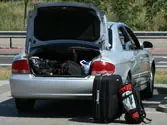
Preferentemente, ¿dónde debe colocar la carga en su turismo?
Where should you preferably put the load in your car?
- AEn el interior del vehículo.In the passenger compartment.
- BEn el maletero.In the boot.
- CEn la baca, correctamente señalizada.On the roof rack, properly marked.
ExplanationWhen the load cannot go in the boot of your car, remember: - Only light, small objects may go in the passenger compartment, because they can be thrown around and injure the occupants. - Heavy, bulky objects on the roof rack can make the vehicle unstable and may even make it overturn. They also increase fuel consumption.
La anchura máxima permitida a un vehículo como norma general es de...
As a general rule, the maximum width allowed for a vehicle is...
- A2,40 metros.2.40 metres.
- B2,50 metros.2.50 metres.
- C2,55 metros.2.55 metres.
ExplanationThe general maximum authorised width for vehicles, including the load, is 2.55 metres, according to Annex IX of the General Vehicle Regulations. Only certain specific vehicles, such as refrigerated vehicles, have a slightly higher limit.
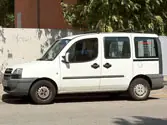
¿Cuál es el número máximo de plazas autorizadas, incluido el conductor, que puede tener un vehículo mixto?
What is the maximum number of authorised seats, including the driver, that a mixed-use vehicle may have?
- A5 plazas.5 seats.
- B3 plazas.3 seats.
- C9 plazas.9 seats.
ExplanationA mixed-use (adaptable) vehicle is a motor vehicle specially designed to carry goods and people, at the same time or not, up to a maximum of 9 people including the driver.
Al circular de noche, ¿es obligatorio señalizar una carga que sobresale lateralmente más de 0,40 metros?
When driving at night, must a load that sticks out at the side by more than 0.40 metres be marked?
- ASí, con una luz blanca y un dispositivo reflectante de color blanco por delante y con una luz roja y un dispositivo reflectante de color rojo por detrás.Yes, with a white light and a white reflective device at the front, and a red light and a red reflective device at the rear.
- BSí, con una luz roja y un dispositivo reflectante rojo por detrás solamente.Yes, with a red light and a red reflective device at the rear only.
- CSí, con un panel reflectante por detrás solamente.Yes, with a reflective panel at the rear only.
ExplanationUnder Article 15 of the General Traffic Regulations, a load that sticks out at the side by more than 0.40 metres beyond the edge of the position lights is marked at night at each end: towards the front with a white light and reflector, and towards the rear with a red light and reflector.
¿Puede la carga sobresalir por delante en vehículos no destinados al transporte de mercancías?
Can the load stick out at the front on vehicles not used for carrying goods?
- ASí, hasta un 10% si la carga es divisible.Yes, up to 10% if the load is divisible.
- BNo.No.
- CSí, hasta un 15% si la carga es indivisible.Yes, up to 15% if the load is indivisible.
ExplanationAs a general rule, the load may not stick out beyond the vehicle's outline seen from above. On vehicles not used only for carrying goods, it may only stick out at the back, by 10 %, or 15 % if it is indivisible, never at the front (Article 15 of the General Traffic Regulations (RGC)).
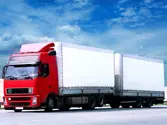
¿Cuál es la altura máxima para un vehiculo, incluida la carga?
What is the maximum height of a vehicle, including its load?
- A4 metros.4 metres.
- B2,55 metros2.55 metres.
- C12 metros12 metres.
ExplanationNo rigid vehicle may be driven with dimensions, including the load, greater than: height 4 m; width 2.55 m; length 12 m.
¿Cuál es la longitud máxima que puede medir un remolque?
What is the maximum length of a trailer?
- A16,50 metros.16.50 metres.
- B12 metros.12 metres.
- C18 metros.18 metres.
ExplanationThe maximum length of a trailer is 12 metres.
¿Cuál es la edad mínima para poder viajar como pasajero en una motocicleta?
What is the minimum age to travel as a passenger on a motorcycle?
- AMayor de 12 años.Older than 12.
- BMayor de 7 años.Older than 7.
- CMayor de 15 años.Older than 15.
ExplanationAs a general rule, children under 12 may not travel as passengers on a motorcycle. In exceptional cases, they may do so from 7 years old when the rider is their father, mother, legal guardian or an authorised adult.
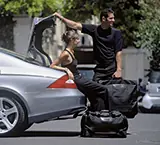
Cuando tenga que bajar del vehículo para descargar el equipaje, ¿debe apagar el motor?
When you have to get out of the vehicle to unload luggage, must you switch off the engine?
- ANo, no es necesario si se trata de una parada breve.No, it is not necessary if it is a short stop.
- BSí, y además debe desconectar el sistema de arranque o contacto.Yes, and you must also switch off the ignition.
- CNo, sólo debe dejar accionado el freno de mano.No, you only need to leave the handbrake on.
ExplanationIf the driver leaves the driving seat, the rules require stopping the engine and switching off the ignition, as well as making sure the vehicle cannot move.
¿Podrá circular durante la noche una motocicleta que arrastra un remolque?
May a motorcycle towing a trailer be ridden at night?
- ASí, con el alumbrado correspondiente.Yes, with the appropriate lights.
- BNo.No.
- CSí, pero solo dentro de poblado.Yes, but only in built-up areas.
ExplanationA motorcycle towing a trailer may not be ridden at night. Nor may it be ridden during the day when weather or environmental conditions reduce visibility.
Si conduce un vehículo que transporta mercancías peligrosas, en un túnel...
If you are driving a vehicle carrying dangerous goods, in a tunnel...
- ASe debe comprobar que no existe ninguna prohibición expresa.You must check that there is no express prohibition.
- BNo hay ninguna limitación referente a la masa del vehículo.There is no limit related to the vehicle's mass.
- CSe circula igual que en el resto de los lugares.You drive the same as anywhere else.
ExplanationYou must check that there is no express prohibition. Always check the signs and local rules to make sure that no additional prohibition is in force.
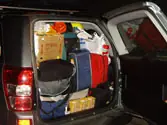
¿Es correcto circular con una furgoneta con las puertas traseras entreabiertas y sobresaliendo la carga un 10% de la longitud del vehículo?
Is it correct to drive a van with the rear doors half open and the load sticking out by 10% of the vehicle's length?
- ASí, si solo recorre un trayecto corto en poblado.Yes, if it is only a short trip in a built-up area.
- BSí, siempre que la carga esté bien sujeta y señalizada.Yes, as long as the load is well secured and marked.
- CNo.No.
ExplanationIt is forbidden to drive with the vehicle's doors open, both side doors and rear doors.

¿Se puede realizar la operación de carga y descarga con el motor en marcha?
May loading and unloading be carried out with the engine running?
- ANo.No.
- BSí, si tengo la marcha atrás puesta.Yes, if I have reverse gear engaged.
- CSí, si tengo el freno de mano accionado.Yes, if I have the handbrake on.
ExplanationWhen the driver leaves their seat, as during loading and unloading, they must stop the engine, switch off the ignition and leave the parking brake on. Having reverse gear engaged or the handbrake on does not make it acceptable to leave the engine running.
La carga que sobresale por los lados de un turismo:
A load that sticks out at the sides of a car:
- AEstá prohibidaIs prohibited
- BPuede sobresalir hasta los retrovisoresMay stick out as far as the mirrors
- CPuede sobresalir como máximo 0,40 metros por cada ladoMay stick out by a maximum of 0.40 metres on each side
ExplanationA car is not used only for carrying goods, so its load may only stick out at the rear: by up to 10% of its length, or 15% if it is indivisible. Sticking out at the sides is prohibited; the 0.40 m on each side is only allowed on goods vehicles with an indivisible load.
El panel que señaliza las cargas que sobresalen…
The panel that marks loads that stick out…
- ADeberá colocarse en el vehículo cuando la carga sobresalga por detrás.Must be fitted to the vehicle when the load sticks out at the rear.
- BDeberá colocarse en el vehículo cuando la carga sobresalga por la parte delantera.Must be fitted to the vehicle when the load sticks out at the front.
- CDeberá colocarse en el vehículo cuando la carga sobresalga lateralmente.Must be fitted to the vehicle when the load sticks out sideways.
ExplanationThe V-20 panel marks a load that sticks out at the rear of the vehicle and is fitted at its rear end, at right angles to the vehicle's axis. A load that sticks out at the front is marked, at night or in poor visibility, with a white light (Article 15.6 of the General Traffic Regulations).

¿Puede una persona adulta transportar a un pasajero en una bicicleta que, por su diseño, no puede ser ocupada por más de una persona?
Can an adult carry a passenger on a bicycle that, by design, cannot be ridden by more than one person?
- ASólo si el conductor pedalea de pie y el pasajero va sentado en el sillín.Only if the rider pedals standing up and the passenger sits on the saddle.
- BSí, a un menor de hasta 22 kg en un asiento adicional.Yes, a child weighing up to 22 kg on an additional seat.
- CNo, está prohibido.No, it is prohibited.
ExplanationAccording to Article 154 of the General Traffic Regulations (RGC), as worded by RD 518/2026, if the rider is an adult, bicycles that by design cannot carry more than one person may carry children weighing up to 22 kg who are able to sit up on their own, on additional seats.
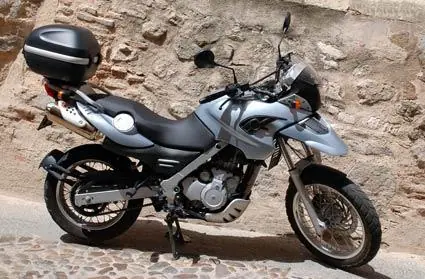
En un vehículo cuya anchura es inferior a un metro, la carga…
On a vehicle less than one metre wide, the load…
- ANo puede sobresalir más de 25 centímetros por la parte posterior.Must not project more than 25 centimetres at the rear.
- BNo puede sobresalir ni por la parte anterior ni por la posterior.Must not project either at the front or at the rear.
- CPuede sobresalir 25 centímetros por delante y por detrás.May project 25 centimetres at the front and at the rear.
ExplanationUnder Article 15.4 of the General Traffic Regulations (RGC), on vehicles less than one metre wide the load must not project at the front, and at the rear it may project 0.25 metres at most. Sideways it may project up to 0.50 metres on each side of the vehicle's longitudinal axis.
¿Dónde es mejor llevar la carga?
Where is the best place to carry a load?
- AEn el maletero.In the boot.
- BEn la baca del coche.On the car's roof rack.
- CDentro del habitáculo.Inside the passenger compartment.
ExplanationThe boot is the best place: the load is kept apart from the occupants, it can be secured well and it does not affect stability. On the roof rack it raises the centre of gravity and increases wind resistance, and in the passenger compartment loose objects can be thrown against the occupants in sudden braking or a crash.
¿Cómo debe colocarse la carga en un vehículo?
How must the load be placed in a vehicle?
- ADebe cubrirse total o parcialmente si la carga produce polvo o se trata de sustancias nocivas.It must be fully or partly covered if the load gives off dust or consists of harmful substances.
- BDe forma que no arrastre, no pueda caerse ni desplazarse de forma peligrosa.So that it does not drag and cannot fall or shift dangerously.
- CSin comprometer la estabilidad del vehículo, aunque para ello se oculten los dispositivos de alumbrado.Without affecting the vehicle's stability, even if this means hiding the lighting devices.
ExplanationArticle 14 of the General Traffic Regulations (RGC) requires the load to be arranged and secured so that it cannot drag, fall or shift dangerously. Materials that give off dust must be covered fully and effectively, not partly, and the load may never hide the lighting devices.
Las operaciones de carga y descarga deben realizarse...
Loading and unloading must be done…
- Adepositando la mercancía en la calle para agilizar el trabajo.by putting the goods down in the street to speed up the work.
- Brespetando siempre las normas de parada y estacionamiento.always following the rules on stopping and parking.
- Csolo por el lado derecho de la calzada.only on the right-hand side of the carriageway.
ExplanationArticle 16 of the General Traffic Regulations requires loading and unloading to be done off the road. If it is unavoidable to do it on the road, you must follow the rules on stopping and parking and the local council's times. It is prohibited to put the goods down on the carriageway, and using the side of the vehicle nearest the edge of the carriageway is required only where possible.
La carga transportada en un ciclomotor de dos ruedas no puede...
The load carried on a two-wheeled moped must not...
- ASobresalir por detrás del vehículo.Stick out at the rear of the vehicle.
- BDesplazarse de manera peligrosa.Move about dangerously.
- CProducir olores.Give off smells.
ExplanationThe load carried on a two-wheeled moped must not move about dangerously, because this could make the vehicle unstable and put road safety at risk. It is important to make sure the load is well secured and does not move during the journey.
En un vehículo destinado al transporte escolar y de menores, debe llevar...
A vehicle used for school transport and transport of children must carry...
- AUna rueda completa de repuesto, sin posibilidad de sustituirla por una de uso temporal.A full-size spare wheel, which may not be replaced by a temporary-use one.
- BDos triángulos de preseñalización de peligro.Two warning triangles.
- CUn equipo homologado de extinción de incendios, adecuado y en condiciones de uso.Approved fire-fighting equipment, suitable and in working order.
ExplanationAccording to Annex XII of the General Vehicle Regulations, buses must carry the V-16 flashing warning beacon and a reflective vest, and also approved fire-fighting equipment, suitable and in working order. Since 1 January 2026, warning triangles are no longer valid in place of the V-16 beacon.
¿Está permitido depositar la carga en la calzada o en los arcenes de una vía?
Is it allowed to put the load down on the carriageway or on the hard shoulders of a road?
- ANo, ni en los arcenes ni en la calzadaNo, neither on the hard shoulders nor on the carriageway
- BEn cualquier parte de la víaAnywhere on the road
- CÚnicamente en la calzadaOnly on the carriageway
ExplanationThe answer is a clear no. According to the General Traffic Regulations, it is forbidden to throw, put down or leave on the road any objects or materials that could obstruct free traffic, stopping or parking, make them dangerous or damage the road. This applies to the whole road surface, which includes both the carriageway (the area for traffic) and the hard shoulders. If the load falls off by accident, the driver must remove it as soon as possible and mark the obstacle while it is there, but the road may never be used as a place to leave things on purpose.
En un turismo con remolque, ¿cuándo se han de poner los calzos?
In a car towing a trailer, when must you use wheel chocks?
- ASiempre que se estacione.Whenever you park.
- BAl estacionar en pendiente.When parking on a slope.
- CNo es obligatorio.It is not compulsory.
ExplanationWhen we park a car with a trailer on a noticeable slope, we must chock the wheels properly.
¿Cuáles la altura máxima permitida, para un vehículo destinado al arrastre o transporte de otros vehículos, si circula con carga?
What is the maximum height allowed for a vehicle designed for towing or carrying other vehicles, when it is travelling loaded?
- A4 metros, incluida la carga.4 metres, load included.
- B2,55 metros incluida la carga.2.55 metres, load included.
- C4,5 metros incluida la carga.4.5 metres, load included.
ExplanationMaximum height (load included): all vehicles in general, 4.00 m; lorries for carrying vehicles or certain types of container, and tow trucks, 4.50 m; urban buses, 4.20 m.
¿Qué porcentaje puede sobresalir una carga indivisible por la parte trasera de un turismo?
By what percentage may an indivisible load stick out at the rear of a car?
- AHasta un 10%.Up to 10%.
- BHasta un 15% debidamente señalizada con el panel V-20.Up to 15%, properly marked with the V-20 panel.
- CNo puede sobresalir nada bajo ningún concepto.It may not stick out at all, under any circumstances.
ExplanationIn cars, the load may only stick out at the rear: up to 10% if it is divisible and up to 15% if it is indivisible (marked with the V-20 panel).
¿Cómo señalizaremos la carga que sobresale por la parte de atrás de un turismo conduciendo de noche?
How will we mark a load sticking out from the back of a car when driving at night?
- AÚnicamente con el panel de señalización reglamentario porque es reflectante.Only with the regulation panel, because it is reflective.
- BCon el panel de señalización reglamentario y una luz de color rojo.With the regulation panel and a red light.
- CCon el panel de señalización reglamentario y un trapo de color rojo.With the regulation panel and a red cloth.
ExplanationWhen driving at night or in poor visibility, a load sticking out from the back of a car must be marked with the regulation panel and also with a red light.
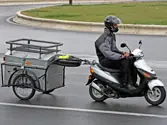
Las motocicletas, ciclomotores o vehículos de tres ruedas, ¿pueden arrastrar un remolque o semirremolque?
May motorcycles, mopeds or three-wheeled vehicles tow a trailer or semi-trailer?
- ANo.No.
- BSí, siempre que, entre otros requisitos, sea de día y en condiciones que no disminuyan la visibilidad.Yes, provided that, among other requirements, it is daytime and conditions do not reduce visibility.
- CSí, y además pueden transportar personas en el remolqueYes, and they may also carry people in the trailer.
ExplanationUnder Article 12.3 of the General Traffic Regulations (RGC), as worded by RD 518/2026, motorcycles, three-wheeled vehicles and mopeds may tow a trailer or semi-trailer that does not exceed 50% of the unladen mass of the towing vehicle, provided they travel during the day and in conditions that do not reduce visibility, reduce their speed by 10% and do not carry people in the towed vehicle.
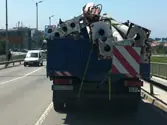
Si circulamos durante la noche con un camión en el que sobresale la carga tanto por delante como por detrás, ¿cómo lo señalizaremos?
If we are driving a lorry at night and its load sticks out both at the front and at the back, how must we mark it?
- ACon una luz roja por detrás y una blanca por delante.With a red light at the back and a white light at the front.
- BCon una luz roja por detrás, una blanca por delante y un panel reglamentario de 50 centímetros de lado.With a red light at the back, a white light at the front and a regulation panel measuring 50 cm on each side.
- CSólo con la luz roja por la parte posterior, más el panel reglamentario de 50 centímetros de lado.Only with a red light at the back, plus a regulation panel measuring 50 cm on each side.
ExplanationIn all cases, a load that sticks out at the back of a vehicle (except vehicles less than 1 metre wide) must be marked with a 50 × 50 cm panel with alternating red and white diagonal stripes. It is placed at the rear end of the load, at right angles to the vehicle's axis. When the load sticks out along the whole width of the back of the vehicle, we place 2 panels, and their stripes form an upside-down "V". Also, when driving at night or in conditions that noticeably reduce visibility, we must have a red light at the back and a white light at the front.
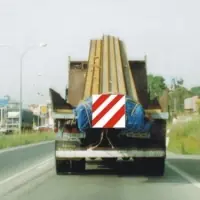
¿Cuanto podrá sobresalir por la parte posterior una viga indivisible en un vehículo de carga con longitud inferior a 5 metros?
On a goods vehicle less than 5 metres long, how far may an indivisible beam stick out at the rear?
- AUn cuarto de la longitud del vehículoOne quarter of the vehicle's length
- BLa mitad de la longitud del vehículoHalf of the vehicle's length
- CUn tercio de la longitud del vehículoOne third of the vehicle's length
ExplanationOn vehicles 5 metres long or less, an indivisible load may stick out by one third of the vehicle's length at the front and at the rear.
La anchura máxima autorizada de un vehículo, incluida la carga, será como norma general...
As a general rule, the maximum authorised width of a vehicle, including its load, is...
- A2 metros.2 metres.
- B2,55 metros.2.55 metres.
- C3 metros.3 metres.
ExplanationAs a general rule, a vehicle may be at most 2.55 metres wide, although some vehicles may be up to 2.60 metres wide.
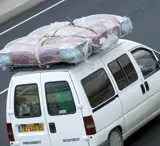
El equipaje en la baca de un turismo, ¿puede sobresalir por los lados?
May luggage on a car's roof rack stick out at the sides?
- ASí, cuando el equipaje es ancho y no se puede dividir.Yes, when the luggage is wide and cannot be divided.
- BNoNo
- CSí, pero el ancho total tiene que ser menor de 2,5 metrosYes, but the total width must be less than 2.5 metres
ExplanationOn a car, which is not used exclusively to carry goods, the load may not stick out beyond the sides of the vehicle; it may only stick out at the back, within certain limits (Article 15 of the General Traffic Regulations). Luggage on the roof rack must stay within the width of the car.
Un remolque se considera 'ligero' cuando su MMA no supera:
A trailer is considered 'light' when its MAM does not exceed:
- A750 kg.750 kg.
- B1.500 kg.1,500 kg.
- C3.500 kg.3,500 kg.
ExplanationA light trailer is one with a maximum authorised mass of no more than 750 kg.
¿Debe señalizar de alguna manera la carga cuando ésta caiga a la vía?
Must you mark the load in any way if it falls onto the road?
- ANo.No.
- BNo, sólo se señaliza el vehículo cuando está averiado.No, you only mark the vehicle when it has broken down.
- CSí, con el dispositivo de preseñalización de peligro.Yes, with the hazard warning device.
ExplanationIf we create an obstacle or danger on the road, we must remove it as soon as possible. Meanwhile, we must take the necessary measures so that other road users can notice it and so that traffic is not obstructed. In all cases we will place the hazard warning device to warn of the obstacle. The V-16 hazard warning device is an approved amber light with geolocation. It runs on its own power supply (batteries). It must be placed on the highest point of the broken-down vehicle, to make it as visible as possible. Today the V-16 is the only legal way to signal a broken-down vehicle or an obstacle on the road, and warning triangles are no longer used.

¿Deben los remolques de 900 kg de MMA llevar una placa de matrícula diferente de la del vehículo tractor?
Must trailers with a MAM of 900 kg carry a number plate different from that of the towing vehicle?
- ASíYes
- BNoNo
- CÚnicamente los remolques, pero no los semirremolquesOnly trailers, not semi-trailers
ExplanationTrailers and semi-trailers with a maximum authorised mass of more than 750 kg must be registered and carry their own number plate, different from that of the towing vehicle. Light trailers, up to 750 kg, carry the number plate of the vehicle towing them instead.
¿Puede un vehículo de tres ruedas llevar un remolque?
Can a three-wheeled vehicle tow a trailer?
- ANo, nunca.No, never.
- BSí.Yes.
- CSí, cualquier remolque.Yes, any trailer.
ExplanationAccording to Article 12.3 of the General Traffic Regulations (RGC), as worded by RD 518/2026, motorcycles, three-wheeled vehicles and mopeds may tow a trailer or semi-trailer of no more than 50 % of the unladen mass of the towing vehicle, travelling during the day and in conditions that do not reduce visibility, with speed reduced by 10 % and without carrying people in the towed vehicle.
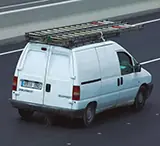
La carga que sobresale por delante de un vehículo, ¿cómo debe ir señalizada?
How must a load that sticks out at the front of a vehicle be marked?
- ACon una luz blanca, de noche o en condiciones que disminuyan sensiblemente la visibilidad.With a white light, at night or in conditions that considerably reduce visibility.
- BCon una luz blanca, tanto de día como de noche.With a white light, both day and night.
- CCon una luz blanca y un reflectante blanco, de noche o en condiciones que disminuyan sensiblemente la visibilidad.With a white light and a white reflector, at night or in conditions that considerably reduce visibility.
ExplanationA load that sticks out at the back of a vehicle must always be properly marked, and a load that sticks out at the front only at night or in conditions that considerably reduce visibility.
Se denomina peso en carga a...
The laden weight is...
- ALa mma menos la tara.The MAM minus the unladen weight (tare).
- BEl peso del vehículo más el de su carga.The weight of the vehicle plus the weight of its load.
- CLa masa efectiva del vehículo y de su carga, incluido el peso del personal de servicio y el de los pasajeros.The actual mass of the vehicle and its load, including the weight of the crew and the passengers.
ExplanationThe laden weight is the actual mass of the vehicle and its load, including the weight of the crew and the passengers. It is the total weight of the vehicle, including its own mass and the mass of the load it carries, as well as the weight of the crew and passengers. All these elements must be taken into account when calculating a vehicle's laden weight.
¿Se puede transportar sobre la baca de un turismo un armario si sobresale de la proyección en planta del vehículo, por la parte posterior del mismo, el 10% de la longitud del vehículo?
Can a wardrobe be carried on a car's roof rack if it sticks out beyond the vehicle's outline seen from above, at the rear, by 10% of the vehicle's length?
- ASe puede transportar un armario, pero no podrá sobresalir de la proyección en planta del vehículo.A wardrobe may be carried, but it may not stick out beyond the vehicle's outline seen from above.
- BNo, en los turismos está prohibido transportar cargas que no sean equipajes de sus ocupantes.No, cars are not allowed to carry loads other than the occupants' luggage.
- CSí, pero deberá ir debidamente señalizado con una, o dos en su caso, placas de 50 x 50 cm, con franjas diagonales blancas y rojas.Yes, but it must be properly marked with one, or two where applicable, 50 x 50 cm panels with white and red diagonal stripes.
ExplanationOn cars the load may stick out at the rear by up to 10% of the vehicle's length, or 15% if it is indivisible, and it must be marked with one or, if it sticks out across the full width, two V-20 panels of 50 x 50 cm with red and white diagonal stripes (Article 15 of the General Traffic Regulations).
¿Cuánto podrá sobresalir la carga indivisible que transportamos en un vehículo mixto?
How far may an indivisible load carried in a mixed-use vehicle stick out?
- A2 metros por delante y 3 metros por detrás.2 metres at the front and 3 metres at the back.
- BNo podrá sobresalir nada.It must not stick out at all.
- CUn 15% solo por detrás.15%, only at the back.
ExplanationIn cars and mixed-use vehicles, a divisible load may stick out at the back by 10% of the vehicle's length. When the load is indivisible, it may stick out by 15%.

¿Está el conductor de un vehículo obligado a mantener la adecuada colocación del animal que transporta para que no le moleste mientras conduce?
Must the driver of a vehicle keep an animal they are carrying properly placed so that it does not disturb them while driving?
- ASí, debe ponerse el animal correctamente en todo momento.Yes, the animal must be properly placed at all times.
- BNo, no está obligado a ello.No, they do not have to.
- CSólo cuando circula por vías interurbanas.Only on interurban roads.
ExplanationThe driver of a vehicle is responsible for making sure that the animal they are carrying is properly placed and does not interfere with driving. This is essential to avoid distractions and to ensure the safety of the driver, the animal itself and other road users. The traffic rules state that animals must be secured so that they cannot move freely around the vehicle and do not interfere with driving.
En un vehículo de anchura inferior a un metro, ¿cuánto podrá sobresalir la carga por la parte posterior?
In a vehicle less than one metre wide, how far may the load stick out at the back?
- AUn metro.One metre.
- BVeinticinco centímetros.Twenty-five centimetres.
- CNo podrá sobresalir nada.Not at all.
ExplanationIn vehicles less than one metre wide, the load must not stick out more than 50 cm on each side of the centre line, or more than 25 cm at the back.
Los mamparos de una cisterna, además de dividir la cisterna en compartimentos de carga, ayudan a...
As well as dividing the tank into load compartments, the baffles in a tank help to...
- AAumentar el oleaje y aumentar la seguridad de la cisterna.Increase the surge and increase the safety of the tank.
- BDisminuir el oleaje del líquido y mejorar la estabilidad de la cisterna.Reduce the surge of the liquid and improve the stability of the tank.
- CComprometer la estabilidad de la cisterna.Put the stability of the tank at risk.
ExplanationThe baffles in a tank help to reduce the surge of the liquid and improve the stability of the tank. Because the baffles divide the tank into load compartments, the liquid cannot move suddenly and the vehicle sways less. This improves the stability of the tank during transport.
La carga transportada en un vehículo debe colocarse de manera que...
The load carried in a vehicle must be placed so that…
- Ano cubra las luces ni los dispositivos de señalización luminosa.it does not cover the lights or the light signalling devices.
- Bocupe el menor espacio posible.it takes up as little space as possible.
- Cno cubra las luces, aunque podría cubrir los dispositivos de señalización luminosa.it does not cover the lights, although it may cover the light signalling devices.
ExplanationUnder Article 14 of the General Traffic Regulations, the load must be placed so that it does not hide the lighting or light signalling devices, the compulsory plates or markings, or the driver's hand signals. Taking up little space is not the rule.
En un vehículo de anchura inferior a 1 metro la carga podrá sobresalir...
In a vehicle less than 1 metre wide, the load may stick out...
- A2 metros por delante y 3 metros por detrás.2 metres at the front and 3 metres at the back.
- B0,50 metros por cada lado.0.50 metres on each side.
- CUn 10 por ciento de la longitud del vehículo.10 per cent of the vehicle's length.
ExplanationIn vehicles less than one metre wide, the load may stick out at most 0.50 metres on each side and 0.25 metres at the back.
¿A qué normativa debe ajustarse la protección de la carga en los vehículos mixtos?
Which rules must load protection in mixed-use vehicles comply with?
- AA la legislación reguladora de los vehículosThe legislation regulating vehicles
- BAl manual de usuario del vehículoThe vehicle's owner's manual
- CA las instrucciones del fabricante de neumáticosThe tyre manufacturer's instructions
ExplanationAdaptable mixed-use vehicles can carry people and goods at the same time or one or the other. Because loose loads are a risk in sudden braking or a crash, there must be a proper physical separation between the passengers and the load. This protection (usually grilles or dividers) is not optional and is not governed just by an owner's manual: it must be approved and comply strictly with the legislation regulating vehicles (General Vehicle Regulations). The tyre instructions have nothing to do with separating the load.
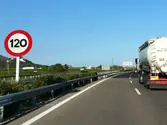
Un turismo que circula arrastrando un remolque, podría circular por la vía de la imagen a 120km/h?
Could a car towing a trailer drive at 120 km/h on the road in the picture?
- ANo.No.
- BNo, debe limitar su velocidad máxima a 80km/h.No, it must keep to a maximum of 80 km/h.
- CSi, dado que es la velocidad máxima permitida para esa autopista.Yes, because that is the maximum speed allowed on that motorway.
ExplanationWhen the maximum speed sign shows the same figure as the general maximum speed (taking the car's limit as the reference), the sign is only a reminder of the general speed, so each vehicle must keep to its own general maximum speed for the type of road it is on. Any motor vehicle with a trailer has a general maximum speed of 90 km/h on motorways (autopistas) and dual carriageways (autovías), and 80 km/h on conventional roads.
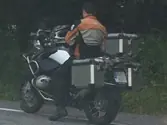
En las motocicletas, ¿qué es obligatorio tener en cuenta con el equipaje transportado?
On motorcycles, what must you take into account with the luggage carried?
- AQue no sobresalga por la parte trasera.That it does not stick out at the back.
- BQue no sobresalga lateralmente.That it does not stick out at the sides.
- CQue vaya colocado y sujeto de forma que no afecte la estabilidad de la motocicleta.That it is placed and secured so that it does not affect the stability of the motorcycle.
ExplanationOn motorcycles, any load carried, such as luggage, must be well placed and secured on the luggage rack or in two side bags or cases at the back, one on each side, fixed to the frame. The rider must take care not to unbalance the motorcycle.
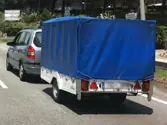
Si arrastra con su vehículo un remolque cargado de mercancías, en cuanto a la distribución de la carga ¿deberá tomar precauciones especiales?
If your vehicle is towing a trailer loaded with goods, do you need to take special care with how the load is distributed?
- ASi, la carga debe estar bien distribuida, e ir bien sujeta de forma que se evite su desplazamiento para que no se desestabilice el vehículoYes, the load must be well distributed and firmly secured so that it cannot shift and make the vehicle unstable.
- BNo, salvo que supere los pesos o dimensiones máximos establecidosNo, unless it exceeds the maximum weights or dimensions allowed.
- CSi, situar el peso en la parte más trasera del remolque, para que baje el centro de gravedad y aumente la estabilidad del vehículo.Yes, put the weight at the very back of the trailer, to lower the centre of gravity and make the vehicle more stable.
ExplanationThe load must be spread evenly over the vehicle and secured so that it cannot shift or fall off, either completely or in part.
¿Cuánto podrá sobresalir la carga por la parte posterior en una motocicleta?
How far may the load stick out at the back of a motorcycle?
- A25 cm.25 cm.
- B50 cm.50 cm.
- C40 cm.40 cm.
ExplanationOn motorcycles, and in general on all vehicles less than 1 metre wide, the load may stick out 25 cm at the back.
All topics
- Definitions
- Documents and penalty points
- The driver's condition
- Duties of drivers and pedestrians
- Vehicle safety devices
- Vehicle controls and equipment
- Vehicle lights and horn
- Traffic signs, markings and signals
- The road and its lanes
- Speed and distances
- Manoeuvres
- Right of way
- Driving safely in difficult conditions
- Vehicle mechanics and maintenance
- Road accidents and first aid
- Defensive and eco-driving
Independent app: not affiliated with or endorsed by the DGT (Spain's Directorate-General for Traffic) or the Ministry of the Interior. The official exam is booked with the DGT and taken at its test centres. The questions here are practice material; the DGT's official question bank is not public.
Basado en datos de la Agencia Estatal Boletín Oficial del Estado (https://www.boe.es). Textos consolidados de carácter meramente informativo. La AEBOE no patrocina ni respalda este sitio.
Parte de las preguntas procede de los tests de la revista «Tráfico y Seguridad Vial» de la DGT, reproducidos con indicación de la fuente.