
DGT test · 574 questions
Carrying passengers and loads · Page 6 of 12
Passengers, children, loads and trailers: what you may carry and how it must be secured and marked.
Questions in this topic, with answers
574 questions, 50 per page, with the correct answer and the explanation. Page 6 of 12.
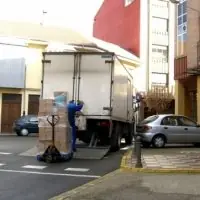
Durante las operaciones de carga y descarga, ¿está permitido depositar las mercancías en la calzada?
During loading and unloading, is it allowed to put goods down on the carriageway?
- ASí.Yes.
- BNo, como norma general.No, as a general rule.
- CEn la calzada no, pero en los arcenes y en las zonas peatonales sí.Not on the carriageway, but it is allowed on hard shoulders and in pedestrian areas.
ExplanationLoading and unloading must be done off the road. Exceptionally, when it cannot be avoided on the road, it must be done without causing danger or serious disruption to other road users, following these rules: the rules on stopping and parking must be respected and, in built-up areas, so must the local authority rules on suitable times and places. As far as possible, it must be done on the side of the vehicle nearest the edge of the carriageway. It must be done with enough means to be as quick as possible, avoiding unnecessary noise and nuisance. It is forbidden to put the goods down on the carriageway, hard shoulder or in pedestrian areas.
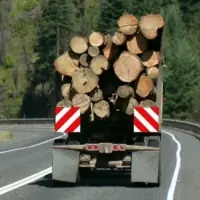
En un camión de longitud inferior a 5 metros, una carga indivisible no puede sobresalir más…
On a lorry less than 5 metres long, an indivisible load must not stick out by more than…
- Ade 2 metros por delante y 3 metros por detrás.2 metres at the front and 3 metres at the rear.
- Bde un tercio de la longitud del vehículo, tanto por delante como por detrás.one third of the vehicle's length, both at the front and at the rear.
- Cde 3 metros por delante y 2 metros por detrás.3 metres at the front and 2 metres at the rear.
ExplanationUnder Article 15 of the General Traffic Regulations, on goods vehicles up to 5 metres long, an indivisible load may stick out by one third of the vehicle's length at each end. The limits of 2 metres at the front and 3 at the rear apply to vehicles more than 5 metres long.
¿Cómo se tiene que colocar la carga en un vehículo?
How must a load be placed in a vehicle?
- ACubierta total o parcialmente cuando la carga produzca polvo o se trata de sustancias nocivas.Fully or partly covered when the load gives off dust or consists of harmful substances.
- BDe forma que no arrastre, que no pueda caerse ni desplazarse de forma peligrosa.So that it does not drag and cannot fall or shift dangerously.
- CSin comprometer la estabilidad del vehículo aunque para ello oculte los dispositivos de alumbrado.Without affecting the stability of the vehicle, even if this means covering the lights.
ExplanationThe load carried in a vehicle, and any accessories used to secure or protect it, must be arranged and, if necessary, fastened so that they cannot: a) drag, fall fully or partly, or shift dangerously; b) affect the stability of the vehicle; c) cause avoidable noise, dust or other nuisance; d) cover the lights or light signals, the compulsory plates or markings, or the driver's hand signals. Materials that give off dust or may fall must always be carried fully and effectively covered. Loads that are unpleasant, harmful, unhealthy or dangerous, or that need special packing or stowing, must also follow the specific rules on the matter.
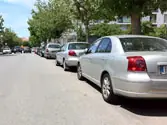
¿Qué carril o carriles podrá utiliza un vehículo de mercancías de mas de 3500 kg de MMA, circulando por una vía urbana provista de tres carriles para su sentido?
Which lane or lanes may a goods vehicle with a MAM of more than 3500 kg use on an urban road with three lanes in its direction?
- AEl derecho y el inmediato.The right-hand lane and the next one.
- Bel derecho y el resto para adelantar.The right-hand lane, and the others to overtake.
- CEl que más convenga a su destino, si los carriles están debidamente dlimitados.The one that best suits its destination, if the lanes are properly marked.
ExplanationAny vehicle on an urban road with several properly marked lanes in its direction may use the lane or lanes that best suit its destination.
¿Una motocicleta podrá arrastrar un remolque?
Can a motorcycle tow a trailer?
- ANo, nunca.No, never.
- BSi, pero solo si la motocicleta es de más de 500 cm³.Yes, but only if the motorcycle is over 500 cm³.
- CSí, siempre que se cumplan unos requisitos establecidos.Yes, as long as certain set requirements are met.
ExplanationMotorcycles may tow a trailer as long as they do so during the day, do not carry people in it and the weight of the trailer does not exceed 50% of the weight of the motorcycle.
En un vehículo de menos de 5 metros de longitud destinado al transporte de mercancías, ¿cuánto puede sobresalir por delante una carga de longitud indivisible?
On a goods vehicle less than 5 metres long, how far may an indivisible load stick out at the front?
- ANada puede sobresalir.Nothing may stick out.
- BUn tercio de la longitud del vehículo.One third of the vehicle's length.
- CEl 15% de la longitud del vehículo.15% of the vehicle's length.
ExplanationOn vehicles used only for carrying goods that are five metres long or less, an indivisible load may stick out by one third of the vehicle's length at the front and another third at the back (Article 15.2 of the General Traffic Regulations (RGC)).
Durante la marcha, parte de la carga de su vehículo cae a la calzada. ¿Debe detenerse para señalizarlo?
While you are driving, part of your vehicle's load falls onto the carriageway. Must you stop to signal it?
- ANo, no es obligatorio si puede retirar la carga inmediatamente.No, it is not compulsory if you can remove the load immediately.
- BSí, utilizando el dispositivo de preseñalización de peligro.Yes, using the hazard warning device.
- CNo.No.
ExplanationAccording to Article 130 of the General Traffic Regulations (RGC), if part of a vehicle's load falls onto the carriageway, the driver must stop and properly signal the load on the road. This is crucial to warn other drivers and avoid accidents. Correct signalling is essential for traffic safety, so the correct answer is to stop and use a hazard warning device.
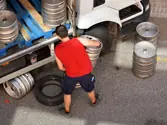
¿Cómo realizaremos las operaciones de carga y descarga en una vía urbana?
How will we load and unload on an urban road?
- AAproximando el vehículo al borde derecho de la calzada.By moving the vehicle close to the right-hand edge of the carriageway.
- BRespetando las normas de las autoridades municipales.By respecting the local authority's rules.
- CRespetando solamente las disposiciones generales que rigen en las paradas y estacionamientos.By respecting only the general rules on stopping and parking.
ExplanationWhen loading and unloading, we must respect both the local authority's rules and the general rules on stopping and parking. The option about respecting only the general rules is wrong, because we must NOT ONLY respect the general rules.
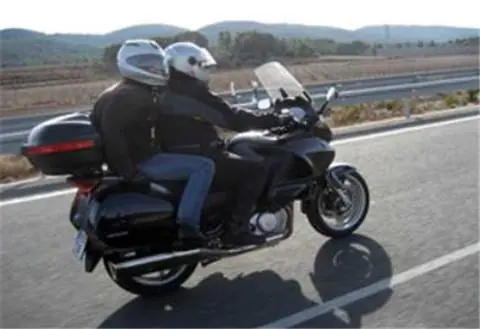
Si conduce una motocicleta con un pasajero, ¿qué debe tener en cuenta?
If you ride a motorcycle with a passenger, what must you bear in mind?
- AQue aumentará el tiempo de reacción.That your reaction time will increase.
- BQue será más difícil que, al frenar, la rueda trasera se quede bloqueada.That it will be harder for the rear wheel to lock when you brake.
- CQue la distancia de frenado será menor.That the braking distance will be shorter.
ExplanationWhen braking, the weight of the motorcycle shifts forwards and the rear wheel carries less load, so it locks easily. With a passenger there is more weight on that wheel and it is harder for it to lock; however, the braking distance does not decrease.
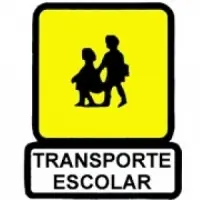
¿Qué significa el distintivo V-10 en relación con lo qué se transporta?
What does the V-10 sign mean in relation to what is being carried?
- AConductor novelNovice driver
- BTransporte escolarSchool transport
- CTransporte de mercancías peligrosasTransport of dangerous goods
ExplanationThe V-10 sign identifies vehicles providing school transport and transport of minors.
En la baca de su vehículo ha depositado el equipaje. ¿Qué altura máxima del vehículo incluido el equipaje no podrá sobrepasar?
You have put luggage on your vehicle's roof rack. What maximum height, including the luggage, must the vehicle not exceed?
- A2,50 metros.2.50 metres.
- B3 metros.3 metres.
- C4 metros.4 metres.
Explanation4 metres is the maximum height allowed for a vehicle, including luggage on the roof rack. This limit makes sure the vehicle can travel safely and in line with traffic rules.
Cuando cambiamos los neumáticos, ¿es importante consultar que coincida el índice de carga?
When changing tyres, is it important to check that the load index matches?
- ANo, solo es importante el diámetro de la rueda.No, only the wheel diameter is important.
- BNo, solo es importante el diámetro y el ancho de la rueda.No, only the wheel diameter and width are important.
- CSí.Yes.
ExplanationEach tyre has characteristics that depend on the use it was designed for, including the load index, which shows the maximum load the tyre can carry. It will not be the same for a van as for a car, for example.
Los vehículos no destinados al transporte de mercancias, ¿puede sobresalir la carga de la proyección en planta del vehículo?
On vehicles not intended for carrying goods, may the load stick out beyond the vehicle's outline seen from above?
- ASí, siempre.Yes, always.
- BNo, como norma general.No, as a general rule.
- CSí, pero solo por la parte delantera.Yes, but only at the front.
ExplanationAs a general rule, the load may not stick out beyond the vehicle's outline seen from above. On vehicles not intended exclusively for carrying goods, it may only stick out at the rear, by up to 10% of the vehicle's length, or 15% if it is indivisible (Article 15 of the General Traffic Regulations).
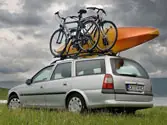
La carga de un turismo, ¿cuánto puede sobresalir por detrás?
How far may a car's load stick out at the back?
- AEl 20% de la longitud del vehículo.20% of the vehicle's length.
- BEl 15% de la longitud del vehículo.15% of the vehicle's length.
- C1/3 de la longitud del vehículo.1/3 of the vehicle's length.
ExplanationIn vehicles not designed exclusively for carrying goods, the load may only stick out at the back: - Up to 10% of the vehicle's length if the load is divisible. - Up to 15% of the vehicle's length if the load is indivisible.
La masa máxima autorizada (MMA) de un vehículo es:
The maximum authorised mass (MAM) of a vehicle is:
- AEl peso del vehículo vacío.The weight of the empty vehicle.
- BLa masa máxima con la que se permite su circulación, fijada por la Administración.The maximum mass at which it is allowed on the road, set by the authorities.
- CEl peso de los ocupantes.The weight of the occupants.
ExplanationThe MAM is the maximum mass at which the loaded vehicle is allowed on the road; exceeding it is an offence and a risk.
La edad mínima para viajar como pasajero en una motocicleta o ciclomotor será de...
The minimum age to travel as a passenger on a motorcycle or moped is...
- A3 años, pero siempre con un asiento adicional.3 years, but always on an additional seat.
- Bsiempre 12 años.always 12 years.
- C12 años y, excepcionalmente, 7 años si la motocicleta o ciclomotor es conducido por el padre, madre o tutor.12 years and, exceptionally, 7 years if the motorcycle or moped is ridden by the child's father, mother or guardian.
ExplanationAccording to Article 12 of the General Traffic Regulations (RGC), as worded by RD 518/2026, the passenger on a motorcycle or moped must be over twelve; exceptionally, children over seven may travel if the rider is their father, mother or guardian or an adult authorised by them, wearing an approved protective helmet.
¿Podrá llevar carga en la baca un turismo?
May a car carry a load on the roof rack?
- ASi, siempre que no desestabilice el vehículo.Yes, as long as it does not make the vehicle unstable.
- BNo, está prohibido.No, it is prohibited.
- CSí, aunque lo desestabilice un poco.Yes, even if it makes the vehicle a little unstable.
ExplanationA load may be carried on the roof rack as long as it is arranged so that it does not affect the vehicle's stability.
¿Puede un vehículo con 5 ocupantes y un remolque ligero circular por un carril VAO (vehículos de alta ocupación)?
Can a vehicle with 5 occupants and a light trailer use an HOV lane (VAO, high-occupancy vehicles)?
- ASí, porque lleva 5 personas.Yes, because it is carrying 5 people.
- BNo, está prohibido.No, it is prohibited.
- CSí, aunque solo vaya el conductor.Yes, even with only the driver on board.
ExplanationAccording to Article 35.2.a of the General Traffic Regulations (RGC), as worded by RD 518/2026, the HOV lane (VAO) is limited to motorcycles, cars and convertible dual-purpose vehicles and is prohibited for all other vehicles and vehicle combinations, including cars towing trailers. The number of occupants does not change this prohibition, and the V-15 sign only exempts a vehicle from the occupancy condition, not from the ban on towing a trailer.
¿Cuál es la MMA mínima para que el remolque de un vehículo especial deba estar matriculado?
What is the minimum MAM at which the trailer of a special vehicle must be registered?
- ASuperior a 750 kilogramos.Over 750 kilograms.
- BMayor de 1500 kilogramos.Over 1,500 kilograms.
- CSuperior a 2500 kilogramos.Over 2,500 kilograms.
ExplanationTrailers with an MAM over 750 kilograms must be registered at the relevant provincial traffic office (Jefatura de Tráfico), and so carry their own number plate. Trailers with an MAM under 750 kilograms carry the number plate of the towing vehicle.
¿Es aconsejable quitar la baca porta equipajes, si no la va a utilizar?
Is it advisable to remove the roof rack if you are not going to use it?
- ANo.No.
- BSí, para ahorrar combustible.Yes, to save fuel.
- CSi, para aumentar la estabilidad del vehículo.Yes, to increase the vehicle's stability.
ExplanationA roof rack, even when empty, increases air resistance and the vehicle's weight, which raises fuel consumption and emissions. That is why it is advisable to remove it when you are not going to use it.
Una carga colocada en la baca de un turismo, ¿está permitido que sobresalga lateralmente?
Is a load carried on a car's roof rack allowed to stick out at the sides?
- ASi, 0,25 metros por cada lado.Yes, 0.25 metres on each side.
- BNo, en los turismos no puede sobresalir la carga lateralmente.No, on cars the load may not stick out at the sides.
- CSi, 0,50 metros por cada lado.Yes, 0.50 metres on each side.
ExplanationOn cars the load may not stick out at the sides, including a load on the roof rack: it may only stick out at the rear, by up to 10% of the vehicle's length or 15% if it is indivisible.
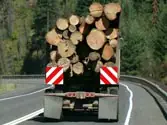
El panel obligatorio para indicar la carga que sobresale por la parte posterior, ¿podrá sustituirse en algún caso?
Can the compulsory panel for marking a load that sticks out at the back ever be replaced?
- ASí, si no se dispone del panel se podrá poner un trapo de color rojo vivo.Yes, if you do not have the panel you may use a bright red cloth.
- BSí, se podrá sustituir por una luz blanca delante y una luz roja detrás.Yes, it may be replaced by a white light at the front and a red light at the back.
- CNo.No.
ExplanationThe panel marking a load that sticks out at the back is compulsory and cannot be replaced by any other device. A load that sticks out at the back of a vehicle, except on vehicles less than 1 metre wide, must be marked with a 50 x 50 cm panel with alternating red and white diagonal stripes, placed at the rear end of the load and perpendicular to the vehicle's axis. When the load sticks out along the whole width of the rear of the vehicle, we will place 2 panels, and their stripes will form an inverted “V”.
De noche, es obligatorio señalizar una carga que sobresale lateralmente más de 0,40 metros del borde exterior de la luz delantera o posterior de posición del vehículo...
At night, a load that sticks out sideways more than 0.40 metres beyond the outer edge of the vehicle's front or rear sidelight must be marked...
- Acon una luz blanca y un dispositivo reflectante de color blanco por delante y con una luz roja y un dispositivo reflectante de color rojo por detrás.with a white light and a white reflector at the front, and a red light and a red reflector at the back.
- Bcon un panel reflectante por detrás solamente.with a reflective panel at the back only.
- Ccon una luz roja y un dispositivo reflectante rojo por detrás, solamente.with a red light and a red reflector at the back only.
ExplanationIf the load sticks out sideways so that its end is more than 0.40 m from the outer edge of the front or rear sidelight: – By day it is not marked. – Between sunset and sunrise, or when visibility is significantly reduced, it must be marked at each of its side ends, with a white light and a white reflector facing forwards and a red light and a red reflector facing backwards.
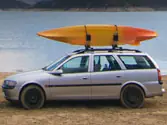
¿Hasta cuánto puede sobresalir la carga indivisible por la parte posterior de un vehículo no destinado exclusivamente al transporte de mercancías?
How far may an indivisible load stick out from the back of a vehicle that is not used exclusively for carrying goods?
- AHasta un 10% de la longitud del vehículo.Up to 10% of the length of the vehicle.
- BHasta un 15% de la longitud del vehículo.Up to 15% of the length of the vehicle.
- CHasta un 15% la longitud de la carga.Up to 15% of the length of the load.
ExplanationUnder Article 15 of the General Traffic Regulations (RGC), in vehicles not used exclusively for goods, an indivisible load may stick out at the back by up to 15% of the length of the vehicle, not of the load. If the load is divisible, the limit is 10%.
¿MMA implica la masa máxima autorizada al vehículo para circular con carga?
Does MAM mean the maximum mass at which the vehicle is authorised to travel laden?
- ASí.Yes.
- BNo, es la masa del vehículo vacío, sin carga.No, it is the mass of the empty vehicle, without a load.
- CNo.No.
ExplanationThe maximum authorised mass (MAM) is the maximum mass allowed for using a vehicle laden on public roads. So it means the maximum mass at which the vehicle is authorised to travel laden.
El dispositivo que se coloca para señalizar una carga que sobresale por la parte trasera del vehículo es:
The device used to mark a load sticking out at the rear of the vehicle is:
- ALa señal V-16.The V-16 signal.
- BLa señal V-20.The V-20 signal.
- CLa señal V-2.The V-2 signal.
ExplanationA load sticking out at the rear is marked with the V-20; the V-16 is the emergency warning beacon.
En los vehículos de anchura inferior a 1 metro, ¿cuánto podrá sobresalir lateralmente la carga?
On vehicles less than 1 metre wide, how far may the load stick out at the sides?
- ANo podrá sobresalir nada.It may not stick out at all.
- BPodrá sobresalir medio metro por cada lado del eje longitudinal.It may stick out half a metre on each side of the longitudinal axis.
- CPodrá sobresalir 40 centímetros por cada lado del vehículo.It may stick out 40 centimetres on each side of the vehicle.
ExplanationOn vehicles less than 1 metre wide, the load must not stick out at the sides more than half a metre on each side of the longitudinal axis, and no more than 25 centimetres at the back.
Si un turismo que mide 1,40 metros de ancho, transporta sobre la baca una serie de maletas que conforman su equipaje, ¿cuánto puede sobresalir el equipaje por los laterales del turismo?
If a car 1.40 metres wide is carrying several suitcases of luggage on its roof rack, how far may the luggage stick out at the sides of the car?
- APor los laterales del turismo no puede sobresalir nada, sólo podría sobresalir por la parte posterior.Nothing may stick out at the sides of the car; it could only stick out at the rear.
- BPodrá sobresalir hasta 0,40 metros.It may stick out up to 0.40 metres.
- CTanto como se quiera, siiempre que no pueda caerse.As much as you like, as long as it cannot fall.
ExplanationOn a car, which is not intended exclusively for carrying goods, the load may not stick out at the sides, not even luggage on the roof rack. It may only stick out at the rear, by up to 10% of the vehicle's length or 15% if it is indivisible.
Un niño de 14 años, ¿puede viajar como pasajero en una motocicleta?
May a 14-year-old child travel as a passenger on a motorcycle?
- ANo, hasta los 16 años está prohibido.No, it is prohibited until the age of 16.
- BSí.Yes.
- CSolo si el conductor es el padre, madre, tutor legal o mayor de edad autorizado.Only if the driver is their father, mother, legal guardian or an authorised adult.
ExplanationOn motorcycles and mopeds, as well as the driver, one passenger may travel, provided the vehicle's licence or registration certificate allows it, the passenger is over 12 and wears a helmet. As an exception, children over 7 may ride on motorcycles or mopeds driven by their father, mother or guardian, or by adults authorised by them, as long as they wear an approved helmet.
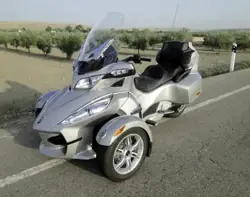
En un vehículo de tres ruedas de un metro de anchura, ¿Cuánto podría sobresalir la carga por los costados como norma general?
On a three-wheeled vehicle one metre wide, as a general rule, how far could the load stick out at the sides?
- ANada.Not at all.
- B0,40 m por cada lado.0.40 m on each side.
- C0,50 m a cada lado del vehículo.0.50 m on each side of the vehicle.
ExplanationThe rule allowing the load to stick out sideways up to 0.50 metres from the axis only applies to vehicles less than one metre wide. This vehicle is one metre wide, so the general rule applies: the load may not stick out beyond its outline at the sides.
Si después de la carga nos damos cuenta de que se ha escapado parte del contenido, ¿qué hay que hacer?
If, after loading, you notice that some of the contents have leaked out, what must you do?
- ALimpiarlo cuando tengamos tiempo libre.Clean it up when you have some free time.
- BDesinfectarlo.Disinfect it.
- CHay que limpiar el vehículo.You must clean the vehicle.
ExplanationYou must clean the vehicle, because if some of the load has leaked out, it may have left dirt or residue in the vehicle. It is important to clean it to keep it in good condition and avoid possible hygiene or contamination problems.
¿Cómo deben salir los ocupantes de su vehículo?
How must the occupants get out of your vehicle?
- APor cualquier lado, siempre que se haga rápidamente.On either side, as long as they do it quickly.
- BPor el lado más próximo al borde de la vía, si es posible, y siempre con el vehículo inmovilizado.On the side nearest the edge of the road, if possible, and always with the vehicle stationary.
- CCon el vehículo inmovilizado si es posible, y por cualquiera de los dos lados.With the vehicle stationary if possible, and on either side.
ExplanationAs a general rule, you get in and out of the vehicle on the side nearest the edge of the road and only when it has stopped (Article 114.2 of the General Traffic Regulations). Before opening the door you must check that you are not putting other road users in danger.
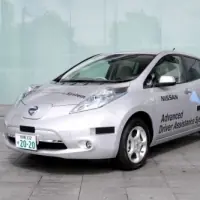
¿Cual es la finalidad de las placas de ensayo o investigación?
What is the purpose of test or research plates?
- AProbar el buen funcionamiento únicamente de ciclos y bicicletasTo test that cycles and bicycles, and only these, work properly
- BProbar un vehículo que ha tenido un grave accidente después de ésteTo test a vehicle after it has had a serious accident
- CProbar el funcionamiento de un nuevo vehículoTo test how a new vehicle works
ExplanationThe purpose of test plates is to identify new vehicles whose operation is being tested and researched before they are possibly put on the market. They are used on all types of vehicles, not only on cycles or bicycles.
De noche, la carga que sobresale por delante, debe señalizarla con una luz….
At night, a load sticking out at the front must be marked with a light that is….
- ARoja.Red.
- BBlanca o amarilla y un dispositivo reflectante del mismo color.White or yellow, with a reflective device of the same colour.
- CBlanca.White.
ExplanationAt night or in poor visibility, a load sticking out at the front of the vehicle is marked with a white light, and one sticking out at the rear with a red light as well as the V-20 sign. Yellow is not used for this marking.
Un remolque se considera 'ligero' cuando su masa máxima autorizada no supera:
A trailer is considered 'light' when its maximum authorised mass does not exceed:
- A750 kg.750 kg.
- B1.000 kg.1,000 kg.
- C500 kg.500 kg.
ExplanationA light trailer has a MAM of 750 kg or less.
Como norma general, ¿cuál es el número máximo de remolques o semirremolques que le está permitido arrastrar a un vehículo tractor?
As a general rule, what is the maximum number of trailers or semi-trailers that a towing vehicle is allowed to tow?
- ADos, salvo los trenes turísticos que pueden arrastrar hasta cinco remolques.Two, except tourist road trains, which may tow up to five trailers.
- BDos, siempre que uno de ellos, al menos, sea un remolque.Two, as long as at least one of them is a trailer.
- CUno, ya sea remolque o semirremolque.One, whether a trailer or a semi-trailer.
ExplanationAs a general rule, no towing vehicle may tow more than one trailer or semi-trailer at a time (Article 9 of the General Vehicle Regulations). Only expressly regulated exceptions are allowed.
En un turismo, ¿cuánto podrá sobresalir como máximo la carga transportada?
In a car, what is the maximum the load carried may stick out?
- AUn 10% de la longitud del vehículo por la parte posterior.10% of the vehicle's length at the back.
- BUn 15% de la longitud del vehículo por la parte posterior.15% of the vehicle's length at the back.
- C3 metros por la parte posterior.3 metres at the back.
ExplanationIn vehicles not designed exclusively for carrying goods, an indivisible load may stick out at the back by 15%, and a divisible load by 10%.
¿En un turismo podrá sobresalir lateralmente la carga de la baca?
On a car, may the load on the roof rack stick out at the sides?
- ASí, si no sobrepasa los 2,50 metros de anchura.Yes, if it does not exceed a width of 2.50 metres.
- BSí, podrá sobresalir 0,50 metros por cada lado.Yes, it may stick out 0.50 metres on each side.
- CNo podrá sobresalir nada lateralmente.It may not stick out at the sides at all.
ExplanationAs a general rule, the load may not stick out beyond the outline of the vehicle seen from above. In exceptional cases, on vehicles not intended to carry goods, such as cars, the load may stick out at the back: up to 10% of the vehicle's length if the load is divisible; up to 15% of the vehicle's length if the load is indivisible. It may not stick out at the front or at the sides.
Para un vehículo con carga, ¿Cuál es la altura máxima permitida?
For a laden vehicle, what is the maximum height allowed?
- A4 metros.4 metres.
- B2,55 metros.2.55 metres.
- C12 metros.12 metres.
ExplanationThe maximum height allowed for a vehicle, including its load, is 4 metres. The figure of 2.55 metres is the general maximum width of vehicles, not their height.
¿La carga podrá sobresalir por la parte delantera de un turismo?
May the load stick out from the front of a car?
- ASí, 1/3 de la longitud del vehículo.Yes, 1/3 of the length of the vehicle.
- BNo.No.
- CSí, 2 m por la parte anterior y 3 m por la parte posterior.Yes, 2 m at the front and 3 m at the back.
ExplanationIn cars, the load must not stick out at the front. At the back it may stick out by up to 10% of the vehicle's length and, when the load is indivisible, by up to 15%.
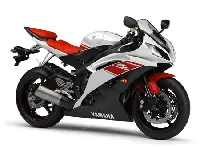
¿Cuánto puede sobresalir por detrás la carga en una motocicleta?
How far may a load stick out at the rear of a motorcycle?
- A50 cm máximo.50 cm at most.
- B25 cm máximo.25 cm at most.
- CNo está permitido que sobresalga nadaNothing may stick out at all
ExplanationUnder Article 15 of the General Traffic Regulations, on vehicles less than one metre wide, such as motorcycles, the load may stick out at most 0.25 metres at the rear. Nothing may stick out at the front, and to the sides up to 0.50 metres from the axis.
En un turismo, ¿cuánto podrá sobresalir lateralmente la carga?
In a car, how far may the load stick out at the sides?
- AUn 10% si es divisible y un 15% si es indivisible.10% if it is divisible and 15% if it is indivisible.
- B40 centímetros.40 centimetres.
- CNada.Not at all.
ExplanationLoad carried in cars may only stick out at the back, never at the sides or the front. If we carry an indivisible load in a car, it may stick out at the back by up to 15% of the vehicle's length, and if it is divisible, by up to 10%.
En los vehículos destinados exclusivamente al transporte de mercancías con longitud superior a 5 metros, ¿cuánto podrá sobresalir la carga?
On vehicles used only for carrying goods and longer than 5 metres, how far may the load stick out?
- A2 metros por delante y 3 metros por detrás.2 metres at the front and 3 metres at the back.
- BUn tercio por delante y un tercio por detrás.One third at the front and one third at the back.
- CUn tercio solamente por la parte posterior.One third, only at the back.
ExplanationOn vehicles used only for carrying goods that are longer than 5 metres, indivisible loads such as beams or pipes may stick out 2 metres at the front and 3 at the back (Article 15 of the General Traffic Regulations, RGC). The limit of one third at each end is for vehicles of 5 metres or less.
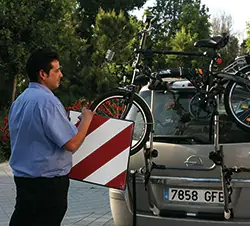
Cuando la carga sobresale de un vehículo, ¿es obligatorio señalizarla con el panel de la imagen?
When a load sticks out of a vehicle, is it compulsory to mark it with the panel in the picture?
- ANo, excepto para los vehículos destinados al transporte de mercancías.No, except for vehicles used to carry goods.
- BSolo es obligatorio si la carga sobresale por la parte trasera.It is only compulsory if the load sticks out at the back.
- CSí, para todo tipo de vehículos, pero solo cuando la carga sea indivisible.Yes, for all types of vehicle, but only when the load is indivisible.
ExplanationThe red and white striped panel (V-20) is compulsory when the load sticks out at the back of the vehicle, to warn those behind about the overhang.

¿Hay que señalizar las cargas que sobresalen de su vehículo de noche con los paneles?
At night, must loads that stick out of your vehicle be marked with panels?
- ANo, sólo Con las luces de señalización de carga.No, only with the load marker lights.
- Bsí, sólo con los paneles es suficiente.Yes, the panels alone are enough.
- CSí, tanto con los paneles como con las luces correspondientes.Yes, both with the panels and with the corresponding lights.
ExplanationUnder Article 15 of the General Traffic Regulations, a load that sticks out at the rear is always marked with the V-20 panel. At night or in poor visibility you must also add the corresponding light: red to the rear, or white if the load sticks out at the front.
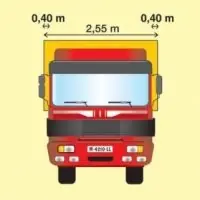
De noche, es obligatorio señalizar una carga que sobresale lateralmente más de 0,40 metros...
At night, a load that sticks out sideways by more than 0.40 metres must be marked…
- Acon un panel reflectante por detrás solamente.with a reflective panel at the rear only.
- Bcon una luz blanca y un dispositivo reflectante de color blanco por delante y con una luz roja y un dispositivo reflectante de color rojo por detrás.with a white light and a white reflective device at the front, and with a red light and a red reflective device at the rear.
- Ccon una luz roja y un dispositivo reflectante rojo por detrás, solamente.with a red light and a red reflective device at the rear only.
ExplanationUnder Article 15 of the General Traffic Regulations, at night or in poor visibility, a load that sticks out sideways by more than 0.40 metres beyond the sidelight must carry on each side a white light and a white reflector facing forwards, and a red light and a red reflector facing backwards.
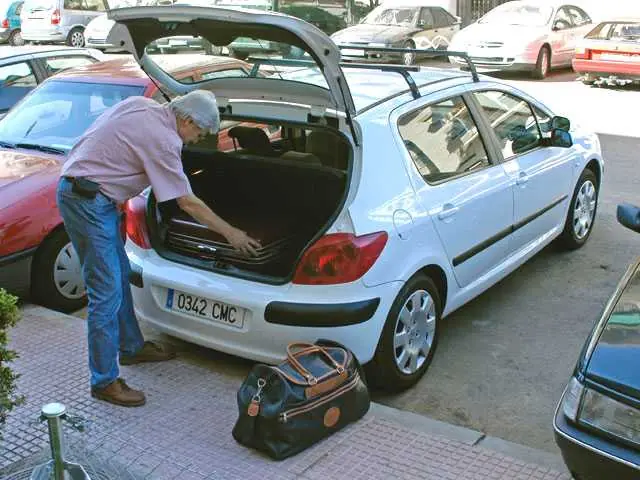
¿Cómo debes llevar una carga en un vehículo?
How must you carry a load in a vehicle?
- ADe forma que no afecte a la estabilidad del vehículo.So that it does not affect the vehicle's stability.
- BLa carga debe estar suelta y se puede mover dentro del vehículo.The load must be loose and may move around inside the vehicle.
- CTapando las luces del vehículo.Covering the vehicle's lights.
ExplanationThe load must be placed and, if necessary, secured so that it does not put the vehicle's stability at risk and cannot fall or shift, and without covering lights, number plates or signs (Article 14 of the General Traffic Regulations). Carrying it loose or covering the lights is prohibited.
¿Cuál es la anchura máxima para un vehículo acondicionado?
What is the maximum width of a conditioned (temperature-controlled) vehicle?
- A2,65 metros.2.65 metres.
- B2,60 metros.2.60 metres.
- C2,55 metros.2.55 metres.
ExplanationAccording to the Regulations, the maximum authorised width for a conditioned (temperature-controlled) vehicle is 2.60 metres.
En un turismo para 5 plazas, incluido el conductor, ¿está permitido que viajen 6 personas?
In a 5-seat car, including the driver, may 6 people travel?
- ANo, porque no se puede sobrepasar el número de plazas autorizadas.No, because the number of authorised seats cannot be exceeded.
- BSí, cuando no se supera la M.M.A del vehículo.Yes, when the vehicle's MAM is not exceeded.
- CSí, cuando el vehículo circula en vías urbanas.Yes, when the vehicle is travelling on urban roads.
ExplanationThe number of people carried in a vehicle may not be greater than the number of seats authorised for it.
Circulando de noche con carga sobresaliendo por la parte posterior del vehículo, ¿cómo lo debemos señalizar?
When driving at night with a load sticking out at the back of the vehicle, how must we mark it?
- ACon un panel reflectante de 50 cm de lado con franjas diagonales alternas rojas y blancas.With a 50 cm square reflective panel with alternating red and white diagonal stripes.
- BCon una luz blanca dirigida hacia atrás.With a white light facing backwards.
- CCon un panel reflectante de 50 cm de lado con franjas diagonales alternas rojas y blancas y, además, una luz de color rojo.With a 50 cm square reflective panel with alternating red and white diagonal stripes and, in addition, a red light.
ExplanationWhen driving at night, as well as marking the load with the panel, we must use a red light.
All topics
- Definitions
- Documents and penalty points
- The driver's condition
- Duties of drivers and pedestrians
- Vehicle safety devices
- Vehicle controls and equipment
- Vehicle lights and horn
- Traffic signs, markings and signals
- The road and its lanes
- Speed and distances
- Manoeuvres
- Right of way
- Driving safely in difficult conditions
- Vehicle mechanics and maintenance
- Road accidents and first aid
- Defensive and eco-driving
Independent app: not affiliated with or endorsed by the DGT (Spain's Directorate-General for Traffic) or the Ministry of the Interior. The official exam is booked with the DGT and taken at its test centres. The questions here are practice material; the DGT's official question bank is not public.
Basado en datos de la Agencia Estatal Boletín Oficial del Estado (https://www.boe.es). Textos consolidados de carácter meramente informativo. La AEBOE no patrocina ni respalda este sitio.
Parte de las preguntas procede de los tests de la revista «Tráfico y Seguridad Vial» de la DGT, reproducidos con indicación de la fuente.