
DGT test · 574 questions
Carrying passengers and loads · Page 7 of 12
Passengers, children, loads and trailers: what you may carry and how it must be secured and marked.
Questions in this topic, with answers
574 questions, 50 per page, with the correct answer and the explanation. Page 7 of 12.
Si al enganchar el remolque a un vehículo, el conjunto mide 13 metros, se debe instalar...
If, when you hitch the trailer to a vehicle, the combination is 13 metres long, you must fit...
- AEn la parte posterior, uno o dos paneles con franjas rojas y blancas.At the rear, one or two panels with red and white stripes.
- BEn la parte posterior la señal indicadora de que el conjunto mide más de 12 metros.At the rear, the sign showing that the combination is more than 12 metres long.
- CEn la parte superior delantera del tractor, una luz amarilla giratoria.On the top front of the towing vehicle, a rotating amber light.
ExplanationSign V-6 (long vehicle) shows that the vehicle or vehicle combination is more than 12 metres long, and it is placed at the rear (Annex XI of the General Vehicle Regulations). It does not mean that the permitted length is exceeded.
¿Cómo debe ir sentado el pasajero de una motocicleta?
How must a motorcycle passenger sit?
- AA horcajadas y con los pies apoyados en los reposapiés laterales.Astride, with their feet on the side footrests.
- BDe cualquier forma, siempre que vaya cómodo.In any way, as long as they are comfortable.
- CEntre el conductor y el manillar.Between the rider and the handlebar.
ExplanationUnder Article 12.1 of the General Traffic Regulations, a motorcycle passenger must sit astride, with their feet on the side footrests, behind the rider. They may never sit between the rider and the handlebar.
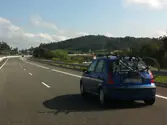
¿Cómo señalizaremos una carga que sobresale por la parte trasera en un turismo?
How will we mark a load sticking out from the back of a car?
- AEn un turismo la carga no puede sobresalir por detrás.On a car, the load may not stick out from the back.
- BCon el panel reglamentario para cargas que sobresalen.With the regulation panel for projecting loads.
- CCon un trapo de color vivo.With a brightly coloured cloth.
ExplanationIf the load sticks out from the back of a car, by day, in clear weather and with normal visibility, it must be marked with a 50 × 50 centimetre panel painted with alternating red and white diagonal stripes. The panel is placed at the rear end of the load so that it is always at right angles to the length of the vehicle. If the load sticks out from the back between sunset and sunrise, or in weather or other conditions that greatly reduce visibility, it must be marked with the panel or panels described above, which have a reflective surface, and with a red light.
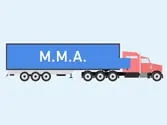
¿Qué es la MMA de un vehículo?
What is a vehicle's MAM?
- ALa masa del vehículo.The mass of the vehicle.
- BLa masa máxima autorizada para la utilización del vehículo.The maximum authorised mass for using the vehicle.
- CLa suma de las masas del vehículo de motor y del remolque arrastrado.The combined mass of the motor vehicle and the trailer it tows.
ExplanationThe maximum authorised mass (MAM) is given in kg and shows the maximum mass at which we may use the vehicle.
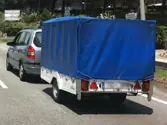
Un turismo con remolque y ocupado por 5 personas, ¿podrá circular por un carril VAO?
May a car with a trailer and 5 people on board use a HOV lane (VAO)?
- ASí, porque supera el número mínimo de ocupantes.Yes, because it has more than the minimum number of occupants.
- BSí.Yes.
- CNo.No.
ExplanationUnder Article 35 of the General Traffic Regulations (RGC) (as worded by RD 518/2026), combinations of vehicles, including cars with trailers, may not use the HOV lane (VAO), whatever the number of occupants.
¿Está permitido conducir una motocicleta con remolque por la noche (entre la puesta y la salida del sol)?
Is it allowed to ride a motorcycle towing a trailer at night (between sunset and sunrise)?
- ASí, si se circula a una velocidad un 10% inferior a la permitida en la vía.Yes, if you ride 10% below the speed allowed on the road.
- BSí, como en cualquier otro momento del día.Yes, as at any other time of day.
- CNo.No.
ExplanationRiding a motorcycle towing a trailer at night is prohibited. This is because of reduced visibility and the difficulty of manoeuvring. The trailer makes the vehicle bigger and changes how it behaves, which can make it harder to control, especially in the dark. Poor visibility and lighting conditions make this riding more dangerous. During the day, trailers are allowed, but the speed and load limits must be respected.
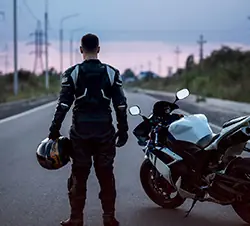
Para los conductores y pasajeros de motocicletas, ¿tiene importancia el vestuario a utilizar?
For motorcycle riders and passengers, does the clothing they wear matter?
- ANo, es indiferente siempre que lleven el casco.No, it makes no difference as long as they wear a helmet.
- BNo, porque no aporta nada a la seguridad.No, because it adds nothing to safety.
- CSí, es fundamental porque el cuerpo está directamente expuesto a las inclemencias del tiempo.Yes, it is essential, because the body is directly exposed to bad weather.
ExplanationOn a motorcycle the body is directly exposed: suitable clothing (gloves, a jacket with protectors, boots) protects against bad weather and reduces abrasion and impact injuries in a fall.
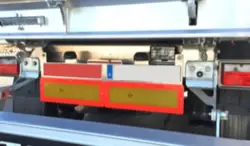
¿Los remolques ligeros necesitan llevar matrícula propia?
Do light trailers need their own registration number?
- ANo.No.
- BSí.Yes.
- CDepende del número de ocupantes del turismo.It depends on the number of occupants in the car.
ExplanationNo. Only trailers with a maximum authorised mass of more than 750 kg need their own registration (Article 25 of the General Vehicle Regulations). Light trailers carry a plate with the registration number of the vehicle towing them, whatever the number of occupants in the car.
Un turismo transporta una carga que sobresale por detrás. ¿Debe señalizarla?
A car is carrying a load that sticks out at the back. Must it be signalled?
- ASí, con una tela roja.Yes, with a red cloth.
- BNo, sólo es obligatorio para camiones.No, it is only compulsory for lorries.
- CSí, con una placa reglamentaria.Yes, with an official panel.
ExplanationAccording to the General Traffic Regulations (RGC), if a car is carrying a load that sticks out at the back, it must be signalled with an official panel (V-20 sign). This rule is important for road safety, because proper signalling tells other drivers how far the load extends and helps avoid accidents. The sign must be placed so that it is clearly visible and at right angles to the vehicle's centre line, as required by the regulations.
La carga en un turismo, ¿cuánto podrá sobresalir como máximo por detrás?
What is the maximum a car's load may stick out at the back?
- ANo podrá sobresalir en ningún caso.It may never stick out.
- BUn tercio de la longitud del vehículo.A third of the vehicle's length.
- CUn quince por cien de la longitud del vehículo.Fifteen per cent of the vehicle's length.
ExplanationIn vehicles not designed exclusively for carrying goods, the load may not stick out at all at the front. At the back it may stick out by 10% of the vehicle's length if the load is divisible, or 15% of the vehicle's length if it is indivisible.
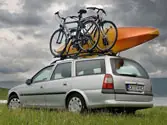
Un turismo, ¿puede transportar carga en la baca?
May a car carry a load on the roof rack?
- ASí, cuando no comprometa la estabilidad del vehículo.Yes, when it does not make the vehicle unstable.
- BSí, pero sólo si circula de día.Yes, but only when driving during the day.
- CNo.No.
ExplanationThe load carried in a vehicle, and any accessories used to pack or protect it, must be arranged and, if necessary, secured so that they cannot make the vehicle unstable. Putting things on the roof rack increases air resistance and therefore fuel consumption, so whenever we can, we should put things in the boot.
La masa en orden de marcha se obtiene sumando a la tara del vehículo...
The mass in running order is obtained by adding to the vehicle's unladen weight...
- Ala masa del conductor, valorada en 75 kg.the mass of the driver, taken as 75 kg.
- Bla masa del conductor, valorada en 68 kg.the mass of the driver, taken as 68 kg.
- Cla masa del conductor y un acompañante, 150 kg.the mass of the driver and one passenger, 150 kg.
ExplanationOnly the driver is added, taken as 75 kg. The other options change the figure or add a passenger.
¿Está permitido que viaje como pasajero en una motocicleta un menor de 12 años?
Is a child under 12 allowed to travel as a passenger on a motorcycle?
- ASí, en todo caso.Yes, in all cases.
- BSí, siempre que sea mayor de siete años y el conductor sea el padre, madre o tutor.Yes, as long as the child is over seven and the rider is their father, mother or guardian.
- CNo, a los menores de 12 años no pueden ir como pasajeros en las motocicletas.No, children under 12 cannot travel as passengers on motorcycles.
ExplanationAs a general rule, a motorcycle passenger must be over 12. As an exception, a child over 7 may travel if the rider is their father, mother or guardian, or an adult authorised by them, with an approved helmet and seated properly (Article 12 of the General Traffic Regulations).
Si lleva a un pasajero en la motocicleta, debe tener en cuenta que...
If you carry a passenger on your motorcycle, you must bear in mind that...
- Ala distancia de frenado aumenta.the braking distance increases.
- Bdebe conducir más rápido.you must ride faster.
- Cla distancia de frenado disminuye.the braking distance decreases.
ExplanationUnder the General Traffic Regulations (RGC) and the Traffic and Road Safety Code, braking distance depends on the mass of the vehicle and on road conditions. When a motorcycle carries a passenger, the total weight increases, which increases the inertia that the braking system has to overcome. In addition, the centre of gravity shifts, and the distribution of the load over the rear wheel can reduce braking grip, making the stopping distance longer. That is why the correct answer is that the braking distance increases.
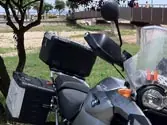
En una motocicleta, ¿cuánto podrá sobresalir lateralmente la carga?
On a motorcycle, how far may the load stick out at the sides?
- ANo podrá sobresalir nada.Not at all.
- B40 cm.40 cm.
- C50 cm.50 cm.
ExplanationIn vehicles less than 1 metre wide, the load may stick out at the sides by at most 50 cm on each side of the centre line.
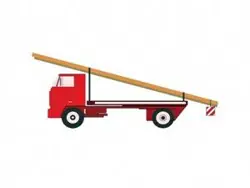
En los vehículos de más de 5 metros destinados al transporte de mercancías, una carga de longitud indivisible puede sobresalir...
On goods vehicles more than 5 metres long, a load of indivisible length may stick out…
- AEl 15% de la longitud del vehículo por detrás.By 15% of the vehicle's length at the rear.
- B1/3 de la longitud del vehículo.By 1/3 of the vehicle's length.
- C2 metros por la parte anterior y 3 metros por la parte posterior.2 metres at the front and 3 metres at the rear.
ExplanationUnder Article 15 of the General Traffic Regulations, on goods vehicles more than 5 metres long, a load of indivisible length, such as beams or pipes, may stick out 2 metres at the front and 3 at the rear. On those 5 metres long or less, it may stick out by one third of the length at each end.
¿Puede un ciclista llevar a un pasajero?
May a cyclist carry a passenger?
- ANo, está prohibido.No, it is forbidden.
- BSí, sentado entre el ciclista y el manillar.Yes, sitting between the cyclist and the handlebars.
- CSí, a un menor de hasta 22 kg sentado en un asiento adicional.Yes, a child of up to 22 kg sitting in an additional seat.
ExplanationAccording to Article 154 of the General Traffic Regulations (as worded by RD 518/2026), if the rider is an adult, bicycles built for only one person may carry children of up to 22 kg who can sit up by themselves in additional seats.
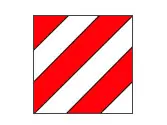
La instalación del panel V-20 que indica que la carga del vehículo sobresale posteriormente, ¿será obligatoria solo para los camiones?
Is fitting the V-20 panel, which shows that the vehicle's load sticks out at the back, compulsory only for lorries?
- ASí.Yes.
- BEs obligatoria para camiones y vehículos mixtos.It is compulsory for lorries and dual-purpose vehicles.
- CEs obligatoria para camiones, vehículos mixtos e incluso turismos.It is compulsory for lorries, dual-purpose vehicles and even cars.
ExplanationThe V-20 panel must be used on all vehicles except two-wheelers to mark a load sticking out at the back, even on cars.
¿Está permitido transportar a un niño entre el manillar y el conductor en una motocicleta?
Is it allowed to carry a child between the handlebars and the rider on a motorcycle?
- ANo.No.
- BSí, pero solo si el conductor es el padre, la madre o una persona autorizada.Yes, but only if the rider is the child's father, mother or an authorised person.
- CSí, con casco apropiado que se ajuste a su talla.Yes, with a suitable helmet that fits the child's size.
ExplanationAccording to Article 12.1 of the General Traffic Regulations (RGC), as worded by RD 518/2026, the passenger must sit astride on the seat behind the rider and may never be placed between the rider and the handlebars of the motorcycle, whatever their age and whoever the rider is.
¿Qué requisitos mínimos son necesarios para conducir un turismo de 3.000 kg de MMA que arrastra un remolque de 800 kg de MMA?
What are the minimum requirements for driving a car with a maximum authorised mass of 3,000 kg towing a trailer with a maximum authorised mass of 800 kg?
- ASer titular del permiso de la clase B y haber superado las pruebas de control de aptitudes y comportamientos para la obtención del código 96.To hold a category B licence and to have passed the skills and behaviour tests for code 96.
- BSer titular del permiso de la clase B+E.To hold a category B+E licence.
- CSer titular del permiso de la clase B.To hold a category B licence.
ExplanationTo drive a combination of 3,800 kg, made up of a 3,000 kg car and an 800 kg trailer, a B licence plus passing the test or training for code 96 is enough (Article 5 of the General Driver Regulations). The B+E is needed only if the combination exceeds 4,250 kg.
Si su ciclomotor lleva enganchado un remolque, ¿debe concertar un seguro para el remolque?
If your moped is towing a trailer, must you take out insurance for the trailer?
- ANo.No.
- BSí, si circula por vías interurbanas.Yes, if you ride on roads outside built-up areas.
- CSí.Yes.
ExplanationNo, you do not need to take out insurance for the trailer if your moped is towing one.
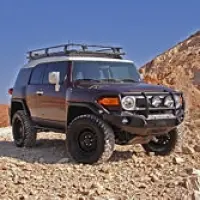
Cuando no se utiliza la baca del vehículo ¿es aconsejable retirarla?
When you are not using the vehicle's roof rack, is it advisable to remove it?
- ASí, porqué sin la baca ahorro carburante.Yes, because without the roof rack I save fuel.
- BEs igual, porqué la baca no influye en el consumo.It makes no difference, because the roof rack does not affect fuel consumption.
- CNo, porqué la baca aumenta la estabilidad del vehículo.No, because the roof rack makes the vehicle more stable.
ExplanationYes. A roof rack, even when empty, increases air resistance and so fuel consumption, especially at high speeds. In addition, when loaded, it raises the centre of gravity and reduces stability, so it is best to remove it when it is not in use.
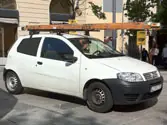
Durante el día, con tiempo claro y en condiciones de visibilidad normales, ¿cómo se señalizará la carga que sobresale por delante del vehículo?
During the day, in clear weather and with normal visibility, how must a load that sticks out at the front of the vehicle be marked?
- ACon un panel de 50 por 50 cm reglamentario.With a regulation 50 by 50 cm panel.
- BNo es necesario señalizarla.It does not need to be marked.
- CCon un trapo de color vivo.With a brightly coloured cloth.
ExplanationThe V-20 panel is only required for a load that sticks out at the rear. If it sticks out at the front, it is marked with a white light, but only between sunset and sunrise or when visibility is considerably reduced (Article 15.6 of the General Traffic Regulations). By day and with good visibility it does not need to be marked, although its projecting end must be protected.
En el transporte escolar, la persona encargada del cuidado de los menores durante el transporte...
In school transport, the person in charge of looking after the children during the journey...
- ADebe ocupar plaza al lado del conductor.Must sit next to the driver.
- BDebe ocupar plaza en las inmediaciones de la puerta de servicio central o trasera.Must sit near the central or rear service door.
- CDebe permanecer de pie durante todo el trayecto.Must stand for the whole journey.
ExplanationThe person in charge of the children must sit near the central or rear service door. It is important for them to be close to the doors so that they can supervise the children and keep them safe during school transport.
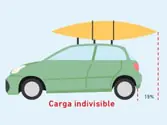
¿Debe un turismo que transporta una carga que sobresale por detrás, señalizarla durante el día?
Must a car carrying a load that sticks out from the back mark it during the day?
- ANo, sólo es obligatorio para los camiones.No, this is only compulsory for lorries.
- BSí, con un panel reglamentario.Yes, with a regulation panel.
- CSí, con un trapo rojo.Yes, with a red cloth.
ExplanationWhenever the load sticks out from the back of the vehicle (except for vehicles less than 1 metre wide), it must be marked with a 50 × 50 centimetre panel (V-20) painted with alternating red and white diagonal stripes. The panel must be placed at the rear end of the load so that it is always at right angles to the length of the vehicle. When the vehicle is driven between sunset and sunrise, or in weather or other conditions that greatly reduce visibility, the load must also be marked with a red light.
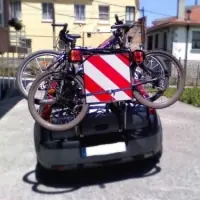
¿Qué debe tener en cuenta para transportar una carga en su vehículo?
What must you bear in mind when carrying a load in your vehicle?
- AQue la carga no debe arrastrar, ni desplazarse de manera peligrosa.That the load must not drag or move about dangerously.
- BQue no se pueden transportar cargas que sobresalgan.That loads that stick out may not be carried.
- CQue se debe utilizar un dispositivo adecuado como un remolque.That a suitable device such as a trailer must be used.
ExplanationUnder Article 14 of the General Traffic Regulations, the load must be arranged and secured so that it cannot drag, fall or move about dangerously, or compromise the vehicle's stability. The load may stick out within certain limits, and a trailer is not required.
Un turismo transporta en su baca carga que no es equipaje. ¿Es correcto?
A car is carrying a load that is not luggage on its roof rack. Is this correct?
- ANo, porque está prohibido.No, because it is prohibited.
- BSí, siempre que la carga no sobresalga de la estructura del vehículo.Yes, as long as the load does not stick out beyond the vehicle's structure.
- CSí, siempre que la carga sea adecuada a las características del vehículo, no comprometa su estabilidad y, en su caso, vaya correctamente señalizada.Yes, as long as the load is suitable for the vehicle's characteristics, does not affect its stability and, where necessary, is properly marked.
ExplanationA roof rack may carry a load that is not luggage. Article 14 of the General Traffic Regulations requires the load to be arranged and secured so that it cannot fall and does not affect the vehicle's stability. On a car, it may stick out at the rear by up to 10% of its length, or 15% if it is indivisible, marked with the V-20 panel (Article 15).
¿Está permitido utilizar la baca de un turismo para transportar equipaje?
Is it allowed to use a car's roof rack to carry luggage?
- ASolo si hay más de 3 pasajerosOnly if there are more than 3 passengers
- BSí, si se coloca correctamenteYes, if it is placed correctly
- CNo, está prohibidoNo, it is forbidden
ExplanationYes, it is allowed. As a general rule, luggage should go in the boot. However, if the boot is not big enough, you may use the roof rack or an outside luggage carrier, as long as the load is placed and secured correctly. It must be secured so that it cannot fall, move about dangerously, affect the vehicle's stability or hide the lights or the number plate. The option about the number of passengers is wrong, because using the roof rack does not depend on how many people are in the vehicle.
En los ciclomotores o motocicletas, ¿qué menores no pueden circular como pasajeros?
On mopeds or motorcycles, which children may not travel as passengers?
- ALos menores de 2 años.Children under 2.
- BTodos.All of them.
- CLos menores de 12 años.Children under 12.
ExplanationAs a general rule, only people over 12 may travel as passengers on mopeds and motorcycles. The exception is children over 7 when the rider is their father, mother, guardian or an adult authorised by them, always with a helmet.
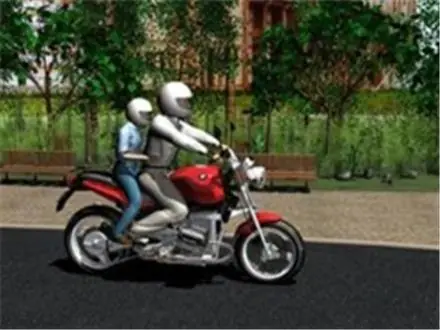
Una persona mayor de edad, ¿puede circular con una motocicleta llevando como pasajero a un niño de 10 años, si no es su padre, ni su madre, ni su tutor legal?
May an adult ride a motorcycle carrying a 10-year-old child as a passenger if the adult is not the child's father, mother or legal guardian?
- ASí, siempre que el menor lleve casco homologado.Yes, as long as the child wears an approved helmet.
- BSólo si está autorizado por alguno de ellos.Only if authorised by one of them.
- CNo.No.
ExplanationAccording to Article 12.2 of the General Traffic Regulations, a child under twelve but over seven may only travel as a passenger on a motorcycle if the rider is their father, mother, guardian or an adult authorised by them. The child must also wear an approved helmet.
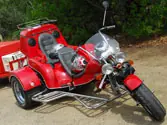
¿Puede un vehículo de tres ruedas, arrastrar un remolque?
May a three-wheeled vehicle tow a trailer?
- ANo, nunca.No, never.
- BSí.Yes.
- CSí, cualquier remolque.Yes, any trailer.
ExplanationUnder Article 12.3 of the General Traffic Regulations (RGC) (as worded by RD 518/2026), motorcycles, three-wheeled vehicles and mopeds may tow a trailer or semi-trailer that does not exceed 50% of the towing vehicle's unladen mass, travelling in daylight and in conditions that do not reduce visibility, with their speed reduced by 10% and without carrying people in the towed vehicle.
En los vehículos no destinados al transporte de mercancías, ¿podrá sobresalir la carga por la parte delantera?
On vehicles not intended for carrying goods, may the load stick out at the front?
- ASí, hasta un 10 por ciento si la carga es divisible.Yes, by up to 10 per cent if the load is divisible.
- BNo.No.
- CSí, hasta un 15 por ciento si la carga es indivisible.Yes, by up to 15 per cent if the load is indivisible.
ExplanationA load carried in a car may only stick out at the back, never at the sides or the front. If we carry an indivisible load in a car, it may stick out at the back by up to 15% of the vehicle's length; if it is divisible, by up to 10%.
En un turismo, ¿cuánto podrá sobresalir la carga por su parte posterior como máximo?
In a car, what is the maximum the load may stick out at the back?
- AEn un turismo la carga no podrá sobresalir en ningún caso.In a car, the load may never stick out.
- BUn 15% de la longitud del vehículo si la carga es indivisible.15% of the vehicle's length if the load is indivisible.
- CUn 10% de la longitud del vehículo si la carga es indivisible.10% of the vehicle's length if the load is indivisible.
ExplanationIf the load is indivisible, it may stick out at the back by at most 15% of the vehicle's length; when the load is divisible, by at most 10%.
¿Se pueden transportar objetos o paquetes que sobresalgan por las ventanillas laterales?
Can objects or packages be carried sticking out of the side windows?
- ANo.No.
- BSí, hasta 30 centímetros.Yes, up to 30 centimetres.
- CSí, con una tela de color rojo.Yes, with a red cloth.
ExplanationAccording to the General Traffic Regulations (RGC), it is prohibited to carry objects or packages sticking out of the side windows of the vehicle. This is for the safety of all road users, since objects sticking out of the windows can cause accidents, both by affecting visibility and by possibly being thrown onto other vehicles. The correct option is «No», since carrying loads in this unsuitable way goes against the basic rules of road safety.
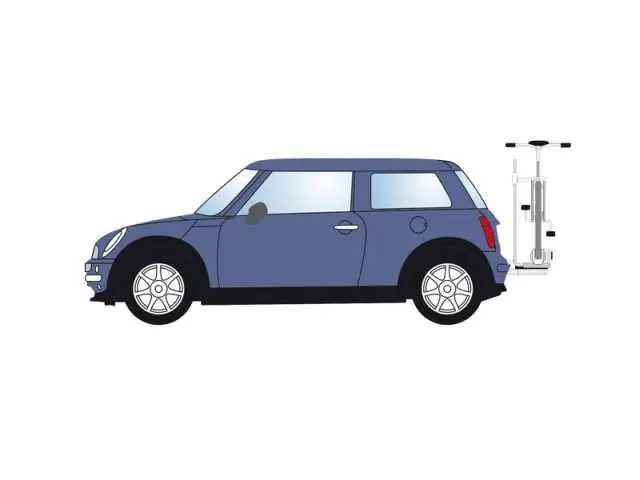
¿Debe señalizar la carga que transporta y que sobresale por la parte trasera de su turismo?
Must you mark a load you are carrying that sticks out at the rear of your car?
- ASólo si es indivisible y sobresale más de 40 centímetros.Only if it is indivisible and sticks out by more than 40 centimetres.
- BSí, con un panel de franjas rojas y blancas.Yes, with a panel with red and white stripes.
- CNo, en un turismo no es obligatorio señalizarla.No, on a car it is not compulsory to mark it.
ExplanationYes. On cars the load may only stick out at the rear, by up to 10% of the vehicle's length, or 15% if it is indivisible, and it must be marked with the V-20 panel with diagonal red and white stripes; at night, also with a red light (Article 15 of the General Traffic Regulations).
Un vehículo de hasta 3500 kg destinado al transporte de mercancías, ¿cuándo pasará la primera ITV?
When does a goods vehicle of up to 3,500 kg have its first vehicle inspection (ITV)?
- AA partir de los 4 años.From 4 years.
- BA partir de los 2 años.From 2 years.
- CA partir de los 3 años.From 3 years.
ExplanationGoods vehicles and combinations of vehicles of up to 3,500 kg have their first ITV at 2 years, then every two years until they are six years old. From 6 years they have it every year until 10 years, when they start having it every 6 months.
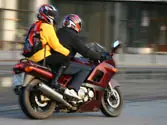
¿Cuánto podrá sobresalir el equipaje en las motocicletas por la parte trasera?
How far may luggage stick out at the back of a motorcycle?
- ANo puede sobresalir nada.It must not stick out at all.
- B0,50 metros.0.50 metres.
- C0,25 metros0.25 metres.
ExplanationAt the back of a motorcycle, as it is a vehicle less than 1 metre wide, luggage may stick out 0.25 metres. It does not have to be marked with a sign.
¿A qué denominamos un remolque?
What do we call a trailer?
- AUn vehículo autopropulsado.A self-propelled vehicle.
- BUn vehículo no autopropulsado.A vehicle that is not self-propelled.
- CEs lo mismo que un semirremolque.The same as a semi-trailer.
ExplanationA trailer is a vehicle that is not self-propelled, designed to be towed by a motor vehicle. It differs from a semi-trailer, which rests part of its weight on the towing vehicle.
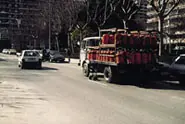
Las operaciones de carga y descarga, ¿por qué lado del vehículo deben realizarse?
From which side of the vehicle must loading and unloading be carried out?
- APor el lado que haya más espacio libre.From the side with more free space.
- BPor la parte trasera del vehículo.From the rear of the vehicle.
- CPor el lado que quede más próximo al borde de la calzada.From the side nearest the edge of the carriageway.
ExplanationUnder Article 16 of the General Traffic Regulations, loading and unloading on the road must be done, whenever possible, from the side of the vehicle nearest the edge of the carriageway, so that people do not have to stand in the middle of traffic.
El conductor de una bicicleta,¿puede transportar un pasajero?
Can the rider of a bicycle carry a passenger?
- ASí, a un menor de hasta 22 kg en un asiento adicional, si el conductor es mayor de edad.Yes, a child weighing up to 22 kg in an additional seat, if the rider is an adult.
- BNo, ya que está prohibido.No, because it is prohibited.
- CSí, a un menor de hasta 7 años, aunque el conductor sea menor de edad.Yes, a child aged up to 7, even if the rider is under 18.
ExplanationUnder Article 154 of the General Traffic Regulations (as worded by RD 518/2026), if the rider is an adult, a bicycle may carry children weighing up to 22 kg who are able to sit up by themselves, in additional seats.
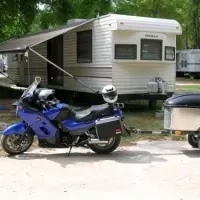
¿Pueden las motocicletas, los ciclomotores o los vehículos de tres ruedas llevar un remolque o semirremolque?
May motorcycles, mopeds or three-wheeled vehicles tow a trailer or semi-trailer?
- ANo.No.
- BSí, si se cumplen las condiciones reglamentarias, como circular de día, con buena visibilidad y sin transportar personas en el remolque.Yes, if the legal conditions are met, such as riding in daylight, with good visibility and without carrying people in the trailer.
- CSí, y además pueden transportar personas en el remolque.Yes, and they may also carry people in the trailer.
ExplanationUnder Article 12.3 of the General Traffic Regulations, motorcycles, three-wheeled vehicles and mopeds may tow a trailer that does not exceed 50% of their unladen mass, as long as they travel in daylight and with good visibility, at a speed 10% lower than the general limit and without carrying people in the trailer.
En un vehículo no destinado exclusivamente al transporte de mercancías, ¿cuánto podrá sobresalir por su parte posterior una carga indivisible?
In a vehicle not designed exclusively for carrying goods, how far may an indivisible load stick out at the back?
- AUn 10% de su longitud.10% of its length.
- BUn 15% de su longitud.15% of its length.
- C3 metros por la parte posterior.3 metres at the back.
ExplanationIn vehicles not designed exclusively for carrying goods, the load may not stick out at the back by more than 10% if it is divisible or 15% if it is indivisible.
En una motocicleta que mide menos de 1 metro de ancho, ¿cuánto podrá sobresalir la carga por la parte de atrás?
On a motorcycle less than 1 metre wide, how far may the load stick out at the back?
- A0,50 m.0.50 m.
- B0,25 m.0.25 m.
- C0,50 m por delante y 0,25 m por detrás.0.50 m at the front and 0.25 m at the back.
ExplanationOn a motorcycle, the load may never stick out at the front; it may only stick out by at most 25 cm at the back and 50 cm at the sides, measured from the centre line.
¿Pueden los ciclomotores llevar un remolque?
Can mopeds tow a trailer?
- ASí, si circulan de noche y no llevan pasajeros en el remolque.Yes, if they travel at night and do not carry passengers in the trailer.
- BNo, está prohibido.No, it is prohibited.
- CSí, si cumplen ciertas condiciones.Yes, if they meet certain conditions.
ExplanationAccording to Article 12.3 of the General Traffic Regulations (RGC), as worded by RD 518/2026, motorcycles, three-wheeled vehicles and mopeds may tow a trailer or semi-trailer of no more than 50 % of the unladen mass of the towing vehicle, travelling during the day and in conditions that do not reduce visibility, with speed reduced by 10 % and without carrying people in the towed vehicle.
Una carga indivisible transportada en un vehículo mixto, ¿podrá sobresalir por la parte posterior?
May an indivisible load carried in a mixed-use vehicle stick out at the back?
- ANo, en ningún caso.No, never.
- BSí, un 15% como máximo.Yes, by 15% at most.
- CSí, un tercio de la longitud del vehículo.Yes, by one third of the vehicle's length.
ExplanationOn cars and mixed-use vehicles, an indivisible load may stick out by a maximum of 15% of the vehicle's length. When the load is divisible, it may only stick out by 10%.
¿Puede haber autobuses con una anchura máxima de 2,60 metros?
Can there be buses with a maximum width of 2.60 metres?
- ASí, los autobuses articulados.Yes, articulated buses.
- BSí, los especiales para presos.Yes, special buses for prisoners.
- CNo.No.
ExplanationThe maximum authorised width for a vehicle is 2.55 metres as a general rule, but for the bodies of conditioned (temperature-controlled) vehicles and for buses specially adapted to carry prisoners, a maximum width of 2.60 metres is allowed.
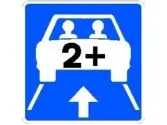
Por el carril para vehículos de alta ocupación (VAO), ¿puede circular un turismo con remolque?
May a car with a trailer use the high-occupancy vehicle lane (HOV lane, VAO)?
- ASí, cuando el remolque sea ligero.Yes, when the trailer is light.
- BNo.No.
- CSí, cuando lo ocupan el número de personas exigido.Yes, when it carries the required number of people.
ExplanationIn general, the following may use the BUS-VAO lane: two- or three-wheeled motorcycles, cars, buses with a maximum authorised mass over 3,500 kilograms, articulated buses and adaptable dual-purpose vehicles, with the number of occupants set for each stretch. All other vehicles and combinations of vehicles are prohibited, including cars with a trailer, cycles and mopeds. However, the lane may also be used, even with only the driver on board, by: - The authorised types of vehicle if they display the V-15 sign (reduced mobility badge). - Two- or three-wheeled motorcycles. - Buses with a maximum authorised mass over 3,500 kilograms and articulated buses. - Vehicles classified as taxis under the use criteria in Annex II of the General Vehicle Regulations that have an external roof light and a valid taxi licence. - Police, fire, civil protection, rescue and medical vehicles on an emergency call, and maintenance teams for the road and its facilities. - Vehicles with environmental badges (CERO, ECO, B and C) may use the BUS-VAO lane only when road signs indicate so.
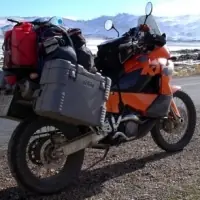
En los vehículos que tienen una anchura de menos de un metro, la carga no puede sobresalir lateralmente más de...
On vehicles less than one metre wide, the load must not stick out sideways by more than…
- A0,50 metros a cada lado del eje longitudinal del vehículo.0.50 metres on each side of the vehicle's longitudinal axis.
- B0,20 metros a cada lado del vehículo.0.20 metres on each side of the vehicle.
- C0,40 metros a cada lado del vehículo.0.40 metres on each side of the vehicle.
ExplanationOn vehicles less than one metre wide, such as bicycles or mopeds, the load must not stick out sideways by more than 0.50 metres on each side of the longitudinal axis; it must not stick out at the front at all, nor by more than 0.25 metres at the rear (Article 15 of the General Traffic Regulations).
Una motocicleta ¿puede arrastrar un remolque durante la noche?
May a motorcycle tow a trailer at night?
- ANo.No.
- BSí, siempre que circule por vías bien iluminadas.Yes, as long as it travels on well-lit roads.
- CSí, pero sólo por vías urbanas.Yes, but only on urban roads.
ExplanationMotorcycles may not tow a trailer at night. This is because travelling at night or in conditions that reduce visibility is forbidden when towing a trailer.
Salvo los autobuses, ¿cuál será la longitud máxima de los vehículos a motor?
Apart from buses, what is the maximum length of motor vehicles?
- A12 metros.12 metres.
- B10 metros.10 metres.
- C8 metros.8 metres.
ExplanationThe maximum permitted length for motor vehicles, except buses, is 12 metres.
All topics
- Definitions
- Documents and penalty points
- The driver's condition
- Duties of drivers and pedestrians
- Vehicle safety devices
- Vehicle controls and equipment
- Vehicle lights and horn
- Traffic signs, markings and signals
- The road and its lanes
- Speed and distances
- Manoeuvres
- Right of way
- Driving safely in difficult conditions
- Vehicle mechanics and maintenance
- Road accidents and first aid
- Defensive and eco-driving
Independent app: not affiliated with or endorsed by the DGT (Spain's Directorate-General for Traffic) or the Ministry of the Interior. The official exam is booked with the DGT and taken at its test centres. The questions here are practice material; the DGT's official question bank is not public.
Basado en datos de la Agencia Estatal Boletín Oficial del Estado (https://www.boe.es). Textos consolidados de carácter meramente informativo. La AEBOE no patrocina ni respalda este sitio.
Parte de las preguntas procede de los tests de la revista «Tráfico y Seguridad Vial» de la DGT, reproducidos con indicación de la fuente.