
DGT test · 574 questions
Carrying passengers and loads · Page 5 of 12
Passengers, children, loads and trailers: what you may carry and how it must be secured and marked.
Questions in this topic, with answers
574 questions, 50 per page, with the correct answer and the explanation. Page 5 of 12.
Un vehículo cuyo maletero va lleno.¿Dónde puede transportar la carga?
A vehicle's boot is full. Where can it carry more load?
- AEn el asiento trasero.On the back seat.
- BEn la baca.On the roof rack.
- CNo podré transportar más equipaje.I will not be able to carry any more luggage.
ExplanationIf the boot is full, extra load can be carried on the roof rack, well secured and without sticking out dangerously. Carrying loose items on the back seat is dangerous, because under braking they are thrown against the occupants.
Cuando se transporta un pasajero en la motocicleta, ¿puede verse afectado el centro de gravedad de la motocicleta?
When a passenger is carried on a motorcycle, can the motorcycle's centre of gravity be affected?
- ASolamente en el caso de que el pasajero tenga un peso excesivo.Only if the passenger is excessively heavy.
- BSí.Yes.
- CComo norma general no, ya que las motocicletas están preparadas para transportar hasta dos personas.As a general rule, no, because motorcycles are designed to carry up to two people.
ExplanationThe motorcycle's centre of gravity can be affected when a passenger is carried. The extra weight at the rear of the motorcycle can change its balance and stability, which can affect the rider's ability to manoeuvre. So the correct answer is "Yes".
La sobrecarga de un vehículo (superar su MMA):
Overloading a vehicle (exceeding its MAM):
- AMejora el agarre y acorta la distancia de frenado.Improves grip and shortens the braking distance.
- BEmpeora la frenada y la estabilidad, además de ser una infracción.Makes braking and stability worse, and is also an offence.
- CNo influye si se conduce despacio.Makes no difference if you drive slowly.
ExplanationExceeding the maximum authorised mass (MAM) increases the braking distance, reduces stability and is an offence.
¿Cuál será como norma general la anchura máxima autorizada para que un vehículo pueda circular?
As a general rule, what is the maximum authorised width for a vehicle to be driven on the road?
- A2,55 metros, carga incluida.2.55 metres, load included.
- B2,55 metros, más lo que sobresalga la carga.2.55 metres, plus whatever the load sticks out.
- C2,60 metros.2.60 metres.
ExplanationAs a general rule, the maximum authorised width for a vehicle to be driven on the road, load included, is 2.55 metres.
¿Puede sobresalir la carga de la proyección en planta de un turismo?
May a load stick out beyond the outline of a car seen from above?
- ANo, en este tipo de vehículos la carga no puede sobresalir nunca.No, in this type of vehicle the load may never stick out.
- BSi, hasta un 10% de la longitud del vehículo o un 15% si la carga es indivisible. Solo por detrás.Yes, up to 10% of the vehicle's length, or 15% if the load is indivisible. Only at the back.
- CSi, hasta un tercio de la longitud del vehículo por detrás y un tercio por delanteYes, up to a third of the vehicle's length at the back and a third at the front.
ExplanationIn cars, the load may stick out beyond the vehicle's outline (the vehicle seen from above or below) by ten or fifteen per cent of the vehicle's total length, only at the back.
La carga divisible en un turismo puede sobresalir por detrás como máximo:
A divisible load in a car may stick out at the rear by a maximum of:
- A5% de la longitud5% of the length
- B10% de la longitud10% of the length
- C15% de la longitud15% of the length
ExplanationThe load may stick out at the rear by up to 10% of the vehicle's length (15% if it is indivisible). It must be marked with the V-20 panel.
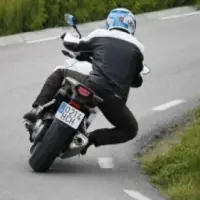
¿Cómo es la carga que soporta un neumático en marcha?
What is the load on a tyre like while the vehicle is moving?
- AVariable en el caso de conducir por ciudad y continua fuera de ellaVariable when driving in town and constant outside town
- BVariableVariable
- CContinua, ya que la carga es la mismaConstant, since the load is the same
ExplanationThe load on a tyre while the vehicle is moving is variable and depends on acceleration, braking, bends, slopes and the condition of the carriageway, whether you are driving inside or outside built-up areas.
Los ocupantes que viajen en su vehículo, ¿cómo deben descender del mismo?
How must the occupants of your vehicle get out of it?
- APor cualquier lado, siempre que se haga con rapidez.On either side, as long as they do it quickly.
- BPor el lado más próximo al borde de la vía, si es posible, y siempre con el vehículo inmovilizado.On the side nearest the edge of the road, if possible, and always with the vehicle stationary.
- CCon el vehículo inmovilizado si es posible, y por cualquiera de los dos lados.With the vehicle stationary if possible, and on either side.
ExplanationOnce the vehicle is stationary, as a general rule occupants must get in or out on the side nearest the pavement or hard shoulder, that is, on the right-hand side in the direction of travel. The exception is a one-way urban road, where they may get in or out on the right or the left, depending on which side of the carriageway the vehicle has stopped.
¿Qué nombre recibe un vehículo en el que la carga descansa totalmente sobre su chasis?
What is a vehicle called when the load rests entirely on its own chassis?
- AArticulado.Articulated.
- BTractor.Tractor unit.
- CRígido.Rigid.
ExplanationA vehicle whose load rests entirely on its own chassis is called "rigid". This is because the vehicle's structure is solid and has no articulated joint or trailer.
Si transportamos a un pasajero en la motocicleta...
If we carry a passenger on a motorcycle...
- AAumentará el tiempo de reacción del conductor.The rider's reaction time will increase.
- BDisminuirá la distancia de frenado.The braking distance will decrease.
- CSe bloquearán las ruedas con más dificultad.The wheels will lock less easily.
ExplanationCarrying a passenger on a motorcycle increases the weight, so when the brakes are applied with the same force, it is harder to lock the wheels.
¿La carga que sobresalga por detrás se señalizará siempre de día por medio de un panel de 50x50 cm?
During the day, must a load sticking out at the rear always be marked with a 50 x 50 cm panel?
- ASí, pero solo si sobresale más de un metro.Yes, but only if it sticks out more than one metre.
- BSí.Yes.
- CNo.No.
ExplanationDuring the day, a load sticking out at the rear must always be marked with a 50 x 50 cm panel. This makes it visible and warns other drivers that there is a load sticking out.
Para algunos productos de las clases 6.1 y 9 está prohibida la carga y descarga en los lugares públicos, como en...
For some products of classes 6.1 and 9, loading and unloading is prohibited in public places such as...
- ANúcleos urbanos, sin autorización especial.Towns and cities, without special authorisation.
- BNúcleos urbanos, con autorización especial.Towns and cities, with special authorisation.
- CNúcleos urbanos, con o sin autorización especial.Towns and cities, with or without special authorisation.
ExplanationFor some products of classes 6.1 and 9, loading and unloading in public places is prohibited without special authorisation.
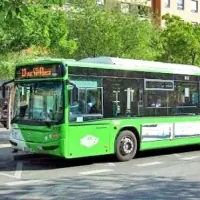
¿Qué dos tipos de servicios puede tener un vehículo automóvil?
What two types of service can a motor car have?
- AServicio de transporte de personas o de mercanciasPassenger or goods transport service
- BServicio público o privadoPublic or private service
- CServicio laboral o personalWork or personal service
ExplanationDepending on their use, motor cars are divided into those providing a public service, such as buses or taxis, and those providing a private service, such as private cars.
¿A partir de qué edad se podrá viajar como pasajero en una motocicleta?
From what age can someone travel as a passenger on a motorcycle?
- AA partir de los 14 años.From 14 years old.
- BA partir de los 18 años.From 18 years old.
- CA partir de los 12 años, y excepcionalmente a partir de los 7 años.From 12 years old, and in exceptional cases from 7 years old.
ExplanationA motorcycle passenger must be at least 12 years old. In exceptional cases, children from 7 years old may travel, as long as the rider is their father or mother, their legal guardian or an adult authorised by them.
¿Se permite llevar las puertas abiertas o el maletero abierto para aumentar la capacidad de carga?
Is it allowed to drive with the doors or the boot open to carry more load?
- ANo las puertas, pero sí el maletero si la carga está bien sujeta y no puede caerse.Not the doors, but the boot is allowed if the load is well secured and cannot fall out.
- BNo, salvo en vehículos destinados al transporte de mercancías.No, except in vehicles used for carrying goods.
- CNo.No.
ExplanationNo. Article 114 of the General Traffic Regulations prohibits driving with the vehicle's doors open. An open boot also usually covers the number plate and rear lights, which Article 14 prohibits, and leaves the load at risk of falling out.
¿Cuál será la edad mínima para transportar a un niño como pasajero en una motocicleta?
What is the minimum age for carrying a child as a passenger on a motorcycle?
- A12 años sin excepción.12 years, with no exceptions.
- B7 años, si el conductor es el padre, madre, tutor legal o mayor de edad autorizado.7 years, if the rider is the child's father, mother, legal guardian or an authorised adult.
- C14 años.14 years.
ExplanationThe minimum age for a motorcycle passenger is 12 years. As an exception, a child aged 7 or over may be carried if the rider is the child's father, mother, legal guardian or an authorised adult.
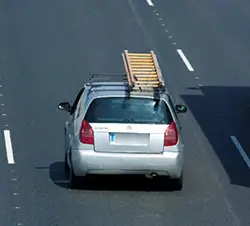
¿Puede sobresalir por la parte trasera del vehículo la carga indivisible que transporta un turismo?
Can an indivisible load carried by a car stick out at the back of the vehicle?
- ASí, un máximo de hasta el 10% de la longitud del vehículo.Yes, up to a maximum of 10% of the vehicle's length.
- BNo, la carga no puede sobresalir por la parte trasera de un turismo.No, the load may not stick out at the back of a car.
- CSí, un máximo de hasta el 15% de la longitud del vehículo.Yes, up to a maximum of 15% of the vehicle's length.
ExplanationIn a car, an indivisible load may stick out at the back by up to 15% of the vehicle's length (10% if the load is divisible), and it must be marked with the V-20 panel.
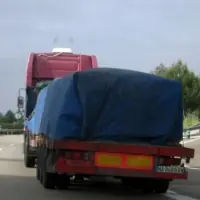
¿Si un remolque lleva su propia matrícula, debe también llevar la del vehículo tractor que lo arrastra?
If a trailer has its own number plate, must it also carry the plate of the vehicle towing it?
- ANo, únicamente llevará una placaNo, it will only carry one plate
- BSi, pero únicamente en los remolques no en los semirremolquesYes, but only trailers, not semi-trailers
- CSíYes
ExplanationTrailers and semi-trailers with an MAM over 750 kg must carry their own number plate at the rear and another plate with the registration number of the towing vehicle on the right-hand side.
El pasajero que viaje en un ciclomotor de dos ruedas...
A passenger travelling on a two-wheeled moped...
- APodrá ir de lado, siempre que vaya bien sujeto.May sit sideways, as long as they hold on well.
- BPodrá situarse entre el manillar y el asiento del conductor, si es un menor de doce años.May sit between the handlebars and the rider's seat, if they are under twelve.
- CIrá detrás del conductor, a horcajadas y con los pies apoyados en los reposapiés laterales.Must sit behind the rider, astride, with their feet on the side footrests.
ExplanationA passenger on a two-wheeled moped must sit behind the rider, astride, with their feet on the side footrests. This is the safest and most stable position for the passenger, and it helps the rider to keep the vehicle balanced and under control.
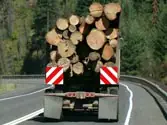
¿Lleva este camión la carga correctamente señalizada?
Is this lorry's load correctly marked?
- ANo, tendría que llevar también una luz roja.No, it would also need a red light.
- BSí.Yes.
- CSí, si es un camión de más de 3.500 kg de MMA.Yes, if it is a lorry with a MAM of more than 3,500 kg.
ExplanationThe lorry's load is correctly marked because it is travelling in daylight. If it were travelling at night, it would also need a red light at the rear and a white light at the front.
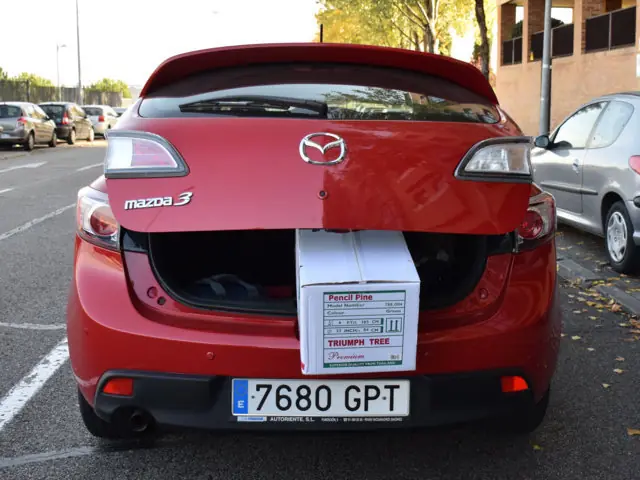
Transporta en su turismo una carga que sobresale por la parte trasera; ¿debe señalizarla si circula de día?
You are carrying a load in your car that sticks out at the back. Must you mark it if you are driving in daylight?
- ASolo se señalizará de noche o con condiciones meteorológicas adversas.It is only marked at night or in adverse weather conditions.
- BSí, con un panel colocado en el extremo posterior de la carga.Yes, with a panel placed at the rear end of the load.
- CNo; en los turismos no es obligatorio señalizar la carga durante el día.No; in cars it is not compulsory to mark the load during the day.
ExplanationUnder Article 15 of the General Traffic Regulations (RGC), a load that sticks out at the back of a car must always be marked with the V-20 panel at its rear end, also during the day. At night or in poor visibility, a red light must also be added.
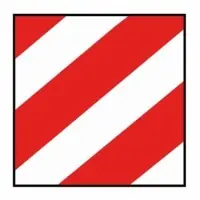
De noche, la carga que sobresale por detrás debe señalizarse con un panel reflectante y…
At night, a load that sticks out at the rear must be marked with a reflective panel and…
- AUna luz roja.A red light.
- BDos luces de color amarillo auto.Two amber lights.
- CUna luz amarilla o blanca.A yellow or white light.
ExplanationUnder Article 15 of the General Traffic Regulations, a load that sticks out at the rear is marked with the V-20 panel with red and white stripes. At night or in poor visibility it must also carry a red light. If the load sticks out at the front, the light must be white.
Transportar un pasajero, ¿puede afectar al centro de gravedad de la motocicleta?
Can carrying a passenger affect the motorcycle's centre of gravity?
- AComo norma general no, ya que las motocicletas están preparadas para transportar hasta dos personas.As a general rule no, because motorcycles are designed to carry up to two people.
- BSí.Yes.
- CSolamente en el caso de que el pasajero tuviera un peso excesivo.Only if the passenger is very heavy.
ExplanationYes, carrying a passenger can affect the motorcycle's centre of gravity. The passenger's extra weight can change the vehicle's stability and balance, which can make it harder to control. It is important to take the weight and how the load is distributed into account to ride the motorcycle safely.
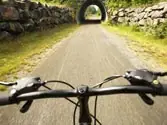
¿Las bicicletas pueden llevar remolque?
May bicycles tow a trailer?
- ASí, con unas condiciones específicas.Yes, under specific conditions.
- BSí, siempre.Yes, always.
- CNo.No.
ExplanationUnder Article 154 of the General Traffic Regulations (RGC) (as worded by RD 518/2026), bicycles may use trailers or semi-trailers that meet the technical specifications to carry people, animals of up to 15 kg or goods, subject to any restrictions set by the local authority; on interurban roads, only in daylight and in conditions that do not reduce visibility.
¿Cuánto podrá sobresalir la carga en un camión de más de 5 metros de longitud?
How far may the load stick out on a lorry more than 5 metres long?
- AUn 15 por ciento por la parte posterior.15 per cent at the back.
- B1/3 por la parte posterior.1/3 at the back.
- C3 metros por la parte posterior.3 metres at the back.
ExplanationOn a lorry more than 5 metres long, the load may stick out 2 metres at the front and 3 metres at the back.
La carga transportada en una motocicleta de una anchura inferior a 1 metro, ¿puede sobresalir por la parte delantarea o trasera?
May the load carried on a motorcycle less than 1 metre wide stick out at the front or at the rear?
- APor delante no, pero por atrás si hasta 0,25 metros.Not at the front, but at the rear yes, by up to 0.25 metres.
- BSí , por la parte de atrás solo hasta 0,50 metrosYes, at the rear only, by up to 0.50 metres
- CSí, hasta 0,50 metros por delante y por detrás.Yes, by up to 0.50 metres at the front and at the rear.
ExplanationUnder Article 15 of the General Traffic Regulations, on vehicles less than one metre wide, such as a motorcycle, the load may not stick out at all at the front and at most 0.25 metres at the rear. At the sides it may reach up to 0.50 metres from the vehicle's axis.
¿Puede sobresalir por detrás la carga de un turismo?
Can a car's load stick out at the back?
- ANo.No.
- BSí, hasta un tercio de la longitud del vehículo.Yes, up to one third of the vehicle's length.
- CSí, hasta un 15 % de la longitud del vehículo.Yes, up to 15 % of the vehicle's length.
ExplanationAccording to Article 15 of the General Traffic Regulations (RGC), a car's load may stick out at the back by up to 10% of the vehicle's length, and by up to 15% in the case of indivisible loads. This applies to vehicles not used only for carrying goods, such as cars. So the correct answer is yes, the load may stick out at the back by up to 15% of the vehicle's length.
¿Podrá ud. conducir un vehículo que transporte mercancías y personas al mismo tiempo?
May you drive a vehicle that carries goods and people at the same time?
- ANo, sólo se podrá transportar exclusivamente personas o exclusivamente mercancías.No, it may carry only people or only goods.
- BSí.Yes.
- CSí, pero solo con el permiso de la clase C1.Yes, but only with a class C1 licence.
ExplanationThere are vehicles designed to carry goods and people, at the same time or not, up to a maximum of 9 people including the driver. They are called adaptable mixed-use vehicles.
Si su motocicleta tiene una anchura inferior a un metro y en el portaequipajes de la misma desea transportar una maleta, debe saber que ésta no deberá sobresalir lateralmente...
If your motorcycle is less than one metre wide and you want to carry a suitcase on its luggage rack, you must know that the suitcase must not stick out sideways...
- AMás de 0,50 metros a cada lado del eje longitudinal de la motocicleta.More than 0.50 metres on each side of the motorcycle's longitudinal axis.
- BNada.At all.
- CMás de 0,25 metros a cada lado del eje longitudinal de la motocicleta.More than 0.25 metres on each side of the motorcycle's longitudinal axis.
ExplanationThe correct answer is "More than 0.50 metres on each side of the motorcycle's longitudinal axis" because on vehicles less than one metre wide the load must not stick out sideways more than 0.50 metres from the vehicle's axis.
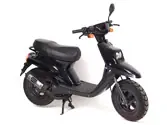
En un vehículo de anchura inferior a 1 metro, ¿cuánto podrá sobresalir la carga por la parte delantera?
In a vehicle less than 1 metre wide, how far may the load stick out at the front?
- A0,25 m.0.25 m.
- BNada.Not at all.
- C1/3 de la longitud del vehículo.1/3 of the vehicle's length.
ExplanationIn a vehicle less than 1 metre wide, such as a motorcycle, the load may not stick out at all at the front; it may only stick out 25 cm at the back and 50 cm at the sides.
Señaliza la carga que sobresale por la parte trasera con un panel con franjas rojas y blancas alternas. De noche, ¿debe señalizarlo de alguna otra manera?
You mark a load sticking out at the rear with a panel with alternating red and white stripes. At night, must you mark it in any other way?
- ASí, con una luz roja.Yes, with a red light.
- BSí, con una luz blanca o amarilla.Yes, with a white or yellow light.
- Csí, con dos luces de color amarillo auto.yes, with two amber lights.
ExplanationA load sticking out at the rear is marked with the V-20 panel with red and white stripes and also, between sunset and sunrise or in poor visibility, with a red light (Article 15 of the General Traffic Regulations). The white light is for a load sticking out at the front.
La longitud máxima de un conjunto turismo + remolque no puede exceder:
The maximum length of a car + trailer combination must not exceed:
- A12 metros12 metres
- B18,75 metros18.75 metres
- C20 metros20 metres
ExplanationThe maximum authorised length for a combination made up of a car and a trailer is 18.75 metres. For lorry + trailer combinations the limit is also 18.75 metres.
¿Cuántos metros puede sobresalir por la parte trasera la carga que transporta un ciclomotor?
How many metres may the load carried by a moped stick out at the rear?
- A0,25 metros0.25 metres
- B0,50 metros0.50 metres
- CNo puede sobresalir nada por la parte traseraIt may not stick out at all at the rear
ExplanationOn vehicles less than one metre wide, such as mopeds, the load may not stick out sideways more than 0.50 metres on each side of the vehicle's centre line. In addition, the load may not stick out at the front, and only 0.25 metres at the rear.
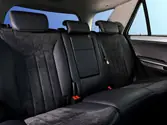
En un turismo con cinco plazas autorizadas, ¿puede transportar a seis personas?
In a car with five authorised seats, may you carry six people?
- ANo, no está permitido.No, it is not allowed.
- BSí, siempre que no supere en un 50% el número de plazas autorizado.Yes, as long as the number of authorised seats is not exceeded by more than 50%.
- CSí, siempre que no supere la masa máxima autorizada.Yes, as long as the maximum authorised mass is not exceeded.
ExplanationThe number of people carried in a vehicle may not be greater than the number of authorised seats. We must also bear in mind the maximum authorised mass: the maximum weight at which the loaded vehicle may be driven on public roads. Passengers and load together must never exceed that weight.
Al transportar carga en un vehículo, ¿qué efecto negativo sobre la estabilidad se debe evitar prioritariamente para garantizar la seguridad?
When carrying a load in a vehicle, which negative effect on stability must you avoid above all to ensure safety?
- AReducir el peso total del vehículo cuando está vacíoReducing the total weight of the vehicle when it is empty
- BComprometer la estabilidad del vehículo por mala distribución o exceso de pesoCompromising the vehicle's stability through poor distribution or excess weight
- CAumentar la tracción en las ruedas motrices en condiciones normalesIncreasing traction on the driving wheels in normal conditions
ExplanationThe General Traffic Regulations state that the load and accessories must be arranged and secured so that they do not compromise the vehicle's stability. If the load is badly distributed (for example, too much weight on one side or a very high centre of gravity) or there is too much weight, the vehicle's dynamic behaviour changes dramatically, increasing the risk of overturning and the braking distance. The other options are wrong because 'increasing traction' is usually a desired effect (not one to avoid) and 'reducing the weight of the empty vehicle' is not a direct effect of carrying a badly stowed load.
La diferencia entre la masa máxima autorizada y la tara de su turismo es de 350 kilogramos. ¿Le está permitido transportar en él, entre personas y equipaje, un peso de 550 kilogramos?
The difference between the maximum authorised mass and the unladen weight of your car is 350 kilograms. Are you allowed to carry a total of 550 kilograms of people and luggage in it?
- ANo.No.
- BSi, en todo caso.Yes, in all cases.
- CSí, pero únicamente repartiendo la carga entre la baca y el maletero.Yes, but only if the load is shared between the roof rack and the boot.
ExplanationThe correct option is 'No' because the maximum authorised mass (MAM) of a vehicle is the maximum weight it may reach, including the vehicle itself, the driver, the passengers and the luggage. If the difference between the maximum authorised mass and the unladen weight of the car is 350 kilograms, you may only load up to 350 kilograms in total. Carrying 550 kilograms exceeds this limit, which is not allowed and can be dangerous.
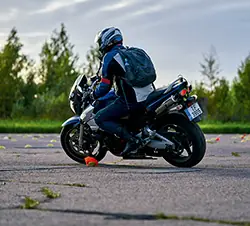
¿Puede trasportar una carga indivisible que por sus dimensiones sobresalga lateralmente de la proyección en planta de una motocicleta?
May you carry an indivisible load which, because of its size, sticks out sideways beyond the outline of a motorcycle seen from above?
- ASí, ya que, aunque sobresalga más de 1 metro no compromete su estabilidad.Yes, because even if it sticks out more than 1 metre it does not affect stability.
- BNo, ya que dicha carga solamente puede sobresalir por la parte anterior y posterior.No, because such a load may only stick out at the front and at the back.
- CSí, siempre que no sobresalga más de 0,50 metros por cada lado de su eje longitudinal.Yes, as long as it does not stick out more than 0.50 metres on each side of its longitudinal axis.
ExplanationThe Regulations allow an indivisible load on a motorcycle to stick out sideways by up to 0.50 metres on each side of its longitudinal axis; this limit is meant to avoid affecting stability or taking up other road users' space.
Una motocicleta que arrastra un remolque, ¿puede transportar una persona en él?
Can a motorcycle towing a trailer carry a person in the trailer?
- ASí, igual que si se tratara de un sidecar.Yes, just as if it were a sidecar.
- BSí, si se trata de un niño mayor de 7 años.Yes, if it is a child over 7.
- CNo, en ningún caso.No, never.
ExplanationArticle 12.3 of the General Traffic Regulations allows motorcycles to tow a trailer, but on the express condition that no people are ever carried in the towed vehicle, whatever their age.
Un turismo transporta una carga que sobresale por detrás de día y en condiciones de buena visibilidad, ¿está obligado a señalizarla?
A car is carrying a load that sticks out at the back, during the day and in good visibility. Must the load be marked?
- ANo, sólo es obligatorio para los camiones.No, this is only compulsory for lorries.
- BSí, con un panel reglamentario.Yes, with a regulation panel.
- CSí, con un trapo rojo.Yes, with a red cloth.
ExplanationWhenever the load sticks out at the back of the vehicle (except vehicles less than 1 metre wide), it must be marked with a 50 × 50 cm panel (V-20) painted with alternating red and white diagonal stripes. The panel must be placed at the rear end of the load, so that it is always at right angles to the vehicle's axis. When the vehicle is travelling between sunset and sunrise, or in weather or environmental conditions that noticeably reduce visibility, the load must also be marked with a red light.
¿Un menor de 12 años podrá viajar como pasajero en una motocicleta?
Can a child under 12 travel as a passenger on a motorcycle?
- ANo, en ningún caso.No, under no circumstances.
- BSí, si el conductor es el padre.Yes, if the rider is the child's father.
- CSí, si mide al menos 1,35 metros.Yes, if the child is at least 1.35 metres tall.
ExplanationAs a general rule, a child under 12 may not travel as a passenger on a motorcycle. As an exception, children over 7 may do so as long as the rider is their father, mother, legal guardian or an adult authorised by them.
En un camión de más de 5 metros de longitud la carga puede sobresalir por delante....
On a lorry more than 5 metres long, the load may stick out at the front by....
- A3 metros.3 metres.
- B0,50 metros.0.50 metres.
- C2 metros.2 metres.
ExplanationUnder Article 15 of the General Traffic Regulations, on goods vehicles more than 5 metres long, an indivisible load may stick out 2 metres at the front and 3 metres at the rear.
¿Es aconsejable llevar en el vehículo un chaleco reflectante para el acompañante?
Is it advisable to carry a reflective vest in the vehicle for the passenger?
- ANo, solo es necesario el del conductor.No, only the driver's vest is needed.
- BSí, para todos los ocupantes es obligatorio.Yes, it is compulsory for all occupants.
- CSí, aunque sólo es obligatorio llevar uno.Yes, although only one is compulsory.
ExplanationOnly the driver's reflective vest is compulsory, but it is advisable to carry two in case a passenger has to help the driver.
Los vehículos de mercancías peligrosas, ¿deben llevar el mismo equipo de seguridad que los vehículos de carga general?
Must dangerous goods vehicles carry the same safety equipment as general goods vehicles?
- ANo, deberán llevar un equipamiento especial.No, they must carry special equipment.
- BSí, los equipos de seguridad son exigibles a todo el transporte en general.Yes, safety equipment is required for all transport in general.
- CSí, serán los mismos, con independencia de la mercancía transportada.Yes, it will be the same, whatever goods are carried.
ExplanationDangerous goods vehicles must carry special equipment because of the nature of their load. Dangerous goods are an extra risk for road safety and need specific safety measures. So the equipment needed for these vehicles is different from the equipment required for general goods vehicles.
La carga indivisible en un turismo...
An indivisible load in a car...
- ANo podrá sobresalir en ningún caso.may never stick out.
- BPodrá sobresalir como máximo un 10% por la parte posterior.may stick out by at most 10% at the back.
- CPodrá sobresalir como máximo un 15% por la parte posterior.may stick out by at most 15% at the back.
ExplanationAn indivisible load in a car may stick out by at most 15% at the back. If it is divisible, it may stick out by at most 10%, also at the back.
Una carga colocada en la baca de un turismo, ¿ puede sobresalir lateralmente?
Can a load carried on a car's roof rack stick out at the sides?
- ASí, 0.25 metros por cada lado.Yes, 0.25 metres on each side.
- BSí, 0.50 metros por cada lado.Yes, 0.50 metres on each side.
- CNo, en los turismos no puede sobresalir la carga lateralmente.No, on cars the load may not stick out at the sides.
ExplanationIn cars and other vehicles not intended exclusively for carrying goods, the load may stick out only at the rear, by up to 10% of the length or 15% if it is indivisible. It may not stick out at the sides at all.
¿Un turismo con remolque podrá utilizar un carril VAO?
Can a car towing a trailer use an HOV lane (VAO)?
- ASí, cuando esté ocupado por el número mínimo de personas fijado para este tramo de vía.Yes, when it carries the minimum number of people set for that stretch of road.
- BNo.No.
- CNo, estos carriles solo pueden ser usados por los autobuses.No, these lanes can only be used by buses.
ExplanationAs a general rule, BUS-HOV (BUS-VAO) lanes may be used by two- or three-wheeled motorcycles, cars, buses with a maximum authorised mass of more than 3,500 kg, articulated buses and convertible dual-purpose vehicles carrying the number of occupants set for each stretch. All other vehicles and vehicle combinations are prohibited, including cars towing trailers, cycles and mopeds. However, they may also be used, even with only the driver on board, by: - the authorised types of vehicle if they display the V-15 sign (reduced mobility badge); - two- or three-wheeled motorcycles; - buses with a maximum authorised mass of more than 3,500 kg and articulated buses; - vehicles classed as taxis under the use criteria in Annex II of the General Vehicle Regulations, with an external roof light and a valid taxi licence; - police, fire, civil protection, rescue and ambulance vehicles on an emergency call, and maintenance crews for the road's facilities and infrastructure; - vehicles with environmental badges (CERO, ECO, B and C) may use the BUS-HOV lane only when road signs say so.
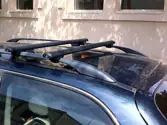
Cuando no utiliza la baca del vehículo, ¿es aconsejable quitarla?
When you are not using the vehicle's roof rack, is it advisable to remove it?
- ANo, porque la baca aumenta la estabilidad del vehículo.No, because the roof rack increases the vehicle's stability.
- BSí, porque sin baca ahorro carburante.Yes, because without a roof rack I save fuel.
- CEs igual, porque la baca no influye en el consumo.It makes no difference, because the roof rack does not affect fuel consumption.
ExplanationIt is advisable to remove the roof rack when it is not in use, as this improves the vehicle's aerodynamics and therefore saves fuel.
¿Puede la carga de un vehículo arrastrar sobre la calzada?
May a vehicle's load drag along the carriageway?
- AÚnicamente cuando sean camiones los que la carguenOnly when it is carried by lorries
- BSí, siempre que no supere los tres metros fuera del vehículoYes, as long as it does not stick out more than three metres from the vehicle
- CNo, está totalmente prohibidoNo, it is completely forbidden
ExplanationThe load must be placed and secured so that it cannot drag, fall completely or partly, or move dangerously (Article 14.1 of the General Traffic Regulations). A dragging load is forbidden in all cases, whatever the vehicle or however far it sticks out.
¿Cuánto podrá sobresalir la carga por la parte posterior de un turismo?
How far may the load stick out at the back of a car?
- AComo máximo hasta 3 metros.Up to 3 metres at most.
- BComo máximo un 15% de la longitud del vehículo.At most 15% of the vehicle's length.
- CEs un turismo la carga no podrá sobresalir en ningún caso.As it is a car, the load must never stick out.
ExplanationIn cars, the load may stick out at the back by up to 10% of the vehicle's length and, when it is indivisible, by 15%.
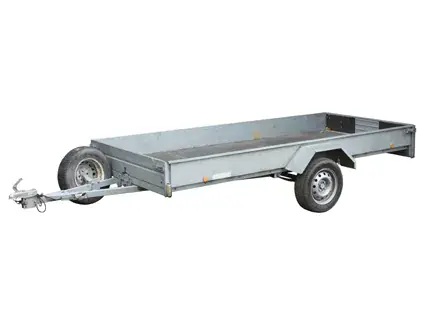
Cuando circule arrastrando un remolque de un solo eje, debe tener en cuenta que la masa que reposa sobre el enganche afecta a...
When towing a single-axle trailer, you must bear in mind that the mass resting on the hitch affects...
- ALa masa máxima por eje técnicamente admisible.The technically permissible maximum mass per axle.
- BLa tara del vehículo tractor.The unladen weight (tare) of the towing vehicle.
- CLa masa por eje del vehículo tractor.The axle mass of the towing vehicle.
ExplanationThe mass resting on the hitch affects the axle mass of the towing vehicle. This is because part of the trailer's weight is carried by the wheels of the towing vehicle, which can change the load on each axle. It is important to take this weight distribution into account for the stability and safety of the combination.
All topics
- Definitions
- Documents and penalty points
- The driver's condition
- Duties of drivers and pedestrians
- Vehicle safety devices
- Vehicle controls and equipment
- Vehicle lights and horn
- Traffic signs, markings and signals
- The road and its lanes
- Speed and distances
- Manoeuvres
- Right of way
- Driving safely in difficult conditions
- Vehicle mechanics and maintenance
- Road accidents and first aid
- Defensive and eco-driving
Independent app: not affiliated with or endorsed by the DGT (Spain's Directorate-General for Traffic) or the Ministry of the Interior. The official exam is booked with the DGT and taken at its test centres. The questions here are practice material; the DGT's official question bank is not public.
Basado en datos de la Agencia Estatal Boletín Oficial del Estado (https://www.boe.es). Textos consolidados de carácter meramente informativo. La AEBOE no patrocina ni respalda este sitio.
Parte de las preguntas procede de los tests de la revista «Tráfico y Seguridad Vial» de la DGT, reproducidos con indicación de la fuente.