
DGT test · 574 questions
Carrying passengers and loads · Page 3 of 12
Passengers, children, loads and trailers: what you may carry and how it must be secured and marked.
Questions in this topic, with answers
574 questions, 50 per page, with the correct answer and the explanation. Page 3 of 12.
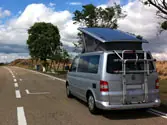
En un turismo, ¿cuánto podrá sobresalir como máximo la carga por la parte posterior?
In a car, what is the maximum the load may stick out at the back?
- ANo puede sobresalir nada.It may not stick out at all.
- BUn 15%.15%.
- CUn 10%.10%.
ExplanationIn a car, the load may only stick out at the back: 10% if the load is divisible and 15% if it is indivisible. So the most the load may stick out is 15%.
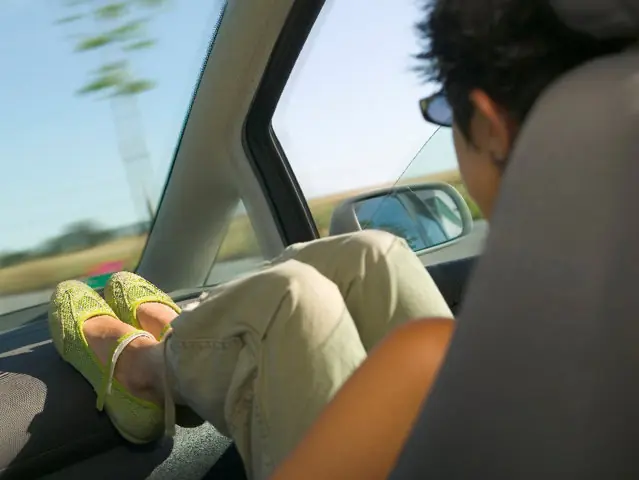
El conductor, ¿está obligado a cuidar que el resto de pasajeros mantengan una posición adecuada en el vehículo?
Is the driver obliged to make sure the other passengers keep a suitable position in the vehicle?
- ASí.Yes.
- BSolo si el vehículo es de transporte colectivo de personas.Only if the vehicle is used for collective passenger transport.
- CNo.No.
ExplanationArticle 18 of the General Traffic Regulations (RGC) requires the driver to take special care to keep a suitable position and to make sure the other passengers keep one too, and to place objects and animals properly, so that nothing interferes with driving. This applies in any vehicle, not only in collective passenger transport.
Si usted conduce un turismo con remolque de 750 kilogramos de masa máxima autorizada, ¿le está permitido circular por un carril que, por motivos de fluidez de la circulación, ha sido habilitado para ser utilizado en sentido contrario al habitual?
If you are driving a car with a trailer with an MAM of 750 kilograms, may you use a lane that has been opened in the opposite direction to normal to keep traffic flowing?
- ASí, porque se trata de un remolque ligero.Yes, because it is a light trailer.
- BSí, salvo que una señal lo prohíba expresamente.Yes, unless a sign expressly prohibits it.
- CNo, en ningún caso.No, never.
ExplanationAccording to the traffic rules, vehicles towing trailers may not use lanes opened in the opposite direction to normal, whatever the road conditions. This is to keep all road users safe.
¿Cuál es la edad mínima para viajar como acompañante en una motocicleta o ciclomotor?
What is the minimum age for travelling as a passenger on a motorcycle or moped?
- ATres años, pero siempre con asiento adicional.Three years, but always with an additional seat.
- BSiempre 12 años.Always 12 years.
- C12 años y, excepcionalmente, siete si la motocicleta o ciclomotor van conducidos por el padre, madre o tutor.12 years and, as an exception, seven if the motorcycle or moped is ridden by the child's father, mother or guardian.
ExplanationUnder Article 12 of the General Traffic Regulations, a passenger on a motorcycle or moped must be over twelve. As an exception, a child over seven may travel if the rider is their father, mother, guardian or an adult authorised by them, and always with an approved helmet.
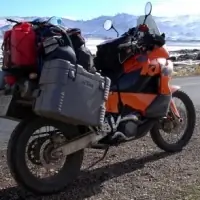
¿Cómo debe señalizar la carga que sobresale de una motocicleta?
How must you signal a load sticking out of a motorcycle?
- AEn las motocicletas, no es necesario señalizar la carga.On motorcycles, the load does not need to be signalled.
- BDe noche con una luz roja por la parte trasera.At night, with a red light at the back.
- CCon un panel reglamentario en el extremo de la carga.With an official panel at the end of the load.
ExplanationOn vehicles less than one metre wide, a load sticking out at the back does not need to be signalled. Remember that on motorcycles the load may not stick out more than 0.25 metres at the back, not at all at the front, and no more than 0.50 metres sideways on each side of the centre line.
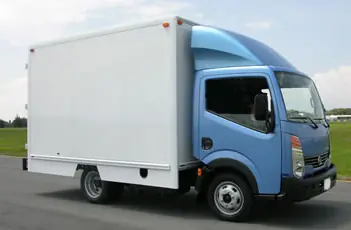
En los vehículos destinados al transporte de mercancías, ¿cuánto podrá sobresalir lateralmente una carga indivisible?
On vehicles intended for carrying goods, how far may an indivisible load stick out sideways?
- ANada.Not at all.
- B0,40 metros por cada lado.0.40 metres on each side.
- C0,50 metros por cada lado.0.50 metres on each side.
ExplanationOn vehicles intended exclusively for carrying goods, an indivisible load whose smallest dimension is wider than the vehicle may stick out sideways up to 0.40 metres on each side, as long as the total width does not exceed 2.55 metres.
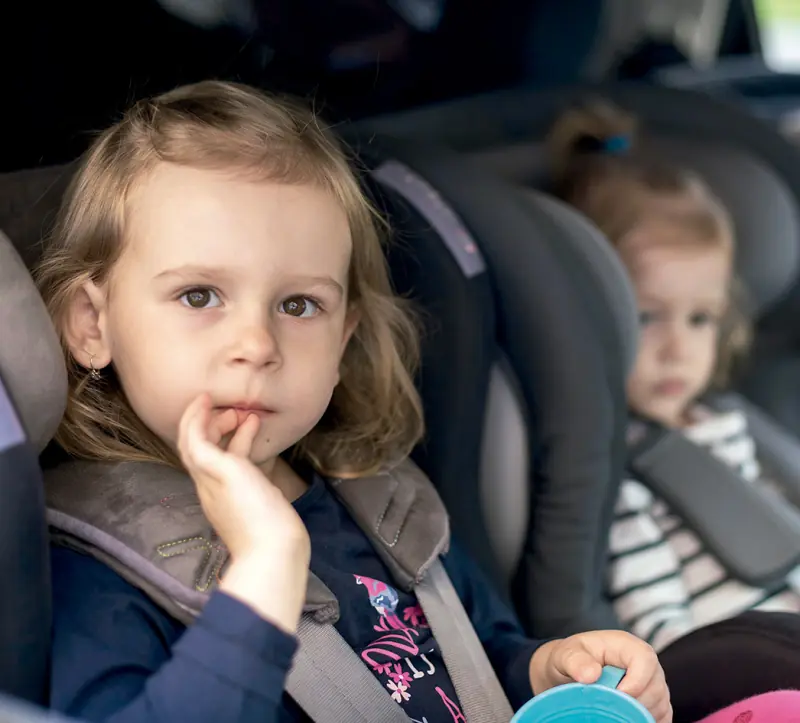
En un turismo de nueve plazas, incluida la del conductor, ¿pueden viajar nueve menores de edad?
In a nine-seat car, including the driver's seat, may nine minors travel?
- ANo, porque se supera el número de plazas autorizado.No, because the authorised number of seats is exceeded.
- BSólo si los niños son menores de 12 años.Only if the children are under 12.
- CSí, siempre que el conductor sea su padre, madre o tutor.Yes, as long as the driver is their father, mother or guardian.
ExplanationNo more people may travel than the number of authorised seats shown in the vehicle's documents; the occupants being minors or being related to the driver is not an exception.
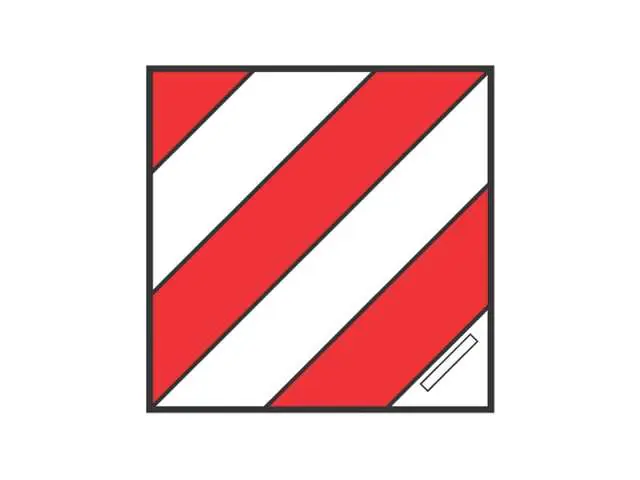
La carga sobresale en un vehículo. ¿Es obligatorio señalizarla con el cartel de la imagen?
A vehicle's load sticks out. Is it compulsory to mark it with the panel in the picture?
- ASí. Todos los vehículos deben poner el cartel, pero solo cuando la carga no se puede dividir.Yes. All vehicles must display the panel, but only when the load cannot be divided.
- BSolo es obligatorio cuando la carga sobresale por detrás.It is only compulsory when the load sticks out at the back.
- CNo. Excepto para los vehículos de mercancías.No. Except for goods vehicles.
ExplanationUnder Article 15 of the General Traffic Regulations, a load that sticks out at the back of the vehicle must be marked with sign V-20, a square panel with red and white stripes. This obligation applies to any vehicle, not only goods vehicles, and to both divisible and indivisible loads.
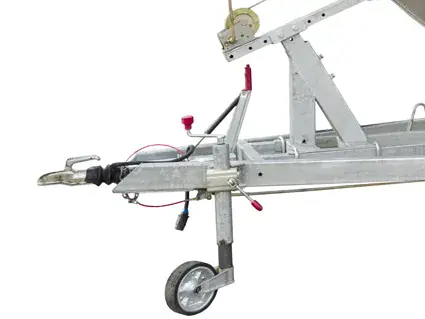
La masa del brazo de acoplamiento de su remolque...
The coupling-arm mass of your trailer...
- AEs el esfuerzo descendente ejercido sobre el enganche por la barra del remolque.Is the downward force exerted on the hitch by the trailer's drawbar.
- BEs la capacidad de retención que produce el freno de inercia.Is the holding force produced by the overrun brake.
- CEs el esfuerzo que se produce en el momento del arranque del conjunto.Is the force produced when the combination moves off.
ExplanationThe coupling-arm mass of your trailer is the downward force exerted on the hitch by the trailer's drawbar. This is the weight that rests on the trailer hitch, and it is important to take it into account for the correct stability and balance of the combination.
En caso de avería en autopista, los pasajeros del vehículo:
If there is a breakdown on a motorway (autopista), the vehicle's passengers:
- APueden caminar por la calzada.May walk on the carriageway.
- BDeben permanecer dentro del vehículo.Must stay inside the vehicle.
- CPueden salir, pero no circular por la calzada.May get out, but not walk on the carriageway.
ExplanationIf there is a breakdown on a motorway (autopista), passengers may leave the vehicle but must not walk on the carriageway, as this would be extremely dangerous because of the speed of other vehicles. They must stay in a safe place, such as the hard shoulder or behind the safety barriers, until help arrives or they move to a safe place. It is not correct to stay inside the vehicle if there is a risk, nor to walk on the carriageway, as this greatly increases the chance of an accident.
¿Es importante la ropa que usan los conductores y pasajeros de motocicletas?
Are the clothes worn by motorcycle riders and passengers important?
- ASí, es importante porque el cuerpo queda expuesto al clima.Yes, they are important because the body is exposed to the weather.
- BNo, no importa mientras usen casco.No, it does not matter as long as they wear a helmet.
- CNo, no aporta nada a la seguridad.No, they add nothing to safety.
ExplanationAccording to Article 118.1 of the General Traffic Regulations (RGC), as worded by RD 518/2026, motorcycle riders and passengers must wear an approved helmet, protective gloves on roads outside built-up areas and closed footwear covering the whole foot on all types of road. The rest of their clothing also protects the body, which is directly exposed to the weather and to falls.
En su turismo, ¿le está permitido, como norma general, arrastrar a la vez más de un remolque?
As a general rule, may your car tow more than one trailer at the same time?
- ASí, siempre que la longitud de conjunto no supere los siete metros.Yes, as long as the combination is not more than seven metres long.
- BNo, porque está prohibido.No, because it is forbidden.
- CSí, si los dos son remolques ligeros.Yes, if both are light trailers.
ExplanationAccording to Article 9 of the General Vehicle Regulations, as a general rule no towing vehicle may tow more than one trailer or semi-trailer at the same time. So a car may only tow one trailer, whatever the length of the combination.
Durante el día, ¿cómo señalizaremos la carga que sobresalga por la parte delantera de un camión?
During the day, how should we signal a load that sticks out beyond the front of a lorry?
- ACon una luz de color blanco.With a white light.
- BCon una luz de color rojo.With a red light.
- CNo es necesario señalizarla.It does not need to be signalled.
ExplanationArticle 15 of the General Traffic Regulations (RGC) only requires a white light for a load sticking out at the front between sunset and sunrise or in poor visibility. By day it does not need to be signalled, although its end must be protected. A load sticking out at the rear always carries the V-20 panel, and at night a red light as well.
Los remolques de hasta 750 kg de m.m.a, ¿Deben ser matriculados?
Must trailers with a maximum authorised mass of up to 750 kg be registered?
- ANo.No.
- BSí.Yes.
- CSolo si tienen dos ejes.Only if they have two axles.
ExplanationOnly trailers and semi-trailers with a maximum authorised mass over 750 kg must be registered. Light trailers, up to 750 kg, do not have their own registration number: they carry a rear plate with the same registration number as the vehicle towing them.
Conduce un coche con un remolque de menos de 750 kg (masa máxima autorizada, MMA) y transporta mercancías. ¿Debe tomar precauciones especiales al distribuir la carga?
You are driving a car with a trailer of less than 750 kg (maximum authorised mass, MAM) and carrying goods. Must you take special care when distributing the load?
- ASí, la carga debe estar bien distribuida y bien sujeta para evitar que se desplace y desestabilice el vehículo.Yes, the load must be well distributed and well secured so that it does not shift and make the vehicle unstable.
- BNo, a menos que se supere la masa máxima autorizada del remolque.No, unless the trailer's maximum authorised mass is exceeded.
- CNo, en un remolque ligero la carga puede ir colocada de cualquier manera.No, on a light trailer the load can be placed any way you like.
ExplanationThe load must be arranged and, if necessary, secured so that it cannot shift dangerously or affect the vehicle's stability (Article 14.1 of the General Traffic Regulations (RGC)). This applies to any trailer, including light ones.
En una motocicleta la carga no podrá sobresalir lateralmente más de...
On a motorcycle, the load may not stick out at the sides by more than...
- Amedio metro en cada lado del eje longitudinal del vehículo.half a metre on each side of the vehicle's centre line.
- B25 centímetros desde el eje del vehículo por cada lado.25 centimetres from the vehicle's centre line on each side.
- C0,50 metros en total desde el eje longitudinal del vehículo.0.50 metres in total from the vehicle's centre line.
ExplanationOn a motorcycle, the load may not stick out at the sides by more than half a metre on each side of the vehicle's centre line, that is, 1 metre in total from one end of the load to the other.
En un turismo, ¿cuánto puede sobresalir el equipaje transportado por la parte posterior de la estructura del vehículo?
In a car, how far may luggage stick out beyond the rear of the vehicle's structure?
- ASi el equipaje u objetos transportados no se pueden dividir, un tercio de la longitud total del vehículo.If the luggage or objects carried cannot be divided, one third of the vehicle's total length.
- BPor la parte posterior podrá sobresalir hasta un 10% de su longitud y si fuera indivisible hasta un 15%.At the rear it may stick out up to 10% of the vehicle's length, and up to 15% if it is indivisible.
- C1,5 metros como máximo.1.5 metres at most.
ExplanationAccording to the rules, luggage or objects carried at the rear of a car may stick out up to 10% of the vehicle's length. If the luggage is indivisible, it may stick out up to 15%. This rule keeps the vehicle properly balanced and prevents danger to traffic.
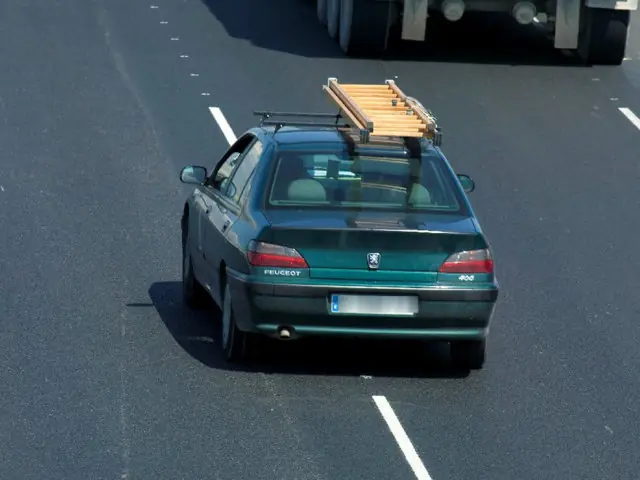
¿De qué manera se debe acondicionar siempre la carga transportada en la baca de un turismo?
How must a load carried on a car's roof rack always be arranged?
- ACubriéndola totalmente con una lona o un plástico.Completely covered with a tarpaulin or plastic sheet.
- BOcultando parcialmente los dispositivos de señalización luminosa.Partly hiding the lighting and signalling devices.
- CDe tal forma que no comprometa la estabilidad del vehículo.In such a way that it does not compromise the vehicle's stability.
ExplanationA load carried on a car's roof rack must be placed safely and properly secured. It is essential that it does not move while driving or change the way the vehicle behaves. Poor distribution can affect balance, steering or braking. It is also important not to exceed the vehicle's maximum capacity. All of this contributes to more stable and safer driving.
En vehículos de menos de un metro de anchura, la carga no debe sobresalir por la parte trasera más de...
On vehicles less than one metre wide, the load must not stick out at the back more than...
- A0,50 metros.0.50 metres.
- B0,25 metros.0.25 metres.
- C0,40 metros.0.40 metres.
ExplanationOn vehicles less than one metre wide, the load may not stick out sideways more than 0.50 metres on each side of the centre line, may not stick out at the front, and may not stick out more than 0.25 metres at the back (Article 15.4 of the General Traffic Regulations (RGC)).
¿Para qué sirven los vehículos automóviles?
What are motor cars used for?
- APara transportar únicamente personas o sus equipajes.Only to carry people or their luggage.
- BPara transportar personas, cosas, o ambas a la vez, y también para tracción de otros vehículos.To carry people, goods, or both at the same time, and also to tow other vehicles.
- CSirven para transportar aparatos de obras y material agrícola.To carry construction equipment and farm material.
ExplanationA motor car is a motor vehicle normally used to carry people or goods, or both at the same time, and to tow other vehicles. Motor vehicles also include special vehicles.
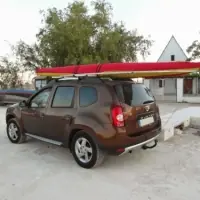
La carga indivisible de un turismo, ¿cuánto puede sobresalir por detrás?
How far may an indivisible load on a car stick out at the back?
- AEl 15% de la largura del vehículo.15% of the vehicle's length.
- BEl 20% de la largura del vehículo.20% of the vehicle's length.
- C1/3 de la largura del vehículo.1/3 of the vehicle's length.
ExplanationOn cars, if the load being carried is indivisible, it may not stick out at the front or the sides, but it may stick out at the back by up to 15 % of the vehicle's length. If, on the other hand, the load is divisible, it may not stick out at the sides or the front either, but it may stick out at the back by up to 10 % of the vehicle's total length.
En una zona reservada para carga y descarga, durante el horario de utilización:
In an area reserved for loading and unloading, during its hours of use:
- ANo está permitido ni parar ni estacionar.Neither stopping nor parking is allowed.
- BSolo está permitido estacionar.Only parking is allowed.
- CSolo pueden estacionar los vehículos destinados a la carga y descarga.Only vehicles used for loading and unloading may park.
ExplanationLoading and unloading areas, during their hours of use, are mainly intended to help goods vehicles do their work. In general, stopping is allowed, but parking is only allowed for vehicles used for this type of transport. Other vehicles may not park there. The aim is to keep these areas working smoothly.
Si transportamos un pasajero en una motocicleta, ¿qué ocurrirá al accionar el freno trasero?
If we carry a passenger on a motorcycle, what will happen when the rear brake is applied?
- AQue la rueda se bloqueará con mayor facilidad.The wheel will lock more easily.
- BQue la rueda se bloqueará con menor facilidad.The wheel will lock less easily.
- CNo cambia nada respecto a circular sin pasajeros.Nothing changes compared with riding without a passenger.
ExplanationIf we carry a passenger on a motorcycle, there is more weight on the rear wheel, so it is harder for that wheel to lock.
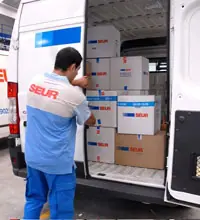
yo en mi camión de menos de 3.500 kg de m.m.a, ¿cómo debo de descargar la carga?
In my lorry of less than 3,500 kg MAM, how should I unload the load?
- APor el lado más alejado al borde de la calzada.From the side furthest from the edge of the carriageway.
- BPor el lado más próximo al borde de la calzadaFrom the side nearest the edge of the carriageway.
- CEs indiferente, lo importante es no depositar la carga en la acera.It makes no difference; what matters is not to put the load on the pavement.
ExplanationLoading and unloading must be done from the side of the vehicle nearest the edge of the carriageway, so as not to take up the lane or expose the person unloading to traffic. Nor may the goods be left on the carriageway, the hard shoulder or the pavement.
¿Cuál es la edad mínima que tendrá que tener el pasajero de la motocicleta?
What is the minimum age for a motorcycle passenger?
- A12 años en todo caso.12 years old in all cases.
- B14 años.14 years old.
- C12 años y excepcionalmente a los 7 años.12 years old, and 7 years old in exceptional cases.
ExplanationThe minimum age for a motorcycle passenger is 12. In exceptional cases, passengers from 7 years old may be carried, as long as the rider is their father, mother, legal guardian or an authorised adult.
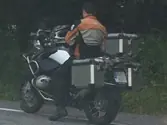
En una motocicleta de anchura inferior a 1 metro, la carga no debe sobresalir...
On a motorcycle less than 1 metre wide, the load must not stick out...
- Amás de 0,25 metros por cada lado del eje longitudinal.more than 0.25 metres on each side of the centre line.
- Bmás de 0,20 metros por la parte trasera.more than 0.20 metres at the back.
- Cmás de 0,50 metros por cada lado del eje longitudinal.more than 0.50 metres on each side of the centre line.
ExplanationIn vehicles less than one metre wide, the load must not stick out more than 0.50 metres on each side of the vehicle's centre line, or more than 0.25 metres at the back, and not at all at the front.
Cómo norma general, ¿cuántos remolques puede arrastrar un vehículo tractor?
As a general rule, how many trailers may a towing vehicle pull?
- AUno.One.
- BDos, cuando lo exija el transporte.Two, when the transport requires it.
- CDos en cualquier caso.Two in all cases.
ExplanationAs a general rule, a towing vehicle is prohibited from pulling two or more trailers, except with special authorisation.
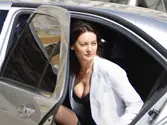
¿Por qué lado del vehículo deberán salir los ocupantes?
On which side of the vehicle must the occupants get out?
- ASiempre por el lado derecho.Always on the right-hand side.
- BSiempre por el lado más próximo al centro de la calzada.Always on the side closest to the middle of the carriageway.
- CPor el lado más próximo al borde de la calzada.On the side closest to the edge of the carriageway.
ExplanationThe vehicle's occupants must get out on the side closest to the edge of the carriageway, which is usually the right-hand side. If the road is one-way and the vehicle is parked on the left-hand side, then we get out on the left.
¿Puede una persona mayor de edad transportar a un pasajero en una bicicleta que, por su construcción, no está diseñada para más de una persona?
May an adult carry a passenger on a bicycle that is not built for more than one person?
- ASí, a un menor de hasta 22 kg en un asiento adicional.Yes, a child of up to 22 kg in an additional seat.
- BNo, está prohibido.No, it is forbidden.
- CSolo si el conductor pedalea de pie y el pasajero va sentado en el sillín.Only if the rider pedals standing up and the passenger sits on the saddle.
ExplanationAccording to Article 154 of the General Traffic Regulations (as worded by RD 518/2026), if the rider is an adult, bicycles built for only one person may carry children of up to 22 kg who can sit up by themselves in additional seats.
¿Puede una bicicleta arrastrar un remolque por una vía interurbana?
May a bicycle tow a trailer on a road outside built-up areas?
- ASí, de día y en condiciones que no disminuyan la visibilidad.Yes, in daylight and in conditions that do not reduce visibility.
- BNo, está prohibido.No, it is prohibited.
- CSí, únicamente para transportar personas.Yes, only to carry people.
ExplanationUnder Article 154 of the General Traffic Regulations (as worded by RD 518/2026), bicycles may tow trailers to carry people, animals of up to 15 kg or goods; on roads outside built-up areas, only in daylight and in conditions that do not reduce visibility.
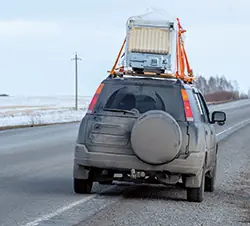
La carga transportada en un turismo no deberá...
The load carried in a car must not...
- ADescargarse por el lado del vehículo más próximo al borde de la calzada.Be unloaded on the side of the vehicle nearest the edge of the carriageway.
- BSobresalir por la parte posterior más de un 5% de su longitud.Stick out at the back by more than 5% of the vehicle's length.
- CComprometer su estabilidad.Put its stability at risk.
ExplanationThe load must be placed so that it does not put the vehicle's stability at risk and cannot fall or shift: poor distribution affects steering and braking.
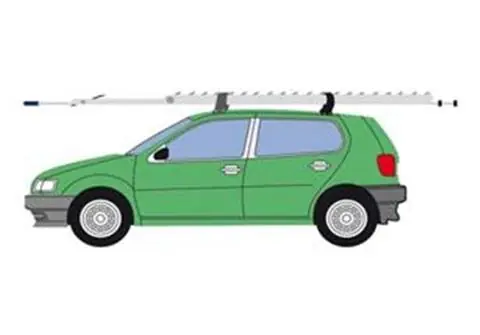
¿Cuánto podrá sobresalir por la parte posterior de un turismo una carga indivisible, como un tubo o un poste?
How far may an indivisible load, such as a pipe or a pole, stick out at the rear of a car?
- AUn tercio de la longitud del vehículo.One third of the vehicle's length.
- BUn 15 % de la longitud del vehículo.15% of the vehicle's length.
- CEl 10 % de la longitud del vehículo.10% of the vehicle's length.
ExplanationAccording to Article 15 of the General Traffic Regulations, on vehicles not used exclusively for carrying goods, the load may stick out at the rear by up to 10% of the vehicle's length, or 15% if it is indivisible, such as a pipe or a pole. It may not stick out at all at the front.
¿La carga que sobresalga por la parte posterior del vehículo deberá señalizarse?
Must a load that sticks out from the back of the vehicle be marked?
- ASólo en los camiones.Only on lorries.
- BSólo en condiciones meteorológicas o ambientales que disminuyan sensiblemente la visibilidad.Only in weather or environmental conditions that noticeably reduce visibility.
- CSí.Yes.
ExplanationA load that sticks out from the back of the vehicle must be marked with the V-20 panel placed at the rear end of the load. If it is also night-time, or there are weather or environmental conditions that noticeably reduce visibility, it must also be marked with a red light.
Un vehículo de 7 toneladas de MMA con una capacidad de carga de 3,2 toneladas es...
A vehicle with an MAM of 7 tonnes and a load capacity of 3.2 tonnes is...
- AUn vehículo pesado.A heavy vehicle.
- BUn vehículo ligero.A light vehicle.
- CUn vehículo especial.A special vehicle.
ExplanationA vehicle with an MAM of 7 tonnes and a load capacity of 3.2 tonnes is considered a heavy vehicle because its maximum authorised mass (MAM) is over 3,500 kg, which is the limit for a light vehicle.
¿Puede sobresalir la carga 2 metros por delante y 3 metros por detrás en vehículos de longitud superior a 5 metros?
On vehicles longer than 5 metres, may the load stick out 2 metres at the front and 3 metres at the rear?
- ASí.Yes.
- BSí, pero solo si la carga es divisible.Yes, but only if the load is divisible.
- CNo.No.
ExplanationUnder Article 15 of the General Traffic Regulations, on vehicles longer than 5 metres used only for carrying goods, an indivisible load, such as beams or pipes, may stick out 2 metres at the front and 3 metres at the rear.
Los niños menores de doce años, ¿pueden viajar como pasajeros en las motocicletas?
May children under twelve ride as passengers on motorcycles?
- ASí, en cualquier caso.Yes, in all cases.
- BSí, siempre que lleven un casco debidamente homologado.Yes, as long as they wear a properly approved helmet.
- CNo, como norma general.No, as a general rule.
ExplanationAs a general rule, children under twelve may not ride as passengers on mopeds and motorcycles. As an exception, children aged 7 and over may ride as passengers on these vehicles as long as the rider is their father, mother, legal guardian or an adult authorised by them. The following conditions must also be met: 1. The vehicle's registration documents must show that it is approved for more than one person. 2. The passenger must use the seat behind the rider. 3. The passenger must sit astride, with their feet on the side footrests. The passenger may never sit between the rider and the handlebar of the moped or motorcycle. 4. Both must wear approved protective helmets.
Si conduce una furgoneta en la que la carga sobresale por detrás y no puede cerrar la puerta trasera, debe saber que ….
If you are driving a van in which the load sticks out at the rear and you cannot close the rear door, you should know that ….
- ADebe sujetar bien las puertas y la carga, señalizando tal circunstancia correctamente.You must secure the doors and the load well, marking this situation correctly.
- BTiene que señalizar la carga con una o dos placas con franjas rojas y blancas.You must mark the load with one or two panels with red and white stripes.
- CNo puede circular.You cannot drive.
ExplanationIt is prohibited to drive with the vehicle's doors open, including the rear door of a van, because the load may fall and others are put in danger. If the load does not fit with the door closed, another means of transport must be used.
¿Está bien dejar objetos en la calzada durante la carga o descarga?
Is it all right to leave things on the carriageway while loading or unloading?
- ANo. No se deben dejar mercancías en la calzada.No. Goods must not be left on the carriageway.
- BSí, si se hace por el lado más cercano al borde de la calzada.Yes, if it is done on the side nearest the edge of the carriageway.
- CSí, siempre que no cause molestias a otros usuarios.Yes, as long as it does not bother other road users.
ExplanationArticle 16 of the General Traffic Regulations requires loading and unloading to be done off the road and, when it is unavoidable to do it on the road, expressly prohibits putting the goods down on the carriageway, the hard shoulder or pedestrian areas, even if it is done on the side nearest the edge or without bothering anyone.
En un camión de longitud inferior a 5 metros, ¿cuánto podrá sobresalir una carga indivisible?
On a lorry less than 5 metres long, how far may an indivisible load stick out?
- A2 m por la parte anterior y 3 m por la posterior.2 m at the front and 3 m at the back.
- BUn 15 % de longitud del vehículo por la parte posterior.15% of the vehicle's length at the back.
- C1/3 de la longitud del vehículo tanto por delante como por detrás.1/3 of the vehicle's length, both at the front and at the back.
ExplanationOn lorries up to 5 m long, an indivisible load may stick out by 1/3 of the vehicle's length, both at the front and at the back. When the lorry is longer than 5 m, the load may stick out 2 m at the front and 3 m at the back.
En un vehículo de mercancías de más de 5 metros de longitud, ¿cuántos metros podrá sobresalir la carga indivisible por su parte posterior?
On a goods vehicle longer than 5 metres, how many metres may an indivisible load stick out at the back?
- A2 metros.2 metres.
- B3 metros.3 metres.
- CUn 15% de la longitud del vehículo.15% of the vehicle's length.
ExplanationOn vehicles used only for carrying goods that are longer than five metres, a load of indivisible length may stick out two metres at the front and three at the back (Article 15.2 of the General Traffic Regulations, RGC). If the vehicle is five metres long or less, the limit is one third of its length.
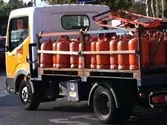
Al descargar la mercancía de este vehículo, ¿dónde podremos depositar la mercancía?
When unloading goods from this vehicle, where may we put the goods?
- AEn el arcén.On the hard shoulder.
- BEn la acera, pero sin molestar a los peatones.On the pavement, but without disturbing pedestrians.
- CEstá prohibido depositar las mercancías en la calzada, el arcén y zonas peatonales.It is prohibited to put goods on the carriageway, the hard shoulder and pedestrian areas.
ExplanationAs a general rule, loading and unloading must be done off the road. If it is essential to do it on the road, these rules must be followed: – If possible, it must be done on the side of the vehicle closest to the edge of the carriageway. – The rules on stopping and parking must be respected and, in built-up areas, any rules issued on times and places. – It is prohibited to put goods on the carriageway, hard shoulder or pedestrian areas. – The necessary means must be used to do it quickly, avoiding danger, noise and unnecessary nuisance.
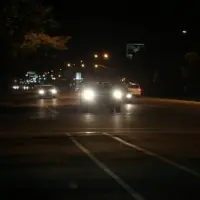
De noche, ¿cómo se debe señalizar la carga que sobresale por delante y por detrás?
At night, how must a load that sticks out at the front and at the rear be marked?
- ACon un catadióptrico blanco por delante y otro rojo por detrás.With a white reflector at the front and a red one at the rear.
- BCon una luz blanca por delante, una luz roja por detrás y el panel de franjas oblicuas rojas y blancas.With a white light at the front, a red light at the rear and the panel with red and white diagonal stripes.
- CSolo con el panel de franjas oblicuas rojas y blancas.Only with the panel with red and white diagonal stripes.
ExplanationBetween sunset and sunrise, or in weather or other conditions that greatly reduce visibility, a load sticking out at the front must be marked with a white light. At the rear it must be marked with a red light and a 50 by 50 centimetre panel painted with alternating red and white diagonal stripes. The panel is placed at the rear end of the load so that it always stays at right angles to the vehicle's axis.
¿Cuál es la masa máxima autorizada para un remolque ligero no agrícola?
What is the maximum authorised mass of a light non-agricultural trailer?
- AIgual o inferior a 750 kilogramos.750 kilograms or less.
- BIgual o inferior a 1.500 kilogramos.1,500 kilograms or less.
- CSuperior a 750 kilogramos.More than 750 kilograms.
ExplanationNon-agricultural trailers and semi-trailers are classed as light or heavy according to their maximum authorised mass (MAM). They are light when their MAM is 750 kg or less. They are heavy (not light) when their MAM is more than 750 kg.
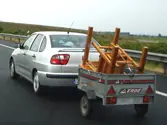
Un vehículo ocupado por 5 personas y que arrastre un remolque ligero, ¿podrá circular por un carril VAO?
May a vehicle with 5 people on board towing a light trailer use a HOV lane (VAO)?
- ASí, porque viajan en él 5 personas.Yes, because there are 5 people in it.
- BNo, está prohibido.No, it is prohibited.
- CSí, aunque viaje solo el conductor.Yes, even with only the driver on board.
ExplanationAs a general rule, the BUS-HOV lane (BUS-VAO) may be used by two- or three-wheeled motorcycles, cars, buses with a maximum authorised mass of more than 3,500 kg, articulated buses and adaptable mixed-use vehicles carrying the number of occupants set for each stretch. All other vehicles and combinations of vehicles, including cars with trailers, cycles and mopeds, may not use it. However, it may also be used, even with only the driver on board, by: - The authorised types of vehicle if they display the V-15 sign (reduced mobility badge). - Two- or three-wheeled motorcycles. - Buses with a maximum authorised mass of more than 3,500 kg and articulated buses. - Vehicles classed as taxis under the usage criterion in Annex II of the General Vehicle Regulations, with an exterior light unit and a valid taxi licence. - Police, fire, civil protection, rescue and medical vehicles on an emergency call, and maintenance teams for the road's facilities and infrastructure. - Vehicles with environmental badges (CERO, ECO, B and C) may use the BUS-HOV lane only when road signs say so.
En un ciclomotor de dos ruedas de anchura inferior a 1 metro, ¿puede sobresalir lateralmente la carga transportada?
On a two-wheeled moped less than 1 metre wide, may the load stick out to the sides?
- ASí, hasta 0,25 metros a cada lado de su eje longitudinal.Yes, up to 0.25 metres on each side of its longitudinal axis.
- BSí, hasta 0,50 metros a cada lado de su eje longitudinal.Yes, up to 0.50 metres on each side of its longitudinal axis.
- CNo.No.
ExplanationOn a two-wheeled moped less than 1 metre wide, the load may stick out sideways by up to 0.50 metres on each side of its longitudinal axis. The maximum dimensions allow the load to extend within these limits without compromising the vehicle's stability. Always secure the load properly to avoid any risk during the journey.
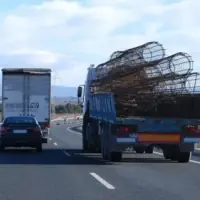
¿Es contrario a la seguridad vial cargar el vehículo con más carga de la que el fabricante indica?
Is it against road safety to load a vehicle with more than the manufacturer states?
- ASi, es ilegalYes, it is illegal
- BNo, cada conductor puede llevar la carga que le convengaNo, each driver may carry the load that suits them
- CÚnicamente los camiones podrán llevar más carga que la establecida en su tarjeta I.T.VOnly lorries may carry more load than stated on their ITV card
ExplanationLoading your vehicle with more weight than its maximum authorised mass allows can be against road safety and very dangerous for other road users. So it is forbidden to overload your vehicle beyond the permitted limits, and you may be fined or penalised.
¿Puede sustituirse el panel obligatorio que indica la carga que sobresale por la parte trasera?
Can the compulsory panel that marks a load sticking out at the rear be replaced by something else?
- ASí. Si no se dispone del panel, se puede colocar un trapo de color rojo vivo.Yes. If you do not have the panel, you can use a bright red cloth.
- BSí. Se puede sustituir por una luz blanca delante y una luz roja detrás.Yes. It can be replaced by a white light at the front and a red light at the rear.
- CNo.No.
ExplanationAccording to Article 15.6 of the General Traffic Regulations, a load that sticks out at the rear must be marked with the V-20 panel, placed at its rear end. It cannot be replaced by a cloth or by lights: at night or in poor visibility a red light is added, but the panel is still compulsory.
¿Podemos transportar personas en un remolque arrastrado por un ciclomotor?
May we carry people in a trailer towed by a moped?
- ASí, si llevan casco homologado.Yes, if they wear approved helmets.
- BNo.No.
- CSí.Yes.
ExplanationPeople may not be carried in a trailer towed by a moped.
Los remolques de MMA superior a 750 kg...
Trailers with a MAM over 750 kg...
- APueden circular con el permiso de circulación del vehículo tractor.may be driven with the towing vehicle's registration certificate.
- BNo tienen que tener el permiso de circulación.do not need a registration certificate.
- CSí tienen que tener el permiso de circulación.must have their own registration certificate.
ExplanationA trailer with a MAM over 750 kg must carry its own registration certificate, its ITV card (inspection certificate) and insurance, and it must be registered.
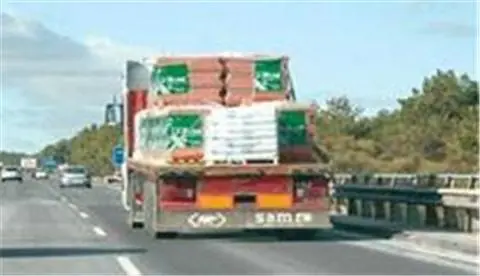
En un vehículo es obligatorio colocar y sujetar la carga de forma que...
In a vehicle, the load must be placed and secured so that it...
- Aoculte las advertencias manuales que realice el conductor.hides the hand signals made by the driver.
- Bno pueda arrastrar, caer o desplazarse de manera peligrosa.cannot drag, fall or move about dangerously.
- Cproduzca ruido, para advertir del peligro a otros usuarios.makes a noise, to warn other road users of the danger.
ExplanationArticle 14 of the General Traffic Regulations requires the load to be arranged and secured so that it cannot drag, fall or move about dangerously, and does not compromise the vehicle's stability, make avoidable noise or hide the lights, plates or the signals the driver makes with their arm.
All topics
- Definitions
- Documents and penalty points
- The driver's condition
- Duties of drivers and pedestrians
- Vehicle safety devices
- Vehicle controls and equipment
- Vehicle lights and horn
- Traffic signs, markings and signals
- The road and its lanes
- Speed and distances
- Manoeuvres
- Right of way
- Driving safely in difficult conditions
- Vehicle mechanics and maintenance
- Road accidents and first aid
- Defensive and eco-driving
Independent app: not affiliated with or endorsed by the DGT (Spain's Directorate-General for Traffic) or the Ministry of the Interior. The official exam is booked with the DGT and taken at its test centres. The questions here are practice material; the DGT's official question bank is not public.
Basado en datos de la Agencia Estatal Boletín Oficial del Estado (https://www.boe.es). Textos consolidados de carácter meramente informativo. La AEBOE no patrocina ni respalda este sitio.
Parte de las preguntas procede de los tests de la revista «Tráfico y Seguridad Vial» de la DGT, reproducidos con indicación de la fuente.