
DGT test · 534 questions
The road and its lanes · Page 11 of 11
Carriageway, lanes, hard shoulder and road types: where you drive and how lanes are used on motorways, dual carriageways and streets.
Questions in this topic, with answers
534 questions, 50 per page, with the correct answer and the explanation. Page 11 of 11.
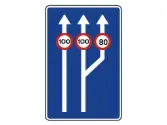
Si circulamos a 70 km/h por el carril central y no hay más tráfico en la calzada, ¿lo hacemos correctamente?
If we are driving at 70 km/h in the centre lane and there is no other traffic on the carriageway, are we doing it correctly?
- ASí, porque circulo a velocidad inferior a la máxima indicada.Yes, because I am driving below the maximum speed shown.
- BSí, porque puedo circular por el carril que más conviene a mi destino.Yes, because I can use the lane that best suits my destination.
- CNo, tendré que circular por el carril de la derecha.No, I must drive in the right-hand lane.
ExplanationOutside built-up areas, as a general rule we drive in the right-hand lane, and may use the other lanes when traffic conditions require it. The sign shows that the road has three lanes and that the maximum speed in the right-hand lane is 80 km/h. As we are doing 70 km/h, we must use that lane. If we speed up and drive at more than 80 km/h, we must use the centre or left lane, because we would be going over the limit for the right-hand lane.
Cuando circulamos por una vía urbana, como norma general, ¿qué carril utilizaremos?
When driving on an urban road, as a general rule, which lane will we use?
- AEl que más convenga a nuestro destino en todo caso.In all cases, whichever best suits our destination.
- BEl carril de la derecha siempre.Always the right-hand lane.
- CEl carril que mejor convenga nuestro destino cuando éstos estén delimitados.The lane that best suits our destination, when the lanes are marked.
ExplanationIn built-up areas you may use the lane that best suits your destination, as long as the lanes are marked by longitudinal lines. When they are not marked, we must drive on the right.
¿Podrá un turismo que arrastra un remolque ligero circular por un carril VAO?
May a car towing a light trailer use an HOV lane (VAO)?
- ASí, si el remolque no supera los 500 kg.Yes, if the trailer does not exceed 500 kg.
- BSí.Yes.
- CNo.No.
ExplanationA car towing a trailer, whether light or not, may never use an HOV lane (VAO).
Si circulamos por una vía dotada de tres calzadas, la calzada central será normalmente...
If we are driving on a road with three carriageways, the centre carriageway is normally...
- ADe un solo sentido.One-way.
- BDe dos sentidos.Two-way.
- CSolo para vehículos destinados al transporte público.Only for public transport vehicles.
ExplanationOn roads with three carriageways, the centre one is normally for traffic in both directions and the side ones are one-way.
En caso de avería en una autopista, ¿se puede circular por el arcén izquierdo?
If you break down on a motorway (autopista), may you drive on the left-hand hard shoulder?
- ASí, si la avería se produce circulando por el carril izquierdo.Yes, if the breakdown happens while you are driving in the left-hand lane.
- BSí, siempre que no haya tráfico.Yes, as long as there is no traffic.
- CNo, se debe circular únicamente por el carril o arcén derecho.No, you may only drive in the right-hand lane or on the right-hand hard shoulder.
ExplanationIf the vehicle needs help because of a breakdown, it must leave the lanes as soon as possible and head for the first exit using the right-hand hard shoulder; if this is not possible, it must stop on the right-hand hard shoulder or where it causes the least obstruction (Article 130.2 of the General Traffic Regulations). The left-hand hard shoulder is not used for driving.
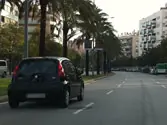
Dentro de poblado con 3 carriles en mi sentido, ¿podré circular por el carril de la izquierda?
In a built-up area with 3 lanes in my direction, may I drive in the left-hand lane?
- ASí, si es el que más conviene a mi destino.Yes, if it is the one that best suits my destination.
- BNo.No.
- CSí, porque hay más de dos carriles.Yes, because there are more than two lanes.
ExplanationIn built-up areas we may drive in the lane that best suits our destination, provided there is more than one lane in the same direction and the lanes are marked by road markings. If they are not marked, we must drive on the right, as on roads outside built-up areas, and may use the other lanes when traffic or road conditions make it advisable.
¿Por qué carril circulará normalmente en una autopista de 3 o más carriles en su sentido de la marcha un conjunto de vehículos de 7 metros?
On a motorway (autopista) with 3 or more lanes in its direction of travel, which lane should a 7-metre combination of vehicles normally use?
- ACirculará normalmente por el situado más a su derecha.It should normally use the lane furthest to its right.
- BUsará solo el carril más a su derecha o el inmediato.It should use only the lane furthest to its right or the one next to it.
- CUsará el carril que mejor convenga a su destino.It should use the lane that best suits its destination.
ExplanationA combination of vehicles up to 7 metres long (the rule would be different for more than 7 metres) should normally use the lane furthest to its right, although it may use the other lanes when traffic or road conditions make it advisable, provided it does not hold up any vehicle behind it.
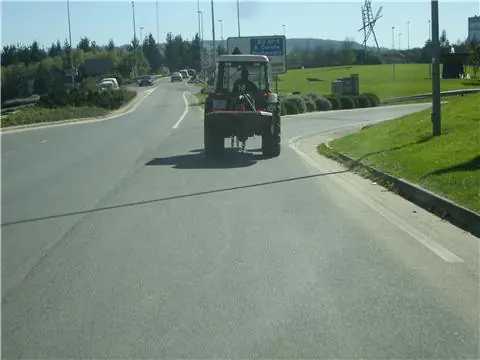
Fuera de poblado, deben circular por la calzada y no por el arcén todos los automóviles y...
Outside built-up areas, the following must use the carriageway and not the hard shoulder: all motor cars and...
- Atodos los vehículos especiales.all special vehicles.
- Blos vehículos especiales con MMA no superior a 3.500 kilogramos.special vehicles with a MAM not over 3,500 kg.
- Clos vehículos especiales con MMA superior a 3.500 kilogramos.special vehicles with a MAM over 3,500 kg.
ExplanationUnder Article 31 of the General Traffic Regulations, motor cars and special vehicles over 3,500 kg must use the carriageway and not the hard shoulder, except in an emergency. Special vehicles of up to 3,500 kg, on the other hand, must use the hard shoulder if it is usable.
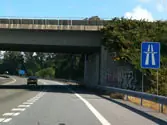
Circulando por una autopista, ¿facilitaremos la incorporación de los vehículos que circulen por el carril de aceleración?
Driving on a motorway (autopista), will we make it easier for vehicles in the acceleration lane to join?
- ASolo a los vehículos que se incorporen por el lado derecho.Only for vehicles joining on the right-hand side.
- BSí, a todos los vehículos que se incorporen.Yes, for all vehicles joining.
- CNo, por autopista no estamos obligados a facilitar la incorporación a ningún vehículo.No, on a motorway we are not required to make it easier for any vehicle to join.
ExplanationWhen driving on a motorway, even though we have right of way, we must, as far as possible, make it easier for vehicles approaching in an acceleration lane to join.
¿Por dónde circularán los vehículos especiales de menos de 3500 kg de MMA en las vías fuera de poblado cuando no exista arcén?
Where must special vehicles with an MAM under 3,500 kg travel on roads outside built-up areas when there is no hard shoulder?
- ALo más ceñido al borde derecho posibleAs close as possible to the right-hand edge
- BLo más ceñido al borde izquierdo posibleAs close as possible to the left-hand edge
- CJusto en el centro del carrilRight in the centre of the lane
ExplanationThe position of special vehicles on the carriageway depends on their maximum authorised mass. Special vehicles with an MAM of no more than 3,500 kg, when there is no area set aside for them, must travel outside built-up areas as close as possible to the right-hand edge of the carriageway if there is no hard shoulder. If there is a usable hard shoulder that is wide enough, they must travel on it.
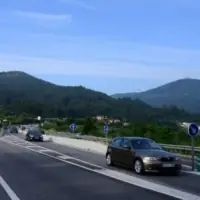
¿Pueden tener las vías por las que transitamos varias calzadas?
Can the roads we use have several carriageways?
- ANoNo
- BSíYes
- CÚnicamente las vías fuera de pobladoOnly roads outside built-up areas
ExplanationRoads can have one or more carriageways, and each carriageway can have one or two directions of traffic. So single-carriageway roads can have one or two directions of traffic, and roads divided into two carriageways have two directions of traffic unless signs show otherwise.
Si un vehículo queda detenido en el arcén de una autopista, ¿pueden sus ocupantes circular por la calzada?
If a vehicle is stopped on the hard shoulder of a motorway (autopista), may its occupants walk on the carriageway?
- ASí, para colocar la señal de preseñalización de peligro.Yes, to place the hazard warning device.
- BSí, si llevan el chaleco reflectante.Yes, if they are wearing the reflective vest.
- CNo, porque está prohibido.No, because it is prohibited.
ExplanationWhen a vehicle is immobilised, you must not go onto the carriageway, not even when wearing the reflective vest.
Por obras en la calzada han habilitado un carril en sentido contrario. ¿Puede circular por él un coche con remolque?
Because of roadworks on the carriageway, a lane has been opened in the opposite direction. Can a car towing a trailer use it?
- ASí, si el remolque es ligero.Yes, if the trailer is light.
- BSí, si no lo prohíban otras señales.Yes, if other signs do not prohibit it.
- CNo, sólo pueden hacerlo turismos y motocicletas.No, only cars and motorcycles may use it.
ExplanationAccording to Article 41.1 of the General Traffic Regulations (RGC), when a lane in the opposite direction to the usual one is opened because of roadworks on the carriageway, it may be used by all vehicles allowed on the road under works, including cars towing trailers, unless expressly prohibited.
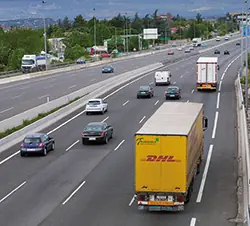
No pueden circular por autopista...
Which of these may not use a motorway (autopista)...
- Alas motocicletas.motorcycles.
- Blos ciclomotores.mopeds.
- Clos camiones de más de 3.500 kg de M.M.A.lorries over 3,500 kg maximum authorised mass (MAM).
ExplanationMopeds are prohibited on motorways (autopistas) and dual carriageways (autovías): their maximum speed (45 km/h) is not compatible with these roads. Motorcycles and lorries may use them.
Un rebaño, en una carretera convencional sin vía pecuaria, ¿por dónde debe circular?
On a conventional road with no livestock track, where must a herd move?
- ALo más cerca posible del borde derecho de la vía.As close as possible to the right edge of the road.
- BPor el arcén derecho o por el izquierdo, indistintamente.On the right or the left hard shoulder, either way.
- CPor la parte transitable del arcén izquierdo.On the usable part of the left hard shoulder.
ExplanationA herd may only use the road when there is no usable livestock track (Article 126). Under Article 127.1.c of the General Traffic Regulations, it must move at walking pace, as close as possible to the right edge of the road and never taking up more than the right half of the carriageway.
Los conductores que circulen por un carril reversible deben...
Drivers using a reversible lane must...
- ALlevar encendidas, al menos, las luces de cruce tanto de día como de noche.Have at least their dipped headlights on, both by day and by night.
- BLlevar encendidas, al menos, las luces de cruce tanto de día como de noche y circular a una velocidad máxima de 80 km/h y mínima de 60 km/h.Have at least their dipped headlights on, both by day and by night, and drive at a maximum speed of 80 km/h and a minimum of 60 km/h.
- CCircular a una velocidad máxima de 80 km/h y mínima de 60 km/h.Drive at a maximum speed of 80 km/h and a minimum of 60 km/h.
ExplanationUnder Article 40 of the General Traffic Regulations, anyone driving in a reversible lane must have at least the dipped headlights on, both by day and by night. The 60 and 80 km/h limits apply to lanes opened for traffic in the opposite direction to the usual one, not to reversible lanes.
Un ciclomotor puede circular por…
A moped may be ridden on…
- ACarreteras convencionales y vías urbanas únicamente.Conventional roads and urban roads only.
- BAutopistas.Motorways (autopistas).
- CTodas las autovías.All dual carriageways (autovías).
ExplanationMopeds are prohibited on motorways (autopistas) and dual carriageways (autovías), and may not use roads reserved for motor vehicles either. They may be ridden on conventional roads and urban roads, respecting their maximum speed of 45 km/h.
En una glorieta de una vía interurbana con dos carriles, ¿por dónde circularemos?
On a two-lane roundabout on an interurban road, where shall we drive?
- APor el carril de la derecha, utilizando el resto cuando las circunstancias lo aconsejen.In the right-hand lane, using the others when circumstances make it advisable.
- BPor el carril que más convenga a nuestro destino.In the lane that best suits our destination.
- CPor el carril que nos sea más cómodo.In the lane we find most comfortable.
ExplanationOutside built-up areas, on carriageways with more than one lane for the same direction, we normally drive in the lane furthest to the right, and may use the other lanes whenever circumstances make it advisable.
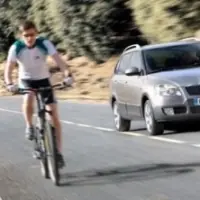
¿Pueden los ciclistas, ir por el carril de la derecha en una carretera con desnivel y curvas?
May cyclists ride in the right-hand lane on a road with slopes and bends?
- ANo, siempre deben utilizar el arcén.No, they must always use the hard shoulder.
- BSí.Yes.
- CPueden utilizar el carril entero.They may use the whole lane.
ExplanationYes. On long descents with bends, when it is safe to do so, cyclists may leave the hard shoulder and ride on the part of the right-hand side of the carriageway that they need (Article 36 of the General Traffic Regulations). They may not take up the whole lane or the whole carriageway.
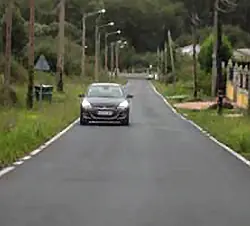
En una calzada de doble sentido de circulación en la que no están delimitados los carriles, está obligado a circular por...
On a two-way carriageway where the lanes are not marked, you must drive...
- Ael lugar de la calzada que crea más seguro.in the part of the carriageway you think is safest.
- Bla derecha, lo más cerca posible del borde de la calzada.on the right, as close as possible to the edge of the carriageway.
- Cel eje imaginario de la calzada.along the imaginary centre line of the carriageway.
ExplanationWhen the lanes are not marked, the general rule of driving on the right applies: you must keep as close as possible to the right-hand edge of the carriageway, leaving the opposite side free.
¿Puede circular un turismo con remolque por un carril reservado para Vehículos de Alta Ocupación (VAO)?
May a car with a trailer use a lane reserved for high-occupancy vehicles (HOV lane, VAO)?
- ASí, si viajan al menos 3 personas.Yes, if at least 3 people are travelling.
- BNo, aunque viajen varias personas en el turismo.No, even if several people are travelling in the car.
- CSí, únicamente en días festivos.Yes, but only on public holidays.
ExplanationArticle 35.2.a of the General Traffic Regulations restricts the HOV lane (VAO) to motorcycles, cars and adaptable mixed-use vehicles, and prohibits it to all other vehicles and combinations, including cars with a trailer, even if several people are travelling in them.
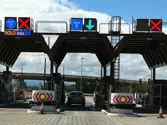
Si su vehículo está dotado de un equipo de telepeaje, ¿qué carril usará?
If your vehicle has an electronic toll device, which lane will you use?
- AEl carril de la izquierda.The left-hand lane.
- BEl carril central.The centre lane.
- CEl carril de la izquierda y también el central.The left-hand lane and also the centre lane.
ExplanationIn the picture we can see a red X-shaped light above the left-hand lane and above the right-hand lane, which means you may not use those lanes. So the only lane you can use is the centre lane.
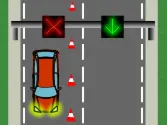
¿Tiene permitido circular una motocicleta por un carril habilitado en sentido contrario al habitual?
Is a motorcycle allowed to use a lane opened for traffic in the opposite direction to the usual one?
- ASí.Yes.
- BNo.No.
- CSí, pero sólo si se trata de una motocicleta de dos ruedas sin sidecar.Yes, but only if it is a two-wheeled motorcycle without a sidecar.
ExplanationLanes opened for traffic in the opposite direction to the usual one to keep traffic flowing may only be used by motorcycles, with or without a sidecar, and cars. However, when they are opened because of roadworks, they may be used by all vehicles allowed on that road, unless expressly prohibited.
En una carretera, por motivos de fluidez, ha sido habilitado un carril para ser utilizado en sentido contrario al habitual, ¿le está permitido circular por dicho carril a un turismo con remolque no ligero?
On a road, a lane has been opened for use in the opposite direction to the usual one to keep traffic flowing. May a car towing a trailer that is not light use that lane?
- ANo, porque está prohibido.No, because it is prohibited.
- BSí, siempre que circule como mínimo a 80 kilómetros por hora.Yes, provided it drives at 80 kilometres per hour or more.
- CSí, siempre que circule con la luz de cruce encendida, aún de día.Yes, provided it drives with dipped headlights on, even during the day.
ExplanationA car towing a trailer that is not light is prohibited from using a lane opened in the opposite direction to the usual one. These lanes may only be used by motorcycles and by cars without a trailer. So a car towing a trailer that is not light may not use that lane.
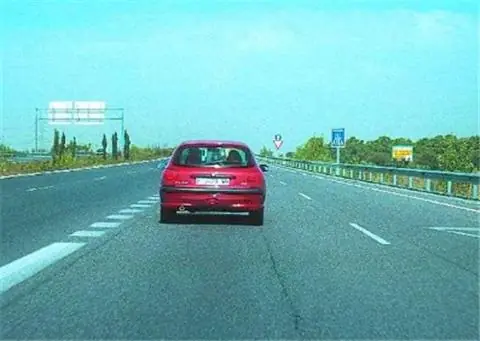
Por una autovía, ¿puede circular un ciclomotor?
Can a moped be ridden on a dual carriageway (autovía)?
- ASí, por el arcén.Yes, on the hard shoulder.
- BNo.No.
- CDepende de la velocidad a la que circule.It depends on the speed at which it is travelling.
ExplanationMopeds are not allowed on motorways (autopistas) or dual carriageways (autovías), including the hard shoulder, because their maximum speed of 45 km/h is far below that of the rest of the traffic. The speed at which they are travelling at any given moment makes no difference.
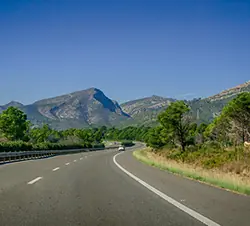
En esta carretera convencional con arcén transitable, ¿por dónde debe circular un ciclomotor?
On this conventional road with a usable hard shoulder, where must a moped ride?
- APor el centro de la calzada o por el arcén de la derecha.In the centre of the carriageway or on the right-hand hard shoulder.
- BPor la calzada, lo más cerca posible del borde derecho.On the carriageway, as close as possible to the right-hand edge.
- CPor el arcén de la derecha.On the right-hand hard shoulder.
ExplanationMopeds must ride on the hard shoulder on their right when it is usable and wide enough; only if it is not may they use the carriageway, keeping as close as possible to its right-hand edge.
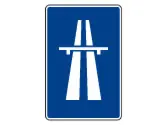
¿Está permitido remolcar con un turismo a un vehículo averiado por una autopista?
May you use a car to tow a broken-down vehicle on a motorway (autopista)?
- ASí, hasta el taller más próximo.Yes, to the nearest garage.
- BNo, debe hacerlo una grúa.No, a tow truck must do it.
- CSí, cuando la grúa tarde más de media hora.Yes, when the tow truck will take more than half an hour.
ExplanationOn motorways (autopistas) and dual carriageways (autovías), where vehicles travel at very high speeds, as on all other roads, you may not tow a broken-down vehicle with a car. This is reserved for vehicles authorised for this purpose (tow trucks).
Va un turismo por una autovía con mucho tráfico. ¿Está permitido circular por el arcén para tomar la siguiente salida?
You are driving a car on a dual carriageway (autovía) with heavy traffic. Are you allowed to drive on the hard shoulder to take the next exit?
- ASí, con las luces de emergencia.Yes, with the hazard warning lights on.
- BSí, para facilitar la circulación.Yes, to help traffic flow.
- CNo.No.
ExplanationUnder the General Traffic Regulations, drivers of motor cars must not drive on the hard shoulder except in emergencies. Driving on the hard shoulder to take the exit on a dual carriageway with heavy traffic is not an emergency. This is set out in the article on the use of the hard shoulder, which states that only vehicles such as cycles, mopeds or those whose weight does not exceed certain limits may use the hard shoulder, and only when there is no road intended for them. So the answer is 'No'.
Para el cómputo de carriles, no se tienen en cuenta los carriles...
When counting lanes, you do not include lanes that are...
- Areversibles.reversible.
- Breservados a determinados vehículos.reserved for certain vehicles.
- Cespeciales.special.
ExplanationUnder Article 34 of the General Traffic Regulations, when counting the lanes on a carriageway, lanes reserved for certain vehicles or certain manoeuvres are not taken into account. This helps drivers choose the right lane for where they are going without interfering with other traffic. For example, lanes reserved for buses or high-occupancy vehicles are exclusive and are therefore left out of the count of lanes available to other vehicles.
¿Puede un ciclomotor circular por un carril VAO?
May a moped use an HOV lane (VAO)?
- ANo, en ningún casoNo, never
- BSí, siempre que lo ocupen dos personasYes, as long as two people are on it
- CSí, sea cual sea su ocupaciónYes, however many people are on it
ExplanationUnder Article 35 of the General Traffic Regulations, HOV lanes (VAO) may only be used by motorcycles, cars and adaptable mixed-use vehicles. They are forbidden to all others, including mopeds, cycles and cars towing a trailer, however many occupants they have.
Dentro de poblado, circula conduciendo su turismo por el carril izquierdo de una vía con dos carriles separados por marcas discontinuas para el mismo sentido de circulación. Si Ud. pretende adelantar al vehículo que circula delante por el mismo carril, ¿puede hacerlo por la derecha?
In a built-up area, you are driving your car in the left-hand lane of a road with two lanes in the same direction separated by broken markings. If you want to overtake the vehicle in front of you in the same lane, may you do so on the right?
- ANo, porque el adelantamiento por la derecha está siempre prohibido.No, because overtaking on the right is always prohibited.
- BSí; a condición de que me cerciore de que puedo hacerlo sin peligro para los demás usuarios.Yes, as long as I make sure I can do it without danger to other road users.
- CNo, porque únicamente está permitido adelantar por la derecha en vías interurbanas (fuera de poblado).No, because overtaking on the right is only allowed on roads outside built-up areas.
ExplanationThis option is correct because, on a road with two lanes in the same direction, you may overtake on the right as long as you make sure there is no danger to other road users. It is important to pay attention to the traffic conditions and to everyone's safety.
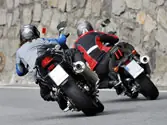
¿Se podrán realizar competiciones en circuito urbano?
Can competitions be held on an urban circuit?
- ASí, en el espacio comprendido entre un vehículo de la autoridad con bandera roja y uno de cierre con bandera verde.Yes, in the space between an authority vehicle with a red flag and a closing vehicle with a green flag.
- BNo, en ningún caso se podrán realizar pruebas deportivas en la vía pública.No, sporting events may never be held on public roads.
- CSí, teniendo precaución con los demás usuarios de la vía.Yes, taking care with other road users.
ExplanationNo competition of any kind may be held on a public road unless the road is specially closed to traffic and the competition is authorised.
Al circular por un carril reversible debemos...
When driving in a reversible lane we must...
- ALlevar encendida la luz de corto alcance y circular a una velocidad máxima de 80 y mínima de 60 km/h.Have the dipped headlights on and drive at a maximum speed of 80 and a minimum of 60 km/h.
- BLlevar encendida la luz de corto alcance.Have the dipped headlights on.
- CCircular como máximo a 60 km/h.Drive at 60 km/h at most.
ExplanationWhen driving in a reversible lane we must have the dipped headlights on, by day and by night. The maximum and minimum speeds are the general ones for the road.
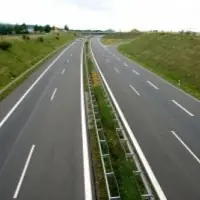
¿Como se denomina la franja que separa las dos calzadas de una vía?
What is the strip separating the two carriageways of a road called?
- AArcénHard shoulder
- BIntersecciónJunction
- CMedianaCentral reservation
ExplanationThe central reservation is the separating space, ditch or low wall that separates the two directions of traffic on a motorway (autopista) or dual carriageway (autovía) to stop vehicles crossing into the opposite lane.
All topics
- Definitions
- Documents and penalty points
- The driver's condition
- Duties of drivers and pedestrians
- Vehicle safety devices
- Vehicle controls and equipment
- Vehicle lights and horn
- Traffic signs, markings and signals
- Speed and distances
- Manoeuvres
- Right of way
- Carrying passengers and loads
- Driving safely in difficult conditions
- Vehicle mechanics and maintenance
- Road accidents and first aid
- Defensive and eco-driving
Independent app: not affiliated with or endorsed by the DGT (Spain's Directorate-General for Traffic) or the Ministry of the Interior. The official exam is booked with the DGT and taken at its test centres. The questions here are practice material; the DGT's official question bank is not public.
Basado en datos de la Agencia Estatal Boletín Oficial del Estado (https://www.boe.es). Textos consolidados de carácter meramente informativo. La AEBOE no patrocina ni respalda este sitio.
Parte de las preguntas procede de los tests de la revista «Tráfico y Seguridad Vial» de la DGT, reproducidos con indicación de la fuente.