
DGT test · 534 questions
The road and its lanes · Page 8 of 11
Carriageway, lanes, hard shoulder and road types: where you drive and how lanes are used on motorways, dual carriageways and streets.
Questions in this topic, with answers
534 questions, 50 per page, with the correct answer and the explanation. Page 8 of 11.
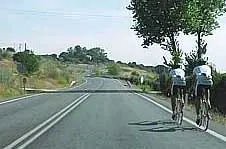
¿Pueden los ciclistas utilizar el arcén circulando por Autopista?
May cyclists use the hard shoulder on a motorway (autopista)?
- ASí, si son mayores de 14 años.Yes, if they are over 14.
- BSí.Yes.
- CNo.No.
ExplanationCycling on motorways (autopistas) is prohibited, including on their hard shoulder. The exception for cyclists over 14 only applies to the hard shoulders of dual carriageways (autovías), unless a sign prohibits it (Article 38.1 of the General Traffic Regulations).

Si nos encontramos un niño que está cruzando la calzada por un lugar prohibido, ¿qué debemos hacer?
If we come across a child crossing the carriageway where crossing is not allowed, what should we do?
- AAnticiparnos a las posibles reacciones del niño moderando la velocidad, llegando incluso a detenernos.Anticipate the child's possible reactions by slowing down, even stopping.
- BContinuaremos, actuando sobre la marcha según la reacción del niño.Carry on and react as we go, depending on what the child does.
- CContinuaremos nuestra marcha pitándole para que se dé cuenta de su error.Carry on and sound the horn so the child realises the mistake.
ExplanationWhen there are pedestrians on the part of the road we are using, we must slow down, even coming to a complete stop, to prevent accidents. Pedestrians are vulnerable road users who suffer serious harm if they are hit, so we must drive very carefully when they are around, especially if they are children, so that this never happens.
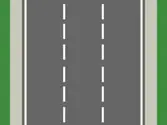
En una carretera con 3 carriles y doble sentido de circulación, ¿se podrá circular por el carril izquierdo?
On a road with 3 lanes and two-way traffic, may you drive in the left-hand lane?
- ASí.Yes.
- BNo.No.
- CSólo para realizar los adelantamientos precisos.Only when you need to overtake.
ExplanationBoth in and outside built-up areas, on two-way carriageways with 3 lanes separated by broken longitudinal lines: you drive in the right-hand lane (never in the left-hand one). The central lane may be used only for overtaking or turning left (provided it is not occupied by traffic from the opposite direction).
¿Está permitido que las bicicletas circulen por una autovía?
Are bicycles allowed on an autovía (dual carriageway)?
- ANo, está totalmente prohibido en todos los casos.No, it is completely prohibited in all cases.
- BSí, incluso los niños, circulando por el lado derecho de la calzada.Yes, even children, riding on the right-hand side of the carriageway.
- CSolo por el arcén y únicamente los ciclistas mayores de 14 años.Only on the hard shoulder, and only cyclists over 14 years old.
ExplanationBicycles may not be ridden on autopistas or autovías, but cyclists over 14 years old may ride on the hard shoulders of autovías, unless this is prohibited by signs for safety reasons (Article 38.1 of the General Traffic Regulations).
En una calzada con doble sentido de circulación y dos carriles, ¿por dónde debe circular un vehículo especial cuya Masa Máxima Autorizada (MMA) supera los 3.500 kg?
On a two-way carriageway with two lanes, where must a special vehicle with a maximum authorised mass (MAM) of more than 3,500 kg drive?
- APor el carril de su derechaIn the lane on its right
- BPor el arcén derechoOn the right-hand hard shoulder
- CPor el carril izquierdoIn the left-hand lane
ExplanationThe correct answer is in the lane on its right. As a general rule, special vehicles with a MAM of more than 3,500 kg behave like a lorry or a car as regards their position on the road: they must drive on the carriageway, not on the hard shoulder. It is important to distinguish them from special vehicles of up to 3,500 kg, which must use the hard shoulder if there is one and it is usable. So: 1. They may not use the right-hand hard shoulder (reserved for light special vehicles, cycles, mopeds, etc.). 2. They may not use the left-hand lane, because on a two-way road with two lanes the left-hand lane is for traffic in the opposite direction (entering it would be very dangerous, except to overtake where this is allowed).
Un turismo que arrastra un remolque ligero, ¿podrá circular por un carril VAO?
May a car towing a light trailer use a HOV lane (VAO)?
- ASí, si está ocupado por lo menos por cuatro personas.Yes, if there are at least four people on board.
- BNo.No.
- CSí, en todo caso.Yes, in all cases.
ExplanationNo vehicle towing a trailer may use a HOV lane (VAO), even if it carries the minimum number of people.
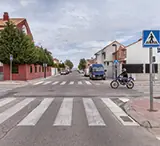
En esta vía urbana con dos carriles para cada sentido que no tiene líneas de separación de carriles, ¿por qué carril se debe circular?
On this urban road with two lanes in each direction and no lane markings, which lane must you drive in?
- APor el de su derecha.In the lane on your right.
- BPor el carril que más convenga para mi destino.In the lane that best suits my destination.
- CPor el carril de la derecha y no puedo cambiar al segundoIn the right lane, and I may not move to the second one
ExplanationWhen driving on a road where the lanes are not marked, we will only drive in the right lane, and may use the others when circumstances make it advisable. If the road is two-way with two lanes in each direction, we will never enter the half of the carriageway intended for the opposite direction.
Por un carril reversible...
In a reversible lane...
- ACircularemos a 80 km/h como máximo y a 60 km/h como mínimo.We will drive at a maximum of 80 km/h and a minimum of 60 km/h.
- BCircularemos a 80 km/h como máximo, a 60 km/h como mínimo y usaremos la luz de cruce.We will drive at a maximum of 80 km/h and a minimum of 60 km/h and use dipped headlights.
- CDeberemos usar la luz de cruce tanto de día como de noche.We must use dipped headlights both by day and by night.
ExplanationThe only special obligation when driving in a reversible lane is to use dipped headlights. The maximum and minimum permitted speeds are the general ones for the road.
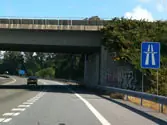
Cuando un vehículo que circula por el carril de aceleración avanza más rápido que los vehículos que circulan por los carriles normales de la autopista, ¿se considera un adelantamiento?
When a vehicle in the acceleration lane moves faster than the vehicles in the normal lanes of the motorway (autopista), is this considered overtaking?
- ASí.Yes.
- BNo.No.
- CNo, se considera un rebasamiento.No, it is considered passing.
ExplanationOn a stretch of road with an acceleration lane, moving faster in that lane than the vehicles in the normal lanes is not considered overtaking. Nor is it considered passing.
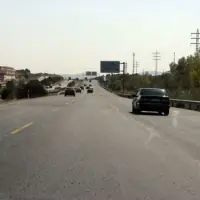
¿Pueden discurrir por poblado las autopistas?
Can motorways (autopistas) run through built-up areas?
- ANo, nuncaNo, never
- BSi, únicamente cuando sean una ronda o circunvalaciónYes, only when they are a ring road or bypass
- CSi, siempreYes, always
ExplanationMotorways may run through built-up areas when they are a ring road or bypass ('ronda' or 'circunvalación'), which are the names given to these roads within built-up areas; they are mainly used to relieve traffic in urban centres.
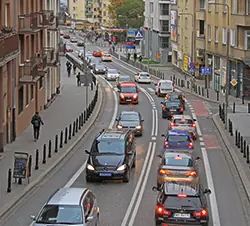
En una vía urbana con un carril en cada sentido, deberá circular...
On an urban road with one lane in each direction, you must drive...
- Alo más cerca posible del borde derecho de la calzada.as close as possible to the right-hand edge of the carriageway.
- Bpor la zona que mejor convenga.in whichever part suits you best.
- Cpor el centro de la calzada, en tramos rectos.in the centre of the carriageway, on straight stretches.
ExplanationOn a carriageway with only one lane in each direction, you must drive on the right, as close as possible to the right-hand edge, leaving the left part free for oncoming traffic. Only with two or more lanes in each direction in built-up areas may you choose the lane that best suits your destination.
Circulando por una carretera convencional con 3 carriles para el mismo sentido, ¿por dónde podrá circular un conjunto de vehículos?
Driving on a conventional road with 3 lanes in the same direction, where may a vehicle combination drive?
- ANormalmente por el carril de la derecha y por el carril contiguo solo para adelantar.Normally in the right-hand lane, and in the next lane only to overtake.
- BSi mide más de 7 metros por el de la derecha y en ningún caso por el tercer carril.If it is longer than 7 metres, in the right-hand lane and never in the third lane.
- CSi el remolque pesa más de 750 kg podrá usar el carril de la derecha.If the trailer weighs more than 750 kg, it may use the right-hand lane.
ExplanationIf the vehicle combination is longer than 7 metres, it will drive in the first lane as a general rule, and may use the second lane if necessary. It may never use the third lane.
En una calzada con tres carriles para su sentido, una señal de carriles indica una velocidad mínima de 70 km/h en los carriles central e izquierdo y ninguna en el derecho. Si circula a 60 km/h, ¿por qué carril debe ir?
On a carriageway with three lanes in your direction, a lane sign shows a minimum speed of 70 km/h in the centre and left lanes and none in the right lane. If you are driving at 60 km/h, which lane must you use?
- AEn el carril izquierdo.The left lane.
- BEn el carril derecho.The right lane.
- CEn el carril central.The centre lane.
ExplanationSigns for lanes reserved according to speed (S-50) mean that the lanes showing the minimum speed sign (R-411) may only be used by vehicles travelling at that speed or faster. At 60 km/h you may not use the lanes that require 70 km/h, so you must drive in the right lane (Article 35.1 of the RGC).
¿Puede un ciclomotor con dos personas usar normalmente un carril VAO?
Can a moped carrying two people normally use an HOV lane (VAO)?
- ANo.No.
- BSí, porque lleva a dos personas.Yes, because it is carrying two people.
- CSí, si circula por el arcén.Yes, if it travels on the hard shoulder.
ExplanationThe HOV lane (VAO, high-occupancy vehicles) is for vehicles with several passengers and other categories set by the local rules. In Spain, mopeds may not use this lane, even if they carry two people. This is because mopeds do not meet the safety and speed requirements typical of HOV lanes, which are usually reserved for cars, buses and motorcycles.
En una travesía con dos carriles por sentido, ¿se puede usar el carril izquierdo para girar a la izquierda?
On a travesía (stretch of road through a town) with two lanes in each direction, may you use the left lane to turn left?
- ASolo si se va a adelantar, ya que la travesía es una vía interurbana.Only if you are going to overtake, as a travesía is a road outside built-up areas.
- BNo, porque en la travesía se debe circular siempre por la derecha.No, because on a travesía you must always keep to the right.
- CSí, porque en la travesía se circula igual que en las vías urbanas.Yes, because on a travesía you drive the same way as on urban roads.
ExplanationA travesía is the stretch of a road that passes through a built-up area, and in built-up areas with two or more lanes in each direction you may use the lane that best suits your destination and change lanes to get ready to turn (Article 33 of the General Traffic Regulations). To turn left you use the left lane.
Los conductores de motocicletas, ¿tienen permitido circular en paralelo?
Are motorcycle riders allowed to ride side by side?
- ASí, en columna de a dos, orillándose todo lo posible al extremo derecho de la vía.Yes, in double file, keeping as far to the right-hand edge of the road as possible.
- BNo.No.
- CSi, como cualquier vehículo de dos ruedas.Yes, like any two-wheeled vehicle.
ExplanationThe General Traffic Regulations allow only cyclists to ride in double file; motorcyclists are not given this option. Even when the hard shoulder is opened to motorcycles in traffic jams, Article 36.3 requires them to ride in single file.
¿Por dónde debe circular un vehículo que realiza funciones de acompañamiento a ciclistas en una carretera con arcén transitable?
Where must a vehicle accompanying cyclists drive on a road with a usable hard shoulder?
- APor el centro de la víaIn the middle of the road
- BPor el arcén, si es transitableOn the hard shoulder, if it is usable
- CPor el carril derecho para mayor protecciónIn the right-hand lane, for better protection
ExplanationThe correct answer is on the hard shoulder, if it is usable. Under the General Traffic Regulations, vehicles accompanying cyclists must adjust their speed to that of the bicycles. Since their speed will be below the minimum allowed, or abnormally low, in order to stay with the group, they must drive on the hard shoulder whenever it is usable and wide enough. The aim is twofold: 1. Safety: they protect the rear of the group of cyclists. 2. Traffic flow: by keeping to the hard shoulder, they avoid needlessly blocking the main traffic lane for other drivers.
Para el cómputo de carriles no se tendrá en cuenta...
When counting lanes, the following are not taken into account...
- ASolo el carril del autobús.Only the bus lane.
- BLos carriles delimitados con línea continua.Lanes marked with a solid line.
- CLos carriles reservados a determinados vehículos o para ciertas maniobras.Lanes reserved for certain vehicles or for certain manoeuvres.
ExplanationWhen counting lanes, the following, among others, are not taken into account: bus, taxi and cycle lanes, and acceleration lanes.
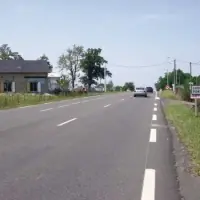
Circula por una calzada con dos sentidos y tres carriles, separados por marcas longitudinales discontinuas, ¿qué carril debe utilizar normalmente?
You are driving on a two-way carriageway with three lanes separated by broken longitudinal lines. Which lane must you normally use?
- AEl carril por el que haya menos vehículos.The lane with the fewest vehicles.
- BEl situado más a la derecha.The one furthest to the right.
- CEl carril derecho, o el central indistintamente.Either the right-hand lane or the centre lane.
ExplanationUnder Article 30 of the General Traffic Regulations, on two-way carriageways with three lanes separated by broken lines you drive in the right-hand lane. The centre lane is only used for overtaking or turning left, and the left-hand lane is never used.
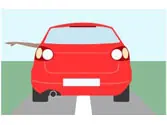
Circulando por una vía fuera de poblado con 3 carriles en el mismo sentido de la marcha, ¿en qué carril nos situaremos para cambiar de dirección a la izquierda?
Driving on a road outside a built-up area with 3 lanes in the same direction, which lane will we move into to turn left?
- AEn el carril central.The centre lane.
- BEn el carril de la izquierda.The left-hand lane.
- CEn el eje de la calzada.The centre line of the carriageway.
ExplanationTo turn left: - On one-way roads, we move into the left-hand lane. - On roads with 3 lanes and two-way traffic, into the centre lane. - On two-way roads with one lane in each direction, we move next to the centre line that separates the two directions.
En una vía urbana de tres carriles para el mismo sentido, circula con su turismo por el carril central. ¿es correcto?
On an urban road with three lanes in the same direction, you are driving your car in the centre lane. Is this correct?
- ASí, pero sólo si voy a seguir de frente porque es el carril reservado a los vehículos que sigan esa dirección.Yes, but only if I am going straight on, because it is the lane reserved for vehicles going in that direction.
- BSí, siempre que sea el carril que mejor convenga a mi destino.Yes, as long as it is the lane that best suits my destination.
- CNo, porque existe espacio suficiente en el carril derecho y estoy obligado a circular por él.No, because there is enough room in the right lane and I am required to drive in it.
ExplanationAccording to Article 33 of the General Traffic Regulations, in built-up areas, on carriageways with at least two lanes in the same direction marked by longitudinal lines, except motorways and dual carriageways, you may use the lane that best suits your destination, as long as you do not obstruct other vehicles. There is no obligation to use the right lane, and the centre lane is not reserved for vehicles going straight on.
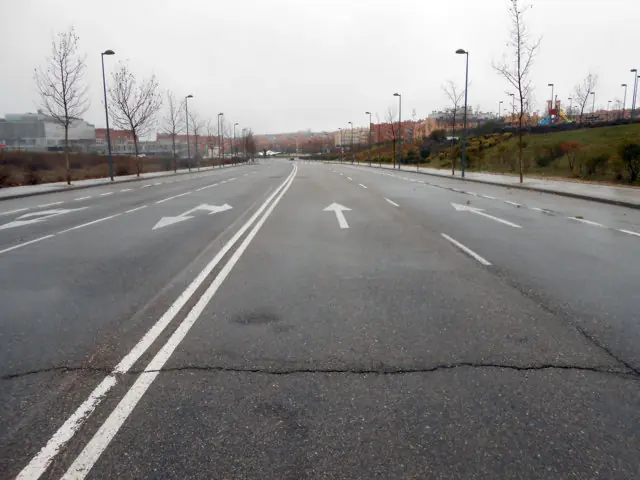
En una travesía de dos carriles para cada sentido, ¿puede circular por el carril izquierdo del sentido de su marcha para girar a la izquierda?
In a travesía (stretch of road through a town) with two lanes in each direction, may you drive in the left-hand lane of your direction to turn left?
- ASí, porque en la travesía se circula igual que en las vías urbanas.Yes, because in a travesía you drive the same way as on urban roads.
- BNo, porque en la travesía se debe circular siempre por la derecha.No, because in a travesía you must always drive on the right.
- CSolo si se va a adelantar, ya que la travesía es una vía interurbana.Only if you are going to overtake, because a travesía is an interurban road.
ExplanationA travesía is the stretch of road that passes through a built-up area, and there the lanes are used as on urban roads: with two or more lanes in each direction, you may drive in whichever lane best suits your destination. To turn left, you must move into the left-hand lane of your direction in good time.
¿Se podrá circular por el arcén de la izquierda en caso de emergencia?
May you drive on the left-hand hard shoulder in an emergency?
- ASí.Yes.
- BNo.No.
- CSí, pero solo en autopistas y autovías.Yes, but only on motorways (autopistas) and dual carriageways (autovías).
ExplanationWhen travelling at an abnormally low speed and seriously disrupting traffic, you must use the right-hand hard shoulder or the part of the carriageway that is strictly necessary.
En una calzada con dos sentidos y tres carriles, separados por marcas longitudinales discontinuas, ¿qué carril debe usar?
On a two-way carriageway with three lanes separated by broken longitudinal lines, which lane must you use?
- ADebe circular por el carril situado más a la derecha.You must drive in the right-hand lane.
- BDebe circular por el carril que más convenga a su destino.You must drive in the lane that best suits your destination.
- CDebe circular por el carril situado más a la derecha, y podrá utilizar el central únicamente para adelantar.You must drive in the right-hand lane and may use the centre lane only to overtake.
ExplanationUnder Article 30 of the General Traffic Regulations, on two-way carriageways with three lanes separated by broken lines, you drive in the right-hand lane. The centre lane is used for overtaking and also for turning left, which is why it is wrong to say it is only for overtaking.
¿Podrá circular un turismo con remolque por un carril en sentido contrario al habitual por motivo de obras?
May a car with a trailer use a lane in the opposite direction to usual because of roadworks?
- ASí.Yes.
- BNo, salvo que el remolque sea ligero.No, unless it is a light trailer.
- CNo.No.
ExplanationCars with a trailer may not use a lane in the opposite direction to usual when that lane has been opened to keep traffic flowing. They may do so when it is because of work on the carriageway (roadworks), so in this case the car could use that lane.
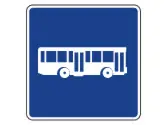
¿Se podrá circular por el carril bus?
May you drive in the bus lane?
- ASí, cuando el vehículo circule ocupado por un número mínimo de personas.Yes, when the vehicle carries a minimum number of people.
- BSí, circulando a velocidad anormalmente reducida.Yes, when driving at an abnormally low speed.
- CNo.No.
ExplanationSign S-51a shows a lane reserved for the vehicles whose symbol appears on it, here buses. Other vehicles may not drive in it, even if they carry several occupants or are going slowly; they may only cross it at the broken line for manoeuvres such as turning.
¿Una furgoneta de hasta 3500 kg podrá utilizar un carril VAO?
Can a van of up to 3,500 kg use an HOV lane (VAO)?
- ANo.No.
- BSí, si va ocupada por un número mínimo de personas.Yes, if it carries a minimum number of people.
- CNo, por un carril VAO solo pueden circular los turismos.No, only cars can use an HOV lane.
ExplanationUse of the HOV lane (VAO) is limited to motorcycles, cars and convertible dual-purpose vehicles. It is prohibited for all other vehicles.

En una autovía, ¿está permitido que un peatón haga autostop?
On a dual carriageway (autovía), may a pedestrian hitchhike?
- ASí.Yes.
- BSí, si está transitando por el arcén de la derecha.Yes, if they are walking on the right-hand hard shoulder.
- CNo.No.
ExplanationUnder Article 125.1 of the General Traffic Regulations (RGC), as worded by RD 518/2026, pedestrians may not walk on motorways or dual carriageways, except in the cases in Article 130, and may not ask for lifts on any part of them, including the areas at toll stations.
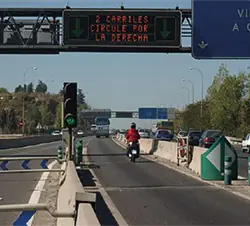
¿Está permitido que las motocicletas circulen por un carril reservado para vehículos con alta ocupación (VAO)?
Are motorcycles allowed to use a lane reserved for high-occupancy vehicles (VAO)?
- ANo.No.
- BSolo si lleva algún ocupante, además del conductor.Only if there is at least one occupant besides the rider.
- CSí.Yes.
ExplanationMotorcycles may use HOV lanes (VAO) even when only the rider is on board: the rules expressly allow them, together with motor cars that meet the minimum required occupancy.
¿Tienen los peatones los mismos derechos que los conductores para usar las vías públicas?
Do pedestrians have the same rights as drivers to use public roads?
- ASólo en las calles residenciales.Only in residential streets.
- BSí.Yes.
- CNo.No.
ExplanationPedestrians are road users with the same right to use the road as drivers, although each must use the area meant for them and follow its rules. That is why drivers must respect them and take extra care with them, especially with children, older people and people with disabilities.
Si circulamos por una autopista urbana, ¿qué carril usaremos normalmente?
If we are driving on an urban motorway (autopista), which lane do we normally use?
- AEl carril que mejor convenga a nuestro destino.The lane that best suits our destination.
- BEl carril de la derecha.The right-hand lane.
- CCualquier carril a condición de no molestar a otros vehículos que circulen más rápidos.Any lane, as long as we do not disturb faster vehicles.
ExplanationOn an urban motorway (autopista) inside a built-up area, we apply the same rule as on motorways outside built-up areas: we must normally drive in the right-hand lane.
El conductor de un turismo, ¿debe facilitar la incorporación a un ciclista que se incorpora por el carril de aceleración de una autovía?
Must a car driver make it easier for a cyclist to join a dual carriageway (autovía) from the acceleration lane?
- ASí.Yes.
- BUn ciclista no puede circular por autovía.A cyclist cannot ride on a dual carriageway (autovía).
- CNo.No.
ExplanationCyclists over 14 may ride on the hard shoulder of dual carriageways (autovías) and can therefore join them from the acceleration lane. Under the General Traffic Regulations, other drivers must, as far as possible, make it easier for them to join.
Un vehículo mixto en el que sólo viaja el conductor, ¿puede en algún caso circular por un carril VAO?
May a mixed-use vehicle with only the driver on board ever use a HOV lane (VAO)?
- ASí, si es conductor novel.Yes, if the driver is a novice driver.
- BSí, si lleva la señal de minusválido.Yes, if it displays the disabled badge.
- CNo, tiene que estar ocupado por cierto número de personas.No, it must carry a certain number of people.
ExplanationA mixed-use vehicle may use a HOV lane (VAO) with only the driver on board if it displays the disabled badge.
¿Cuándo y dónde debemos observar y asegurarnos que podemos incorporarnos a la autopista si accedemos a ella por un carril de aceleración?
When and where must we look and make sure we can join the motorway (autopista) if we enter it by an acceleration lane?
- AAl final del carril de aceleración.At the end of the acceleration lane.
- BAl principio del carril de aceleración.At the beginning of the acceleration lane.
- CCuando lo creamos conveniente.When we think it appropriate.
ExplanationWhen joining the motorway (autopista), we must look at the beginning of the acceleration lane and stop if it is not possible to join at that moment.
¿En algún caso los ciclomotores podrán circular en columna de a dos?
Can mopeds ever ride two abreast?
- ANo, está prohibido que circulen en posición paralela.No, they may not ride side by side.
- BSí, por el arcén, cuando sea transitable y suficiente.Yes, on the hard shoulder, when it is usable and wide enough.
- CSí, por la calzada, cuando no exista arcén.Yes, on the carriageway, when there is no hard shoulder.
ExplanationAccording to Article 36.2 of the General Traffic Regulations (RGC), as worded by Royal Decree 518/2026, vehicles that must use the hard shoulder, including mopeds, may not ride side by side. Only bicycles may ride two abreast. The old exception that allowed mopeds to ride two abreast on the hard shoulder no longer exists.
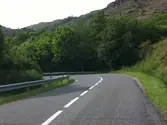
Si tiene que empujar a pie un ciclomotor de dos ruedas por una vía interurbana sin arcén, ¿por dónde circulará?
If you have to push a two-wheeled moped on foot along a road outside built-up areas that has no hard shoulder, where should you go?
- AEn este caso no se puede circular.In this case you may not use the road.
- BPor el lado izquierdo, como los peatones.On the left-hand side, like pedestrians.
- CPor el lado derecho de la calzada.On the right-hand side of the carriageway.
ExplanationUnder Article 122.2 of the General Traffic Regulations (RGC) (as worded by RD 518/2026), anyone pushing or pulling a cycle, a two-wheeled moped or a personal mobility vehicle must always keep to the right. If there is no hard shoulder, they must use the carriageway, keeping as close as possible to its outer edge.
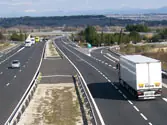
Si se ve obligado a inmovilizar su vehículo en una autopista, ¿puede hacerlo en la mediana?
If you have to bring your vehicle to a standstill on a motorway (autopista), may you do so on the central reservation?
- ANo, sólo es posible hacerlo en el lado derecho, aunque ocupe parte de la calzada.No, it can only be done on the right, even if this means taking up part of the carriageway.
- BSí, cuando no haya otra posibilidad.Yes, when there is no other option.
- CNo, hay que continuar hasta el área de descanso más próxima.No, you must carry on to the nearest rest area.
ExplanationVehicles that have had an accident or breakdown but can continue must do so immediately, making sure they drive safely. If they need assistance, they must leave the traffic lanes as soon as possible and head for the first available exit, using the right-hand hard shoulder. If this is not possible, they must stop on the right-hand hard shoulder of the road or wherever they cause the least obstruction to traffic.
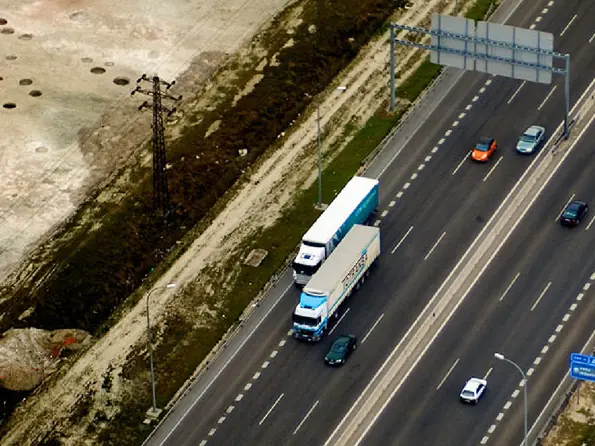
Esta autopista tiene 3 carriles para cada sentido. ¿Qué carril debe elegir un turismo para circular?
This motorway (autopista) has 3 lanes in each direction. Which lane should a car use?
- AEl carril del centro. Para que otros vehículos puedan incorporarse por la derecha.The centre lane, so that other vehicles can join from the right.
- BCualquier carril, siempre que sea el que le convenga para ir a su destino.Any lane, as long as it is the one that best suits its destination.
- CEl carril derecho.The right-hand lane.
ExplanationOutside built-up areas, on carriageways with several lanes in the same direction, you normally drive in the right-hand lane. The other lanes are used when traffic conditions make it advisable, for example to overtake, without obstructing those behind (Article 31 of the General Traffic Regulations, RGC).
Si queremos abandonar la autopista por el próximo carril de deceleración, ¿dónde nos colocaremos?
If we want to leave the motorway (autopista) by the next deceleration lane, where should we position ourselves?
- AEn el carril central.In the centre lane.
- BEn el carril de la derecha.In the right-hand lane.
- CEn el carril más próximo a la salida.In the lane closest to the exit.
ExplanationThe deceleration lane is normally on the right, but it can also be on the left. In that case, we should move into the left-hand lane.
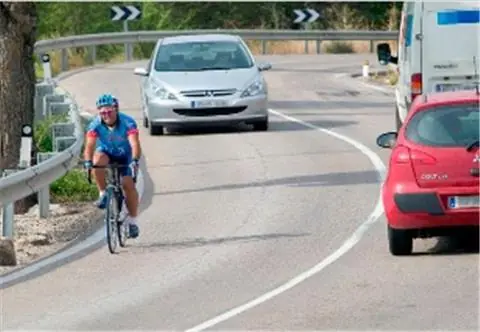
¿Qué debe tener en cuenta cuando circule con su vehículo por una vía urbana cerca de un ciclista?
What must you bear in mind when driving your vehicle on an urban road near a cyclist?
- AQue la bicicleta es un vehículo frágil y vulnerable.That a bicycle is a fragile and vulnerable vehicle.
- BQue el ciclista no debe circular por la calzada.That the cyclist must not ride on the carriageway.
- CQue por seguridad, le está permitido adelantarle a una velocidad superior a la permitida.That, for safety, you are allowed to overtake them at more than the speed limit.
ExplanationA cyclist is a vulnerable road user: the bicycle gives no protection in a collision. Cyclists may ride on the carriageway, and you must keep at least 5 metres behind them in a built-up area and leave a lateral clearance of 1.5 metres when overtaking them. You may never exceed the speed limit to overtake them.
¿Podrá un ciclomotor circular por una carretera que no esté provista de arcén?
May a moped be ridden on a road that has no hard shoulder?
- ASí.Yes.
- BNo.No.
- CSí, pero solo durante el día.Yes, but only during the day.
ExplanationIf the road has no hard shoulder, the moped must use the part of the carriageway that is strictly necessary.
Fuera de la parte transitable del arcén...
Off the passable part of the hard shoulder...
- AEstá permitido parar, pero no estacionar.stopping is allowed, but not parking.
- BEstá permitido estacionar pero no parar.parking is allowed, but not stopping.
- CEstá permitido parar y estacionar, si no provocamos peligro por falta de visibilidad.stopping and parking are allowed, if we do not cause danger by blocking visibility.
ExplanationOff the passable part of the hard shoulder, you may both stop and park, as long as the vehicle does not block other drivers' view.
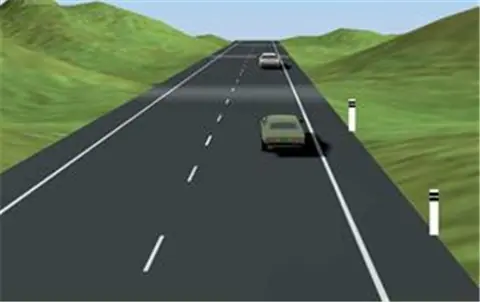
Como norma general, ¿cuál es la parte de la carretera destinada a la circulación de turismos?
As a general rule, which part of the road is intended for cars to drive on?
- ALa mediana.The central reservation.
- BLa calzada.The carriageway.
- CLos carriles y arcenes.The lanes and hard shoulders.
ExplanationThe carriageway is the part of the road intended for vehicles to drive on, and it is divided into lanes. Hard shoulders are not intended for cars except in emergencies, and the central reservation separates the carriageways.
En una calzada con tres carriles y doble sentido de circulación, que esten delimitados por marcas longitudinales discontinuas, si quiere girar a la izquierda en que carril debe situarse ....
On a two-way carriageway with three lanes separated by broken longitudinal lines, which lane must you move into if you want to turn left?
- AEl carril más situado a la izquierda.The left-hand lane.
- BEl carril central.The centre lane.
- CEl carril más situado a la derecha.The right-hand lane.
ExplanationOn a two-way carriageway with three lanes separated by broken lines, the centre lane is used only for overtaking and for turning left, and the left-hand lane is never used (Article 30 of the General Traffic Regulations). To turn left you must move into the centre lane.
¿Una motocicleta con remolque podrá circular por un carril VAO?
Can a motorcycle towing a trailer use an HOV lane (VAO)?
- ASí, si el remolque es ligero.Yes, if the trailer is light.
- BSí, si va ocupada por dos personas.Yes, if two people are riding it.
- CNo.No.
ExplanationVehicles towing a trailer may not use an HOV lane (VAO).
Circula con su motocicleta por una autopista o autovía donde la circulación está detenida por congestión, ¿puede utilizar el arcén derecho?
You are riding your motorcycle on a motorway (autopista) or dual carriageway (autovía) where traffic is at a standstill because of congestion. Can you use the right-hand hard shoulder?
- ASolo en los tramos habilitados y señalizados para ello.Only on stretches enabled and signed for this.
- BSí, en cualquier tramo, si la motocicleta es de dos ruedas.Yes, on any stretch, if the motorcycle has two wheels.
- CSí, en cualquier tramo, si conduce a velocidad muy reducida.Yes, on any stretch, if you ride at a very low speed.
ExplanationUnder Article 36.3 of the General Traffic Regulations (as worded by RD 518/2026), extraordinary use of the right-hand hard shoulder by motorcycles may be allowed only on stretches agreed in advance and marked with vertical signs and road markings, when traffic in the lanes is at a standstill because of congestion. Speed is limited to 30 km/h and you ride in single file.
Un ciclista circula por una vía que carece de arcén transitable. ¿Por dónde debe circular?
A cyclist is riding on a road that has no usable hard shoulder. Where must they ride?
- APor la calzada, pero solo debe ir pegado al borde derecho cuando le adelanta un vehículo.On the carriageway, but they only have to keep close to the right-hand edge when a vehicle is overtaking them.
- BPor la parte imprescindible de la calzada, lo más cerca posible de su borde derecho.On the part of the carriageway that is strictly necessary, as close as possible to its right-hand edge.
- CPor el arcén, aunque no sea transitable, para no ocupar la calzada.On the hard shoulder, even if it is not usable, so as not to take up the carriageway.
ExplanationAccording to Article 36.1 of the General Traffic Regulations, cyclists must ride on the hard shoulder on their right if it is usable and wide enough. If it is not, they use the part of the carriageway that is strictly necessary, as close as possible to its right-hand edge (Article 29.1), whether or not they are being overtaken.
En una calle urbana con un carril en cada sentido, debe circular...
On an urban street with one lane in each direction, you must drive...
- Alo más cerca posible del lado derecho de la vía.as close as possible to the right-hand side of the road.
- Ben la zona que más convenga.in whichever area suits you best.
- Cen el centro de la calzada, en tramos rectos.in the middle of the carriageway, on straight stretches.
ExplanationUnder Article 29.1 of the General Traffic Regulations, as a general rule vehicles keep to the right and as close as possible to the edge of the carriageway, leaving enough side clearance to pass oncoming vehicles safely. This also applies on a street with only one lane in each direction.
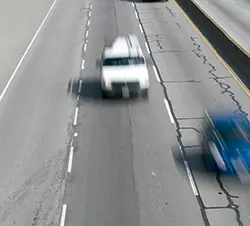
En una autopista con tres carriles para el mismo sentido, normalmente, ¿cuál debe utilizar?
On a motorway (autopista) with three lanes in the same direction, which one should you normally use?
- ACualquiera de ellos.Any of them.
- BEl central o el derecho, indistintamente.The centre or the right lane, either one.
- CEl derecho.The right lane.
ExplanationThe general rule requires you to drive in the right lane, even if there are several in the same direction; the others are used to overtake or when traffic conditions make it advisable.
Si tiene que inmovilizar su vehículo en una autopista, ¿puede hacerlo en la mediana?
If you have to bring your vehicle to a standstill on a motorway (autopista), may you do so on the central reservation?
- ANo. Debe dirigirse a la primera salida por el arcén derecho y, si no puede, detenerse en el arcén derecho.No. You must head for the first exit using the right-hand hard shoulder and, if you cannot, stop on the right-hand hard shoulder.
- BSí, si no hay otra opción.Yes, if there is no other option.
- CSí, siempre que active la señal de emergencia.Yes, as long as you switch on the hazard warning lights.
ExplanationA broken-down vehicle that needs assistance must leave the traffic lanes as soon as possible and head for the first exit using the right-hand hard shoulder; if this is not possible, it stops on the right-hand hard shoulder (Article 130.2 of the General Traffic Regulations). Stopping on the central reservation seriously obstructs traffic (Article 91.2.e).
All topics
- Definitions
- Documents and penalty points
- The driver's condition
- Duties of drivers and pedestrians
- Vehicle safety devices
- Vehicle controls and equipment
- Vehicle lights and horn
- Traffic signs, markings and signals
- Speed and distances
- Manoeuvres
- Right of way
- Carrying passengers and loads
- Driving safely in difficult conditions
- Vehicle mechanics and maintenance
- Road accidents and first aid
- Defensive and eco-driving
Independent app: not affiliated with or endorsed by the DGT (Spain's Directorate-General for Traffic) or the Ministry of the Interior. The official exam is booked with the DGT and taken at its test centres. The questions here are practice material; the DGT's official question bank is not public.
Basado en datos de la Agencia Estatal Boletín Oficial del Estado (https://www.boe.es). Textos consolidados de carácter meramente informativo. La AEBOE no patrocina ni respalda este sitio.
Parte de las preguntas procede de los tests de la revista «Tráfico y Seguridad Vial» de la DGT, reproducidos con indicación de la fuente.