
DGT test · 539 questions
Vehicle mechanics and maintenance · Page 3 of 11
Engine, brakes, steering, suspension and tyres: how they work and what maintenance prevents breakdowns and crashes.
Questions in this topic, with answers
539 questions, 50 per page, with the correct answer and the explanation. Page 3 of 11.
¿Podremos usar el motor del vehículo como freno?
May we use the vehicle's engine as a brake?
- ANo, el motor únicamente impulsa el vehículo.No, the engine only drives the vehicle forward.
- BSí.Yes.
- CSolo en vehículos con cambio automático.Only in vehicles with an automatic gearbox.
ExplanationWe may use the engine to get a braking effect. Low gears hold the vehicle back more than high gears.
Un turismo debe llevar las herramientas necesarias para...
A car must carry the tools needed to...
- Acambiar una rueda por la de repuesto.change a wheel for the spare one.
- Bhacer pequeñas reparaciones.carry out small repairs.
- Ccambiar mangueras, correas y bujías.change hoses, belts and spark plugs.
ExplanationCars must carry a full-size or temporary-use spare wheel with the tools needed to change it, or else an alternative system that ensures mobility (Annex XII of the General Vehicle Regulations). Tools for other repairs are not required.
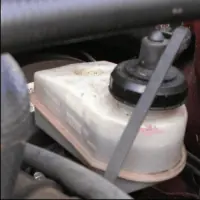
¿Dónde se encuentra situado el depósito de líquido de frenos?
Where is the brake fluid reservoir located?
- AEn el maleteroIn the boot
- BEn el cuadro de mandosIn the dashboard
- CBajo el capóUnder the bonnet
ExplanationThe reservoir holding the brake fluid of a vehicle such as a car is located under the bonnet, in an accessible place so that the owner can top it up and check its condition when necessary.
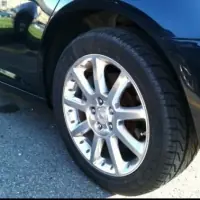
¿En qué tipo de pavimento se adherirán mejor los neumáticos?
On what type of road surface will tyres grip best?
- ACalzada con gravillaCarriageway with loose gravel
- BCalzada con manchas de grasaCarriageway with patches of grease
- CCalzada limpiaClean carriageway
ExplanationTyre grip will always be better on flexible, rigid or rough surfaces than on polished surfaces. Roads in good condition that are dry and clean also give more grip than uneven or icy roads or roads with loose gravel, for example.
¿A que sistema pertenece el combustible en un vehículo?
Which system does the fuel in a vehicle belong to?
- AAl de alimentación.The fuel supply system.
- BAl de lubricación.The lubrication system.
- CAl de suspensión.The suspension system.
ExplanationThe fuel in a vehicle belongs to the fuel supply system. This system supplies fuel from the tank to the engine, where it is mixed with air for combustion. It includes parts such as the fuel pump, the fuel filter, the injectors and the air intake system. Its main job is to give the engine the right amount of fuel for the driving conditions, so that it runs efficiently and correctly.
¿Intervienen los neumáticos en la suspensión?
Do tyres play a part in the suspension?
- ASí sólo si son neumáticos sin cámara (tubeless).Yes, but only if they are tubeless tyres.
- BNo.No.
- CSí.Yes.
ExplanationTyres do play a part in the suspension: the air inside them and the flexibility of the rubber absorb some of the bumps in the road surface before they reach the shock absorbers and springs. This happens both with and without an inner tube.
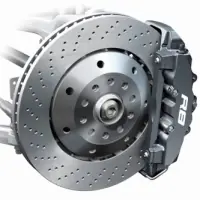
¿Qué puede provocar un calentamiento excesivo en el circuito de frenado?
What can cause excessive heating in the braking system?
- ALa presencia de aire en las canalizaciones de los frenos.Air in the brake lines.
- BLa fuga de líquido de frenos.A brake fluid leak.
- CEl roce prolongado de las pastillas o zapatas contra los discos o tambores.Prolonged rubbing of the pads or shoes against the discs or drums.
ExplanationBrakes overheat mainly because of prolonged rubbing of the pads against the discs or of the shoes against the drums, for example when braking continuously on a long downhill stretch. Air or a lack of fluid reduces braking efficiency, but does not heat the brakes.
Su motocicleta va equipada con ruedas de distintas dimensiones delante y detrás. En este caso, ¿qué repuestos deberá llevar?
Your motorcycle has wheels of different sizes at the front and rear. In this case, what spares must you carry?
- ADeberá llevar dos ruedas de repuesto, una para cada rueda.You must carry two spare wheels, one for each wheel.
- BEs suficiente llevar una rueda de repuesto para la rueda trasera.A spare wheel for the rear wheel is enough.
- CNo es obligatorio llevar ninguna rueda de repuesto.You do not have to carry any spare wheel.
ExplanationYou do not have to carry any spare wheel if your motorcycle has wheels of different sizes at the front and rear.
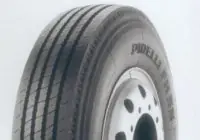
¿Cada cuanto debemos reviar la presión de los neumáticos?
How often should we check the tyre pressure?
- A2 veces al mes.Twice a month.
- BRegularmente y en caliente.Regularly and with the tyres hot.
- CRegularmente y en frío.Regularly and with the tyres cold.
ExplanationTyre pressure should be checked regularly, at least once a month and before long journeys, and always with the tyres cold. When they are hot the air expands and the pressure gauge shows more than the real pressure, which would lead you to leave the pressure too low.
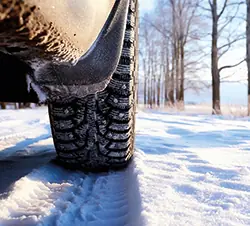
Si ha instalado en su vehículo neumáticos de invierno, ¿es conveniente sustituirlos cuando las temperaturas comiencen a ser más cálidas?
If you have fitted winter tyres to your vehicle, is it advisable to replace them when temperatures start to get warmer?
- ASí, porque cuando la temperatura es más cálida se desgastan con más rapidez.Yes, because they wear faster when the temperature is warmer.
- BNo, porque se adaptan progresivamente a los cambios de temperatura.No, because they gradually adapt to changes in temperature.
- CSí, porque en tiempo cálido disminuye considerablemente la distancia de frenado.Yes, because braking distance is considerably reduced in warm weather.
ExplanationThe rubber compound of winter tyres is designed for low temperatures: in the heat it softens and wears much faster, so it is advisable to replace them when the warm weather arrives.
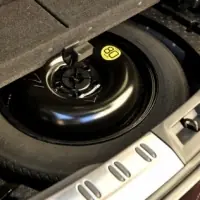
¿Qué suelen llevar algunos vehículos en vez de una rueda de repuesto?
What do some vehicles usually carry instead of a spare wheel?
- ARueda de metalA metal wheel
- BRueda con pinchazoA punctured wheel
- CRueda de emergenciaAn emergency wheel
ExplanationSome vehicles may carry, in the place where the spare wheel should be, an emergency wheel to be used if we have a puncture or another problem with our tyres that stops us from continuing. A punctured wheel should never be carried, because it would be useless in the event of a breakdown.
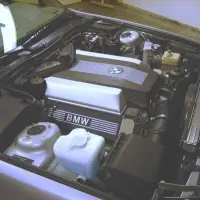
¿Para qué sirve el circuito de carga de la batería de un vehículo?
What is a vehicle's battery charging circuit for?
- AProducir corriente contínuaTo produce direct current
- BEvitar que la batería se descargue rápidamenteTo stop the battery from running down quickly
- CCargar el cárter con corriente eléctricaTo charge the sump with electric current
ExplanationThe battery would run down in little more than an hour from the use of the car's various electrical devices. To prevent this, the vehicle has a charging system, which puts back into the battery the energy used, by means of a generator (alternator or dynamo) driven by the crankshaft.
Circular con los neumáticos deshinchados, ¿qué efecto produce?
What is the effect of driving with under-inflated tyres?
- AEl vehículo consume menos combustible.The vehicle uses less fuel.
- BEl vehículo consume más combustible.The vehicle uses more fuel.
- CEl vehículo tiene más adherencia a la calzada.The vehicle has more grip on the road.
ExplanationUnder-inflated tyres have a larger contact area with the ground and there is more friction with the road surface, so fuel consumption will increase.
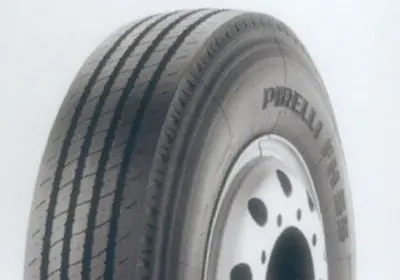
El estado de los neumáticos del vehículo es un factor que influye de manera decisiva en...
The condition of the vehicle's tyres is a factor that has a decisive effect on...
- ALa distancia de frenado.The braking distance.
- BLa distancia recorrida durante el tiempo de reacción.The distance travelled during the reaction time.
- CAmbas contestaciones son correctas.Both answers are correct.
ExplanationThe condition of the tyres has a decisive effect on grip and therefore on braking distance. The distance travelled during the reaction time depends on the driver and on the speed, not on the tyres.
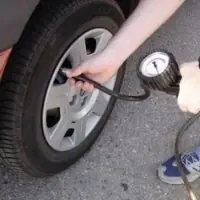
Cuando la presión de inflado de los neumáticos es inferior a la recomendada...
When the tyre pressure is lower than recommended...
- Ael vehículo consume menos combustible.the vehicle uses less fuel.
- Bla presión de inflado no afecta al consumo de combustible.tyre pressure does not affect fuel consumption.
- Cel vehículo consume más combustible.the vehicle uses more fuel.
ExplanationWith a pressure lower than recommended, the tyre flexes more and the area in contact with the ground and the rolling resistance increase, so the vehicle uses more fuel. The tyre also wears out sooner and stability gets worse.
Si el neumático se desgasta más por el centro de la banda de rodadura, ¿cuál podría ser la causa?
If a tyre wears more in the centre of the tread, what could be the cause?
- APresión insuficiente en los neumáticos.Too little pressure in the tyres.
- BPresión excesiva en los neumáticos.Too much pressure in the tyres.
- CAlineación incorrecta de las ruedas.Incorrect wheel alignment.
ExplanationThe correct answer is too much tyre pressure. According to the rules, significant wear in the centre of the tread shows that the tyre pressure is too high. This happens because when tyres are over-inflated, the contact area with the ground is reduced, which causes more wear in the centre of the tyre. This not only shortens the life of the tyre but can also put the vehicle's safety at risk, because it affects grip and handling. This is linked to the minimum requirements for tyre use set out in the Traffic and Road Safety Code.
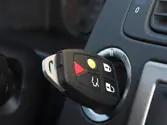
Cuando al accionar la llave de contacto el motor de arranque no gira y las luces tienden a extinguirse, ¿a qué puede ser debido?
When you turn the ignition key, the starter motor does not turn and the lights tend to go out. What could be the cause?
- ALa batería tiene poca carga.The battery is low.
- BLa correa del ventilador está destensada.The fan belt is loose.
- CFalta de líquido de refrigeración.Lack of coolant.
ExplanationWhen you try to start the engine, the battery gives a very strong discharge of electrical energy. So if the battery is low, when starting it will seem to run out for a moment and the vehicle's lights will tend to go out.
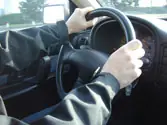
Un vehículo con dirección asistida, ¿requiere algún mantenimiento especial?
Does a vehicle with power steering need any special maintenance?
- ANo.No.
- BSí, revisaremos periódicamente el nivel de líquido de la dirección.Yes, we will regularly check the steering fluid level.
- CSi, engrasar el volante anualmente.Yes, grease the steering wheel once a year.
ExplanationIf the power steering works with a hydraulic system, it will have a reservoir with special steering fluid and maximum and minimum level marks. We must regularly check that this fluid level is correct.
¿Intervienen los neumáticos en la frenada?
Do tyres play a part in braking?
- Así y en la suspensión.Yes, and in the suspension.
- BNo.No.
- CSí, pero no intervienen en la suspensión.Yes, but they play no part in the suspension.
ExplanationYes. Tyres are the vehicle's only contact with the ground, so the effectiveness of braking depends on their condition; also, because they are flexible and contain air, they absorb some of the bumps and work together with the suspension.
¿Qué presión deben tener los neumáticos?
What pressure should the tyres have?
- AEs recomendable que tengan diferente presión en cada eje.It is advisable for them to have a different pressure on each axle.
- BLos neumáticos deben llevar la presión más alta recomendada por el fabricante.The tyres must have the highest pressure recommended by the manufacturer.
- CLos neumáticos deben llevar siempre la presión recomendada por el fabricante.The tyres must always have the pressure recommended by the manufacturer.
ExplanationTyres must always have the pressure recommended by the manufacturer, as set out in the General Traffic Regulations. This rule is essential for safety, vehicle performance and fuel efficiency. The wrong tyre pressure can cause uneven wear, less grip on the road surface and, in extreme cases, a blowout, which increases the risk of accidents.
Para un buen mantenimiento del sistema de frenado, deberá…
To maintain the braking system well, you should...
- APisar de vez en cuando el pedal del freno, para comprobar su eficacia.Press the brake pedal from time to time to check how well it works.
- BComprobar periódicamente el nivel del liquido de frenos, revisar el estado de los latiguillos y sustituir las zapatas o pastillas si producen chirridos o ruidos metatices.Regularly check the brake fluid level, check the condition of the brake hoses and replace the brake shoes or pads if they squeak or make metallic noises.
- CNada, los sistemas de frenado actuales, no requieren mantenimiento alguno.Nothing, modern braking systems need no maintenance at all.
ExplanationTo maintain your vehicle's braking system well, you should check, among other things, the brake fluid level, keeping it at the maximum mark; check that the brake hoses and other lines are not leaking; and change the braking parts when necessary.
¿Cuál es la profundidad mínima legal del dibujo de la banda de rodadura de los neumáticos?
What is the legal minimum tyre tread depth?
- A0,8 milímetros.0.8 millimetres.
- B1,6 milímetros.1.6 millimetres.
- C3,2 milímetros.3.2 millimetres.
ExplanationThe legal minimum tyre tread depth is 1.6 mm.
A parte de revisar periódicamente el nivel de líquido de frenos, ¿deberemos sustituirlo completamente?
Apart from checking the brake fluid level regularly, should we replace it completely?
- ANo, el líquido de frenos nunca deberá sustituirse.No, brake fluid should never be replaced.
- BSí, deberá sustituirse completamente en los plazos indicados por el fabricante del vehículo.Yes, it should be replaced completely at the intervals set by the vehicle manufacturer.
- CNo, simplemente añadiremos líquido si observamos que el nivel ha bajado.No, we will just add fluid if we see that the level has dropped.
ExplanationWe will check the brake fluid level often and replace it completely at the intervals set by the vehicle manufacturer.
¿Pueden los Agentes de la Circulación obligar a un conductor a que sus neumáticos lleven cadenas?
Can traffic officers make a driver fit snow chains to their tyres?
- ANo, es opcional poner las cadenas y nunca obligatorio.No, fitting chains is optional and never compulsory.
- BSí, si las condiciones atmosféricas así lo requieren.Yes, if the weather conditions require it.
- CÚnicamente los policías locales nos podrán obligar.Only local police officers can make us do so.
ExplanationIn bad weather, such as heavy snow, officers of the authority can require us to fit the necessary chains to our tyres so that we can drive safely without our vehicle skidding.
Como norma general, ¿qué neumático de la motocicleta sufre un mayor desgaste durante la conducción?
As a general rule, which motorcycle tyre wears more while riding?
- ALos dos neumáticos se desgastarán siempre de igual manera.Both tyres will always wear in the same way.
- BEl trasero.The rear one.
- CEl delantero.The front one.
ExplanationThe rear tyre of a motorcycle transmits the engine's power to the road and carries most of the weight of the rider, the passenger and the load. That is why, as a general rule, it wears out before the front one and should be checked more often.
Si los neumáticos del vehículo se desgastan irregularmente puede ser...
If the vehicle's tyres wear unevenly, this may be...
- Aporque la suspensión o la amortiguación estén en malas condiciones.because the suspension or the shock absorbers are in poor condition.
- BÚnicamente porque la suspensión esté en malas condiciones.Only because the suspension is in poor condition.
- CÚnicamente porque la amortiguación esté en malas condiciones.Only because the shock absorbers are in poor condition.
ExplanationUneven tyre wear may be caused by suspension or shock absorbers in poor condition, and also by bad wheel alignment or balancing. So it cannot be put down to just one of those causes.
Debe cambiar los neumáticos de su vehículo ....
You must change your vehicle's tyres…
- AAl menos cada 10 años.At least every 10 years.
- BCada 5 años si no tienen dibujo suficiente.Every 5 years if they do not have enough tread.
- CAl menos cada 5 años.At least every 5 years.
ExplanationThe rubber of tyres ages and loses its properties over time even if the tread looks sufficient, which is why the DGT recommends changing them at least every five years. If the tread falls below 1.6 mm before then, or there are cuts, they must be replaced without waiting that long.
¿Los neumáticos del vehículo caducan?
Do a vehicle's tyres expire?
- ANo, solo se desgastan con el uso.No, they only wear with use.
- BSí, aunque no se usen debemos cambiarlos como máximo a los 5 años.Yes, even if they are not used, we must change them after 5 years at the most.
- CSí, caducan a los 3 años.Yes, they expire after 3 years.
ExplanationTyre rubber hardens over time and loses grip, so we must change the tyres every 5 years at the most.
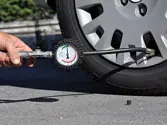
Si el neumático de nuestro vehículo tiene más presión que la recomendada por el fabricante...
If our vehicle's tyre has more pressure than the manufacturer recommends...
- Atendrá mayor adherencia.it will have more grip.
- Btendrá menor adherenciait will have less grip.
- Ccircularemos mejor y con mayor confort.we will drive better and more comfortably.
ExplanationTyre pressure must always be the one recommended by the manufacturer. If we have more pressure than recommended, the tyre will have less grip.
¿Qué tipo de neumático retiene más tiempo el aire en su interior después de haber sufrido un pinchazo?
Which type of tyre keeps the air inside for longer after a puncture?
- AEl regroovable "regravable", con cámara.The regroovable tyre, with an inner tube.
- BEl provisto de cámara.The tyre with an inner tube.
- CEl tubeless "sin cámara".The tubeless tyre.
ExplanationThe tubeless tyre keeps the air inside for longer after a puncture because it has no inner tube that can lose air. Instead, the air is sealed directly inside the tyre, which helps to prevent air leaks in case of a puncture.
Como norma general, ¿qué presión de inflado debe Ud. dar a la rueda de repuesto de su turismo?
As a general rule, what pressure should you inflate your car's spare wheel to?
- ALa más alta de las fijadas por el fabricante.The highest of the pressures set by the manufacturer.
- BLa recomendada por el fabricante para el resto de las ruedas.The pressure recommended by the manufacturer for the other wheels.
- CLa más baja de las fijadas por el fabricante.The lowest of the pressures set by the manufacturer.
ExplanationThe spare wheel should be inflated to the highest pressure recommended by the manufacturer, because this makes sure the wheel performs at its best if it has to be used. A spare wheel with the right pressure gives better grip on the ground and more safety when driving, especially in emergencies.
Si el aceite está caliente y circula con cierta presión, ¿cómo sabremos que la lubricación es correcta?
If the oil is hot and circulating at a certain pressure, how will we know that the lubrication is correct?
- APorque el testigo de presión del aceite estará apagado.Because the oil pressure warning light will be off.
- BPorque el testigo de presión del aceite estará encendido.Because the oil pressure warning light will be on.
- CPorque al quitar el tapón de la culata con el motor parado sale humo.Because smoke comes out when you remove the cap on the cylinder head with the engine stopped.
ExplanationThe correct answer is that the warning light will be off, because an oil pressure light that is off shows that the oil pressure is normal and the engine is properly lubricated. This is essential for the engine to run safely, as the hot oil is circulating properly and giving the lubrication needed to prevent wear and damage to the parts. According to the General Traffic Regulations, the engine and its parts must be in satisfactory mechanical condition to ensure safety.
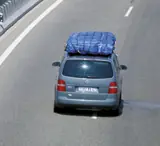
¿Puede afectar la carga excesiva del vehículo al correcto funcionamiento de los neumáticos?
Can overloading the vehicle affect how well the tyres work?
- ANo, en ningún caso.No, never.
- BSí, cuando se excede de los límites de carga permitidos.Yes, when the permitted load limits are exceeded.
- CNo, si el vehículo lleva amortiguadores nuevos.No, if the vehicle has new shock absorbers.
ExplanationTyres are made to carry the maximum load the vehicle may transport at the speed given in the speed code. This is especially relevant for professional drivers and is shown on the tyre by a number code. If we load the vehicle above its maximum authorised mass (MAM), the tyres will not work properly and this can lead to an accident.
Si un neumático presenta un desgaste irregular (más gastado por un lado):
If a tyre shows uneven wear (more worn on one side):
- ANo tiene importancia mientras tenga dibujo.It does not matter as long as it has tread.
- BSuele indicar un problema de presión, alineación o suspensión que conviene revisar.It usually shows a pressure, alignment or suspension problem that should be checked.
- CSignifica que el neumático es nuevo.It means the tyre is new.
ExplanationUneven wear warns of problems with pressure, alignment (tracking) or suspension: it needs to be checked.
Si Ud. observa que los neumáticos de su vehículo se han desgastado prematuramente, ello puede ser debido a que...
If you notice that your vehicle's tyres have worn out too early, this may be because...
- ALas ruedas estén desequilibradas.The wheels are unbalanced.
- BEstán poco inflados y que el desgaste se ha producido en el centro de la banda de rodamiento.They are under-inflated and the wear is in the centre of the tread.
- CEstán excesivamente inflados y el desgaste se ha producido en los laterales de la banda de rodamiento.They are over-inflated and the wear is at the sides of the tread.
ExplanationUnbalanced wheels can cause uneven tyre wear. This happens because the vehicle's weight is not spread evenly, so some parts of the tread wear faster than others. This kind of early wear is a clear sign that the wheels need balancing to get even wear and safer driving.
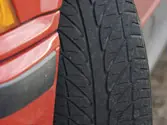
En vez de una rueda de repuesto, ¿se puede usar una rueda de uso temporal?
Can a temporary-use wheel be used instead of a spare wheel?
- ASí, pero solo en vía urbana.Yes, but only on urban roads.
- BSí, pero respetando sus propias limitaciones.Yes, but keeping to its own limits.
- CNo, porque está prohibido.No, because it is prohibited.
ExplanationThe spare wheel can be replaced by a temporary-use wheel or by an alternative system that gives enough guarantee that the vehicle can keep moving. A temporary-use wheel has its own limits, for example a maximum speed of 80 km/h and a maximum distance of 200 km.
¿Qué debe hacer si sufre un pinchazo durante la marcha?
What should you do if you get a puncture while driving?
- AFrenar bruscamenteBrake sharply
- BSujetar firmemente el volante, no frenar bruscamente y reducir velocidad gradualmenteHold the steering wheel firmly, do not brake sharply, and slow down gradually
- CApagar el motor inmediatamenteSwitch off the engine immediately
ExplanationIf you get a puncture: hold the steering wheel, do not brake sharply, slow down gradually.
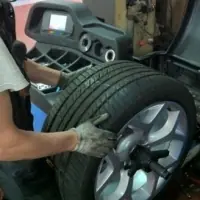
¿Qué ocurre cuando las ruedas están desequilibradas?
What happens when the wheels are unbalanced?
- ASe descargará la batería por el exceso de energíaThe battery will run down because of excess energy
- BSe pinchará la rueda más fácilmente originando un accidenteThe wheel will get a puncture more easily, causing an accident
- CVibrarán más y se desestabilizará la direcciónThey will vibrate more and the steering will become unstable
ExplanationThe rim and tyre together must be balanced around their axis of rotation. Wheels must turn in a perfect circle, because when the rim and tyre are not balanced, the wheel will vibrate strongly, which damages the suspension and stability.
El motor de combustión interna de un ciclomotor, ¿qué cilindrada máxima puede tener?
What is the maximum engine capacity of a moped's internal combustion engine?
- A75 centímetros cúbicos.75 cubic centimetres.
- B50 centímetros cúbicos.50 cubic centimetres.
- C125 centímetros cúbicos.125 cubic centimetres.
ExplanationThe correct answer is 50 cubic centimetres because, according to the definition of a three-wheeled moped, the internal combustion engine cannot have a capacity of more than 50 cm³.
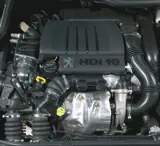
¿Cuál es la misión principal del líquido refrigerante?
What is the main job of the coolant?
- AQue el vehículo tenga calefacción.To give the vehicle heating.
- BQue el vehículo tenga aire acondicionado.To give the vehicle air conditioning.
- CEnfriar el motor del vehículo.To cool the vehicle's engine.
ExplanationCoolant circulates through the engine to absorb its heat and stop it from overheating; it also protects the circuit from freezing and corrosion. The heating uses this heat, but that is not its main job, and the air conditioning uses a different circuit.
¿Qué se debe tener en cuenta al usar una rueda de repuesto de uso temporal?
What must you keep in mind when using a temporary-use spare wheel?
- AQue debe llevar la presión más alta de las que habitualmente llevan las otras ruedas.That it must have a higher pressure than the other wheels normally have.
- BLa usaremos teniendo en cuenta sus condiciones particulares.We will use it taking its particular conditions into account.
- CQue puede utilizarse sin limitación de velocidad ni de distancia.That it can be used with no speed or distance limit.
ExplanationTemporary-use wheels must be used taking into account their particular conditions of maximum speed, pressure and mileage.
Un desgaste irregular de los neumáticos (más por un lado que por otro) puede indicar:
Uneven tyre wear (more on one side than the other) can indicate:
- AQue todo está perfecto.That everything is perfect.
- BUn problema de presión, alineación o suspensión que conviene revisar.A pressure, alignment or suspension problem that should be checked.
- CQue el neumático es nuevo.That the tyre is new.
ExplanationUneven wear is usually caused by incorrect pressure, bad alignment (tracking) or the suspension; it should be checked at a garage.
¿Qué característica es propia de los neumáticos "run flat"?
What is a feature of "run flat" tyres?
- AEstán fabricados con unos materiales que permiten circular con nieve sin necesidad de instalar cadenas.They are made of materials that allow you to drive on snow without fitting chains.
- BPermiten controlar el vehículo en caso de pinchazo y seguir circulando durante casi 100 kilómetros.They allow you to control the vehicle if you get a puncture and to keep driving for almost 100 kilometres.
- CTienen una banda de rodadura más estrecha de lo normal por lo que ofrecen mayor resistencia al asfalto.They have a narrower tread than normal, so they offer more resistance to the road surface.
ExplanationRun-flat tyres are designed to let you control the vehicle if you get a puncture and to keep driving for a limited distance, usually about 80-100 kilometres, at a maximum speed of about 80 km/h, depending on the model and the manufacturer's recommendations. This is possible thanks to their reinforced sidewalls, which can carry the vehicle's weight even when there is no air pressure. This allows the driver to reach a safe place or a garage without having to change the punctured tyre straight away.
¿Al accionar el freno de pie, sobre cuántas ruedas estamos actuando?
When you press the foot brake, how many wheels are you acting on?
- ASobre las ruedas delanteras.On the front wheels.
- BSobre las ruedas motrices.On the driving wheels.
- CSobre las cuatro ruedas.On all four wheels.
ExplanationThe foot brake (service brake) acts on all four wheels, putting more pressure on the front ones.
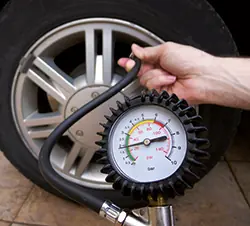
Si la presión de inflado en los neumáticos es inferior a la recomendada, ¿aumenta el consumo de combustible?
If the tyre pressure is lower than recommended, does fuel consumption increase?
- ASí, porque existe mayor rozamiento con el pavimento.Yes, because there is more friction with the road surface.
- BSí, y además el desgaste es mayor en el centro de la banda de rodamiento.Yes, and wear is also greater in the centre of the tread.
- CNo, siempre que estén compensadas las presiones entre todos los neumáticos del vehículo.No, as long as the pressures are equal in all the vehicle's tyres.
ExplanationWith less pressure the tyre flattens, the contact area and friction with the road surface increase, and the engine uses more fuel. Also, the wear is concentrated at the edges of the tread, not in the centre.
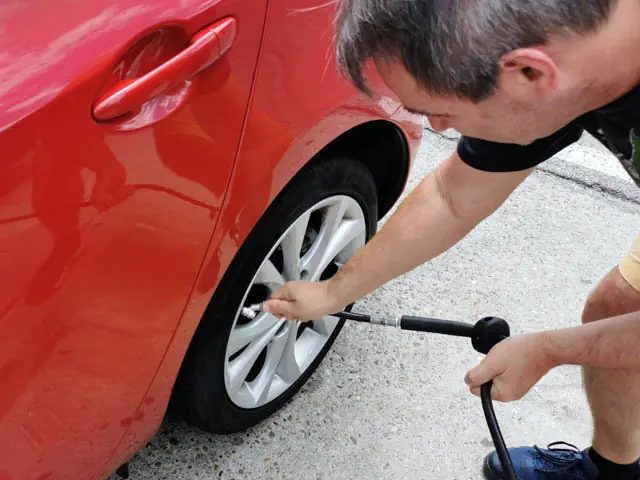
¿A qué presión de inflado se deben llevar los neumáticos de un vehículo?
What pressure should a vehicle's tyres be inflated to?
- AUn 15% por debajo de la recomendada por el fabricante del vehículo.15% below the pressure recommended by the vehicle manufacturer.
- BUn 10% por encima de la recomendada por el fabricante del vehículo.10% above the pressure recommended by the vehicle manufacturer.
- CA la recomendada en cada caso por el fabricante del vehículo.The pressure recommended in each case by the vehicle manufacturer.
ExplanationTyre pressure must be checked regularly, with the tyres cold and with a pressure gauge in good condition. It must be the pressure recommended by the manufacturer (the spare wheel should be given the highest pressure).
¿En una motocicleta es más eficaz el freno delantero o el trasero?
On a motorcycle, which brake is more effective, the front or the rear?
- AEl freno delantero.The front brake.
- BEl freno trasero.The rear brake.
- CLos dos por igual.Both equally.
ExplanationWhen braking, the motorcycle's weight shifts forwards and there is less pressure on the rear axle, so the rear wheel tends to lock if you brake sharply.
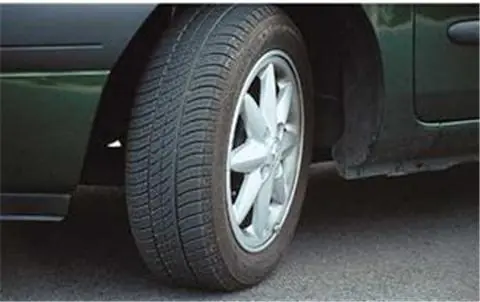
¿Qué indica la palabra "tubeless" escrita en el lateral del neumático?
What does the word "tubeless" written on the side of the tyre mean?
- AQue es un neumático adecuado para colocarlo en un autobús.That the tyre is suitable for fitting to a bus.
- BQue es un neumático preparado para ser montado sin cámara.That the tyre is designed to be fitted without an inner tube.
- CQue es un neumático adecuado para utilizarlo cuando la calzada tenga agua.That the tyre is suitable for use when there is water on the carriageway.
ExplanationThe word «tubeless» means that the tyre is designed to be fitted without an inner tube. These tyres lose air more slowly if they are punctured, so they are safer; it has nothing to do with buses or wet carriageways.
¿Cada cuánto tiempo es recomendable controlar la presión de inflado de los neumáticos?
How often is it advisable to check tyre pressure?
- ASólo cuando deba pasar la itv (inspección técnica de vehículos).Only when the vehicle has to pass the ITV (vehicle inspection).
- BUna vez al año.Once a year.
- CUna o dos veces al mes.Once or twice a month.
ExplanationTyre pressure must be checked regularly, once or twice a month, to make sure it is the one set by the manufacturer. This should be done with the tyres cold. Checking the pressure regularly helps us keep the tyres in good condition and stay safe when driving.
En un vehículo que dispone de servofreno, ¿qué ocurre si se para el motor?
In a vehicle with a brake servo, what happens if the engine stops?
- ANada, el servofreno es independiente del motor.Nothing, the brake servo works independently of the engine.
- BEl servofreno no funcionará.The brake servo will not work.
- CEl servofreno funcionará de manera más brusca.The brake servo will work more abruptly.
ExplanationThe brake servo works with the vacuum created by the intake manifold, so if the engine is stopped the brake servo does not work.
All topics
- Definitions
- Documents and penalty points
- The driver's condition
- Duties of drivers and pedestrians
- Vehicle safety devices
- Vehicle controls and equipment
- Vehicle lights and horn
- Traffic signs, markings and signals
- The road and its lanes
- Speed and distances
- Manoeuvres
- Right of way
- Carrying passengers and loads
- Driving safely in difficult conditions
- Road accidents and first aid
- Defensive and eco-driving
Independent app: not affiliated with or endorsed by the DGT (Spain's Directorate-General for Traffic) or the Ministry of the Interior. The official exam is booked with the DGT and taken at its test centres. The questions here are practice material; the DGT's official question bank is not public.
Basado en datos de la Agencia Estatal Boletín Oficial del Estado (https://www.boe.es). Textos consolidados de carácter meramente informativo. La AEBOE no patrocina ni respalda este sitio.
Parte de las preguntas procede de los tests de la revista «Tráfico y Seguridad Vial» de la DGT, reproducidos con indicación de la fuente.