
DGT test · 691 questions
Vehicle safety devices · Page 3 of 14
Seat belts, child restraints, helmets, head restraints and airbags: when they are compulsory, the exceptions and how to use them properly.
Questions in this topic, with answers
691 questions, 50 per page, with the correct answer and the explanation. Page 3 of 14.
¿Es recomendable usar los reposacabezas en todos los asientos de un coche?
Is it advisable to use the head restraints on all the seats of a car?
- ANo, pueden ser perjudiciales para la seguridad de los ocupantes.No, they can be harmful to the occupants' safety.
- BSí, puede evitar lesiones graves en la zona cervical.Yes, they can prevent serious neck injuries.
- CNo, son un elemento meramente decorativo.No, they are purely decorative.
ExplanationA head restraint properly adjusted to the height of the head and close to it limits the sudden backward movement of the neck in a crash, especially in rear-end collisions. In this way it prevents serious neck injuries, such as whiplash, to the occupants of all seats.
Si no lleva bien puesto el cinturón de seguridad, ¿puede empeorar las consecuencias de un accidente?
If you are not wearing the seat belt properly, can it make the consequences of an accident worse?
- ANo, el cinturón es siempre efectivo.No, the seat belt is always effective.
- BNo, si el vehículo dispone además de airbag.No, if the vehicle also has an airbag.
- CSí, porque puede provocar lesiones graves.Yes, because it can cause serious injuries.
ExplanationUnder Article 117 of the General Traffic Regulations (RGC), all vehicle occupants must wear a seat belt. It is designed to reduce injuries in an accident. If the seat belt is not worn correctly, its effectiveness is greatly reduced, which can lead to serious injuries in accidents, even if there is an airbag. Airbags are complementary and do not replace the need to wear a seat belt. So the correct statement is that not wearing the seat belt properly can affect the injuries caused by an accident.
Los menores de edad, ¿pueden viajar en los asientos delanteros de un turismo?
May minors travel in the front seats of a car?
- ASí, si su estatura es superior a 135 centímetros.Yes, if they are taller than 135 centimetres.
- BNo, nunca.No, never.
- CSí, cuando su edad sea superior a los 12 años.Yes, when they are over 12 years old.
ExplanationMinors who are 1.35 m tall or less must sit in the rear seats of the vehicle, always using an approved restraint system suited to their height and weight. There are three exceptions in which minors below that height may travel in the front seat: 1. When the vehicle has no rear seats. 2. When all the rear seats are already taken by minors in the same situation, so it is impossible to fit all the child seats needed at that moment. 3. When it is not possible to fit child restraint systems in those seats. When minors are taller than 1.35 m, they may sit in the front seat using the adult seat belt.
¿Es obligatorio el cinturón de seguridad en los asientos traseros?
Is the seat belt compulsory in the rear seats?
- ASolo para menoresOnly for minors
- BSí, para todos los ocupantesYes, for all occupants
- CNo es obligatorioIt is not compulsory
ExplanationThe seat belt is compulsory for all vehicle occupants, in both the front and the rear seats. Wearing it reduces the risk of death in an accident by up to 50%.
El conductor de un vehículo de reparto. ¿Cuándo puede conducir sin cinturón de seguridad?
The driver of a delivery vehicle: when may they drive without a seat belt?
- ACuando circule por una zona urbana y las entregas estén muy cerca unas de otras.When driving in an urban area and the deliveries are very close to each other.
- BSolo en las exenciones generales, como al hacer marcha atrás o estacionar.Only under the general exemptions, such as when reversing or parking.
- CSiempre puede conducir sin cinturón de seguridad.They may always drive without a seat belt.
ExplanationUnder Article 119.2 of the General Traffic Regulations (RGC) (as worded by Royal Decree 518/2026), in built-up areas the seat belt exemption only covers drivers and passengers of vehicles on emergency duty; delivery drivers are no longer exempt. The general exemptions in Article 119.1 still apply, such as reversing or parking.
Si tenemos un accidente de tráfico y llevamos el cinturón de seguridad demasiado holgado, ¿qué puede suceder?
If you have a road accident and your seat belt is too loose, what can happen?
- ANada puesto que es más efectivo.Nothing, because it is more effective.
- BQue el cinturón no sea capaz de retenernos adecuadamente.The seat belt may not be able to hold you properly.
- CQue nos cansemos más durante el trayecto.You may get more tired during the journey.
ExplanationWearing the seat belt too loose causes what is known as submarining: the seat belt cannot hold the driver's body in an accident, and the body slides under the lap strap.
Un niño va en el asiento delantero sujeto con un sistema de retención orientado hacia atrás. ¿Está permitido?
A child is in the front seat in a rear-facing restraint system. Is this permitted?
- ASí, pero el airbag debe estar desactivado.Yes, but the airbag must be deactivated.
- BSí, pero el airbag debe estar activado.Yes, but the airbag must be activated.
- CNo.No.
ExplanationUnder Article 117 of the RGC, a rear-facing restraint system in a front seat with a front airbag may only be used if the airbag is deactivated, because when it inflates it would hit the back of the child seat and the child's head.
En un cuadriciclo, ¿quién está obligado a llevar casco?
On a quadricycle, who must wear a helmet?
- AEl conductor y el pasajero.The driver and the passenger.
- BNadie, ni el conductor ni el pasajero.No one, neither the driver nor the passenger.
- CSólo el conductor.Only the driver.
ExplanationDrivers and passengers of quadricycles must wear approved protective helmets both in and outside built-up areas.
En un vehículo con varias plazas traseras ocupadas, el cinturón de seguridad:
In a vehicle with several rear seats occupied, the seat belt:
- ASolo lo usa el del centro.Is only worn by the person in the middle.
- BDebe usarlo cada ocupante en su plaza.Must be worn by each occupant in their seat.
- CEs opcional detrás.Is optional in the back.
ExplanationAll occupants must wear the seat belt in seats that have one, including the rear seats.
¿Cuántos tipos de airbag existen?
How many types of airbag are there?
- ASolo los del conductor y del acompañante.Only the driver's and the front passenger's.
- BSolo el del conductor.Only the driver's.
- CEl del conductor, del acompañante , los laterales, de techo o de cortina.The driver's, the front passenger's, side airbags, and roof or curtain airbags.
ExplanationThere are different types of airbag. The most common are in the steering wheel and the dashboard, but there are also airbags in the sides of the seats, and roof airbags above the windows.
El conductor y los demás ocupantes de un vehículo mixto adaptable de 3.500 kg de MMA, ¿están obligados a usar el cinturón de seguridad en todas las vías?
Must the driver and other occupants of an adaptable mixed-use vehicle with an MAM of 3,500 kg wear seat belts on all roads?
- ASí, pero solamente el conductor, para el resto es opcional.Yes, but only the driver; for the others it is optional.
- BNo, sólo en vías urbanas.No, only in built-up areas.
- CSí, en cualquier tipo de vías.Yes, on any type of road.
ExplanationAll occupants of an adaptable mixed-use vehicle, driver and passengers, must wear the seat belt on any type of road, in or outside built-up areas. It is not optional for passengers.
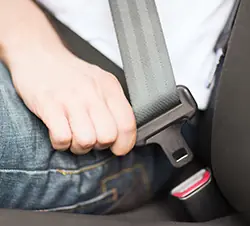
Una persona provista de un certificado médico que le exima de utilizar los sistemas de retención del vehículo, ¿está obligada a llevar abrochado el cinturón de seguridad?
Must a person with a medical certificate exempting them from using the vehicle's restraint systems wear a fastened seat belt?
- ASí.Yes.
- BNo.No.
- CÚnicamente fuera de poblado.Only outside built-up areas.
ExplanationThe Regulations exempt from wearing a seat belt anyone who proves with a medical certificate that there is a serious reason not to use it; the certificate must be carried in the vehicle and state how long it is valid.
Con la reforma de 2026, respecto al cinturón de seguridad, los taxistas y repartidores:
With the 2026 reform, regarding the seat belt, taxi drivers and delivery drivers:
- ADejan de estar exentos y deben usarlo siempre.Are no longer exempt and must always wear it.
- BSiguen exentos en ciudad.Are still exempt in towns.
- CSolo lo usan en autopista.Only wear it on the autopista (motorway).
ExplanationThe reform removes the old seat belt exemption for taxi drivers, delivery drivers and driving instructors.
Dentro de poblado, ¿los niños están exentos de usar cinturón de seguridad?
In built-up areas, are children exempt from wearing a seat belt?
- ASí, pero solo durante trayectos cortos.Yes, but only on short journeys.
- BSí, cuando van al cuidado de un adulto.Yes, when they are in the care of an adult.
- CNo.No.
ExplanationBoth the driver and the occupants of vehicles must always wear a seat belt or, in the case of children, use an approved child restraint system.
Las pinzas que se utilizan para retener el mecanismo del cinturón de seguridad, con objeto de que haga menos presión sobre el pecho del ocupante...
Clips used to hold the seat belt mechanism so that it presses less on the occupant's chest...
- ASon obligatorias.Are compulsory.
- BSon aconsejables.Are advisable.
- CEstán prohibidas.Are prohibited.
ExplanationClips that hold the seat belt so that it is less tight are not allowed: they leave slack that stops it fitting closely to the body and greatly reduce its effectiveness in a crash. Article 117 of the RGC requires it to be properly fastened.
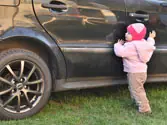
Un niño de 7 años, como norma general, ¿puede ir en el asiento delantero del vehículo con el cinturón de seguridad homologado?
As a general rule, may a 7-year-old child sit in the front seat of the vehicle wearing the approved seat belt?
- ASí.Yes.
- BNo.No.
- CSí, si utiliza un cojín elevador homologado.Yes, if they use an approved booster cushion.
ExplanationChildren whose height is 1.35 m or less must sit in the rear seats of the vehicle, always using an approved child restraint suited to their height and weight. There are two exceptions in which children below that height may travel in the front seat: 1. If the vehicle has no rear seats. 2. If the rear seats are already taken by children of the same size, so that it is not possible to fit all the child seats needed at that time. When children are taller than 1.35 m, they may sit in the front seat using the adult seat belt.
¿Es conveniente usar guantes al conducir un ciclomotor?
Is it advisable to wear gloves when riding a moped?
- ASolo con lluvia, para no resbalar del manillar.Only in the rain, so that your hands do not slip off the handlebars.
- BEn invierno sí, en verano no.Yes in winter, no in summer.
- CSí, tanto en invierno como en verano, para protegernos en caso de caída.Yes, both in winter and in summer, to protect us if we fall.
ExplanationGloves protect your hands in a fall at any time of year. In addition, according to Article 118 of the General Traffic Regulations (as worded by RD 518/2026), moped riders must wear protective gloves when riding on roads outside built-up areas.
Cuando el casco del conductor de una motocicleta no dispone de visera...
When a motorcycle rider's helmet does not have a visor...
- AEstá prohibido circular con él.It is prohibited to ride with it.
- BNo es conveniente utilizar gafas protectoras.It is not advisable to wear protective goggles.
- CEs conveniente utilizar gafas protectoras, especialmente en vía interurbana.It is advisable to wear protective goggles, especially on interurban roads.
ExplanationA helmet without a visor leaves the eyes exposed to wind, dust and insects, which is more dangerous at the speeds of interurban roads. That is why it is advisable to wear protective goggles. Riding with such a helmet is allowed if it is approved.
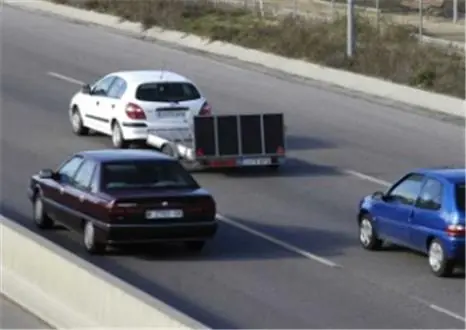
Si la parte rígida de la carrocería es de gran resistencia, ¿es aconsejable no usar el cinturón de seguridad?
If the rigid part of the bodywork is very strong, is it advisable not to wear a seat belt?
- ASí, porque los ocupantes del vehículo están bien protegidos.Yes, because the vehicle's occupants are well protected.
- BSólo en los vehículos todo terreno o en los de más de 3.500 kg de MMA.Only in off-road vehicles or vehicles with an MAM over 3,500 kg.
- CNo.No.
ExplanationThe seat belt must always be worn, however strong the bodywork is. A rigid body protects the passenger compartment, but without a seat belt the occupants hit the inside of the vehicle or are thrown out. The type of vehicle does not exempt you from wearing it either.
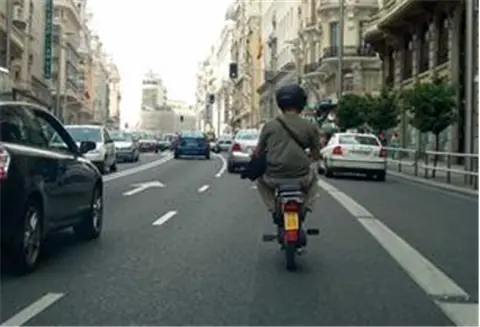
Los conductores de ciclomotores, ¿están obligados a llevar casco de protección cuando circulen por una vía urbana?
Must moped riders wear a protective helmet when riding on an urban road?
- ASí, es obligatorio.Yes, it is compulsory.
- BNo, los conductores de ciclomotores no están obligados a llevar casco.No, moped riders do not have to wear a helmet.
- CLos conductores si están obligados, pero los pasajeros no lo están.Riders must, but passengers do not have to.
ExplanationMoped riders and passengers must wear a fastened protective helmet on roads both in and outside built-up areas (Article 118 of the General Traffic Regulations). From 1 October 2026 the helmet must be approved (type-approved), with a one-year transition period for certificates.
Un menor que mide menos de 1,35m, ¿qué sistema de sujeción debe utilizar?
A minor less than 1.35 m tall: which restraint must they use?
- AUn sistema de retención homologado adaptado a su talla y peso.An approved restraint system suited to their height and weight.
- BIndistintamente el cinturón de seguridad o un sistema de retención homologado.Either the seat belt or an approved restraint system.
- CSolo el cinturón de seguridad.Only the seat belt.
ExplanationUnder Article 117 of the General Traffic Regulations (RGC), minors 135 cm tall or less must use an approved child restraint system suited to their height and weight. The seat belt alone does not protect them well, because the straps do not fit their body.
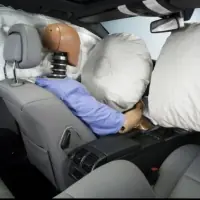
¿Qué deben hacer las personas de baja estatura en relación al airbag?
What should short people do with regard to the airbag?
- AOcupar preferiblemente los asientos traserosPreferably sit in the rear seats
- BNo es recomendable que las personas de baja estatura monten en automóvilesIt is not advisable for short people to travel in cars
- CUtilizar un elevasiento que eleve al menos 10 centímetros su estaturaUse a booster cushion that raises their height by at least 10 centimetres
ExplanationShort people sit very close to the steering wheel and the dashboard, right where the front airbag deploys, which increases the risk of injury from the airbag itself. So it is better for them to sit in the rear seats.
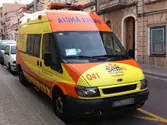
En este vehículo prioritario en servicio de urgencia dentro de poblado, ¿es obligatorio el cinturón de seguridad para el conductor y los pasajeros?
In this priority vehicle on an emergency call in a built-up area, is the seat belt compulsory for the driver and passengers?
- ASí, para el conductor, no para los pasajeros.Yes for the driver, no for the passengers.
- BNo.No.
- CNo para el conductor, sí para los pasajeros.No for the driver, yes for the passengers.
ExplanationDrivers and passengers of vehicles on an emergency call are exempt from wearing a seat belt when driving in built-up areas.
¿Se permite que un menor viaje en el asiento delantero de un coche?
Is a minor allowed to travel in the front seat of a car?
- ANo.No.
- BSí, pero siempre debe usar un sistema de retención infantil orientado hacia atrás.Yes, but they must always use a rear-facing child restraint system.
- CSí, si mide más de 135 cm.Yes, if they are taller than 135 cm.
ExplanationAccording to the General Traffic Regulations (RGC), a minor may travel in the front seat of a car only in certain situations. The rule states that occupants under 12 must use child restraint systems suited to their height and weight and that, in exceptional cases, they may sit in the front seat if there are no rear seats available or if the rear seats are taken. In this case, if a minor is taller than 135 centimetres, they do not need a specific child restraint system and may use the vehicle's seat belt. So the correct answer is yes, it is allowed if they are taller than 135 centimetres, under the exceptions set out in the rules.
¿A partir de qué estatura puede un menor de edad viajar en un turismo sin utilizar un Sistema de Retención Infantil (SRI) homologado?
From what height may a minor travel in a car without an approved child restraint system (child seat)?
- AA partir de 150 cm de estatura.From 150 cm tall.
- BA partir de más de 135 cm de estatura.From over 135 cm tall.
- CA partir de los 12 años sin importar la altura.From the age of 12, whatever their height.
ExplanationMinors taller than 135 cm may use the vehicle's adult seat belt directly.
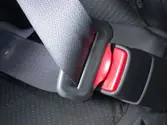
Las personas provistas de un certificado médico de exención, ¿están obligadas a abrocharse el cinturón de seguridad?
Must people with a medical exemption certificate fasten their seat belt?
- AÚnicamente fuera de poblado.Only outside built-up areas.
- BNo.No.
- CSí.Yes.
ExplanationUnder Article 119 of the General Traffic Regulations (RGC) (as worded by Royal Decree 518/2026), in built-up areas only drivers and passengers of vehicles on emergency duty are exempt from wearing a seat belt; taxi drivers, delivery drivers and those accompanying learner drivers no longer are. The general exemptions remain: the driver while reversing or parking, and people with a medical exemption certificate.
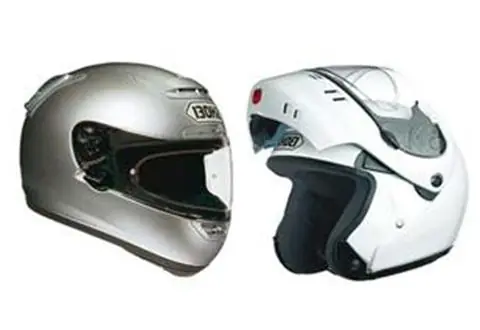
Las personas provistas de un certificado médico adecuado, ¿pueden estar exentas de utilizar el casco?
Can people with a suitable medical certificate be exempt from wearing a helmet?
- ASí, en vías de poblado, pero no en vías interurbanas.Yes, on roads in built-up areas, but not on roads outside built-up areas.
- BSí, en todas las vías, si así lo indica el certificado.Yes, on all roads, if the certificate says so.
- CNo, el certificado médico no exime del uso del casco.No, a medical certificate does not exempt you from wearing a helmet.
ExplanationUnder Article 118.1 of the General Traffic Regulations (RGC) (as worded by Royal Decree 518/2026), motorcycle riders and passengers must wear an approved helmet on all types of road; the only exemption is for vehicles with a protective structure and seat belts. Royal Decree 518/2026 removed section 3 of Article 119, which allowed an exemption from wearing a helmet for serious medical reasons.
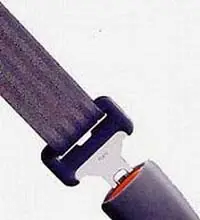
Utilizar pinzas para retener el cinturón de seguridad¿Está permitido?
Is it allowed to use clips to hold the seat belt?
- ASí.Yes.
- BNo, porque reduce la eficacia del cinturón.No, because they reduce the effectiveness of the seat belt.
- CSí, en trayectos urbanos cortos.Yes, on short urban journeys.
ExplanationClips loosen the seat belt and leave it slack, so in a collision it does not hold the body back in time and is less effective. The seat belt must be worn properly fastened and tight against the body on any type of road and journey.
¿El sistema de suspensión es un elemento de seguridad activa?
Is the suspension system an active safety feature?
- ANo, su única función es aumentar la comodidad del vehículo.No, its only function is to make the vehicle more comfortable.
- BSí.Yes.
- CNo, es un sistema de seguridad pasiva.No, it is a passive safety system.
ExplanationThe suspension affects stability and braking and helps prevent accidents, so it is an active safety feature.
¿Qué ventajas tiene usar el cinturón de seguridad?
What are the advantages of wearing a seat belt?
- APermite circular a mayor velocidad con seguridad.It lets you drive faster safely.
- BQue se pueden desactivar otros sistemas de seguridad como el airbag.Other safety systems, such as the airbag, can be switched off.
- CEvita que salgamos despedidos del vehículo en caso de accidente.It stops us from being thrown out of the vehicle in a crash.
ExplanationThe seat belt holds the occupant in their seat in a collision or rollover, stopping them from being thrown out or hitting the inside of the vehicle. The airbag and the other systems are designed to work together with the seat belt, not to replace it.
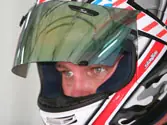
El casco para el motorista, ¿tiene que estar homologado?
Must a motorcyclist's helmet be approved?
- ASolo los cascos integrales.Only full-face helmets.
- BSí, obligatoriamente.Yes, it is compulsory.
- CNo es obligatorio pero si recomendable.It is not compulsory, but it is recommended.
ExplanationMotorcycle helmets must be properly approved. This guarantees that the helmet has passed minimum safety tests so that it can protect the rider.
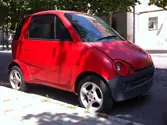
Si conduce un cuatriciclo equipado con cinturones de seguridad, ¿quiénes los deben utilizar?
If you drive a quadricycle fitted with seat belts, who must wear them?
- ASólo el conductor en todo tipo de vías.Only the driver, on all types of road.
- BEl conductor y el pasajero sólo cuando circulen por vías fuera de poblado.The driver and the passenger, only on roads outside built-up areas.
- CTanto el conductor como el pasajero.Both the driver and the passenger.
ExplanationSeat belts or other approved restraint systems, correctly fastened, must be worn both in and outside built-up areas by the driver and passengers of motorcycles, motorcycles with sidecars, mopeds, three-wheeled vehicles and quadricycles, when these have a protective structure and seat belts and this is stated on the relevant technical inspection card.
En un taxi dentro de poblado, ¿quién está exento de utilizar el cinturón de seguridad?
In a taxi in a built-up area, who is exempt from wearing a seat belt?
- ANinguno de los ocupantes, ni siquiera el conductor.None of the occupants, not even the driver.
- BEl conductor y todos los pasajeros.The driver and all the passengers.
- CSolamente el conductor.Only the driver.
ExplanationUnder Article 119.2 of the General Traffic Regulations (RGC) (as worded by Royal Decree 518/2026), in built-up areas only drivers and passengers of vehicles on emergency duty are exempt from wearing a seat belt, so neither taxi drivers nor their passengers are exempt. The only exception is that, in urban traffic or urban areas of large cities, a taxi may carry people under 135 cm tall in a rear seat without a restraint system suited to their height and weight.
¿Es aconsejable utilizar el cinturón de seguridad con mucha ropa de abrigo?
Is it advisable to wear the seat belt over a lot of warm clothing?
- ANo, ya que disminuye la eficacia del cinturón.No, because it reduces the effectiveness of the seat belt.
- BSí, porque la ropa amortigua los golpes.Yes, because the clothing cushions the impacts.
- CSí.Yes.
ExplanationThick warm clothing stops the seat belt fitting closely to the body, so in a crash the body moves further before it is held and the belt is less effective. That is why it is best to take off your coat before you start driving.
¿Qué asientos de un turismo podrá ocupar un niño que ha cumplido 10 años, y tiene una estatura superior a 1,50 m.?
Which seats in a car may a child who is 10 years old and taller than 1.50 m use?
- ADeberá ir obligatoriamente en los asientos posteriores, utilizando el cinturón de seguridad.The child must travel in the rear seats, using the seat belt.
- BPodrá ir en los asientos delanteros o posteriores, utilizando el cinturón de seguridad.The child may travel in the front or rear seats, using the seat belt.
- CDeberá ir en los asientos posteriores, utilizando un sistema de retención infantil.The child must travel in the rear seats, using a child restraint system.
ExplanationOnly children 135 cm tall or less are required to use child restraint systems and, as a general rule, to travel in the rear seats. A child taller than 1.50 m may travel in the front or the back with the seat belt, whatever their age (Article 117 of the General Traffic Regulations).
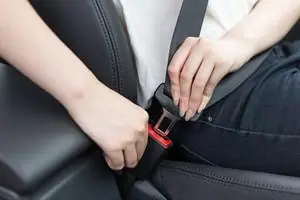
¿Qué funciones cumple el cinturón de seguridad?
What does the seat belt do?
- AEvita lesiones en el cuello.It prevents neck injuries.
- BEvita que la persona que lo utiliza salga despedida en caso de accidente.It stops the person wearing it from being thrown out in an accident.
- CNinguna.Nothing.
ExplanationThe main function of the seat belt is to hold the occupant in their seat in an accident, so that they are not thrown out of the vehicle or against the inside. Neck injuries are prevented mainly by a correctly positioned head restraint.
¿Le está permitido llevar en los asientos delanteros de su vehículo a un menor de edad de estatura igual o inferior a 1,35 metros?
Are you allowed to carry a minor who is 1.35 metres tall or less in the front seats of your vehicle?
- ASí, siempre que utilice un dispositivo de retención homologado.Yes, as long as they use an approved restraint system.
- BNo, como norma general deben ocupar los asientos traseros.No, as a general rule they must sit in the rear seats.
- CSí, con el cinturón de seguridad de adultos.Yes, with the adult seat belt.
ExplanationAs a general rule, since 2015 minors who are 1.35 m tall or less must travel in the rear seats, using a child restraint system (child seat) suited to their height and weight.
La separación entre la cabeza y el apoyacabezas debe ser...
The gap between the head and the head restraint should be...
- AComo mínimo de 4 centímetros.at least 4 centimetres.
- BLa mínima posible y nunca superior a 4 centímetros.as small as possible and never more than 4 centimetres.
- CLa que permita conducir con comodidad.whatever lets you drive comfortably.
ExplanationThe head restraint is correctly adjusted when the gap to the head is as small as possible and never more than 4 centimetres.
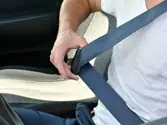
La cinta abdominal del cinturón de seguridad debe colocarse...
The lap strap of the seat belt must be placed...
- Asobre los huesos de la cadera o sobre el abdomen.over the hip bones or over the abdomen.
- Bsobre el abdomen, únicamente.over the abdomen only.
- Csobre los huesos de la cadera, siempre por debajo del abdomen.over the hip bones, always below the abdomen.
ExplanationThe lap strap of the belt must go over the hip bones, below the abdomen, and the chest strap over the collarbone and the middle of the chest. If the lap strap goes over the belly, in a crash it can damage internal organs or let the body slide underneath (submarining).
¿Cómo es aconsejable situar la silla homologada de retención infantil cuando el niño es menor de 4 años?
How is it advisable to fit an approved child seat when the child is under 4?
- AEn el sentido de la marcha con la espalda en el asientoFacing forwards, with the back against the seat
- BA contramarcha, con las espalda hacia delanteRear-facing, with the back towards the front
- CLateralmente en los asientos traserosSideways on the rear seats
ExplanationThe best child restraint devices for minors are approved child seats. When the child is under 4, it is better to fit them rear-facing, with the child's back towards the front of the car; if the child is between 4 and 12, fit them facing forwards, like the other occupants.
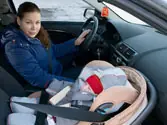
Un niño de 3 años viajará...
A 3-year-old child must travel...
- Aen el asiento delantero con el cinturón de adulto.in the front seat with the adult seat belt.
- Ben los brazos de un adulto.in an adult's arms.
- Cen un dispositivo de retención homologado.in an approved child restraint.
ExplanationA 3-year-old child is much shorter than 135 cm, so under Article 117 of the General Traffic Regulations (RGC) they must travel in an approved child restraint system suited to their height and weight, in the rear seats. Never in an adult's arms or with the adult seat belt.
¿Es importante el color del casco en los usuarios de motocicletas?
Is the colour of the helmet important for motorcycle users?
- ASí, los de colores claros o brillantes son más seguros.Yes, light-coloured or bright helmets are safer.
- BSi, los de color oscuro son más seguros.Yes, dark-coloured helmets are safer.
- CNo, es indiferente.No, it makes no difference.
ExplanationLight-coloured or bright helmets make the rider more visible to other drivers, by day and by night, and reduce the risk of not being seen in time. For the same reason it is recommended to wear bright, eye-catching colours.
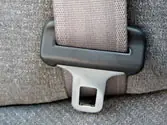
En un turismo. ¿Quién está obligado a llevar puesto el cinturón de seguridad?
In a car, who must wear a seat belt?
- ASólo los que van en los asientos delanteros.Only those in the front seats.
- BSólo los que van en los asientos traseros.Only those in the rear seats.
- CTodos los ocupantes del vehículo.All occupants of the vehicle.
ExplanationUnder Article 119 of the General Traffic Regulations (RGC) (as worded by Royal Decree 518/2026), in built-up areas only drivers and passengers of vehicles on emergency duty are exempt from wearing a seat belt; taxi drivers, delivery drivers and those accompanying learner drivers no longer are. The general exemptions remain: the driver while reversing or parking, and people with a medical exemption certificate.
¿Pueden viajar niños menores de 12 años en el asiento delantero?
May children under 12 travel in the front seat?
- ANunca.Never.
- BSí, si miden más de 135 cm, usando el cinturón de seguridad.Yes, if they are taller than 135 cm, using the seat belt.
- CSolo en trayectos cortos.Only on short trips.
ExplanationAge is not the criterion: under Article 117 of the General Traffic Regulations (RGC), what counts is height. A child taller than 135 cm may travel in the front with the seat belt; if they are 135 cm tall or less, they travel in the back in a child restraint system, and only in exceptional cases in the front.
¿Deben usar el cinturón de seguridad los conductores y los pasajeros de vehículos de servicios de emergencia cuando circulan por la ciudad?
Must drivers and passengers of emergency service vehicles wear seat belts when driving in town?
- ALos conductores deben usarlo; los pasajeros, no.Drivers must wear them; passengers need not.
- BLos conductores no están obligados; los pasajeros, sí.Drivers need not; passengers must.
- CNo.No.
ExplanationUnder Article 119 of the General Traffic Regulations (RGC), the obligation to wear a seat belt set out in Article 117 explicitly does not apply to drivers and passengers of vehicles on emergency duty. So in town, the occupants of these vehicles do not have to wear seat belts.
La banda abdominal del cinturón de seguridad, ¿por dónde pasará?
Where should the lap strap of the seat belt go?
- APasará sobre los muslos.Over the thighs.
- BSobre los huesos de la cadera.Over the hip bones.
- CSobre el abdomen.Over the abdomen.
ExplanationThe lap strap of the seat belt must go below the abdomen, over the hip bones.
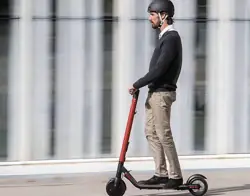
¿Es obligatorio el casco en los VMP?
Is a helmet compulsory on personal mobility vehicles (PMVs)?
- AEn vías urbanas no es obligatorio.It is not compulsory in built-up areas.
- BSí, en cualquier tipo de vía.Yes, on any type of road.
- CNo.No.
ExplanationFrom 1 October 2026, the General Traffic Regulations (RGC) require riders of personal mobility vehicles to wear an approved or certified helmet, properly fastened, whatever the type of road. Also, at night or when visibility is poor, they must wear a lit or reflective item.
¿Qué distancia es la más recomendable para evitar el impacto directo de la bolsa del airbag contra la cara del conductor?
What is the most advisable distance to prevent the airbag from hitting the driver's face directly?
- AA más de 50 centímetros del volante.More than 50 centimetres from the steering wheel.
- BA unos 25 centímetros del volante.About 25 centimetres from the steering wheel.
- CA menos de 10 centímetros del volante.Less than 10 centimetres from the steering wheel.
ExplanationSo that the front airbag does not hit the driver's face when it deploys, there should be about 25 centimetres between the chest and the centre of the steering wheel. Too close, and the impact of the airbag can cause injury; too far, and you lose control of the steering wheel.
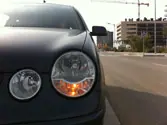
¿Se podrá modificar la parte delantera del vehículo?
May the front of the vehicle be modified?
- ANo, porque disminuye la velocidad punta.No, because it reduces top speed.
- BNo, porque en caso de atropello puede causar fuertes lesiones a los peatones.No, because if a pedestrian is hit, it can cause serious injuries.
- CSí, si es por estética del vehículo.Yes, if it is for the look of the vehicle.
ExplanationThe front of vehicles is designed, among other things, to minimise harm to pedestrians if they are hit. If you change this structure, you could cause serious injuries to pedestrians.
¿Qué función tiene el cinturón de seguridad?
What is the function of the seat belt?
- AAbsorber la máxima cantidad de energía que se libera durante el accidente.To absorb as much as possible of the energy released in the accident.
- BEjercer de freno de tu cuerpo, reduciendo a la mitad la posibilidad de muerte en caso de accidente.To act as a brake on your body, halving the chance of death in an accident.
- CEvita que suframos accidentes.It stops us from having accidents.
ExplanationIn an accident, the seat belt acts as a brake on your body. Without it, you are twice as likely to suffer fatal injuries. The seat belt does not absorb the energy produced in the accident; the chassis and the bodywork are what absorb that energy.
All topics
- Definitions
- Documents and penalty points
- The driver's condition
- Duties of drivers and pedestrians
- Vehicle controls and equipment
- Vehicle lights and horn
- Traffic signs, markings and signals
- The road and its lanes
- Speed and distances
- Manoeuvres
- Right of way
- Carrying passengers and loads
- Driving safely in difficult conditions
- Vehicle mechanics and maintenance
- Road accidents and first aid
- Defensive and eco-driving
Independent app: not affiliated with or endorsed by the DGT (Spain's Directorate-General for Traffic) or the Ministry of the Interior. The official exam is booked with the DGT and taken at its test centres. The questions here are practice material; the DGT's official question bank is not public.
Basado en datos de la Agencia Estatal Boletín Oficial del Estado (https://www.boe.es). Textos consolidados de carácter meramente informativo. La AEBOE no patrocina ni respalda este sitio.
Parte de las preguntas procede de los tests de la revista «Tráfico y Seguridad Vial» de la DGT, reproducidos con indicación de la fuente.