
DGT test · 839 questions
Vehicle lights and horn · Page 11 of 17
Side, dipped, main-beam, fog and hazard lights, and the horn: when each one is compulsory and when it is forbidden.
Questions in this topic, with answers
839 questions, 50 per page, with the correct answer and the explanation. Page 11 of 17.
La luz antiniebla trasera está señalizada en el salpicadero por un indicador de color...
On the dashboard, the rear fog light is shown by a warning light that is...
- AVerde.green.
- BAmarillo auto.amber.
- CRojo.red.
ExplanationWhen the rear fog light is on, a steady (not flashing) amber warning light shows on the dashboard, and for the front fog light a green one.
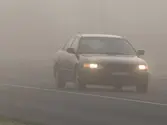
Circulando por esta vía con niebla,¿qué alumbrado usaremos como mínimo?
When driving on this road in fog, which lights will we use at least?
- ALuces de emergencia.Hazard warning lights.
- BLuces de corto alcance.Dipped headlights.
- CLuces de posición y circularemos por el arcén.Sidelights, and we will drive on the hard shoulder.
ExplanationWhen driving in bad weather or environmental conditions, we will use at least dipped headlights. We could also use the front fog light, optionally.
Las advertencias acústicas podrán hacerse...
The horn may be used...
- APara advertir, tanto dentro como fuera de poblado, el propósito de adelantar a otro vehículo.to warn, both inside and outside built-up areas, that you intend to overtake another vehicle.
- BPara advertir, fuera de poblado, el propósito de adelantar a otro vehículo.to warn, outside built-up areas, that you intend to overtake another vehicle.
- CSolamente para evitar un posible accidente.only to avoid a possible accident.
ExplanationThe horn is allowed in the following cases: - To avoid a possible accident, for example on narrow roads with many bends. - Outside built-up areas, to warn the driver of another vehicle that you intend to overtake them. - To warn other road users that you are there when on an emergency call.
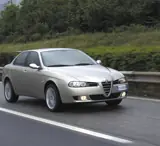
¿Está permitido circular utilizando solamente el alumbrado de posición del vehículo entre la puesta y la salida del sol?
Are you allowed to drive using only the vehicle's sidelights between sunset and sunrise?
- ANo, debe utilizarse además el alumbrado de cruce o el de carretera.No, you must also use dipped headlights or main beam.
- BSí, en vías de poblado suficientemente iluminadas.Yes, on sufficiently lit roads in built-up areas.
- CSí, en cualquier vía suficientemente iluminada.Yes, on any sufficiently lit road.
ExplanationEvery vehicle driving on urban roads and roads outside built-up areas between sunset and sunrise must have its sidelights on. When the vehicle is moving, sidelights must always be on together with dipped headlights, main beam or the front fog lights. Sidelights are for showing that we are there, not for seeing, so to drive they must be used together with some other light.
Si circulamos con niebla, ¿es correcto que lo hagamos con las luces cortas y las antiniebla delanteras?
If we are driving in fog, is it correct to use dipped headlights and the front fog lights?
- ASí.Yes.
- BNo.No.
- CNo, sólo debemos llevar las antiniebla.No, we should only use the fog lights.
ExplanationIn fog, by day or by night, it is correct to drive with dipped headlights and the front fog lights. During the day it could be correct to use the sidelights with the front fog light, and at night dipped headlights should also be on.
¿Qué alumbrado usará una motocicleta durante el día al circular por una vía dentro de poblado?
Which lights will a motorcycle use during the day on a road inside a built-up area?
- AEl alumbrado de posición, únicamente.Only the sidelight.
- BEl alumbrado de posición o el de cruce.The sidelight or the dipped headlight.
- CEl alumbrado de posición y el de cruce.The sidelight and the dipped headlight.
ExplanationMotorcycles must always use at least the sidelight together with the dipped headlight, by day and by night.
Para usar bien las luces, ¿qué debe comprobar?
To use your lights properly, what should you check?
- ASolo la regulación; debe hacerse con cierta frecuencia.Only their adjustment; this should be done fairly often.
- BLa regulación, el funcionamiento y el estado del sistema de alumbrado.The adjustment, operation and condition of the lighting system.
- CNada, porque el alumbrado debe revisarlo un taller.Nothing, because the lights must be checked by a garage.
ExplanationTo use your lights properly you must regularly check three things: the adjustment of the headlights, so you see well without dazzling; the operation of all the lights; and their condition, with clean, unbroken lenses. Many of these checks can be done by the driver.
Si circula con lluvia intensa, ¿está obligado a utilizar la luz antiniebla trasera de su turismo?
If you are driving in heavy rain, must you use your car's rear fog light?
- ASí.Yes.
- BSí y también la luz antiniebla delantera.Yes, and also the front fog light.
- CNo.No.
ExplanationREAR FOG LIGHT: - Fitting and using it are compulsory. - It must be red. - It must be used in DENSE fog, VERY heavy rain, HEAVY snowfall or THICK clouds of smoke or dust. During the day, the front fog light may be on with just the sidelights, but it may also be used together with dipped headlights or main beam. At night, it must be used at least with dipped headlights. During the day, the rear fog light must be used at least together with the front fog light or dipped headlights. At night, at least with dipped headlights. FRONT FOG LIGHT: - Fitting and using it are NOT compulsory. - It must be white or selective yellow. - It may be used, voluntarily, in fog, heavy rain, snowfall, clouds of smoke or dust, or similar conditions. - It may also be used on narrow roads with many bends, that is, roads with a carriageway 6.5 m wide or less that are signposted with ‘dangerous bends’ signs.
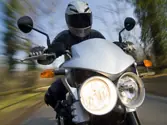
Las motocicletas durante el día, ¿con qué alumbrado circularán?
During the day, which lights will motorcycles ride with?
- ASi hay buena visibilidad no es necesario que utilicen ningún alumbrado.If visibility is good, they do not need any lights.
- BFuera de poblado la luz de corto alcance, dentro de poblado solo la de posición.Dipped headlight outside built-up areas, only the sidelight inside built-up areas.
- CEl alumbrado de corto alcance o cruce.Dipped headlight.
ExplanationMotorcycles must always use at least the dipped headlight, by day and by night.
Si está conduciendo en un área urbana y no puede leer una matrícula a menos de 10 metros, ¿qué tipo de alumbrado debería utilizar?
If you are driving in an urban area and cannot read a number plate at less than 10 metres, which lights should you use?
- ALuz de carretera o largo alcance.Main beam.
- BLuz de cruce o corto alcance.Dipped headlights.
- CSolamente luz de posición.Only the sidelights.
ExplanationA road is considered insufficiently lit when, with normal eyesight, at some point on its carriageway you cannot read a number plate at 10 metres or cannot make out a dark-painted vehicle at 50 metres. In built-up areas, whether the road is sufficiently or insufficiently lit, you must always use dipped headlights, because main beam is prohibited. To drive, you need the sidelights plus some other light.
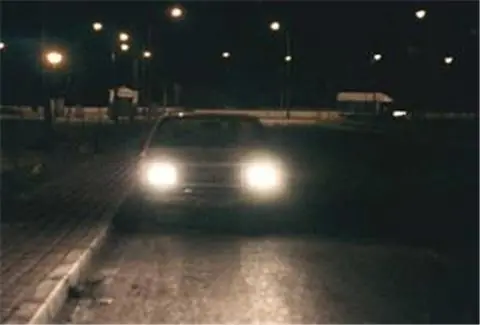
¿Está permitido utilizar el alumbrado de largo alcance en una vía urbana?
Are you allowed to use main beam on an urban road?
- ASí, cuando la vía está insuficientemente iluminada,Yes, when the road is insufficiently lit.
- BSí, cuando circule a más de 40 km/h y no se moleste a los demás usuarios.Yes, when driving at more than 40 km/h without bothering other road users.
- CNo, está prohibido.No, it is prohibited.
ExplanationMain beam is only used outside built-up areas, on insufficiently lit roads and at more than 40 km/h. On urban roads, even poorly lit ones, you use dipped headlights so as not to dazzle other drivers or pedestrians.
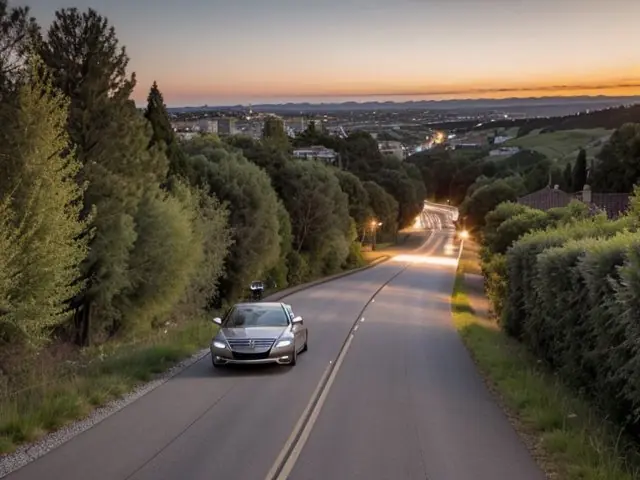
Si un vehículo dispone de sistema de alumbrado automático, ¿en qué momento se activa?
If a vehicle has an automatic lighting system, when does it switch on?
- AA partir de una hora determinada.From a set time of day.
- BCuando un sensor detecta una disminución de visibilidad.When a sensor detects that visibility is getting worse.
- CCuando un sensor detecta que el conductor está fatigado.When a sensor detects that the driver is tired.
ExplanationThe headlights of a car with light sensors come on in places such as garages, tunnels or dark areas, where the sensors detect that the light is getting weaker.
¿Qué alumbrado utilizaremos al circular por una travesía suficientemente iluminada?
Which lights will we use when driving through a sufficiently lit travesía (stretch of road through a town)?
- ANinguno puesto que está suficientemente iluminada.None, because it is sufficiently lit.
- BEl de posición.Sidelights.
- CEl de corto alcance o cruce.Dipped headlights.
ExplanationWhen driving on any sufficiently lit road we must use at least dipped headlights. In this case, because it is a travesía, that is, inside a built-up area, we would use dipped headlights even if it were insufficiently lit.
Durante el día, es obligatorio encender el alumbrado de cruce…
During the day, you must switch on dipped headlights…
- AAl circular por un carril reversible.when driving in a reversible lane.
- BCuando llueve.when it rains.
- CAl circular por un carril para VAO.when driving in an HOV lane (VAO).
ExplanationAccording to Article 104 of the General Traffic Regulations, during the day dipped headlights are compulsory in reversible lanes, temporary additional lanes and lanes opened in the opposite direction to normal, as well as on motorcycles. In rain, lights are required if visibility drops a lot.
Circulando con una fuerte nevada, ¿qué alumbrado llevaremos conectado?
When driving in heavy snow, which lights should we have on?
- ASolo el alumbrado de posición.Only the sidelights.
- BEl de posición con el antiniebla posterior.The sidelights and the rear fog light.
- CEl de corto alcance con el antiniebla posterior.The dipped headlights and the rear fog light.
ExplanationHeavy snow is one of the especially unfavourable conditions in Article 106.2 of the RGC: you must use dipped headlights (or the front fog light) and also the rear fog light. The rear fog light must not be used with only the sidelights on.
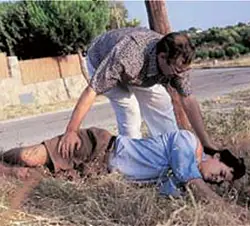
Si por circunstancias especialmente graves un conductor traslada en su vehículo particular a una persona enferma, ¿cómo advertirá de su presencia?
If, because of especially serious circumstances, a driver takes a sick person in their private vehicle, how will they warn others that they are there?
- AAgitando el brazo de arriba abajo con movimientos cortos y rápidos.By waving their arm up and down with short, quick movements.
- BInstalando en el techo de su vehículo una señal luminosa especial.By fitting a special light signal on the roof of their vehicle.
- CHaciendo sonar el claxon y conectando la luz de emergencia.By sounding the horn and switching on the hazard warning lights.
ExplanationWhen urgently taking a sick person in a private vehicle, the Regulations say you must warn others that you are there with the horn and the hazard warning lights; special light devices are only for priority vehicles.
¿Se puede circular alguna vez con la luz antiniebla delantera y la luz de posición sin usar las luces de cruce?
Can you ever drive with the front fog light and sidelights without using dipped headlights?
- ANo. Para circular siempre hay que llevar las luces de posición junto con las de cruce.No. When driving you must always have the sidelights on together with dipped headlights.
- BSí. Al circular de día con niebla no es necesario usar las luces de cruce junto con la luz de posición y la antiniebla.Yes. When driving during the day in fog, you do not need to use dipped headlights together with the sidelights and fog light.
- CSí, en cualquier vía suficientemente iluminada, aunque no haya niebla.Yes, on any road that is well enough lit, even if there is no fog.
ExplanationIn fog, heavy rain or other conditions that reduce visibility, Article 106.2 of the General Traffic Regulations allows you to use the front fog light on its own, without dipped headlights. Without those conditions, it may only be used on signed narrow stretches with many bends, not because the road is lit.
Si su turismo queda inmovilizado de día y con tiempo claro en el arcén de una autopista a causa de una avería, ¿debe encender alguna luz en su vehículo?
If your car breaks down and is immobilised on the hard shoulder of an autopista (motorway) during the day in clear weather, must you switch on any lights?
- ASí, las luces de posición, siempre.Yes, the sidelights, always.
- BNo.No.
- CSí, la señal de emergencia si el vehículo la lleva.Yes, the hazard warning lights, if the vehicle has them.
ExplanationSwitching on the hazard warning lights is correct because it is an essential safety measure when a vehicle is immobilised. The hazard warning lights warn other drivers of the danger and show that the vehicle is there, which helps prevent accidents.
¿En caso de niebla no densa podemos utilizar la luz antiniebla posterior?
In light fog, may we use the rear fog light?
- ANo.No.
- BSí.Yes.
- CSí, si es de noche.Yes, if it is night.
ExplanationThe rear fog light may only be switched on in especially bad conditions: thick fog, very heavy rain, heavy snowfall or thick clouds of smoke or dust. It is not allowed in light fog, because it would dazzle the drivers behind.
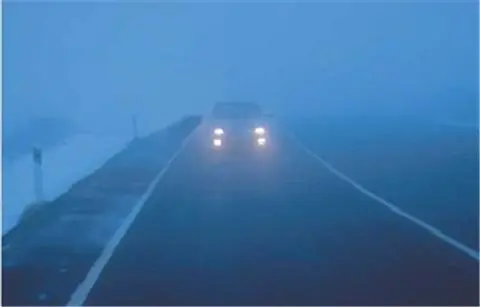
Hay mucha niebla. ¿Con qué luces es correcto que circule el turismo?
There is thick fog. Which lights is it correct for the car to use?
- ALas luces antiniebla junto con las luces de emergencia.Fog lights together with hazard warning lights.
- BLas luces antiniebla junto con las luces cortas.Fog lights together with dipped headlights.
- CLas luces de posición solamente.Sidelights only.
ExplanationIn fog you must have your lights on. The correct thing is to use the front fog light together with the dipped headlights and, if the fog is thick, the rear fog light too (Article 106 of the General Traffic Regulations). Hazard warning lights do not replace the vehicle's lights.
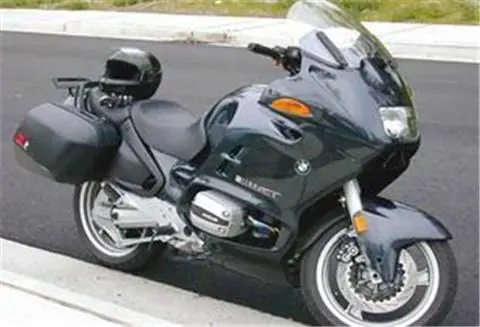
Una motocicleta, ¿pueden llevar luz antiniebla delantera?
Can a motorcycle have a front fog light?
- ASí, es obligatoria para las motocicletas con sidecar.Yes, it is compulsory for motorcycles with a sidecar.
- BSi, de forma opcional la pueden llevar todas las motocicletas.Yes, all motorcycles may have one as an option.
- CNo, las motocicletas no pueden llevar luces antiniebla.No, motorcycles may not have fog lights.
ExplanationAccording to Article 17 of the General Vehicle Regulations, the front fog light is an optional device for all motorcycles, with or without a sidecar: they may have one fitted, but they are not required to.
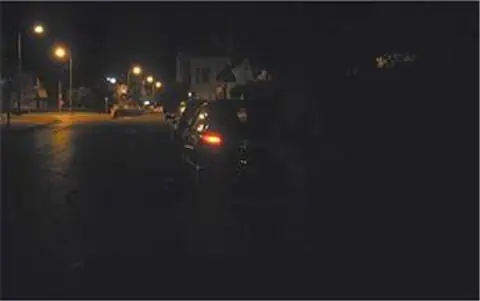
Si estaciona en línea en el arcén de una travesía insuficientemente iluminada, ¿debe dejar encendidas las luces de posición de su turismo?
If you park parallel to the kerb on the hard shoulder of an insufficiently lit travesía (stretch of road through a town), must you leave your car's sidelights on?
- ASí, o bien la de estacionamiento, o las de posición correspondientes al lado de la calzada.Yes, or else the parking light, or the sidelights on the side facing the carriageway.
- BSí, y también las luces de cruce o las de emergencia.Yes, and also dipped headlights or the hazard warning lights.
- CNo, no es necesario dejar encendido el alumbrado.No, you do not need to leave any lights on.
ExplanationAccording to Article 105 of the General Traffic Regulations, a vehicle parked at night on an insufficiently lit travesía must have its sidelights on. They can be replaced by the parking lights or, if the vehicle is parked parallel to the kerb, by the two sidelights on the side facing the carriageway.
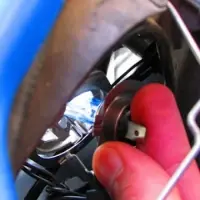
¿Qué se debe hacer cuando se rompe una de las lamparas de luz del vehículo?
What should you do when one of the vehicle's light bulbs breaks?
- ACircular con una luz hasta que la otra se rompa o apagueDrive with one light until the other one breaks or goes out
- BEsperar al menos 10 días para sustituirlaWait at least 10 days before replacing it
- CSustituir las dos luces que forman el dispositivoReplace both bulbs of the pair
ExplanationThe driver must check all the lights often, clean them and replace the bulbs when they notice that they have become dimmer. If one of the bulbs breaks, it is advisable to replace both so that they are equally bright.
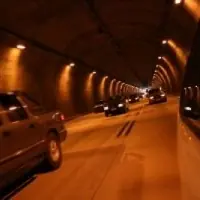
¿En que período del día se deben utilizar las luces de corto alcance dentro de un túnel?
At what time of day must dipped headlights be used inside a tunnel?
- ADurante todo el díaAt all times of day
- BEntre el anochecer y el amanecerBetween dusk and dawn
- CAl mediodíaAt midday
ExplanationWhen we enter a tunnel or underpass we must always switch on the vehicle's dipped headlights, whatever the time of day. So lights are compulsory both during the day and at night.
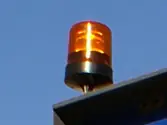
En caso de avería de la señal luminosa V2, ¿con qué alumbrado circularemos?
If the V-2 light signal breaks down, which lights will we drive with?
- ANo será necesario usar ningún tipo de alumbrado.We will not need any lights.
- BCon la señal de cruce solamente.With dipped headlights only.
- CCon la luz de cruce junto con la señal de emergencia.With dipped headlights together with the hazard warning lights.
ExplanationDrivers of special vehicles or special transport must use the V-2 signal whenever they travel on public roads at no more than 40 km/h. If this signal breaks down, they must use dipped headlights together with the hazard warning lights.
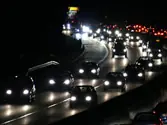
Desde el anochecer hasta el amanecer, ¿qué alumbrado tendremos que llevar encendido obligatoriamente?
From dusk to dawn, which lights must we have on?
- ASólo el de posición.Only the sidelights.
- BEl de posición y largo o corto alcance, dependiendo de las circunstancias.The sidelights and main beam or dipped headlights, depending on the circumstances.
- CEl de posición y el antiniebla.The sidelights and the fog lights.
ExplanationAt night you must drive with the sidelights on, together with dipped headlights inside built-up areas, and with dipped headlights or main beam outside built-up areas.
¿Qué indican las luces rojas encendidas del vehículo que va delante?
What do the lit red lights on the vehicle in front indicate?
- AQue hay niebla.That there is fog.
- BQue estoy circulando por una calle lateral.That I am driving on a side street.
- CQue el vehículo está frenando.That the vehicle is braking.
ExplanationAccording to the definitions in Annex X of the General Vehicle Regulations (RGV), the brake light tells those behind that the driver is applying the service brake. When you see these lights come on in the vehicle ahead, you must be ready to reduce speed.
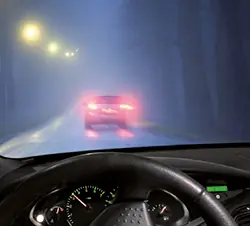
La luz antiniebla trasera deberá utilizarse siempre que...
The rear fog light must be used whenever...
- Acircule por un puerto de montaña.you are driving over a mountain pass.
- Bcircule por un túnel.you are driving through a tunnel.
- Ccircule con fuerte nevada.you are driving in heavy snowfall.
ExplanationThe rear fog light is only for conditions that greatly reduce visibility: dense fog, very heavy rain or heavy snowfall. When visibility is good, its strong light would dazzle the drivers behind.
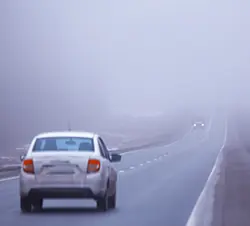
En caso de niebla espesa, ¿qué luces debe utilizar el conductor de un turismo?
In dense fog, which lights must the driver of a car use?
- ALas luces antiniebla delanteras y las de emergencia.The front fog lights and the hazard warning lights.
- BLas luces antiniebla, las de posición y las de emergencia.The fog lights, the sidelights and the hazard warning lights.
- CLas luces antiniebla, las de posición y las de corto alcance.The fog lights, the sidelights and dipped headlights.
ExplanationIn dense fog you drive with the fog lights, the sidelights and dipped headlights. Hazard warning lights are not for driving, and fog lights alone are not enough.
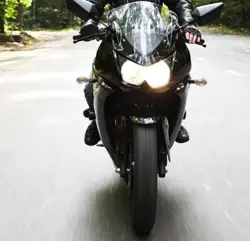
¿Está obligada una motocicleta de menos de 125 cc a llevar instalada luz de largo alcance?
Must a motorcycle under 125 cc have a main-beam light fitted?
- ANo.No.
- BSí.Yes.
- CÚnicamente las que lleven sidecar.Only those with a sidecar.
ExplanationUnder Article 16 of the General Vehicle Regulations, every motorcycle, whatever its engine capacity, must be fitted with a main-beam (long-range) light, as well as a dipped headlight, a brake light, sidelights and a number plate light.
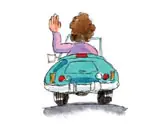
El sonido emitido por las señales acústicas debe ser...
The sound made by a horn must be...
- AMuy agudo.Very high-pitched.
- BCualquiera.Any sound.
- CNo estridente.Not shrill.
ExplanationHorns must make a continuous, even sound that is loud enough but not annoying. Shrill sounds, musical notes and sirens are prohibited.
¿Qué alumbrado utilizará al circular durante la noche por una vía dentro de poblado suficientemente iluminada?
Which lights will you use when driving at night on a sufficiently lit road inside a built-up area?
- AAlumbrado de posición.Sidelights.
- BAlumbrado de corto alcance.Dipped headlights.
- CAlumbrado de largo alcance.Main beam.
ExplanationInside a built-up area, whether the road is sufficiently or insufficiently lit, we will use dipped headlights, never main beam, and we will not use the sidelights alone.
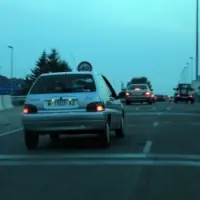
¿Cual es la finalidad de la luz de frenado?
What is the purpose of the brake light?
- AIndicar que el vehículo va a hacer una parada reglamentariaTo show that the vehicle is going to make a stop allowed by the rules
- BIndicar que se está utilizando el freno de servicioTo show that the service brake (footbrake) is being used
- CIndicar que el vehículo va a estacionar en breveTo show that the vehicle is going to park shortly
ExplanationThe main purpose of a vehicle's brake light is to show other road users that the vehicle is using the service brake and that, because it is slowing down, it may become an obstacle that other road users have to get around.
Durante el día, ¿cuándo se llevará encendida la luz de corto alcance?
During the day, when will dipped headlights be on?
- AAl circular por un carril reversible.When driving in a reversible lane.
- BAl circular por un carril V.A.O.When driving in an HOV lane (VAO).
- CEsta luz sólo se puede usar durante la noche.These lights may only be used at night.
ExplanationThe correct answer is when driving in a reversible lane, because in this type of lane we must have dipped headlights on both by day and by night.
Un vehículo debe llevar la luz de gálibo si mide...
A vehicle must have end-outline marker lights if it is...
- Amás de 2,10 metros de ancho.more than 2.10 metres wide.
- Bmás de 4 metros de alto.more than 4 metres high.
- C2 o más metros de ancho y 6 o más metros de largo.2 or more metres wide and 6 or more metres long.
ExplanationEnd-outline marker lights are compulsory for vehicles more than 2.10 metres wide and optional for those between 1.80 and 2.10 metres wide, when driving between sunset and sunrise or in reduced visibility. When the sidelights are switched on, the end-outline marker lights also come on automatically.
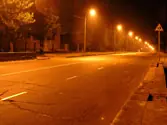
Circulando durante la noche por una vía dentro de poblado insuficientemente iluminada, ¿qué alumbrado usaremos?
When driving at night on an insufficiently lit road inside a built-up area, which lights will we use?
- AEl de posición solamente.Only the sidelights.
- BEl de posición junto con el de corto alcance.The sidelights together with dipped headlights.
- CEl de posición junto con el de largo alcance.The sidelights together with main beam.
ExplanationAt night, inside a built-up area and on an insufficiently lit road, you must have the sidelights and dipped headlights on (Article 101 of the General Traffic Regulations). Sidelights alone are not enough, and main beam is meant for roads outside built-up areas.
Un vehículo especial que carece de luz de freno tendrá limitada su velocidad a...
A special vehicle without a brake light will have its speed limited to...
- A40 km/h.40 km/h.
- B60 km/h.60 km/h.
- C25 km/h.25 km/h.
ExplanationSpecial vehicles without a brake light, those towing a trailer, and single-axle tractors are limited to 25 km/h.
Una o dos luces de color blanco en la parte posterior del vehículo, ¿qué indican?
What do one or two white lights at the rear of a vehicle mean?
- AQue el vehículo se va a detener.That the vehicle is going to stop.
- BQue el vehículo está detenido por una emergencia.That the vehicle is stopped because of an emergency.
- CQue el vehículo tiene la palanca de cambio de velocidades en posición de marcha atrás.That the vehicle's gear lever is in reverse.
ExplanationThe reversing light consists of one or two white lights. It is compulsory on motor cars, except motorcycles, and comes on automatically when the gear lever is put into reverse.
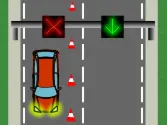
Circula de día por un carril de sentido contrario al habitual que está abierto para la circulación; ¿qué luces debe encender?
During the day you are driving in a lane that has been opened to traffic in the opposite direction to normal. Which lights must you switch on?
- ALa luz de cruce.Dipped headlights.
- BLa luz de carretera.Main beam.
- CLa luz de posición, solamente.Only the sidelights.
ExplanationRoad users driving in a lane opened in the opposite direction to normal must have at least dipped headlights on, both by day and by night. They must drive at a maximum of 80 kilometres per hour and a minimum of 60, or lower if so set or signposted, and they may not move sideways into the lane or lanes for the normal direction of traffic, not even to overtake. Drivers in the lanes for the normal direction of traffic, next to the lane opened in the opposite direction, may not move sideways into the lanes opened in the opposite direction either. They must have at least dipped headlights on, both by day and by night, and, if they have only one lane in their direction, they must drive at a maximum of 80 kilometres per hour and a minimum of 60, or lower if so set or signposted.
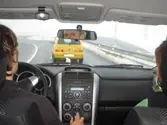
Circulando con una débil nevada, ¿qué alumbrado utilizarás?
When driving in light snowfall, which lights will you use?
- AObligatoriamente el delantero y posterior antiniebla.The front and rear fog lights, as a requirement.
- BEl de corto alcance o cruce.Dipped headlights.
- CEl de corto alcance con el posterior antiniebla.Dipped headlights with the rear fog light.
ExplanationThe rear fog light is only used in heavy snowfall, so in light snowfall we may not use it. We will drive with dipped headlights and, if we have it, optionally the front fog light.
¿Se podrán usar las luces de largo alcance circulando por una travesía?
Can you use main beam when driving through a travesía (stretch of road through a town)?
- ASí.Yes.
- BSí, si la travesía no está iluminada.Yes, if the travesía is not lit.
- CNo.No.
ExplanationA travesía is a road inside a built-up area, so you cannot use main beam.
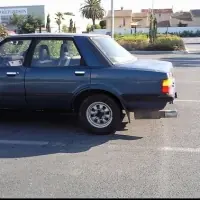
¿Está permitido instalar en un vehículo más luces que las autorizadas en el Reglamento General de Vehículos?
Is it permitted to fit a vehicle with more lights than those authorised in the General Vehicle Regulations?
- ASí, siempre que sean pinturas reflectantes.Yes, as long as they are reflective paints.
- BNo.No.
- CSí, si se trata de luces de emergencia.Yes, if they are emergency lights.
ExplanationUnder Article 15.5 of the General Vehicle Regulations, no more lights than those authorised may be fitted, and unauthorised paints and light-emitting or reflective devices are expressly prohibited. Permitted optional devices may be fitted, as long as they comply with the vehicle regulations.
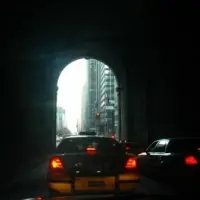
¿Se puede utilizar la luz de gálibo en túneles o pasos inferiores?
May end-outline marker lights be used in tunnels or underpasses?
- ANoNo
- BSí.Yes.
- CÚnicamente en aquellos situados en autovíasOnly in those on autovías (dual carriageways)
ExplanationThe Traffic Regulations allow end-outline marker lights to be used in tunnels and underpasses, on vehicles more than 2.10 metres wide that must have them.
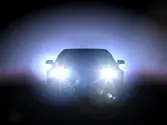
¿Puede llevar instaladas en su vehículo luces adaptativas?
May your vehicle have adaptive headlights fitted?
- ASi, todos los vehículos a motor deben llevarlas.Yes, all motor vehicles must have them.
- BSi, siendo opcionales.Yes, they are optional.
- CNo, porque está prohibido.No, because they are prohibited.
ExplanationWith adaptive headlight technology, when you reach a bend the light beam does not shine in a straight line but follows the curve.
Dentro de poblado, ¿se podrá usar el alumbrado de largo alcance momentáneamente en intervalos muy cortos?
Inside a built-up area, may main beam be used briefly at very short intervals?
- ANo, está siempre prohibido.No, it is always prohibited.
- BDentro de poblado nunca, fuera de poblado sí.Never inside a built-up area, but outside it you may.
- CSí, para evitar un posible accidente.Yes, to avoid a possible accident.
ExplanationWhen driving at night inside a built-up area, you may flash main beam to avoid an accident and to warn others that you are there.
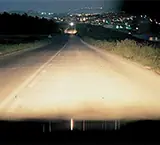
El alumbrado de gálibo es obligatorio para...
End-outline marker lights are compulsory for...
- ALos vehículos que transporten mercancías peligrosas.vehicles carrying dangerous goods.
- BLos vehículos de asistencia en carretera.roadside assistance vehicles.
- CLos vehículos cuya anchura sea mayor de 2,10 metros.vehicles more than 2.10 metres wide.
ExplanationThe General Vehicle Regulations require end-outline marker lights on vehicles more than 2.10 metres wide: they mark the outline of the vehicle so that others can see its size, especially at night.
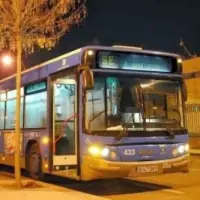
¿Cuantas luces de gálibo deberá llevar un vehículo?
How many end-outline marker lights must a vehicle have?
- ADos traserasTwo at the rear
- BDos delanteras y dos traserasTwo at the front and two at the rear
- CDos delanterasTwo at the front
ExplanationVehicles that, because of their size and structure, must have end-outline marker lights will have two at the front and two at the rear, so that they can be seen both by vehicles in front of them and by those behind.
¿Está permitido usar las luces antiniebla en una travesía cuando la visibilidad es normal?
Are you allowed to use fog lights on a travesía (stretch of road through a town) when visibility is normal?
- ANo.No.
- BNo, porque las luces antiniebla están prohibidas en travesías.No, because fog lights are prohibited on travesías.
- CSí.Yes.
ExplanationAccording to the General Traffic Regulations, specifically Article 106, front fog lights must only be used in reduced visibility, such as fog or heavy rain. In normal visibility, as in the question, they are not allowed. So the correct answer is that you are not allowed to drive on a travesía with the fog lights on in normal conditions.
¿Es obligatorio que las motocicletas dispongan de catadióptricos?
Must motorcycles have reflectors?
- ANo.No.
- BSí, dos de forma no triangular y de color rojo.Yes, two red, non-triangular ones.
- CSí, un catadióptrico de forma no triangular y de color rojo.Yes, one red, non-triangular reflector.
ExplanationMotorcycles, with or without a sidecar, must have one red, non-triangular reflector. Other motor cars must have two.
De día, circulando por un carril contiguo a otro habilitado para circular en sentido contrario al habitual, ¿debe llevar alguna luz encendida?
In daytime, when driving in a lane next to one opened for traffic in the opposite direction to normal, must you have any lights on?
- ASí, al menos las luces de cruce.Yes, at least dipped headlights.
- BSí, la de posición.Yes, the sidelights.
- CNo.No.
ExplanationUnder Article 41.1 of the General Traffic Regulations (RGC), drivers in a lane next to one opened for traffic in the opposite direction to normal must have at least dipped headlights on, day and night, so that oncoming drivers can see them.
All topics
- Definitions
- Documents and penalty points
- The driver's condition
- Duties of drivers and pedestrians
- Vehicle safety devices
- Vehicle controls and equipment
- Traffic signs, markings and signals
- The road and its lanes
- Speed and distances
- Manoeuvres
- Right of way
- Carrying passengers and loads
- Driving safely in difficult conditions
- Vehicle mechanics and maintenance
- Road accidents and first aid
- Defensive and eco-driving
Independent app: not affiliated with or endorsed by the DGT (Spain's Directorate-General for Traffic) or the Ministry of the Interior. The official exam is booked with the DGT and taken at its test centres. The questions here are practice material; the DGT's official question bank is not public.
Basado en datos de la Agencia Estatal Boletín Oficial del Estado (https://www.boe.es). Textos consolidados de carácter meramente informativo. La AEBOE no patrocina ni respalda este sitio.
Parte de las preguntas procede de los tests de la revista «Tráfico y Seguridad Vial» de la DGT, reproducidos con indicación de la fuente.