
DGT test · 839 questions
Vehicle lights and horn · Page 9 of 17
Side, dipped, main-beam, fog and hazard lights, and the horn: when each one is compulsory and when it is forbidden.
Questions in this topic, with answers
839 questions, 50 per page, with the correct answer and the explanation. Page 9 of 17.
Al circular durante la noche por una vía urbana suficientemente iluminada, ¿qué alumbrado utilizaremos?
When driving at night on a sufficiently lit urban road, which lights will we use?
- ANo es necesario utilizar ningún alumbrado.No lights are needed.
- BEl de corto alcance.Dipped headlights.
- CEl de posición.Sidelights.
ExplanationOn an urban road at night, whether it is sufficiently lit or not, we must use dipped headlights.
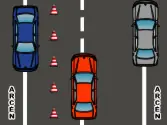
¿Qué alumbrado usaremos durante el día para circular por un carril adicional circunstancial?
Which lights will we use during the day when driving in a temporary additional lane?
- ANo usaremos ningún alumbrado.We will not use any lights.
- BEl alumbrado de corto alcance.Dipped headlights.
- CEl alumbrado de carretera.Main beam.
ExplanationIn a temporary additional lane we will use at least dipped headlights, both by day and by night.
¿Cuándo deben encenderse las luces de cruce de una motocicleta durante el día?
When must a motorcycle's dipped headlights be on during the day?
- ACuando circula por cualquier vía pública.When riding on any public road.
- BSolo si conduce de noche o con mal tiempo.Only when riding at night or in bad weather.
- CSolo si circula por un túnel o en tramos señalizados con señal vertical de túnel.Only when riding through a tunnel or on stretches marked with a ‘tunnel’ road sign.
ExplanationArticle 104 of the General Traffic Regulations says that, during the day, motorcycles riding on any public road must have dipped headlights on. There is no mention of special conditions such as night or poor visibility; the rule applies generally to all public roads.

Al ver esta señal, ¿qué luces debemos encender, como mínimo, en nuestro ciclomotor?
When you see this sign, which lights must we switch on, at least, on our moped?
- ALa luz de posición.The sidelight.
- BLa luz de cruce.Dipped headlight.
- CLa luz de carretera, si el ciclomotor la lleva instalada.Main beam, if the moped has it fitted.
ExplanationThe correct answer is dipped headlight, because it is the minimum required on a moped when you see this sign.
Cuando se acerque a niños o personas mayores...
When you approach children or elderly people...
- Adebe tomar las precauciones necesarias para no ponerlos en peligro.you must take the necessary precautions so as not to put them in danger.
- Bdebe avisarles mediante señales acústicas.you must warn them with your horn.
- Cdebe detenerse para cederles el paso.you must stop to give way to them.
ExplanationThe correct answer is that you must take the necessary precautions so as not to put them in danger. This comes from the driver's duty to take extra care when approaching vulnerable groups such as children and elderly people, who are more likely to have accidents because of their limited mobility. According to the General Traffic Regulations, drivers must be alert near areas with a lot of pedestrian traffic, especially vulnerable people, and must take steps to keep them safe. Warning them with the horn is wrong: although the horn may be used in some situations, it is not a suitable precaution. Stopping to give way to them may apply in some situations, but it is not the most complete or safest answer in all circumstances.
¿De qué color deben ser las luces de posición traseras de los tractores agrícolas o motocultores?
What colour must the rear sidelights of agricultural tractors or single-axle tractors be?
- ABlancoWhite
- BRojoRed
- CAmarilloYellow
ExplanationAgricultural tractors and single-axle tractors must always have two rear sidelights that give a red light. These lights are compulsory for special vehicles that are allowed to drive at night, and also for those that are not allowed to drive at night.
El alumbrado del vehículo es un sistema de seguridad...
The vehicle's lights are a safety system that is...
- AActiva.Active.
- BTerciaria.Tertiary.
- CPasiva.Passive.
ExplanationActive safety systems help the driver to minimise accidents; they include the lights, tyres, brakes, suspension, etc. Passive safety systems are designed to minimise injuries once an accident has happened; they include the seat belt, airbags and the helmet.
¿Está permitido circular solo con las luces de posición entre la puesta y la salida del sol?
Is it allowed to drive with only sidelights on between sunset and sunrise?
- ASí, en calles de poblado bien iluminadas.Yes, on well-lit streets in built-up areas.
- BSí, en cualquier vía que esté suficientemente iluminada.Yes, on any road that is well enough lit.
- CNo, debe utilizarse además el alumbrado de cruce o el de carretera.No, you must also use dipped headlights or main beam.
ExplanationBetween sunset and sunrise, sidelights alone are not enough. Under Articles 100 and 101 of the General Traffic Regulations, on roads that are well enough lit you must also have dipped headlights on, and on roads that are not lit well enough, main beam or, if it could dazzle others, dipped headlights.
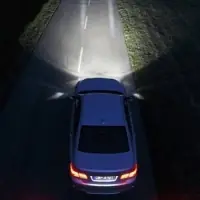
¿De que manera se puede utilizar la luz de largo alcance como señal de aviso?
How can main beam be used as a warning signal?
- ACon señales largas e intermitentesWith long, intermittent signals
- BCon intervalos muy cortosWith very short flashes
- CCon una señal luminosa prolongada en el tiempo y continuaWith a long, continuous light signal
ExplanationMain beam may be used as warning flashes at very short intervals, to avoid a possible accident, to warn other drivers that our vehicle is there, and to warn, both inside and outside built-up areas, that we intend to overtake a vehicle.
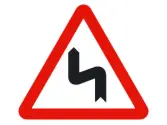
De noche en un tramo con muchas curvas, señalizadas con la señal de curvas peligrosas, ¿está permitido circular con la luz antiniebla delantera?
At night, on a stretch with many bends marked with the ‘dangerous bends’ sign, are you allowed to drive with the front fog light on?
- ASí siempre, utilizándola junto con la luz de posición.Yes, always, using it together with the sidelights.
- BNo, si no hay condiciones meteorológicas adversas.No, if there is no bad weather.
- CSí, en vías estrechas.Yes, on narrow roads.
ExplanationFRONT FOG LIGHT: - Fitting and using it are NOT compulsory. - It must be white or selective yellow. - It may be used, voluntarily, in fog, heavy rain, snowfall, clouds of smoke or dust, or similar conditions. - It may also be used on narrow roads with many bends, that is, roads with a carriageway 6.5 m wide or less that are signposted with ‘dangerous bends’ signs. During the day, the front fog light may be on with just the sidelights, but it may also be used together with dipped headlights or main beam. At night, it must be used at least with dipped headlights.
Si circulamos a 40 km/h por una vía interurbana insuficientemente iluminada, ¿qué alumbrado utilizaremos?
If we are driving at 40 km/h on a poorly lit road outside built-up areas, which lights should we use?
- AObligatoriamente el de corto alcance o cruce.Dipped headlights, as this is compulsory.
- BObligatoriamente el de largo alcance o carretera.Main beam, as this is compulsory.
- CEl de largo o el de corto alcance.Either main beam or dipped headlights.
ExplanationIf we are driving on a poorly lit road at 40 km/h or less, using main beam is optional. On the other hand, if the speed is over 40 km/h and there is no risk of dazzling anyone, main beam is compulsory.
¿Para qué sirven las luces de posición del vehículo?
What are a vehicle's sidelights for?
- APara iluminar la calzada a gran distancia.To light up the carriageway a long way ahead.
- BPara señalizar una avería en la carretera.To signal a breakdown on the road.
- CPara que el vehículo sea visto por los demás y percibir su anchura.So that others can see the vehicle and judge its width.
ExplanationSidelights let other road users see the vehicle and judge its width and length.
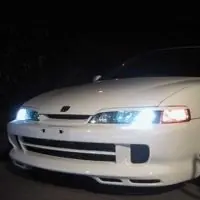
Las luces adaptativas...
Adaptive headlights...
- Aemiten más luz que las luces convencionales.give out more light than normal headlights.
- Bmejoran la visibilidad en determinadas situaciones, como una curva o una intersección.improve visibility in certain situations, such as a bend or a junction.
- Cadaptan su luminosidad a la visibilidad existente.adjust their brightness to the visibility conditions.
ExplanationWith adaptive headlight technology, when you reach a bend the light beam does not shine in a straight line but follows the curve.
Circulando con lluvia muy intensa, ¿es correcto encender la luz antiniebla trasera?
When driving in very heavy rain, is it correct to switch on the rear fog light?
- ASí.Yes.
- BNo, sólo puede utilizarse con niebla densa o fuerte nevada.No, it may only be used in dense fog or heavy snowfall.
- CSí, pero su uso es opcional.Yes, but using it is optional.
ExplanationFRONT FOG LIGHT: - Fitting and using it are NOT compulsory. - It must be white or selective yellow. - It may be used, voluntarily, in fog, heavy rain, snowfall, clouds of smoke or dust, or similar conditions. - It may also be used on narrow roads with many bends, that is, roads with a carriageway 6.5 m wide or less that are signposted with ‘dangerous bends’ signs. REAR FOG LIGHT: - Fitting and using it are compulsory. - It must be red. - It must be used in DENSE fog, VERY heavy rain, HEAVY snowfall or THICK clouds of smoke or dust. During the day, the front fog light may be on with just the sidelights, but it may also be used together with dipped headlights or main beam. At night, it must be used at least with dipped headlights. During the day, the rear fog light must be used at least together with the front fog light or dipped headlights. At night, at least with dipped headlights.
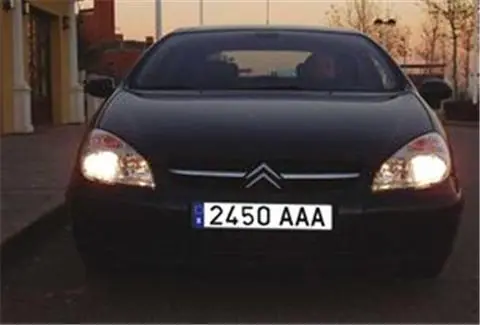
Llevar el reglaje del sistema de alumbrado demasiado bajo, ¿influye en la seguridad?
Does having your headlights aimed too low affect safety?
- ASi, se percibe antes un obstáculo en la calzada.Yes, you see an obstacle on the carriageway sooner.
- BSí, se tarda más en percibir un obstáculo en la calzada.Yes, it takes longer to see an obstacle on the carriageway.
- CNo, llevar los faros mal reglados no influye en la seguridad.No, badly aimed headlights do not affect safety.
ExplanationIf the headlights are aimed too low, the beam lights up a shorter distance and you see obstacles later, which leaves less time to react. If they are aimed too high, they dazzle others. That is why headlight aim directly affects safety.
Si circula de noche por una vía urbana, ¿qué luces debe usar?
If you are driving at night on an urban road, which lights must you use?
- ALas luces largas (de carretera).Main beam.
- BSólo las luces de posición.Only the sidelights.
- CLas luces cortas (de cruce).Dipped headlights.
ExplanationUnder Article 101.1 of the RGC, at night on urban roads you must have your sidelights and dipped headlights on, whether or not the road is well lit. Main beam is only compulsory outside built-up areas, under Article 100.
¿Qué alumbrado deberá utilizarse si se quiere adelantar de noche?
Which lights must be used if you want to overtake at night?
- AAlumbrado de cruceDipped headlights
- BAlumbrado de largo alcanceMain beam
- CAlumbrado de frenadoBrake lights
ExplanationWhen overtaking at night, inside or outside built-up areas, you must use at least dipped headlights during the overtaking manoeuvre.
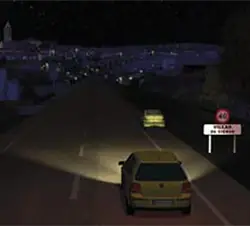
¿Qué alumbrado deberá mantener encendido un vehículo estacionado durante la noche en el arcén de una travesía insuficientemente iluminada?
Which lights must a vehicle keep on when it is parked at night on the hard shoulder of an insufficiently lit travesía (stretch of road through a town)?
- ANinguno, ya que es un estacionamiento dentro de poblado.None, because it is parked inside a built-up area.
- BLas luces de largo alcance y las luces de emergencia.Main beam and hazard warning lights.
- CLas luces de posición, que podrá sustituir por las de estacionamiento.The sidelights, which may be replaced by the parking lights.
ExplanationOn an insufficiently lit travesía, a vehicle parked at night must keep its sidelights on, which may be replaced by the parking lights. That way it is visible without dazzling anyone.
Es obligatorio utilizar las luces de carretera al circular a más de 40 km/h por una vía...
You must use main beam when driving at more than 40 km/h on a road...
- Ainterurbana insuficientemente iluminada.outside built-up areas that is insufficiently lit.
- Binsuficientemente iluminada, dentro o fuera de poblado.that is insufficiently lit, inside or outside a built-up area.
- Cinterurbana suficientemente iluminada.outside built-up areas that is sufficiently lit.
ExplanationEvery vehicle fitted with main beam that is travelling at more than 40 km/h between sunset and sunrise on insufficiently lit roads outside built-up areas, or at any time of day through insufficiently lit tunnels, underpasses and stretches of road covered by the ‘tunnel’ sign, must have main beam on, except when dipped headlights must be used, especially to avoid dazzling. Main beam is completely prohibited inside built-up areas.
¿Se pueden encender las luces largas cuando hay niebla por la noche?
May you switch on main beam in fog at night?
- ASí, en vez de las luces antiniebla.Yes, instead of the fog lights.
- BNo, está prohibido.No, it is prohibited.
- CSí, aunque no es recomendable porque pueden deslumbrar.Yes, although it is not recommended because it can dazzle.
ExplanationThe correct answer is that you may switch on main beam, although it is not recommended because it can dazzle. According to Article 106 of the General Traffic Regulations, main beam is allowed in reduced visibility, such as fog. However, you must be careful not to dazzle other drivers, so the fog light is considered more suitable in these conditions.
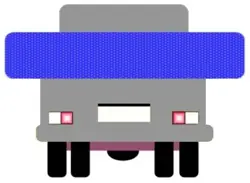
De noche, ¿Es obligatorio señalizar una carga que sobresale lateralmente más de 0,40 metros de la luz de posición?
At night, must a load that sticks out sideways more than 0.40 metres beyond the sidelight be signalled?
- ANo es necesario señalizarla.It does not need to be signalled.
- BSí, en cada una de las extremidades laterales.Yes, at each of its side ends.
- CSí, con un panel reflectante de color blanco en ambos lados.Yes, with a white reflective panel on both sides.
ExplanationAccording to Article 15 of the General Traffic Regulations, at night or in poor visibility, a load that sticks out sideways more than 0.40 metres beyond the sidelight must be signalled at each side end: with a white light and a white reflector facing forwards, and a red light and a red reflector facing backwards.
¿Cuándo es obligatorio circular con las luces de cruce encendidas?
When is it compulsory to drive with dipped headlights on?
- ASolo de noche en carreteras interurbanasOnly at night, on roads outside built-up areas
- BDe noche, en túneles y en carriles reversiblesAt night, in tunnels and in reversible lanes
- CÚnicamente cuando llueve intensamenteOnly when it is raining heavily
ExplanationDipped headlights are compulsory at night, in tunnels or underpasses, in reversible lanes and when visibility is poor.
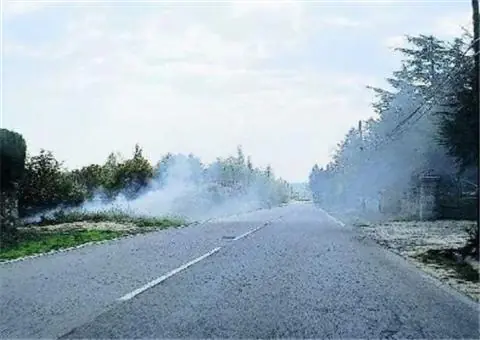
Si una nube de humo disminuye sensiblemente la visibilidad, ¿debe utilizarse algún tipo de alumbrado?
If a cloud of smoke greatly reduces visibility, must any lights be used?
- ANo, excepto entre la puesta y la salida del sol.No, except between sunset and sunrise.
- BSí, la luz antiniebla delantera o la luz de corto o largo alcance.Yes, the front fog light or dipped headlights or main beam.
- CSolo cuando se acerquen vehículos en sentido contrario.Only when vehicles are coming in the opposite direction.
ExplanationAccording to Article 106 of the General Traffic Regulations, when fog, heavy rain or clouds of smoke or dust greatly reduce visibility, you must use lights, also during the day: the front fog light or dipped headlights or main beam.
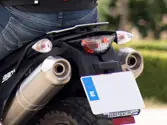
¿Qué placa de matrícula deberá estar iluminada, cuando encienda la luz deposición de su vehículo?
Which number plate must be lit when you switch on your vehicle's sidelights?
- ALa placa posterior de matrícula.The rear number plate.
- BÚnicamente la matricula delantera.Only the front number plate.
- CTanto la placa de matrícula posterior como la anterior.Both the rear and the front number plates.
ExplanationWhen you switch on the sidelights, the rear number plate light comes on and, where fitted, the end-outline marker lights.
Si su vehículo no tiene luces antiniebla delanteras, ¿qué luces debe encender cuando hay niebla?
If your vehicle has no front fog lights, which lights must you switch on in fog?
- ALas luces cortas (de cruce) o las largas (de carretera).Dipped headlights or main beam.
- BSolo las luces de posición.Only the sidelights.
- CSolo las luces largas (de carretera).Only the main beam.
ExplanationIn fog or other conditions that greatly reduce visibility, you must use the front fog lights, dipped headlights or main beam (Article 106.2 of the General Traffic Regulations (RGC)). Without front fog lights, you use dipped headlights or main beam; sidelights alone are not enough.
¿Se pueden usar las luces de emergencia mientras se circula?
May the hazard warning lights be used while driving?
- ANo, solo cuando el vehículo está paradoNo, only when the vehicle is stationary
- BSí, para advertir de un peligro inminenteYes, to warn of an imminent danger
- CNo, nuncaNo, never
ExplanationHazard warning lights may be used while driving to warn of an imminent danger.

Si un turismo circula, entre el ocaso y la salida del sol, por una vía interurbana con circulación intensa, y está utilizando la luz de posición junto con el alumbrado de corto alcance, cuando rebase esta señal...
A car is driving between sunset and sunrise on a road outside built-up areas with heavy traffic, using sidelights together with dipped headlights. When it passes this sign...
- APodrá apagar tanto la luz de posición como el alumbrado de corto alcance.it may switch off both the sidelights and the dipped headlights.
- BPodrá apagar el alumbrado de corto alcance pero no la de posición.it may switch off the dipped headlights but not the sidelights.
- CSeguirá circulando con la luz de posición y el alumbrado de corto alcance.it will continue with the sidelights and dipped headlights on.
ExplanationThis sign asks you to check whether you need to keep your lights on, for example when leaving a tunnel, but it does not allow you to switch them off. Between sunset and sunrise lights are compulsory, and in heavy traffic you keep dipped headlights on so as not to dazzle.
Al repostar combustible en una motocicleta, ¿es obligatorio apagar las luces?
When refuelling a motorcycle, must you switch off the lights?
- ASí.Yes.
- BNo, debe permanecer encendida la luz de cruce.No, the dipped headlight must stay on.
- CNo, debe permanecer encendida la luz de posición.No, the sidelight must stay on.
ExplanationAccording to the General Traffic Regulations, vehicle lights, including those of motorcycles, must be switched off while refuelling. This is for safety, because sources of ignition can cause fires where fuel is being handled. Switching off the lights avoids the risk of starting a fire in the refuelling area, where there are petrol vapours that can catch fire.
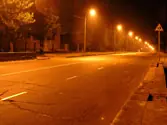
En una vía urbana suficientemente iluminada, ¿con qué alumbrado se circulará?
On a sufficiently lit urban road, which lights will you drive with?
- AComo mínimo con el de posición.At least the sidelights.
- BComo mínimo con el de cruce.At least dipped headlights.
- CCon el de corto alcance.Dipped headlights.
ExplanationOn a sufficiently lit urban road you will always drive with dipped headlights. You may not drive with sidelights alone or with main beam.
Debe Ud. comprobar periódicamente el reglaje del alumbrado de su vehículo?
Must you check the aim of your vehicle's headlights regularly?
- ANo, porque el alumbrado no necesita reglaje.No, because headlights do not need adjusting.
- BNo, porque las luces viene regladas de fábrica y no es necesario.No, because headlights are adjusted in the factory and it is not necessary.
- CSí, porque las luces pueden desequilibrarse por diferentes motivos.Yes, because headlights can go out of adjustment for various reasons.
ExplanationThis is correct because headlights can go out of adjustment for various reasons, such as knocks or changes in the vehicle's load. Checking the headlight aim regularly makes sure the lights work properly and light up the road well, which is essential for safety.
Si las luces del ciclomotor apuntan demasiado bajo...
If a moped's lights point too low...
- ASe mejora la iluminación a larga distancia.long-distance lighting improves.
- BSe acorta la iluminación a larga distancia.long-distance lighting is shortened.
- CSe deslumbra más a otros vehículos.other vehicles are dazzled more.
ExplanationThe correct answer is that long-distance lighting is shortened: if the moped's lights point too low, the distance they light up is reduced, which can make it harder to see far ahead.
¿Qué alumbrado dejaremos encendido al estacionar en una travesía insuficientemente iluminada?
Which lights will we leave on when parking on an insufficiently lit travesía (stretch of road through a town)?
- ANinguno, por encontrarnos dentro de poblado.None, because we are inside a built-up area.
- BLuces de corto alcance con emergencia.Dipped headlights with hazard warning lights.
- CPosición o estacionamiento.Sidelights or parking lights.
ExplanationOn an insufficiently lit travesía we will leave the sidelights on. They may be replaced by the parking lights, which are optional, on vehicles no longer than 6 metres and no wider than 2 metres.
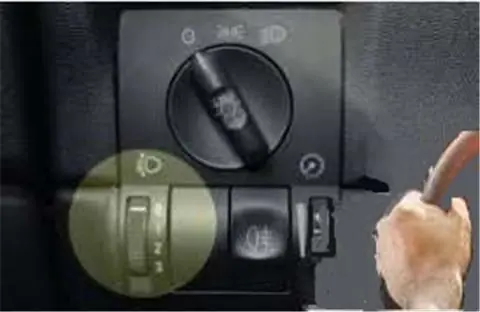
Cuando las luces de su vehículo apuntan demasiado bajo...
When your vehicle's headlights point too low...
- Ase mejora la iluminación de la vía a larga distancia.the road is lit better at long distance.
- Bse puede deslumbrar a los conductores de otros vehículos.you may dazzle the drivers of other vehicles.
- Cse acorta la iluminación a larga distancia.long-distance lighting is shortened.
ExplanationIf the headlights point too low, they only light the nearby area and long-distance visibility is reduced. If they point too high, they dazzle others. That is why their height must be adjusted according to the vehicle's load.
¿Qué alumbrado debe utilizar si circula antes de la salida del sol, pero con buena visibilidad?
Which lights must you use if you are driving before sunrise but visibility is good?
- AÚnicamente el alumbrado de posición.Only the sidelights.
- BEl de posición y el de corto alcance.The sidelights and the dipped headlights.
- CNo es necesario que utilice ningún alumbrado.You do not need to use any lights.
ExplanationBefore sunrise you must have your lights on even if visibility seems good (Article 98 of the General Traffic Regulations): the sidelights together with the dipped headlights, or the main beam if the road is unlit and you do not dazzle anyone.
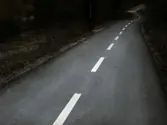
¿Qué ventajas tienen las luces de xenón?
What are the advantages of xenon headlights?
- AAdaptan la zona iluminada de los faros a las necesidades del conductor.They adapt the area lit by the headlights to the driver's needs.
- BSon lo mismo que las luces de día.They are the same as daytime running lights.
- CReducen la fatiga ocular del conductor.They reduce the driver's eye strain.
ExplanationXenon headlights give a light closer to natural light, let you see further, light up the edge of the carriageway better and reduce the driver's eye strain. It is adaptive headlights that adapt the area lit by the headlights to the driver's needs.
En una detención, ¿Podemos utilizar el alumbrado de largo alcance?
When the vehicle is held up by traffic (detención), may we use main beam?
- ASí, si no deslumbramos a los demás usuarios.Yes, if we do not dazzle other road users.
- BNo, pero sí la luz antiniebla delantera.No, but we may use the front fog light.
- CNo, está prohibida siempre.No, it is always prohibited.
ExplanationThe ban in Article 100 of the General Traffic Regulations refers to a vehicle that is stopped or parked. When you are held up by traffic, for example at traffic lights on an unlit road, you may keep main beam on if it does not dazzle anyone.
Es de día. Al entrar en un túnel suficientemente iluminado, ¿debe utilizar algún alumbrado?
It is daytime. When entering a sufficiently lit tunnel, must you use any lights?
- ANo.No.
- BSolamente las luces de posición para indicar cuál es la del vehículo.Only the sidelights, to show where the vehicle is.
- CSí, las luces de posición y las de cruce.Yes, the sidelights and dipped headlights.
ExplanationWhen entering a tunnel, even a lit one, you must use the sidelights and dipped headlights. Dipped headlights light up the road and help other drivers see you, which is essential for safe driving.
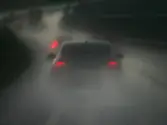
Circulando con lluvia muy intensa, ¿es obligatorio utilizar el alumbrado antiniebla posterior?
When driving in very heavy rain, is it compulsory to use the rear fog light?
- ANo, sólo es opcional.No, it is only optional.
- BSí.Yes.
- CSí, y además también será obligatorio el delantero antiniebla.Yes, and the front fog light will also be compulsory.
ExplanationREAR FOG LIGHT: - Fitting and using it are compulsory. - It must be red. - It must be used in DENSE fog, VERY heavy rain, HEAVY snowfall or THICK clouds of smoke or dust. Using the front fog light is never compulsory; it is always optional.
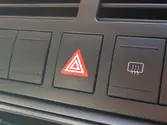
¿Cuándo usaremos la luz de emergencia?
When will we use the hazard warning lights?
- ASólo cuando el vehículo esté detenido por una avería o accidente.Only when the vehicle has stopped because of a breakdown or accident.
- BCuando el vehículo no pueda alcanzar la velocidad mínima exigida y exista peligro de colisión por alcance.When the vehicle cannot reach the required minimum speed and there is a risk of being hit from behind.
- CSólo cuando sea de noche.Only at night.
ExplanationUnder Article 49.3 of the General Traffic Regulations (RGC), if the vehicle cannot reach the required minimum speed and there is a risk of being hit from behind, you must drive with the hazard warning lights on, by day and by night. They are also used, among other cases, when the vehicle is immobilised on a motorway (autopista) or dual carriageway (autovía) or in poor visibility.
¿Qué deberán llevar, aparte de las luces, los conductores de bicicleta en vía interurbana?
Apart from lights, what must cyclists wear on roads outside built-up areas?
- AUna prenda reflectanteA reflective garment
- BTan solo es necesario llevar cascoThey only need to wear a helmet
- CUna linterna de largo alcance en la mano izquierdaA long-range torch held in the left hand
ExplanationOn roads outside built-up areas, between sunset and sunrise or in poor visibility, cyclists must wear, in addition to lights, at least one reflective or luminous item visible from 150 metres (Article 118 of the General Traffic Regulations). A helmet is compulsory, but it is not enough.
¿La luz de freno es obligatoria para los remolques?
Are brake lights compulsory on trailers?
- ANo, puesto que ya la lleva el vehículo que los está remolcando.No, because the towing vehicle already has them.
- BSí.Yes.
- CSolo será obligatoria para los remolques de más de 750 kg.Only on trailers over 750 kg.
ExplanationBrake lights are compulsory on trailers and semi-trailers, whatever their weight.
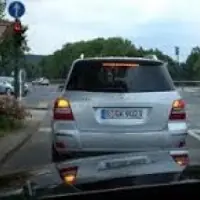
¿Qué debe hacer para avisar de que va a disminuir la velocidad de su vehículo?
What must you do to warn that you are going to slow down?
- APisar varias veces el pedal de freno.Press the brake pedal several times.
- BEncender las luces de posición.Switch on the sidelights.
- CEncender el intermitente izquierdo.Switch on the left indicator.
ExplanationWhen for some reason we have to brake in an emergency, slow down sharply, or simply want to warn that we intend to slow down, we must press the brake several times, so that the brake lights warn the driver behind that we are going to slow down.
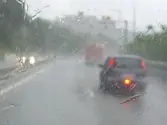
¿Es necesario activar la luz antiniebla trasera cuando se conduce en condiciones de visibilidad, especialmente desfavorables?
Must you switch on the rear fog light when driving in especially poor visibility?
- ANo, es una opción voluntaria.No, it is optional.
- BSí, y también se requiere encender la luz de largo alcance.Yes, and you must also switch on main beam.
- CSí, con el propósito de indicar su posición al resto de usuarios.Yes, to show your position to other road users.
ExplanationFitting and using the rear fog light are compulsory. It must only be on when weather or environmental conditions are especially bad, such as dense fog, very heavy rain, heavy snowfall or thick clouds of dust or smoke. It is used together with the sidelights and also with dipped headlights, main beam or the front fog light. The rear fog light can be switched off independently of the other lights.
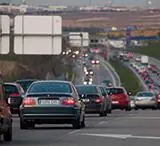
Circulando por autopista, prevé que su vehículo va a quedar inmovilizado por circunstancias del tráfico; ¿cómo deberá advertirlo?
You are driving on an autopista (motorway) and expect your vehicle to come to a stop because of the traffic. How must you warn others?
- AMediante la luz antiniebla trasera y la señal de emergencia.With the rear fog light and the hazard warning lights.
- BMediante el empleo reiterado de las luces de frenado.By using the brake lights repeatedly.
- CEncendiendo las luces de posición, aunque sea de día.By switching on the sidelights, even during the day.
ExplanationA driver who wants to slow down a lot must make sure they can do it safely and warn others by using the brake lights repeatedly, or by moving the arm up and down with short, quick movements.
Debe cambiar las luces largas por las cortas...
You must switch from main beam to dipped headlights...
- Acuando pueda deslumbrar a cualquier usuario de la vía.when you could dazzle any road user.
- Bcuando circule por una vía interurbana.when you are driving on a road outside built-up areas.
- Ccuando solo pueda deslumbrar a los vehículos que vienen en sentido contrario.only when you could dazzle vehicles coming in the opposite direction.
ExplanationThe rules say main beam must be switched off when it could dazzle other road users. This includes not only vehicles coming the other way, but also pedestrians, cyclists and vehicles going in the same direction. You must switch to dipped headlights to avoid danger and keep everyone safe.
En las travesías insuficientemente iluminadas, ¿qué alumbrado usaremos para circular?
On insufficiently lit travesías (stretches of road through a town), which lights will we drive with?
- APosición y largo alcance.Sidelights and main beam.
- BPosición y corto alcance.Sidelights and dipped headlights.
- CSolo posición.Only sidelights.
ExplanationA travesía is a road inside a built-up area, so the rules for built-up areas apply. We will use the sidelights together with dipped headlights, and we will never drive with main beam or with sidelights alone.
Las motocicletas cuya cilindrada no supere los 125cc, ¿están obligadas a llevar instalada la luz de largo alcance o carretera?
Must motorcycles with an engine size of no more than 125 cc have main beam fitted?
- ASí, una o dos lucesYes, one or two lights
- BNoNo
- CÚnicamente estarán obligadas aquellas que lleven sidecarOnly those with a sidecar
ExplanationAll motorcycles used on public roads must have 1 or 2 main beam headlights as part of their normal lighting. So motorcycles under 125 cc, like the one in the question, must also have it.
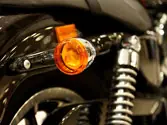
Una motocicleta, ¿puede disponer de señal de emergencia?
May a motorcycle have hazard warning lights?
- ASí.Yes.
- BNo.No.
- CSí, sólo cuando es de más de 125 centímetros cúbicos.Yes, but only if it is over 125 cc.
ExplanationHazard warning lights are used to warn other drivers and road users of the temporary danger caused by a vehicle affected by some emergency. They are optional on motorcycles.
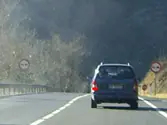
Si circulando con niebla no usamos el alumbrado antiniebla, ¿qué alumbrado usaremos?
If we are driving in fog and do not use the fog lights, which lights will we use?
- AEl de posición o el de corto alcance.The sidelights or dipped headlights.
- BEl de posición y el de corto alcance.The sidelights and dipped headlights.
- CSolo el de posición con el de largo alcance.Only the sidelights with main beam.
ExplanationWhen driving in fog that is not dense, we will use at least the sidelights and dipped headlights. We may use main beam, but it is better not to.
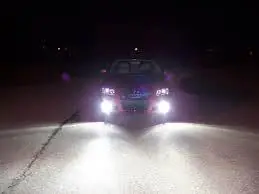
En una calzada recta sin condiciones meteorológicas adversas, ¿es correcto el alumbrado que utiliza este vehículo?
On a straight carriageway with no bad weather, is this vehicle using the correct lights?
- ASí, si la calzada es estrecha.Yes, if the carriageway is narrow.
- BSí, en cualquier caso.Yes, in any case.
- CNo.No.
ExplanationThe vehicle has its front fog lights on without any need. They may only be used in fog, heavy rain, snowfall, smoke or dust, or on narrow roads with many bends that are signposted. On a straight carriageway in good weather they are not allowed.
All topics
- Definitions
- Documents and penalty points
- The driver's condition
- Duties of drivers and pedestrians
- Vehicle safety devices
- Vehicle controls and equipment
- Traffic signs, markings and signals
- The road and its lanes
- Speed and distances
- Manoeuvres
- Right of way
- Carrying passengers and loads
- Driving safely in difficult conditions
- Vehicle mechanics and maintenance
- Road accidents and first aid
- Defensive and eco-driving
Independent app: not affiliated with or endorsed by the DGT (Spain's Directorate-General for Traffic) or the Ministry of the Interior. The official exam is booked with the DGT and taken at its test centres. The questions here are practice material; the DGT's official question bank is not public.
Basado en datos de la Agencia Estatal Boletín Oficial del Estado (https://www.boe.es). Textos consolidados de carácter meramente informativo. La AEBOE no patrocina ni respalda este sitio.
Parte de las preguntas procede de los tests de la revista «Tráfico y Seguridad Vial» de la DGT, reproducidos con indicación de la fuente.