
DGT test · 839 questions
Vehicle lights and horn · Page 15 of 17
Side, dipped, main-beam, fog and hazard lights, and the horn: when each one is compulsory and when it is forbidden.
Questions in this topic, with answers
839 questions, 50 per page, with the correct answer and the explanation. Page 15 of 17.
Circulando con lluvia intensa, ¿es obligatorio utilizar algún alumbrado?
When driving in heavy rain, must you use any lights?
- ASolamente durante la noche.Only at night.
- BSí.Yes.
- CSí, es obligatorio el alumbrado delantero antiniebla.Yes, the front fog light is compulsory.
ExplanationIn heavy rain we will use at least dipped headlights, and we may use the front fog light.
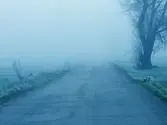
¿Qué luces antiniebla es obligatorio llevar con niebla densa durante el día?
Which fog lights must you use in dense fog during the day?
- ALuz antiniebla trasera.The rear fog light.
- BLuz antiniebla delantera.The front fog light.
- CLuz antiniebla delantera y trasera.The front and rear fog lights.
ExplanationThe only compulsory fog light is the rear one, and it must be used by day and by night when weather conditions are especially bad, such as VERY heavy rain, dense fog, heavy snowfall or clouds of dust or thick smoke. Front fog lights are optional. If our vehicle has them, it is correct to switch them on in weather that reduces visibility (heavy rain, fog, snowfall or clouds of smoke or dust). If it does not have them, we must use dipped headlights.
Si estaciona un coche en línea en el arcén de una travesía poco iluminada, ¿qué luces debe dejar encendidas?
If you park a car parallel to the road on the hard shoulder of a poorly lit travesía (stretch of road through a town), which lights must you leave on?
- ALas luces de posición y las luces de cruce.The sidelights and dipped headlights.
- BLas dos luces de posición del lado correspondiente a la calzada o las luces de estacionamiento.The two sidelights on the carriageway side, or the parking lights.
- CLas luces de estacionamiento y las luces de emergencia.The parking lights and hazard warning lights.
ExplanationAt night, a vehicle parked in a travesía that is not well enough lit must have its sidelights on; they may be replaced by the parking lights, or by the two sidelights on the carriageway side if it is parked parallel to the road (Article 105.2 of the General Traffic Regulations).
En caso de lluvia intensa, ¿es obligatorio llevar las luces del vehículo encendidas?
In heavy rain, is it compulsory to have the vehicle's lights on?
- ASí.Yes.
- BNo.No.
- CSolo entre la puesta y la salida del sol.Only between sunset and sunrise.
ExplanationUnder Article 106 of the RGC, when heavy rain or other conditions noticeably reduce visibility, you must have your lights on at any time of day: dipped headlights, main beam or the front fog light, as well as the sidelights. Not doing so is a serious offence.
Si su vehículo queda detenido de día en una autopista por avería, ¿qué luces debe encender?
If your vehicle breaks down and stops on an autopista (motorway) during the day, which lights must you switch on?
- ASolamente la luz de posición.Only the sidelights.
- BLuces de emergencia.Hazard warning lights.
- CPosición y largas.Sidelights and main beam.
ExplanationIf your vehicle stops on an autopista because of a breakdown, you must switch on the hazard warning lights to warn other drivers of the obstacle and make things safer. If the vehicle has no hazard warning lights, you must use at least the sidelights. This lets other drivers see the vehicle from far away and slow down, avoiding possible accidents. Switching on only the sidelights or main beam is not enough, because they do not do the same job of signalling a danger.
Circulando con niebla espesa, ¿qué alumbrado antiniebla deberemos utilizar?
When driving in dense fog, which fog lights must we use?
- AUsaremos obligatoriamente tanto el alumbrado delantero como el trasero antiniebla.We must use both the front and the rear fog lights.
- BEl uso del alumbrado antiniebla, tanto delantero como trasero, es opcional.Using the fog lights, front and rear, is optional.
- CUsaremos obligatoriamente el alumbrado trasero antiniebla y opcionalmente podremos usar el delantero.We must use the rear fog light, and we may also use the front one if we wish.
ExplanationFRONT FOG LIGHT: - Fitting and using it are NOT compulsory. - It must be white or selective yellow. - It may be used, voluntarily, in fog, heavy rain, snowfall, clouds of smoke or dust, or similar conditions. - It may also be used on narrow roads with many bends, that is, roads with a carriageway 6.5 m wide or less that are signposted with ‘dangerous bends’ signs. REAR FOG LIGHT: - Fitting and using it are compulsory. - It must be red. - It must be used in DENSE fog, VERY heavy rain, HEAVY snowfall or THICK clouds of smoke or dust. During the day, the front fog light may be on with just the sidelights, but it may also be used together with dipped headlights or main beam. At night, it must be used at least with dipped headlights. During the day, the rear fog light must be used at least together with the front fog light or dipped headlights. At night, at least with dipped headlights.
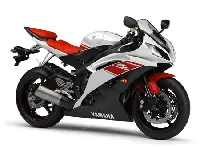
Una motocicleta circulando durante el día, ¿cuándo debe llevar las luces de cruce encendidas?
When must a motorcycle being ridden during the day have its dipped headlights on?
- ACuando circule por cualquier vía pública.When riding on any public road.
- BCuando circule por túneles y tramos de vía afectados por la señal de túnel,únicamente.Only when riding in tunnels and on stretches of road covered by the tunnel sign.
- CSólo cuando circule de noche o en condiciones meteriológicas adversas.Only when riding at night or in bad weather.
ExplanationUnder Article 104 of the General Traffic Regulations, motorcycles must have their dipped headlights on during the day whenever they are on any public road, not only in tunnels or in bad weather. This makes them easier to see in traffic.
En un ciclomotor de tres ruedas, ¿es obligatorio llevar instalada la luz de carretera?
Must a three-wheeled moped have main beam fitted?
- ASí, cuando el ciclomotor disponga de carrocería cerrada.Yes, when the moped has a closed body.
- BNo, es opcional.No, it is optional.
- CSí, siempre.Yes, always.
ExplanationThe correct answer is ‘No, it is optional’, because main beam is not compulsory on a three-wheeled moped.
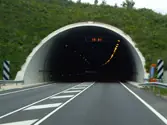
Al circular por un túnel, ¿qué alumbrado usaremos como mínimo?
When driving through a tunnel, which lights will we use at least?
- AEl de posición o el de corto alcance.The sidelights or dipped headlights.
- BEl de posición con el de corto alcance.The sidelights with dipped headlights.
- CEl de posición con el de largo alcance.The sidelights with main beam.
ExplanationWhen driving through a tunnel we will use at least the sidelights with dipped headlights.
¿Podrá usarse el alumbrado de antiniebla trasero en caso de niebla ligera?
May the rear fog light be used in light fog?
- ANo.No.
- BSí, pero solo durante la noche.Yes, but only at night.
- CSí.Yes.
ExplanationThe rear fog light should be switched on only when weather or environmental conditions are especially bad.
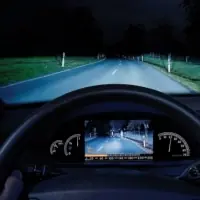
¿Con qué otra luz se utilizan simultáneamente la luz de largo alcance y la luz de cruce?
Main beam and dipped headlights are always used together with which other light?
- ACon la luz de estacionamientoThe parking light
- BCon la de la placa posterior de la matriculaThe rear number plate light
- CCon la luz de frenadoThe brake light
ExplanationMain beam may be used on its own or together with dipped headlights, and it must always work together with the sidelights and the rear number plate light.
¿Cuando el semáforo cambia a verde, podemos hacerle advertencias acústicas al vehículo que nos precede para que reanude la marcha?
When the traffic light turns green, may we sound the horn at the vehicle in front to make it move off?
- ASí, con un toque breve de claxon.Yes, with a short beep of the horn.
- BNo, dentro de poblado.No, not in a built-up area.
- CNo.No.
ExplanationYou may only use the horn to avoid a possible accident, to warn outside built-up areas that you intend to overtake, and to let other road users know that you are on an emergency call in a vehicle that is not a priority vehicle.
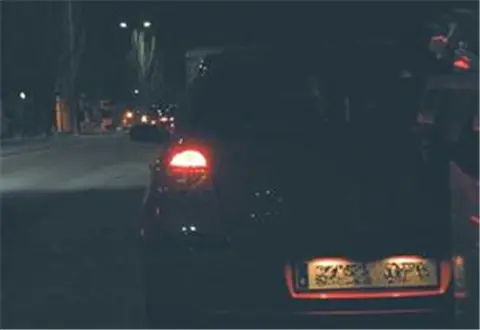
¿Qué alumbrado debe llevar encendido si circula de noche por una travesía insuficientemente iluminada?
Which lights must you have on if you are driving at night through an insufficiently lit travesía (stretch of road through a town)?
- ALa luz de posición y la de largo alcance.The sidelights and main beam.
- BLuz de posición y la de corto alcance.The sidelights and dipped headlights.
- CLa luz de posición, únicamente.Only the sidelights.
ExplanationA travesía is a stretch of road inside a built-up area. At night and with insufficient lighting you must have the sidelights and dipped headlights on; main beam is only used outside built-up areas.
Por una travesía insuficientemente iluminada, ¿con qué alumbrado circularemos?
On an insufficiently lit travesía (stretch of road through a town), which lights will we drive with?
- ACon las luces de corto alcance.With dipped headlights.
- BCon las luces de corto alcance o largo alcance, según las circunstancias.With dipped headlights or main beam, depending on the circumstances.
- CCon la luz de posición o corto alcance.With the sidelights or dipped headlights.
ExplanationWhen driving through an insufficiently lit travesía, because it is inside a built-up area, we will use the sidelights together with dipped headlights; main beam is prohibited.
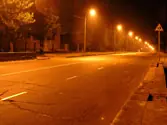
Si circula de noche por una vía urbana, ¿qué alumbrado debe utilizar?
If you are driving at night on an urban road, which lights must you use?
- AEl de largo alcance.Main beam.
- BSólo el de posición.Only the sidelights.
- CEl de corto alcance.Dipped headlights.
ExplanationEvery motor vehicle driving between sunset and sunrise on urban roads, travesías and sufficiently lit roads outside built-up areas, and on insufficiently lit urban roads and travesías, must use dipped headlights. Main beam is prohibited when the vehicle is stopped or parked, or inside a built-up area.
En caso de avería de uno de los dispositivos de alumbrado del vehículo, ¿puede circular de noche con un alumbrado de intensidad inferior?
If one of the vehicle's lights breaks down, may you drive at night with a weaker light?
- ASí, pero deberá reducir la velocidad hasta la que permita detener el vehículo dentro de la zona iluminada.Yes, but you must slow down to a speed that lets you stop the vehicle within the lit area.
- BSí, puede continuar hasta el taller más próximo.Yes, you may continue to the nearest garage.
- CNo, no podrá continuar el viaje.No, you may not continue your journey.
ExplanationIf the lights we should be using break down while driving and we have to use weaker ones, we may drive at night in these conditions as long as we adapt our speed so that we can stop the vehicle within the lit area.
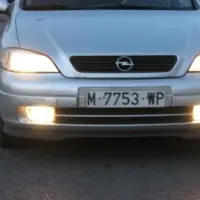
¿Podrá utilizarse simultáneamente la luz de corto alcance y la antiniebla delantera?
May dipped headlights and the front fog light be used at the same time?
- AÚnicamente en caso de condición atmosférica adversaOnly in bad weather
- BSi, se deben utilizar siempre a la vezYes, they must always be used together
- CNo, está prohibido en todo casoNo, it is always prohibited
ExplanationThe front fog light may be used on its own or together with dipped headlights, and it is used with them only in bad weather or when the driver's visibility is reduced (a series of dangerous bends, for example). When visibility is good we must not use the front fog light.
Si un vehículo circula bajo una nevada intensa que dificulta la visibilidad, utilizando las luces de niebla, tanto delantera como posterior, ¿actúa correctamente?
A vehicle is driving in heavy snowfall that makes it hard to see, using both the front and the rear fog lights. Is it doing the right thing?
- ASí, puede utilizar ambas luces.Yes, it may use both lights.
- BNo, sólo podría utilizar la luz de niebla delantera.No, it could only use the front fog light.
- CBajo una nevada intensa está prohibido utilizar tanto la luz de niebla delantera como la posterior.In heavy snowfall, using both the front and the rear fog lights is prohibited.
ExplanationArticle 106 of the General Traffic Regulations allows the front fog light in snowfall, and the rear one in especially bad conditions, such as heavy snowfall. In heavy snowfall that makes it hard to see, both may be used.
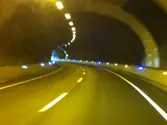
Si circula por un túnel suficientemente iluminado, ¿qué alumbrado debe utilizar?
If you are driving through a sufficiently lit tunnel, which lights must you use?
- AEl alumbrado de posición y el de corto alcance.The sidelights and dipped headlights.
- BSolamente el alumbrado de posición.Only the sidelights.
- CEl alumbrado de largo alcance.Main beam.
ExplanationAccording to Article 101 of the General Traffic Regulations, in a sufficiently lit tunnel you must have the sidelights and dipped headlights on, at any time of day. Main beam is only used in insufficiently lit tunnels and when there is no risk of dazzling.
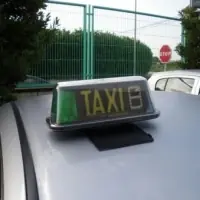
¿Cuál es la finalidad del alumbrado indicador de taxi?
What is the purpose of a taxi's sign light?
- AIndicar que el vehículo está ocupadoTo show that the vehicle is occupied
- BIndicar que están en condiciones de ser alquiladosTo show that it is available for hire
- CIndicar que se trata de un auto-taxiTo show that it is a taxi
ExplanationThe compulsory ‘free’ (libre) light on a taxi shows people who may want a taxi that it is available for hire to take them where they need to go.
Circulando por una travesía insuficientemente iluminada, ¿qué alumbrado utilizaremos?
When driving through an insufficiently lit travesía (stretch of road through a town), which lights will we use?
- APosición y largo alcance si no hay peligro de deslumbrar a otros usuarios de la vía.Sidelights and main beam, if there is no danger of dazzling other road users.
- BPosición y corto alcance.Sidelights and dipped headlights.
- CPosición con corto o largo alcance dependiendo de las circunstancias.Sidelights with dipped headlights or main beam, depending on the circumstances.
ExplanationA travesía is a road inside a built-up area, so main beam is prohibited there even if it is insufficiently lit. We will use the sidelights and dipped headlights.
La luz delantera antiniebla...
The front fog light...
- AEs de uso obligatorio siempre que exista niebla.must be used whenever there is fog.
- BEs de uso opcional.is optional.
- CEs obligatoria al igual que la posterior antiniebla.is compulsory, just like the rear fog light.
ExplanationUsing the front fog light is optional, and it is used, for example, in fog, heavy rain, snowfall, etc.
Con niebla, cuando el vehículo no dispone de alumbrado antiniebla delantero, ¿qué alumbrado debe utilizar?
In fog, when the vehicle has no front fog light, which lights must you use?
- ASólo el de corto alcance y el de largo alcance.Only dipped headlights and main beam.
- BEl de posición y las luces de emergencia.The sidelights and the hazard warning lights.
- CEl de posición junto con el de corto alcance.The sidelights together with dipped headlights.
ExplanationWhen we are driving and come to a stretch of road with fog, we must switch on the front fog light or dipped headlights or main beam. If the vehicle has no front fog light, we must switch on at least the sidelights together with dipped headlights.
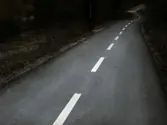
Si circula con su turismo durante la noche por una vía interurbana insuficientemente iluminada a menos de 40 km/h, ¿qué alumbrado podrá llevar encendido?
If you are driving your car at night on an insufficiently lit road outside built-up areas at less than 40 km/h, which lights may you have on?
- AÚnicamente el de largo alcance.Only main beam.
- BÚnicamente el de corto alcance.Only dipped headlights.
- CEl de largo o corto alcance.Main beam or dipped headlights.
ExplanationVehicles fitted with main beam must use it when travelling at more than 40 km/h: - Between sunset and sunrise, on insufficiently lit roads outside built-up areas. - At any time of day, in insufficiently lit tunnels, underpasses and stretches of road covered by the ‘tunnel’ sign. However, the following will use dipped headlights: - Vehicles that do not have main beam. - Vehicles using main beam that could dazzle other road users. At a speed of no more than 40 km/h, you may use dipped headlights or main beam. Main beam is prohibited when the vehicle is stopped or parked, or inside a built-up area. In this case, because you are not travelling at more than 40 km/h, main beam is optional, not compulsory.
¿Es obligatorio encender las luces de corto alcance para circular por un carril reversible al mediodía con luz solar?
Is it compulsory to switch on dipped headlights when driving in a reversible lane at midday in sunshine?
- ANo, de día solo es obligatorio si hay niebla o lluvia.No, during the day it is only compulsory if there is fog or rain.
- BSí, es obligatorio llevar encendida la luz de cruce tanto de día como de noche.Yes, dipped headlights must be on both by day and by night.
- CÚnicamente es obligatorio para motocicletas y vehículos pesados.It is only compulsory for motorcycles and heavy vehicles.
ExplanationIn reversible lanes, lanes opened in the opposite direction to normal and additional lanes, dipped headlights must be on 24 hours a day.
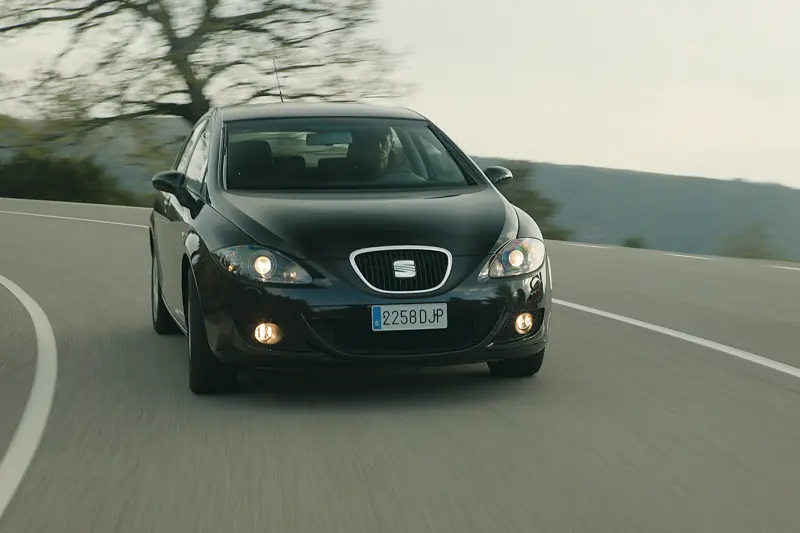
¿Qué indica la luz de posición de un vehículo?
What does a vehicle's sidelight show?
- AQue el vehículo está circulando.That the vehicle is moving.
- BEl lugar que ocupa el vehículo en la calzada y su anchura.Where the vehicle is on the carriageway and how wide it is.
- CQue el vehículo está parado.That the vehicle is stopped.
ExplanationThe sidelight is for being seen: it shows that the vehicle is there, where it is on the carriageway and how wide it is, whether it is moving or stopped.
El conductor de un coche debe trasladar a un enfermo en una emergencia; ¿qué luces debe llevar encendidas?
A car driver has to take a sick person somewhere in an emergency. Which lights must be on?
- ALas luces de emergencia.The hazard warning lights.
- BLas luces largas.The main beam.
- CLas luces de posición.The sidelights.
ExplanationUnder Article 70 of the General Traffic Regulations (RGC), a driver forced to carry out an emergency service in a vehicle that is not a priority vehicle must make themselves noticed by sounding the horn intermittently and using the hazard warning lights, or by waving a handkerchief. They have no priority: they must obey the traffic rules, especially at junctions.
¿Se puede usar el claxon en vías con tráfico denso?
May you use the horn on roads with heavy traffic?
- ASí, pero solo fuera de zonas urbanas.Yes, but only outside urban areas.
- BSí, pero solo dentro de zonas urbanas.Yes, but only inside urban areas.
- CNo, excepto si es estrictamente necesario.No, unless it is strictly necessary.
ExplanationArticle 110 of the RGC only allows the horn to be used exceptionally, for example to avoid a possible accident, and prohibits using it without reason or excessively. A traffic jam or heavy traffic is no reason to sound it.
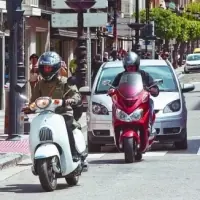
¿Cuándo tiene que encender una motocicleta el alumbrado de corto alcance durante el día?
When must a motorcycle switch on its dipped headlight during the day?
- ACuando conduce en cualquier vía pública.When riding on any public road.
- BSolamente si conduce por un túnel y en tramos que son afectados por la señal vertical de túnel.Only when riding through a tunnel and on stretches covered by the ‘tunnel’ road sign.
- CSolamente si conduce de noche o en condiciones meteorológicas desfavorables.Only when riding at night or in bad weather.
ExplanationA motorcycle must have its dipped headlight on during the day whenever it is on any public road. This is a compulsory safety measure that makes it more visible to other road users and so reduces the risk of accidents. Although lights are also needed in specific conditions such as tunnels or bad weather, using them is compulsory at all times during the day.
Las luces de corto alcance o de cruce, ¿pueden deslumbrar en algún caso?
Can dipped headlights ever dazzle?
- ANo, sólo pueden deslumbrar las luces de largo alcance o de carretera.No, only main beam can dazzle.
- BSí, pueden deslumbrar si están mal regladas.Yes, they can dazzle if they are badly aimed.
- CNo, sólo deslumbran las luces de largo alcance y las posteriores antiniebla.No, only main beam and rear fog lights dazzle.
ExplanationDipped headlights do not dazzle other road users, but if they were badly aimed they could dazzle, so we may not drive with badly aimed lights.
Si estacionamos en una vía urbana suficientemente iluminada, ¿qué alumbrado utilizaremos?
If we park on a sufficiently lit urban road, which lights will we use?
- ANinguno.None.
- BEl de posición.The sidelights.
- CEl de estacionamiento.The parking lights.
ExplanationWhen parking on a sufficiently lit urban road, we do not need to use any lights.
No está permitido utilizar las luces de carretera cuando...
You are not allowed to use main beam when…
- Alas luces de cruce están encendidas.the dipped headlights are on.
- Bpueden deslumbrar a otros usuarios.it may dazzle other road users.
- Clas luces de posición están encendidas.the sidelights are on.
ExplanationArticle 102 of the General Traffic Regulations requires you to switch from main beam to dipped headlights as soon as it may dazzle other road users, both those coming towards you and those driving in front of you. Having the dipped headlights or sidelights on at the same time does not prevent its use (Article 100).
Al conducir con lluvia intensa, ¿es obligatorio usar la luz antiniebla trasera?
When driving in heavy rain, is it compulsory to use the rear fog light?
- ASí, la trasera y la delantera.Yes, the rear and the front one.
- BSí.Yes.
- CNo.No.
ExplanationThe rear fog light is only switched on in especially unfavourable conditions: thick fog, very heavy rain, heavy snowfall or dense clouds of dust or smoke (Article 106.2 of the General Traffic Regulations). In heavy rain, dipped headlights, main beam or the front fog light are enough.
¿Qué alumbrado deberá utilizar si circula con su turismo de noche por una vía interurbana insuficientemente iluminada, a más de 40 km/h, sin riesgo de deslumbrar a otros usuarios?
Which lights must you use if you are driving your car at night on an insufficiently lit road outside built-up areas, at more than 40 km/h, with no risk of dazzling other road users?
- AEl de largo alcance.Main beam.
- BEl de corto alcance.Dipped headlights.
- COpcionalmente el de largo o corto alcance.Main beam or dipped headlights, as you choose.
ExplanationWhen driving at night on an insufficiently lit road outside built-up areas at more than 40 km/h, you must use main beam (also called high beam). This light lets the driver see further along the road, which is essential to spot any obstacle or danger early enough and react in time. Main beam is especially important in these conditions, because visibility is reduced and reaction time is crucial at higher speeds. However, you must make sure you do not dazzle other road users; if there is a risk of dazzling, you must switch to dipped headlights.
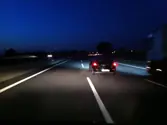
¿Qué alumbrado utilizaremos? Circulando por una vía fuera de poblado insuficientemente iluminada, al cruzarse con otro vehículo.
When driving on an insufficiently lit road outside built-up areas and meeting another vehicle coming the other way, which lights will we use?
- AAlumbrado de posición solamente.Only the sidelights.
- BAlumbrado de corto alcance.Dipped headlights.
- CAlumbrado de largo alcance o carretera.Main beam.
ExplanationWhen driving on an insufficiently lit road outside built-up areas we must use main beam, and switch to dipped headlights when we expect we could dazzle other road users.
Circulando por una vía interurbana insuficientemente iluminada a menos de 40 km/h, ¿qué alumbrado usaremos?
When driving on an insufficiently lit road outside built-up areas at less than 40 km/h, which lights will we use?
- AEl alumbrado de largo alcance o carretera, obligatoriamente.Main beam, as a requirement.
- BEl alumbrado de corto alcance, como mínimo.At least dipped headlights.
- CEl alumbrado de posición, como mínimo.At least the sidelights.
ExplanationWhen we drive on an insufficiently lit road outside built-up areas at no more than 40 km/h, we may use dipped headlights instead of main beam.
¿Qué luces debe mantener encendidas un vehículo estacionado por la noche en el arcén de una travesía poco iluminada?
Which lights must a vehicle parked at night on the hard shoulder of a poorly lit travesía (stretch of road through a town) keep on?
- ANinguna, porque está estacionado en un poblado.None, because it is parked in a built-up area.
- BLas luces de carretera y las luces de emergencia.The main beam and the hazard warning lights.
- CLas luces de posición, que pueden sustituirse por las de estacionamiento.The sidelights, which may be replaced by the parking lights.
ExplanationUnder Article 105.2 of the General Traffic Regulations (RGC), a vehicle stopped or parked at night in an insufficiently lit travesía must have its sidelights on, which may be replaced by the parking lights. Being in a built-up area does not exempt it.
Las luces de emergencia se deben utilizar...
Hazard warning lights must be used...
- AAl realizar una parada en doble fila.when stopping in double file.
- BAl dar marcha atrás.when reversing.
- CAl detenerse dentro de un túnel.when stopping inside a tunnel.
ExplanationHazard warning lights are used to warn of a danger caused by a stopped vehicle, for example when it is immobilised inside a tunnel or on an autopista (motorway). They do not make double-file stopping acceptable, and they are not used to show that you are reversing, which has its own light.
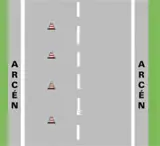
Un vehículo que circula por un carril adicional, ¿está obligado a llevar algún tipo de alumbrado?
A vehicle driving in an additional lane: must it have any lights on?
- ASí, la luz de corto alcance.Yes, dipped headlights.
- BSí, la luz de corto alcance, pero no está obligado cuando circula de día.Yes, dipped headlights, but not when driving during the day.
- CSí, luces de posición.Yes, sidelights.
ExplanationAccording to Article 104 of the General Traffic Regulations, anyone driving in a temporary additional lane, a reversible lane or in the opposite direction to normal must have dipped headlights on, also during the day, so that oncoming traffic can see them.
No está permitido utilizar la luz de largo alcance cuando...
You are not allowed to use main beam when...
- Aestá encendida la luz de corto alcance .dipped headlights are on.
- Bpueda deslumbrar a otros usuarios.it could dazzle other road users.
- Cestá encendida la luz de posición.the sidelights are on.
ExplanationMain beam is prohibited when it could dazzle other drivers or users of the same road, or of any other transport route, coming in the opposite direction, or drivers of vehicles going in the same direction. If it could dazzle, main beam must be replaced by dipped headlights. Main beam is also prohibited: - In built-up areas. - When the vehicle is stopped or parked.
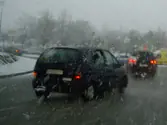
Circula por una vía interurbana y observa que nieva de forma ligera, ¿puede emplear el alumbrado antiniebla?
You are driving on a road outside built-up areas and it is snowing lightly. May you use fog lights?
- ASí, debe usar obligatoriamente las luces antiniebla traseras.Yes, you must use the rear fog lights.
- BSí, pero sólo las luces antiniebla delanteras, ya que las traseras están prohibidas en este caso.Yes, but only the front fog lights, because the rear ones are prohibited in this case.
- CNo, está prohibido usar las luces antiniebla cuando la nevada es ligera.No, fog lights are prohibited when the snowfall is light.
ExplanationFRONT FOG LIGHT: - Fitting and using it are NOT compulsory. - It must be white or selective yellow. - It may be used, voluntarily, in fog, heavy rain, snowfall, clouds of smoke or dust, or similar conditions. - It may also be used on narrow roads with many bends, that is, roads with a carriageway 6.5 m wide or less that are signposted with ‘dangerous bends’ signs. REAR FOG LIGHT: - Fitting and using it are compulsory. - It must be red. - It must be used in DENSE fog, VERY heavy rain, HEAVY snowfall or THICK clouds of smoke or dust. During the day, the front fog light may be on with just the sidelights, but it may also be used together with dipped headlights or main beam. At night, it must be used at least with dipped headlights. During the day, the rear fog light must be used at least together with the front fog light or dipped headlights. At night, at least with dipped headlights.
El alumbrado, ¿es un sistema de seguridad del vehículo?
Is lighting a vehicle safety system?
- ASí, es un sistema de seguridad activa.Yes, an active safety system.
- BSí, es un sistema de seguridad pasiva.Yes, a passive safety system.
- CNo, sólo se utiliza para ver y ser vistos.No, it is only used to see and be seen.
ExplanationYes. Lighting is an active safety feature, because it helps prevent accidents: it lets you see the road and be seen by others. Passive safety features, such as the seat belt or the airbag, act once the accident has already happened.
Circulando de día y con lluvia muy intensa, ¿está permitido circular con el alumbrado de largo alcance?
When driving during the day in very heavy rain, are you allowed to drive with main beam?
- ANo, sólo podrá utilizarse durante la noche.No, it may only be used at night.
- BSí, pero es preferible utilizar la de corto alcance.Yes, but it is better to use dipped headlights.
- CNo, porque con lluvia muy intensa está prohibido su uso.No, because in very heavy rain it is prohibited.
ExplanationIn very heavy rain main beam is not prohibited, but it is advisable to use dipped headlights.
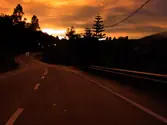
¿Durante la noche se podrá circular únicamente con el alumbrado de posición?
At night, may you drive with only the sidelights?
- ASí, en vías dentro de poblado suficientemente iluminadas.Yes, on sufficiently lit roads inside built-up areas.
- BNo, irá siempre acompañada como mínimo del alumbrado de corto alcance o cruce.No, they must always go with at least dipped headlights.
- CSí, ocasionalmente cuando se estropee el alumbrado de corto alcance.Yes, occasionally, when the dipped headlights break down.
ExplanationYou may never drive with only the sidelights; they must always go with dipped headlights, main beam or the front fog light.
¿Qué dispositivos de alumbrado deberá llevar un VMP?
Which lighting devices must a personal mobility vehicle (PMV, e-scooter) have?
- AEstos vehículos no deben llevar ningún dispositivo de alumbrado.These vehicles do not need any lighting devices.
- BDispositivo de iluminación, blanco delante y rojo por detrás, además de catadióptricos reflectante blanco por delante, amarillo auto por los lados y rojo por detrás.A white light at the front and a red one at the rear, plus reflectors: white at the front, amber on the sides and red at the rear.
- CÚnicamente, catadióptricos reflectante a ambos lados.Only reflectors on both sides.
ExplanationPersonal mobility vehicles must have a lighting device, white at the front and red at the rear. They must also have reflectors: white at the front, red at the rear and amber or white on both sides.
¿Es obligatorio que los ciclomotores dispongan de luz de frenado?
Must mopeds have a brake light?
- ANo es obligatoria para ningún ciclomotor pues las indicaciones se pueden hacer con el brazo.It is not compulsory for any moped, because signals can be given with the arm.
- BEs obligatoria para los ciclomotores puestos en circulación a partir del 01-11-99 y opcional para los puestos en circulación antes de dicha fecha.It is compulsory for mopeds first registered from 1 November 1999 and optional for those registered before that date.
- CSí, es obligatoria para todos los ciclomotores.Yes, it is compulsory for all mopeds.
ExplanationThe correct answer is that it is compulsory for mopeds first registered from 1 November 1999 and optional for those registered before that date. This is because the rules say that mopeds manufactured from 1 November 1999 must have a brake light. However, for mopeds manufactured before that date, the brake light is optional and signals for changing direction can be given with the arm.
¿Qué alumbrado utilizará una motocicleta durante el día?
Which lights will a motorcycle use during the day?
- ADurante el día no será necesario que utilice ningún alumbrado.During the day it will not need any lights.
- BLas motocicletas usarán en todo caso el alumbrado de corto alcance o cruce como mínimo.Motorcycles will always use at least the dipped headlight.
- CEl alumbrado de posición, como mínimo.At least the sidelight.
ExplanationMotorcycles must always use at least the dipped headlight, by day and by night.
¿En qué parte del vehículo deben estar situadas las luces de marcha atrás?
Where on the vehicle must the reversing lights be?
- AEn la parte posteriorAt the rear
- BEn los laterales del vehículoOn the sides of the vehicle
- CEn la parte delanteraAt the front
ExplanationThe reversing light is at the rear of the vehicle, and its job is to warn other road users that we intend to reverse.
Al circular por un túnel fuera de poblado suficientemente iluminado, ¿qué alumbrado llevaremos?
When driving through a sufficiently lit tunnel outside a built-up area, which lights will we have on?
- APosición.Sidelights.
- BLuz de carretera o de cruce.Main beam or dipped headlights.
- CPosición y cruce.Sidelights and dipped headlights.
ExplanationWhen driving through a sufficiently lit tunnel outside a built-up area, we will use the sidelights and dipped headlights. If the tunnel were insufficiently lit, we would use the sidelights with main beam, if there is no chance of dazzling another road user.
Una motocicleta de 125 cm³, ¿qué alumbrado llevará encendido durante el día?
Which lights will a 125 cc motorcycle have on during the day?
- AEl de posición o de corto alcance.The sidelight or the dipped headlight.
- BEl de posición y corto alcance.The sidelight and the dipped headlight.
- CSolo el alumbrado de posición.Only the sidelight.
ExplanationAll motorcycles, whatever their engine size, must always have at least the sidelight on together with the dipped headlight.
All topics
- Definitions
- Documents and penalty points
- The driver's condition
- Duties of drivers and pedestrians
- Vehicle safety devices
- Vehicle controls and equipment
- Traffic signs, markings and signals
- The road and its lanes
- Speed and distances
- Manoeuvres
- Right of way
- Carrying passengers and loads
- Driving safely in difficult conditions
- Vehicle mechanics and maintenance
- Road accidents and first aid
- Defensive and eco-driving
Independent app: not affiliated with or endorsed by the DGT (Spain's Directorate-General for Traffic) or the Ministry of the Interior. The official exam is booked with the DGT and taken at its test centres. The questions here are practice material; the DGT's official question bank is not public.
Basado en datos de la Agencia Estatal Boletín Oficial del Estado (https://www.boe.es). Textos consolidados de carácter meramente informativo. La AEBOE no patrocina ni respalda este sitio.
Parte de las preguntas procede de los tests de la revista «Tráfico y Seguridad Vial» de la DGT, reproducidos con indicación de la fuente.