
DGT test · 961 questions
Speed and distances · Page 9 of 20
Speed limits by road and vehicle type, adapting speed to conditions, safe following distance and stopping distance.
Questions in this topic, with answers
961 questions, 50 per page, with the correct answer and the explanation. Page 9 of 20.
¿Es importante no conducir a más de 50 km/h en la ciudad?
Is it important not to drive at more than 50 km/h in town?
- ANo, especialmente en calles y avenidas anchas.No, especially on wide streets and avenues.
- BSí, pero sólo para evitar ser sancionado por exceso de velocidad.Yes, but only to avoid a fine for speeding.
- CSí, para que, en caso de atropello, el peatón tenga más posibilidades de sobrevivir.Yes, so that if a pedestrian is hit they have a better chance of surviving.
ExplanationIn town the general limit is 50 km/h on roads with two or more lanes in each direction, 30 km/h with a single lane in each direction and 20 km/h on single-level (shared) streets (Article 50.1 of the General Traffic Regulations). Keeping to these limits protects pedestrians above all: their chance of surviving being hit falls sharply as speed increases.
Cuando un vehículo no pueda alcanzar la velocidad mínima y exista peligro de alcance deberá...
When a vehicle cannot reach the minimum speed and there is a risk of being hit from behind, it must...
- ADetenerse inmediatamente en el arcén.Stop immediately on the hard shoulder.
- BUtilizar las luces de emergencia.Use the hazard warning lights.
- CSeguir circulando siempre por el arcén.Always keep travelling on the hard shoulder.
ExplanationWhen a vehicle cannot reach the minimum speed limit of the road it is on and there is a risk of other vehicles hitting it from behind, it must use the hazard warning lights while it is moving.
¿Qué separación tendremos que mantener con el vehículo que nos precede circulando dentro de un túnel?
What gap must we keep from the vehicle in front when driving inside a tunnel?
- A100 metros como mínimo.At least 100 metres.
- B150 metros como máximo.No more than 150 metres.
- CLa que nos permita detenernos sin colisionar con el vehículo que nos precede.One that allows us to stop without hitting the vehicle in front.
ExplanationWhen driving inside a tunnel, we must keep a safe distance of at least 100 metres, or a gap of at least 4 seconds.
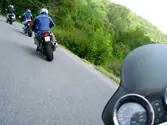
¿Qué distancia frontal de seguridad deberá mantener una motocicleta con el vehículo que le precede?
What safe distance in front must a motorcycle keep from the vehicle ahead?
- A1,5 metros, como mínimo.At least 1.5 metres.
- B100 metros, como mínimo.At least 100 metres.
- CUna distancia suficiente para poder detener el vehículo en caso de frenado brusco del vehículo que le precede.A distance long enough to stop the vehicle if the vehicle ahead brakes sharply.
ExplanationThe safe distance in front must be long enough for us to stop our vehicle if the vehicle ahead brakes sharply. Specifically in a tunnel, this distance must be at least 100 metres.
Una de las principales causas de accidente en personas jóvenes es...
One of the main causes of accidents among young people is...
- Ala falta de confianza en su capacidad de conducción.lack of confidence in their driving ability.
- Bla falta de reflejos.lack of reflexes.
- Cel exceso de velocidad.speeding.
ExplanationRoad accidents are the leading cause of death among people under 35 in Spain, and most of them are due to speeding.
Circulando por un paso inferior, cuando no se pretenda adelantar, ¿qué distancia de seguridad se tendrá que mantener entre vehículos?
When driving through an underpass, if you do not intend to overtake, what safe distance must be kept between vehicles?
- ALa que permita detenerse en caso de frenado brusco.One that allows you to stop if the vehicle in front brakes suddenly.
- BAl menos 100 metros.At least 100 metres.
- C150 metros.150 metres.
ExplanationIn tunnels and underpasses, when not intending to overtake, you must keep a distance of at least 100 metres. Vehicles with a maximum authorised mass (MAM) over 3,500 kg must keep 150 metres.
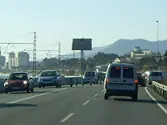
La distancia de seguridad con el vehículo que circula delante depende de...
The safe distance from the vehicle in front depends on...
- Ael tipo de vehículo que circula delante.the type of vehicle in front.
- Bla velocidad y las condiciones de adherencia y de frenado.speed, grip and braking conditions.
- Cla densidad del tráfico.traffic density.
ExplanationWhen driving behind another vehicle, you must leave a space that lets you stop without hitting it if it brakes suddenly, taking into account speed, grip and braking conditions. Also, if you are driving without signalling that you intend to overtake, this gap must let the vehicle behind you overtake you safely. For this purpose, drivers of vehicles with a MAM over 3,500 kg and of vehicles or combinations of vehicles more than 10 metres long must keep a minimum gap of 50 metres. A distance that simply avoids a collision is enough (you do not need to leave room to be overtaken): - In built-up areas. - Where overtaking is prohibited. - Where there is more than one lane in the same direction. - When traffic is congested. - When you intend to overtake.
Las condiciones meteorológicas, ¿influyen en la distancia de frenado?
Do weather conditions affect the braking distance?
- ANo.No.
- BNo, sólo depende de la velocidad.No, it depends only on speed.
- CSí.Yes.
ExplanationThe braking distance is the distance the vehicle travels from the moment the driver applies the brake until it stops. This distance can vary depending on the following factors: the speed of travel; the condition of the vehicle's tyres, suspension and brakes; the vehicle's load; the condition of the road surface; the weather conditions on the road.
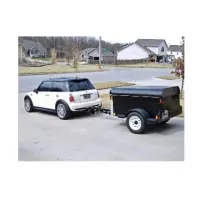
En poblado, en una vía con dos o más carriles por sentido, ¿cuál es la velocidad máxima permitida para un turismo con remolque?
In a built-up area, on a road with two or more lanes in each direction, what is the maximum speed allowed for a car towing a trailer?
- A60 kilómetros por hora.60 kilometres per hour.
- B40 kilómetros por hora.40 kilometres per hour.
- C50 kilómetros por hora.50 kilometres per hour.
ExplanationIn a built-up area the limit does not change because you are towing a trailer: the road's general limit applies, which is a maximum of 50 km/h on roads with two or more lanes in each direction, 30 km/h with a single lane and 20 km/h on single-level (shared) streets (Article 50 of the General Traffic Regulations). The 40 km/h limit is for vehicles carrying dangerous goods.
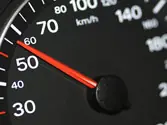
¿Cuál es una de las funciones del sistema ISA (Asistencia Inteligente de Velocidad)?
What is one of the functions of the ISA system (Intelligent Speed Assistance)?
- ADetectar las señales de límite de velocidad y advertir o adaptar la velocidad del vehículo a la señal.To detect speed limit signs and warn the driver or adapt the vehicle's speed to the sign.
- BSolamente mantener la velocidad establecida por el conductor.Only to keep the speed set by the driver.
- CAumentar automáticamente la velocidad si el conductor circula lentamente.To increase the speed automatically if the driver is driving slowly.
ExplanationThe ISA system (Intelligent Speed Assistance) is a driver aid that helps you keep to the legal speed limits. It uses cameras that detect traffic signs, especially speed limit signs. Depending on the type of system, it can warn the driver when they go over the limit or even adjust the vehicle's speed automatically. Even so, the driver can switch it off or override it at any time with a button.
Si encontramos a un peatón cruzando la calle por un paso no señalizado, ¿qué haremos?
If we find a pedestrian crossing the street at a place that is not a marked crossing, what should we do?
- ADetenernos y cederle el paso.Stop and give way to them.
- BReducir la velocidad, incluso detenernos, para no poner en peligro al peatón.Slow down, and even stop, so as not to put the pedestrian in danger.
- CPitar para avisarle y que se aparte.Sound the horn to warn them to move aside.
ExplanationAway from a pedestrian crossing, the pedestrian must make sure they can cross without risk (Article 124.2 of the General Traffic Regulations), but the driver must drive at a moderate speed and stop if necessary when there are pedestrians on the carriageway (Article 46.1.a). Sounding the horn to make them move aside is not justified.
¿Cuál será la velocidad máxima si circulamos con un vehículo mixto adaptable por una carretera convencional?
What is the maximum speed if we are driving an adaptable mixed-use vehicle on a conventional road?
- A90 km/h90 km/h
- B100 km/h100 km/h
- C80 km/h80 km/h
ExplanationUnder the table in Article 48.1.a of the General Traffic Regulations, buses, car-derived vans and adaptable mixed-use vehicles have a maximum of 90 km/h on conventional roads and 100 km/h on motorways (autopistas) and dual carriageways (autovías).
¿Cuál es la velocidad máxima de un camión de hasta 3500 kg circulando por una autopista?
What is the maximum speed for a lorry of up to 3,500 kg on a motorway (autopista)?
- A90 km/h.90 km/h.
- B80 km/h.80 km/h.
- C100 km/h.100 km/h.
ExplanationThe maximum speed allowed for a lorry, whatever its weight, is 90 km/h.
En una carretera convencional, ¿puede un motociclista rebasar la velocidad máxima genérica en alguna circunstancia?
On a conventional road, may a motorcyclist exceed the general maximum speed in any circumstances?
- ANo. Solo los coches pueden rebasarla para adelantar.No. Only cars may exceed it to overtake.
- BNo, en ningún caso.No, under no circumstances.
- CSí, para adelantar, en 20 km/h.Yes, by 20 km/h to overtake.
ExplanationOn a conventional road, the general limit for a motorcycle is 90 km/h, the same as for a car (Article 48.1.a of the General Traffic Regulations (RGC)). Since 21 March 2022, no vehicle may exceed the maximum speed in order to overtake.
Teniendo en cuenta las características de una carretera convencional, ¿qué velocidad máxima no debe rebasar si conduce un conjunto formado por un turismo y un remolque ligero?
Taking into account the features of a conventional road, what maximum speed must you not exceed if you drive a combination made up of a car and a light trailer?
- A90 kilómetros por hora.90 kilometres per hour.
- B80 kilómetros por hora.80 kilometres per hour.
- C70 kilómetros por hora.70 kilometres per hour.
ExplanationUnder Article 48.1.a) of the General Traffic Regulations, motor cars towing a trailer, whether light or not, may drive at up to 80 km/h on conventional roads and up to 90 km/h on motorways (autopistas) and dual carriageways (autovías).
La velocidad excesiva, ¿puede producir el efecto túnel?
Can excessive speed cause tunnel vision?
- ASíYes
- BNoNo
- CNo, solo se produce por el consumo de alcoholNo, it is only caused by drinking alcohol
ExplanationAt high speed your eyes focus on a distant point and your field of vision narrows, so you stop noticing objects at the sides: this is known as tunnel vision. Alcohol also causes it, but it is not the only cause.
¿Cuál es la velocidad máxima por construcción que no puede superar un cuatriciclo ligero?
What is the maximum design speed that a light quadricycle may not exceed?
- A70km/h.70 km/h.
- B45km/h.45 km/h.
- C40km/h.40 km/h.
ExplanationThe maximum speed that light quadricycles can reach by design must not exceed 45 km/h.
Aunque no se superen los límites de velocidad, ¿se puede conducir a una velocidad inadecuada?
Even if you do not exceed the speed limits, can you drive at an inappropriate speed?
- ANo, en ningún caso.No, never.
- BSí. La velocidad debe adaptarse a las condiciones de la vía, por ejemplo, la lluvia, la nieve o el hielo.Yes. Your speed must be adapted to road conditions, for example rain, snow or ice.
- CSí, si se circula a más de 100 km/h.Yes, if you drive at more than 100 km/h.
ExplanationArticle 45 of the General Traffic Regulations requires you to respect the limits and also to adapt your speed to the condition of the road, the weather and the traffic. In rain, snow or ice grip is reduced, and driving at the maximum limit may be an inappropriate speed.
La distancia de seguridad respecto al vehículo que nos precede será de...
The safe distance from the vehicle in front must be...
- AMás de 4 segundos.More than 4 seconds.
- BEntre 1 y 2 segundos.Between 1 and 2 seconds.
- CEntre 2 y 3 segundos.Between 2 and 3 seconds.
ExplanationWe must always keep a safe distance of at least 2 seconds from the vehicle in front in urban areas and 3 seconds on the open road. This safe distance lets us react and make the safest decision if something unexpected happens.
Al adelantar a un ciclista fuera de poblado, ¿qué distancia lateral mínima debes dejar?
When overtaking a cyclist outside a built-up area, what minimum lateral distance must you leave?
- A1 metro1 metre
- B1,5 metros1.5 metres
- C2 metros2 metres
ExplanationWhen overtaking cyclists or mopeds outside built-up areas, you must leave a lateral gap of at least 1.5 metres.
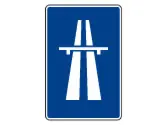
Si a causa de una avería circulamos a 50 km/h por una autopista dificultando la circulación, ¿qué tendremos que hacer?
If, because of a breakdown, we are driving at 50 km/h on a motorway (autopista) and obstructing traffic, what must we do?
- ADetenernos en el arcén.Stop on the hard shoulder.
- BCircular por el arcén y abandonar la autopista en la próxima salida.Drive on the hard shoulder and leave the motorway at the next exit.
- CCircular por el carril de la derecha y abandonar la autopista en la próxima salida.Drive in the right-hand lane and leave the motorway at the next exit.
ExplanationDrivers of vehicles with a maximum authorised mass (MAM) of no more than 3,500 kg who, for emergency reasons, drive at an abnormally low speed and so seriously disrupt traffic must drive on the hard shoulder on their right, if it is usable and wide enough. If it is not, they must use only the part of the carriageway that is strictly necessary. When we do not seriously disrupt traffic, we must drive in the right-hand lane. We warn other road users of this situation with our vehicle's hazard warning lights. When these drivers are on a motorway (autopista) or dual carriageway (autovía), they must leave it at the first exit.
¿Qué distancia mínima debemos mantener con el vehículo que va delante de nosotros en un túnel?
What minimum distance must you keep from the vehicle in front of you in a tunnel?
- ALa que nos permita frenar sin chocar con el vehículo que va delante de nosotros.One that lets you brake without hitting the vehicle in front of you.
- B100 metros como mínimo.At least 100 metres.
- C150 metros como mínimo.At least 150 metres.
ExplanationAccording to the General Traffic Regulations (RGC), in tunnels it is essential to keep a safe distance of at least 100 metres, or a minimum gap of four seconds, from the vehicle in front. This rule is meant to prevent collisions in such an enclosed space, where conditions can change quickly and it is essential to have enough room to brake in an emergency. If the vehicle behind does not keep this distance, it could cause an accident if the vehicle in front brakes suddenly.
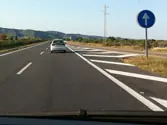
El vehículo que nos precede está circulando a 100 km/h, ¿le podremos adelantar?
The vehicle in front of us is travelling at 100 km/h. May we overtake it?
- ASí, pudiendo alcanzar los 120 km/h.Yes, and we may reach 120 km/h.
- BSí, pudiendo alcanzar los 110 km/h.Yes, and we may reach 110 km/h.
- CNo.No.
ExplanationAs the vehicle in front is already travelling at the maximum speed set for this road, we cannot overtake it by adding 20 km/h to the maximum speed.
La velocidad máxima para una furgoneta de hasta 3.500 kg de MMA circulando por una autopista será de...
The maximum speed for a van with a maximum authorised mass (MAM) of up to 3,500 kg travelling on a motorway (autopista) is...
- A100 km/h.100 km/h.
- B90 km/h.90 km/h.
- C80 km/h.80 km/h.
ExplanationLorries and vans, whatever their maximum authorised mass, may travel at a maximum speed of 90 km/h.
Si circula conduciendo su motocicleta por una travesía con dos carriles para cada sentido y que carece de arcenes, debe saber que no le está permitido rebasar la velocidad máxima de...
If you are riding your motorcycle through a travesía (stretch of road through a town) with two lanes in each direction and no hard shoulders, you must know that you are not allowed to exceed a maximum speed of...
- A100 km/h, porque es una vía interurbana.100 km/h, because it is a road outside built-up areas.
- B90 km/h, porque no tiene arcén.90 km/h, because it has no hard shoulder.
- C50 km/h.50 km/h.
ExplanationUnder Article 50.5 of the General Traffic Regulations, the general limit in travesías is 50 km/h for all types of vehicle, motorcycles included, whether the road has one or more lanes and with or without a hard shoulder.
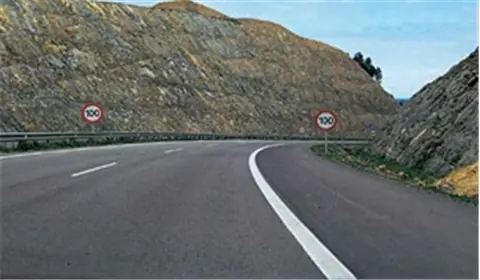
En este tramo de autovía, ¿se puede circular a más de 100 Km/h para adelantar?
On this stretch of dual carriageway (autovía), may you drive at more than 100 km/h to overtake?
- ANo.No.
- BSí, hasta 120 km/h.Yes, up to 120 km/h.
- CSolo turismos y motocicletas.Only cars and motorcycles.
ExplanationThe maximum speed signed on the stretch, in this case 100 km/h, may not be exceeded even to overtake. In addition, the old 20 km/h margin only existed on conventional roads and was abolished on 21 March 2022.
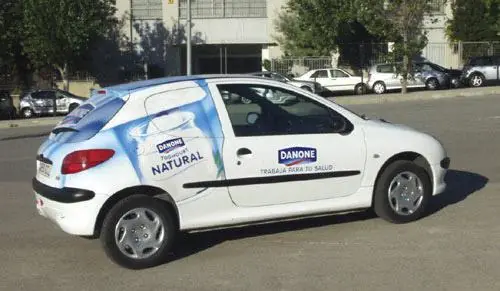
En una carretera convencional la velocidad máxima autorizada para un derivado de turismo es…
On a conventional road, the maximum speed allowed for a car-derived vehicle is…
- A90 km/h.90 km/h.
- B80 km/h.80 km/h.
- C100 km/h.100 km/h.
ExplanationUnder Article 48 of the General Traffic Regulations, on conventional roads car-derived vehicles may travel at a maximum of 90 km/h, the same as cars. On motorways (autopistas) and dual carriageways (autovías) their limit is 100 km/h.
¿Qué separación lateral deberemos de mantener al adelantar a un ciclomotor dentro de poblado?
What sideways gap must we keep when overtaking a moped in a built-up area?
- A1,5 m como mínimo.At least 1.5 m.
- BLa proporcional a la velocidad, anchura y características de la vía.One in proportion to the speed and to the width and features of the road.
- CNo podemos adelantar dentro de poblado.We may not overtake in a built-up area.
ExplanationUnder Article 85.4 of the General Traffic Regulations (RGC) (as worded by RD 518/2026), when overtaking a moped you must use part or all of the next lane or the opposite lane and leave a safety gap of at least 1.5 metres, also in built-up areas.
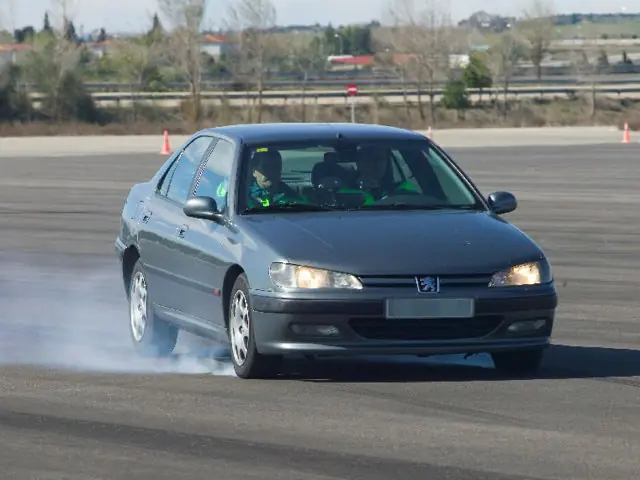
¿Qué es la distancia de detención?
What is stopping distance?
- ALa distancia que recorre el vehículo desde que el conductor pisa el freno hasta que se para el vehículo.The distance the vehicle travels from the moment the driver presses the brake until the vehicle stops.
- BLa distancia que recorre el vehículo desde que el conductor se da cuenta de un peligro hasta que pisa el freno.The distance the vehicle travels from the moment the driver notices a danger until they press the brake.
- CLa distancia que recorre el vehículo desde que el conductor se da cuenta de un peligro hasta que para el vehículo.The distance the vehicle travels from the moment the driver notices a danger until the vehicle stops.
ExplanationStopping distance is the sum of the reaction distance, travelled from the moment the danger is noticed until the brake is pressed, and the braking distance, travelled from the moment the brake is pressed until the vehicle stops.
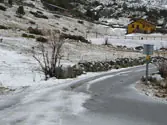
¿Cuánto se puede incrementar la distancia de frenado con hielo?
How much can braking distance increase on ice?
- A5 veces más.5 times more.
- B10 veces más.10 times more.
- CEl doble.Double.
ExplanationBraking distance is the distance the vehicle travels from the moment the driver applies the brake until the vehicle stops. This distance can vary depending on the speed, the condition of the tyres, suspension and brakes, the vehicle's load, the road conditions and the weather. On an icy road surface, braking distance can be up to 10 times longer. On a wet road surface, it can be up to double.
¿Se podrá circular por una autopista a una velocidad inferior a 60km/h?
May you drive on a motorway (autopista) at less than 60 km/h?
- ANo, en ningún caso se puede circular por debajo de la velocidad mínima.No, you may never drive below the minimum speed.
- BNo, ya que es una vía de circulación rápida.No, because it is a fast road.
- CSí, cuando existan condiciones meteorológicas que impidan superar esa velocidad.Yes, when weather conditions prevent you from going faster.
ExplanationUnder Article 49.2 of the General Traffic Regulations (RGC), you may drive below the minimum speed when traffic, vehicle or road conditions prevent you from keeping a higher speed without risk, as happens in thick fog, snow or traffic jams.
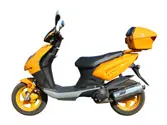
¿Cuál es la velocidad máxima permitida para un ciclomotor?
What is the maximum speed allowed for a moped?
- A40 km/h.40 km/h.
- B45 km/h.45 km/h.
- C50 km/h.50 km/h.
ExplanationAccording to Article 48.1.e of the General Traffic Regulations (RGC), two- and three-wheeled mopeds and light quadricycles may travel at a maximum of 45 km/h, which is the same as their maximum design speed. In built-up areas, the road's limit also applies if it is lower.
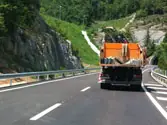
¿Cuál será la velocidad máxima de un turismo circulando por una carretera convencional con un carril por sentido?
What is the maximum speed for a car on a conventional road with one lane in each direction?
- A100 km/h.100 km/h.
- B90 km/h más 20 km/h para adelantar.90 km/h plus 20 km/h to overtake.
- C90 km/h.90 km/h.
ExplanationThe maximum speed for a car on a conventional road is 90 km/h.
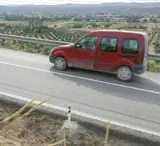
Como norma general, si circula por esta vía con una furgoneta cargada con bultos apilados, en caso de frenada de emergencia, ¿es importante tener en cuenta su masa y su volumen?
As a general rule, if you are driving on this road with a van loaded with stacked packages, is it important to take its mass and volume into account in an emergency stop?
- ASí, por lo que se debe mantener una mayor distancia de seguridad ya que la distancia de frenado es mayor.Yes, so you must keep a greater safe distance, because the braking distance is longer.
- BSí, porque al bajar el centro de gravedad resulta fácil derrapar y perder el control de la misma.Yes, because lowering the centre of gravity makes it easy to skid and lose control of it.
- CNo, porque a mayor peso mayor estabilidad.No, because the greater the weight, the greater the stability.
ExplanationA loaded van has more mass, and the more mass, the more energy to absorb and the longer the braking distance. In addition, stacked packages raise the centre of gravity and can shift under hard braking. That is why you must increase the safe distance; more weight does not mean more stability.
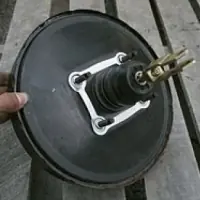
¿Qué elemento hace que nos cueste menos esfuerzo realizar la frenada?
Which component makes braking require less effort?
- AEl freno tubularThe tubular brake
- BEl servofrenoThe brake servo
- CEl maxifrenoThe maxi-brake
ExplanationThe brake servo is an auxiliary mechanism that automatically multiplies the effort the driver applies to the brake. Its purpose is to make braking easier for the driver.
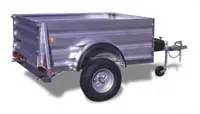
La velocidad máxima a la que puede circular un vehículo con remolque ligero en una autovía es de ...
The maximum speed at which a vehicle with a light trailer may travel on a dual carriageway (autovía) is…
- A80 Kilómetros por hora.80 kilometres per hour.
- B100 kilómetros por hora.100 kilometres per hour.
- C90 kilómetros por hora.90 kilometres per hour.
ExplanationUnder Article 48 of the General Traffic Regulations, motor cars towing a trailer have a maximum speed of 90 km/h on motorways (autopistas) and dual carriageways (autovías) and 80 km/h on conventional roads, even if the trailer is light.
¿Cuál será la velocidad mínima a la que podrá circular un vehículo mixto adaptable por una autovía?
What is the minimum speed at which an adaptable mixed-use vehicle may travel on a dual carriageway (autovía)?
- A60 km/h.60 km/h.
- B50 km/h.50 km/h.
- C70 km/h.70 km/h.
ExplanationAn adaptable mixed-use vehicle on a dual carriageway (autovía) has the same minimum speed as all the vehicles using that road, whatever its maximum speed. That minimum speed is 60 km/h.
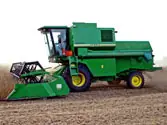
¿Cuál es la velocidad máxima genérica de un vehículo especial que dispone de señalización de frenado y no lleva remolque?
What is the general maximum speed for a special vehicle that has brake lights and is not towing a trailer?
- A80 km/h.80 km/h.
- B40 km/h.40 km/h.
- C25 km/h.25 km/h.
ExplanationAccording to Article 48.1.c of the General Traffic Regulations (RGC), special vehicles may travel at a maximum of 40 km/h; at 25 km/h if they have no brake lights, tow a trailer or are two-wheel tractors; and at 70 km/h if they can go faster than 60 km/h on the flat and meet the technical conditions for this.
En una autopista conduciendo un camión de 3.000 kg de M.M.A., ¿qué distancia es obligatorio dejar con el vehículo que va delante?
On a motorway (autopista), driving a lorry with an MAM of 3,000 kg, what distance must you leave from the vehicle in front?
- A50 metros.50 metres.
- B100 metros.100 metres.
- CLa distancia de seguridad.The safe distance.
ExplanationThe safe distance is the distance you must leave from the vehicle in front so that you can brake without a collision if it brakes sharply. It is a precaution to avoid rear-end collisions. For a lorry with an MAM of 3,000 kg, the safe distance is the distance you must leave from the vehicle in front.
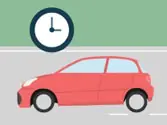
Se denomina tiempo de reacción...
Reaction time is...
- AEl tiempo que transcurre desde que el conductor ve un peligro hasta que responde al mismo.The time from when the driver sees a hazard until they respond to it.
- Bel tiempo que tarda en detenerse el vehículo con el freno accionado.The time the vehicle takes to stop once the brake is applied.
- CEl tiempo que transcurre desde que el conductor observa un peligro hasta que se detiene el vehículo.The time from when the driver sees a hazard until the vehicle stops.
ExplanationReaction time is the time from when the driver sees an obstacle until they react. It varies with the driver's physical and mental state, never with the speed or the condition of the road. Although it may seem that reacting to an obstacle or an unexpected situation should be instant, a driver's average reaction time is about 0.75 seconds. Reaction distance is the number of metres the vehicle travels during the reaction time. It depends on the reaction time and on the speed (the higher the speed, the more metres travelled in the same time). Braking distance is the distance the vehicle travels from when the driver brakes until the vehicle stops. Stopping distance is reaction distance plus braking distance. So stopping distance is the distance the vehicle travels from when the driver notices a hazard until the vehicle comes to a complete stop.
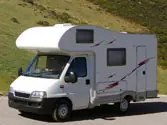
La velocidad máxima, para una autocaravana de hasta 3500 kg de MMA, que circula por autovía es de...
The maximum speed for a motorhome with an MAM of up to 3,500 kg travelling on a dual carriageway (autovía) is...
- A100 km/h.100 km/h.
- B120 km/h.120 km/h.
- C90 km/h.90 km/h.
ExplanationCars, motorcycles, motorhomes with an MAM of up to 3,500 kg and pick-ups may travel on motorways (autopistas) and dual carriageways (autovías) at a maximum speed of 120 km/h.
¿Qué separación lateral deberá mantener una motocicleta al adelantar a un turismo circulando fuera de poblado?
What sideways gap must a motorcycle keep when overtaking a car outside built-up areas?
- A1,5 metros como mínimo.At least 1.5 metres.
- BUna separación proporcional a la velocidad y características de la vía.A gap in proportion to the speed and to the features of the road.
- CLa que crea conveniente.Whatever it considers appropriate.
ExplanationUnder Article 85.5 of the General Traffic Regulations (RGC), the rider of a two-wheeled vehicle overtaking any other vehicle outside built-up areas must leave a space of no less than 1.50 metres between their vehicle and the parts of the overtaken vehicle that stick out most.
Al adelantar a un ciclista en vía interurbana, la separación lateral mínima debe ser de:
When overtaking a cyclist on a road outside a built-up area, the minimum lateral distance must be:
- A0,5 metros.0.5 metres.
- B1,5 metros, pudiendo invadir el carril contiguo o el sentido contrario si es seguro.1.5 metres, and you may move into the adjacent lane or the opposite lane if it is safe.
- CNo es necesario dejar separación.There is no need to leave any gap.
ExplanationYou must leave a lateral gap of at least 1.5 m when overtaking cyclists, even moving partly into the opposite lane if it is safe to do so.
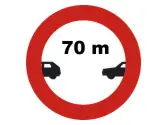
A la vista de la señal, ¿qué separación debe dejar con el vehículo que circula delante?
On seeing the sign, what gap must you leave to the vehicle in front?
- AUna distancia mínima de 70 metros.A minimum distance of 70 metres.
- BLa distancia obligatoria de seguridad.The compulsory safe distance.
- CUna distancia máxima de 70 metros.A maximum distance of 70 metres.
ExplanationThis is the minimum gap sign (R-300): it requires you to keep a distance from the vehicle in front equal to or greater than the one shown, in this case at least 70 metres. It is a minimum, not a maximum, and if circumstances require it you must leave even more space.
¿Qué finalidad tienen los límites de velocidad?
What is the purpose of speed limits?
- AGarantizar la seguridad y la fluidez de la circulación.To ensure traffic safety and flow.
- BQue los vehículos consuman menos combustible.To make vehicles use less fuel.
- CGarantizar la seguridad, solamente.To ensure safety only.
ExplanationThe aims of speed limits are: first, to ensure road safety, because limiting speed reduces the number of fatal accidents; second, to ensure that traffic flows; and, in very specific cases, to limit environmental pollution.
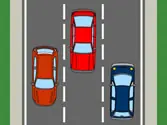
En esta vía urbana, donde hay dos carriles para el sentido contrario y un carril para nuestro sentido, ¿cuál será la velocidad máxima a la que podemos circular con el vehículo azul?
On this urban road, with two lanes in the opposite direction and one lane in our direction, what is the maximum speed we can drive the blue vehicle at?
- AA 50 km/h.50 km/h.
- BA 30 km/h.30 km/h.
- CA 20 km/h.20 km/h.
ExplanationWithout specific signs, the general urban limit depends on the number of lanes in each direction: 30 km/h with a single lane and 50 km/h with two or more (Article 50.1 of the General Traffic Regulations, RGC). The blue vehicle has only one lane in its direction, so its limit is 30 km/h.
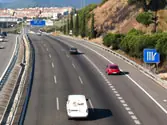
Circulando por una autopista, ¿podremos superar la velocidad máxima permitida para adelantar?
Driving on a motorway (autopista), may we exceed the maximum speed limit to overtake?
- ANo.No.
- BSí, en 20 km/h.Yes, by 20 km/h.
- CSí, en 20 km/h pero solo los turismos y las motocicletas.Yes, by 20 km/h, but only cars and motorcycles.
ExplanationOn a motorway you may not exceed the maximum speed limit to overtake.
Un turismo que arrastra un remolque ligero, ¿a qué velocidad máxima tiene permitido circular por autopista o autovía?
What is the maximum speed at which a car towing a light trailer is allowed to travel on a motorway (autopista) or dual carriageway (autovía)?
- AA 90 kilómetros por hora.90 kilometres per hour.
- BA 80 kilómetros por hora.80 kilometres per hour.
- CA 100 kilómetros por hora.100 kilometres per hour.
ExplanationUnder Article 48 of the General Traffic Regulations, a motor vehicle with a trailer, even a light one, may not exceed 90 km/h on motorways (autopistas) and dual carriageways (autovías). On conventional roads its limit is 80 km/h.
¿Es peligroso conducir demasiado cerca del coche que va delante?
Is it dangerous to drive too close to the car in front?
- ASí, porque puede producirse un choque si frena de repente.Yes, because there may be a collision if it brakes suddenly.
- BNo, si circulo a la misma velocidad que el vehículo de delante.No, if I am travelling at the same speed as the vehicle in front.
- CNo, si los frenos de mi vehículo están en buen estado.No, if my vehicle's brakes are in good condition.
ExplanationDriving too close to the vehicle in front is dangerous because of the risk of a rear-end collision if that vehicle brakes suddenly. Under the General Traffic Regulations, drivers must keep a safe distance that lets them react if the vehicle ahead stops unexpectedly. This gap is essential to avoid accidents and keep all road users safe.
La velocidad mínima en autopista es de:
The minimum speed on a motorway (autopista) is:
- A40 km/h40 km/h
- B60 km/h60 km/h
- C80 km/h80 km/h
ExplanationThe minimum speed on motorways (autopistas) and dual carriageways (autovías) is 60 km/h, except in exceptional circumstances (traffic jams, bad weather).
All topics
- Definitions
- Documents and penalty points
- The driver's condition
- Duties of drivers and pedestrians
- Vehicle safety devices
- Vehicle controls and equipment
- Vehicle lights and horn
- Traffic signs, markings and signals
- The road and its lanes
- Manoeuvres
- Right of way
- Carrying passengers and loads
- Driving safely in difficult conditions
- Vehicle mechanics and maintenance
- Road accidents and first aid
- Defensive and eco-driving
Independent app: not affiliated with or endorsed by the DGT (Spain's Directorate-General for Traffic) or the Ministry of the Interior. The official exam is booked with the DGT and taken at its test centres. The questions here are practice material; the DGT's official question bank is not public.
Basado en datos de la Agencia Estatal Boletín Oficial del Estado (https://www.boe.es). Textos consolidados de carácter meramente informativo. La AEBOE no patrocina ni respalda este sitio.
Parte de las preguntas procede de los tests de la revista «Tráfico y Seguridad Vial» de la DGT, reproducidos con indicación de la fuente.