
DGT test · 961 questions
Speed and distances · Page 15 of 20
Speed limits by road and vehicle type, adapting speed to conditions, safe following distance and stopping distance.
Questions in this topic, with answers
961 questions, 50 per page, with the correct answer and the explanation. Page 15 of 20.
El sistema de navegación, ¿puede servir como controlador de la velocidad?
Can the navigation system be used to monitor speed?
- ANo.No.
- BSí, pero la principal fuente de información ha de ser siempre el velocímetro.Yes, but the main source of information must always be the speedometer.
- CSí, y sustituye por completo al velocímetro.Yes, and it completely replaces the speedometer.
ExplanationA GPS navigation system can be used to monitor speed, although the main source of information must always be the vehicle's speedometer.
¿A qué distancia debe sentarse del airbag?
How far from the airbag should you sit?
- A10 cm10 cm
- B25 cm25 cm
- CLa distancia que le permita conducir con una postura cómoda.Whatever distance lets you drive in a comfortable position.
ExplanationIt is recommended to keep about 25 cm between your chest and the steering wheel or dashboard, because the airbag inflates at great speed and, if the occupant is too close, it can injure them. This is not a legal figure but a safety recommendation.
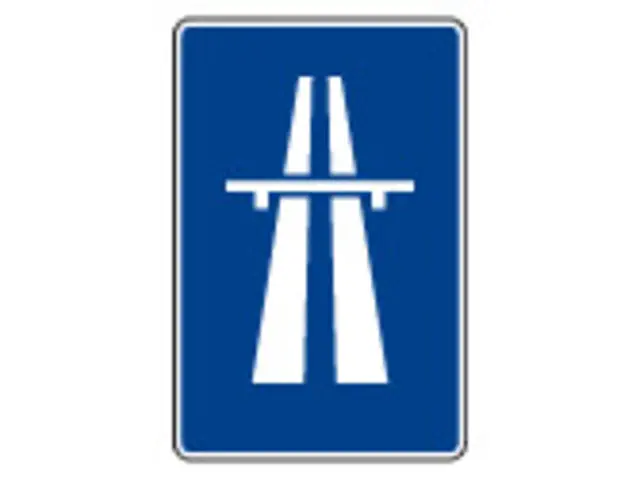
Si circulamos a una velocidad muy baja en la autopista, ¿qué debemos hacer?
If we are driving at a very low speed on the motorway (autopista), what must we do?
- ATomar la próxima salida.Take the next exit.
- BContinuar hasta nuestro destino con precaución.Continue to our destination with care.
- CSeguir circulando sin cambiar de carril.Keep driving without changing lanes.
ExplanationArticle 49.1 of the General Traffic Regulations forbids driving on motorways (autopistas) and dual carriageways (autovías) at less than 60 km/h without good reason, because it holds up others. If you cannot keep up that speed, you must leave the motorway at the next exit.
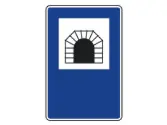
¿Cuál es la distancia mínima que mantendremos con el vehículo que nos precede dentro de un túnel?
What is the minimum distance we must keep from the vehicle in front inside a tunnel?
- ALa que permita frenar sin colisionar con el vehículo que nos precede.The distance that lets us brake without hitting the vehicle in front.
- B100 metros como mínimo.At least 100 metres.
- C150 metros como mínimo.At least 150 metres.
ExplanationIn tunnels or underpasses, when you do not intend to overtake, you must always keep a safe distance from the vehicle in front of at least 100 metres or a time gap of at least four seconds. For vehicles with a maximum authorised mass (MAM) over 3,500 kg, the safe distance is at least 150 metres or a gap of at least 6 seconds. Remember that overtaking is forbidden in tunnels unless there is more than one lane in your direction. The sign in the picture reminds us of the general safe distance we must keep.
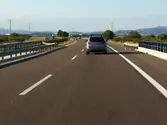
Cuando debido a una avería un turismo circula por una autopista a velocidad anormalmente reducida, ¿por dónde lo hará?
When a car is travelling on a motorway (autopista) at an abnormally low speed because of a breakdown, where must it travel?
- APor el carril derecho y, si perturba gravemente la circulación, debe circular por el arcén.In the right-hand lane and, if it seriously disrupts traffic, on the hard shoulder.
- BPor el arcén para no ser un obstáculo.On the hard shoulder, so as not to be an obstacle.
- CPor el carril derecho, siempre.Always in the right-hand lane.
ExplanationDrivers of vehicles with a MAM of no more than 3,500 kilograms who, for emergency reasons, are travelling at an abnormally low speed and thereby seriously disrupting traffic must travel on the right-hand hard shoulder, if it is passable and wide enough, and if not, on the smallest possible part of the carriageway. When they do not seriously disrupt traffic, they must travel in the right-hand lane. They must warn other road users of this situation with the vehicle's hazard warning lights. When these drivers are on a motorway (autopista) or dual carriageway (autovía), they must leave the road at the first exit.
¿Cuál es la velocidad máxima permitida para un cuadriciclo que circula por una autopista?
What is the maximum speed allowed for a quadricycle on a motorway (autopista)?
- A100 km/h.100 km/h.
- B60 km/h.60 km/h.
- C70 km/h.70 km/h.
ExplanationThe maximum speed for a quadricycle on a motorway (autopista) is 70 km/h. If the question were about a light quadricycle, the answer would be that it may not use dual carriageways (autovías), and its maximum speed on other roads is 45 km/h.
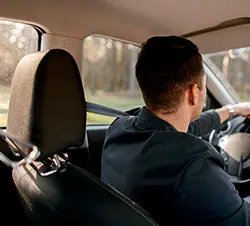
Además de estar regulado a la altura idónea, ¿qué separación debe existir entre el reposacabezas y la cabeza para que sea eficaz?
As well as being set at the right height, what gap must there be between the head restraint and the head for it to be effective?
- ALa mínima posible y nunca superior a 4 centímetros.As small as possible and never more than 4 centimetres.
- BLa máxima posible y nunca inferior a 5 centímetros.As large as possible and never less than 5 centimetres.
- CSuperior a 10 centímetros.More than 10 centimetres.
ExplanationThe head restraint protects against whiplash if it is at the right height and as close as possible to the head, with a gap of never more than 4 centimetres.
¿Cuál será la velocidad mínima en una autopista?
What is the minimum speed on a motorway (autopista)?
- ALa mitad de la máxima genérica para cada vehículo.Half the general maximum speed for each vehicle.
- B60 Km/h.60 km/h.
- C50 km/h.50 km/h.
ExplanationThe minimum speed at which we must drive on a motorway (autopista) is 60 km/h, whatever vehicle we are using.
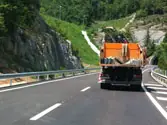
¿Qué separación lateral debe dejar una motocicleta cuando adelante a un camión fuera de poblado?
What sideways gap must a motorcycle leave when overtaking a lorry outside built-up areas?
- AUna separación inferior a 1,5 metros.A gap of less than 1.5 metres.
- BUna distancia proporcional a la velocidad a la que circule.A distance in proportion to the speed it is travelling at.
- CUn espacio no inferior a 1,50 metros.A space of no less than 1.50 metres.
ExplanationUnder Article 85.5 of the General Traffic Regulations (RGC), the rider of a two-wheeled vehicle overtaking any other vehicle outside built-up areas must leave a space of no less than 1.50 metres between their vehicle and the parts of the overtaken vehicle that stick out most.
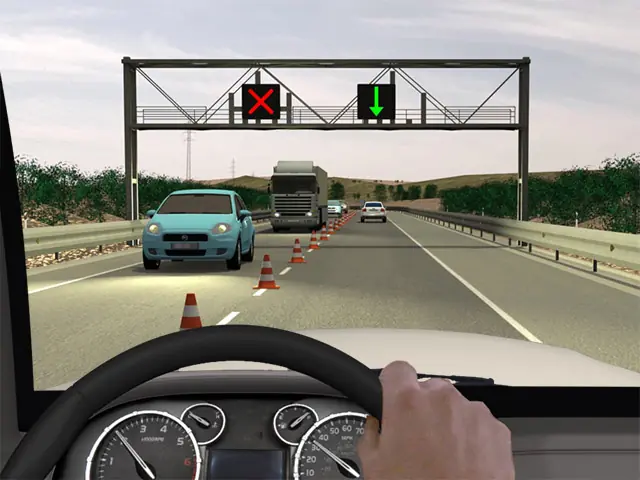
El carril izquierdo está abierto en sentido contrario al habitual. ¿A qué velocidad máxima pueden circular los vehículos que van por el carril derecho?
The left-hand lane is open to traffic in the opposite direction to normal. What is the maximum speed for vehicles in the right-hand lane?
- AA 60 kilómetros por hora.60 kilometres per hour.
- BA 120 kilómetros por hora.120 kilometres per hour.
- CA 80 kilómetros por hora.80 kilometres per hour.
ExplanationUnder Article 41 of the General Traffic Regulations (RGC), when only one lane is left in your direction next to the lane opened to the opposite direction, you must drive at a maximum of 80 km/h and a minimum of 60 km/h, with dipped headlights on and without going into the adjacent lane.
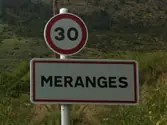
La velocidad máxima será aplicable...
The speed limit will apply...
- Asolo en la travesía.only on the travesía (road through the town).
- Bhasta la primera intersección.up to the first junction.
- Cen todo el poblado.throughout the built-up area.
ExplanationWhen the speed limit sign is placed next to the sign with the name of the town, or on the same post, it means that this speed limit applies throughout the built-up area, unless there are different signs inside it.
Si circula conduciendo una Pick Up, por una autovía, debe saber que la velocidad máxima será…
If you are driving a pick-up on a dual carriageway (autovía), the maximum speed is…
- A120 km/h.120 km/h.
- B110 km/h.110 km/h.
- C90 km/h.90 km/h.
ExplanationThe maximum speed for cars, motorcycles, motorhomes up to 3,500 kg and pick-ups is: - Motorways (autopistas) and dual carriageways (autovías): 120 km/h. - Other roads outside built-up areas: 90 km/h.
Una señal de velocidad máxima colocada en el mismo poste que una señal de peligro, ¿cuándo deja de tener vigencia?
A maximum speed sign placed on the same post as a danger sign: when does it stop being valid?
- ACuando termina el peligro.When the danger ends.
- BCuando encuentres otra señal de otro tipo.When you find another sign of a different type.
- CCuando encuentres otra señal de velocidad distinta.When you find another sign with a different speed.
ExplanationWhen a maximum speed sign is on the same post as a danger warning sign, the limit only applies while that danger lasts. Once past it, the limit stops applying without the need for an end of prohibition sign.
Si conduce un coche por la autopista, ¿qué velocidad se considera anormalmente baja?
If you are driving a car on a motorway (autopista), what speed is considered abnormally low?
- AMenos de 50 km/h.Below 50 km/h.
- BMenos de 60 km/h.Below 60 km/h.
- CMenos de 70 km/h.Below 70 km/h.
ExplanationArticle 49.1 of the General Traffic Regulations prohibits driving on motorways and dual carriageways (autovías) at less than 60 km/h, even if there are no other vehicles. Below that figure and without a justified reason, the speed is abnormally low.
Una motocicleta, al adelantar a un vehículo de tracción animal en una vía fuera de poblado, debe dejar una separación lateral…
A motorcycle overtaking an animal-drawn vehicle on a road outside built-up areas must leave a side clearance…
- AProporcional a la velocidad y a la anchura de la calzada.In proportion to the speed and the width of the carriageway.
- BNo inferior a 1,50 metros, y ocupar parte o la totalidad del carril contiguo de la calzada.Of no less than 1.50 metres, moving partly or fully into the next lane of the carriageway.
- CNo superior a 1,50 metros.Of no more than 1.50 metres.
ExplanationWhen overtaking an animal-drawn vehicle, as with pedestrians, animals or cyclists, you must move partly or fully into the next lane and leave at least 1.5 metres of side clearance. In addition, outside built-up areas, since 1 October 2026 you must reduce your speed by at least 20 km/h below the limit.
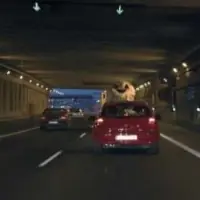
En un túnel, el conductor de una motocicleta, ¿qué distancia debe dejar con el vehículo de delante en caso de que no quiera adelantarlo?
In a tunnel, what distance must a motorcyclist leave from the vehicle in front if they do not want to overtake it?
- AComo mínimo 100 metros.At least 100 metres.
- BComo mínimo 150 metros.At least 150 metres.
- CComo mínimo 50 metros.At least 50 metres.
ExplanationIn a tunnel or underpass, if you are not going to overtake, you must keep at least 100 metres or 4 seconds from the vehicle in front; vehicles over 3,500 kg must keep 150 metres or 6 seconds (Article 95 of the General Traffic Regulations). The same distance applies to motorcycles and cars.
La distancia recorrida desde que percibimos un estímulo hasta que el vehículo se detiene totalmente se denomina...
The distance travelled from when we perceive a stimulus until the vehicle comes to a complete stop is called...
- ADistancia de frenado.Braking distance.
- BDistancia de reacción.Reaction distance.
- CDistancia de detención.Stopping distance.
ExplanationBraking distance is the distance the vehicle travels from when you press the brake pedal until the vehicle stops. Reaction distance is the distance your vehicle travels from when you perceive the danger until you press the brake. And stopping distance is braking distance plus reaction distance, that is, the distance from when you perceive the stimulus until the vehicle comes to a complete stop.

El estado del conductor, ¿influye en la distancia de detención?
Does the driver's condition affect the stopping distance?
- ANo.No.
- BSí, porque influye en el tiempo de reacción.Yes, because it affects reaction time.
- CSí, porque la distancia de frenado es mayor.Yes, because the braking distance is longer.
ExplanationIf the driver is not in perfect condition to drive, their reaction time will be longer and, as a result, so will the stopping distance.
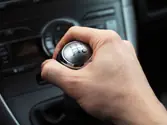
¿Qué marchas tienen más fuerza?
Which gears have the most pulling power?
- Ala 1ª y la 2ª marcha.1st and 2nd gear.
- Bla 3ª y la 4ª marcha.3rd and 4th gear.
- CLa 4ª y 5ª marcha.4th and 5th gear.
ExplanationThe lowest gears, first and second, have more pulling power than the higher gears. Because they have more power, these gears reach lower speeds.
¿Cuál es la velocidad máxima en vías urbanas con un solo carril por sentido?
What is the maximum speed on roads in built-up areas with a single lane in each direction?
- A20 km/h20 km/h
- B30 km/h30 km/h
- C50 km/h50 km/h
ExplanationSince 2021, the maximum speed on roads in built-up areas with a single lane in each direction has been 30 km/h.
¿Qué velocidad mínima deben de alcanzar los vehículos especiales, para que se les permita circular por Autopista y Autovía?
What minimum speed must special vehicles be able to reach to be allowed on motorways (autopistas) and dual carriageways (autovías)?
- AAl menos 50 kilómetros por hora.At least 50 kilometres per hour.
- BAl menos 60 kilómetros por hora.At least 60 kilometres per hour.
- CAl menos 70 kilómetros por hora.At least 70 kilometres per hour.
ExplanationSpecial vehicles may use motorways (autopistas) and dual carriageways (autovías) only if, by their design, they can exceed 60 km/h on the flat, which is the minimum speed on these roads, and they meet the regulatory conditions. Those that cannot reach that speed are prohibited from using them.
¿Cuál es la velocidad máxima de un turismo con remolque de hasta 750 kg circulando por una autopista?
What is the maximum speed on a motorway (autopista) for a car with a trailer of up to 750 kg?
- A90 km/h.90 km/h.
- B80 Km/h.80 km/h.
- C100 Km/h.100 km/h.
ExplanationOn motorways (autopistas) and dual carriageways (autovías), motor vehicles towing a trailer have a general limit of 90 km/h, whatever the mass of the trailer (Article 48.1.a of the General Traffic Regulations, RGC). Since 2019 there is no longer an 80 km/h limit for trailers over 750 kg.
Al cruzarse con otros vehículos que circulan en sentido contrario, ¿qué separación lateral debe dejar una motocicleta?
When passing vehicles coming in the opposite direction, what side clearance must a motorcycle leave?
- A1,5 metros como máximo.1.5 metres at most.
- B1,5 metros como mínimo en cualquier caso.At least 1.5 metres in all cases.
- CUna separación lateral suficiente para que el cruce pueda realizarse con seguridad y sin peligro.Enough side clearance for the vehicles to pass each other safely and without danger.
ExplanationUnder Article 29 of the General Traffic Regulations, vehicles must keep to the right and as close as possible to the edge of the carriageway, keeping enough side clearance to pass oncoming vehicles safely. The rule does not set a specific distance for passing oncoming traffic.
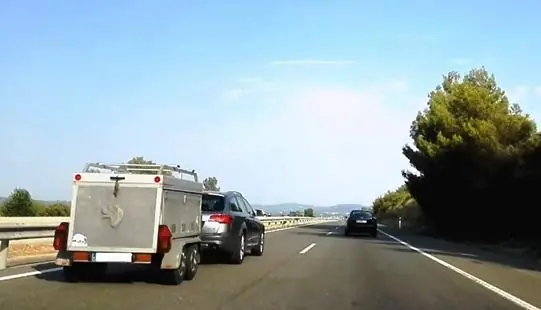
Un turismo con remolque, ¿a qué velocidad máxima puede circular por autovía?
What is the maximum speed at which a car towing a trailer may travel on a dual carriageway (autovía)?
- AA 120 km/h.120 km/h.
- BA 100 km/h.100 km/h.
- CA 90 km/h.90 km/h.
ExplanationUnder Article 48 of the General Traffic Regulations, a car towing a trailer may travel at a maximum of 90 km/h on a motorway (autopista) or dual carriageway (autovía) and 80 km/h on a conventional road. The 120 km/h limit is only for cars without a trailer.
En un túnel con un carril en cada sentido, ¿cuál es la distancia mínima de seguridad que deben mantener los coches?
In a tunnel with one lane in each direction, what is the minimum safe distance cars must keep?
- A50 metros.50 metres.
- B100 metros.100 metres.
- C200 metros.200 metres.
ExplanationThe General Traffic Regulations (RGC), specifically the article on tunnels, state that in tunnels you must keep a safe distance of at least 100 metres when you do not intend to overtake. This is essential so that, if there is sudden braking, there is enough space to prevent collisions. The right safe distance is vital for traffic safety and helps avoid accidents in an enclosed space such as a tunnel. So the correct answer is 100 metres.
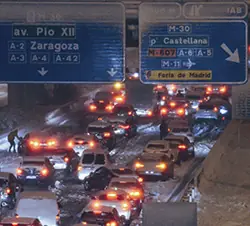
Si queda detenido en un atasco, ¿qué distancia es aconsejable mantener con el vehículo de delante?
If you are stopped in a traffic jam, what distance is it advisable to keep from the vehicle in front?
- AUn metro como máximo.One metre at most.
- BUn espacio mínimo para ocupar menos espacio.The smallest possible gap, so as to take up less space.
- CDos o tres metros para no golpear al vehículo de delante en caso de alcance trasero.Two or three metres, so that you do not hit the vehicle in front if you are hit from behind.
ExplanationLeaving two or three metres in a traffic jam creates a safety cushion: if another vehicle hits you from behind, you avoid being pushed into the one in front, and it also leaves room to manoeuvre out.

En un tramo de vía que tiene viviendas con acceso inmediato a la calzada, ¿se debe tomar alguna precaución?
On a stretch of road with houses that open directly onto the carriageway, should you take any precautions?
- ANo.No.
- BSí, moderar la velocidad.Yes, slow down.
- CSí, realizar señales acústicas para advertir de la presencia del vehículo.Yes, sound the horn to warn that the vehicle is there.
ExplanationYou must drive at a moderate speed and, if necessary, stop the vehicle when circumstances require it, especially in the following cases: on stretches with buildings that have direct access to the part of the road being used.
Si conduce un turismo por una carretera convencional, ¿qué velocidad se considera anormalmente baja?
If you are driving a car on a conventional road, what speed counts as abnormally low?
- AMenos de 40 km/h.Below 40 km/h.
- BMenos de 45 km/h.Below 45 km/h.
- CMenos de 50 km/h.Below 50 km/h.
ExplanationExcept on motorways and dual carriageways, the minimum is half the general speed limit for each type of vehicle on that road (Article 49.1 of the General Traffic Regulations). For a car on a conventional road, where the limit is 90 km/h, driving below 45 km/h is an abnormally low speed.
En una travesía sin señal que limite la velocidad, ¿cuál es la velocidad máxima para adelantar?
In a travesía (stretch of road through a town) with no speed limit sign, what is the maximum speed for overtaking?
- A90 km/h.90 km/h.
- B70 km/h.70 km/h.
- C50 km/h.50 km/h.
ExplanationUnder Article 50.5 of the General Traffic Regulations, the general limit in travesías is 50 km/h for all types of vehicle, and it may not be exceeded to overtake. The municipal authority and the road authority may lower it with signs.
Circulando en un túnel, ¿qué distancia de seguridad debemos mantener con el vehículo que nos precede?
When driving in a tunnel, what safe distance must we keep from the vehicle in front?
- A150 metros como mínimo.At least 150 metres.
- B100 metros como mínimo.At least 100 metres.
- C50 metros como mínimo.At least 50 metres.
ExplanationIn tunnels and underpasses, when not intending to overtake, you must at all times keep a safe distance of at least 100 metres or a minimum time gap of four seconds from the vehicle in front. For vehicles with a maximum authorised mass (MAM) over 3,500 kg, the safe distance must be at least 150 metres or a minimum gap of 6 seconds. Remember that overtaking is prohibited in tunnels unless there is more than one lane in our direction. The sign shown reminds us of the general safe distance we must keep.
Si circula conduciendo una Pick Up, por una carretera convencional, debe saber que la velocidad máxima será…
If you are driving a pick-up on a conventional road, the maximum speed is…
- A90 km/h.90 km/h.
- B120 km/h.120 km/h.
- C100 km/h.100 km/h.
ExplanationThe maximum speed for cars, motorcycles, motorhomes up to 3,500 kg and pick-ups is: - Motorways (autopistas) and dual carriageways (autovías): 120 km/h. - Other roads outside built-up areas: 90 km/h.
La distancia de detención es la que recorre el vehículo...
Stopping distance is the distance a vehicle travels...
- Adesde que el conductor advierte un peligro hasta que el vehículo se detiene.from the moment the driver notices a danger until the vehicle stops.
- Bdesde que el conductor frena hasta que se detiene el vehículo.from the moment the driver brakes until the vehicle stops.
- Cdurante el tiempo que pasa desde que el conductor reacciona hasta que pisa el pedal del freno.during the time from when the driver reacts until they press the brake pedal.
ExplanationStopping distance is the sum of the distance travelled during the reaction time and the braking distance: it runs from the moment the driver notices the danger until the vehicle stops. The distance from the moment you brake until you stop is only the braking distance.
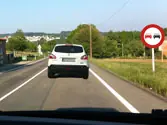
¿Qué distancia mantendremos con este vehículo que nos precede?
What distance should we keep from this vehicle in front of us?
- A50 metros como mínimo.At least 50 metres.
- BUna distancia suficiente para podernos detener sin colisionar con dicho vehículo.A distance long enough for us to stop without hitting that vehicle.
- CUna distancia suficiente para podernos detener sin colisionar con dicho vehículo y que a la vez permita que podamos ser adelantados.A distance long enough for us to stop without hitting that vehicle and that also allows us to be overtaken.
ExplanationWhen you drive behind another vehicle, you must leave a space that lets you stop, if it brakes suddenly, without hitting it, taking into account speed and grip and braking conditions. In addition, if you are driving without signalling an intention to overtake, this gap must allow the vehicle behind to overtake you safely. For this purpose, drivers of vehicles with a MAM of more than 3,500 kg and of vehicles and combinations of vehicles more than 10 metres long must keep a gap of at least 50 metres. Keeping a distance that avoids a collision is enough (there is no need to leave room to be overtaken): in built-up areas; where overtaking is prohibited; where there is more than one lane in the same direction; when traffic is saturated; when you intend to overtake. In the picture, overtaking is prohibited, so you only need to keep the safe distance, that is, a distance that lets you brake and stop without hitting the vehicle in front.
¿Se permite circular por la autovía a una velocidad inferior al mínimo establecido sin una causa justificada?
May you drive on a dual carriageway (autovía) below the minimum speed without a good reason?
- ANo, sería una velocidad anormalmente baja.No, it would be an abnormally low speed.
- BSí, pero solo si circula por el arcén.Yes, but only if you drive on the hard shoulder.
- CSolo si no obstaculiza la circulación normal de otros vehículos.Only if you do not obstruct the normal flow of other vehicles.
ExplanationOn motorways (autopistas) and dual carriageways (autovías), driving below 60 km/h without good reason is prohibited, even if there is no other traffic (Article 49.1 of the General Traffic Regulations (RGC)). It is allowed only in cases such as special vehicles, or when traffic, the vehicle or the road make it impossible to go faster without risk.
¿A qué velocidad deberá circular el conductor de un vehículo, utilizando un carril en sentido contrario al habitual?
At what speed must a driver travel when using a lane in the opposite direction to the usual one?
- AÚnicamente deberá circular utilizando el alumbrado de cruce o corto alcance.The driver only has to drive with dipped headlights on.
- BA una velocidad mínima de 60 km/h y máxima de 80 km/h.At a minimum speed of 60 km/h and a maximum speed of 80 km/h.
- CA la velocidad máxima de la vía por la que circule.At the maximum speed for the road they are on.
ExplanationAccording to Article 41.1 of the General Traffic Regulations (RGC), in a lane opened for traffic in the opposite direction to the usual one you must drive with at least dipped headlights on, day and night. Unless signs say otherwise, the maximum speed is 80 km/h and the minimum is 60 km/h.
La velocidad adecuada está siempre...
The appropriate speed is always...
- Apor debajo de la velocidad mínima.below the minimum speed.
- Bpor encima de la velocidad máxima y por debajo de la mínima.above the maximum speed and below the minimum.
- Cpor encima de la velocidad mínima y por debajo de la máxima.above the minimum speed and below the maximum.
ExplanationThe appropriate speed is the one that lets you stop the vehicle in front of any foreseeable obstacle, taking into account the road, the traffic, the weather and the condition of the driver and the vehicle. It must always be below the maximum permitted speed and above the minimum, so as not to obstruct traffic.
En una autovía sin señalización específica de velocidad, una motocicleta puede circular como máximo a:
On a dual carriageway (autovía) with no specific speed signs, what is the maximum speed for a motorcycle?
- A120 km/h120 km/h
- B90 km/h90 km/h
- C110 km/h110 km/h
ExplanationMotorcycles share with cars the general limit of 120 km/h on dual carriageways (autovías) and motorways (autopistas).
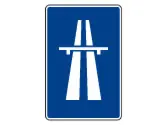
Si por causa de una avería circulamos por una autopista a velocidad inferior a 60 km/h, ¿por dónde lo haremos?
If, because of a breakdown, we are driving on a motorway (autopista) at less than 60 km/h, where should we drive?
- APor el arcén, abandonando la autopista en la salida más próxima.On the hard shoulder, leaving the motorway at the nearest exit.
- BPor la calzada si no perturbamos gravemente la circulación, abandonando la autopista en la salida más próxima.On the carriageway if we are not seriously disrupting traffic, leaving the motorway at the nearest exit.
- CPararemos en el arcén y esperaremos la llegada de la grúa.We stop on the hard shoulder and wait for the tow truck.
ExplanationDrivers of vehicles with a maximum authorised mass (MAM) of no more than 3,500 kg who, for emergency reasons, drive at an abnormally low speed and so seriously disrupt traffic must drive on the hard shoulder on their right, if it is usable and wide enough. If it is not, they must use only the part of the carriageway that is strictly necessary. When we do not seriously disrupt traffic, we must drive in the right-hand lane. We warn other road users of this situation with our vehicle's hazard warning lights. When these drivers are on a motorway (autopista) or dual carriageway (autovía), they must leave it at the first exit.
¿Cuál es la velocidad máxima en un tramo señalizado con una limitación de velocidad?
What is the maximum speed on a stretch of road with a signed speed limit?
- ALa indicada por las señales.The speed shown on the signs.
- BLa indicada por las señales, más 20 km/h para adelantar.The speed shown on the signs, plus 20 km/h to overtake.
- CLa genérica de 90 km/h para adelantar.The general limit of 90 km/h, to overtake.
ExplanationWhen a sign sets a specific limit, for example 80 km/h, that limit takes precedence over the road's general limit (Articles 47 and 52 of the General Traffic Regulations). Since 2022 there has been no 20 km/h margin for overtaking.
La distancia de detención puede variar en función...
Stopping distance may vary depending on...
- Adel mal estado del vehículo, del conductor o de la vía.the poor condition of the vehicle, the driver or the road.
- Bdel mal estado de la vía únicamente.only the poor condition of the road.
- Cdel mal estado del vehículo solamente.only the poor condition of the vehicle.
ExplanationStopping distance is the distance the vehicle travels from when an obstacle or danger is perceived until the vehicle comes to a complete stop. In other words, it is the reaction distance plus the braking distance. Braking and stopping distances depend on several factors, such as the condition of the vehicle and the road, the weather, or the driver's skill. Reaction distance depends directly on the driver and on the speed.
La separación lateral que debe dejar el conductor de un vehículo de dos ruedas al adelantar fuera de poblado no debe ser inferior a...
The lateral clearance left by the rider of a two-wheeled vehicle when overtaking outside built-up areas must not be less than...
- A1,50 metros.1.50 metres.
- B2 metros.2 metres.
- C2,50 metros.2.50 metres.
ExplanationAccording to Article 85.5 of the General Traffic Regulations, the rider of a two-wheeled vehicle who overtakes any other vehicle outside built-up areas must leave a space of at least 1.50 metres between them.
¿Qué le puede pasar a un conductor que circula a una velocidad inadecuada?
What can happen to a driver who drives at an inappropriate speed?
- AQue pueda controlar mejor su vehículo en una situación de emergencia.They may be able to control their vehicle better in an emergency.
- BQue no pueda controlar su vehículo en una situación de emergencia.They may be unable to control their vehicle in an emergency.
- CQue su tiempo de reacción se reduzca.Their reaction time may get shorter.
ExplanationAt an inappropriate speed the vehicle covers more metres during the reaction time and needs a longer distance to brake. In an emergency, the driver has no margin to stop or avoid the obstacle and may lose control (Article 45 of the General Traffic Regulations).
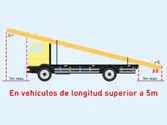
¿A qué velocidad podrá circular como máximo un turismo que arrastra un remolque de 750 kg de M.M.A por una autopista?
What is the maximum speed on a motorway (autopista) for a car towing a trailer with a maximum authorised mass (MAM) of 750 kg?
- A90 km/h.90 km/h.
- B80 km/h.80 km/h.
- C100 km/h.100 km/h.
ExplanationOn motorways (autopistas) and dual carriageways (autovías), motor vehicles towing a trailer have a general limit of 90 km/h, whatever the mass of the trailer (Article 48.1.a of the General Traffic Regulations, RGC). Since 2019 there is no longer an 80 km/h limit for trailers over 750 kg.
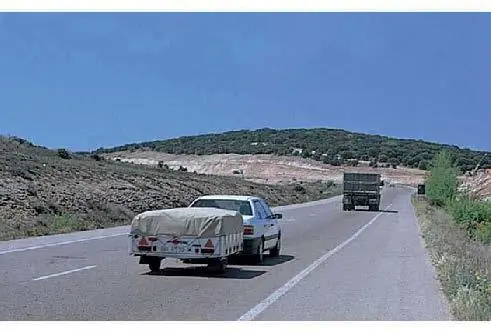
En una autovía circula un turismo con remolque de menos de 750 kg de MMA. ¿Cuál es la velocidad máxima permitida?
A car towing a trailer with a MAM of less than 750 kg is travelling on a dual carriageway (autovía). What is the maximum speed allowed?
- A90 km/h90 km/h
- B70 km/h.70 km/h.
- C80 km/h.80 km/h.
ExplanationUnder Article 48 of the General Traffic Regulations, motor cars towing a trailer may travel at a maximum of 90 km/h on motorways (autopistas) and dual carriageways (autovías) and 80 km/h on conventional roads. The mass of the trailer does not change this limit.
¿Cuál es la velocidad máxima en vía urbana con plataforma única?
What is the maximum speed on a single-level (shared) street in a built-up area?
- A10 km/h10 km/h
- B20 km/h20 km/h
- C30 km/h30 km/h
ExplanationSingle-level street, with the carriageway and pavement at the same level: 20 km/h.
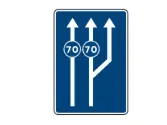
Circula a 60 km/h. ¿Por qué carril debe circular?
You are driving at 60 km/h. Which lane should you use?
- APor el de la izquierda.The left-hand lane.
- BPor el de la derecha.The right-hand lane.
- CPor el del centro.The centre lane.
ExplanationThe sign in the question shows that the lane or lanes under the minimum speed sign may only be used by vehicles travelling at or above the speed shown. In any case, if circumstances allow, you should drive in the right-hand lane.
¿Pueden los sistemas de navegación ayudar a controlar la velocidad?
Can satellite navigation systems help you control your speed?
- ASolo cuando se superan los 100 km/h.Only when you exceed 100 km/h.
- BLos sistemas de navegación no influyen en el control de la velocidad.Satellite navigation systems have no effect on speed control.
- CSí, aunque la fuente principal de información debe ser siempre el velocímetro.Yes, although the speedometer must always be the main source of information.
ExplanationSatnavs can show your speed and warn you of the limits on each stretch, which helps you control it. But they are only an aid: their data may be out of date or fail, and the main reference for the vehicle's speed is always its speedometer.
¿Cuál será la velocidad mínima a la que se circulará sin causa justificada por una autopista?
Without a justified reason, what is the minimum speed at which you may drive on a motorway (autopista)?
- A45 km/h.45 km/h.
- B50 Km/h.50 km/h.
- C60 Km/h.60 km/h.
ExplanationThe maximum speed on a motorway (autopista) is 120 km/h and the minimum speed for all vehicles is 60 km/h. We are not allowed to drive below that speed without a justified reason. Any driver who, because of an emergency, has to drive on a motorway (autopista) or dual carriageway (autovía) at an abnormally low speed must leave it at the first exit. If you are driving at an abnormally low speed that seriously disrupts traffic, you must use the right-hand hard shoulder, if it is wide enough, with the hazard warning lights on (this applies to vehicles with a MAM of no more than 3,500 kg).
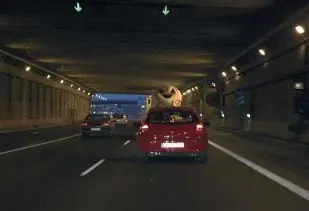
Si circulo por el interior de un túnel de más de un carril para cada sentido, y no pretendo adelantar.¿Qué distancia debo dejar con respecto al vehículo que me precede?
If I am driving inside a tunnel with more than one lane in each direction and do not intend to overtake, what distance must I leave from the vehicle in front?
- A50 metros.50 metres.
- B100 metros.100 metres.
- CLa suficiente para no colisionar con él.Enough not to collide with it.
ExplanationUnder Article 95 of the General Traffic Regulations, in tunnels, if you are not going to overtake, you must keep at least 100 metres or 4 seconds from the vehicle in front, whether the tunnel has one or several lanes in each direction. For vehicles over 3,500 kg it is 150 metres or 6 seconds.
¿Cuál es el límite de velocidad en una autovía para una autocaravana de hasta 3500 kg de MMA?
What is the speed limit on a dual carriageway (autovía) for a motorhome with a maximum authorised mass (MAM) of up to 3,500 kg?
- A100 km/h.100 km/h.
- B90 km/h.90 km/h.
- C120 km/h.120 km/h.
ExplanationAccording to Article 48.1.a of the General Traffic Regulations (RGC), on motorways (autopistas) and dual carriageways (autovías), motorhomes with a MAM of up to 3,500 kg have the same limit as cars: 120 km/h. If their MAM is over 3,500 kg, the limit is 90 km/h.
All topics
- Definitions
- Documents and penalty points
- The driver's condition
- Duties of drivers and pedestrians
- Vehicle safety devices
- Vehicle controls and equipment
- Vehicle lights and horn
- Traffic signs, markings and signals
- The road and its lanes
- Manoeuvres
- Right of way
- Carrying passengers and loads
- Driving safely in difficult conditions
- Vehicle mechanics and maintenance
- Road accidents and first aid
- Defensive and eco-driving
Independent app: not affiliated with or endorsed by the DGT (Spain's Directorate-General for Traffic) or the Ministry of the Interior. The official exam is booked with the DGT and taken at its test centres. The questions here are practice material; the DGT's official question bank is not public.
Basado en datos de la Agencia Estatal Boletín Oficial del Estado (https://www.boe.es). Textos consolidados de carácter meramente informativo. La AEBOE no patrocina ni respalda este sitio.
Parte de las preguntas procede de los tests de la revista «Tráfico y Seguridad Vial» de la DGT, reproducidos con indicación de la fuente.