
DGT test · 961 questions
Speed and distances · Page 16 of 20
Speed limits by road and vehicle type, adapting speed to conditions, safe following distance and stopping distance.
Questions in this topic, with answers
961 questions, 50 per page, with the correct answer and the explanation. Page 16 of 20.
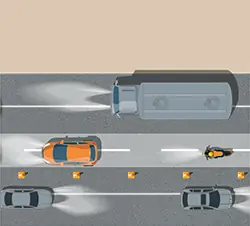
En esta vía se ha habilitado un carril adicional; ¿a qué velocidad como máximo circulará el vehículo naranja?
An additional lane has been set up on this road. What is the maximum speed for the orange vehicle?
- AA 80 kilómetros por hora.80 kilometres per hour.
- BA 60 kilómetros por hora.60 kilometres per hour.
- CA la genérica de la vía.The road's general speed limit.
ExplanationIt is a temporary additional lane, created with temporary cones or markers. Under Article 42 of the General Traffic Regulations, in this lane and on hard shoulders used as lanes, the maximum speed is 80 km/h and the minimum is 60 km/h, with dipped headlights on day and night.

¿Qué debe hacer si durante la marcha su vehículo no puede alcanzar la velocidad mínima exigida y existe peligro de alcance?
What must you do if, while driving, your vehicle cannot reach the required minimum speed and there is a risk of being hit from behind?
- AUtilizar la señal de emergencia.Use the hazard warning lights.
- BPisar de forma intermitente el freno para advertir con las luces de frenado que va a reducir la marcha.Press the brake on and off to warn with the brake lights that you are going to slow down.
- CRealizar destellos con las luces de largo alcance.Flash your main beam.
ExplanationWhen a vehicle cannot reach the required minimum speed and there is a risk of being hit from behind, the indicators must be used as a hazard warning signal (hazard warning lights) while driving. Any driver who, because of an emergency, has to drive on a motorway (autopista) or dual carriageway (autovía) at an abnormally low speed must leave it at the first exit.
Si Ud. circula conduciendo su turismo fuera de poblado, ¿a qué velocidad como máximo le está permitido circular por un carril adicional que se ha habilitado por motivos de fluidez de la circulación?
If you are driving your car outside a built-up area, what is the maximum speed at which you may drive in an additional lane opened to keep traffic flowing?
- AA aquélla a la que, como máximo, esté permitido circular por la vía en la que esté instalado.The maximum speed allowed on the road where the lane has been set up.
- BA 80 kilómetros por hora.80 kilometres per hour.
- CA 90 kilómetros por hora, ya que estos carriles se instalan en vías de doble sentido de circulación con un carril para cada sentido.90 kilometres per hour, because these lanes are set up on two-way roads with one lane in each direction.
ExplanationUnder Article 42 of the General Traffic Regulations, vehicles using a temporary additional lane, and hard shoulders opened to traffic, must drive at a maximum of 80 km/h and a minimum of 60 km/h, or lower if signposted, and with at least dipped headlights on.
La distancia de reacción dependerá ....
Reaction distance will depend on...
- ADel estado de la vía.the condition of the road.
- BDe la velocidad .speed.
- CDel estado de los frenos del vehículo.the condition of the vehicle's brakes.
ExplanationReaction distance depends on the driver's reaction time and on the speed. For example, with a reaction time of 0.75 seconds at 50 km/h, we will have travelled 10 m before starting to brake.
¿La velocidad afecta el campo visual del conductor?
Does speed affect the driver's field of vision?
- ASí, el campo visual se reduce cuando la velocidad aumenta.Yes, the field of vision narrows as speed increases.
- BNo.No.
- CSí, el campo visual se amplía cuando la velocidad aumenta.Yes, the field of vision widens as speed increases.
ExplanationAs speed increases, your eyes focus on a point further and further away and your field of vision narrows: the driver sees less well what is happening at the sides, such as pedestrians or vehicles joining the road. This is known as the tunnel effect.
¿A qué distancia ha de estar el apoyacabezas respecto a la cabeza?
How far from the head must the head restraint be?
- AComo mínimo a 4 cm.At least 4 cm.
- BNunca más de 4 cm.Never more than 4 cm.
- CDe 4 a 8 cm de la cabeza.Between 4 and 8 cm from the head.
ExplanationThe gap between the head and the head restraint must be as small as possible and never more than 4 cm. It is important to have the head restraint correctly adjusted, because if it is not, it can even make injuries worse in a crash.
¿Cuál es la cilindrada de un ciclomotor?
What is the engine capacity of a moped?
- ANo superior a 50 cc y una velocidad máxima no superior a 45 km/h.No more than 50 cc, with a maximum speed of no more than 45 km/h.
- BSuperior a 50 cc si es de combustión interna.More than 50 cc if it has an internal combustion engine.
- CInferior a 50 cc.Less than 50 cc.
ExplanationA moped has a maximum design speed of no more than 45 km/h and, if it has an internal combustion engine, an engine capacity of no more than 50 cm³. If it exceeds either of these values, it is a motorcycle.
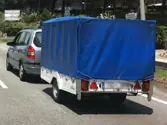
En una carretera convencional, ¿cuál es la velocidad máxima a la que le está permitido circular al conductor de un turismo que arrastre un remolque ligero?
On a conventional road, what is the maximum speed allowed for the driver of a car towing a light trailer?
- A100 kilómetros por hora.100 kilometres per hour.
- B80 kilómetros por hora.80 kilometres per hour.
- C90 kilómetros por hora.90 kilometres per hour.
ExplanationThe maximum speed that must not be exceeded on a conventional road by a motor car with a trailer is 80 km/h, whether the trailer is light (MAM up to 750 kg) or heavy (MAM over 750 kg).
En una autopista que atraviesa una zona urbana, ¿cuál es la velocidad máxima si no hay señales?
On a motorway (autopista) that runs through a built-up area, what is the speed limit if there are no signs?
- A70 km/h.70 km/h.
- B120 km/h.120 km/h.
- C80 km/h.80 km/h.
ExplanationThe general limit on motorways (autopistas) and dual carriageways (autovías) running through built-up areas is 80 km/h (Article 50.6 of the General Traffic Regulations). It may be raised by agreement between the local council and the road authority, with specific signs, but never above the limits for outside built-up areas.
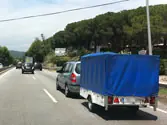
Este turismo con remolque, ¿a qué velocidad puede circular como máximo en una autovía?
What is the maximum speed for this car with a trailer on a dual carriageway (autovía)?
- AA 100 km/h.100 km/h.
- BA 90 km/h.90 km/h.
- CA 120 km/h.120 km/h.
ExplanationMotor cars with a trailer may not exceed a maximum speed of 90 km/h on a motorway or dual carriageway. This speed may never be exceeded, not even to overtake.
¿Cuál será la velocidad máxima de una motocicleta circulando por una autovía?
What is the maximum speed of a motorcycle travelling on a dual carriageway (autovía)?
- A120 km/h.120 km/h.
- B100 km/h.100 km/h.
- C110 km/h.110 km/h.
ExplanationMotorcycles, like cars, motorhomes with a MAM of 3,500 kg or less and pick-ups, have a maximum speed limit of 120 km/h on motorways (autopistas) and dual carriageways (autovías).
¿A qué velocidad máxima está permitido adelantar en una travesía?
What is the maximum speed at which you are allowed to overtake in a travesía (stretch of road through a town)?
- AA 90 km/h90 km/h
- BA 70 km/h70 km/h
- CA 50 km/h50 km/h
ExplanationIn a travesía the general limit is 50 km/h for all vehicles (Article 50 of the General Traffic Regulations), and since 2022 you may no longer exceed the speed limit to overtake. So you overtake at 50 km/h at most, or less if signs say so.
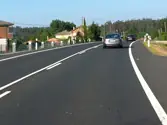
Circulando con un turismo por una carretera convencional, ¿cuál será la velocidad máxima para adelantar?
Driving a car on a conventional road, what is the maximum speed for overtaking?
- A90 km/h90 km/h
- B100 km/h más 20 km/h para adelantar.100 km/h plus 20 km/h to overtake.
- C120 km/h más 20 km/h para adelantar.120 km/h plus 20 km/h to overtake.
ExplanationOn a conventional road the general limit for a car is 90 km/h. Since 21 March 2022, under Law 18/2021, you may no longer exceed the maximum speed by 20 km/h to overtake, so you may not go above 90 km/h even when overtaking.
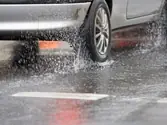
¿Cómo será la distancia de frenado con la calzada mojada?
How will the braking distance be on a wet carriageway?
- AMayor.Longer.
- BMenor.Shorter.
- CIgual.The same.
ExplanationOn a wet carriageway we will travel more metres before the vehicle stops, so the braking distance will be longer.
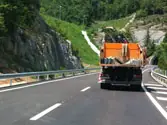
Circula con su turismo por esta vía interurbana con un carril para cada sentido; si no pretende adelantar al camión, ¿qué distancia de seguridad debe dejar?
You are driving your car on this road outside a built-up area with one lane in each direction. If you do not intend to overtake the lorry, what safe distance must you keep?
- A150 metros.150 metres.
- B50 metros.50 metres.
- CLa que permita al vehículo que circule detrás, adelantarme con seguridad.One that allows the vehicle behind me to overtake me safely.
ExplanationEvery driver following another vehicle must leave a clear space between them that allows them to stop without hitting it if it brakes suddenly, taking particular account of speed, grip and braking conditions. In addition, a driver following another vehicle without signalling an intention to overtake must leave a gap large enough for the vehicle following them to overtake safely. Cyclists riding in a group are allowed not to keep this gap.
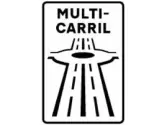
En una carretera multicarril que transcurre fuera de poblado, ¿cuál es la velocidad máxima que le está permitido alcanzar a un turismo para adelantar?
On a multi-lane road outside built-up areas, what is the maximum speed a car may reach to overtake?
- A120 km/h.120 km/h.
- B90 km/h.90 km/h.
- C110 km/h.110 km/h.
ExplanationThe maximum speeds set for conventional roads, and for multi-lane roads that do not run through urban land, may not be exceeded. For cars, this maximum speed is 90 km/h.
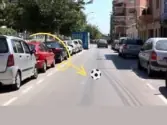
¿Qué nombre recibe la distancia que recorre el vehículo desde que el conductor ve un obstáculo hasta que el vehículo se detiene por completo?
What is the name of the distance the vehicle travels from when the driver sees an obstacle until the vehicle comes to a complete stop?
- ADistancia de reacción.Reaction distance.
- BDistancia de frenado.Braking distance.
- CDistancia de detención.Stopping distance.
ExplanationReaction distance: the metres the vehicle travels from when we notice an obstacle or something unexpected until we react to it, by braking or turning the steering wheel. Braking distance: the metres the vehicle travels from when the driver brakes until the vehicle comes to a complete stop. Stopping distance: the metres the vehicle travels from when the driver notices an obstacle until the vehicle comes to a complete stop. In other words, it is the reaction distance plus the braking distance.
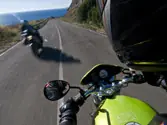
¿Qué separación lateral están obligadas a dejar las motocicletas al cruzarse con otros vehículos que circulen en sentido contrario?
What sideways gap must motorcycles leave when passing vehicles coming the other way?
- A1,5 metros como máximo.No more than 1.5 metres.
- B1,5 metros como mínimo en cualquier caso.At least 1.5 metres in all cases.
- CUna separación lateral suficiente para que el cruce pueda realizarse con seguridad y sin peligro.A sideways gap large enough for them to pass each other safely and without danger.
ExplanationMotorcycles must ride on the right of the carriageway, as close as possible to its right-hand edge, keeping a sideways gap large enough to pass oncoming vehicles safely, especially on bends and on the brow of a hill with limited visibility. The 1.5 metres is the sideways gap they must leave when overtaking any vehicle outside built-up areas.
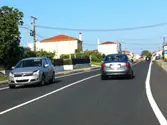
En esta situación, ¿cuál es la distancia de seguridad entre vehículos?
In this situation, what is the safe distance between vehicles?
- A60 metros.60 metres.
- BAquella que me permita detenerme, sin colisionar con él.One that lets me stop without colliding with the vehicle in front.
- C90 metros.90 metres.
ExplanationWhen driving behind another vehicle, you must leave a space that lets you stop without colliding with it if it brakes suddenly, taking into account speed and the grip and braking conditions. In addition, if you are driving without signalling an intention to overtake, this gap must allow the vehicle behind you to overtake you safely. For this purpose, drivers of vehicles with a MAM of more than 3,500 kg and of vehicles and vehicle combinations more than 10 metres long must keep a minimum gap of 50 metres. It is enough to keep a distance that avoids a collision (there is no need to leave room for others to overtake): – In built-up areas. – Where overtaking is prohibited (this is the case in the question: as there is a solid line and overtaking is not possible, you do not need to leave room to be overtaken). – Where there is more than one lane in the same direction. – When traffic is congested. – When you intend to overtake.
Los vehículos especiales que circulan por vías públicas deben usar la luz rotativa amarilla cuando circulen a una velocidad...
Special vehicles on public roads must use the yellow rotating light when travelling at a speed that...
- Ano supere los 40 km/h.does not exceed 40 km/h.
- Bno supere los 40 km/h, únicamente por la noche.does not exceed 40 km/h, only at night.
- Csupere los 40 km/h.exceeds 40 km/h.
ExplanationThe V-2 sign, a yellow light visible from all directions, marks a vehicle that is working, stopped or travelling at no more than 40 km/h (Annex XI of the General Vehicle Regulations). That is why special vehicles use it, day and night, when they do not exceed that speed.
¿Sobre qué rueda se desplaza principalmente el peso de la motocicleta al frenar?
When braking, which wheel does the motorcycle's weight mainly shift onto?
- ASobre la rueda trasera.The rear wheel.
- BSobre las dos ruedas, repartiéndose el peso siempre entre ambas ruedas de forma homogénea.Both wheels, with the weight always shared equally between them.
- CSobre la rueda delantera.The front wheel.
ExplanationWhen braking, inertia shifts the motorcycle's weight forwards, so the front wheel carries most of the load and has the most braking power. That is why the weight is never shared equally between the two wheels.
¿A qué velocidad máxima puede circular un conductor novel durante el primer año?
What is the maximum speed for a novice driver during the first year?
- ASegún el tipo de vía, a la misma que el resto de conductores.The same as for other drivers, depending on the type of road.
- B100 km/h.100 km/h.
- C100 km/h más 20 km/h para adelantar.100 km/h, plus 20 km/h for overtaking.
ExplanationNovice drivers may use the same roads and have the same speed limits as other drivers.
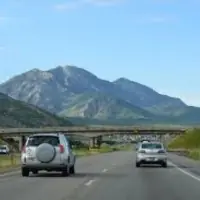
¿Hay alguna relación entre velocidad y daño corporal?
Is there any link between speed and bodily harm?
- ASí, pero solo en relación con los atropellos de peatones.Yes, but only when pedestrians are hit.
- BSí, cuanto más grande sea la velocidad a la cual se circule más graves serán las posibles lesiones en caso de accidente.Yes, the higher the speed you drive at, the more serious the possible injuries in a crash.
- CNo.No.
ExplanationRoad crash studies show that the higher our vehicle's speed, the more serious the injuries we may suffer in a road crash. That is why we must always avoid driving at an inappropriate or excessive speed, because bodily harm is multiplied in a collision.
Si vemos a un niño cruzando la calzada en un lugar prohibido, ¿qué debemos hacer?
If you see a child crossing the carriageway where crossing is prohibited, what should you do?
- AAnticiparnos a las reacciones del niño: reducir la velocidad e incluso detenernos.Anticipate the child's reactions: reduce speed and even stop.
- BSeguir, actuando según la reacción del niño.Carry on, acting according to how the child reacts.
- CContinuar y tocar el claxon para que el niño advierta su error.Carry on and sound the horn so that the child realises their mistake.
ExplanationArticle 46.1.a of the General Traffic Regulations (RGC) requires you to drive at a moderate speed and, if necessary, stop when there are pedestrians on the carriageway, especially if they are children. Their reactions are unpredictable, so you must anticipate them; sounding the horn at the child may frighten them and make the situation worse.
Un coche circula por una carretera plana. ¿Cuándo necesita más distancia para frenar?
A car is driving on a flat road. When does it need a longer distance to brake?
- ACuando el vehículo pesa poco.When the vehicle is light.
- BCuando el vehículo pesa mucho.When the vehicle is heavy.
- CFrena igual porque los frenos se adaptan al peso.It brakes the same, because the brakes adapt to the weight.
ExplanationThe heavier the vehicle, the more energy has to be absorbed to stop it, so with the same brakes and the same grip it needs a longer distance to brake. That is why you must increase your safe distance when the vehicle is loaded.
Aunque no se superen los límites máximos de velocidad, ¿puede llegar a circular a una velocidad inadecuada?
Even without exceeding the maximum speed limits, can you be driving at an inappropriate speed?
- ANo, en ningún caso.No, never.
- BSí, en tanto que la velocidad debe adecuarse a las circunstancias de la vía, como por ejemplo, la lluvia, nieve o hielo.Yes, because speed must be adapted to the road conditions, for example rain, snow or ice.
- CSí, siempre que vaya a más de 100 km/h.Yes, whenever you are driving at more than 100 km/h.
ExplanationWhen we drive at a speed that is not adapted to the weather or to the conditions of the road, the traffic, the vehicle or the driver, we are driving at an inappropriate speed. Our speed may be within the limits for the road, but in a difficult situation we may find it very hard to control the vehicle. For example, there are usually more accidents on rainy days because many drivers drive at the same speed as on a sunny day: the speed is permitted, but it is inappropriate in the rain.
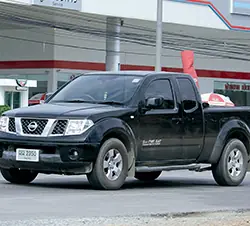
Respecto a la velocidad anormalmente reducida, ¿a qué velocidad mínima, salvo causa justificada, deberá circular una pick-up por una autovía?
Regarding abnormally low speed, what is the minimum speed at which a pick-up must travel on a dual carriageway (autovía), unless there is a justified reason?
- A60 km/h.60 km/h.
- B55 km/h.55 km/h.
- C70 km/h.70 km/h.
ExplanationArticle 49.1 of the General Traffic Regulations (RGC) prohibits driving motor vehicles on motorways (autopistas) and dual carriageways (autovías) at less than 60 km/h, unless there is a justified reason. This is a fixed figure for these roads and it also applies to a pick-up.
Un turismo circula por una carretera convencional fuera de poblado. Sin otra indicación, su velocidad máxima es:
A car is driving on a conventional road outside a built-up area. With no other signs, its maximum speed is:
- A90 km/h90 km/h
- B100 km/h100 km/h
- C80 km/h80 km/h
ExplanationAfter the 2019 reform the 100 km/h limit was abolished, and the general limit on conventional roads became 90 km/h.
¿Qué caracteriza a un ciclomotor?
What defines a moped?
- ACilindrada máxima de 50 cm³ y velocidad máxima por construcción de 45 km/h.A maximum engine capacity of 50 cm³ and a maximum design speed of 45 km/h.
- BCualquier moto de gran cilindrada.Any large-engined motorcycle.
- CUn vehículo de cuatro ruedas de más de 400 kg.A four-wheeled vehicle weighing more than 400 kg.
ExplanationA moped has an engine capacity of no more than 50 cm³ (if it has a combustion engine) and a maximum design speed of 45 km/h.
¿Qué velocidad máxima puede desarrollar, en autopista, un turismo que arrastre un remolque ligero?
What is the maximum speed a car towing a light trailer may reach on a motorway (autopista)?
- A120 km/h.120 km/h.
- B90 km/h.90 km/h.
- C70 km/h.70 km/h.
ExplanationMotor vehicles with a trailer have a limit of 90 km/h on motorways (autopistas) and dual carriageways (autovías) and 80 km/h on conventional roads (Article 48 of the General Traffic Regulations), even if the trailer is light. The 120 km/h limit is for cars without a trailer.
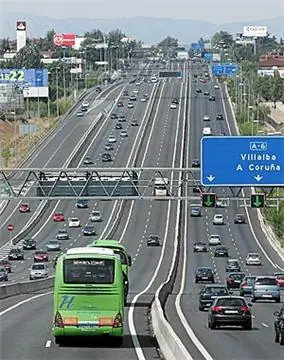
Circulando a una velocidad superior a la velocidad máxima permitida está circulando...
If you drive faster than the maximum speed allowed, you are driving...
- Acon exceso de velocidad.above the speed limit (speeding).
- Ba una velocidad máxima.at maximum speed.
- Ca una velocidad moderada, según las circunstancias.at a moderate speed, depending on the circumstances.
ExplanationDriving above the maximum speed allowed means speeding, or driving at excessive speed, which is an offence that can be fined. The appropriate speed is one that suits the circumstances without going over the limit.
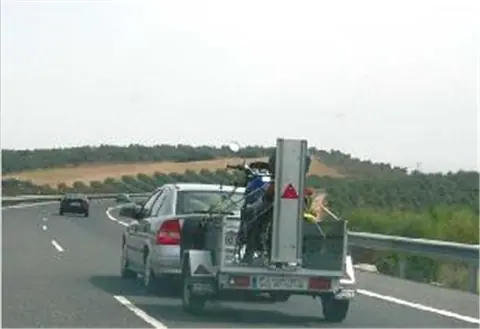
La distancia de frenado de un vehículo cargado es...
The braking distance of a loaded vehicle is...
- Amayor que cuando circula sin carga.longer than when it is driven without a load.
- Bmenor que cuando circula sin carga.shorter than when it is driven without a load.
- Cigual que cuando circula sin carga.the same as when it is driven without a load.
ExplanationA loaded vehicle weighs more and has more inertia, so at the same speed it needs more metres to stop. In addition, the load can change the weight distribution and stability when braking, so you must increase your safe distance.
¿Cómo se puede disminuir la influencia del factor riesgo de la vía?
How can you reduce the effect of the road as a risk factor?
- AAdecuando la velocidad y aumentando la distancia de seguridadBy adapting your speed and increasing your safe distance
- BCirculando de noche porque hay menos tráficoBy driving at night because there is less traffic
- CCirculando a 50 km/hora en todas las víasBy driving at 50 km/h on all roads
ExplanationThe most effective way to reduce the risk posed by the road is to adapt your speed to its features and increase your safe distance from other vehicles. It is not about driving at a fixed speed or driving at night, when visibility is poorer.
Si hay mal tiempo, ¿hay que aumentar la distancia de seguridad?
If the weather is bad, must you increase your safe distance?
- ASí, pero solo de noche.Yes, but only at night.
- BSí, en cualquier caso.Yes, in all cases.
- CNo, nunca.No, never.
ExplanationArticle 54.1 of the General Traffic Regulations requires you to leave a space that allows you to stop without a collision, taking into account speed and grip and braking conditions. In rain, fog or snow, grip and visibility get worse, so the distance must be increased.
Conforme se aumenta la velocidad...
As speed increases...
- ADebemos aumentar la visión periférica.We must widen our peripheral vision.
- BDebemos mirar más veces hacia atrás a través del espejo retrovisor.We must look back in the rear-view mirror more often.
- CDebemos mirar más lejos.We must look further ahead.
ExplanationAs we increase speed we must look further ahead, because we will cover more distance in less time.
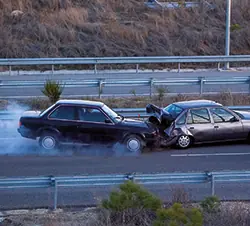
¿De qué depende la distancia de detención?
What does the stopping distance depend on?
- ADe la velocidad, solamente.On speed only.
- BDel tipo de vehículo, solamente.On the type of vehicle only.
- CDe la velocidad, del tiempo de reacción y de la distancia de frenado.On speed, reaction time and braking distance.
ExplanationThe stopping distance is the distance travelled during the reaction time plus the braking distance, and both depend on speed: the higher the speed, the more metres it takes to stop.
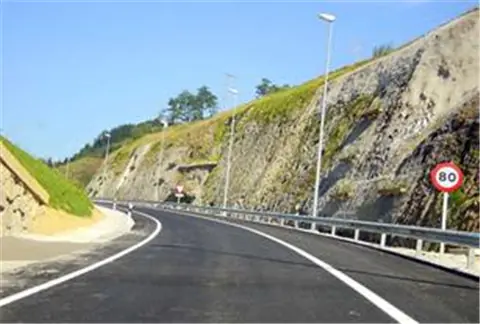
El exceso de velocidad, ¿afecta a nuestra capacidad de anticipación?
Does excessive speed affect our ability to anticipate?
- ANo, sólo afecta a nuestra capacidad de reacción.No, it only affects our ability to react.
- BSí, disminuyéndola.Yes, it reduces it.
- CSí, aumentándola.Yes, it increases it.
ExplanationExcessive speed reduces the ability to anticipate: the field of vision narrows and there is less time to detect and interpret dangers before reaching them. It affects not only reaction but also the perception that comes before it.
La distancia de seguridad será como mínimo de...
The safe distance must be at least...
- A4 segundos.4 seconds.
- B2 segundos en zona urbana y 3 en carretera.2 seconds in urban areas and 3 on the open road.
- C1 segundo en cualquier tipo de vía.1 second on any type of road.
ExplanationThe safe distance from the vehicle in front must be at least 2 seconds in built-up areas and at least 3 seconds on the open road.
¿Cuál es la velocidad máxima en una autovía para una motocicleta de hasta 125 cm³?
What is the maximum speed on a dual carriageway (autovía) for a motorcycle of up to 125 cm³?
- A120 km/h.120 km/h.
- B90 km/h.90 km/h.
- C80 km/h.80 km/h.
ExplanationAccording to the General Traffic Regulations (RGC), Article 48 sets the maximum speed for motorcycles of up to 125 cm³ on motorways (autopistas) and dual carriageways (autovías) at 120 km/h. So the correct answer is 120 km/h, as the other options do not match this rule. This limit applies to these types of vehicle to keep traffic flowing smoothly and safely on fast roads.
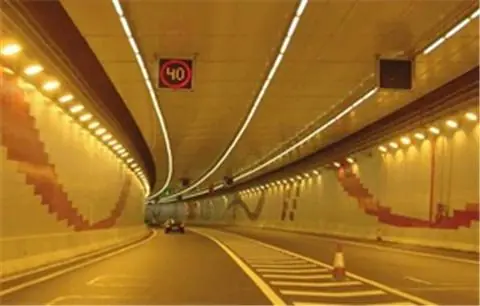
En el túnel de la imagen, si no pretende adelantar, ¿qué distancia de seguridad debe mantener con el vehículo de delante?
In the tunnel in the picture, if you do not intend to overtake, what safe distance must you keep from the vehicle in front?
- ALa que permita una visibilidad suficiente.One that gives enough visibility.
- B100 metros, como mínimo.At least 100 metres.
- C200 metros, como mínimo.At least 200 metres.
ExplanationAccording to Article 95 of the General Traffic Regulations, in tunnels and underpasses, if you are not going to overtake, you must keep at least 100 metres or 4 seconds from the vehicle in front. Vehicles over 3,500 kg must leave 150 metres or 6 seconds.
¿Cómo debe avisar a los vehículos que circulan detrás de que pretende reducir considerablemente la velocidad del vehículo que conduce?
How should you warn the vehicles behind you that you intend to reduce the speed of your vehicle considerably?
- AEncendiendo las luces de posición.By switching on the sidelights.
- BSólo con el intermitente derecho.Only with the right indicator.
- CMediante el empleo reiterado de las luces de frenado.By repeatedly using the brake lights.
ExplanationIf you need to slow the vehicle down considerably, you must warn others by repeatedly using the brake lights, or with your arm, moving it up and down with short, quick movements.
¿A qué velocidad máxima podrá circular un turismo que arrastre un remolque de 750 kg por una autovía?
What is the maximum speed on a dual carriageway (autovía) for a car towing a 750 kg trailer?
- A90 km/h.90 km/h.
- B80 km/h.80 km/h.
- C100 km/h.100 km/h.
ExplanationOn motorways (autopistas) and dual carriageways (autovías), motor vehicles towing a trailer have a general limit of 90 km/h, whatever the mass of the trailer (Article 48.1.a of the General Traffic Regulations, RGC). Since 2019 there is no longer an 80 km/h limit for trailers over 750 kg.
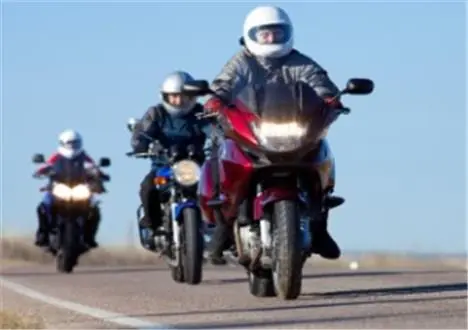
Si conduce una motocicleta, ¿qué separación lateral debe mantener al cruzarse con otro vehículo?
If you are riding a motorcycle, what lateral clearance must you keep when passing an oncoming vehicle?
- ALa necesaria para realizar el cruce con seguridad.The clearance needed to pass it safely.
- BUna distancia menor de 1,50 metros fuera de poblado.A distance of less than 1.50 metres outside built-up areas.
- CUna distancia máxima de 1,50 metros en poblado.A maximum distance of 1.50 metres in built-up areas.
ExplanationWhen passing an oncoming vehicle you must leave the lateral clearance needed to do it safely, depending on the width of the road and the speed. The minimum distance of 1.5 metres is required when overtaking cyclists and other vulnerable road users, not when passing oncoming vehicles.
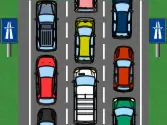
Si por densidad de tráfico circulamos a velocidad inferior a la mínima en una autopista, ¿cómo lo haremos?
If heavy traffic means we are driving below the minimum speed on a motorway (autopista), how should we drive?
- ACircularemos por el arcén.We drive on the hard shoulder.
- BCircularemos por el arcén hasta la próxima salida.We drive on the hard shoulder until the next exit.
- CCircularemos por la calzada.We drive on the carriageway.
ExplanationAny driver who, for emergency reasons, has to drive on a motorway (autopista) or dual carriageway (autovía) at an abnormally low speed, seriously disrupting traffic, must use the right-hand hard shoulder and leave at the first exit. That is not the case in this question: we are driving below the minimum speed because of heavy traffic, not because of an emergency, so we carry on driving on the carriageway.
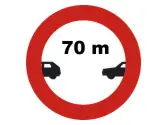
A la vista de esta señal, ¿qué separación se debe mantener con el vehículo que circula delante?
On seeing this sign, what gap must you keep from the vehicle in front?
- A70 metros como máximo.70 metres at most.
- B70 metros como mínimo, excepto para adelantar.At least 70 metres, except when overtaking.
- C70 metros como mínimo, en cualquier caso.At least 70 metres, in all cases.
ExplanationThis sign requires you to keep a gap from the vehicle in front equal to or greater than the one shown, in this case 70 metres. The only exception is overtaking, during which you obviously have to get closer.
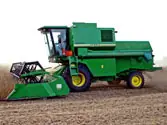
¿Cuál es la velocidad máxima para los vehículos especiales que carecen de señalización de frenado?
What is the maximum speed for special vehicles that have no brake lights?
- A25 kilómetros por hora.25 kilometres per hour.
- B35 kilómetros por hora.35 kilometres per hour.
- C40 kilómetros por hora.40 kilometres per hour.
ExplanationAs a general rule, the maximum speed for special vehicles is: 25 km/h for those that have no brake light, tow a trailer or are two-wheel tractors; 70 km/h for those that can reach 60 km/h on the flat; 40 km/h for all other special vehicles.
Cuando un conductor circula a una velocidad adecuada...
When a driver is driving at an appropriate speed...
- Ahace que el tráfico sea lento y peligroso.they make traffic slow and dangerous.
- Bgenera problemas a otros conductores y puede provocar un accidente.they cause problems for other drivers and may cause an accident.
- Cpuede detectar las intenciones de otros conductores y reaccionar a tiempo para evitar un accidente.they can detect other drivers' intentions and react in time to avoid an accident.
ExplanationThe appropriate speed is the one suited to the road, the traffic, the vehicle and the conditions, so that the driver can always stop within their field of vision (Article 45 of the General Traffic Regulations). This gives them time to understand what others are doing and react.
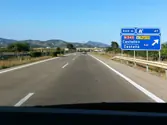
¿Circularemos correctamente por la calzada de una autopista a 60 km/h?
Are we driving correctly on the carriageway of a motorway (autopista) at 60 km/h?
- ANo, deberemos circular por el arcén.No, we must drive on the hard shoulder.
- BSí, siempre que no perturbemos la marcha de otros vehículos.Yes, as long as we do not hold up other vehicles.
- CSí.Yes.
ExplanationOn motorways (autopistas) and dual carriageways (autovías), you may not drive below 60 km/h (Article 49.1 of the General Traffic Regulations, RGC), so at 60 km/h you are driving correctly on the carriageway. The hard shoulder is only used when, in an emergency, you are going at an abnormally low speed that seriously disrupts traffic.
¿De qué dependen los límites de velocidad que se establecen para una vía?
What do the speed limits set for a road depend on?
- ADe su trazado y del tráfico que vaya a soportar.On its layout and the traffic it will carry.
- BDe criterios económicos fundamentalmente.Mainly on economic criteria.
- CDe su trazado y número de curvas.On its layout and the number of bends.
ExplanationSpeed limits depend on a set of technical criteria, for example the layout of the road, the traffic demand, the types of vehicle that will use it, and so on.
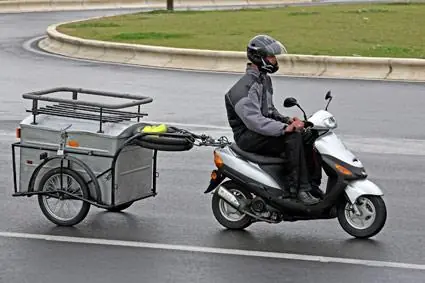
Un ciclomotor arrastrando un remolque, circula por una carretera convencional a la velocidad máxima que le permite la norma, ¿cuál es dicha velocidad?
A moped towing a trailer is travelling on a conventional road at the maximum speed allowed by the rules. What is that speed?
- A40,5 kilómetros hora.40.5 kilometres per hour.
- B45 kilómetros hora.45 kilometres per hour.
- C30 kilómetros hora.30 kilometres per hour.
ExplanationA moped towing a trailer must reduce its general maximum speed by 10% (Article 12 of the General Traffic Regulations). As the limit for mopeds outside built-up areas is 45 km/h, with a trailer the maximum is 40.5 km/h.
All topics
- Definitions
- Documents and penalty points
- The driver's condition
- Duties of drivers and pedestrians
- Vehicle safety devices
- Vehicle controls and equipment
- Vehicle lights and horn
- Traffic signs, markings and signals
- The road and its lanes
- Manoeuvres
- Right of way
- Carrying passengers and loads
- Driving safely in difficult conditions
- Vehicle mechanics and maintenance
- Road accidents and first aid
- Defensive and eco-driving
Independent app: not affiliated with or endorsed by the DGT (Spain's Directorate-General for Traffic) or the Ministry of the Interior. The official exam is booked with the DGT and taken at its test centres. The questions here are practice material; the DGT's official question bank is not public.
Basado en datos de la Agencia Estatal Boletín Oficial del Estado (https://www.boe.es). Textos consolidados de carácter meramente informativo. La AEBOE no patrocina ni respalda este sitio.
Parte de las preguntas procede de los tests de la revista «Tráfico y Seguridad Vial» de la DGT, reproducidos con indicación de la fuente.