
DGT test · 961 questions
Speed and distances · Page 6 of 20
Speed limits by road and vehicle type, adapting speed to conditions, safe following distance and stopping distance.
Questions in this topic, with answers
961 questions, 50 per page, with the correct answer and the explanation. Page 6 of 20.
Un turismo con remolque, ¿puede superar la velocidad máxima permitida para adelantar?
Can a car towing a trailer exceed the maximum speed allowed in order to overtake?
- ANo.No.
- BSí, en 20 Km/h.Yes, by 20 km/h.
- CSí, en 10 Km/h.Yes, by 10 km/h.
ExplanationNo vehicle may exceed the maximum speed to overtake, and that includes a car towing a trailer. The old 20 km/h margin on conventional roads was abolished by Law 18/2021, in force since 21 March 2022.
¿Cuál es la velocidad máxima permitida para un coche en una autovía?
What is the maximum speed allowed for a car on a dual carriageway (autovía)?
- A90 km/h.90 km/h.
- B100 km/h.100 km/h.
- C120 km/h.120 km/h.
ExplanationThe general maximum speed for cars on dual carriageways (autovías) is 120 km/h, under Article 48.1 of the General Traffic Regulations. This means that, unless specific signs say otherwise, all cars must keep to this limit, which keeps traffic on fast roads safe and efficient.
¿Cuál es la velocidad máxima permitida para un vehículo de tres ruedas dentro de poblado, en una vía con dos o más carriles por sentido?
What is the maximum speed allowed for a three-wheeled vehicle inside a built-up area, on a road with two or more lanes in each direction?
- A25 km/h.25 km/h.
- B40 km/h.40 km/h.
- C50 km/h.50 km/h.
ExplanationOn urban roads, the general limits do not depend on the type of vehicle but on the road: 50 km/h with two or more lanes in each direction, 30 km/h with only one lane, and 20 km/h on single-level streets (Article 50.1 of the General Traffic Regulations, RGC).
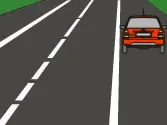
¿Circula de forma correcta este vehículo?
Is this vehicle being driven correctly?
- ASí.Yes.
- BNo, porque no se puede circular por el arcén.No, because it may not drive on the hard shoulder.
- CNo, porque el arcén no es transitable.No, because the hard shoulder is not usable.
ExplanationThis vehicle should be driven on the carriageway. You may only drive on the hard shoulder in exceptional cases, when you are going at an abnormally low speed that seriously disrupts traffic. In the picture there is no traffic being disrupted, so it should be on the carriageway, not on the hard shoulder.
Un turismo circula en llano. ¿Cuándo necesita más distancia (espacio) para frenar?
A car is travelling on level ground. When does it need more distance (space) to brake?
- ACuando el vehículo lleva poco peso.When the vehicle is carrying little weight.
- BCuando el vehículo lleva mucho peso.When the vehicle is carrying a lot of weight.
- CFrena siempre igual, porque los frenos se adaptan al peso.It always brakes the same, because the brakes adjust to the weight.
ExplanationBraking distance is the distance the vehicle travels from when the driver applies the brake until the vehicle stops. This distance can vary with the speed, the condition of the tyres, suspension and brakes, the vehicle's load, the road conditions and the weather.
Circulamos por una carretera con varios carriles en el mismo sentido de la marcha detrás de otra motocicleta que circula a la velocidad máxima permitida para este tipo de vías. ¿Podemos adelantarla?
We are riding on a road with several lanes in our direction of travel, behind another motorcycle that is riding at the maximum speed allowed for this type of road. May we overtake it?
- ASí, pero únicamente si no rebaso los 110 km/h.Yes, but only if I do not exceed 110 km/h.
- BSí, siempre que no necesite desplazarme de carril.Yes, provided I do not need to change lanes.
- CNo, porque la motocicleta a la que pretendo adelantar ya circula a la velocidad máxima permitida.No, because the motorcycle I want to overtake is already riding at the maximum speed allowed.
ExplanationNo, because the motorcycle I want to overtake is already riding at the maximum speed allowed. When overtaking, you need to be going clearly faster than the vehicle you want to overtake. If the motorcycle is already riding at the maximum speed allowed, overtaking it would be neither safe nor necessary.
¿Qué distancia de seguridad debemos mantener con el vehículo que nos precede en el interior de un túnel?
What safe distance should we keep from the vehicle in front inside a tunnel?
- ALa que permita detener el vehículo sin colisionar con el que va delante.One that allows us to stop the vehicle without hitting the one in front.
- BLa que permita en caso de frenado brusco inesperado, poder frenar sin colisionar con el vehículo que nos precede.One that, if the vehicle in front brakes suddenly and unexpectedly, allows us to brake without hitting it.
- C100 metros como mínimo si no tenemos intención de adelantar al vehículo que nos precede.At least 100 metres if we do not intend to overtake the vehicle in front.
ExplanationWhen driving inside a tunnel, we must keep a safe distance of at least 100 metres, or a gap of 4 seconds, from the vehicle in front.
Una motocicleta capaz de alcanzar una velocidad superior a 100 km/h debe llevar obligatoriamente...
A motorcycle that can reach a speed of more than 100 km/h must have...
- AUn espejo retrovisor en el lado izquierdo, por lo menos.At least one rear-view mirror on the left.
- BDos espejos retrovisores obligatoriamente.Two rear-view mirrors; this is compulsory.
- CUn espejo retrovisor en el lado derecho, por lo menos.At least one rear-view mirror on the right.
ExplanationA motorcycle that can go faster than 100 km/h must have two rear-view mirrors, one on each side. When it cannot go faster than 100 km/h, it may be ridden with a single rear-view mirror on the left.
En un túnel de un solo carril, ¿qué distancia de seguridad debe guardar al menos un turismo con el vehículo que va delante?
In a tunnel with a single lane, what is the minimum safe distance a car must keep from the vehicle in front?
- A150 metros o 6 segundos.150 metres or 6 seconds.
- B50 metros o 2 segundos.50 metres or 2 seconds.
- C100 metros o 4 segundos.100 metres or 4 seconds.
ExplanationUnder Article 95.6 of the General Traffic Regulations, in a tunnel, if you are not going to overtake, you must keep at least 100 metres or 4 seconds from the vehicle in front. The 150 metres or 6 seconds are for vehicles with a maximum authorised mass over 3,500 kg.
¿Conducir por debajo de la velocidad mínima permitida podría ser un factor de riesgo?
Could driving below the minimum speed allowed be a risk factor?
- ANo, porque siempre se considera una velocidad adecuada.No, because it is always considered an appropriate speed.
- BNo, nunca.No, never.
- CSí, una velocidad anormalmente baja puede provocar accidentes.Yes, an abnormally low speed can cause accidents.
ExplanationDriving at an abnormally low speed holds up others and leads to overtaking and rear-end collisions. That is why Article 49.1 of the General Traffic Regulations forbids driving at less than 60 km/h on motorways (autopistas) and dual carriageways (autovías) and, on other roads, at less than half the general speed limit.
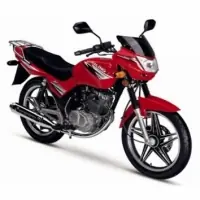
Un automóvil de dos ruedas que por construcción desarrolla una velocidad máxima superior a 45 kilómetros por hora es...
A two-wheeled motor car whose maximum design speed is over 45 kilometres per hour is...
- Auna motocicleta.a motorcycle.
- Bun ciclomotor.a moped.
- Cuna bicicleta.a bicycle.
ExplanationUnder Annex I of the Traffic Act, a motorcycle is a two-wheeled motor car with an engine of more than 50 cm³, if it is an internal combustion engine, and/or a maximum design speed of more than 45 km/h. Mopeds, on the other hand, do not go faster than 45 km/h.
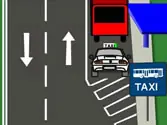
¿A qué velocidad máxima podremos circular por esta vía urbana?
What is the maximum speed at which we may drive on this urban road?
- A50 km/h.50 km/h.
- B30km/h.30 km/h.
- C20 km/h.20 km/h.
ExplanationThe general speed limits on urban roads depend on the type of carriageway: a) 20 km/h on single-level streets where the carriageway and pavement are at the same level; b) 30 km/h on roads with only one lane in each direction; c) 50 km/h on roads with two or more lanes in each direction. Lanes reserved for certain users or only for public transport are not counted for this purpose. The local authority may lower or raise these limits with specific signs. On travesías the limit is 50 km/h for all vehicles, except vehicles carrying dangerous goods, which have a limit of 40 km/h. The local authority may lower this limit by agreement with the road owner, with specific signs.
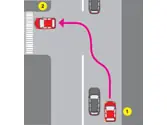
Si la calzada está helada la distancia de frenado podrá ser...
If the road surface is icy, the braking distance may be...
- A3 veces mayor.3 times longer.
- B4 veces mayor.4 times longer.
- C10 veces mayor.10 times longer.
ExplanationIf the road surface is icy, the braking distance may be up to 10 times longer than in normal conditions. So it is not advisable to use the brake. To slow down, we should gradually lift our foot off the accelerator.
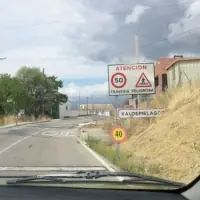
En general, ¿cuál es la velocidad máxima en las travesías?
In general, what is the maximum speed in travesías (stretches of road through a town)?
- A60 km por hora60 km/h
- B50 km por hora50 km/h
- C80 km por hora80 km/h
ExplanationThe general limit in travesías is 50 km/h for all types of vehicle (Article 50.5 of the General Traffic Regulations), and it may not be exceeded even to overtake. It can be lowered with specific signs, such as the 40 km/h sign in the picture.
En una autovía dentro de poblado, ¿A qué velocidad puede circular como máximo si no existe señalización?
On a dual carriageway (autovía) within a built-up area, what is the maximum speed at which you may drive if there are no signs?
- A120 km/h.120 km/h.
- B100 km/h.100 km/h.
- C80 km/h.80 km/h.
ExplanationUnder Article 50 of the General Traffic Regulations, on motorways (autopistas) and dual carriageways (autovías) that run within a built-up area the general limit is 80 km/h. The local authority and the road owner may raise it with signs, without exceeding the limits for outside built-up areas.
¿Cuándo un vehículo especial tendrá que llevar la luz amarilla giratoria?
When must a special vehicle carry the rotating amber light?
- ACuando su velocidad supere los 40 km/h.When its speed is over 40 km/h.
- BCuando su velocidad no supere los 40 km/h.When its speed is not over 40 km/h.
- CNo es necesario en ningún caso.It is not needed in any case.
ExplanationWhen the special vehicle does not go faster than 40 km/h, it must be signalled with the rotating amber light.
¿Cuál será la distancia que deberá mantener un turismo al cruzarse con una motocicleta circulando fuera de poblado?
Outside built-up areas, what distance must a car keep when passing a motorcycle coming the other way?
- A1,50 metros como mínimo.At least 1.50 metres.
- BLa necesaria para realizar el cruce con seguridad.The distance needed to pass each other safely.
- C1,50 metros como máximo.At most 1.50 metres.
ExplanationWhen passing each other in opposite directions, two vehicles must leave between them the space needed to do so safely. The minimum gap of 1.5 metres in Article 85.4 of the General Traffic Regulations (RGC) (as worded by RD 518/2026) refers to overtaking pedestrians, animals, animal-drawn vehicles, mopeds, personal mobility vehicles and cyclists, not to passing a motorcycle coming the other way.
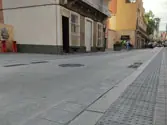
En una vía urbana con plataforma única de calzada y acera, ¿cuál será la velocidad máxima a la que podremos circular?
On an urban road where the carriageway and the pavement are on a single level, what is the maximum speed we may drive at?
- AA 50 kilómetros por hora.50 kilometres per hour.
- BA 30 kilómetros por hora.30 kilometres per hour.
- CA 20 kilómetros por hora.20 kilometres per hour.
ExplanationUnder Article 50.1.a of the General Traffic Regulations (RGC), on urban roads where the carriageway and the pavement share a single level, the general limit is 20 km/h. On roads with a single lane in each direction it is 30 km/h, and on roads with two or more lanes in each direction, 50 km/h.
Un ciclomotor de dos ruedas es un vehículo con motor...
A two-wheeled moped is a vehicle with an engine...
- Ade cilindrada no superior a 50 cm³, si es de combustión interna, y velocidad máxima por construcción no superior a 45 km/h.with a capacity of no more than 50 cm³, if it is an internal combustion engine, and a maximum design speed of no more than 45 km/h.
- Bde menos de 50 cm³, sea cual sea su velocidad máxima.of less than 50 cm³, whatever its maximum speed.
- Cde más de 50 cm³ si tiene motor de combustión interna.of more than 50 cm³ if it has an internal combustion engine.
ExplanationAccording to Annex II of the General Vehicle Regulations, a two-wheeled moped has an engine with a capacity of no more than 50 cm³, if it is an internal combustion engine, and a maximum design speed of no more than 45 km/h. Both conditions must be met.
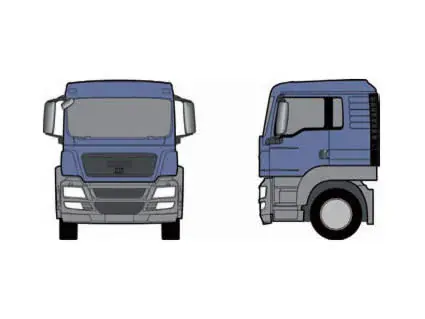
¿Cuál debe ser la separación mínima entre la cabina y el compartimento de carga, en determinados vehículos de mercancías peligrosas?
What must the minimum gap be between the cab and the load compartment in certain vehicles carrying dangerous goods?
- AUn espacio de al menos 100 mm.A space of at least 100 mm.
- BUn espacio libre mínimo de 15 cm.A clear space of at least 15 cm.
- CDependerá del espesor de la pared del compartimento de carga.It will depend on the thickness of the load compartment wall.
ExplanationIn certain vehicles carrying dangerous goods, the minimum gap between the cab and the load compartment must be a clear space of at least 15 cm. This is because enough distance is needed to prevent any fire or explosion from spreading from the load compartment to the cab of the vehicle.
Si conducimos por una travesía con dos carriles para cada sentido sin arcenes, la velocidad máxima será de...
If you are driving through a travesía (a stretch of road through a town) with two lanes in each direction and no hard shoulders, the maximum speed is...
- A50 km/h.50 km/h.
- B90 km/h, porque no existe arcén.90 km/h, because there is no hard shoulder.
- C100 km/h, porque es una vía interurbana.100 km/h, because it is a road outside built-up areas.
ExplanationAccording to Article 50.5 of the General Traffic Regulations, the general limit in a travesía is 50 km/h for all types of vehicles, whatever the number of lanes and even if there is no hard shoulder. It can only be lowered by specific signs.
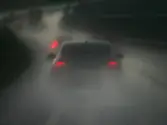
En caso de lluvia, ¿es conveniente aumentar la distancia de seguridad con el vehículo que nos precede?
In the rain, is it advisable to increase the safe distance from the vehicle in front?
- ANo, mantendremos la misma distancia de seguridad que con el asfalto está seco.No, we will keep the same safe distance as on a dry road.
- BSí.Yes.
- CNo, al tener menor visibilidad, nos aproximaremos más al vehículo que nos precede.No; as visibility is lower, we will get closer to the vehicle in front.
ExplanationIn the rain we will increase the safe distance from the vehicle in front. On a wet carriageway, if we brake suddenly, we need more metres to stop the vehicle.
En una calle urbana con un solo carril por sentido, ¿cuál es la velocidad máxima genérica?
On a town street with a single lane in each direction, what is the general maximum speed?
- A30 km/h30 km/h
- B20 km/h20 km/h
- C50 km/h50 km/h
ExplanationRoads in built-up areas with a single lane in each direction have a general limit of 30 km/h.
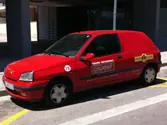
¿Cuál será la velocidad máxima de un vehículo derivado de turismo circulando por una autovía?
What is the maximum speed of a car-derived van on a dual carriageway (autovía)?
- A100 km/h.100 km/h.
- B90 km/h.90 km/h.
- C120 km/h.120 km/h.
ExplanationThe maximum speed allowed for a car-derived van on a dual carriageway (autovía) is 100 km/h, the same as on a motorway (autopista).
Dentro de poblado, ¿a qué velocidad máxima le está permitido circular con su turismo en una vía con un único carril por sentido de circulación si no existe señalización específica?
In a built-up area, what is the maximum speed at which you may drive your car on a road with a single lane in each direction if there are no specific signs?
- A50 kilómetros por hora.50 kilometres per hour.
- B30 kilómetros por hora.30 kilometres per hour.
- C40 kilómetros por hora.40 kilometres per hour.
ExplanationUnder Article 50.1 of the General Traffic Regulations, in force since 11 May 2021, the general limit on roads in built-up areas with a single lane in each direction is 30 km/h. It is 50 km/h with two or more lanes in each direction and 20 km/h on single-level (shared) streets.
Si circulamos a 25 km/h con nuestra motocicleta, sin casco de protección y sufrimos una caída, ¿puede haber riesgo de lesión?
If you are riding your motorcycle at 25 km/h without a helmet and you fall off, is there a risk of injury?
- ASí, entre otras lesiones puede producirse fractura de cráneo y lesiones cerebrales.Yes, among other injuries, skull fractures and brain injuries can occur.
- BPuede existir riesgo de fractura de cráneo, pero nunca de lesión cerebral.There may be a risk of skull fracture, but never of brain injury.
- CNo, ninguno, ya que a tan poca velocidad el sufrir un impacto en la cabeza no tendrá consecuencias negativas.No, none, because at such a low speed a blow to the head will have no harmful effects.
ExplanationMotorcycles are less stable and more fragile vehicles than cars, so falling off at 25 km/h without a helmet can cause serious injuries, such as skull fractures and brain injuries. The head and face are the parts of the body most affected in motorcycle accidents, so it is important to wear a helmet to reduce the chance of these injuries.
En caso de emergencia circulando a velocidad anormalmente reducida y perturbando gravemente la circulación, ¿qué vehículos usarán el arcén?
In an emergency, when driving at an abnormally low speed and seriously disrupting traffic, which vehicles will use the hard shoulder?
- ASolo los turismos.Only cars.
- BSolo los camiones de más de 3.500 kg.Only lorries of more than 3,500 kg.
- CLos vehículos con M.M.A. no superior a 3.500 kg.Vehicles with a MAM of no more than 3,500 kg.
ExplanationAccording to Article 36 of the General Traffic Regulations, vehicles with a maximum authorised mass of up to 3,500 kg that, because of an emergency, are travelling at an abnormally low speed and seriously disrupting traffic must use the hard shoulder if it is passable and wide enough. Vehicles of more than 3,500 kg travel on the carriageway.
¿Cuál será la velocidad máxima a la que podrá circular un vehículo mixto adaptable por una autovía?
What is the maximum speed at which an adaptable mixed-use vehicle may travel on a dual carriageway (autovía)?
- A90 km/h.90 km/h.
- B80 km/h.80 km/h.
- C100 km/h.100 km/h.
ExplanationOn motorways (autopistas) and dual carriageways (autovías), buses, car-derived vans and adaptable mixed-use vehicles have a general limit of 100 km/h (Article 48.1.a of the General Traffic Regulations (RGC)). Motorhomes may travel at 120 km/h if their MAM is not over 3,500 kg and at 90 km/h if it is.
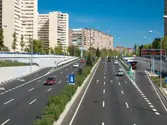
En una autopista urbana en la que no se indica límite de velocidad, ¿a qué velocidad circularemos como máximo?
On an urban motorway (autopista) where no speed limit is shown, what is the maximum speed we may drive at?
- A50 km/h.50 km/h.
- B120 km/h.120 km/h.
- C80 km/h.80 km/h.
ExplanationOn an urban motorway, that is, one inside a built-up area, the general maximum speed, when no specific sign shows otherwise, is 80 km/h. On a non-urban motorway, the general maximum speed is 120 km/h.
¿Cuál será la velocidad máxima a la que se podrá circular por un carril en sentido contrario al habitual?
What is the maximum speed at which you may drive in a lane running against its usual direction?
- AA la máxima genérica de la vía.The general maximum speed for that road.
- BA 80 km/h.80 km/h.
- CA 60 km/h.60 km/h.
ExplanationIn a lane running against its usual direction, the maximum speed is 80 km/h and the minimum is 60 km/h.
Una autocaravana tiene una MMA (masa máxima autorizada) de 3700 kg. ¿Cuál es su velocidad máxima en una carretera convencional?
A motorhome has a MAM (maximum authorised mass) of 3,700 kg. What is its speed limit on a conventional road?
- A80 km/h80 km/h
- B90 km/h90 km/h
- C100 km/h100 km/h
ExplanationOn a conventional road, motorhomes with a MAM over 3,500 kg, like this 3,700 kg one, have a general limit of 80 km/h. Those of 3,500 kg or less may travel at 90 km/h, like cars (Article 48.1.a of the General Traffic Regulations).
¿Cuál es la velocidad máxima en autopista o autovía para un turismo que arrastra un remolque ligero?
What is the maximum speed on a motorway (autopista) or dual carriageway (autovía) for a car towing a light trailer?
- A80 km/h80 km/h
- B100 km/h100 km/h
- C90 km/h90 km/h
ExplanationArticle 48.1.a of the General Traffic Regulations (RGC) sets 90 km/h on motorways (autopistas) and dual carriageways (autovías) for motor cars with a trailer, whether the trailer is light (up to 750 kg MAM) or not. The car without a trailer could travel at 120 km/h.
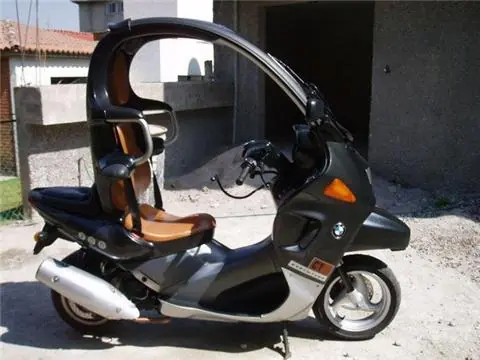
¿Cuántos espejos retrovisores tiene que llevar obligatoriamente una motocicleta con estructura de autoprotección, si su velocidad máxima no supera los 100 km/h?
How many rear-view mirrors must a motorcycle with a protective structure have if its maximum speed does not exceed 100 km/h?
- ADos exteriores, uno en cada lado.Two outside mirrors, one on each side.
- BUno interior y otro exterior izquierdo.One inside mirror and one outside mirror on the left.
- CUno exterior, en el lado izquierdo.One outside mirror, on the left.
ExplanationAccording to Annex III of the General Vehicle Regulations, motorcycles whose maximum speed does not exceed 100 km/h must have an outside rear-view mirror on the left; the right one is optional. If their maximum speed is higher, both are compulsory.
¿Cómo será la distancia de detención circulando por una calzada seca en comparación con la de una calzada mojada?
How will the stopping distance on a dry carriageway compare with that on a wet carriageway?
- AMenor.Shorter.
- BMayor.Longer.
- CIgual.The same.
ExplanationThe stopping distance is the sum of the distance travelled during the reaction time and the distance travelled while braking. On a dry surface the braking distance will be shorter than on a wet one, so the stopping distance will also be shorter.
¿Cuál es la velocidad máxima permitida para que un turismo adelante a otro en una carretera convencional?
What is the maximum speed allowed for a car overtaking another on a conventional road?
- A110 km/h.110 km/h.
- B90 km/h.90 km/h.
- C120 km/h.120 km/h.
ExplanationWhen overtaking on conventional roads, cars and motorcycles may not go faster than 90 km/h.
Si circula detrás de otro vehículo, ¿cuál debe ser la distancia de seguridad entre ambos?
If you are driving behind another vehicle, what should the safe distance between you be?
- A60 metros.60 metres.
- BLa que me permita detenerme sin chocar con el otro vehículo.A distance that lets me stop without hitting the other vehicle.
- C90 metros.90 metres.
ExplanationArticle 54.1 of the General Traffic Regulations does not set a figure in metres: it requires you to leave a clear space from the vehicle in front that lets you stop, if it brakes sharply, without colliding with it, taking into account your speed and the grip and braking conditions.
Si no hay señalización, ¿cuál es la velocidad máxima permitida para una furgoneta en una autovía dentro del casco urbano?
If there are no signs, what is the maximum speed allowed for a van on a dual carriageway (autovía) inside a town?
- A80 km/h.80 km/h.
- B100 km/h.100 km/h.
- C90 km/h.90 km/h.
ExplanationThe general limit on motorways (autopistas) and dual carriageways (autovías) that run through built-up areas is 80 km/h (Article 50.6 of the General Traffic Regulations (RGC)). It may be raised by agreement between the local authority and the road owner, with prior signs, but not above the limits outside built-up areas.
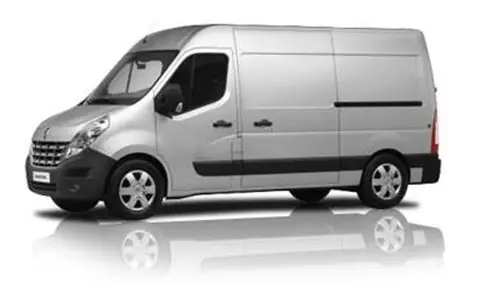
En una carretera convencional sin arcenes, la velocidad máxima para un furgón es...
On a conventional road without hard shoulders, the maximum speed for a van is...
- A80 Km/h.80 km/h.
- B90 km/h.90 km/h.
- C110 km/h.110 km/h.
ExplanationAccording to Article 48.1.a) of the General Traffic Regulations, vans may travel at a maximum of 80 km/h on conventional roads and 90 km/h on motorways (autopistas) and dual carriageways (autovías). Since 2019 the hard shoulder no longer affects the limit.
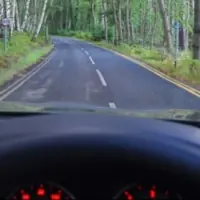
¿Cómo se denomina el acto de circular superando los límites de velocidad?
What is driving above the speed limits called?
- AVelocidad excesivaExcessive speed.
- BVelocidad adecuadaAppropriate speed.
- CVelocidad inadecuadaInappropriate speed.
ExplanationA vehicle is said to be driving at an inappropriate speed when its speed does not suit the traffic or road conditions. If we drive faster than the set limits, this is called excessive speed, and if we drive below the minimum speed set for that road, this is abnormally reduced speed.
Conducir a velocidad anormalmente reducida, ¿puede provocar accidentes?
Can driving at an abnormally low speed cause accidents?
- ANo, porque al circular más despacio vamos más seguros.No, because driving more slowly is safer.
- BSí.Yes.
- CSí, tanto como circular a velocidad excesiva.Yes, as much as driving too fast.
ExplanationDriving at abnormally low speeds can cause accidents because it disrupts the normal flow of traffic on the road. However, in speed-related accidents, only 1% of drivers were driving at an abnormally low speed.
Si aumentamos la velocidad de 55 km/h a 110 km/h, ¿aumenta también la distancia de frenado?
If we increase our speed from 55 km/h to 110 km/h, does the braking distance also increase?
- ASí, en la misma proporción.Yes, in the same proportion.
- BSí, en mayor proporción.Yes, in a greater proportion.
- CNo, la distancia de frenado no depende de la velocidad.No, braking distance does not depend on speed.
ExplanationBraking distance increases roughly with the square of the speed: if speed doubles, from 55 to 110 km/h, braking distance is multiplied by about four. That is why it increases in a greater proportion than the speed.
Si conducimos un camión que arrastra un remolque ligero, ¿a qué velocidad podremos circular como máximo por una autopista si estamos adelantando?
If we are driving a lorry towing a light trailer, what is the maximum speed at which we may drive on a motorway (autopista) while overtaking?
- A80 km/h.80 km/h.
- B90 km/h.90 km/h.
- C110 km/h.110 km/h.
ExplanationOn motorways (autopistas) and dual carriageways (autovías), lorries and motor vehicles with a trailer have a general limit of 90 km/h (Article 48.1.a of the General Traffic Regulations (RGC)). Since 21 March 2022 you may not exceed the maximum speed to overtake.
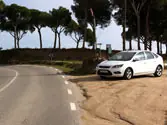
En una vía sin pavimentar, ¿a qué velocidad máxima puede circular un turismo?
On an unpaved road, what is the maximum speed for a car?
- AA 90 km/h.90 km/h.
- BA 50 km/h.50 km/h.
- CA 30 km/h.30 km/h.
ExplanationThe maximum speed allowed on unpaved roads is 30 km/h for all vehicles.
En esta autopista dentro de poblado, ¿a qué velocidad puede circular como máximo si no existe señalización?
On this motorway (autopista) in a built-up area, what is the maximum speed at which you may drive if there are no signs?
- AA 70 km/h.70 km/h.
- BA 120 km/h.120 km/h.
- CA 80 km/h.80 km/h.
ExplanationThe speed limit on motorways (autopistas) and dual carriageways (autovías) in built-up areas may be raised with the appropriate signs, but never above the general limits set for these roads outside built-up areas. Where there are no signs, the maximum speed that vehicles must not exceed on motorways and dual carriageways in built-up areas is 80 km/h.
Circulando por un túnel con un vehículo de masa máxima autorizada de hasta 3500 kilos, ¿qué distancia de seguridad mantendremos con el vehículo que nos precede?
When driving through a tunnel in a vehicle with a maximum authorised mass of up to 3,500 kg, what safe distance will we keep from the vehicle in front?
- A100 metros, al menos.At least 100 metres.
- B150 metros.150 metres.
- CLa distancia que permita detenernos sin colisionar en caso de frenado brusco.The distance that allows us to stop without hitting it if it brakes suddenly.
ExplanationIn tunnels and underpasses, when we do not intend to overtake, we will keep a minimum distance of 100 metres from the vehicle in front. For vehicles with a maximum authorised mass over 3,500 kg, this distance is 150 metres.
¿Qué es la distancia de reacción?
What is reaction distance?
- ALa distancia que recorre el vehículo mientras está frenando hasta detenerse totalmente.The distance the vehicle travels while braking until it comes to a complete stop.
- BLa distancia que recorre el vehículo mientras el conductor está reaccionando.The distance the vehicle travels while the driver is reacting.
- CEl tiempo que tarda el conductor en reaccionar.The time the driver takes to react.
ExplanationA driver does not act immediately when something happens; it takes some time, called the reaction time, which is 0.75 seconds on average. During this time the vehicle travels a certain distance, called the reaction distance.
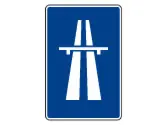
A 100 km/h por una vía así señalizada, ¿circula a una velocidad adecuada?
At 100 km/h on a road with this sign, are you driving at an appropriate speed?
- ANo, porque lo aconsejado es circular a 120 km/h.No, because the recommended speed is 120 km/h.
- BSí, siempre que lo permitan las circunstancias del tráfico y la vía.Yes, as long as the traffic and road conditions allow it.
- CSí, siempre que no entorpezca la circulación.Yes, as long as you do not obstruct traffic.
ExplanationThe appropriate speed is one that does not exceed the limit and is suited to the driver, the road, the vehicle, the load, the weather and the traffic, so that you can always stop within your field of vision (Article 45 of the RGC). On motorways (autopistas) and dual carriageways (autovías) the limit is 120 km/h, but 100 km/h is only appropriate if the circumstances allow it.
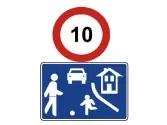
¿En la zona afectada por esta señal cuál será la velocidad máxima?
What will the maximum speed be in the area covered by this sign?
- A10 km/h.10 km/h.
- B50 km/h.50 km/h.
- C30 km/h.30 km/h.
ExplanationIn this area, which is mainly for pedestrians, the limit shown on the round sign above applies: 10 km/h. Drivers must also let pedestrians pass, and they may only park in signed places.
¿Qué separación lateral deberá mantener como mínimo el conductor de un ciclomotor cuando, fuera de poblado, adelante a un turismo?
What is the minimum sideways gap a moped rider must keep when overtaking a car outside built-up areas?
- AUna separación lateral de seguridad proporcional a la velocidad y anchura de la calzada.A sideways safety gap in proportion to the speed and the width of the carriageway.
- BAl menos 1,5 metros.At least 1.5 metres.
- CAl menos 1 metro.At least 1 metre.
ExplanationUnder Article 85.5 of the General Traffic Regulations (RGC), the rider of a two-wheeled vehicle overtaking any vehicle outside built-up areas must leave a sideways gap of no less than 1.5 metres between them.
¿En qué circunstancias aumentaremos la distancia de seguridad con el vehículo que nos precede?
In what circumstances will we increase our safe distance from the vehicle in front?
- ACuando el tráfico sea muy denso.When the traffic is very heavy.
- BCuando el trazado de la vía tenga muchas curvas.When the road has many bends.
- CConduce bajo condiciones ambientales adversas.When driving in bad weather conditions.
ExplanationIn certain circumstances we must increase our safe distance from the vehicle in front, for example when driving in bad weather conditions, when the driver is not in the best condition, or when another vehicle is following us too closely.
All topics
- Definitions
- Documents and penalty points
- The driver's condition
- Duties of drivers and pedestrians
- Vehicle safety devices
- Vehicle controls and equipment
- Vehicle lights and horn
- Traffic signs, markings and signals
- The road and its lanes
- Manoeuvres
- Right of way
- Carrying passengers and loads
- Driving safely in difficult conditions
- Vehicle mechanics and maintenance
- Road accidents and first aid
- Defensive and eco-driving
Independent app: not affiliated with or endorsed by the DGT (Spain's Directorate-General for Traffic) or the Ministry of the Interior. The official exam is booked with the DGT and taken at its test centres. The questions here are practice material; the DGT's official question bank is not public.
Basado en datos de la Agencia Estatal Boletín Oficial del Estado (https://www.boe.es). Textos consolidados de carácter meramente informativo. La AEBOE no patrocina ni respalda este sitio.
Parte de las preguntas procede de los tests de la revista «Tráfico y Seguridad Vial» de la DGT, reproducidos con indicación de la fuente.