
DGT test · 961 questions
Speed and distances · Page 7 of 20
Speed limits by road and vehicle type, adapting speed to conditions, safe following distance and stopping distance.
Questions in this topic, with answers
961 questions, 50 per page, with the correct answer and the explanation. Page 7 of 20.
¿Cuál será la velocidad máxima a la que podrá circular por una autovía una furgoneta de menos de 3500 kg de MMA?
What is the maximum speed at which a van with a maximum authorised mass (MAM) of less than 3,500 kg may travel on a dual carriageway (autovía)?
- A120 km/h.120 km/h.
- B100 km/h.100 km/h.
- C90 km/h.90 km/h.
ExplanationLorries and vans, whatever their weight, may travel on motorways (autopistas) and dual carriageways (autovías) at a maximum of 90 km/h.
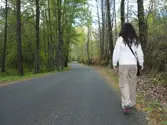
Cuando conduciendo su turismo adelante a un peatón por una vía fuera de poblado, ¿qué separación lateral de seguridad deberá dejar?
When you overtake a pedestrian in your car on a road outside built-up areas, what lateral safety clearance must you leave?
- A1,50 metros como máximo.1.50 metres at most.
- BUn margen de seguridad proporcional a la anchura y características de la vía.A safety margin in proportion to the width and characteristics of the road.
- C1,5 metros como mínimo, ocupando de forma parcial o total el carril contiguo y siempre que existan las condiciones precisas.At least 1.5 metres, partly or fully occupying the adjacent lane, as long as the necessary conditions exist.
ExplanationWhen overtaking a pedestrian, you must occupy part or all of the adjacent or opposite lane and leave a lateral clearance of at least 1.5 metres, as long as the manoeuvre can be done safely (Article 85 of the General Traffic Regulations). Outside built-up areas, you must also reduce your speed by at least 20 km/h below the limit.
La distancia de reacción...
Reaction distance...
- Adepende solo del estado psicofísico del conductor.depends only on the driver's physical and mental state.
- Bdepende de la velocidad a la que se circula.depends on the speed you are driving at.
- Cdepende de si la calzada está mojada.depends on whether the carriageway is wet.
ExplanationReaction distance is the distance the vehicle travels from when the danger is perceived until the brake is pressed. As reaction time is about one second, the higher the speed, the more metres you travel. The driver's state also has an effect, but it does not depend only on that, or on whether the surface is wet.
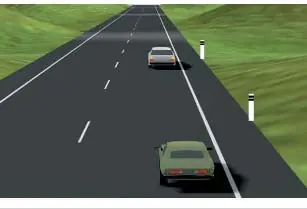
¿Cuándo debe aumentarse la distancia de seguridad?
When must the safe distance be increased?
- ACuando aumenta la velocidad de los vehículos.When the vehicles' speed increases.
- BCuando quiero adelantar.When I want to overtake.
- CCuando disminuye la velocidad de los vehículos.When the vehicles' speed decreases.
ExplanationVehicles must always keep a safe distance that allows them to stop without hitting the vehicle in front if it brakes suddenly. Speed and the grip and braking conditions must be taken into account in particular. So if we are driving at a high speed, we must leave a larger safe distance.
Cuando un conductor circula a velocidad adecuada...
When a driver drives at an appropriate speed...
- Ahace que la circulación sea lenta y peligrosa.they make traffic slow and dangerous.
- Bestorba a otros conductores y puede causar un accidente.they get in other drivers' way and may cause an accident.
- Cpuede detectar las intenciones de otros usuarios y reaccionar a tiempo para evitar un accidente.they can detect other road users' intentions and react in time to avoid an accident.
ExplanationWhen driving at an appropriate speed we can control our vehicle when faced with any obstacle or unexpected event. We must always drive at an appropriate speed, because it is the speed suited to the traffic conditions, and we run less risk of an accident than when driving at an inappropriate or excessive speed.
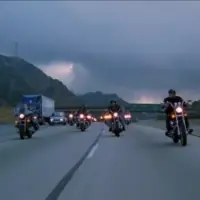
En una autopista, ¿a qué velocidad máxima puede circular una motocicleta?
On a motorway (autopista), what is the maximum speed for a motorcycle?
- A120 km/h, y puede llegar a los 140 km/h para adelantar.120 km/h, and it may reach 140 km/h to overtake.
- B100 km/h.100 km/h.
- C120 km/h.120 km/h.
ExplanationIf there are no signs on the road saying otherwise, the maximum speed on motorways (autopistas) and dual carriageways (autovías) outside built-up areas is 120 kilometres per hour for cars and motorcycles. This limit may not be raised, and it may not be exceeded even when overtaking.
¿Cuál es la velocidad máxima para circular por una autopista, para un derivado de turismo?
What is the maximum speed on a motorway (autopista) for a car-derived van?
- A120 km/h.120 km/h.
- B100 km/h.100 km/h.
- C90 km/h.90 km/h.
ExplanationA car-derived van on a motorway (autopista) or dual carriageway (autovía) has a maximum speed of 100 km/h, and it may never exceed it.
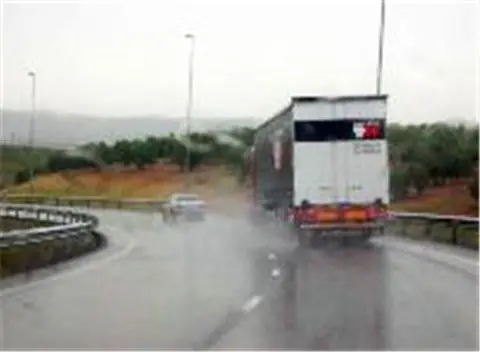
Cuándo circula adaptando la velocidad a las circunstancias del tráfico, lo hace a velocidad...
When you drive adapting your speed to the traffic conditions, you are driving at a speed that is...
- Aexcesiva.excessive.
- Breducida.reduced.
- Cadecuada.appropriate.
ExplanationDriving at an appropriate speed means adapting it at all times to the conditions of the traffic, the road, the vehicle and the driver, without ever exceeding the limit. It is not the same as going slowly: a speed that is too low can also get in the way.
En autopista o autovía la velocidad máxima para un turismo con remolque ligero es de 90 km/h. ¿Cuál es la velocidad máxima en este tipo de vías para un camión con un remolque ligero?
On a motorway (autopista) or dual carriageway (autovía), the maximum speed for a car with a light trailer is 90 km/h. What is the maximum speed on these roads for a lorry with a light trailer?
- A90 km/h.90 km/h.
- B70 km/h.70 km/h.
- C60 km/h.60 km/h.
ExplanationUnder Article 48.1.a) of the General Traffic Regulations, lorries and motor cars towing a trailer, whether light or not, have a maximum of 90 km/h on motorways and dual carriageways and 80 km/h on conventional roads. So a lorry with a light trailer may drive at 90 km/h.
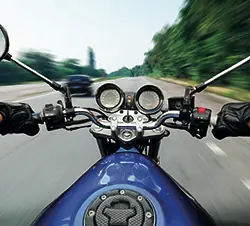
En una autovía, el límite de velocidad para una motocicleta es de...
On a dual carriageway (autovía), the speed limit for a motorcycle is...
- A120 km/h, pudiéndose superar en 20 km/h para adelantar.120 km/h, which may be exceeded by 20 km/h to overtake.
- B120 km/h.120 km/h.
- C100 km/h.100 km/h.
ExplanationOn motorways (autopistas) and dual carriageways (autovías), the general limit for cars and motorcycles is 120 km/h. There is no margin to exceed it when overtaking; that possibility was abolished and it never applied to dual carriageways (autovías).
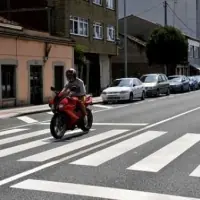
¿Cuál de estos conceptos de velocidad no existe?
Which of these speed concepts does not exist?
- AVelocidad aconsejadaAdvisory speed
- BVelocidad excesivaExcessive speed
- CVelocidad vehicularVehicular speed
ExplanationExcessive speed is speed above the set limits, and advisory speed is the speed that it is recommended not to exceed on a particular stretch. There is also inappropriate speed, which is speed not adapted to the circumstances. The term 'vehicular speed' does not exist.
Si circulamos por un carril que ha sido habilitado para circular en sentido contrario al habitual por razones de fluidez, ¿a qué velocidad mínima debemos circular si no existe señal que establezca otra distinta?
If we are driving in a lane opened for traffic in the opposite direction to the usual one to keep traffic flowing, what is the minimum speed at which we must drive if no sign sets a different one?
- AA 60 km/h.60 km/h.
- BA 40 km/h.40 km/h.
- CNo existe límite mínimo de velocidad para circular en este tipo de carriles.There is no minimum speed limit in this type of lane.
ExplanationUnder Article 41 of the General Traffic Regulations, in a lane opened for traffic in the opposite direction to the usual one the minimum speed is 60 km/h and the maximum 80 km/h, unless other, lower speeds are signposted, and dipped headlights must be on day and night.
La mayoría de accidentes se producen por circular a...
Most accidents happen because of driving at...
- Avelocidad adecuada.an appropriate speed.
- Bvelocidad de diseño.the design speed.
- Cvelocidad inadecuada.an inappropriate speed.
ExplanationMost accidents happen because of driving at an inappropriate speed, that is, a speed not adapted to the road conditions and circumstances.
¿Qué es la "velocidad mínima"?
What is the "minimum speed"?
- AEs la velocidad inferior a la que circula nuestro vehículo.A speed lower than the one our vehicle is travelling at.
- BEs el límite inferior de velocidad permitida en función de la vía.The lowest speed allowed, depending on the road.
- CEs el límite superior de velocidad permitida.The highest speed allowed.
Explanation"Minimum speed" means the lowest speed allowed, depending on the vehicle and the road you are using.
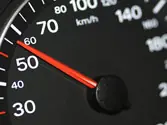
Una de las funciones del sistema avanzado de ayuda a la conducción conocido como “Control de velocidad adaptativo” es:
One of the functions of the advanced driver assistance system known as "adaptive cruise control" is:
- AMantener de forma constante la velocidad elegida por el conductor.To keep the speed chosen by the driver constant.
- BDetectar las señales de limitación de velocidad y fijar la velocidad del vehículo a la indicada en la señal, en cualquier caso.To detect speed limit signs and set the vehicle's speed to the one on the sign, in all cases.
- CAumentar la velocidad del vehículo cuando detecta que el conductor va muy despacio.To increase the vehicle's speed when it detects that the driver is going very slowly.
ExplanationAdaptive cruise control keeps the speed chosen by the driver constant and, using a front radar, reduces it if it catches up with another vehicle, to keep a safe distance. It does not set the speed shown on signs by itself, and it does not speed up because the driver is going slowly.
Con su turismo, usted va a realizar un adelantamiento permitido a un ciclista que circula fuera de poblado por una calzada con un carril para cada sentido. ¿Es suficiente dejarle una separación lateral de 1,50 metros?
In your car, you are going to make a permitted overtaking manoeuvre past a cyclist riding outside a built-up area on a carriageway with one lane in each direction. Is it enough to leave a lateral distance of 1.50 metres?
- ASí, es suficiente.Yes, it is enough.
- BSí, pero solamente cuando esté prohibido adelantar.Yes, but only when overtaking is prohibited.
- CNo, deberá invadir, además, parte o la totalidad del carril de sentido contrario.No, you must also move into part or all of the lane for the opposite direction.
ExplanationUnder Article 85.4 of the General Traffic Regulations (as worded by RD 518/2026), to overtake a cyclist you must occupy part or all of the adjacent or opposite lane, keeping a safety gap of at least 1.5 metres. In addition, outside built-up areas you must reduce your speed by at least 20 km/h below the road's limit before and throughout the manoeuvre.
¿Cuál es la velocidad máxima de un ciclomotor?
What is the maximum speed of a moped?
- A45 km/h, pudiendo superarla en 20 km/h para adelantar.45 km/h, and it may exceed this by 20 km/h to overtake.
- B45 km/h.45 km/h.
- C40 km/h.40 km/h.
ExplanationAccording to Article 48.1.e) of the General Traffic Regulations, mopeds may not exceed 45 km/h outside built-up areas, which is also their maximum design speed. There is no margin for overtaking; only cyclists may exceed it where the road allows.
Si aumentamos la velocidad de 55 km/h a 110 km/h, ¿habremos aumentado también la distancia de frenado?
If we increase our speed from 55 km/h to 110 km/h, does the braking distance also increase?
- ASí, en igual proporción.Yes, in the same proportion.
- BSí, en mayor proporción.Yes, in a greater proportion.
- CNo, la distancia de frenado no depende de la velocidad.No, braking distance does not depend on speed.
ExplanationIf we double our speed, the braking distance is multiplied by four. In other words, braking distance increases in a greater proportion than speed.
Un vehículo circula a una velocidad inadecuada cuando...
A vehicle is travelling at an inappropriate speed when...
- Ano se adapta ni a las circunstancias del tráfico ni a las de la vía.it is not adapted either to the traffic conditions or to the road conditions.
- Bse adapta a las condiciones de la vía pero supera los límites de velocidad establecidos.it is adapted to the road conditions but exceeds the set speed limits.
- Ccircula por debajo de la velocidad máxima y por encima de la mínima.it is travelling below the maximum speed and above the minimum.
ExplanationArticle 45 of the General Traffic Regulations requires you to respect the limits and also to adapt your speed to the condition of the road, the vehicle and its load, the traffic and the weather. A speed that is not adapted to these circumstances is inappropriate even if it does not exceed the limit.
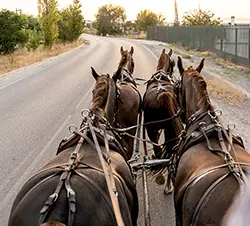
Cuando se adelante a vehículos de tracción animal, fuera de poblado, la separación lateral...
When overtaking animal-drawn vehicles outside built-up areas, the lateral distance...
- Ano debe ser inferior a 1,5 metros.must not be less than 1.5 metres.
- Bdebe ser inferior a 1,5 metros, en todos los casos.must be less than 1.5 metres, in all cases.
- Cdebe ser siempre proporcional a la anchura y características de la vía.must always be in proportion to the width and features of the road.
ExplanationOutside built-up areas, when overtaking animal-drawn vehicles, cycles, mopeds, pedestrians or animals, the compulsory minimum lateral distance is 1.5 metres.
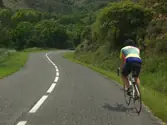
¿Qué distancia lateral mantendremos al adelantar a un ciclista circulando fuera de poblado?
What sideways distance should we keep when overtaking a cyclist outside built-up areas?
- A1,50 metros como mínimo.At least 1.50 metres.
- B1,50 metros como máximo.No more than 1.50 metres.
- CLa distancia proporcional a las condiciones de la vía.A distance in proportion to the road conditions.
ExplanationArticle 85 of the General Traffic Regulations (RGC) requires cyclists to be overtaken with a sideways gap of at least 1.5 metres, using part or all of the next lane. In addition, outside built-up areas you must reduce your speed by at least 20 km/h below the road's speed limit.
Al adelantar a ciclistas en subidas largas, ¿conviene aumentar la separación lateral más que la mínima permitida?
When overtaking cyclists on long uphill stretches, is it advisable to leave more lateral space than the minimum allowed?
- ASí, pero solo en carreteras con más de un carril por sentido.Yes, but only on roads with more than one lane in each direction.
- BNo; basta con respetar la separación mínima de 1,5 metros.No; it is enough to keep the minimum gap of 1.5 metres.
- CSí, porque debido al esfuerzo su trayectoria puede ser inestable y oscilar.Yes, because the effort can make their path unsteady and they may wobble.
ExplanationAccording to Article 85.4 of the General Traffic Regulations (RGC), as worded by RD 518/2026, when overtaking cyclists you must take special care not to put them in danger. The 1.5 metres is a minimum: on long uphill stretches it is advisable to leave more, because the cyclist may wobble.
¿Cuál será la velocidad máxima genérica de un vehículo de 3 ruedas circulando por una carretera convencional?
What is the general maximum speed of a three-wheeled vehicle on a conventional road?
- A70 km/h.70 km/h.
- B45 km/h.45 km/h.
- C60 km/h.60 km/h.
ExplanationA three-wheeled vehicle on a conventional road has a maximum speed of 70 km/h.

Según la señal, ¿cuál es la velocidad máxima en una carretera con tres carriles en cada sentido?
According to the sign, what is the maximum speed on a road with three lanes in each direction?
- A50 kilómetros por hora.50 kilometres per hour.
- B100 kilómetros por hora.100 kilometres per hour.
- C60 kilómetros por hora.60 kilometres per hour.
ExplanationThe sign marks the entrance to a built-up area. On urban roads with two or more lanes in each direction, such as one with three lanes each way, the general limit is 50 km/h (Article 50.1.c of the General Traffic Regulations (RGC)); with only one lane in each direction it would be 30 km/h.
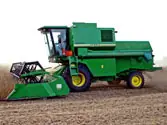
¿Cuál será la velocidad máxima genérica para un vehículo especial que carece de señalización de frenado?
What is the general maximum speed for a special vehicle that has no brake light signals?
- A25 km/h.25 km/h.
- B40 km/h.40 km/h.
- C70 km/h.70 km/h.
ExplanationThe speeds for special vehicles, and for combinations of vehicles that count as special even if only one of the vehicles in the combination is special, are: if they have no brake light signals, are towing a trailer or are single-axle tractors (motocultores), 25 kilometres per hour; other special vehicles, 40 kilometres per hour, except when, because of their features, they can reach more than 60 kilometres per hour on level ground and they meet the conditions set out in the vehicle regulations; in that case, the maximum speed is 70 kilometres per hour.
En autovía (máximo genérico 120 km/h para turismos), la velocidad mínima genérica es de:
On a dual carriageway (autovía) (general maximum 120 km/h for cars), the general minimum speed is:
- A60 km/h60 km/h
- B50 km/h50 km/h
- C40 km/h40 km/h
ExplanationArticle 49.1 of the General Traffic Regulations prohibits driving motor vehicles at less than 60 km/h on motorways (autopistas) and dual carriageways (autovías). It is a fixed figure; the rule of half the general speed limit applies on other roads.
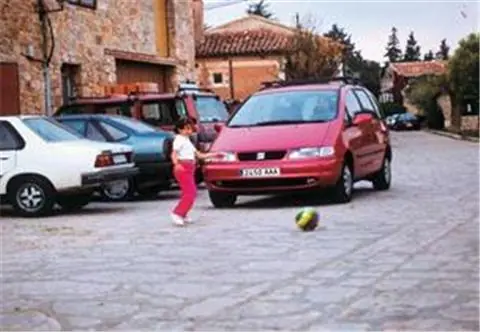
La distancia de frenado es...
Braking distance is...
- Ael espacio recorrido desde que el conductor ve el obstáculo hasta que acciona el freno.the distance travelled from when the driver sees the obstacle until they apply the brake.
- Bel espacio recorrido desde que el conductor acciona el freno hasta que el vehículo se detiene.the distance travelled from when the driver applies the brake until the vehicle stops.
- Cel espacio recorrido desde que el conductor ve el obstáculo hasta que detiene el vehículo.the distance travelled from when the driver sees the obstacle until they stop the vehicle.
ExplanationBraking distance is the distance the vehicle travels from when the driver applies the brake until it stops. The distance travelled from seeing the obstacle until pressing the brake is the reaction distance, and the sum of both is the stopping distance.
Que distancia debemos mantener con el vehículo que nos precede al circular por un paso inferior?
What distance must we keep from the vehicle in front when driving through an underpass?
- ALa que nos permita detener sin colisionar con el vehículo que nos precede.A distance that lets us stop without hitting the vehicle in front.
- BAl menos 100 metros.At least 100 metres.
- CAl menos 150 metros.At least 150 metres.
ExplanationIn tunnels and underpasses, when you do not intend to overtake, you must keep a distance of at least 100 metres from the vehicle in front.
La velocidad máxima permitida para un turismo por una autopista es de…
The maximum speed allowed for a car on a motorway (autopista) is…
- A120 km/h, pudiendo superarla en 20 km/h para adelantar.120 km/h, and it may exceed this by 20 km/h to overtake.
- B90 km/h.90 km/h.
- C120 km/h.120 km/h.
ExplanationOn motorways (autopistas) and dual carriageways (autovías) the general limit for cars is 120 km/h (Article 48 of the General Traffic Regulations). It may not be exceeded to overtake: that 20 km/h margin was abolished, and it never applied to motorways.
Fuera de poblado, al acercarte a un vehículo detenido en la calzada, ¿qué precauciones debes tomar?
Outside built-up areas, when you approach a vehicle stopped on the carriageway, what precautions must you take?
- ANinguna, si no vienen vehículos en sentido contrario.None, if no vehicles are coming the other way.
- BModerar la velocidad y, si fuera preciso, detener el vehículo.Slow down and, if necessary, stop the vehicle.
- CMantener la velocidad y prestar atención a la señalización vertical.Keep your speed and pay attention to the road signs.
ExplanationArticle 46.1.f of the General Traffic Regulations (RGC) requires you to drive at a moderate speed and, if necessary, stop when you approach broken-down (immobilised) vehicles on the carriageway outside built-up areas. If the vehicle occupies the lane, when you pass it you must leave at least 1.5 metres and reduce your speed by 20 km/h (Article 88.1).
Si conducimos con niebla densa, ¿deberemos aumentar la distancia de seguridad con los vehículos que nos preceden??
If we are driving in thick fog, must we increase the safe distance from the vehicles in front?
- ANo, si llevamos el alumbrado correcto.No, if we have the correct lights on.
- BSí, para no colisionar con los vehículos que nos preceden.Yes, so as not to hit the vehicles in front.
- CNo.No.
ExplanationWhen driving in fog you must increase the safe distance, because visibility is reduced and the road surface is wet.
La velocidad máxima a la que puede estar diseñado un vehículo de movilidad personal (VMP) es:
The maximum speed that a personal mobility vehicle (PMV) may be designed for is:
- A25 km/h.25 km/h.
- B30 km/h.30 km/h.
- C20 km/h.20 km/h.
ExplanationPMVs have a design speed of between 6 and 25 km/h; they cannot exceed 25 km/h.
En carreteras convencionales, con o sin arcén, ¿a qué velocidad máxima podrán circular los automóviles con remolque?
On conventional roads, with or without a hard shoulder, what is the maximum speed for motor cars towing a trailer?
- A50 km/h.50 km/h.
- B70 km/h.70 km/h.
- C80 km/h.80 km/h.
ExplanationUnder Article 48.1.a) of the General Traffic Regulations (RGC), motor cars towing a trailer may drive at up to 80 km/h on conventional roads, whether or not they have a hard shoulder, and at up to 90 km/h on motorways (autopistas) and dual carriageways (autovías).
¿Cuál es la velocidad máxima permitida para un vehículo especial, que no dispone de luz de freno, al circular por una carretera convencional?
What is the maximum speed allowed on a conventional road for a special vehicle that has no brake light?
- A60 km/h.60 km/h.
- B40 km/h.40 km/h.
- C25 km/h.25 km/h.
ExplanationAs a general rule, the maximum speed for special vehicles is: 25 km/h for those that have no brake light, tow a trailer or are two-wheel tractors; 70 km/h for those that can reach 60 km/h on the flat; 40 km/h for all other special vehicles.
La velocidad, ¿influye en la capacidad de reacción?
Does speed affect your ability to react?
- ASí.Yes.
- BSolo por encima de 120 km/h.Only above 120 km/h.
- CNo.No.
ExplanationAs speed increases, our ability to react decreases. One example is the tunnel effect: the angle of vision narrows as speed increases, down to only about 30° at speeds between 130 and 150 km/h, whereas at 35 km/h our field of vision is 104°.
¿Cuál es la velocidad mínima permitida en una autovía?
What is the minimum speed allowed on a dual carriageway (autovía)?
- A120 km/h120 km/h
- B60 km/h60 km/h
- C90 km/h90 km/h
ExplanationAccording to the General Traffic Regulations (RGC) in Spain, the minimum speed on a dual carriageway (autovía) is 60 km/h. Driving below this speed on motorways (autopistas) and dual carriageways (autovías) is prohibited so as not to hinder the normal flow of other vehicles. This keeps traffic flowing more efficiently and reduces the risk of accidents. The correct answer is therefore 60 km/h.
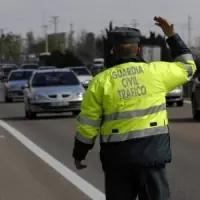
¿A qué distancia deben ser visibles los Agentes de Circulación por los usuarios de la vía?
From what distance must traffic officers be visible to road users?
- AA 20 metros20 metres
- BA 150 metros150 metres
- CA 500 metros500 metres
ExplanationTraffic officers directing traffic on public roads must do so in such a way that both they and their instructions are visible to approaching vehicles from a distance of at least 150 metres.
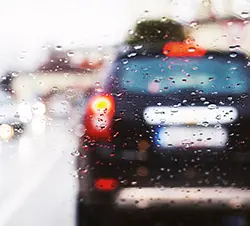
En caso de lluvia, ¿es aconsejable aumentar la distancia de seguridad con el vehículo que circula delante?
In rain, is it advisable to increase the safe distance from the vehicle in front?
- ASí, porque la distancia de frenado aumenta.Yes, because the braking distance increases.
- BNo, porque la distancia de frenado disminuye.No, because the braking distance decreases.
- CSolo en vías rápidas, pero no en vías urbanas ni en carreteras convencionalesOnly on fast roads, but not on urban roads or conventional roads
ExplanationOn a wet road surface, grip decreases and the braking distance increases on any type of road. That is why it is advisable to increase the gap to the vehicle in front: it gives you more room to stop without hitting it.
En una carretera convencional con niños jugando cerca del arcén, el conductor debe:
On a conventional road with children playing near the hard shoulder, the driver must:
- AExtremar la precaución y reducir la velocidad.Take extreme care and reduce speed.
- BMantener el límite máximo.Keep to the maximum limit.
- CCambiar de emisora de radio.Change radio station.
ExplanationThe presence of pedestrians, and especially children, means you must slow down and pay extra attention.
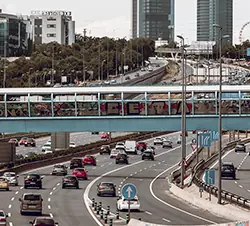
En una autopista que transcurre por zona urbana, ¿a qué velocidad máxima puede circular un turismo si no existe señalización?
On a motorway (autopista) that runs through an urban area, what is the maximum speed for a car if there are no signs?
- AA 80 km/h.80 km/h.
- BA 120 km/h.120 km/h.
- CA 100 km/h.100 km/h.
ExplanationWhen a motorway (autopista) runs through an urban area, its general limit is 80 km/h, not the 120 km/h that applies outside built-up areas (Article 50 of the General Traffic Regulations). It can only be higher if this is expressly signed.
¿Qué distancia de seguridad debemos mantener en el interior de un túnel?
What safe distance should we keep inside a tunnel?
- ALa que permita frenar sin colisionar con el vehículo que nos precede.One that allows us to brake without hitting the vehicle in front.
- B100 metros.100 metres.
- C150 metros.150 metres.
ExplanationWhen driving behind a vehicle inside a tunnel with no intention of overtaking it, we must keep a safe distance of at least 100 metres.
Una motocicleta de 125 centímetros cúbicos, ¿a qué velocidad máxima puede circular por autovía?
What is the maximum speed at which a 125 cc motorcycle may travel on a dual carriageway (autovía)?
- AA 120 km/h.120 km/h.
- BA 100 km/h.100 km/h.
- CA 125 km/h.125 km/h.
ExplanationThe general limit on dual carriageways (autovías) for motorcycles is 120 km/h, whatever their engine capacity, the same as for cars.
¿Cuál es el límite que tiene el frenado de un vehículo?
What is the limit of a vehicle's braking?
- AEl número de pasajeros a bordoThe number of passengers on board
- BLa velocidad máxima del vehículoThe vehicle's maximum speed
- CLa adherencia del neumático con el sueloThe grip between the tyre and the road
ExplanationThe braking force can increase until it equals the grip force, so the limit of a vehicle's braking is the grip between the tyre and the ground or road surface you are driving on.
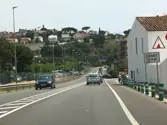
¿Cuál será la velocidad máxima con carácter general, circulando por una travesía?
As a general rule, what is the maximum speed when driving on a travesía (stretch of road through a town)?
- A60 km/h.60 km/h.
- B50 km/h.50 km/h.
- C80 km/h.80 km/h.
ExplanationAs a travesía is inside a built-up area, its general maximum speed is 50 km/h.
Como norma general, ¿está permitido rebasar la velocidad máxima permitida a los ciclomotores para adelantar a otros vehículos?
As a general rule, are mopeds allowed to exceed their maximum permitted speed in order to overtake other vehicles?
- ASí, en 20 kilómetros por hora.Yes, by 20 kilometres per hour.
- BSí, siempre que el ciclomotor pueda alcanzar una velocidad de 60 kilómetros hora.Yes, provided the moped can reach a speed of 60 kilometres per hour.
- CNo.No.
ExplanationThe correct answer is "No" because mopeds have a maximum speed of 45 km/h and are not allowed to exceed the maximum speed set for the road, even when overtaking other vehicles.
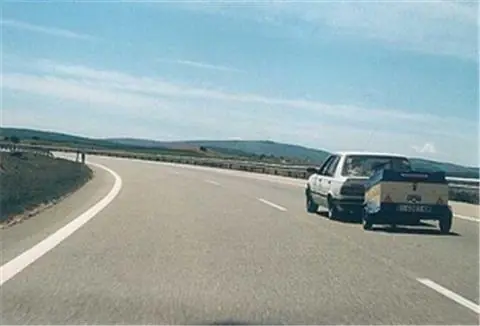
Un turismo con remolque de más de 750 kg de MMA., ¿Cuál es la velocidad máxima a la que puede circular en una autopista?
What is the maximum speed at which a car towing a trailer with a MAM of more than 750 kg may travel on a motorway (autopista)?
- AA 120 km/h.120 km/h.
- BA 100 km/h.100 km/h.
- CA 90 km/h.90 km/h.
ExplanationAccording to Article 48.1.a) of the General Traffic Regulations (RGC), motor cars with a trailer, whether light or not, may travel at a maximum of 90 km/h on motorways (autopistas) and dual carriageways (autovías) and 80 km/h on conventional roads. This limit may not be exceeded, not even to overtake.
¿A qué velocidad como máximo podrá circular por una autopista una motocicleta con cilindrada inferior a 125 cm³?
What is the maximum speed on a motorway (autopista) for a motorcycle with an engine capacity below 125 cm³?
- A90 km/h.90 km/h.
- B80 km/h.80 km/h.
- C120 km/h.120 km/h.
ExplanationThe maximum speed for a motorcycle on a motorway (autopista) is 120 km/h, whatever its engine capacity.
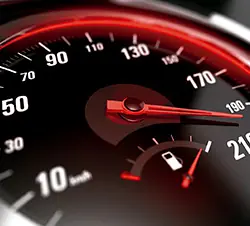
En caso de accidente, ¿existe relación entre la velocidad de circulación y la gravedad de las lesiones de los ocupantes de un vehículo?
In an accident, is there a link between the speed of travel and how serious the injuries to the occupants of a vehicle are?
- ASí; a mayor velocidad menor es la probabilidad de sufrir lesiones graves.Yes; the higher the speed, the lower the chance of serious injury.
- BSí; a mayor velocidad mayor es la probabilidad de sufrir lesiones graves.Yes; the higher the speed, the higher the chance of serious injury.
- CNo; la gravedad de las lesiones depende sólo de los sistemas de seguridad pasiva.No; how serious the injuries are depends only on the passive safety systems.
ExplanationThe energy released in an impact grows with the square of the speed: the higher the speed, the more violent the crash and the higher the chance of serious or fatal injuries.
En un túnel, ¿qué distancia de seguridad hay que mantener con el vehículo que circula delante?
In a tunnel, what safe distance must you keep from the vehicle in front?
- AAl menos 100 metros si no se va a adelantar.At least 100 metres if you are not going to overtake.
- BÚnicamente la distancia suficiente para no colisionar en caso de frenado brusco.Only enough distance to avoid a collision if it brakes sharply.
- C200 metros.200 metres.
ExplanationIn tunnels, the rules require you to keep a safe distance of at least 100 metres, or a minimum gap of four seconds, from the vehicle in front, especially when you do not intend to overtake. This is essential for safety in an enclosed space, where visibility is poorer and the risk of collisions is higher. The General Traffic Regulations (RGC) include this measure to prevent serious accidents and help traffic move safely.
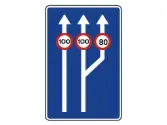
Circula a 70 km/h, ¿por qué carril es obligatorio circular?
You are driving at 70 km/h. Which lane must you use?
- APor el del centro.The centre lane.
- BPor el de la derecha.The right-hand lane.
- CPor el que mejor convenga a mi destino.The one that best suits my destination.
ExplanationThis information sign is on a road outside a built-up area, so vehicles must use the right-hand lane. The sign shows that the road has three lanes and that the maximum speed in the right-hand lane is 80 km/h. As we are driving at 70 km/h, we must use this lane. If we speed up and drive at more than 80 km/h, we must use the centre or left-hand lane.
All topics
- Definitions
- Documents and penalty points
- The driver's condition
- Duties of drivers and pedestrians
- Vehicle safety devices
- Vehicle controls and equipment
- Vehicle lights and horn
- Traffic signs, markings and signals
- The road and its lanes
- Manoeuvres
- Right of way
- Carrying passengers and loads
- Driving safely in difficult conditions
- Vehicle mechanics and maintenance
- Road accidents and first aid
- Defensive and eco-driving
Independent app: not affiliated with or endorsed by the DGT (Spain's Directorate-General for Traffic) or the Ministry of the Interior. The official exam is booked with the DGT and taken at its test centres. The questions here are practice material; the DGT's official question bank is not public.
Basado en datos de la Agencia Estatal Boletín Oficial del Estado (https://www.boe.es). Textos consolidados de carácter meramente informativo. La AEBOE no patrocina ni respalda este sitio.
Parte de las preguntas procede de los tests de la revista «Tráfico y Seguridad Vial» de la DGT, reproducidos con indicación de la fuente.