
DGT test · 961 questions
Speed and distances · Page 10 of 20
Speed limits by road and vehicle type, adapting speed to conditions, safe following distance and stopping distance.
Questions in this topic, with answers
961 questions, 50 per page, with the correct answer and the explanation. Page 10 of 20.
Al conducir una motocicleta con la calzada helada, las distancias de frenado pueden aumentar incluso hasta...
When riding a motorcycle on an icy carriageway, braking distances can increase by up to...
- ACincuenta veces más que en condiciones normales.Fifty times more than in normal conditions.
- BDiez veces más que en condiciones normales.Ten times more than in normal conditions.
- CEl doble que en condiciones normales.Twice as much as in normal conditions.
ExplanationOn an icy carriageway, braking distances can be up to ten times longer because there is little grip between the tyres and the slippery road surface. This means you need more time and space to stop the motorcycle completely. It is important to slow down and increase your safe distance to avoid accidents.
La velocidad máxima para un conductor novel es...
The maximum speed for a novice driver is...
- A80 km/h.80 km/h.
- B80 km/h + 20 km/h para adelantar.80 km/h + 20 km/h for overtaking.
- CSegún el tipo de vía, la misma que el resto de conductores.The same as for other drivers, depending on the type of road.
ExplanationNovice drivers may use the same roads and have the same speed limits as other drivers.
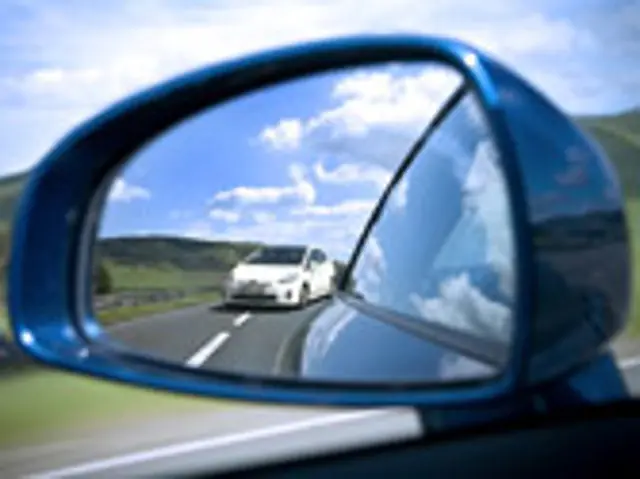
¿Es necesario reducir la velocidad para facilitar un adelantamiento?
Is it necessary to slow down to make overtaking easier?
- ANo, nunca.No, never.
- BNo. Debe reducir la velocidad el conductor del vehículo que circula en sentido contrario.No. It is the driver of the vehicle coming the other way who must slow down.
- CSí. El conductor que va a ser adelantado debe reducirla si, una vez iniciada la maniobra, el adelantamiento se vuelve peligroso.Yes. The driver being overtaken must slow down if, once the manoeuvre has started, the overtaking becomes dangerous.
ExplanationUnder Article 86.2 of the General Traffic Regulations, the driver being overtaken must not speed up or make the manoeuvre difficult, and must slow down if, once the overtaking has started, a dangerous situation arises for them, for the overtaking driver or for other road users.
¿Cuál será la velocidad máxima a la que podrá circular una motocicleta por una autopista?
What is the maximum speed at which a motorcycle may travel on a motorway (autopista)?
- A100 km/h más 20 km/h para adelantar.100 km/h plus 20 km/h to overtake.
- B120 km/h.120 km/h.
- C130 km/h.130 km/h.
ExplanationMotorcycles, like cars, may travel at no more than 120 km/h and may not exceed that speed even to overtake.
¿Qué es la velocidad inadecuada?
What is unsuitable speed?
- ALa velocidad que no se adapta a las condiciones del tráfico, de la vía o del conductor.A speed that is not adapted to the traffic, road or driver conditions.
- BLa velocidad permitida en la vía.The speed allowed on the road.
- CLa que no rebasa el límite máximo de velocidad para la vía.A speed that does not go over the road's speed limit.
ExplanationWhen we drive at a speed that is not adapted to the weather, or to the road, traffic or vehicle conditions, or to the driver's condition, we are driving at an unsuitable speed. Our speed may be within the limits allowed for the road but, if a problem arises, we may find it very hard to control the vehicle. For example, there are usually more accidents on rainy days because many drivers drive at the same speed as on a sunny day, that is, at a speed that is allowed but unsuitable in the rain.
La distancia de frenado se verá afectada cuando...
Braking distance will be affected when...
- ALlueva, exista gravilla, nieve o hielo.it rains, or there is gravel, snow or ice.
- BTengamos el sol de frente y nos deslumbre.the sun is in front of us and dazzles us.
- CExistan retenciones de tráfico en la vía.there are traffic jams on the road.
ExplanationBraking distance is the distance travelled from when the brake pedal is pressed until the vehicle stops completely. It may vary depending on the following factors: - The speed you are driving at. - The condition of the vehicle's tyres, suspension and brakes. - The vehicle's load. - The condition of the road surface. - The weather conditions on the road.
¿Qué vehículos circularán por el arcén si lo hacen por razones de emergencia a velocidad anormalmente reducida perturbando con ello gravemente la circulación?
Which vehicles must use the hard shoulder if, because of an emergency, they are travelling at an abnormally low speed and seriously disrupting traffic?
- ATodos los vehículos.All vehicles.
- BLos vehículos de M.M.A hasta 3.500 kg.Vehicles with a MAM of up to 3,500 kg.
- CSólo los automóviles.Only motor cars.
ExplanationUnder Article 36 of the General Traffic Regulations (RGC), vehicles with a maximum authorised mass of no more than 3,500 kg that, because of an emergency, are travelling at an abnormally low speed and seriously disrupting traffic must use the right-hand hard shoulder if it is passable and wide enough.
Circulando por un túnel, ¿qué distancia deberemos mantener con el vehículo que nos precede?
When driving through a tunnel, what distance must we keep from the vehicle in front?
- A100 metros como mínimo.At least 100 metres.
- B100 metros como máximo.At most 100 metres.
- C50 metros como mínimo.At least 50 metres.
ExplanationWhen driving inside a tunnel we will keep a minimum distance of 100 metres from the vehicle in front.
¿Se puede rebasar la velocidad máxima establecida en carreteras convencionales para adelantar a otro vehiculo?
Can you exceed the maximum speed on conventional roads in order to overtake another vehicle?
- ASi, en 20 k/h mientras dure la maniobra.Yes, by 20 km/h while overtaking.
- BNo, en ningún caso.No, under no circumstances.
- CSi, adoptando las debidas precauciones.Yes, taking due care.
ExplanationIt is prohibited to exceed the maximum speed of a road, whether it is set as a general limit or by signs.
¿Cuál es la velocidad máxima que no debe superar un tractor con remolque fuera de poblaciones?
What maximum speed must a tractor towing a trailer not exceed outside towns?
- A70 kilómetros por hora.70 kilometres per hour.
- B25 kilómetros por hora.25 kilometres per hour.
- C40 kilómetros por hora.40 kilometres per hour.
ExplanationOutside built-up areas, special vehicles that are towing a trailer, have no brake lights or are two-wheel tractors (motocultores) have a limit of 25 km/h (Article 48.1.c of the General Traffic Regulations (RGC)). A tractor towing a trailer falls into this case.
¿Cómo debe ser la distancia de detención respecto a la distancia al obstáculo?
How must the stopping distance compare with the distance to the obstacle?
- AMenor que la distancia al obstáculo.Shorter than the distance to the obstacle.
- BIgual a la distancia al obstáculo.The same as the distance to the obstacle.
- CMayor que la distancia al obstáculo.Longer than the distance to the obstacle.
ExplanationThe vehicle's stopping distance must always be shorter than the distance to the obstacle ahead. If the stopping distance were the same as or longer than the distance to the obstacle, the vehicle might not stop in time, which would increase the risk of a collision. The General Traffic Regulations state that the driver must adapt their speed and distance to be able to stop safely and effectively in normal traffic conditions.
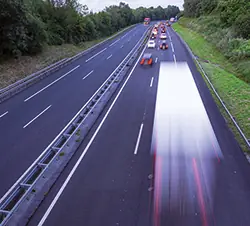
¿En qué tipo de vías se debe mantener la distancia de seguridad?
On what type of roads must you keep a safe distance?
- ASolo en calzadas con dos sentidos de circulación.Only on carriageways with two-way traffic.
- BSolo en calzadas en mal estado.Only on carriageways in poor condition.
- CEn todo tipo de vías.On all types of roads.
ExplanationKeeping a safe distance is compulsory on all types of roads: it must allow you to stop without a collision if the vehicle in front brakes suddenly, whatever the condition or type of carriageway.

¿A qué velocidad circularemos?
At what speed will we drive?
- AA menos de 30 kilómetros por hora.At less than 30 kilometres per hour.
- BA más de 30 kilómetros por hora.At more than 30 kilometres per hour.
- CA 30 kilómetros por hora por lo menos.At 30 kilometres per hour or more.
ExplanationThe sign shows the minimum speed at which we must drive, in this case at least 30 km/h. Remember that a sign of the same colour but square shows the recommended maximum speed.
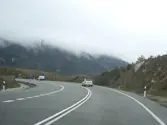
¿Cuál es la velocidad máxima permitida a la que puede circular un turismo al circular por una carretera convencional en la que dispone de dos carriles para su sentido?
What is the maximum speed allowed for a car on a conventional road that has two lanes in its direction?
- A90 kilómetros por hora.90 kilometres per hour.
- B100 kilómetros por hora.100 kilometres per hour.
- C120 kilómetros por hora.120 kilometres per hour.
ExplanationThe general maximum speed for cars on conventional roads is 90 kilometres per hour, however many lanes there are in their direction. The road owner may set a limit of 100 km/h, but only if the two directions are physically separated and this is properly signed.
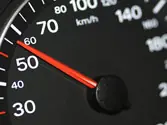
La máxima velocidad segura que puede mantenerse sobre una sección de carretera en condiciones favorables es la velocidad...
The maximum safe speed that can be kept on a section of road in favourable conditions is the...
- Ade fluidez de una vía.flow speed of a road.
- Badecuada de una vía.appropriate speed of a road.
- Cde diseño de una vía.design speed of a road.
ExplanationThe design (or project) speed is the maximum speed that can safely be kept on a stretch of road when conditions are favourable, and it is used to design bends, banking and visibility. The appropriate speed, on the other hand, depends on the specific circumstances at the time.
El conductor que circula detrás de una motocicleta debe mantener con ella, como mínimo, una separación …
A driver travelling behind a motorcycle must keep, as a minimum, a gap from it …
- AQue permita al vehículo que circula detrás de él adelantarle con seguridad.That allows the vehicle behind the driver to overtake safely.
- BDe 50 metros.Of 50 metres.
- CQue le permita detenerse, en caso de que ésta frene bruscamente, sin colisionar con ella.That allows the driver to stop without colliding with it if it brakes suddenly.
ExplanationArticle 54 of the General Traffic Regulations requires you to leave a gap from the vehicle in front, whether it is a motorcycle or anything else, that allows you to stop without crashing if it brakes suddenly. The 50 metres are required only of vehicles over 3,500 kg or over 10 metres long.
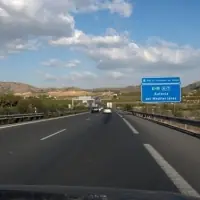
¿A qué velocidad máxima puede un automóvil con remolque y masa máxima autorizada de 700 kg conducir en una autovía?
What is the maximum speed on a dual carriageway (autovía) for a motor car towing a trailer with a maximum authorised mass of 700 kg?
- AA 80 km/h.80 km/h.
- BA 90 km/h.90 km/h.
- CA 100 km/h.100 km/h.
ExplanationUnder Article 48 of the General Traffic Regulations, motor cars towing a trailer have a limit of 90 km/h on motorways (autopistas) and dual carriageways (autovías) and 80 km/h on conventional roads, whatever the mass of the trailer.
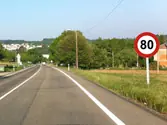
¿Cuál es el propósito principal de los límites de velocidad establecidos en las carreteras?
What is the main purpose of the speed limits set on roads?
- AAsegurar la seguridad exclusivamente.To ensure safety only.
- BGarantizar la seguridad y la fluidez.To ensure safety and the smooth flow of traffic.
- CAdecuar la conducción a las nuevas tecnologías de los vehículos y al entorno ambiental.To adapt driving to new vehicle technology and to the environment.
ExplanationEvery speed limit is based on a set of technical criteria, with the aim that vehicles travel with the greatest possible safety and smooth traffic flow. One of the most important is the design speed of the road: the highest speed that can be kept safely on a section of road in good conditions. It must never be exceeded, because that would undo the safety conditions the road was designed for.
Por una autopista, ¿cuál será la velocidad máxima a la que puede circular una furgoneta de las que pueden ser conducidas con el permiso B?
On a motorway (autopista), what is the maximum speed for a van of the kind that can be driven with a B licence?
- A90 km/h, como un camión.90 km/h, like a lorry.
- B120 km/h, como un turismo.120 km/h, like a car.
- C100 km/h, como un vehículo mixto.100 km/h, like a mixed-use vehicle.
ExplanationLorries, box vans and vans have the same speed limit, whatever their weight. On a motorway (autopista) it is 90 km/h.
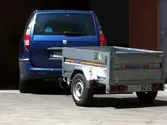
Un turismo que arrastra un remolque ligero por una autovía, podrá circular como máximo a...
A car towing a light trailer on a dual carriageway (autovía) may drive at a maximum of...
- A80 km/h.80 km/h.
- B90 km/h.90 km/h.
- C100 km/h.100 km/h.
ExplanationOn motorways (autopistas) and dual carriageways (autovías), motor vehicles with a trailer have a general limit of 90 km/h, whether or not the trailer is light (Article 48.1.a of the General Traffic Regulations (RGC)). Since 2019 there has no longer been an 80 km/h limit for trailers of more than 750 kg.
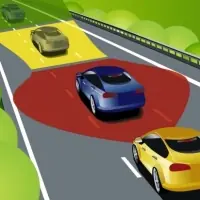
Si aumenta la velocidad, la distancia de frenado...
If speed increases, braking distance...
- AAumenta.increases.
- BNo cambia.does not change.
- CDisminuye.decreases.
ExplanationBraking distance is the distance the vehicle travels from when we apply the brake until it comes to a complete stop. This distance depends on three factors: the vehicle's load, since the heavier the load, the longer the stopping distance; the condition of the road and its grip; and the speed we are driving at. So if our speed increases, the braking distance also increases.
El chaleco reflectante, ¿a qué distancia, como mínimo, debe ser visible?
From what minimum distance must a reflective vest be visible?
- AA 150 metros.150 metres.
- BA 100 metros.100 metres.
- CA 50 metros.50 metres.
ExplanationThe rules require reflective clothing and items to make the person wearing them visible from a minimum distance of 150 metres, for example pedestrians and cyclists on interurban roads at night. That is why the vest must be certified and in good condition.
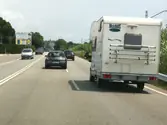
La autocaravana de la imagen tiene una MMA de 3700 kg, ¿cuál será su velocidad máxima en esta vía?
The motorhome in the picture has a MAM of 3,700 kg. What is its maximum speed on this road?
- A80 km/h80 km/h.
- B90 km/h.90 km/h.
- C100 km/h.100 km/h.
ExplanationOn conventional roads, the maximum permitted speed for motorhomes with a MAM of 3,500 kg or less is 90 km/h. When their maximum authorised mass is over 3,500 kg, their maximum permitted speed is 80 km/h.
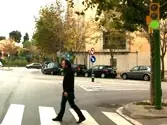
¿Cómo actuara ante esta situación?
What will you do in this situation?
- AContinuar la marcha, porque la señalización lo permite.Carry on, because the signs allow it.
- BModerar la velocidad, incluso detenerse, porque hay peatones en la calzada.Slow down, and even stop, because there are pedestrians on the carriageway.
- CDetenerse, para obedecer las marcas viales.Stop, to obey the road markings.
ExplanationWhen there are pedestrians on the part of the road being used, or when you can expect them to step onto it suddenly, drivers must drive at a moderate speed and even stop if necessary.
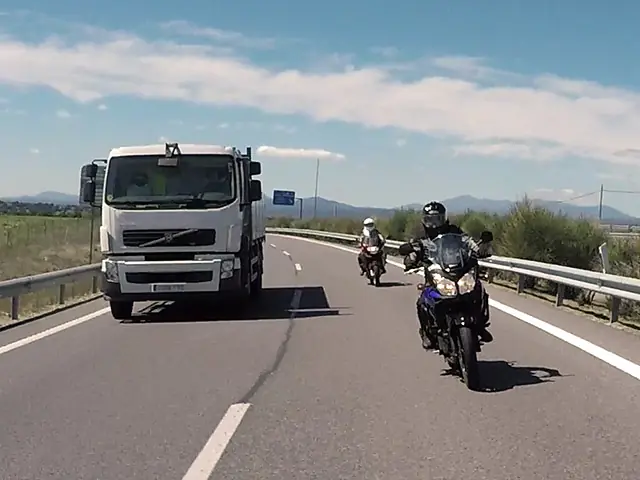
¿Qué separación lateral debe dejar la motocicleta que está adelantando al camión?
What lateral clearance must the motorcycle overtaking the lorry leave?
- AUna distancia proporcional a la velocidad a la que circule.A distance proportional to the speed it is travelling at.
- BUn espacio no inferior a 1,50 metros.A space of no less than 1.50 metres.
- CUna separación inferior a 1,5 metros.A clearance of less than 1.5 metres.
ExplanationDrivers of two-wheeled vehicles who wish to overtake a lorry outside built-up areas must keep a minimum lateral clearance of 1.50 metres between the two vehicles.
¿Cuál será la velocidad máxima de un camión circulando por autopista?
What is the maximum speed of a lorry on a motorway (autopista)?
- A100 km/h.100 km/h.
- B80 km/h.80 km/h.
- C90 km/h.90 km/h.
ExplanationThe maximum speed at which a lorry may travel on a motorway (autopista) is 90 km/h, whatever its MAM.
En autopista, a una motocicleta se le prohíbe circular sin causa justificada a una velocidad…
On a motorway (autopista), a motorcycle is prohibited from travelling without good reason at a speed…
- ADe 60 kilómetros por hora.Of 60 kilometres per hour.
- BDe 60 kilómetros por hora o inferior.Of 60 kilometres per hour or less.
- CInferior a 60 kilómetros por hora.Below 60 kilometres per hour.
ExplanationArticle 49 of the General Traffic Regulations prohibits driving motor vehicles, including motorcycles, on motorways (autopistas) and dual carriageways (autovías) at less than 60 km/h without good reason. Travelling at exactly 60 km/h is allowed.
Si circulamos por el carril derecho de una autopista, fuera de poblado, conduciendo nuestra motocicleta a una velocidad de 60 km/h, debemos saber que...
If you are riding your motorcycle in the right-hand lane of a motorway (autopista), outside built-up areas, at 60 km/h, you should know that...
- ACirculamos a velocidad anormalmente reducida.You are travelling at an abnormally low speed.
- BCirculamos a la velocidad mínima permitida en este tipo de vías.You are travelling at the minimum speed allowed on this type of road.
- CEstaremos obligados a circular por el arcén.You must ride on the hard shoulder.
ExplanationAccording to Article 49.1 of the General Traffic Regulations, on motorways (autopistas) and dual carriageways (autovías) you must not drive at less than 60 km/h without a good reason. Travelling at 60 km/h means you are at the minimum speed allowed, not at an abnormally low speed.
¿A qué velocidad máxima puede circular un turismo en una travesía?
What is the maximum speed at which a car may drive through a travesía (stretch of road through a town)?
- A30 km/h30 km/h
- B50 km/h50 km/h
- C90 km/h90 km/h
ExplanationTravesías are stretches of road that run through a built-up area. The general limit is 50 km/h, unless specific signs say otherwise.
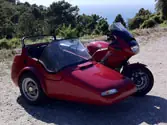
¿Cuál será la velocidad máxima de una motocicleta con sidecar por una autopista?
What is the maximum speed of a motorcycle with a sidecar on a motorway (autopista)?
- A100 km/h.100 km/h.
- B110 km/h.110 km/h.
- C120 km/h.120 km/h.
ExplanationMotorcycles on a motorway (autopista), with or without a sidecar, may travel at a maximum of 120 km/h.
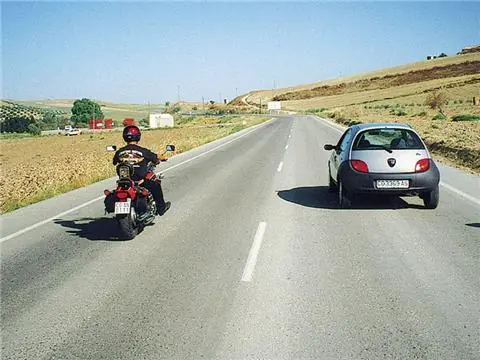
Si circula con una motocicleta por una carretera convencional con dos carriles para cada sentido, ¿qué velocidad máxima le está permitido alcanzar para adelantar a otro vehículo?
If you are riding a motorcycle on a conventional road with two lanes in each direction, what is the maximum speed you may reach to overtake another vehicle?
- A120 Km/h.120 km/h.
- B90 Km/h.90 km/h.
- C80 km/h.80 km/h.
ExplanationOn a conventional road, even if it has two lanes in each direction, the general limit for cars and motorcycles is 90 km/h. Since 21 March 2022 you may no longer exceed it by 20 km/h to overtake, so the limit is the same while overtaking.
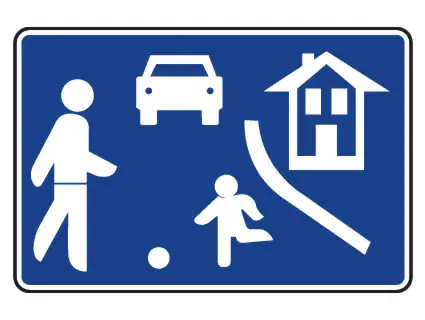
A partir de esta señal, ¿a qué velocidad máxima está permitido circular conduciendo un ciclomotor?
From this sign onwards, what is the maximum speed allowed when riding a moped?
- AA 10 kilómetros por hora.10 kilometres per hour.
- BA 50 kilómetros por hora.50 kilometres per hour.
- CA 45 kilómetros por hora.45 kilometres per hour.
ExplanationThis is sign S-28 Stay and play zone (zona de estancia y juego), the former residential street: there the maximum speed for all vehicles, mopeds included, is 10 km/h, and pedestrians have priority. The 20 km/h limit applies to the shared-space zone (zona de coexistencia, S-47).
¿Cuál es la velocidad máxima permitida para un camión de MMA inferior de 3500 kg circulando por una autopista?
What is the maximum speed allowed on a motorway (autopista) for a lorry with a maximum authorised mass (MAM) below 3,500 kg?
- A120 km/h.120 km/h.
- B100 km/h.100 km/h.
- C90 km/h.90 km/h.
ExplanationMaximum speeds for lorries (whatever their MAM and whether or not they tow a trailer): motorways (autopistas) and dual carriageways (autovías), 90 km/h; conventional roads, 80 km/h; unpaved roads, 30 km/h. On urban roads, depending on the type of carriageway: a) 20 km/h on single-level streets where the carriageway and pavement are at the same level; b) 30 km/h on roads with only one lane in each direction; c) 50 km/h on roads with two or more lanes in each direction (40 km/h for vehicles carrying dangerous goods). Lanes reserved for certain users or only for public transport are not counted for this purpose. The local authority may lower or raise these limits with specific signs. On travesías the limit is 50 km/h for all vehicles, except vehicles carrying dangerous goods, which have a limit of 40 km/h. The local authority may lower this limit by agreement with the road owner, with specific signs.
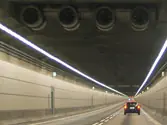
¿Qué distancia mantendremos con el vehículo que nos precede al circular por un túnel?
What distance should we keep from the vehicle in front when driving through a tunnel?
- A150 metros como mínimo.At least 150 metres.
- B100 metros como mínimo.At least 100 metres.
- C50 metros como mínimo.At least 50 metres.
ExplanationIn a tunnel, when we do not intend to overtake, we must always keep a safe distance of at least 100 metres, or a gap of at least four seconds, from the vehicle in front. Vehicles with a maximum authorised mass of more than 3,500 kg must keep a safe distance of at least 150 metres, or a gap of at least six seconds, from the vehicle in front.
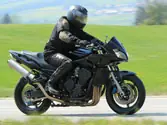
Al adelantar con una motocicleta fuera de poblado se tendrá que mantener una distancia lateral de al menos...
When overtaking on a motorcycle outside built-up areas, you must keep a lateral distance of at least...
- A1,50 metros.1.50 metres.
- B3 metros.3 metres.
- C1 metro.1 metre.
ExplanationAccording to Article 85.5 of the General Traffic Regulations, the driver of a two-wheeled vehicle who overtakes any other vehicle outside built-up areas must leave a space of at least 1.50 metres between the two vehicles.
En una vía urbana, con dos carriles en el sentido contrario y uno en nuestro sentido, ¿cuál es la velocidad máxima a la que podemos circular?
On a road in a built-up area with two lanes in the opposite direction and one lane in our direction, what is the maximum speed at which we may drive?
- A50 km/h.50 km/h.
- B30 km/h.30 km/h.
- C20 km/h.20 km/h.
ExplanationOn urban roads, the general limit depends on the number of lanes in each direction: 30 km/h where there is a single lane in the direction of travel, as in ours, even if the opposite direction has two, and 50 km/h where there are two or more lanes (Article 50.1 of the General Traffic Regulations, RGC).
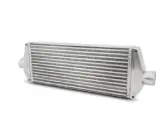
¿Cual será la distancia de seguridad para un turismo en un túnel?
What is the safe distance for a car in a tunnel?
- A100 metros.100 metres.
- B150 metros.150 metres.
- CDepende del número de carriles.It depends on the number of lanes.
ExplanationIn tunnels and underpasses, when you do not intend to overtake, you must keep a distance of at least 100 metres or a gap of at least 4 seconds.
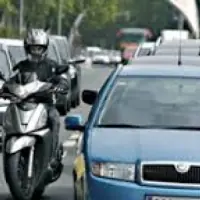
Circula por una vía fuera de poblado y desea adelantar a un ciclomotor. ¿Qué separación lateral mínima dejará al realizar el adelantamiento?
You are driving on a road outside a built-up area and want to overtake a moped. What minimum lateral clearance will you leave when overtaking?
- A1 metro.1 metre.
- B0,50 metros.0.50 metres.
- C1,50 metros.1.50 metres.
ExplanationUnder Article 85.4 of the General Traffic Regulations (as worded by RD 518/2026), when overtaking mopeds, cyclists, pedestrians or personal mobility vehicles you must keep a safety clearance of at least 1.5 metres. Outside built-up areas you must also reduce your speed by at least 20 km/h below the road's limit.
¿Cuál es la velocidad máxima que por construcción puede desarrollar un ciclomotor?
What is the maximum design speed of a moped?
- A45 km/h.45 km/h.
- B50 km/h.50 km/h.
- C40 km/h.40 km/h.
ExplanationA moped must not be able, by design, to go faster than 45 km/h, and its engine must have a capacity of 50 cm³ or less.
En una vía se ha habilitado un carril adicional. ¿Cuál es la velocidad máxima a la que puede circular un vehículo por ese carril?
An additional lane has been set up on a road. What is the maximum speed at which a vehicle may drive in that lane?
- A80 kilómetros por hora.80 kilometres per hour.
- B60 kilómetros por hora.60 kilometres per hour.
- CLa velocidad genérica de la vía.The general speed limit of the road.
ExplanationAccording to Article 42 of the General Traffic Regulations, when a temporary additional lane is set up on a two-way carriageway, vehicles using it and the hard shoulders must drive at a maximum of 80 km/h and a minimum of 60 km/h, unless a lower limit is signed, and with dipped headlights on.
¿Cuál es la velocidad máxima para un turismo en carretera convencional que no tenga arcén de 1,50 m?
What is the maximum speed for a car on a conventional road that does not have a 1.50 m hard shoulder?
- A80 km/h80 km/h
- B90 km/h90 km/h
- C100 km/h100 km/h
ExplanationSince 2019 the general limit for cars on conventional roads has been 90 km/h, whether or not they have a 1.50-metre hard shoulder; the 100 km/h limit linked to the width of the hard shoulder no longer exists, under Article 48 of the General Traffic Regulations.
¿En qué vías la velocidad mínima será de 60 km/h?
On which roads is the minimum speed 60 km/h?
- AEn las autopistas.On motorways (autopistas).
- BEn las autopistas y autovías.On motorways (autopistas) and dual carriageways (autovías).
- CEn las vías para automóvil.On motor roads.
ExplanationOn a motorway (autopista) or dual carriageway (autovía), the minimum speed is 60 km/h, whatever its maximum speed.
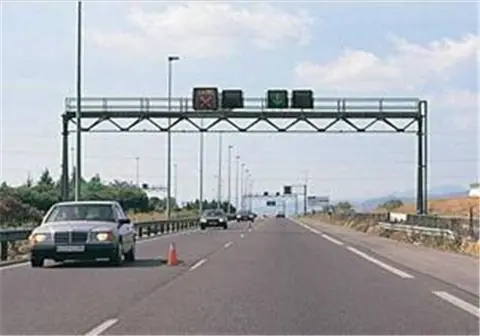
Este vehículo circula por un carril habilitado en sentido contrario al habitual, a falta de señalización, ¿a qué velocidad debe circular?
This vehicle is driving in a lane opened for traffic in the opposite direction to normal. If there are no signs, at what speed must it travel?
- AEntre 60 y 80 km/h, pudiendo rebasar esta en 20 km/h para adelantar.Between 60 and 80 km/h, and it may exceed this by 20 km/h to overtake.
- BEntre 60 y 80 km/h.Between 60 and 80 km/h.
- CA la mínima y máxima genérica establecida para el tipo de vía por la que circula.At the general minimum and maximum speeds set for the type of road it is on.
ExplanationIn lanes opened for traffic in the opposite direction to normal, unless signs show otherwise, the maximum speed is 80 km/h and the minimum is 60 km/h (Article 41.1 of the General Traffic Regulations). In these lanes you may not move into the next lane, not even to overtake.
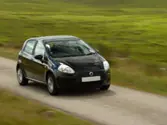
La velocidad del vehículo, ¿influye en la distancia de reacción?
Does the vehicle's speed affect the reaction distance?
- ANo.No.
- BNo, solo influye en la distancia de frenado.No, it only affects the braking distance.
- CSí.Yes.
ExplanationThe higher the speed, the longer the distance travelled during the reaction time, so the higher the speed, the longer the reaction distance.
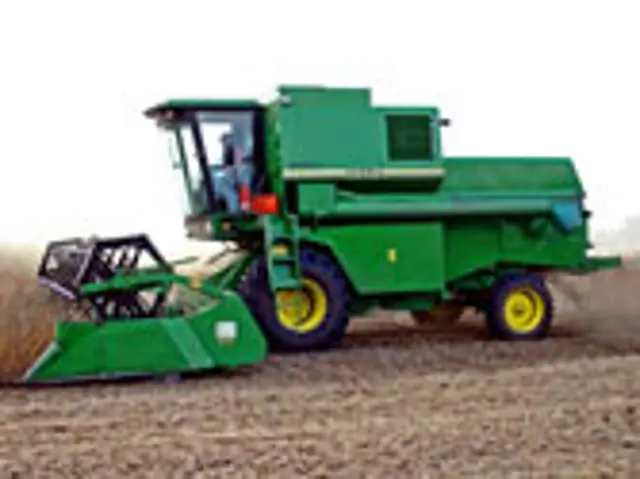
¿Cuál es la velocidad máxima para los vehículos especiales que no tienen luces de freno?
What is the maximum speed for special vehicles that have no brake lights?
- A25 kilómetros por hora.25 kilometres per hour.
- B35 kilómetros por hora.35 kilometres per hour.
- C40 kilómetros por hora.40 kilometres per hour.
ExplanationArticle 48.1.c of the General Traffic Regulations limits to 25 km/h, outside built-up areas, special vehicles that have no brake lights, are towing a trailer or are single-axle tractors (motocultores). Other special vehicles are generally limited to 40 km/h.
¿Cuál es la velocidad máxima de un turismo en una carretera convencional?
What is the maximum speed for a car on a conventional road?
- A100 km/h100 km/h
- B90 km/h90 km/h
- C120 km/h120 km/h
ExplanationA conventional road is one that does not have the features of a motorway (autopista), dual carriageway (autovía) or road for motor vehicles (vía para automóviles). On it the general limit for cars and motorcycles is 90 km/h (Article 48.1.a of the General Traffic Regulations); 120 km/h only applies on motorways and dual carriageways.
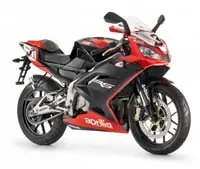
Circulando por una autopista con una motocicleta, ¿cuál será la velocidad mínima a la que podrá circular?
When riding a motorcycle on a motorway (autopista), what is the minimum speed at which you may ride?
- Ainferior a 60 kilómetros por hora.Lower than 60 kilometres per hour.
- Bde 60 kilómetros por hora.60 kilometres per hour.
- Cde 60 kilómetros por hora o inferior.60 kilometres per hour or lower.
ExplanationUnder Article 49 of the General Traffic Regulations, on motorways (autopistas) and dual carriageways (autovías) it is prohibited to drive motor vehicles below 60 km/h unless there is a justified reason. So the minimum speed is 60 km/h, for motorcycles too.
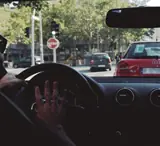
Circular demasiado cerca del vehículo de delante, ¿puede ser peligroso?
Can driving too close to the vehicle in front be dangerous?
- ASí, por el riesgo de alcance en caso de frenada.Yes, because of the risk of a rear-end collision if it brakes.
- BNo, cuando los frenos de mi vehículo estén en buen estado.No, when my vehicle's brakes are in good condition.
- CNo, cuando circule a la misma velocidad que el vehículo de delante.No, when I am travelling at the same speed as the vehicle in front.
ExplanationDriving without keeping a safe distance in front can be very dangerous, because if the driver in front brakes unexpectedly we might not have time to react and could hit them (a rear-end collision). When driving behind another vehicle, you must leave a space that allows you to stop, if it brakes suddenly, without hitting it, taking into account speed, grip and braking conditions. In addition, if you are driving without signalling that you intend to overtake, this gap must allow the vehicle behind you to overtake you safely. For this purpose, drivers of vehicles with a maximum authorised mass (MAM) over 3,500 kg and of vehicles and vehicle combinations over 10 metres long must keep a minimum gap of 50 metres. It is enough to keep a distance that avoids a collision (without the gap needed for others to overtake you): - In built-up areas. - Where overtaking is prohibited. - Where there is more than one lane in the same direction. - When traffic is congested. - When you intend to overtake.
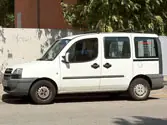
¿Cuál es la velocidad máxima de un vehículo mixto circulando por una autovía?
What is the maximum speed for a mixed-use vehicle on a dual carriageway (autovía)?
- A100 km/h.100 km/h.
- B90 km/h.90 km/h.
- C80 km/h.80 km/h.
ExplanationA mixed-use vehicle on a dual carriageway (autovía) has a maximum speed of 100 km/h, and it may not exceed it, not even to overtake.
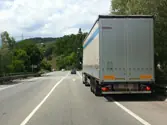
Fuera de poblado, al acercarse a un vehículo inmovilizado en la calzada, ¿qué precauciones se deben tomar?
Outside built-up areas, when approaching a broken-down (immobilised) vehicle on the carriageway, what precautions must you take?
- ANinguna si no vienen vehículos en sentido contrario.None, if no vehicles are coming the other way.
- BModerar la velocidad y, si fuera preciso, detener el vehículo.Slow down and, if necessary, stop.
- CMantener la velocidad y estar atento al cumplimiento de la señalización vertical.Keep your speed and watch out for the road signs.
ExplanationWhen approaching an immobilised vehicle on the carriageway outside an urban area, it is important to take proper precautions to keep the road safe. Stopping or slowing down gives the driver more time to assess the situation and react safely. Also, stopping if necessary can be crucial to avoid hitting the immobilised vehicle or other vehicles that may be manoeuvring around it.
All topics
- Definitions
- Documents and penalty points
- The driver's condition
- Duties of drivers and pedestrians
- Vehicle safety devices
- Vehicle controls and equipment
- Vehicle lights and horn
- Traffic signs, markings and signals
- The road and its lanes
- Manoeuvres
- Right of way
- Carrying passengers and loads
- Driving safely in difficult conditions
- Vehicle mechanics and maintenance
- Road accidents and first aid
- Defensive and eco-driving
Independent app: not affiliated with or endorsed by the DGT (Spain's Directorate-General for Traffic) or the Ministry of the Interior. The official exam is booked with the DGT and taken at its test centres. The questions here are practice material; the DGT's official question bank is not public.
Basado en datos de la Agencia Estatal Boletín Oficial del Estado (https://www.boe.es). Textos consolidados de carácter meramente informativo. La AEBOE no patrocina ni respalda este sitio.
Parte de las preguntas procede de los tests de la revista «Tráfico y Seguridad Vial» de la DGT, reproducidos con indicación de la fuente.