
DGT test · 961 questions
Speed and distances · Page 17 of 20
Speed limits by road and vehicle type, adapting speed to conditions, safe following distance and stopping distance.
Questions in this topic, with answers
961 questions, 50 per page, with the correct answer and the explanation. Page 17 of 20.

Circular a velocidad anormalmente reducida, ¿puede causar accidentes?
Can driving at an abnormally low speed cause accidents?
- ASí.Yes.
- BNo, porque se va más despacio y es más seguro.No, because you are going more slowly and it is safer.
- CSolo en autopistas y autovías.Only on motorways (autopistas) and dual carriageways (autovías).
ExplanationAn abnormally low speed is a speed below the minimum allowed. Driving at such a speed disrupts the normal flow of traffic and can therefore cause accidents.
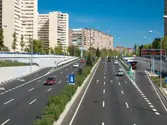
¿A qué velocidad podremos circular por una autopista urbana?
At what speed may we drive on an urban motorway (autopista)?
- A120 km/h.120 km/h.
- B50 km/h.50 km/h.
- C80 km/h.80 km/h.
ExplanationOn a motorway (autopista) or dual carriageway (autovía) inside a built-up area, the maximum speed is 80 km/h.
La velocidad inadecuada, ¿es un factor de riesgo?
Is inappropriate speed a risk factor?
- ANo, la velocidad inadecuada no es determinante en la producción de accidentes.No, inappropriate speed is not a decisive factor in causing accidents.
- BSí, pero sólo en caso de lluvia.Yes, but only when it rains.
- CSí, influye en más de un 25% de los accidentes.Yes, it plays a part in more than 25% of accidents.
ExplanationInappropriate speed makes accidents more frequent and has a particular effect on how serious they are. Inappropriate speed is present in more than 25% of accidents.
¿Cuál es la velocidad máxima permitida para un coche en una vía urbana con plataforma única de calzada y acera?
What is the maximum speed allowed for a car on an urban road where the carriageway and pavement share a single level (single-level street)?
- A45 km/h.45 km/h.
- B50 km/h.50 km/h.
- C20 km/h.20 km/h.
ExplanationOn urban roads where the carriageway and pavement form a single surface, with no difference in level between them, the general limit is 20 km/h (Article 50.1.a of the General Traffic Regulations). With a single lane in each direction it would be 30 km/h, and with two or more, 50 km/h.
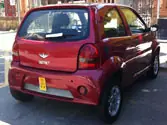
Un cuadriciclo ligero, ¿a qué velocidad máxima puede circular fuera de poblado?
What is the maximum speed of a light quadricycle outside built-up areas?
- AA 70 km/h.70 km/h.
- BA 45 km/h.45 km/h.
- CA 50 km/h.50 km/h.
ExplanationFor three-wheeled vehicles and quadricycles that are NOT light, the limit is 70 km/h on any paved road outside built-up areas where they are allowed. A light quadricycle is considered a four-wheeled moped. Mopeds are built so that they cannot go faster than 45 km/h, so that is the limit they must keep to.
En una carretera convencional de doble sentido, ¿a qué velocidad máxima le está permitido adelantar con su turismo a un camión?
On a conventional two-way road, what is the maximum speed at which you may overtake a lorry in your car?
- AA 120 kilómetros por hora.120 kilometres per hour.
- BA 110 kilómetros por hora.110 kilometres per hour.
- CA 90 kilómetros por hora.90 kilometres per hour.
ExplanationThe 20 km/h margin for overtaking on conventional roads was abolished by Law 18/2021, with effect from 21 March 2022. A car may not exceed its general limit of 90 km/h on these roads, not even while overtaking.
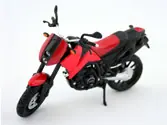
Circulando por una vía sin pavimentar, ¿cuál será la velocidad máxima permitida para una motocicleta?
Riding on an unpaved road, what is the maximum speed allowed for a motorcycle?
- A30 km/h.30 km/h.
- B50 km/h.50 km/h.
- C80 km/h.80 km/h.
ExplanationOn unpaved roads the maximum speed limit is 30 km/h for all vehicles.
La velocidad máxima de un ciclomotor es, con carácter general:
As a general rule, the maximum speed of a moped is:
- A45 km/h.45 km/h.
- B60 km/h.60 km/h.
- C90 km/h.90 km/h.
ExplanationA moped may not exceed 45 km/h.
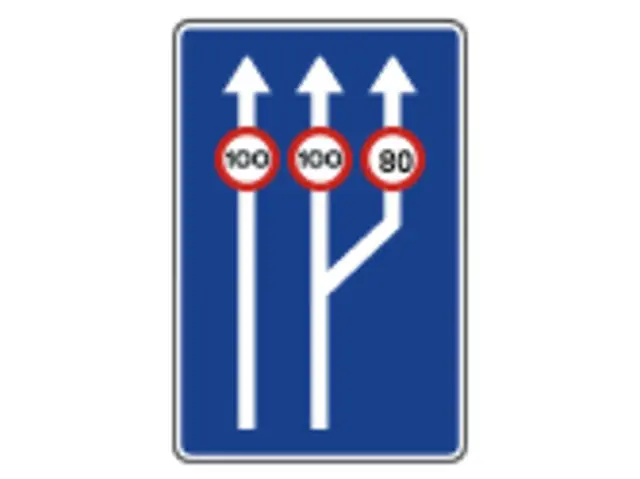
Circula a 70 km/h. ¿En qué carril es obligatorio circular?
You are driving at 70 km/h. Which lane must you use?
- APor el carril central.The centre lane.
- BPor el carril derecho.The right-hand lane.
- CPor el carril que mejor convenga a su destino.Whichever lane suits your destination best.
ExplanationOutside built-up areas, on carriageways with more than one lane in each direction, you normally drive in the right-hand lane and use the others when traffic or road conditions make it advisable (Article 31.1 of the General Traffic Regulations). The figures on the sign are maximums, not minimums.
¿Qué distancia lateral deben dejar las motocicletas al cruzarse con otros vehículos que circulen en sentido contrario?
What lateral distance must motorcycles leave when passing vehicles coming in the opposite direction?
- A1,5 metros como máximo.No more than 1.5 metres.
- B1,5 metros como mínimo en cualquier caso.At least 1.5 metres in all cases.
- CUna separación lateral suficiente para que el cruce pueda realizarse con seguridad y sin riesgo.Enough lateral space for them to pass each other safely and without risk.
ExplanationMotorcycles must leave enough lateral space when passing vehicles coming in the opposite direction, for the safety of both. This is because motorcycles, given their size and stability, need more space to avoid collisions. The rules say that the gap must be sufficient, not a fixed figure, which is why the correct option is the one that mentions enough lateral space for them to pass each other safely and without danger.
¿Cuál es la velocidad anormalmente reducida en autovía?
What is an abnormally low speed on a dual carriageway (autovía)?
- ALa inferior a 80 km/h.Below 80 km/h.
- Bla inferior a 60 km/h.Below 60 km/h.
- Cla inferior a 50 km/h.Below 50 km/h.
ExplanationOn a dual carriageway (autovía) or motorway (autopista), the minimum speed is 60 km/h, and an abnormally low speed is any speed below the minimum.
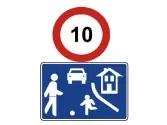
Con esta señal la velocidad máxima a la que se podrá circular será de...
With this sign, the maximum speed at which you may drive is...
- A30 km/h.30 km/h.
- B10 km/h.10 km/h.
- C20 km/h.20 km/h.
ExplanationThe sign in the question, “Zona de estancia y juego” (stay-and-play zone), marks specially designed traffic areas intended mainly for pedestrians, where the following special traffic rules apply: – The maximum speed for vehicles is set at 10 kilometres per hour. – Drivers must give priority to pedestrians. – Vehicles may only park in places marked by signs or road markings. – Cycles and, where applicable, PMVs may travel in both directions, unless the competent authority decides otherwise. – Pedestrians may use the whole traffic area, so pedestrian crossings are not marked. – Games and sports are allowed there. It is always accompanied by sign R-301, which limits speed to 10 km/h.
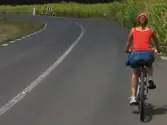
si circula detrás de un ciclo, en condiciones de visibilidad reducidas, deberá…
If you are driving behind a cycle in poor visibility, you must...
- AHacerle señales acústicas para advertirle de nuestra presencia.Sound your horn to warn the rider that you are there.
- BMantener la velocidad constate y atender a las señales.Keep a constant speed and pay attention to the signs.
- CModerar la velocidad y extremar la precaución, sin hacerle señales acústicas.Slow down and take extra care, without sounding your horn.
ExplanationWhen driving behind cycles or mopeds and visibility does not allow overtaking, you must slow down, keep a suitable distance and never sound your horn at them.
¿Está permitido realizar competiciones de velocidad en las vías públicas?
Are speed competitions allowed on public roads?
- ANo, como norma general.No, as a general rule.
- BSí, pero todas las pruebas autorizadas irán precedidas por un agente de la autoridad con una bandera de color verde.Yes, but all authorised events must be led by a police officer with a green flag.
- CSí, siempre.Yes, always.
ExplanationAs a general rule, any kind of competition on public roads is forbidden, unless it has been expressly authorised.
En una carretera convencional, un camión quiere adelantar a otro vehículo, ¿a qué velocidad máxima puede hacerlo?
On a conventional road, a lorry wants to overtake another vehicle. What is the maximum speed at which it may do so?
- AA 100 Km/h.100 km/h.
- BA 120 Km/h.120 km/h.
- CA 80 Km/h.80 km/h.
ExplanationUnder Article 48.1.a) of the General Traffic Regulations, a lorry has a maximum of 80 km/h on a conventional road and may not exceed it while overtaking. The 20 km/h margin for overtaking was abolished with effect from 21 March 2022.
Si su vehículo no puede alcanzar 60 km/h, ¿por qué vías no podrá circular?
If your vehicle cannot reach 60 km/h, on which roads may it not be driven?
- APor vías urbanas.On urban roads.
- BPor carreteras interurbanas.On non-urban roads.
- CPor autopistas y autovías.On motorways (autopistas) and dual carriageways (autovías).
ExplanationArticle 49.1 of the General Traffic Regulations forbids driving motor vehicles at less than 60 km/h on motorways (autopistas) and dual carriageways (autovías). On other roads the minimum is half the general limit for each vehicle, so a vehicle that cannot reach 60 km/h may be driven on them.
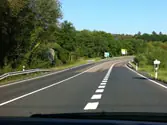
¿A qué velocidad podrá circular un conductor novel por esta carretera convencional?
At what speed may a novice driver drive on this conventional road?
- A80 km/h, más 20 km/h para adelantar.80 km/h, plus 20 km/h for overtaking.
- B90 km/h.90 km/h.
- C100 km/h.100 km/h.
ExplanationThe maximum speed for a novice driver is the same as for other drivers, although they must display a plate with the letter L in a visible place. The maximum speed allowed on conventional roads is 90 km/h.

Circulando por un mercado o parte de la vía frecuentada por peatones, especialmente niños o ancianos, ¿qué haremos?
When driving through a market or a part of the road used by many pedestrians, especially children or elderly people, what will we do?
- AReducir la velocidad, incluso llegando a detenerme.Reduce speed, even stopping if necessary.
- BAdoptaré las medidas necesarias para su seguridad, sin tener que moderar obligatoriamente la velocidad.Take the necessary steps for their safety, without necessarily having to reduce speed.
- CReducir la velocidad, sin necesidad de detenerme.Reduce speed, without needing to stop.
ExplanationIf there are pedestrians on the part of the road we are using, we must reduce speed, even to the point of stopping, although the pedestrians do not have priority. Pedestrians are fragile and vulnerable road users who would suffer serious injury if hit, so great care is needed to prevent this.
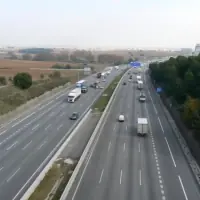
Conducir a una velocidad adecuada nos permite...
Driving at a suitable speed allows us to...
- AEvitar atascos.avoid traffic jams.
- BAhorrar el mantenimiento preventivo del vehículo.save on preventive maintenance of the vehicle.
- CControlar el vehículo ante algún suceso imprevisto.control the vehicle if something unexpected happens.
ExplanationThe traffic authority states that a vehicle is travelling at a suitable speed when that speed allows us to control the vehicle in the face of any obstacle or unexpected event. This suitable speed is not based only on the limits shown by signs; the conditions of the road, of our vehicle and our own condition must also be taken into account. So we drive at a suitable speed when we adapt it to the conditions of the moment: driver, vehicle and environment.
Circula con un turismo por autopista, ¿qué velocidad se considera anormalmente reducida?
You are driving a car on a motorway (autopista). What speed is considered abnormally low?
- ALa menor de 50 km/h.Below 50 km/h.
- BLa menor de 60 km/h.Below 60 km/h.
- CLa menor de 70 km/h.Below 70 km/h.
ExplanationAn abnormally low speed means driving below the minimum speed allowed on a road. The minimum speed on motorways (autopistas) and dual carriageways (autovías) is 60 km/h.
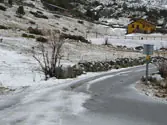
La distancia de frenado con la calzada helada será...
On an icy carriageway, braking distance will be...
- AHasta 2 veces mayor que si está seca.up to 2 times longer than when it is dry.
- BHasta 10 veces mayor que si está seca.up to 10 times longer than when it is dry.
- CEl estado de la calzada no influye en la distancia de frenado.The condition of the carriageway does not affect braking distance.
ExplanationBraking distance is the distance the vehicle travels from when the driver applies the brake until the vehicle stops. This distance may vary depending on the following factors: - The speed you are driving at. - The condition of the vehicle's tyres, suspension and brakes. - The vehicle's load. - The condition of the road surface. - The weather conditions on the road. Braking distance can double when the carriageway is wet and be up to 10 times longer on ice or snow.
¿Cuándo hay que aumentar la distancia de seguridad?
When must you increase your safe distance?
- ACuando aumenta la velocidad.When your speed increases.
- BCuando voy a adelantar.When I am going to overtake.
- CCuando disminuye la velocidad de los vehículos.When the speed of vehicles decreases.
ExplanationArticle 54.1 of the General Traffic Regulations requires you to leave enough space behind the vehicle in front to stop without hitting it, taking speed into account in particular. As stopping distance increases with speed, the faster you go, the bigger the gap must be.
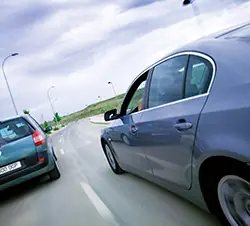
En determinadas circunstancias, un turismo, ¿puede superar para adelantar la velocidad máxima fijada para el tipo de vía por la que circule?
In certain circumstances, may a car exceed the maximum speed set for the type of road it is on in order to overtake?
- ANo, en ningún caso.No, in no case.
- BSí, en carreteras convencionales interurbanas.Yes, on conventional roads outside built-up areas.
- CSí, en todo tipo de vías interurbanas.Yes, on all types of road outside built-up areas.
ExplanationNo vehicle may exceed the road's maximum speed, not even to overtake. Article 51 of the General Traffic Regulations, which allowed exceeding it by 20 km/h on conventional roads, was repealed by Law 18/2021 with effect from 21 March 2022.
¿Cuál es la velocidad máxima a la que se puede circular por una vía sin pavimentar?
What is the maximum speed allowed on an unpaved road?
- A50 km/h.50 km/h.
- B30 km/h.30 km/h.
- C20 km/h.20 km/h.
ExplanationAccording to Article 48.1.f of the General Traffic Regulations (RGC), the maximum speed limit on unpaved roads is 30 km/h, whatever the vehicle. A sign may set an even lower limit.
¿Qué distancia mantendremos con el vehículo que nos precede si no tenemos intención de adelantarle?
What distance should we keep from the vehicle in front if we do not intend to overtake it?
- A100 metros como mínimo.At least 100 metres.
- B50 metros como mínimo.At least 50 metres.
- CLa distancia que nos permita frenar sin colisionar con él en caso de emergencia.A distance that allows us to brake without hitting it in an emergency.
ExplanationWhen driving behind another vehicle, we must keep a safe distance that allows us to stop without hitting it in an emergency. In tunnels and underpasses, this distance must be at least 100 metres.
Si un vehículo circula a velocidad inferior al límite máximo permitido, ¿puede suponer un riesgo?
If a vehicle is travelling below the maximum speed limit, can it still be a risk?
- ANo, si la velocidad es inferior a la máxima no puede haber riesgo.No, if the speed is below the maximum there can be no risk.
- BNo, el riesgo únicamente se produce al circular a una velocidad superior a la máxima.No, risk only arises when driving above the maximum speed.
- CSí.Yes.
ExplanationEven when driving within the speed limits, problem situations can arise that mean you must slow down to suit the conditions, for example rain, fog or snow on the carriageway.
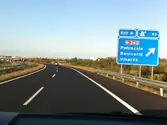
Por esta vía, ¿circularemos correctamente a 60 km/h utilizando el arcén?
On this road, are we driving correctly on the hard shoulder at 60 km/h?
- ASí.Yes.
- BNo.No.
- CSí, si el arcén es transitable y suficiente.Yes, if the hard shoulder is passable and wide enough.
ExplanationTo use the hard shoulder we must be driving at an abnormally low speed, that is, below 60 km/h, because of an emergency, and also be seriously disrupting traffic.
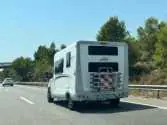
¿Cuál será la velocidad máxima a la que le está permitido circular por una autopista si conduce una autocaravana de MMA inferior a 3.500 kg?
What is the maximum speed at which you may drive on a motorway (autopista) if you are driving a motorhome with a maximum authorised mass (MAM) of less than 3,500 kg?
- A90 kilómetros por hora.90 kilometres per hour.
- B100 kilómetros por hora.100 kilometres per hour.
- C120 kilómetros por hora.120 kilometres per hour.
ExplanationCars, motorcycles, motorhomes with a MAM of up to 3,500 kg and pick-ups may travel on motorways (autopistas) and dual carriageways (autovías) at a maximum speed of 120 km/h. When a motorhome's MAM is over 3,500 kg, its maximum speed on motorways and dual carriageways is 90 km/h.
¿Qué distancia debe mantener un turismo con el vehículo precedente, en el interior de un túnel, en vía interurbana, si no se tiene intención de adelantar?
What distance must a car keep from the vehicle in front inside a tunnel on an interurban road, if it does not intend to overtake?
- AComo mínimo 150 metros o seis segundos.At least 150 metres or six seconds.
- BComo mínimo 100 metros o cuatro segundos.At least 100 metres or four seconds.
- CLa suficiente para no colisionar con el vehículo precedente y que permita el adelantamiento del vehículo que le siga.Enough not to collide with the vehicle in front and to allow the vehicle behind to overtake.
ExplanationUnder Article 95 of the General Traffic Regulations, a car that is not going to overtake must keep at least 100 metres or 4 seconds from the vehicle in front inside a tunnel. The 150 metres or 6 seconds are required of vehicles over 3,500 kg.
¿Qué separación se debe mantener respecto a un ciclomotor en el momento de adelantarlo?
What side clearance must you keep from a moped when overtaking it?
- AUna distancia igual o mayor a 1,50 metros y ocupar el carril contiguo, en parte o en su totalidad.A distance of 1.50 metres or more, moving partly or fully into the next lane.
- BUna distancia prudencial en función de la velocidad y las características de la vía.A sensible distance depending on the speed and the features of the road.
- CNo hay que guardar ninguna distancia en concreto.You do not have to keep any particular distance.
ExplanationWhen overtaking a moped, you must move partly or fully into the next lane and leave a side clearance of at least 1.5 metres (Article 85 of the General Traffic Regulations). Outside built-up areas, you must also reduce your speed by at least 20 km/h.
¿Es peligroso sobrepasar la velocidad de diseño de una vía?
Is it dangerous to exceed the design speed of a road?
- ASí, porque la vía está diseñada para una velocidad determinada en condiciones de seguridad.Yes, because the road is designed for a certain speed in safe conditions.
- BNo, es simplemente un límite aconsejado.No, it is only a recommended limit.
- CNo, no es peligroso si se supera en 20 km/h.No, it is not dangerous if you exceed it by 20 km/h.
ExplanationThe design speed of a road is the highest safe speed that can be kept on that road in good conditions. Every road is different. For example, if a road is designed for driving at 90 km/h, driving faster breaks the safety conditions applied when it was designed.
¿Cuál es la velocidad máxima permitida en una vía urbana donde la calzada y la acera están en la misma plataforma?
What is the maximum speed allowed on an urban road where the carriageway and the pavement are on the same level?
- A50 km/h.50 km/h.
- B30 km/h.30 km/h.
- C20 km/h.20 km/h.
ExplanationArticle 50.1.a of the General Traffic Regulations sets a general limit of 20 km/h on urban roads where the carriageway and pavement form a single level (single-level street). The municipal authority may lower it with specific signs.
La distancia de frenado de un vehículo con carga será...
The braking distance of a loaded vehicle will be...
- AMenor que sin carga.shorter than without a load.
- BIgual que sin carga.the same as without a load.
- CMayor que sin carga.longer than without a load.
ExplanationA loaded vehicle travels further when braking, so its braking distance is longer. The same vehicle without a load will stop in a shorter distance.
¿A qué velocidad puede circular un conductor novato por una carretera convencional?
At what speed may a novice driver drive on a conventional road?
- A80 km/h, más 20 km/h para adelantar.80 km/h, plus 20 km/h to overtake.
- B90 km/h.90 km/h.
- C100 km/h.100 km/h.
ExplanationNovice drivers are subject to the same general limits as everyone else: on a conventional road, 90 km/h for a car (Article 48.1.a of the General Traffic Regulations). Since 21 March 2022 nobody may exceed that limit to overtake.
¿Qué permiso se necesita para conducir un vehículo agrícola especial que pueda superar los 45 km/h?
Which licence do you need to drive a special agricultural vehicle that can exceed 45 km/h?
- APermiso para vehículos agrícolas y también el permiso de la clase B.An agricultural vehicle licence and also a class B licence.
- BPermiso para vehículos agrícolas.An agricultural vehicle licence.
- CPermiso de la clase B.A class B licence.
ExplanationUnder Article 5.9 of the General Driver Regulations (Reglamento General de Conductores), to drive self-propelled special agricultural vehicles whose maximum design speed exceeds 45 km/h you always need a class B licence; the agricultural vehicle licence is not enough.
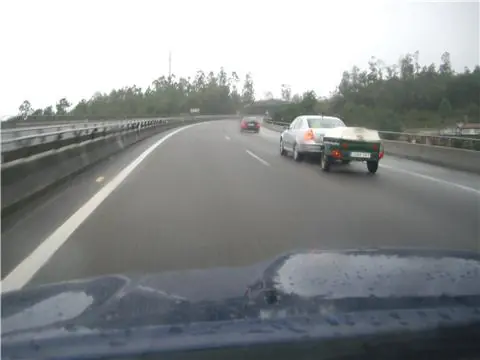
Un turismo que arrastra un remolque ligero, ¿a qué velocidad máxima puede circular por autopista o autovía?
What is the maximum speed at which a car towing a light trailer may travel on a motorway (autopista) or dual carriageway (autovía)?
- AA 80 km/h.80 km/h.
- BA 90 Km/h.90 km/h.
- CA 100 km/h.100 km/h.
ExplanationAccording to Article 48.1.a) of the General Traffic Regulations (RGC), a car with a trailer, even a light one, may travel at a maximum of 90 km/h on a motorway (autopista) or dual carriageway (autovía) and 80 km/h on a conventional road. The 120 km/h limit is only for a car without a trailer.
¿Qué distancia de seguridad lateral mantendremos al adelantar a una bicicleta en una vía urbana?
What sideways safe distance should we keep when overtaking a bicycle on an urban road?
- A1,50 metros como mínimo.At least 1.50 metres.
- B1,50 metros como máximo.No more than 1.50 metres.
- CUn margen lateral proporcional a la velocidad anchura y características de la víaA sideways gap in proportion to the speed and to the width and features of the road.
ExplanationUnder Article 85.4 of the General Traffic Regulations (RGC) (as worded by RD 518/2026), when overtaking cyclists you must leave a safety gap of at least 1.5 metres, also on urban roads; the old gap "in proportion to speed and width" no longer applies.
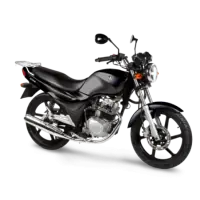
Una motocicleta que llega a una velocidad superior a 100 kilómetros por hora, debe llevar obligatoriamente...
A motorcycle that can reach a speed of more than 100 kilometres per hour must have...
- AUn espejo retrovisor en el lado derecho, únicamente.One rear-view mirror on the right-hand side only.
- BDos espejos retrovisores, uno a cada lado.Two rear-view mirrors, one on each side.
- CUn espejo retrovisor en el lado izquierdo, únicamente.One rear-view mirror on the left-hand side only.
ExplanationAccording to Annex III of the General Vehicle Regulations, all motorcycles must have an exterior left-hand mirror. If their maximum speed does not exceed 100 km/h, the right-hand one is optional; if it does exceed it, the right-hand one is also compulsory, so they must have two, one on each side.
¿Cuál será la velocidad máxima de un cuadriciclo ligero circulando fuera de poblado?
What is the maximum speed of a light quadricycle outside built-up areas?
- A40 km/h.40 km/h.
- B45 km/h.45 km/h.
- C60 km/h.60 km/h.
ExplanationA light quadricycle, by design, cannot go faster than 45 km/h. Three-wheeled vehicles have a maximum permitted speed of 70 km/h.
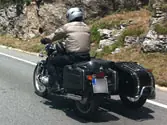
¿Cuál será la velocidad máxima de una moto con sidecar circulando por una autopista?
What is the maximum speed of a motorcycle with a sidecar travelling on a motorway (autopista)?
- A120 km/h.120 km/h.
- B100 km/h.100 km/h.
- C90 km/h.90 km/h.
ExplanationOn motorways (autopistas) and dual carriageways (autovías), the maximum speed allowed for cars and motorcycles, with or without a sidecar, is 120 km/h.
Al circular a mayor velocidad aumentará...
Driving at a higher speed will increase...
- AEl tiempo de reacción del conductor.The driver's reaction time.
- BLa capacidad del conductor.The driver's ability.
- CLa distancia de reacción.The reaction distance.
ExplanationAt a higher speed the driver's reaction time does not change, but their ability to react and anticipate does decrease, so the reaction distance increases; that is, the number of metres travelled during the reaction time increases. The higher the speed, the more metres travelled in the same time.
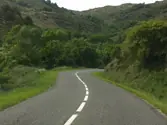
En esta vía, ¿a qué velocidad mínima está permitido circular con un turismo?
On this road, what is the minimum speed permitted for a car?
- AA 45 km/h.45 km/h.
- BA 50 km/h.50 km/h.
- CA 40 km/h.40 km/h.
ExplanationOn conventional roads the minimum speed for a car is 45 km/h, which is half of the general maximum speed for that type of road.
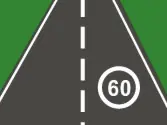
La marca vial de velocidad máxima de 60 km/h, ¿a qué vehículos afecta?
Which vehicles does a 60 km/h maximum speed road marking apply to?
- AA todos los que circulen por la vía.All vehicles on the road.
- BSolamente a los que circulen por el carril en el que se encuentra la marca.Only those in the lane where the marking is.
- CSolamente a los turismos y motocicletas que circulen por la vía.Only cars and motorcycles on the road.
ExplanationA speed limit road marking only applies to vehicles in the lane where the marking is, as long as the lanes are marked; if they are not, it applies to the whole carriageway.
Dentro de poblado, ¿por qué es importante no superar los 50 km/h?
In built-up areas, why is it important not to exceed 50 km/h?
- APara no ser multado.So as not to be fined.
- BPorque lo dice la norma general.Because the general rule says so.
- CPorque en caso de atropello de un peatón, la probabilidad de lesiones graves es menor.Because if a pedestrian is hit, the likelihood of serious injury is lower.
ExplanationThe higher the speed at the moment a pedestrian is hit, the more serious the injuries and the lower their chances of survival. Moreover, in built-up areas 50 km/h is the general limit only on roads with two or more lanes in each direction; with a single lane in each direction it is 30 km/h (Article 50.1 of the RGC).
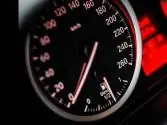
Si el vehículo que conduce no puede desarrollar la velocidad de 60 kilómetros por hora, ¿por qué vías no podrá circular?
If the vehicle you are driving cannot reach a speed of 60 km/h, which roads may you not use?
- APor vías urbanas.Urban roads.
- BPor todas las vías interurbanas.All roads outside built-up areas.
- CPor autopistas y autovías.Motorways (autopistas) and dual carriageways (autovías).
ExplanationYou must not obstruct the normal progress of other vehicles by driving at an abnormally low speed without good reason. For this purpose, motor vehicles may not be driven on motorways (autopistas) and dual carriageways (autovías) at less than 60 km/h, or on other roads at less than half the general speed limit set for each category of vehicle on that road, even if there is no other traffic.
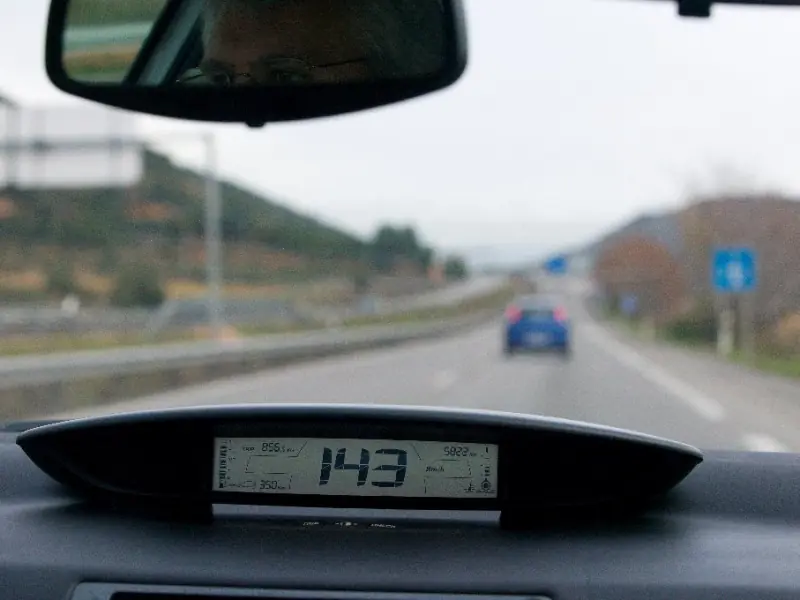
Vas más rápido de la velocidad máxima permitida, ¿cómo estás circulando?
You are going faster than the maximum permitted speed. How are you driving?
- AA una velocidad excesiva.At an excessive speed.
- BA una velocidad adecuada.At a suitable speed.
- CA una velocidad moderada.At a moderate speed.
ExplanationExceeding the maximum permitted speed is driving at an excessive speed. An unsuitable speed, on the other hand, is one that does not match the circumstances, such as rain, fog or heavy traffic, even if it does not exceed the road's limit.
Dentro de los límites máximos de velocidad, ¿puede ser que circulemos a velocidad inadecuada?
Is it possible to be driving at an inappropriate speed while within the maximum speed limits?
- ASí, pero solo si circulamos de noche.Yes, but only if we are driving at night.
- BNo, nunca.No, never.
- CSí, cuando la velocidad no se adapte a las circunstancias de la vía.Yes, when the speed is not suited to the road conditions.
ExplanationAn appropriate speed is one suited to the changing conditions of the traffic, the road and the driver. So even when driving within the permitted limits, in certain circumstances we must slow down; for example, in fog the appropriate speed must be much lower than the maximum allowed.
¿Se puede sobrepasar para adelantar una velocidad máxima de 90 km/h señalizada en un tramo de autopista?
Can you exceed a 90 km/h speed limit signposted on a stretch of motorway (autopista) in order to overtake?
- ASí, en 20 km/h.Yes, by 20 km/h.
- BNo, nunca.No, never.
- CSí, si no sobrepaso los limites genéricos.Yes, if I do not exceed the general limits.
ExplanationA specific speed limit may never be exceeded, not even to overtake.
Un turismo que arrastra un remolque circula por autovía. Su velocidad máxima genérica se ve reducida a:
A car towing a trailer is driving on a dual carriageway (autovía). Its general maximum speed is reduced to:
- A90 km/h90 km/h
- B100 km/h100 km/h
- C80 km/h80 km/h
ExplanationThe correct answer is 90 km/h: on a dual carriageway, the combination with a trailer has a lower limit than the 120 km/h of the car on its own.
¿Qué intervalo de seguridad mantendremos como mínimo dentro de un túnel?
What is the minimum safe time gap we should keep inside a tunnel?
- A4 seg.4 seconds.
- B3 seg.3 seconds.
- C6 seg.6 seconds.
ExplanationThe minimum safe time gap inside a tunnel is 4 seconds, or 100 metres from the vehicle in front.
All topics
- Definitions
- Documents and penalty points
- The driver's condition
- Duties of drivers and pedestrians
- Vehicle safety devices
- Vehicle controls and equipment
- Vehicle lights and horn
- Traffic signs, markings and signals
- The road and its lanes
- Manoeuvres
- Right of way
- Carrying passengers and loads
- Driving safely in difficult conditions
- Vehicle mechanics and maintenance
- Road accidents and first aid
- Defensive and eco-driving
Independent app: not affiliated with or endorsed by the DGT (Spain's Directorate-General for Traffic) or the Ministry of the Interior. The official exam is booked with the DGT and taken at its test centres. The questions here are practice material; the DGT's official question bank is not public.
Basado en datos de la Agencia Estatal Boletín Oficial del Estado (https://www.boe.es). Textos consolidados de carácter meramente informativo. La AEBOE no patrocina ni respalda este sitio.
Parte de las preguntas procede de los tests de la revista «Tráfico y Seguridad Vial» de la DGT, reproducidos con indicación de la fuente.