
DGT test · 961 questions
Speed and distances · Page 3 of 20
Speed limits by road and vehicle type, adapting speed to conditions, safe following distance and stopping distance.
Questions in this topic, with answers
961 questions, 50 per page, with the correct answer and the explanation. Page 3 of 20.
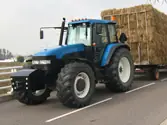
¿Cuál es la velocidad máxima para un vehículo especial con remolque?
What is the maximum speed for a special vehicle with a trailer?
- A40 km/h.40 km/h.
- B25 km/h.25 km/h.
- C45 km/h.45 km/h.
ExplanationA special vehicle that has no brake lights, that tows a trailer or that is a two-wheel tractor has a maximum speed of 25 km/h.
Al determinar la distancia de seguridad con el vehículo que va delante...
When deciding on the safe distance from the vehicle in front...
- Adebe tener en cuenta la velocidad, la visibilidad y el estado de la vía.you must take into account speed, visibility and the condition of the road.
- Bdebe tener en cuenta el tipo de vehículo que va delante.you must take into account the type of vehicle in front.
- Cdebe tener en cuenta únicamente la velocidad.you must take into account only speed.
ExplanationThe correct answer is that you must take into account speed, visibility and the condition of the road surface when deciding on your safe distance. The General Traffic Regulations state that the safe distance must be enough for the driver to react properly to any unexpected situation and keep everyone on the road safe. Speed affects the distance you will need to stop, visibility affects your ability to anticipate dangers, and the condition of the road surface can affect tyre grip and how the vehicle behaves.
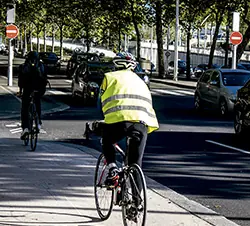
En las proximidades de vías de uso exclusivo de ciclos, ¿qué precauciones se deben tomar?
Near roads reserved exclusively for cycles, what precautions must you take?
- AHacer señales acústicas para indicar nuestra presencia.Use the horn to show that we are there.
- BModerar la velocidad y, si fuera preciso, detener el vehículo.Slow down and, if necessary, stop the vehicle.
- CMantener la velocidad y estar atento al cumplimiento de la señalización vertical.Keep the same speed and watch out for the road signs.
ExplanationNear roads reserved exclusively for cycles, the Regulations require you to slow down and, if necessary, to stop the vehicle, because cyclists may be entering or leaving them.
¿Cuál es la velocidad máxima permitida de un vehículo mixto en una autopista?
What is the maximum speed allowed for a mixed-use vehicle on a motorway (autopista)?
- A120 km/h.120 km/h.
- B100 km/h.100 km/h.
- C90 km/h.90 km/h.
ExplanationThe maximum speed allowed for a mixed-use vehicle on a motorway (autopista) is 100 km/h.
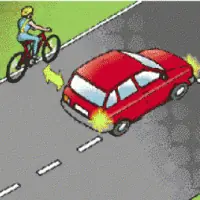
Cuando adelanta a un ciclista, ¿qué separación lateral de seguridad es obligatorio dejar?
When you overtake a cyclist, what lateral safety clearance must you leave?
- AAl menos 1,5 metros, tanto en poblado como fuera de poblado.At least 1.5 metres, both in and outside built-up areas.
- BSolo un margen lateral proporcional a la velocidad.Only a lateral margin in proportion to your speed.
- CAl menos 1,5 metros, pero solo cuando el adelantamiento se realice fuera de poblado.At least 1.5 metres, but only when overtaking outside built-up areas.
ExplanationUnder Article 85.4 of the General Traffic Regulations (as worded by RD 518/2026), when overtaking cyclists you must move partly or fully into the next lane or the opposite lane and keep a safety clearance of at least 1.5 metres, with no difference between built-up areas and outside them. If the carriageway has more than one lane in each direction, you must move completely into the next lane.
¿Cuál será la velocidad máxima de un turismo con remolque circulando por una autopista?
What is the maximum speed of a car towing a trailer on a motorway (autopista)?
- A120 km/h.120 km/h.
- B100 km/h.100 km/h.
- C90 km/h.90 km/h.
ExplanationThe maximum speed of a motor car towing a trailer on motorways (autopistas) and dual carriageways (autovías) is 90 km/h.
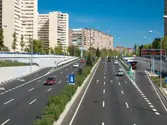
¿A qué velocidad máxima podrá circular una motocicleta por una autopista dentro de poblado?
What is the maximum speed for a motorcycle on a motorway (autopista) inside a built-up area?
- A80 km/h.80 km/h.
- B100 km/h.100 km/h.
- C120 km/h.120 km/h.
ExplanationThe maximum speed for motorcycles on motorways (autopistas) and dual carriageways (autovías) is 120 km/h, except when these roads run through urban land, where it becomes 80 km/h.
Cuando adelante conduciendo su turismo a un peatón por una vía fuera de poblado, ¿qué separación lateral de seguridad debe dejar?
When you overtake a pedestrian in your car on a road outside a built-up area, what lateral safety distance must you leave?
- A1,50 metros, como máximo.1.50 metres at most.
- B1,50 metros, como mínimo.1.50 metres at least.
- CUn margen de seguridad proporcional a la velocidad y a la anchura y características de la calzada.A safety margin in proportion to the speed and to the width and features of the carriageway.
ExplanationThis option is correct because it states that you must leave a lateral distance of at least 1.50 metres when overtaking a pedestrian. This is important for the pedestrian's safety, as it gives them enough room to move without the risk of being hit by the vehicle.
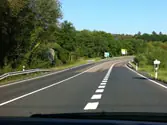
¿Cuál será la velocidad máxima circulando por una carretera convencional con dos carriles en nuestro sentido y un carril en el sentido contrario?
What is the maximum speed on a conventional road with two lanes in our direction and one lane in the opposite direction?
- A90 km/h.90 km/h.
- B100 km/h.100 km/h.
- C120 km/h.120 km/h.
ExplanationThe maximum speed on a conventional road, whatever its number of lanes, is 90 km/h.
Si circulamos a velocidad anormalmente reducida por autopista, ¿por dónde lo haremos?
If we are driving at an abnormally low speed on a motorway (autopista), where should we drive?
- APor la calzada si no perturbamos gravemente la circulación.On the carriageway, if we are not seriously disrupting traffic.
- BSiempre por el arcén.Always on the hard shoulder.
- CPor donde creamos conveniente.Wherever we think best.
ExplanationIf we are driving at an abnormally low speed on a motorway (autopista) without seriously disrupting traffic, we drive on the carriageway. But if we were seriously disrupting traffic, we would drive on the hard shoulder.
La velocidad a la que circula un vehículo, ¿influirá en la distancia de frenado?
Will the speed at which a vehicle is travelling affect the braking distance?
- ASí, aumentaráYes, it will increase it.
- BSí, disminuirá.Yes, it will reduce it.
- CNo, la velocidad solo afecta al consumo.No, speed only affects fuel consumption.
ExplanationThe higher the speed, the longer the distance needed to stop the vehicle, and it grows by a greater proportion than the increase in speed.
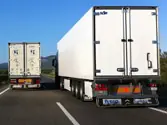
En una carretera convencional, ¿a qué velocidad máxima puede adelantar un camión?
On a conventional road, what is the maximum speed at which a lorry may overtake?
- AA 80 km/h.80 km/h.
- BA 100 km/h.100 km/h.
- CA 120 km/h.120 km/h.
ExplanationOn conventional roads, the maximum speed for lorries, even when overtaking, is 80 km/h.
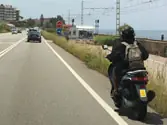
¿Circula correctamente este ciclomotor?
Is this moped being ridden correctly?
- ASí, si sufre una avería.Yes, if it has broken down.
- BSí, si circula a velocidad anormalmente reducida, perturbando gravemente la circulación.Yes, if it is going at an abnormally low speed that seriously disrupts traffic.
- CSí, porque el ciclomotor tiene que circular por el arcén.Yes, because mopeds must be ridden on the hard shoulder.
ExplanationA moped must be ridden on the hard shoulder if there is one and it is usable. In this case it is being ridden correctly.
El efecto túnel provocado por una velocidad excesiva es especialmete peligroso en...
The tunnel effect caused by excessive speed is especially dangerous...
- ALas autopistas y autovías.On motorways (autopistas) and dual carriageways (autovías).
- BLas intersecciones.At junctions.
- CLos adelantamientos.When overtaking.
ExplanationThe tunnel effect caused by excessive speed reduces peripheral vision, so it is especially dangerous at junctions, where you need to spot in time the vehicles and pedestrians coming from the sides.
En una carretera convencional, ¿cuál es la velocidad máxima a la que puede circular un turismo que arrastra un remolque?
On a conventional road, what is the maximum speed for a car towing a trailer?
- A80 km/h.80 km/h.
- B90 km/h.90 km/h.
- C70 km/h.70 km/h.
ExplanationOn conventional roads, lorries, tractor units, vans, motorhomes over 3,500 kg, articulated vehicles and motor cars with a trailer have a maximum permitted speed of 80 km/h.
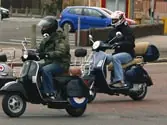
¿Cuál será la velocidad máxima de una motocicleta de 125 cm3 por una autopista?
What is the maximum speed of a 125 cm³ motorcycle on a motorway (autopista)?
- A100 km/h.100 km/h.
- B90 km/h.90 km/h.
- C120 km/h.120 km/h.
ExplanationA motorcycle, whatever its engine capacity, has a maximum speed of 120 km/h on a motorway (autopista) or dual carriageway (autovía).
¿Qué haremos si percibimos que vamos a ser adelantados?
What should we do if we notice that we are about to be overtaken?
- APoner el indicador de dirección de la derecha para que nos adelanten.Switch on the right indicator so that we are overtaken.
- BModerar la velocidad hasta detenernos en caso necesario.Slow down, stopping if necessary.
- CCeñirnos al borde derecho de la vía sin variar la velocidad.Keep close to the right-hand edge of the road without changing speed.
ExplanationWhen we notice that we are about to be overtaken, we must move over to the right-hand edge of the road to make overtaking easier, and not change our speed, unless the overtaking vehicle has trouble completing the manoeuvre; in that case, we should slow down.
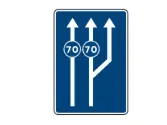
¿Podremos circular a más de 70 km/h por el carril de la derecha?
May we drive at more than 70 km/h in the right-hand lane?
- ANo, la señal lo prohíbe.No, the sign prohibits it.
- BSí.Yes.
- CNo, es un carril destinado a los vehículos que no pueden alcanzar la velocidad mínima de 70 km/h.No, it is a lane for vehicles that cannot reach the minimum speed of 70 km/h.
ExplanationThe second and third lanes may only be used by vehicles travelling at 70 km/h or more, although, if circumstances allow, vehicles must use the right-hand lane.
En una carretera convencional, ¿cuál será la velocidad máxima a la que podrá circular una motocicleta?
On a conventional road, what is the maximum speed for a motorcycle?
- A100 km/h.100 km/h.
- B90 km/h.90 km/h.
- C80 km/h.80 km/h.
ExplanationOn conventional roads, the maximum speed for motorcycles is 90 km/h.
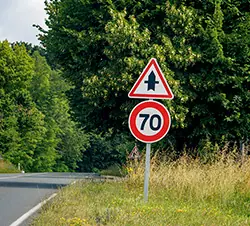
¿Puede rebasar la velocidad máxima indicada en la señal?
Can you exceed the maximum speed shown on the sign?
- ASí, en 20 km/h para adelantar.Yes, by 20 km/h to overtake.
- BNo.No.
- CSí, mientras lo permitan las circunstancias.Yes, as long as the circumstances allow it.
ExplanationSignposted limits may never be exceeded: in 2022 the 20 km/h margin that allowed cars and motorcycles to exceed the limit when overtaking on conventional roads was abolished.
En una carretera sin asfaltar, ¿a qué velocidad máxima puede circular un coche?
On an unpaved road, what is the maximum speed at which a car may be driven?
- AA 90 km/h.90 km/h.
- BA 50 km/h.50 km/h.
- CA 30 km/h.30 km/h.
ExplanationUnder Article 48.1.f of the General Traffic Regulations, on unpaved roads the maximum limit is 30 km/h, unless a sign sets a lower one. They offer less grip and there is a greater risk of throwing up stones.
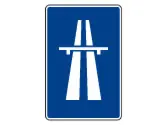
Si circulamos a velocidad anormalmente reducida por una autopista, ¿qué debemos hacer?
If we are driving at an abnormally low speed on a motorway (autopista), what must we do?
- ASalir por la próxima salida.Leave at the next exit.
- BLlegar hasta nuestro destino con precaución.Carry on carefully to our destination.
- CSeguir circulando sin cambiarnos de carril.Keep driving without changing lanes.
ExplanationIf we are driving at an abnormally low speed on a motorway (autopista), that is, below 60 km/h, we must leave it at the nearest exit. Vehicles with a MAM of no more than 3,500 kg that, because of an emergency, are driving at an abnormally low speed and seriously disrupting traffic must drive on the hard shoulder. If they are not disrupting traffic, they drive on the carriageway.
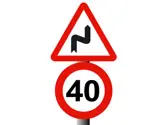
¿Cuándo terminará la prohibición de circular a velocidad superior a 40 km/h?
When will the ban on driving faster than 40 km/h end?
- ACuando encontremos la señal de fin de prohibición.When we find the end of prohibition sign.
- BCuando termine la sucesión de curvas próximas entre sí.When the series of bends close to each other ends.
- CCuando encontremos una señal de velocidad máxima distinta.When we find a different maximum speed sign.
ExplanationWhen the speed limit sign is placed on the same post as a danger sign, the ban ends when the signposted danger ends.
¿Cuál es la velocidad máxima permitida para un camión en autovía?
What is the maximum speed allowed for a lorry on a dual carriageway (autovía)?
- A90 km/h.90 km/h.
- B100 km/h.100 km/h.
- C80 km/h.80 km/h.
ExplanationAccording to Article 48.1.a) of the General Traffic Regulations, lorries, whatever their mass, may travel at a maximum of 90 km/h on motorways (autopistas) and dual carriageways (autovías) and 80 km/h on conventional roads. Vans and motor vehicles with trailers have the same limits.
¿Qué velocidad máxima puede desarrollar una motocicleta en una autovía?
What is the maximum speed a motorcycle may reach on a dual carriageway (autovía)?
- A100 km/h.100 km/h.
- B140 km/h140 km/h
- C120 km/h.120 km/h.
ExplanationOn motorways (autopistas) and dual carriageways (autovías) the general maximum speed for cars and motorcycles is 120 km/h. The 100 km/h limit applies, for example, to buses, and reaching 140 km/h is never allowed.
La máxima velocidad a la que un vehículo puede circular con seguridad prácticamente total en condiciones de circulación favorables, se llama...
The maximum speed at which a vehicle can travel with almost complete safety in favourable traffic conditions is called...
- AVelocidad adecuada.Appropriate speed.
- BVelocidad de diseño.Design speed.
- CVelocidad anormalmente reducida.Abnormally low speed.
ExplanationThe design speed of a road is the maximum speed that can be kept on a section of road in favourable traffic conditions without any risk. For example, a dual carriageway has a higher design speed than an urban road.
En una vía urbana con dos o más carriles por sentido y sin otra señalización, ¿a qué velocidad máxima puede circular con un turismo con remolque?
On an urban road with two or more lanes in each direction and no other signs, what is the maximum speed for a car with a trailer?
- AA 50 km/h.50 km/h.
- BA 60 km/h.60 km/h.
- CA 40 km/h.40 km/h.
ExplanationAccording to Article 50.1 of the General Traffic Regulations, the general limit on urban roads with two or more lanes in each direction is 50 km/h, and it does not change because you are towing a trailer. Only vehicles carrying dangerous goods have a lower limit on these roads, 40 km/h (Article 50.4).
Entre otras, la distancia de frenado puede aumentar debido a:
Among other things, braking distance may increase because of:
- AUn mayor tiempo de reacción del conductor.A longer driver reaction time.
- BCircular por una calzada mojada o deslizante.Driving on a wet or slippery carriageway.
- CUtilizar el freno motor.Using engine braking.
ExplanationBraking distance is the distance the vehicle travels from when the brake is pressed until it stops, and it increases on a wet or slippery surface because there is less grip. A longer reaction time increases the reaction distance, not the braking distance, and engine braking helps you slow down.
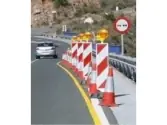
En una autopista o autovía, ¿se puede sobrepasar el límite de 120 km/h?
On a motorway (autopista) or dual carriageway (autovía), may you exceed the 120 km/h limit?
- ASí, para adelantar.Yes, to overtake.
- BSí, en los tramos con tres o más carriles por sentido.Yes, on stretches with three or more lanes in each direction.
- CNo.No.
ExplanationOn motorways and dual carriageways, the maximum speed for cars and motorcycles is 120 km/h, and it may not be exceeded, not even to overtake. The 20 km/h margin for overtaking only existed on conventional roads and was abolished on 21 March 2022.
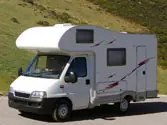
¿Cuál es la velocidad máxima permitida para una autocaravana de hasta 3500 kg de MMA circulando por una autopista?
What is the maximum speed allowed on a motorway (autopista) for a motorhome with a maximum authorised mass (MAM) of up to 3,500 kg?
- A120 km/h.120 km/h.
- B100 km/h.100 km/h.
- C90 km/h.90 km/h.
ExplanationCars, motorcycles and motorhomes of up to 3,500 kg may travel at a maximum speed of 120 km/h on motorways (autopistas) and dual carriageways (autovías). When the motorhome's MAM is over 3,500 kg, this maximum speed is 90 km/h.
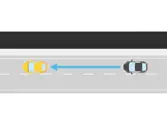
¿Cómo deberá ser la distancia de detención con relación a la distancia a la que se encuentra un obstáculo?
How should the stopping distance compare with the distance to an obstacle?
- AMayor.Longer.
- BMenor.Shorter.
- CIgual.The same.
ExplanationThe stopping distance is the distance the vehicle travels from the moment the driver sees a danger until the vehicle comes to a complete stop. It must be shorter than the distance to the obstacle, because if it is the same or longer, we will hit it.
En un paso inferior, ¿qué distancia de seguridad mantendremos con el vehículo que nos precede?
In an underpass, what safe distance must we keep from the vehicle in front?
- AUna distancia como mínimo de 150 metros o un intervalo de 6 segundos.At least 150 metres or a 6-second gap.
- BUna distancia como mínimo de 100 metros o un intervalo de 4 segundos.At least 100 metres or a 4-second gap.
- CLa que creamos conveniente para poder detener el vehículo sin colisionar con el que nos precede.Whatever distance we think is enough to stop without hitting the vehicle in front.
ExplanationVehicles with a MAM of up to 3,500 kg must keep a minimum distance of 100 metres or 4 seconds. For vehicles with a MAM over 3,500 kg, the distance is 150 metres or 6 seconds.
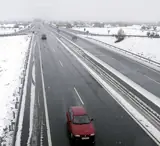
Si mientras circula con su vehículo comienza a nevar, ¿debe extremar la precaución y reducir la velocidad?
If it starts to snow while you are driving, must you take extra care and reduce your speed?
- ANo, solamente cuando nieve de forma copiosa.No, only when it is snowing heavily.
- BSí, y en el caso de realizar frenadas y aceleraciones lo haré de forma suave y progresiva.Yes, and I will brake and accelerate smoothly and gradually.
- CSí, y, obligatoriamente, pondré las cadenas.Yes, and I must fit snow chains.
ExplanationIn snow, grip decreases and braking distance increases, so you must reduce speed from the start and brake, accelerate and steer smoothly and gradually. Snow chains are only compulsory when signs require them or the road conditions make them necessary, not as soon as it starts to snow.
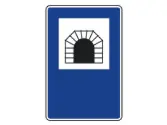
¿Qué distancia de seguridad dejaremos con el vehículo que nos precede en un túnel?
What safe distance should we leave from the vehicle in front in a tunnel?
- A150 metros, si el vehículo de delante es un camión de más de 3.500 kg.150 metres, if the vehicle in front is a lorry of more than 3,500 kg.
- B100 metros como mínimo, cualquiera que sea el vehículo que circule delante de nosotros.At least 100 metres, whatever vehicle is in front of us.
- C50 metros como mínimo.At least 50 metres.
ExplanationUnder Article 95.6 of the General Traffic Regulations (RGC), in tunnels and underpasses, if you are not going to overtake, you must keep at least 100 metres or four seconds from the vehicle in front. The 150 metres apply to vehicles of more than 3,500 kg themselves, not according to the type of vehicle in front.
La velocidad máxima por construcción de un ciclomotor o cuadriciclo ligero es de:
The maximum design speed of a moped or light quadricycle is:
- A40 km/h40 km/h
- B45 km/h45 km/h
- C50 km/h50 km/h
ExplanationThe correct answer is 45 km/h: it is the legal maximum design speed, neither 40 nor 50.
En una carretera convencional, ¿se permite exceder el límite de velocidad para adelantar?
On a conventional road, may you exceed the speed limit to overtake?
- ASí, hasta 140 km/h.Yes, up to 140 km/h.
- BSí, 20 km/h más.Yes, by 20 km/h.
- CNo.No.
ExplanationNo. Since 21 March 2022, when Article 51 of the General Traffic Regulations was repealed by Law 18/2021, you may not exceed the limit by 20 km/h to overtake on any road. You must overtake without going above the maximum speed.
La distancia de reacción, ¿es igual a la distancia de frenado?
Is reaction distance the same as braking distance?
- ASí.Yes.
- BNo.No.
- CSí, si las condiciones son desfavorables.Yes, if conditions are unfavourable.
ExplanationReaction distance is the number of metres the vehicle travels during the reaction time. It depends on the reaction time and the speed (the higher the speed, the more metres travelled in the same time). Braking distance is the distance the vehicle travels from when the driver brakes until the vehicle stops. It may vary depending on the following factors: - The speed you are driving at. - The condition of the vehicle's tyres, suspension and brakes. - The vehicle's load. - The condition of the road surface. - The weather conditions on the road.
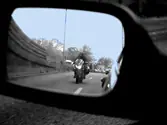
Fuera de poblado, ¿qué separación lateral debe dejar una motocicleta al adelantar un camión?
Outside built-up areas, what side clearance must a motorcycle leave when overtaking a lorry?
- AUna distancia proporcional a la velocidad a la que circule.A distance in proportion to the speed it is travelling at.
- BUn espacio no inferior a 1,50 metros.A space of no less than 1.50 metres.
- CUna separación que considere segura en función de las circunstancias del momento.Whatever clearance it considers safe given the circumstances at the time.
ExplanationUnder Article 85.5 of the General Traffic Regulations (RGC), the driver of a two-wheeled vehicle overtaking any other vehicle outside a built-up area must leave a space of no less than 1.50 metres between them. Also, under Article 85.4 (as worded by RD 518/2026), when overtaking pedestrians, animals, animal-drawn vehicles, cyclists, mopeds or personal mobility vehicles, you must leave at least 1.5 metres, both in and outside built-up areas.
Si estamos circulando por una autopista a velocidad anormalmente reducida perturbando gravemente la circulación,...
If we are driving on a motorway (autopista) at an abnormally low speed and seriously disrupting traffic,...
- ASeguiremos circulando por el arcén hasta llegar a nuestro destino.We carry on along the hard shoulder until we reach our destination.
- BSeguiremos circulando por el arcén y abandonaremos la autopista por la próxima salida.We carry on along the hard shoulder and leave the motorway at the next exit.
- CSeguiremos circulando por el carril de la derecha y abandonaremos la autopista por la próxima salida.We carry on in the right-hand lane and leave the motorway at the next exit.
ExplanationDrivers of vehicles with a maximum authorised mass (MAM) of no more than 3,500 kg who, for emergency reasons, drive at an abnormally low speed and so seriously disrupt traffic must drive on the hard shoulder on their right, if it is usable and wide enough. If it is not, they must use only the part of the carriageway that is strictly necessary. When they do not seriously disrupt traffic, they must drive in the right-hand lane. They must warn other road users of this situation with the vehicle's hazard warning lights. When these drivers are on a motorway (autopista) or dual carriageway (autovía), they must leave it at the first exit.
Velocidad inadecuada es...
Inappropriate speed is...
- ACircular a una velocidad ilegal que se adapta a las circunstancias.Driving at an illegal speed that suits the circumstances.
- BCircular a una velocidad legal que no se adapta a las circunstancias.Driving at a legal speed that does not suit the circumstances.
- CCircular a una velocidad superior a la máxima permitida para una vía.Driving faster than the maximum speed allowed on a road.
ExplanationInappropriate speed is a speed that does not suit the conditions or circumstances of the road. Even if that speed is within the legal limits, in a difficult situation it would be very hard to control the vehicle.
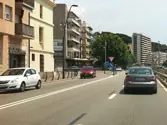
La distancia de seguridad que tenemos que mantener con el vehículo que nos precede...
The safe distance we must keep from the vehicle in front...
- Asolo la mantendremos en algunas vías.only has to be kept on some roads.
- Bla tenemos que mantener en todas las vías.must be kept on all roads.
- Cserá al menos de 100 metros.will be at least 100 metres.
ExplanationThe safe distance that must always be kept from the vehicle in front varies with speed and with traffic or road conditions. In the specific case of a tunnel, this distance is at least 100 metres.
La distancia que recorre el vehículo desde que el conductor percibe un estímulo hasta que reacciona se llama...
The distance a vehicle travels from the moment the driver perceives a stimulus until they react is called...
- Adistancia de reacciónreaction distance
- Bdistancia de frenadobraking distance
- Cdistancia de detenciónstopping distance
ExplanationReaction distance is the distance a vehicle travels from the moment the driver perceives a stimulus (such as a traffic sign or an obstacle) until they start to act, by braking or steering. It depends directly on the driver's reaction time. Braking distance, on the other hand, is the distance the vehicle needs to stop completely once braking has started. Understanding these distances helps to prevent accidents.
Al adelantar a un peatón en carretera, ¿qué distancia lateral debes dejar?
When overtaking a pedestrian on a road outside a built-up area, what lateral distance must you leave?
- A1 metro1 metre
- B1,5 metros1.5 metres
- C2 metros2 metres
ExplanationWhen overtaking pedestrians (and animals) walking on the hard shoulder of roads outside built-up areas, you must leave a lateral gap of at least 1.5 metres.
Si un vehículo circula demasiado cerca por detrás, ¿qué debe hacer?
If a vehicle is following you too closely, what should you do?
- AMantener la distancia de seguridad con el vehículo de delante.Keep the same safe distance from the vehicle in front.
- BAumentar la distancia de seguridad con el vehículo de delante.Increase the safe distance from the vehicle in front.
- CReducir la distancia de seguridad con el vehículo de delante.Reduce the safe distance from the vehicle in front.
ExplanationIf a vehicle is following too closely, the driver should increase the safe distance from the vehicle in front. This gives a bigger safety margin if they need to brake and helps avoid collisions if there is sudden braking. Keeping or reducing the safe distance would be dangerous, because it increases the risk of an accident both for the driver and for the vehicles behind.
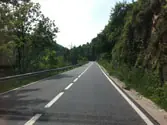
¿Circulamos correctamente si lo hacemos a velocidad inferior a 45 km/h por esta carretera?
Are we driving correctly if we drive below 45 km/h on this road?
- ASí, porque es una carretera muy estrecha.Yes, because it is a very narrow road.
- BNo, la velocidad mínima es de 45 km/h.No, the minimum speed is 45 km/h.
- CSí, porque circulamos a la mínima velocidad permitida.Yes, because we are driving at the minimum speed allowed.
ExplanationConventional roads have a general maximum speed of 90 km/h and a minimum of 45 km/h, so you may not drive below this speed without a good reason.
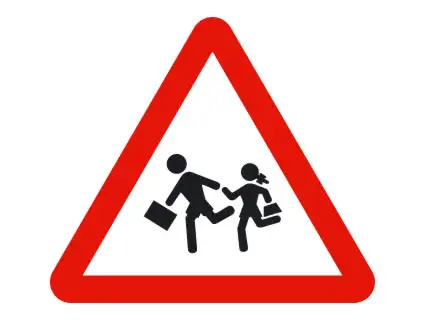
¿Debemos moderar la velocidad de nuestra motocicleta si nos aproximamos a un colegio?
Should you slow down on your motorcycle when approaching a school?
- ASí, llegando incluso a detenernos si fuera necesario.Yes, and even stop if necessary.
- BNo, sólo deben hacerlo vehículos de cuatro ruedas.No, only four-wheeled vehicles must do so.
- CNo.No.
ExplanationYou should slow down on your motorcycle when approaching a school because children are likely to be there. It is important to keep pedestrians safe, especially children, so you must reduce your speed and even stop if necessary.
Si conduce una motocicleta debe saber que no le está permitido rebasar la velocidad de 20 kilómetros por hora cuando circule por...
If you ride a motorcycle, you must know that you are not allowed to exceed 20 kilometres per hour when riding on...
- AVías urbanas.Roads in built-up areas.
- BCalles residenciales señalizadas.Signposted residential streets.
- CTravesías.Travesías (stretches of road through a town).
ExplanationThe correct answer is "Signposted residential streets" because in these areas the maximum speed for vehicles, including motorcycles, is 20 kilometres per hour. Residential streets are specially designed for pedestrians, and the aim is to keep them safe.
Si circulamos al doble de velocidad, ¿la distancia de frenado aumenta también el doble?
If we drive at twice the speed, does the braking distance also double?
- ALa distancia de frenado siempre es la misma independientemente de la velocidad.Braking distance is always the same, whatever the speed.
- BSí, aumenta en la misma proporción.Yes, it increases in the same proportion.
- CNo, aumenta en mayor proporción.No, it increases in a greater proportion.
ExplanationIf we double the speed, the braking distance becomes 4 times longer. So the increase is not proportional to the increase in speed; it is greater.
Una autocaravana de 3600 kg de MMA, ¿a qué velocidad máxima puede circular por esta carretera convencional?
What is the maximum speed of a motorhome with a MAM of 3,600 kg on this conventional road?
- AA 100 km/h.100 km/h.
- BA 80 km/h.80 km/h.
- CA 90 km/h.90 km/h.
ExplanationOn conventional roads the maximum speed for motorhomes with a MAM of 3,500 kg or less is 90 km/h. When their maximum authorised mass is more than 3,500 kg, their maximum permitted speed is 80 km/h.
Si por una avería circulamos por una autopista a una velocidad anormalmente reducida, ¿por dónde lo haremos?
If, because of a breakdown, we are driving on a motorway (autopista) at an abnormally low speed, where should we drive?
- APor el carril de la derecha siempre.Always in the right-hand lane.
- BPor el carril de la derecha y, si perturbamos gravemente la circulación, por el arcén.In the right-hand lane and, if we are seriously disrupting traffic, on the hard shoulder.
- CEn todo caso por la mediana.On the central reservation in all cases.
ExplanationWhen driving at an abnormally low speed and so seriously disrupting traffic, you must drive on the right-hand hard shoulder or, if there is none, on the part of the carriageway that is strictly necessary, and leave at the first exit.
All topics
- Definitions
- Documents and penalty points
- The driver's condition
- Duties of drivers and pedestrians
- Vehicle safety devices
- Vehicle controls and equipment
- Vehicle lights and horn
- Traffic signs, markings and signals
- The road and its lanes
- Manoeuvres
- Right of way
- Carrying passengers and loads
- Driving safely in difficult conditions
- Vehicle mechanics and maintenance
- Road accidents and first aid
- Defensive and eco-driving
Independent app: not affiliated with or endorsed by the DGT (Spain's Directorate-General for Traffic) or the Ministry of the Interior. The official exam is booked with the DGT and taken at its test centres. The questions here are practice material; the DGT's official question bank is not public.
Basado en datos de la Agencia Estatal Boletín Oficial del Estado (https://www.boe.es). Textos consolidados de carácter meramente informativo. La AEBOE no patrocina ni respalda este sitio.
Parte de las preguntas procede de los tests de la revista «Tráfico y Seguridad Vial» de la DGT, reproducidos con indicación de la fuente.