
DGT test · 961 questions
Speed and distances · Page 8 of 20
Speed limits by road and vehicle type, adapting speed to conditions, safe following distance and stopping distance.
Questions in this topic, with answers
961 questions, 50 per page, with the correct answer and the explanation. Page 8 of 20.
Circulando dentro de poblado por una vía con dos o más carriles por sentido, ¿cuál es la velocidad máxima permitida para un turismo que arrastra un remolque?
Driving in a built-up area on a road with two or more lanes in each direction, what is the maximum speed allowed for a car towing a trailer?
- A50 km/h.50 km/h.
- B60 km/h.60 km/h.
- C40 km/h.40 km/h.
ExplanationOn roads in built-up areas the general limit does not depend on whether the car is towing a trailer, but on the road: 50 km/h with two or more lanes in each direction, 30 km/h with a single lane and 20 km/h on a single-level (shared) street (Article 50.1 of the General Traffic Regulations, RGC).
¿Cómo será la distancia de frenado de un vehículo cargado respecto al mismo vehículo sin carga?
How will the braking distance of a loaded vehicle compare with that of the same vehicle without a load?
- AMayor.Longer.
- BMenor.Shorter.
- CIgual.The same.
ExplanationBecause it carries more weight, the loaded vehicle will travel more metres before it stops than the unloaded vehicle; in other words, its braking distance is longer.
Si circulando a 50 km/h aumentamos la velocidad hasta los 100 km/h, ¿variará la distancia de frenado?
If we are driving at 50 km/h and speed up to 100 km/h, will the braking distance change?
- ANo, la distancia de frenado no depende de la velocidad.No, braking distance does not depend on speed.
- BSi, aumentará en la misma proporción en que ha aumentado la velocidad.Yes, it will increase in the same proportion as the speed.
- CSí, aumentará en mayor proporción con la que ha aumentado la velocidad.Yes, it will increase in a greater proportion than the speed.
ExplanationBraking distance increases in a greater proportion than the increase in speed. If the speed has doubled, the braking distance will be 4 times longer.
¿Por qué dentro de poblado los límites de velocidad son más bajos que fuera de poblado?
Why are speed limits lower in built-up areas than outside them?
- APorque los peatones tienen preferencia de paso.Because pedestrians have right of way.
- BPorque se comparte el espacio con los peatones.Because the space is shared with pedestrians.
- CPara que haya menos contaminación acústica.To reduce noise pollution.
ExplanationIn built-up areas, vehicles share the space with pedestrians and cyclists, and hitting a pedestrian is much more serious the higher the speed. That is why the general urban limit is 50, 30 or 20 km/h, depending on the number of lanes in each direction or whether the carriageway and pavement are at the same level.
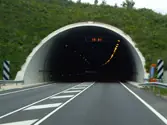
En un túnel con un carril para cada sentido, ¿qué distancia de seguridad mínima es obligatoria para turismos?
In a tunnel with one lane in each direction, what is the minimum compulsory safe distance for cars?
- A50 metros.50 metres.
- B100 metros.100 metres.
- C200 metros.200 metres.
ExplanationUnder Article 95.6 of the General Traffic Regulations (RGC), in tunnels, when not intending to overtake, a car must keep at least 100 metres or 4 seconds from the vehicle in front; vehicles over 3,500 kg, 150 metres or 6 seconds. With one lane in each direction, overtaking is prohibited.

Si nos encontramos un peatón atravesando la calzada por un paso que no está señalizado, ¿qué haremos?
If we come across a pedestrian crossing the carriageway at a place that is not a marked crossing, what should we do?
- ADetenernos y cederle el paso.Stop and give way to them.
- BModerar la velocidad, hasta incluso llegar a detenernos, para no suponer un riesgo para él.Slow down, even stopping, so that we are not a danger to them.
- CPitaremos para avisarle y que se aparte.Sound the horn to warn them to move out of the way.
ExplanationIf there are pedestrians on the part of the road we are using, we must slow down, even stopping, because although the pedestrian does not have right of way, they are a vulnerable road user and we must be very careful not to hit them.
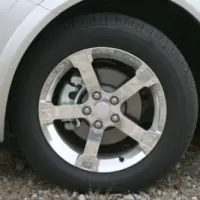
¿Influye el estado de los neumáticos en la distancia de frenado?
Does the condition of the tyres affect braking distance?
- ANo, porque la distancia de frenado es siempre la misma.No, because braking distance is always the same.
- BNo, porque la distancia de frenado depende solo de la velocidad.No, because braking distance depends only on speed.
- CSí.Yes.
ExplanationDriving on tyres in poor condition can have a negative effect on the vehicle's braking distance: with less grip on the carriageway, the vehicle will find it harder to brake, so the braking distance will be longer. Remember that braking distance is not always the same; it varies with different circumstances such as the condition of the tyres, the brakes or the carriageway.
¿Qué distancia de seguridad se deberá mantener entre vehículos en los túneles y pasos inferiores?
What safe distance must be kept between vehicles in tunnels and underpasses?
- A100 metros como mínimo en todo caso.At least 100 metres in all cases.
- B100 metros cuando no se pretenda adelantar.100 metres when you do not intend to overtake.
- C150 metros.150 metres.
ExplanationThe safe distance between vehicles in tunnels and underpasses, when you do not intend to overtake, must be at least 100 metres, which is the same as a gap of 4 seconds.
Conduce su coche detrás de un camión por una carretera interurbana de un carril por sentido; si no piensa adelantarlo, ¿qué distancia de seguridad debe mantener?
You are driving your car behind a lorry on a road outside built-up areas with one lane in each direction. If you do not intend to overtake it, what safe distance must you keep?
- A150 metros.150 metres.
- B50 metros.50 metres.
- CLa suficiente para que el vehículo que circula detrás pueda adelantarme con seguridad.Enough for the vehicle behind me to overtake me safely.
ExplanationUnder Article 54.2 of the General Traffic Regulations (RGC), a driver following another vehicle without intending to overtake it must leave a gap that allows the vehicle behind to overtake safely. This does not apply in built-up areas, where overtaking is prohibited, or where there is more than one lane in your direction.
En el interior de un túnel, circula con su motocicleta detrás de otro vehículo al que no desea adelantar, ¿qué separación deberá dejar entre ambos?
Inside a tunnel, you are riding your motorcycle behind another vehicle that you do not want to overtake. What distance must you leave between the two?
- AEl doble de la longitud del vehículo que va delante.Twice the length of the vehicle in front.
- B150 metros como máximo.150 metres at most.
- C100 metros, como mínimo.100 metres at least.
ExplanationThe correct answer is 100 metres at least, because vehicles with a maximum authorised mass (MAM) of up to 3,500 kg must keep a distance of 100 metres or 4 seconds when driving through tunnels or underpasses. This safe distance is needed to drive safely and avoid collisions if the vehicle in front brakes sharply.
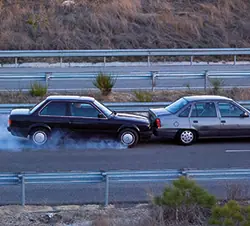
La distancia de frenado es el espacio recorrido desde que el conductor…
Braking distance is the distance travelled from the moment the driver…
- AVe el obstáculo hasta que se detiene el vehículo.Sees the obstacle until the vehicle stops.
- BVe el obstáculo hasta que acciona el freno.Sees the obstacle until they apply the brake.
- CAcciona el freno hasta que el vehículo se detiene.Applies the brake until the vehicle stops.
ExplanationBraking distance runs from the moment the brake is applied until the vehicle comes to a complete stop. The distance between seeing the obstacle and pressing the brake is the reaction distance, and the sum of both is the stopping distance.
¿Cuál es la velocidad máxima en autopista para un coche que lleva un remolque ligero?
What is the maximum speed on a motorway (autopista) for a car towing a light trailer?
- A120 km/h120 km/h
- B100 km/h100 km/h
- C90 km/h90 km/h
ExplanationAccording to Article 48 of the General Traffic Regulations (RGC), the maximum speed allowed for a car towing a light trailer on a motorway (autopista) is 90 km/h. This rule applies because vehicles towing light trailers have a lower speed limit than cars without a trailer, which is 120 km/h on motorways. So the correct answer is 90 km/h, the specific limit for cars with light trailers on these roads.
¿Cuál será la velocidad máxima al circular por una autopista que está dentro de poblado?
What is the maximum speed when driving on a motorway (autopista) that runs through a built-up area?
- A110 km/h.110 km/h.
- B80 km/h.80 km/h.
- C50 km/h.50 km/h.
ExplanationThe maximum speed when driving on a motorway (autopista) that runs through a built-up area is 80 km/h. This is because motorways (autopistas) and dual carriageways (autovías) running through built-up areas have a maximum speed of 80 km/h for all vehicles.
¿Cuál es la velocidad máxima a la que puede circular una motocicleta por una carretera convencional sin separación física de ambos carriles y un arcén pavimentado de menos de 1,5 metros de ancho?
What is the maximum speed for a motorcycle on a conventional road with no physical separation between the two directions and a paved hard shoulder less than 1.5 metres wide?
- A120 km/h120 km/h
- B100 km/h100 km/h
- C90 km/h90 km/h
ExplanationOn conventional roads the limit for motorcycles and cars is 90 km/h. Only if there is a physical separation between the two directions may the road authority raise it to 100 km/h. The width of the hard shoulder no longer affects the maximum speed.
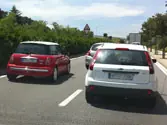
¿Cuál es la velocidad máxima a la que podemos circular por una travesía?
What is the maximum speed at which we may drive on a travesía?
- A60 Km/h.60 km/h.
- B50 km/h.50 km/h.
- C80 km/h.80 km/h.
ExplanationA travesía is inside a built-up area, so the maximum speed is 50 km/h.
¿Cuál será la velocidad máxima para una motocicleta de hasta 125 cc circulando por autopista?
What is the maximum speed for a motorcycle of up to 125 cc on a motorway (autopista)?
- A120 km/h.120 km/h.
- B100 km/h.100 km/h.
- C90 km/h.90 km/h.
ExplanationThe maximum speed for a motorcycle on a motorway (autopista), whatever its engine capacity, is 120 km/h.
¿Cuál es la velocidad máxima de un turismo en una autovía?
What is the maximum speed for a car on a dual carriageway (autovía)?
- A120 km/h.120 km/h.
- B100 km/h más 20 km/h para adelantar.100 km/h, plus 20 km/h for overtaking.
- C100 km/h solamente.100 km/h only.
ExplanationThe maximum speed on motorways (autopistas) and dual carriageways (autovías) is 120 km/h, and you may not add anything to it for overtaking.
Si conduce un conjunto de vehículos por una autopista, fuera de poblado, ¿cuál es la velocidad mínima a la que le está permitido circular, sin causa justificada?
If you are driving a vehicle combination on a motorway (autopista), outside built-up areas, what is the minimum speed at which you may travel without a good reason?
- A60 kilómetros por hora.60 kilometres per hour.
- B50 kilómetros por hora.50 kilometres per hour.
- C45 kilómetros por hora.45 kilometres per hour.
ExplanationOn motorways (autopistas) the minimum speed allowed is 60 km/h.
Si un vehículo no puede alcanzar la velocidad mínima y existe peligro de alcance...
If a vehicle cannot reach the minimum speed and there is a risk of being hit from behind...
- ADeberá detenerse en el arcén y no podrá seguir circulando.It must stop on the hard shoulder and may not continue.
- BPodrá seguir circulando usando las luces de emergencia.It may continue using the hazard warning lights.
- CPodrá seguir circulando normalmente extremando la precaución.It may continue as normal, taking extreme care.
ExplanationIf a vehicle cannot reach the minimum speed required on the road it is using and there is also a risk of being hit from behind by other vehicles, it may continue using the hazard warning lights.
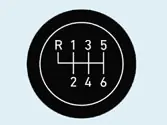
La primera marcha la debemos usar:
We should use first gear:
- ADurante mucho rato antes de pasar a la segunda marcha.For a long time before changing into second.
- BHasta llegar a la velocidad de 30 km/h.Until we reach 30 km/h.
- CSólo para el inicio de la marcha y cambiarla lo antes posible.Only to move off, changing up as soon as possible.
ExplanationChoosing the right gear is one of the key aspects of eco-driving. When driving in high gears with the engine at low revs, fuel consumption is lower. We should use the highest possible gear (4th or 5th) even in town, and keep the engine at low revs. In low gears, the engine runs at higher revs and uses more fuel. First gear has a lot of power but little speed, so using it for a long time makes fuel consumption shoot up. It should only be used to move off, and we should change up as soon as possible, after about 2 seconds or 6 metres.
¿Qué distancia de separación respecto al vehículo que le precede deberá mantener un vehículo de más de 3.500 kg. de MMA, circulando por una autovía?
What gap must a vehicle with a MAM of more than 3,500 kg keep from the vehicle in front when driving on a dual carriageway (autovía)?
- A50 metros como mínimo.At least 50 metres.
- B50 metros si no pretende adelantar.50 metres if it does not intend to overtake.
- CLa que le permita detenerse sin colisionar con él.One that allows it to stop without hitting it.
ExplanationWhen driving behind another vehicle, you must leave a space that lets you stop, if it brakes suddenly, without hitting it, taking into account speed and grip and braking conditions. In addition, if we are driving with no intention of overtaking, this gap must be such that the vehicle behind can overtake us. For this purpose, vehicles with a MAM of more than 3,500 kg and vehicles and combinations of vehicles more than 10 metres long must keep a distance of 50 metres. However, keeping a distance that avoids a collision is enough (no specific number of metres applies) in these cases: in built-up areas; where overtaking is prohibited; where there is more than one lane in the same direction (this is the case on motorways (autopistas) and dual carriageways (autovías), because they always have more than one lane); when traffic is saturated; when you intend to overtake.
Si un vehículo circula a velocidad anormalmente reducida por una autopista, circulará...
If a vehicle is travelling at an abnormally low speed on a motorway (autopista), it will use...
- APor el arcén.The hard shoulder.
- BPor el carril de la derecha si no perturba gravemente la circulación. Si la perturba lo hará por el arcén.The right-hand lane if it does not seriously disrupt traffic. If it does, it will use the hard shoulder.
- CTendrá que inmovilizarse no pudiendo circular en ningún caso.It will have to stop and may not travel at all.
ExplanationA vehicle travelling at an abnormally low speed because of an emergency will use the right-hand lane. Only if this seriously disrupts traffic must it move onto the hard shoulder on its right, if it is passable and wide enough, under Article 36 of the General Traffic Regulations (RGC).
La distancia de detención, ¿de qué depende?
What does stopping distance depend on?
- ADe la velocidad, solamente.On speed only.
- BDe la velocidad, del tiempo de reacción y del tiempo de frenado.On speed, reaction time and braking time.
- CDel tipo de vehículo solamenteOn the type of vehicle only.
ExplanationReaction time is the time from when the driver sees an obstacle until they react. This time varies with the driver's physical and mental state, never with speed or road conditions. Although it may seem that our reaction to an obstacle or unexpected situation should be instant, a driver's average reaction time is about 0.75 seconds. Reaction distance is the number of metres the vehicle travels during that reaction time. This distance depends on the reaction time and the speed (the higher the speed, the more metres travelled in the same time). Braking distance is the distance the vehicle travels from when the driver brakes until the vehicle stops. It depends on speed, the vehicle's mass and load, the condition of the vehicle, road conditions and the weather (rain x2, snow or ice x10). Stopping distance is the reaction distance plus the braking distance. So stopping distance is the distance the vehicle travels from when the driver perceives a danger until the vehicle comes to a complete stop.
¿Cuál será la velocidad mínima de un camión arrastrando un remolque ligero al circular por una autopista?
What is the minimum speed of a lorry towing a light trailer on a motorway (autopista)?
- A60 km/h.60 km/h.
- B80 km/h.80 km/h.
- C90 km/h.90 km/h.
ExplanationThe minimum speed on motorways (autopistas) and dual carriageways (autovías) is the same for all types of vehicle: 60 km/h.
¿Cuál es la velocidad máxima permitida para una furgoneta circulando por autopista?
What is the maximum speed allowed for a van on a motorway (autopista)?
- A120 km/h.120 km/h.
- B100 km/h.100 km/h.
- C90 km/h.90 km/h.
ExplanationVans, like lorries, have a speed limit of 90 km/h on motorways (autopistas).
¿Cuál será la velocidad máxima de una furgoneta de 3.500 kg al circular por una autopista?
What is the maximum speed of a 3,500 kg van on a motorway (autopista)?
- A120 km/h.120 km/h.
- B100 km/h.100 km/h.
- C90 km/h.90 km/h.
ExplanationVans, like lorries, are limited to a maximum speed of 90 km/h, whatever their weight.
¿Cuál será la velocidad máxima permitida para una autocaravana de 3500 kg de MMA circulando por una autovía?
What is the maximum speed allowed for a motorhome with a maximum authorised mass (MAM) of 3,500 kg on a dual carriageway (autovía)?
- A90 km/h.90 km/h.
- B100 km/h.100 km/h.
- C120 km/h.120 km/h.
ExplanationOn motorways (autopistas) and dual carriageways (autovías), the maximum speed allowed for motorhomes with a MAM of 3,500 kg or less is 120 km/h. When their maximum authorised mass is over 3,500 kg, their maximum speed allowed is 90 km/h.
El estado y conservación del vehículo influirá en...
The condition and maintenance of the vehicle will affect...
- ALa distancia de frenado.The braking distance.
- BLa distancia de reacción.The reaction distance.
- CEl tiempo de reacción.The reaction time.
ExplanationThe condition of the vehicle affects how it behaves. If the brakes are in good condition, this will affect the braking distance: the vehicle will travel fewer metres before it stops.

Circular por debajo de la velocidad mínima permitida, ¿podría ser un factor de riesgo?
Could driving below the minimum speed allowed be a risk factor?
- ANo, ya que siempre se considera una velocidad adecuada.No, because it is always considered a suitable speed.
- BNo, nunca.No, never.
- CSí, una velocidad anormalmente reducida puede causar accidentes.Yes, an abnormally low speed can cause accidents.
ExplanationA driver going below the minimum speed allowed (abnormally low speed) would obstruct the normal flow of other road users, forcing them to overtake at unsuitable times or places. That is why driving at this speed is dangerous and can cause accidents. Even if there is no specific minimum or maximum speed sign, we must keep to the general speeds for the type of road and vehicle. The general minimum speed on motorways (autopistas) and dual carriageways (autovías) is 60 km/h, while on other roads it is half the maximum speed for each type of vehicle.
En caso de accidente, ¿hay relación entre la velocidad y la gravedad de las lesiones de los ocupantes de un vehículo?
In a crash, is there a link between speed and how serious the injuries to a vehicle's occupants are?
- ASí; a mayor velocidad, menor probabilidad de sufrir lesiones graves.Yes; the higher the speed, the lower the chance of serious injuries.
- BSí; a mayor velocidad, mayor probabilidad de sufrir lesiones graves.Yes; the higher the speed, the higher the chance of serious injuries.
- CNo; la gravedad de las lesiones depende solo de los sistemas de seguridad pasiva.No; how serious the injuries are depends only on the passive safety systems.
ExplanationThe higher the speed, the more energy has to be absorbed in the crash, and this energy grows with the square of the speed. That is why both the chance of having a crash and the seriousness of the injuries increase; passive safety systems reduce injuries but do not cancel out the effect of speed.
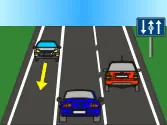
¿Cuál es la velocidad máxima en esta vía?
What is the maximum speed on this road?
- A100 km/h.100 km/h.
- B100 km/h en el sentido en el que existen los dos carriles y 90 km/h en el sentido contrario.100 km/h in the direction with two lanes and 90 km/h in the opposite direction.
- C90 km/h.90 km/h.
ExplanationOn conventional roads, the maximum speed is 90 km/h, however many lanes there are.
Los Agentes de la autoridad y el personal de obras, ¿están obligados a utilizar dispositivos retrorreflectantes que permitan distinguirlos a una distancia mínima de 150 metros?
Must police officers and road workers use reflective items that let them be seen from at least 150 metres away?
- ASí, siempre.Yes, always.
- BSí, pero sólo de noche.Yes, but only at night.
- CNo.No.
ExplanationPolice officers directing traffic and road workers must wear brightly coloured clothing and reflective devices or items that let approaching drivers and other road users see them from at least 150 metres away.
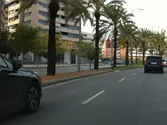
En esta vía urbana, donde hay dos carriles para el mismo sentido ¿cuál será la velocidad máxima a la que podemos circular?
On this urban road, with two lanes in the same direction, what is the maximum speed we can drive at?
- AA 30 km/h.30 km/h.
- BA 50 km/h.50 km/h.
- CA 20 km/h.20 km/h.
ExplanationWithout specific signs, on urban roads with two or more lanes in each direction the general limit is 50 km/h (Article 50.1.c of the General Traffic Regulations, RGC). With only one lane in each direction it would be 30 km/h, and 20 km/h on a single-level (shared) street, where the carriageway and pavement are at the same level.
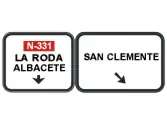
En una vía así señalizada, ¿a qué velocidad máxima le está permitido circular a un turismo que arrastra un remolque?
On a road with these signs, what is the maximum speed allowed for a car towing a trailer?
- A80 km/h.80 km/h.
- B90 km/h.90 km/h.
- C100 km/h.100 km/h.
ExplanationThe signs in the picture, a direction sign for the road we are on (on the left) and an immediate exit sign (on the right), tell us that we are on a conventional road. We can tell this because the direction sign for our road is white. If it were blue, it would mean we were on a motorway. It is also important to note that immediate exit signs always have the colour of the road they lead to. The general maximum speed for cars on conventional roads is 90 kilometres per hour. As the car is towing a trailer, its maximum speed is 80 km/h.
¿Cuál será la velocidad máxima para una furgoneta de 2000 kg de MMA circulando por una autopista?
What is the maximum speed for a van with a maximum authorised mass (MAM) of 2,000 kg on a motorway (autopista)?
- A120 km/h, igual que un turismo.120 km/h, the same as a car.
- B100 km/h, igual que un vehículo mixto.100 km/h, the same as a mixed-use vehicle.
- C90 km/h, igual que un camión.90 km/h, the same as a lorry.
ExplanationA van, whatever its maximum mass, has the same speed limit as a lorry, so its speed limit on a motorway (autopista) is 90 km/h.
En un túnel, ¿qué distancia debe mantener un motociclista respecto al vehículo que circula delante si no va a adelantarlo?
In a tunnel, what distance must a motorcyclist keep from the vehicle in front if they are not going to overtake it?
- A150 metros.150 metres.
- B50 metros.50 metres.
- C100 metros.100 metres.
ExplanationAccording to Article 95.6 of the General Traffic Regulations (RGC), in tunnels, when you do not intend to overtake, you must keep at least 100 metres or 4 seconds from the vehicle in front. The 150 metres or 6 seconds are only required for vehicles with a MAM of more than 3,500 kg.
Circulando por una vía dentro de poblado y sin intención de adelantar, ¿qué distancia debemos mantener con el vehículo que nos precede?
Driving on a road in a built-up area with no intention of overtaking, what distance must we keep from the vehicle in front?
- ALa que permita ser adelantados por el vehículo que nos sigue.One that allows the vehicle behind us to overtake us.
- BLa que permita frenar sin colisionar con el vehículo que nos precede.One that allows us to brake without hitting the vehicle in front.
- C2 metros como mínimo.At least 2 metres.
ExplanationWhen driving in a built-up area you must leave a clear space between vehicles that allows you to stop without hitting the vehicle in front, taking into account the speed and the grip of the road.
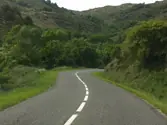
¿Puede llegar a circular a una velocidad inadecuada, aunque no se superen los límites máximos de velocidad?
Can you be driving at an unsuitable speed even without going over the speed limits?
- ANo, en ningún caso.No, never.
- BSí, ya que la velocidad debe adaptarse a las circunstancias de la vía, del trafico etc.Yes, because speed must be adapted to the road and traffic conditions, etc.
- CSí, siempre que vaya a más de 100 km/h.Yes, as long as you are going faster than 100 km/h.
ExplanationOur speed may be within the limits allowed for the road but still be unsuitable. When it is not adapted to the weather or to the road, traffic or vehicle conditions, or to the driver's condition, we are driving at an unsuitable speed.
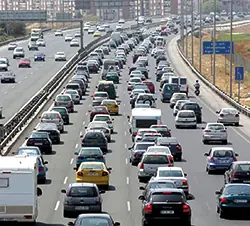
En defecto de señalización, ¿cuál es la velocidad máxima que no deberán rebasar los vehículos en una autopista dentro de poblado?
Where there are no signs, what is the maximum speed that vehicles must not exceed on a motorway (autopista) in a built-up area?
- A50 km/h, pudiéndola superar en 20 km/h para adelantar.50 km/h, which may be exceeded by 20 km/h to overtake.
- B80 km/h.80 km/h.
- C50 km/h.50 km/h.
ExplanationThe general limit on motorways (autopistas) and dual carriageways (autovías) running through built-up areas is 80 km/h (Article 50 of the General Traffic Regulations, RGC). In addition, since 2022 you are no longer allowed to exceed the speed limit to overtake.
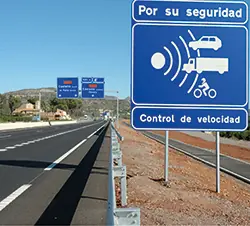
En esta vía, la velocidad mínima permitida a los turismos es de...
On this road, the minimum permitted speed for cars is...
- A90 km/h90 km/h
- B60 km/h60 km/h
- C75 km/h75 km/h
ExplanationThe picture shows a dual carriageway (autovía). Article 49.1 of the General Traffic Regulations prohibits driving motor vehicles on motorways (autopistas) and dual carriageways (autovías) at less than 60 km/h; this is a fixed figure for these roads, not calculated from the maximum speed.
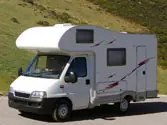
¿A qué velocidad máxima podrá circular una autocaravana de hasta 3500 kg por una autovía?
What is the maximum speed on a dual carriageway (autovía) for a motorhome of up to 3,500 kg?
- A90 km/h.90 km/h.
- B100 km/h.100 km/h.
- C120 km/h.120 km/h.
ExplanationMotorhomes of up to 3,500 kg may travel at a maximum speed of 120 km/h on motorways (autopistas) and dual carriageways (autovías). When they weigh more than 3,500 kg, their maximum speed is 90 km/h.
Un camión de 3.500 Kg de MMA circula por una autopista. La velocidad máxima que no debe superar es...
A lorry with a maximum authorised mass of 3,500 kg is travelling on a motorway (autopista). The maximum speed it must not exceed is...
- A100 Km/h.100 km/h.
- B90 Km/h.90 km/h.
- C120 Km/h.120 km/h.
ExplanationUnder Article 48 of the General Traffic Regulations, lorries and vans, even if they have a mass of 3,500 kg and are driven with a B licence, may travel at a maximum of 90 km/h on motorways (autopistas) and dual carriageways (autovías) and 80 km/h on conventional roads.
Si circulamos a 70 km/h por el carril central y no hay más vehículos en la vía, ¿estamos conduciendo correctamente?
If we are driving at 70 km/h in the centre lane and there are no other vehicles on the road, are we driving correctly?
- ASí, porque voy por debajo del límite de velocidad.Yes, because I am below the speed limit.
- BSí, porque puedo circular por el carril que más convenga a mi destino.Yes, because I can use whichever lane best suits my destination.
- CNo, debo circular por el carril de la derecha.No, I must drive in the right-hand lane.
ExplanationOutside built-up areas, on carriageways with more than one lane in the same direction, you normally drive in the right-hand lane (Article 31.1 of the General Traffic Regulations). The other lanes are only used when traffic or the road makes it advisable, for example to overtake; driving in the centre lane when the road is clear is not justified.
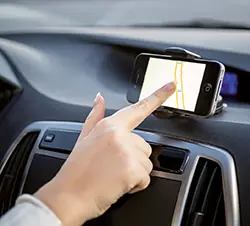
Los sistemas de navegación, ¿pueden ayudarnos a controlar la velocidad de circulación?
Can navigation systems help us control our speed?
- ASolo cuando se circula a velocidades superiores a 100 km/h.Only when driving at speeds over 100 km/h.
- BNo, los sistemas de navegación no ayudan a controlar la velocidad.No, navigation systems do not help to control speed.
- CSí, aunque la principal fuente de información debe de ser siempre el velocímetro.Yes, although the main source of information must always be the speedometer.
ExplanationSatnavs can warn about speed limits and show the speed you are travelling at, and in that way they help; but the valid reference must always be the vehicle's speedometer, which is the approved instrument.
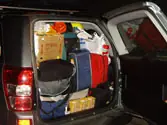
¿Cómo será la distancia de frenado de un vehículo cargado en relación al mismo vehículo sin carga?
How will the braking distance of a loaded vehicle compare with the same vehicle without a load?
- AMayor.Longer.
- BMenor.Shorter.
- CLa misma.The same.
ExplanationA loaded vehicle weighs more, so it will need a longer braking distance than when it has no load.
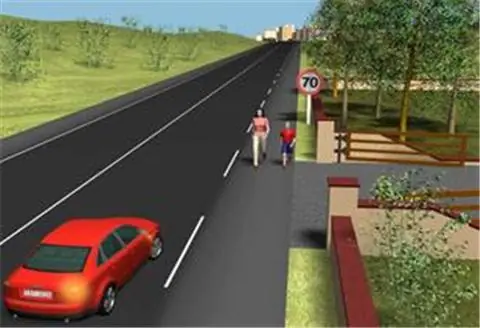
Cuando en las inmediaciones de la calzada se encuentran niños con intención de cruzar, se debe...
When there are children near the carriageway who intend to cross, you must…
- Aadvertir de la presencia con las luces de largo alcance.warn them of your presence with the main beam.
- Bmoderar la velocidad del vehículo y si fuera preciso detenerse.reduce your speed and, if necessary, stop.
- Ccircular a menos de la mitad de la velocidad permitida.drive at less than half the permitted speed.
ExplanationWhen there are children near the carriageway intending to cross, you must drive at a moderate speed and stop if necessary (Article 46 of the General Traffic Regulations), because they may suddenly run out. Flashing the main beam does not help, and the law does not require you to halve your speed.
Ud. circula conduciendo su turismo por un tramo de autopista en el que, mediante la correspondiente señal, se prohíbe circular a más de 100 kilómetros por hora. ¿Sabe Ud. a qué velocidad como mínimo debe circular si no existe causa justificada que le obligue a circular a velocidad inferior?
You are driving your car on a stretch of motorway (autopista) where a sign prohibits driving at more than 100 kilometres per hour. Do you know the minimum speed at which you must drive if there is no good reason forcing you to drive more slowly?
- A60 kilómetros por hora, circulen o no otros vehículos.60 kilometres per hour, whether or not there are other vehicles on the road.
- B50 kilómetros por hora, si no circulan otros vehículos.50 kilometres per hour, if there are no other vehicles on the road.
- C50 kilómetros por hora, circulen o no otros vehículos.50 kilometres per hour, whether or not there are other vehicles on the road.
ExplanationUnder Article 49.1 of the General Traffic Regulations, on motorways (autopistas) and dual carriageways (autovías) it is prohibited to drive at less than 60 km/h, even when there are no other vehicles on the road. This figure does not depend on the maximum limit signposted on the stretch, for example 100 km/h.
¿Puede un turismo superar la velocidad máxima genérica en 20 km/h para adelantar?
Can a car exceed the general maximum speed by 20 km/h in order to overtake?
- ANo.No.
- BSí, en carreteras convencionales fuera del casco urbano.Yes, on conventional roads outside towns.
- CEn todas las vías, siempre que no lo prohíba la señalización.On all roads, as long as signs do not prohibit it.
ExplanationNo vehicle may exceed the maximum speed in order to overtake. Article 51 of the General Traffic Regulations (RGC), which allowed it to be exceeded by 20 km/h on conventional roads, was repealed by Law 18/2021 with effect from 21 March 2022.
¿Cuál es la velocidad máxima permitida para un cuadriciclo no ligero en una carretera convencional?
What is the maximum speed allowed for a non-light quadricycle on a conventional road?
- A100 km/h.100 km/h.
- B45 km/h.45 km/h.
- C70 km/h.70 km/h.
ExplanationArticle 48.1.h of the RGC sets a limit of 70 km/h for three-wheeled vehicles and non-light quadricycles on any road they are allowed to use. The 45 km/h limit is for mopeds and light quadricycles.
Para evitar un accidente en caso de una frenada brusca, ¿debe adaptar la velocidad y la distancia de seguridad respecto al vehículo que va delante si conduce una furgoneta cargada?
To avoid a crash if you have to brake sharply, must you adapt your speed and safe distance from the vehicle in front if you are driving a loaded van?
- ASí, el peso de la carga aumenta la distancia de frenado.Yes, the weight of the load increases the braking distance.
- BNo, el peso de la carga no afecta la distancia de frenado.No, the weight of the load does not affect the braking distance.
- CSí, el peso de la carga disminuye la distancia de frenado.Yes, the weight of the load reduces the braking distance.
ExplanationWith more mass there is more energy to absorb when braking, so a loaded van needs more distance to stop. Article 54.1 of the General Traffic Regulations requires you to leave a space that allows you to stop without a collision, taking into account speed, grip and braking conditions.
All topics
- Definitions
- Documents and penalty points
- The driver's condition
- Duties of drivers and pedestrians
- Vehicle safety devices
- Vehicle controls and equipment
- Vehicle lights and horn
- Traffic signs, markings and signals
- The road and its lanes
- Manoeuvres
- Right of way
- Carrying passengers and loads
- Driving safely in difficult conditions
- Vehicle mechanics and maintenance
- Road accidents and first aid
- Defensive and eco-driving
Independent app: not affiliated with or endorsed by the DGT (Spain's Directorate-General for Traffic) or the Ministry of the Interior. The official exam is booked with the DGT and taken at its test centres. The questions here are practice material; the DGT's official question bank is not public.
Basado en datos de la Agencia Estatal Boletín Oficial del Estado (https://www.boe.es). Textos consolidados de carácter meramente informativo. La AEBOE no patrocina ni respalda este sitio.
Parte de las preguntas procede de los tests de la revista «Tráfico y Seguridad Vial» de la DGT, reproducidos con indicación de la fuente.