
DGT test · 982 questions
Manoeuvres · Page 18 of 20
Joining traffic, overtaking, turning, U-turns, reversing, stopping and parking: how and where to do them and when they are forbidden.
Questions in this topic, with answers
982 questions, 50 per page, with the correct answer and the explanation. Page 18 of 20.
¿Cómo nos incorporaremos al salir de un estacionamiento?
How will we join the traffic when pulling out of a parking space?
- ACon rapidez.Quickly.
- BLentamente.Slowly.
- CCediendo el paso a los vehículos que se aproximen tanto por la derecha como por la izquierda.Giving way to vehicles approaching from both the right and the left.
ExplanationEvery vehicle that wants to join the traffic must give way to other vehicles already moving, whether they are approaching from the right or from the left.
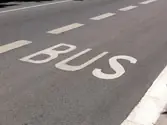
¿Se podrá efectuar una parada en un carril bus?
Can you stop in a bus lane?
- AUna parada sí, un estacionamiento no.Stopping yes, parking no.
- BNo se podrá parar ni estacionar.You can neither stop nor park.
- CUna parada sí, pero solo si dura menos de dos minutos.Stopping yes, but only if it lasts less than two minutes.
ExplanationIn a bus lane, as a general rule, we may not drive, stop or park.
Si la circulación está saturada, que un carril circule más rápido que el otro, ¿se considera adelantamiento?
If traffic is saturated, is it considered overtaking when one lane moves faster than the other?
- ANo.No.
- BNo, se considera rebasamiento.No, it is considered passing.
- CSí.Yes.
ExplanationMoving faster in one lane than in another is not considered overtaking. It is the same as when driving in an acceleration or deceleration lane or in lanes reserved for certain vehicles.
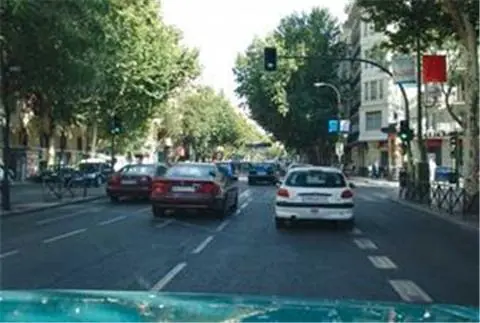
En esta vía urbana, para advertir al conductor del vehículo blanco su intención de adelantarle, ¿puede usar las señales acústicas?
On this urban road, may you use the horn to warn the driver of the white vehicle that you intend to overtake?
- ASí, excepto que haya una señal que lo prohíba.Yes, unless a sign forbids it.
- BSí, pero solamente en caso de avería de las luces de mi vehículo.Yes, but only if my vehicle's lights have failed.
- CNo, porque está prohibido.No, because it is forbidden.
ExplanationUnder Article 110 of the General Traffic Regulations, the horn may only be used to warn that you are overtaking outside built-up areas. On an urban road it is only allowed to avoid a possible accident, so it cannot be used to warn that you are going to overtake.
¿Se podrá adelantar en un paso para ciclistas?
Can you overtake on a cycle crossing?
- ANo.No.
- BSí, a un vehículo de dos ruedas.Yes, a two-wheeled vehicle.
- CSí, a una velocidad muy reducida.Yes, at a very low speed.
ExplanationOn a cycle crossing and near it you can never overtake.
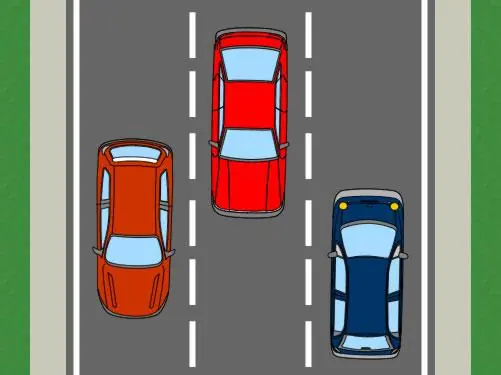
Para adelantar en una vía con doble sentido de circulación y tres carriles delimitados por marcas longitudinales discontinuas se utilizará el carril…
To overtake on a two-way road with three lanes marked by broken longitudinal lines, you use the lane…
- ASituado más a la izquierda de la vía.Furthest to the left of the road.
- BDerecho , en todo caso.On the right, in all cases.
- CCentral, siempre que no lo hayan ocupado los conductores que circulen en sentido contrario.In the centre, as long as it is not occupied by drivers coming in the opposite direction.
ExplanationOn two-way carriageways with three lanes separated by broken lines, you drive in the right-hand lane, the centre lane is only used for overtaking or turning left, and the lane furthest to the left is never used (Article 30 of the General Traffic Regulations).
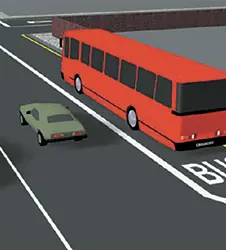
En un carril bus, ¿puede un turismo realizar una parada?
Can a car stop in a bus lane?
- ASolo cuando no obstaculice la circulación de autobuses.Only when it does not get in the way of buses.
- BSí, en todo caso.Yes, in all cases.
- CNo.No.
ExplanationThe bus lane is reserved for the vehicles shown on the signs, so a car cannot drive, stop or park in it: it would get in the way of public transport.
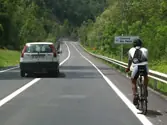
Al adelantar al ciclista deberá...
When overtaking the cyclist, you must...
- ADejar una separación lateral de al menos 1,50 metros y no pisar la línea continua.Leave a side gap of at least 1.50 metres and not drive on the solid line.
- BDejar una separación lateral de al menos 1,50 metros y pisar la línea continua para desplazarse de carril parcialmente o totalmente.Leave a side gap of at least 1.50 metres and drive over the solid line to move partly or completely into the other lane.
- CEn este momento no puedo adelantar al ciclista porque la línea continua me lo prohíbe.At this moment I cannot overtake the cyclist because the solid line prohibits it.
ExplanationAccording to Article 88.2 of the General Traffic Regulations (RGC) (as worded by RD 518/2026), even where overtaking is prohibited, you may overtake cyclists by using the part of the carriageway reserved for the opposite direction when, because of their speed, they can be overtaken without risk. Article 85.4 requires you to use part or all of the next lane or the opposite lane, keeping at least 1.5 metres and, outside built-up areas, to reduce your speed by at least 20 km/h below the road's speed limit.
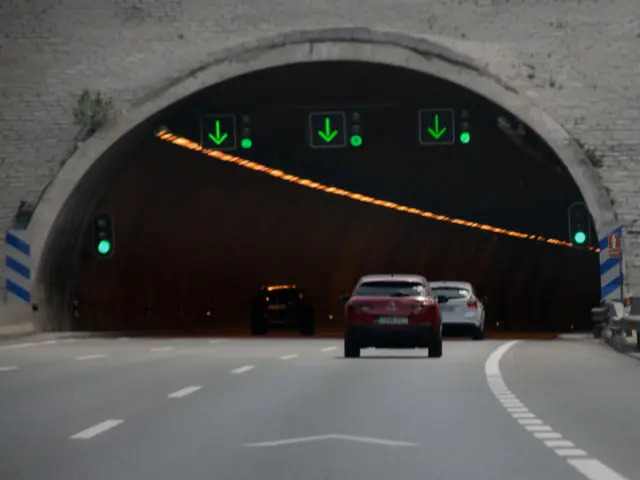
¿Puedes adelantar dentro de un túnel con más de un carril para cada sentido de la circulación?
Can you overtake inside a tunnel with more than one lane in each direction?
- ASí, pero solo dentro de poblado.Yes, but only in built-up areas.
- BNo, está prohibido.No, it is prohibited.
- CSí, cuando no hay señales que prohíban adelantar.Yes, when there are no signs prohibiting overtaking.
ExplanationArticle 87 of the General Traffic Regulations (RGC) prohibits overtaking in tunnels and underpasses only when there is a single lane in your own direction. If there is more than one lane in each direction, you may overtake, unless a sign or road marking prohibits it.
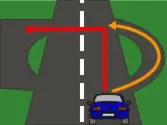
Para efectuar el cambio de dirección hacia la izquierda, ¿cuál será la trayectoria correcta que deberá tomar el vehículo de la imagen?
To turn left, what is the correct path for the vehicle in the picture?
- ALa trayectoria de color rojo.The red path.
- BLa trayectoria de color amarillo.The yellow path.
- CLas dos trayectorias son correctas.Both paths are correct.
ExplanationAs the road has a turning loop (raqueta) for turning left, we must follow the yellow path, using the loop. If the road were not set up like this, the red path would be correct.
El conductor de una bicicleta que adelanta fuera de poblado a otro vehículo, ¿tiene alguna obligación?
Does a cyclist overtaking another vehicle outside built-up areas have any obligation?
- ASí, mantener una distancia lateral no inferior a 1,50 metros.Yes, to keep a side distance of at least 1.50 metres.
- BNo, siempre y cuando el adelantamiento se realice con seguridad.No, as long as the overtaking is done safely.
- CNo, la distancia lateral mínima de 1,50 metros solo se aplica circulando dentro de poblado.No, the minimum side distance of 1.50 metres only applies in built-up areas.
ExplanationThe rider of a two-wheeled vehicle overtaking any other vehicle outside built-up areas must keep a safe side distance of at least 1.50 metres.
Si queremos girar para entrar en otra vía y hay animales cruzándola...
If you want to turn into another road and there are animals crossing it...
- ADebemos cederles el paso.You must give way to them.
- BNo tendrán prioridad si no está señalizada como cañada.They do not have priority if it is not signed as a livestock route (cañada).
- CTendrán prioridad de paso sólo si van en grupo.They have right of way only if they are in a group.
ExplanationWhen you are going to turn into another road and there are animals crossing it, they have priority even if there is no crossing for them (Article 66.1.b of the General Traffic Regulations). They also have priority on signed livestock routes (cañadas) and when you cross a hard shoulder along which animals are moving where there is no livestock route.
Nuestra motocicleta posee un caballete central. ¿Qué debemos tener en cuenta cuando la estacionemos?
Our motorcycle has a centre stand. What should we bear in mind when parking it?
- AQue el terreno esté nivelado.That the ground is level.
- BNo tendremos nada en cuenta.We do not need to bear anything in mind.
- CQue sea un terreno con pendiente.That the ground is sloping.
ExplanationWe must make sure the ground is level when parking our motorcycle on its centre stand, to keep it stable and stop it from falling over. If the ground is sloping, there is a risk that the motorcycle will lose its balance and fall, which can cause damage to the motorcycle and to people or vehicles nearby. So it is important to find level ground to park our motorcycle correctly.
Como norma general, en una vía interurbana la parada y el estacionamiento se harán:
As a general rule, on a road outside built-up areas, stopping and parking will be done:
- Asiempre fuera de la calzada, en el lado derecho de la misma y dejando libre la parte transitable del arcén.always off the carriageway, on its right-hand side and leaving the usable part of the hard shoulder free.
- Ben el arcén, cuando sea transitable y suficiente.on the hard shoulder, when it is usable and wide enough.
- Csiempre en el arcén.always on the hard shoulder.
ExplanationAccording to Article 90 of the General Traffic Regulations (RGC), on roads outside built-up areas stopping and parking must always be done off the carriageway, on the right-hand side, leaving the usable part of the hard shoulder free. This keeps road users safe, avoiding obstructions and possible accidents. The correct option makes sure this rule is followed, avoiding the risk of obstructing traffic.
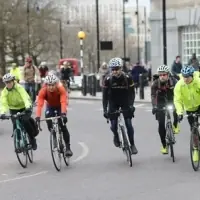
¿Se puede adelantar si circulan ciclistas en sentido contrario?
Can you overtake if cyclists are coming in the opposite direction?
- ASí, pegado al borde derecho de la calzada.Yes, keeping close to the right-hand edge of the carriageway.
- BNo, porque puede ponerlos en peligro.No, because you may put them in danger.
- CSí, extremando la precaución.Yes, taking extreme care.
ExplanationIt is prohibited to overtake if this puts in danger or obstructs those coming in the opposite direction, even if they are on the hard shoulder (Article 85.4 of the General Traffic Regulations). If cyclists are coming towards you, you must wait until they have passed before overtaking.
Si observo que voy a ser adelantado, ¿qué debo hacer?
If I see that I am about to be overtaken, what must I do?
- ACeñirme al lado derecho de la calzada.Keep close to the right-hand side of the carriageway.
- BDisminuir la velocidad.Slow down.
- CPoner el intermitente de la derecha.Switch on the right indicator.
ExplanationArticle 86 of the General Traffic Regulations (RGC) requires a driver about to be overtaken to keep close to the right-hand edge of the carriageway and prohibits them from speeding up. They do not have to brake, unless danger arises, or switch on the right indicator.
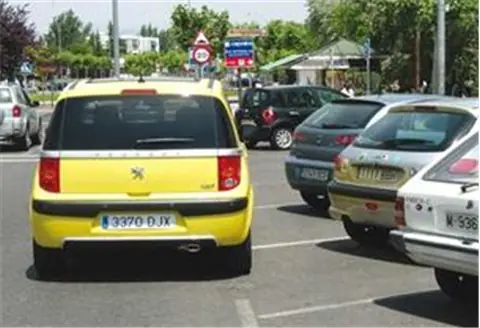
Un conductor ha estacionado su vehículo en doble fila, ¿ha actuado correctamente?
A driver has double-parked their vehicle. Have they acted correctly?
- ASí, siempre que el vehículo no suponga un obstáculo ni un peligro para otros usuarios.Yes, as long as the vehicle is not an obstacle or a danger for other road users.
- BSólo si deja encendidas la luces de emergencia.Only if they leave the hazard warning lights on.
- CNo, porque está prohibido estacionar en doble fila.No, because double parking is prohibited.
ExplanationArticle 94 of the General Traffic Regulations prohibits double parking in all cases, even if the vehicle does not seem to be in the way or the hazard warning lights are on. A vehicle parked like this reduces the usable carriageway and forces others to manoeuvre.
Va a girar a la derecha y lo indica con el intermitente. ¿Cuánto tiempo hay que mantenerlo encendido?
You are going to turn right and signal it with your indicator. How long must you keep it on?
- AHasta estar seguro de que el vehículo que viene detrás ha visto la señal.Until you are sure the vehicle behind has seen the signal.
- BHasta que finalice la maniobra.Until the manoeuvre is completed.
- CEl menor tiempo posible.For as short a time as possible.
ExplanationVisual warnings must be given well in advance and, if they are light signals, they must stay on until the manoeuvre is finished (Article 109.1 of the General Traffic Regulations (RGC)). So the indicator stays on until the turn is completed.
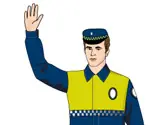
Este agente obliga a detenerse a...
Who does this traffic officer require to stop?
- ALos vehículos que se acercan de frente al agente, solamente.Only vehicles approaching the officer from the front.
- BLos vehículos que se acercan de frente al agente y por su espalda, solamente.Only vehicles approaching the officer from the front and from behind.
- CTodos los usuarios que se acerquen a él.All road users approaching the officer.
ExplanationThis traffic officer requires all road users approaching them to stop, whether from the front, from behind or from the sides.
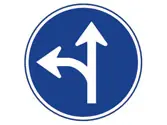
¿Se podrá efectuar un cambio de sentido en la intersección así señalizada?
Can you make a U-turn at a junction marked like this?
- ASí.Yes.
- BNo.No.
- CSí, si no se aproximan vehículos en sentido contrario.Yes, if no vehicles are approaching in the opposite direction.
ExplanationThe arrows show the only directions that vehicles may take. At a junction marked like this you may turn left, but you are not allowed to turn right or to make a U-turn.
Si en una calle cortada no podemos seguir de frente ni cambiar de sentido o dirección...
If, in a closed street, we cannot go straight on, make a U-turn or turn...
- APodemos circular marcha hacia atrás como máximo 15 metros.We can reverse for a maximum of 15 metres.
- BNo podemos invadir un cruce de vías.We cannot enter a road junction.
- CPodemos retroceder la distancia necesaria para salir de la calle.We can reverse as far as necessary to get out of the street.
ExplanationIf there is no other way to get out of a closed street, we may reverse the distance needed to get out of it.
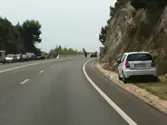
El vehículo que se observa en la parte derecha de la fotografía, ¿está correctamente estacionado?
Is the vehicle on the right of the photograph parked correctly?
- ASí, siempre que el estacionamiento dure menos de dos minutos.Yes, as long as the parking lasts less than two minutes.
- BSí, porque se encuentra fuera de la zona transitable del arcén.Yes, because it is off the usable part of the hard shoulder.
- CNo, porque obstaculiza.No, because it is in the way.
ExplanationAs a general rule, stopping or parking on roads outside built-up areas must always be done off the carriageway, on its right-hand side and leaving the usable part of the hard shoulder free. In built-up areas, on urban roads, it is done on the carriageway and on the hard shoulder, even if it is usable, as long as a free space of at least 3 m is left.
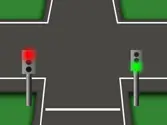
En esta vía, deben obedecer sólo a las indicaciones situadas a su izquierda los que pretendan...
On this road, the drivers who must obey only the signals on their left are those who intend to...
- Aseguir de frente o girar a la derecha.go straight on or turn right.
- Bgirar a la izquierda o seguir de frente.turn left or go straight on.
- Cgirar a la izquierda solamente.turn left only.
ExplanationWhen there are traffic lights showing different signals on the right and on the left, a driver who intends to turn left or go straight on must only obey the lights immediately to their left. Those who intend to turn right will follow the traffic light on the right.
Si va a girar en una intersección, ¿cómo debe avisar a los demás conductores?
If you are going to turn at a junction, how must you warn other drivers?
- ASolo con los intermitentes.Only with the indicators.
- BCon los intermitentes o con la mano.With the indicators or by hand.
- CCon la mano o con la bocina.By hand or with the horn.
ExplanationThe sideways move of a turn is signalled with the indicator on the corresponding side or with the arm (Article 109.2 of the General Traffic Regulations). The horn is not used to indicate a turn: it is only used exceptionally, for example to avoid an accident.
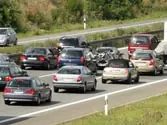
Si un vehículo te sobrepasa estando en esta situación, ¿se considera un adelantamiento?
If a vehicle goes past you in this situation, is it considered overtaking?
- ANo, es un rebasamiento.No, it is passing.
- BNo.No.
- CSí, es un adelantamiento.Yes, it is overtaking.
ExplanationIn these circumstances, the fact that one lane moves faster than another is not considered overtaking, nor passing.
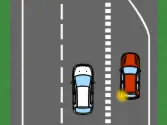
El turismo blanco, ¿tiene alguna obligación?
Does the white car have any obligation?
- ASí, deberá detenerse para que el vehículo rojo pueda incorporarse.Yes, it must stop so that the red vehicle can join.
- BSí, deberá facilitar, en la medida de lo posible, la incorporación del vehículo rojo.Yes, as far as possible, it must make it easier for the red vehicle to join.
- CNo tiene ninguna obligación.It has no obligation.
ExplanationA driver on the motorway (autopista) or dual carriageway (autovía) has priority over a driver entering from the acceleration lane, but must, as far as possible, make it easier for them to join, by changing lanes or reducing speed slightly (Article 73.1 of the General Traffic Regulations).
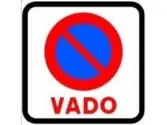
¿Está prohibido estacionar delante de un vado señalizado reglamentariamente?
Is it forbidden to park in front of a properly signed vehicle entrance (vado)?
- ASí.Yes.
- BNo, si el conductor permanece dentro del vehículo.No, if the driver stays inside the vehicle.
- CNo.No.
ExplanationThe vehicle entrance (vado) sign prohibits parking but allows stopping.
¿Para qué sirve la cámara de marcha atrás instalada en el vehículo?
What is a reversing camera fitted to the vehicle for?
- ASustituir la obligación de mirar por los espejos.To replace the obligation to look in the mirrors.
- BOfrecer una visión nítida y en tiempo real de la zona situada detrás del vehículo.To give a clear, real-time view of the area behind the vehicle.
- CPermitir conducir más de 15 metros para realizar el estacionamiento.To allow you to drive more than 15 metres in reverse to park.
ExplanationA reversing camera shows the area behind the vehicle in real time so that you can detect obstacles or people. It is an aid: it does not replace the mirrors or checking directly, and it does not change the 15-metre limit for reversing as part of parking.
Al estacionar un turismo con remolque en una pendiente ascendente, su conductor, si no dispones de calzos, está obligado…
When parking a car with a trailer on an uphill slope, if you do not have wheel chocks, the driver is required…
- AA apoyar una de las ruedas delanteras en el bordillo, orientada hacia la calzada.To rest one of the front wheels against the kerb, turned towards the carriageway.
- BA utilizar como calzos elementos naturales.To use natural objects as chocks.
- CÚnicamente a dejar embragada la primera velocidad.Only to leave it in first gear.
ExplanationCombinations of vehicles parked on a noticeable slope must be secured with chocks or by resting a steering wheel against the kerb, turned towards the centre of the carriageway if the slope is uphill (Article 92 of the General Traffic Regulations). It is prohibited to use stones or other objects not intended for this purpose.
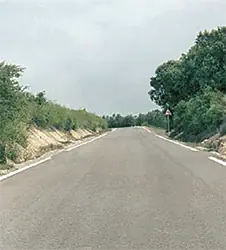
Para girar a la izquierda en una vía en la que no hay marca que separe los dos sentidos de circulación, ¿dónde debe situarse?
To turn left on a road with no marking separating the two directions of traffic, where must you position yourself?
- AObligatoriamente en el arcén, para realizar la maniobra desde allí.On the hard shoulder, as a requirement, to make the manoeuvre from there.
- BEn el centro de la calzada, invadiendo parte del sentido contrario si es preciso.In the centre of the carriageway, moving partly into the opposite direction if necessary.
- CJunto al eje de la calzada, sin invadir el sentido contrario.Next to the centre line of the carriageway, without moving into the opposite direction.
ExplanationIf there is no marking separating the directions, to turn left you must keep close to the centre line of the carriageway, that is, move as close as possible to the centre without moving into the opposite direction.
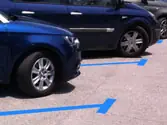
En caso de no disponer del tiquet que acredita haber pagado en una zona de estacionamiento con limitación de horario, ¿podrán los agentes proceder a la inmovilización del vehículo?
If you do not have the ticket showing that you have paid in a time-limited parking zone, may the police immobilise the vehicle?
- ASí.Yes.
- BNo.No.
- CSolo si el vehículo entorpece gravemente la circulación.Only if the vehicle seriously obstructs traffic.
ExplanationWhen a vehicle has no ticket or exceeds the time allowed, it may be immobilised until its driver is identified.
¿En algún caso se podrá efectuar un adelantamiento por la derecha?
Can you ever overtake on the right?
- ANo en ningún caso.No, never.
- BSí, en poblado con al menos dos carriles en el mismo sentido estando estos delimitados.Yes, in built-up areas with at least two lanes in the same direction, marked out.
- CSí, siempre que sea en poblado.Yes, as long as it is in a built-up area.
ExplanationOvertaking on the right is allowed when overtaking a tram running in the central area of a two-way road, when the driver you want to overtake signals that they intend to turn left, or in built-up areas if there are at least two lanes in the same direction separated by longitudinal markings.
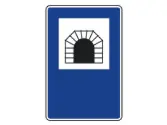
¿Está permitido cambiar el sentido de la marcha en un túnel?
Is it allowed to make a U-turn in a tunnel?
- ASí, salvo que no exista suficiente visibilidad.Yes, unless there is not enough visibility.
- BSí, cuando no esté expresamente prohibido.Yes, when it is not expressly prohibited.
- CNo.No.
ExplanationA U-turn is prohibited in any situation where you cannot check that you will not endanger or obstruct other road users, for example on bends and brows of hills with reduced visibility, or in fog or heavy rain. A U-turn is also prohibited: - On level crossings (it is not prohibited near them). - In tunnels, underpasses and stretches of road covered by the 'Tunnel' sign. - On motorways (autopistas) and dual carriageways (autovías), except in the places provided for it. - On one-way carriageways and stretches of road. - On all stretches of road where overtaking is prohibited, unless the U-turn is expressly allowed.
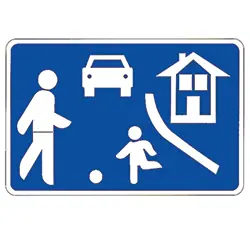
¿Está permitido estacionar en las calles residenciales?
Is it allowed to park in residential streets?
- ANo, excepto en los lugares señalizados.No, except in the marked places.
- BNo, excepto en horas nocturnas.No, except at night.
- CSí, en cualquier lugar de la vía.Yes, anywhere on the road.
ExplanationIn residential streets the space is shared with pedestrians and children playing: parking is only allowed in places expressly marked for it.
Al incorporarse a la circulación dando marcha atrás, ¿se puede invadir un cruce?
When joining traffic by reversing, may you go into a junction?
- ASí, siempre que no se recorran más de 15 metros.Yes, provided you do not cover more than 15 metres.
- BSí, si se siguen las indicaciones de otra persona.Yes, if you follow another person's directions.
- CNo.No.
ExplanationNo. Under Article 80.2 of the RGC, reversing as a manoeuvre that complements stopping, parking or joining traffic may not exceed 15 metres or go into a junction, even if another person is giving directions.
¿Se puede parar en el carril de autobuses?
May you stop in a bus lane?
- ANo.No.
- BSí, si es por menos de 2 minutos.Yes, if it is for less than 2 minutes.
- CSí, si usa las luces de emergencia.Yes, if you use the hazard warning lights.
ExplanationNo. Article 94 of the RGC prohibits stopping in lanes for the exclusive use of urban public transport and in lanes reserved for certain users, even briefly or with the hazard warning lights on.
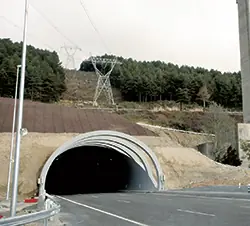
¿Cuándo está prohibido adelantar en los túneles?
When is overtaking prohibited in tunnels?
- ACuando solo existe un carril para cada sentido.When there is only one lane in each direction.
- BCuando existe más de un carril para cada sentido.When there is more than one lane in each direction.
- CCuando el túnel no está iluminado.When the tunnel is not lit.
ExplanationIn tunnels and underpasses overtaking is prohibited when there is only one lane in each direction, because it would mean moving into the opposite direction in an enclosed place, with no side visibility or escape route.
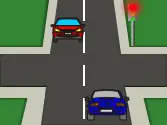
A la vista del semáforo en rojo, ¿el coche azul podrá cambiar de dirección hacia la derecha?
With the traffic light on red, may the blue car turn right?
- ASí, no podrá seguir de frente pero sí podrá cambiar de dirección tanto a la derecha como a la izquierda.Yes; it may not go straight on, but it may turn either right or left.
- BNo.No.
- CSí, si antes cede el paso a los peatones que crucen.Yes, if it first gives way to pedestrians crossing.
ExplanationEven though the traffic light is on the far side of the junction, it must be obeyed in the same way as if it were before the junction. So the vehicle must stop before entering the junction and wait until the light allows it through.
¿En cuál de estos lugares está prohibida la parada?
In which of these places is stopping prohibited?
- AEn las proximidades de un paso para peatones.Near a pedestrian crossing.
- BEn las zonas señalizadas para uso exclusivo de personas con discapacidad.In areas marked for the exclusive use of people with disabilities.
- CEn todas las intersecciones.At all junctions.
ExplanationStopping and parking are prohibited in areas marked for the exclusive use of people with disabilities (article 94.1.j of the General Traffic Regulations). You may stop near a pedestrian crossing, and at a junction if you do not make it difficult for other vehicles to turn.
Un vehículo le está adelantando y no puede completar la maniobra con seguridad. ¿Qué debe hacer?
A vehicle is overtaking you and cannot complete the manoeuvre safely. What should you do?
- AAumentar la velocidad para evitar el adelantamiento.Speed up to prevent the overtaking.
- BMantener su trayectoria y velocidad, no intentar ayudar al que adelanta.Keep your course and speed, and not try to help the overtaking driver.
- CFacilitar que termine la maniobra de adelantamiento (reducir la velocidad y, si es seguro, dejar espacio).Help them finish the overtaking manoeuvre (slow down and, if it is safe, leave space).
ExplanationThe driver being overtaken may not speed up or hinder the overtaking, and if a dangerous situation arises during the manoeuvre they must reduce their speed (Article 86.2 of the General Traffic Regulations), making it easier for the other driver to finish or return to their lane.
Al estacionar un turismo en pendiente ascendente, su conductor deberá ...
When parking a car on an uphill slope, the driver must...
- Adejar seleccionada la marcha atrás.leave it in reverse gear.
- Bdejar accionado el freno de estacionamiento.leave the parking brake on.
- Capoyar una rueda delantera en el bordillo y orientarla hacia fuera de la calzada.rest a front wheel against the kerb and turn it away from the carriageway.
ExplanationWhen parking a car you must switch off the engine, leave the parking brake on and, on an uphill slope, leave it in first gear (Article 92.3 of the General Traffic Regulations, RGC). Reverse gear is used on a downhill slope, and uphill the wheel is turned towards the centre of the carriageway.
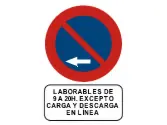
¿Podrá estacionar su vehículo a las 7 horas?
Can you park your vehicle at 7:00?
- ANo.No.
- BNo podré estacionar pero sí parar.I cannot park, but I can stop.
- CSí.Yes.
ExplanationThe sign prohibits parking from 9:00 to 20:00, except for loading and unloading, so at 7:00 we can park.
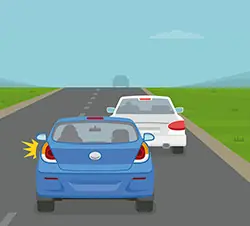
Un conductor que señaliza un cambio de carril, ¿tiene preferencia sobre los conductores de los vehículos que circulan por el carril al que se pretende desplazar?
Does a driver who signals a lane change have priority over drivers of vehicles travelling in the lane they want to move into?
- ASí.Yes.
- BNo.No.
- CSólo si va a adelantar a un vehículo de grandes dimensiones.Only if they are going to overtake a large vehicle.
ExplanationSignalling a manoeuvre does not give priority: the driver changing lane must give way to vehicles already travelling in the lane they are moving into, and only move over when this does not force them to change speed or course.
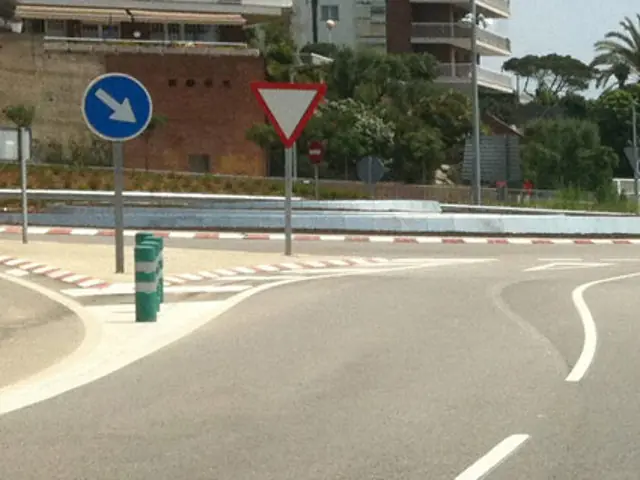
¿Podemos girar a la izquierda al llegar a la intersección que se muestra en la imagen?
May we turn left when we reach the junction shown in the picture?
- ASí.Yes.
- BNo.No.
- CNo, la señal azul obliga a girar a la derecha.No, the blue sign requires you to turn right.
ExplanationThe blue sign with the diagonal arrow is a compulsory direction sign: it shows which side of the traffic island you must pass, in this case on the right. It does not require you to turn right or forbid turning left at the junction, where you will only have to give way as shown by the triangular sign.
Si un vehículo se incorpora a la circulación saliendo de un estacionamiento, ¿se le debe facilitar la incorporación?
If a vehicle is joining the traffic from a parking space, should you make it easier for it to join?
- ANo, solo a los autobuses.No, only for buses.
- BNo, solo a los autobuses y taxis.No, only for buses and taxis.
- CSí, a todos.Yes, for all vehicles.
ExplanationWe must make it easier, as far as possible, for all vehicles joining the traffic.
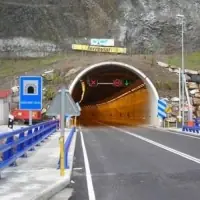
¿Está permitido el adelantamiento en un túnel?
Is overtaking allowed in a tunnel?
- ASí, si existe más de un carril para cada sentido de la marcha.Yes, if there is more than one lane in each direction.
- BSí, si los dos sentidos de la marcha están separados.Yes, if the two directions of traffic are separated.
- CNo.No.
ExplanationIn tunnels with only one lane in each direction, overtaking is prohibited. It is only allowed if there is more than one lane for your own direction of traffic, and then without moving into the opposite direction. Having the directions separated is not enough if there is only one lane.
Si circulando por una carretera convencional advertimos que el vehículo que nos sigue tiene la intención de adelantarnos, ¿cómo actuaremos?
If, while driving on a conventional road, we notice that the vehicle behind intends to overtake us, what will we do?
- ANos ceñiremos lo máximo posible al borde derecho de la calzada.We will keep as close as possible to the right-hand edge of the carriageway.
- BReduciremos la velocidad.We will slow down.
- CPondremos el intermitente de la derecha.We will switch on the right indicator.
ExplanationA driver who notices that a vehicle behind intends to overtake must keep close to the right-hand edge of the carriageway.
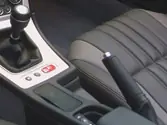
Cuando se estaciona el vehículo en una pendiente ascendente es obligatorio dejar...
When parking the vehicle on an uphill slope, you must leave...
- Ael freno de estacionamiento accionado, únicamente.only the parking brake on.
- Baccionado el freno de estacionamiento y colocada la primera velocidad.the parking brake on and first gear engaged.
- Ccolocada la marcha atrás y el freno de estacionamiento accionado.reverse gear engaged and the parking brake on.
ExplanationWhen parking on uphill slopes, as well as leaving the parking brake on, we must leave first gear engaged. On downhill slopes, we will leave the parking brake on and reverse gear engaged.
El intermitente derecho se usa para indicar...
The right indicator is used to show...
- Acambio de sentido.a U-turn.
- Bgiro a la izquierda.a left turn.
- Cmaniobra lateral hacia la derecha.a sideways manoeuvre to the right.
ExplanationThe right indicator is used to show a sideways movement to the right. According to Article 109 of the General Traffic Regulations (RGC), the driver must use visual signals to warn of any manoeuvre involving moving sideways, switching on the indicator on the side they are going to move to. So if a driver is going to move to the right, they must switch on the right indicator to tell other drivers that they intend to change lane or turn to that side.
¿Se permite adelantar si al hacerlo se dificulta la circulación de ciclistas?
Is overtaking allowed if doing so makes it difficult for cyclists to ride?
- ASí, siempre que se haga con precaución y se avise a los ciclistas con tiempo.Yes, as long as it is done carefully and the cyclists are warned in good time.
- BSí, siempre, incluso si se pone en peligro a los ciclistas.Yes, always, even if it puts the cyclists in danger.
- CNo, está prohibido.No, it is prohibited.
ExplanationAccording to Article 85.4 of the General Traffic Regulations (RGC) (as worded by RD 518/2026), when overtaking cyclists you must take special care not to put them in any danger, and it is prohibited to overtake if this endangers or gets in the way of those coming from the opposite direction, even if they are travelling on the hard shoulder.
All topics
- Definitions
- Documents and penalty points
- The driver's condition
- Duties of drivers and pedestrians
- Vehicle safety devices
- Vehicle controls and equipment
- Vehicle lights and horn
- Traffic signs, markings and signals
- The road and its lanes
- Speed and distances
- Right of way
- Carrying passengers and loads
- Driving safely in difficult conditions
- Vehicle mechanics and maintenance
- Road accidents and first aid
- Defensive and eco-driving
Independent app: not affiliated with or endorsed by the DGT (Spain's Directorate-General for Traffic) or the Ministry of the Interior. The official exam is booked with the DGT and taken at its test centres. The questions here are practice material; the DGT's official question bank is not public.
Basado en datos de la Agencia Estatal Boletín Oficial del Estado (https://www.boe.es). Textos consolidados de carácter meramente informativo. La AEBOE no patrocina ni respalda este sitio.
Parte de las preguntas procede de los tests de la revista «Tráfico y Seguridad Vial» de la DGT, reproducidos con indicación de la fuente.