
DGT test · 982 questions
Manoeuvres · Page 13 of 20
Joining traffic, overtaking, turning, U-turns, reversing, stopping and parking: how and where to do them and when they are forbidden.
Questions in this topic, with answers
982 questions, 50 per page, with the correct answer and the explanation. Page 13 of 20.
¿Qué debe de tener en cuenta el conductor de una motocicleta antes de cambiar de carril?
What should a motorcyclist bear in mind before changing lane?
- AQue si circula a mucha velocidad puede ser difícil que el resto de usuarios de la vía adviertan el desplazamiento.That if they are going very fast, it may be hard for other road users to notice the sideways movement.
- BQue las motocicletas serán más fácilmente vistas si llevan todas sus luces encendidas.That motorcycles will be seen more easily if all their lights are on.
- CQue no será necesario indicar el desplazamiento con el indicador de dirección.That it will not be necessary to signal the movement with the indicator.
ExplanationIt is important for motorcycles to signal all manoeuvres in good time. The motorcyclist must make sure that other drivers have seen them, because motorcycles are smaller vehicles and can sometimes appear unexpectedly to others.
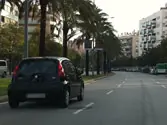
Antes de cambiar de carril, ¿cómo debe avisar?
Before changing lane, how must you warn others?
- ACon los indicadores de dirección.With the indicators.
- BCon el claxon.With the horn.
- CCon las luces de frenado.With the brake lights.
ExplanationWarnings must be given clearly, well before the manoeuvre starts, and, as a general rule, using the vehicle's lights or, if that is not possible, the arm. Warnings given with the vehicle's lights must stay on until the manoeuvre they announce is finished. If the driver's arm signal and the vehicle's light signal contradict each other, we must follow what the driver shows, because the lights may be faulty. Brake lights are used to show drivers behind us that the vehicle is braking or that we want to reduce speed considerably. Sound signals, that is the horn, may be used to avoid accidents, when on an emergency call, and on narrow roads with many bends, both on urban and non-urban roads. The horn can also be used to warn that you are overtaking, but only on roads outside built-up areas.
Si aparca su coche, deberá...
If you park your car, you must...
- Adejar la primera marcha puesta en pendientes descendentes.leave first gear engaged on downhill slopes.
- Bdejar la primera marcha puesta en pendientes ascendentes.leave first gear engaged on uphill slopes.
- Capoyar una de las ruedas delanteras en el bordillo de la acera.rest one of the front wheels against the kerb.
ExplanationWhen parking a vehicle on an uphill slope, the rule says that first gear must be left engaged. This is necessary to stop the vehicle from rolling backwards if the parking brake fails, which helps keep traffic safe. According to Article 92 of the General Traffic Regulations (RGC), when a vehicle is parked on an uphill slope, the driver must take precautions to stop it from moving by accident.
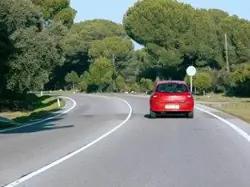
¿Está permitido adelantar en una curva o cambio de rasante de visibilidad reducida?
Is it allowed to overtake on a bend or at the brow of a hill with reduced visibility?
- ASí, moderando la velocidad.Yes, slowing down.
- BSí, si no hay señal que lo prohíba.Yes, if there is no sign prohibiting it.
- CNo, salvo si los dos sentidos están claramente delimitados y la maniobra puede efectuarse sin invadir el sentido contrario.No, unless the two directions are clearly marked out and the manoeuvre can be done without moving into the opposite direction.
ExplanationOvertaking is prohibited on bends and brows of hills with reduced visibility. However, in these cases overtaking is allowed when the two directions of traffic are clearly marked out and the manoeuvre can be done without moving into the area reserved for the opposite direction.
Si aparca en una pendiente descendente, ¿en qué marcha debe dejar el coche?
If you park on a downhill slope, which gear should you leave the car in?
- ANinguna, solo el freno de mano.None, just the handbrake.
- BMarcha atrás.Reverse.
- CPrimera marcha.First gear.
ExplanationWhen parking on a downhill slope you must leave the car in reverse gear, as well as applying the parking brake (Article 92.3 of the General Traffic Regulations). Going downhill, the car tends to roll forwards, and reverse gear resists that movement; uphill, you leave it in first.
¿Está prohibido adelantar en las rotondas?
Is overtaking prohibited at roundabouts?
- ASí, porque son intersecciones.Yes, because they are junctions.
- BSí, solo en vías interurbanas.Yes, only on interurban roads.
- CNo.No.
ExplanationAlthough overtaking is prohibited at and near junctions, the RGC expressly makes an exception for roundabouts (Article 87.1.c of the RGC). So you may overtake within a roundabout if you do it safely.
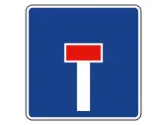
Si estamos en una calle sin salida y no existe ninguna otra posibilidad, ¿cuántos metros podemos circular marcha atrás?
If you are in a dead-end street and there is no other option, how many metres may you reverse?
- AMenos de 15 metros.Less than 15 metres.
- BJusto hasta la primera intersección sin invadirla.Only up to the first junction, without entering it.
- CLos suficientes para salir de la calle, aun invadiendo un cruce de vías.As many as you need to leave the street, even if it means entering a junction.
ExplanationWhen it is not possible to go forwards or turn round, as in a dead-end street, you may reverse, covering the shortest distance needed. In that case the 15-metre limit and the ban on entering a junction do not apply, as they are for reversing as part of another manoeuvre (Article 80 of the General Traffic Regulations).
Está prohibido parar y estacionar en el interior de un túnel porque:
Stopping and parking inside a tunnel is prohibited because:
- ASupone un grave peligro y dificulta la evacuación.It is a serious danger and makes evacuation harder.
- BSolo por estética.Only for appearance.
- CNo está prohibido.It is not prohibited.
ExplanationStopping in a tunnel (except in an emergency) is very dangerous: it reduces visibility and gets in the way if there is an incident.
Si no existen señales que lo prohíban, en una vía urbana de sentido único se podrá parar o estacionar ...
If there are no signs prohibiting it, on a one-way urban road you may stop or park...
- ASólo en el lado derecho.Only on the right-hand side.
- BSólo en el lado izquierdo.Only on the left-hand side.
- CEn ambos lados.On both sides.
ExplanationWhere you must stop and park: - On urban roads: on the carriageway and on the hard shoulder, even if it is usable, as long as a free space of at least 3 metres is left. - On both sides, if the road is one-way. - Only on the right-hand side, if the road is two-way. - On roads outside built-up areas: off the carriageway and off the usable part of the hard shoulder. - Only on the right-hand side, even if the road is one-way.
¿Se puede parar en doble fila en vía urbana?
In a built-up area, can you stop double-parked (next to vehicles already at the kerb)?
- ASí, en cualquier caso, aunque haya sitio junto al borde de la calzada.Yes, in any case, even if there is space next to the edge of the carriageway.
- BNo, nunca.No, never.
- CSí, si no hay espacio en las proximidades.Yes, if there is no space nearby.
ExplanationIn a built-up area you must stop as close as possible to the right-hand edge, or also to the left-hand edge if the street is one-way (Article 90.2 of the General Traffic Regulations). Only if there is no space nearby may you stop double-parked; parking double-parked is always prohibited.
¿Está permitido realizar una parada en un vado debidamente señalizado?
Is it allowed to stop in front of a properly marked vehicle entrance?
- ANo.No.
- BSí.Yes.
- CSolamente para que puedan subir o bajar pasajeros.Only to let passengers get in or out.
ExplanationIn front of a properly marked vehicle entrance, parking is prohibited, but stopping is allowed.
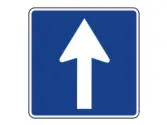
¿Podemos cambiar de dirección hacia la derecha?
May we turn right?
- ASí.Yes.
- BSí, pero solo en las intersecciones con semáforo.Yes, but only at junctions with traffic lights.
- CNo.No.
ExplanationThis sign shows that the carriageway is one-way. It only prohibits changing the direction of travel (a U-turn); it does not prohibit turning. Turning would be prohibited if the sign were a compulsory direction sign.
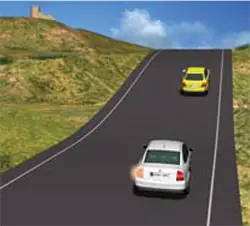
En este cambio de rasante de reducida visibilidad, ¿puede adelantar el vehículo blanco al amarillo?
At this brow of a hill with reduced visibility, can the white vehicle overtake the yellow one?
- ASí, porque no hay señalización expresa que lo prohíba.Yes, because there is no sign expressly prohibiting it.
- BNo, porque para ello debe ocupar parte de la calzada que corresponde al sentido contrario.No, because to do so it must use part of the carriageway for the opposite direction.
- CSí, porque lo ha señalizado convenientemente.Yes, because it has signalled properly.
ExplanationAt a brow of a hill with reduced visibility, overtaking is prohibited if you have to use the lane for the opposite direction, because you cannot check that it is clear for the whole distance needed.
¿Está permitido ir marcha atrás más de quince metros para incorporarse a la circulación?
Is it permitted to reverse more than fifteen metres to join traffic?
- ASí, en cualquier caso.Yes, in any case.
- BNo.No.
- CSí, siempre que no entres en un cruce.Yes, provided you do not enter a junction.
ExplanationReversing as a manoeuvre that complements joining traffic, stopping or parking may not exceed 15 metres or go into a junction (Article 80.2 of the RGC). Only when it is impossible either to go forward or to turn round is the minimum necessary distance allowed, even if it is longer.
Un vehículo circula por el carril izquierdo. ¿Se puede adelantar por la derecha?
A vehicle is travelling in the left-hand lane. Can it be overtaken on the right?
- ANo, siempre se debe adelantar por la izquierda.No, you must always overtake on the left.
- BSí, cuando hay varios carriles en el mismo sentido.Yes, when there are several lanes in the same direction.
- CSí, cuando los carriles están marcados y la vía está en una zona urbana.Yes, when the lanes are marked and the road is in an urban area.
ExplanationIn Spain, overtaking on the right is generally prohibited. According to Article 82 of the Traffic Regulations, overtaking must be done on the left. However, there is an exception: on urban roads, when the lanes are clearly marked out by road markings, overtaking on the right is allowed. This is because in urban areas vehicles can move at different speeds in different lanes, which helps traffic flow.
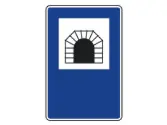
¿Podrá usted adelantar en un túnel?
May you overtake in a tunnel?
- ANo, en ningún caso.No, never.
- BSí, a vehículos de dos ruedas.Yes, two-wheeled vehicles.
- CSí, cuando se disponga de más de un carril en el mismo sentido de circulación del vehículo al que se pretende adelantar.Yes, when there is more than one lane in the direction of travel of the vehicle you intend to overtake.
ExplanationOvertaking is prohibited in tunnels, underpasses and stretches with the «Tunnel» sign where there is only one lane for the direction of travel (article 87.1.d of the General Traffic Regulations). If there is more than one lane in that direction, you may overtake.
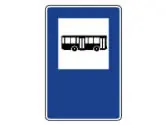
En una parada de autobús señalizada, ¿qué está prohibido?
At a marked bus stop, what is prohibited?
- AEstacionar.Parking.
- BCircular sobre ella.Driving over it.
- CAdelantar cerca de ella.Overtaking near it.
ExplanationStopping and parking are prohibited in lanes or parts of the road reserved exclusively for certain users, such as urban public transport (bus lane, bus stop and taxi rank).
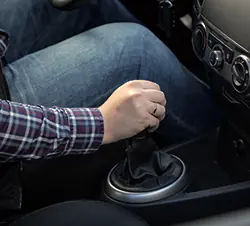
Si su vehículo está provisto de caja de cambios manual, en una calle con pendiente ascendente, ¿cómo debe estacionar?
If your vehicle has a manual gearbox, how must you park on an uphill street?
- APoniendo el freno de estacionamiento y la primera velocidad.By applying the parking brake and engaging first gear.
- BPoniendo el freno de estacionamiento y la marcha atrás.By applying the parking brake and engaging reverse gear.
- CBasta con poner el freno de estacionamiento.Applying the parking brake is enough.
ExplanationOn an uphill slope you leave first gear engaged (the gear for the direction of travel up the slope), as well as the parking brake: if the brake fails, engine compression holds the vehicle.
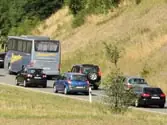
Cuando exista mucha densidad de circulación el hecho de que los vehículos que circulen por un carril lo hagan más rápidamente que los de otro carril, ¿se considera un adelantamiento?
In very heavy traffic, is it considered overtaking when vehicles in one lane move faster than those in another lane?
- ASí, y está prohibido.Yes, and it is prohibited.
- BNo, y está prohibido.No, and it is prohibited.
- CNo se considera un adelantamiento y está permitido.It is not considered overtaking, and it is allowed.
ExplanationWhen traffic is so heavy that it takes up the whole width of the carriageway and you can only drive at a speed that depends on the vehicles in front, the fact that one lane moves faster than another is not considered overtaking. Nor is it considered passing, as the vehicles being passed are not stationary.
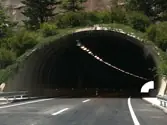
¿En un túnel podemos efectuar un adelantamiento?
Can we overtake in a tunnel?
- ANo, en ningún caso.No, never.
- BSí, si no invadimos el sentido contrario y disponemos de más de un carril en nuestro sentido.Yes, if we do not move into the opposite direction and have more than one lane in our direction.
- CSí, si las circunstancias de la circulación lo permiten.Yes, if traffic conditions allow it.
ExplanationAs a general rule, overtaking is prohibited in tunnels, underpasses and stretches of road covered by the tunnel sign, unless we have more than one lane in our direction and we do not move into the opposite direction.
En un carril Bus con líneas discontinuas ¿Un vehículo podrá parar?
In a bus lane marked with broken lines, may a vehicle stop?
- ANoNo
- BSí.Yes.
- CSI, en un tiempo inferior a los 2 minYes, for less than 2 minutes
ExplanationArticle 94 of the General Traffic Regulations forbids stopping in lanes reserved for certain users, such as a bus lane. A broken line only allows you to cross it to manoeuvre, for example to turn, but not to stop in the lane, not even for a moment.
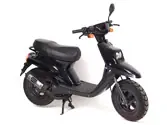
Si un ciclomotor pretende girar hacia la izquierda en una vía interurbana y no existe carril expresamente acondicionado para ello, ¿desde dónde deberá iniciar dicho cambio de dirección?
If a moped wants to turn left on a road outside built-up areas and there is no lane specially set up for it, where must it start the turn from?
- ADesde el centro de la calzada, sin invadir el sentido contrario.From the centre of the carriageway, without moving into the opposite direction.
- BDesde el lado derecho de la calzada.From the right-hand side of the carriageway.
- CDesde el lado derecho, fuera de la calzada siempre que sea posible.From the right-hand side, off the carriageway whenever possible.
ExplanationOn roads outside built-up areas, if there is no lane specially set up for turning left, mopeds must position themselves on the right, off the carriageway whenever possible, and start the manoeuvre from there.
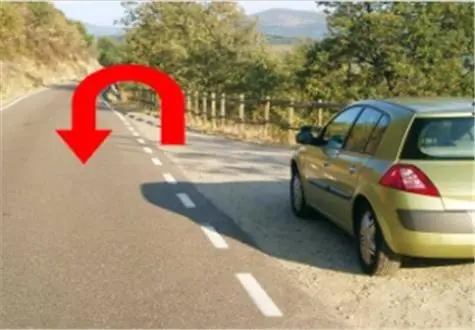
Si pretende cambiar el sentido de la marcha, debe cerciorarse de que...
If you intend to make a U-turn, you must make sure that...
- Ase encuentra en una vía urbana, ya que es una maniobra prohibida fuera de poblado.you are on an urban road, because this manoeuvre is prohibited outside built-up areas.
- Bpuede hacerlo sin poner en peligro ni obstaculizar a otros usuarios.you can do it without endangering or obstructing other road users.
- Cno haya ningún otro usuario de la vía a menos de 100 metros de distancia.there are no other road users within 100 metres.
ExplanationBefore making a U-turn, you must check that it can be done without endangering or obstructing other road users, and signal the manoeuvre. It is not prohibited outside built-up areas in general, only in specific places such as tunnels, level crossings or stretches where overtaking is prohibited.
El conductor de la furgoneta, ¿puede parar en doble fila para descargar?
May the van driver stop double-parked to unload?
- ANo, está prohibido.No, it is prohibited.
- BSí, excepcionalmente y respetando las normas sobre paradas.Yes, exceptionally and following the rules on stopping.
- CSí, durante el tiempo que necesite.Yes, for as long as needed.
ExplanationLoading and unloading is done off the road; only exceptionally, when it is unavoidable, may it be done on the road, following the rules on stopping and without causing danger (Article 16 of the General Traffic Regulations). You may stop double-parked, but not park (Article 94.2.g).
¿Se podrá adelantar en un paso para peatones?
May you overtake on a pedestrian crossing?
- ANo.No.
- BSí.Yes.
- CSí, si se circula a velocidad muy reducida.Yes, if driving at a very low speed.
ExplanationUnder Article 87.1.b of the General Traffic Regulations (RGC), as worded by Royal Decree 518/2026, overtaking is prohibited on marked pedestrian crossings and near them; the exception that allowed overtaking at a very low speed has been removed.
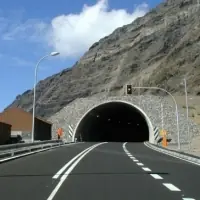
En los túneles con un carril para cada sentido, ¿está prohibido realizar un adelantamiento?
In tunnels with one lane in each direction, is overtaking prohibited?
- ANo.No.
- BSí.Yes.
- CNo, excepto cuando no tenga arcenes.No, except when there is no hard shoulder.
ExplanationAccording to Article 95 of the General Traffic Regulations (RGC), in two-way tunnels and underpasses overtaking is prohibited, unless there is more than one lane in your own direction. With one lane in each direction, overtaking is prohibited.
Circulando por una calzada con 3 carriles en el mismo sentido, ¿en qué carril nos tenemos que situar para cambiar de dirección a la izquierda?
When driving on a carriageway with 3 lanes in the same direction, which lane must we be in to turn left?
- AEn el carril de la derecha.In the right-hand lane.
- BEn el carril central.In the centre lane.
- CEn el carril de la izquierda.In the left-hand lane.
ExplanationWhen turning left, you must drive in the left-hand lane and keep close to the left-hand edge of the carriageway. If the carriageway had 3 lanes and two directions, the left turn would be made from the centre lane.
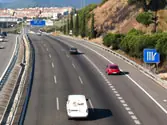
Un camión con 3500 kg de MMA en una autopista, ¿podrá utilizar el tercer carril para adelantar?
May a lorry with a MAM of 3,500 kg use the third lane of a motorway (autopista) to overtake?
- ASí.Yes.
- BNo.No.
- CSolo si circula sin carga.Only if it is not carrying a load.
ExplanationOn roads outside built-up areas, lorries with a MAM of more than 3,500 kg may not use the third lane. In this question the lorry has a MAM of up to 3,500 kg, so it may use that lane.
¿Se podrá parar en una parada de autobús?
Can you stop at a bus stop?
- ASí, pero menos de 2 minutos.Yes, but for less than 2 minutes.
- BSí, al no ser un estacionamiento.Yes, because it is not parking.
- CNo podré parar.I will not be able to stop.
ExplanationIn areas set aside for parking and stopping for the exclusive use of urban public transport, both stopping and parking are prohibited.
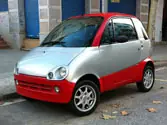
¿Dónde está prohibida la parada?
Where is stopping prohibited?
- AEn carriles destinados al transporte público.In lanes reserved for public transport.
- BEn zonas de carga y descarga.In loading and unloading areas.
- CEn doble fila.Double-parked.
ExplanationStopping is prohibited in lanes reserved for public transport and in those reserved for bicycles, because it gets in the way of their users. In loading and unloading areas and double-parked, what is prohibited is parking; a short stop is allowed.
El adelantamiento se efectuará por la derecha y con la máxima precaución...
Overtaking is done on the right, taking the utmost care...
- Aen vías con más de un carril en el mismo sentido..on roads with more than one lane in the same direction.
- Bcuando el conductor del vehículo al que se va a adelantar indica claramente que va a girar a la izquierda..when the driver of the vehicle to be overtaken clearly signals that they are going to turn left.
- Csiempre que se adelante a un vehículo articulado..whenever you overtake an articulated vehicle.
ExplanationOvertaking on the right is only allowed in certain circumstances, such as when the driver of the vehicle you intend to overtake signals that they are going to turn left. This is set out in Article 82.2 of the General Traffic Regulations, which states that overtaking must normally be done on the left but allows it on the right when specific conditions justify it, so as to keep the road safe.
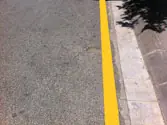
En el tramo de carril que se observa en la fotografía, ¿se puede estacionar?
On the section of lane shown in the photograph, can you park?
- ASí, porque es una vía con poca circulación.Yes, because it is a road with little traffic.
- BNo, porque lo prohíbe la marca vial.No, because the road marking prohibits it.
- CNo, porque hay acera.No, because there is a pavement.
ExplanationA solid yellow line on the kerb, or next to the edge of the carriageway, means that stopping and parking are prohibited, or subject to a time restriction shown by signs, along the whole length of the line and on the side where it is.
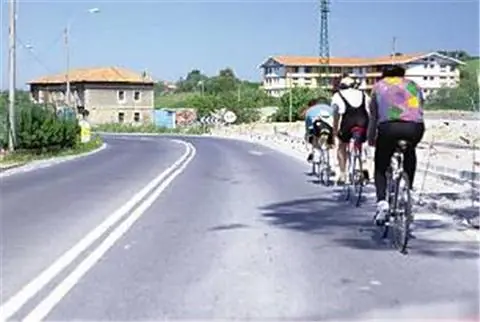
Al adelantar a un ciclista en un día de viento, es importante...
When overtaking a cyclist on a windy day, it is important to...
- Amantener la velocidad y estar atento al cumplimiento de la señalización vertical.keep your speed and pay attention to the road signs.
- Bdejar una separación lateral suficiente, ya que se pueden desestabilizar con facilidad.leave enough side distance, because they can easily be knocked off balance.
- Cal estar cerca de ellos hacer señales acústicas para indicar nuestra presencia.sound the horn when close to them to show we are there.
ExplanationIn wind, cyclists can be knocked off balance and swerve sideways suddenly. When overtaking them you must leave a wide side gap, always at least 1.5 metres, and reduce speed. Using the horn close to them can startle them and make them lose their balance.
Como norma general, ¿en qué vías está prohibido circular marcha atrás?
As a general rule, on which roads is reversing prohibited?
- ASólo en las vías urbanas.Only on urban roads.
- BSólo en las autopistas y autovías.Only on motorways (autopistas) and dual carriageways (autovías).
- CEn todas las vías, salvo como complemento a determinadas maniobras.On all roads, except as part of certain manoeuvres.
ExplanationAs a general rule, reversing is prohibited, except in the following cases, exceptionally and always for the shortest distance necessary: 1. As an additional manoeuvre when stopping, parking or joining the traffic. In this case you may not reverse more than 15 metres or enter a road junction. 2. When it is not possible to move forwards, turn or make a U-turn. In this case there is no limit on the reversing distance, and you may even enter a road junction if necessary. Reversing is prohibited on dual carriageways (autovías) and motorways (autopistas).
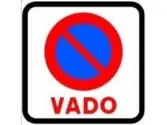
¿Se puede estacionar en un vado permanentemente señalizado?
Can you park in front of a vehicle entrance with a permanent sign?
- ASí, si se activan las luces de emergencia.Yes, if you switch on the hazard warning lights.
- BSí, si el conductor es el propietario del vado.Yes, if the driver is the owner of the entrance.
- CNo, está prohibido en cualquier caso.No, it is prohibited in all cases.
ExplanationYou cannot park in front of a vehicle entrance with a permanent sign under any circumstances. These entrances are there to give vehicles free access to garages or private entrances, so parking in front of them would block the way in or out. Neither switching on the hazard warning lights nor being the owner of the entrance allows you to park; the ban is absolute, to keep traffic moving and access safe.
¿Se podrá realizar un estacionamiento en la calzada de una travesía?
May you park on the carriageway of a travesía (stretch of road through a town)?
- ANo, está prohibido realizar estacionamientos en la calzada.No, parking on the carriageway is prohibited.
- BSí, tendremos que hacerlo normalmente lo más próximo a su borde derecho.Yes, and we will normally have to do so as close as possible to its right-hand edge.
- CNo se podrá estacionar porque la travesía se considera una vía fuera de poblado.You may not park, because a travesía counts as a road outside built-up areas.
ExplanationOn urban roads and travesías you may park on the carriageway. On a two-way road, as close as possible to the right-hand edge. On a one-way road, you may also park on the left-hand side.
¿Cuándo un vehículo estacionado impide gravemente la circulación?
When does a parked vehicle seriously obstruct traffic?
- ACuando está cerca de un paso de peatones.When it is near a pedestrian crossing.
- BCuando está estacionado en doble fila sin conductor.When it is double-parked without a driver.
- CCuando está en una zona reservada para carga y descarga fuera del horario de uso.When it is in a loading and unloading area outside its hours of use.
ExplanationArticle 91.2 of the General Traffic Regulations lists the types of parking that seriously obstruct traffic; among them is double parking without a driver (letter h). A loading and unloading area only counts during its hours of use, and being near a pedestrian crossing is not on the list.
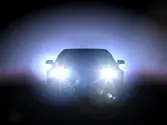
Los vehículos que incorporan LED de última generación, ¿cómo pueden evitar el deslumbramiento a otros usuarios de la vía entre la puesta y la salida del sol?
Vehicles fitted with the latest LED lights: how can they avoid dazzling other road users between sunset and sunrise?
- ADesviando las luces hacia la derecha mientras haya en la vía otros usuarios que puedan ser deslumbrados.By turning the lights to the right while there are other road users on the road who could be dazzled.
- BReduciendo la velocidad del vehículo llegando incluso a detenerlo.By reducing the vehicle's speed, even stopping it.
- CReduciendo la intensidad de la luz que incide directamente sobre el objetivo, permitiendo al conductor gozar de la máxima visibilidad del resto de la carretera.By reducing the intensity of the light falling directly on the target, while the driver still has maximum visibility of the rest of the road.
ExplanationLED technology prevents other drivers from being dazzled, because this system can switch off several LEDs to avoid it, and this can only be done with this type of lighting.
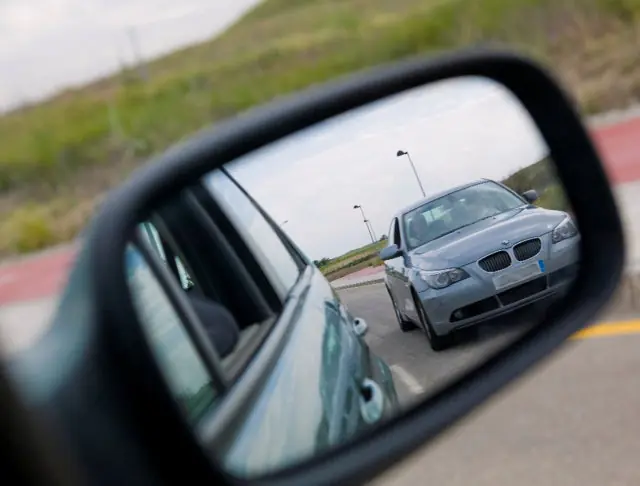
Como norma general, ¿qué debes hacer cuando te van a adelantar?
As a general rule, what should you do when you are about to be overtaken?
- AEncender el intermitente derecho, para indicar que permites que te adelante.Switch on the right indicator to show that you are letting them overtake.
- BIr hacia el borde derecho de la calzada para facilitar el adelantamiento.Move towards the right-hand edge of the carriageway to make overtaking easier.
- CAumentar la velocidad.Speed up.
ExplanationArticle 86 of the General Traffic Regulations (RGC) requires the driver about to be overtaken to keep close to the right-hand edge of the carriageway and prohibits them from speeding up. The rules only provide for the right indicator for slow or heavy vehicles that cannot move over completely, not as a general way of allowing overtaking.
Una vez iniciado el adelantamiento, se producen circunstancias que hacen difícil su finalización sin provocar riesgos; ¿qué está obligado a hacer el conductor?
After overtaking has started, circumstances arise that make it difficult to finish without creating risks. What must the driver do?
- AAumentar la velocidad para finalizar el adelantamiento.Speed up to finish overtaking.
- BAdvertir del riesgo al vehículo al que pretende adelantar para que detenga su marcha.Warn the vehicle they want to overtake of the risk so that it stops.
- CReducir la velocidad y regresar a su carril sin obstaculizar.Slow down and return to their lane without getting in the way.
ExplanationIf circumstances arise that prevent the overtaking from being completed safely, the driver must give up: slow down and return to their lane without getting in anyone's way. Speeding up to force the manoeuvre increases the risk.
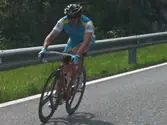
¿Está permitido efectuar un adelantamiento si al realizarlo entorpece la circulación de ciclistas?
Is it allowed to overtake if doing so gets in the way of cyclists?
- ASí, siempre y cuando se haga con precaución y se advierta a los ciclistas con anticipación.Yes, as long as it is done carefully and the cyclists are warned in advance.
- BSí, siempre aunque se ponga en peligro a los ciclistas.Yes, always, even if it puts the cyclists in danger.
- CNo, está prohibido.No, it is prohibited.
ExplanationAccording to Article 85.4 of the General Traffic Regulations (RGC) (as worded by RD 518/2026), when overtaking cyclists you must take special care not to put them in any danger, and it is prohibited to overtake if this endangers or gets in the way of those coming from the opposite direction, even if they are travelling on the hard shoulder.

¿Es necesario dejar debidamente calzado un vehículo que arrastra un remolque ligero al estacionar en una pendiente?
Must a vehicle towing a light trailer be properly chocked when parked on a slope?
- ASí, obligatoriamente.Yes, it is compulsory.
- BSólo cuando estacione en una pendiente ascendente.Only when parked on an uphill slope.
- CNo, no es necesario.No, it is not necessary.
ExplanationWhen a vehicle with a MAM of more than 3,500 kg, a bus or a combination of vehicles stops or parks on a noticeable slope, the driver must leave it properly chocked, either by placing chocks or by resting one of the steering (front) wheels against the kerb, turned towards the centre of the carriageway on uphill slopes and outwards on downhill slopes. Natural objects such as stones or pieces of wood must not be used as chocks.
Va a girar a la derecha, y lo señaliza con el indicador luminoso correspondiente, ¿hasta cuando es necesario mantenerlo encendido?
You are going to turn right and signal it with the indicator. Until when must you keep it on?
- AHasta que sepa con seguridad que el que me sigue ha visto la indicación.Until I know for sure that the driver behind me has seen the signal.
- BHasta que finalice la maniobra.Until the manoeuvre is finished.
- CEl menor tiempo posible.For as short a time as possible.
ExplanationYou must keep the indicator on until you finish the turn or sideways movement.
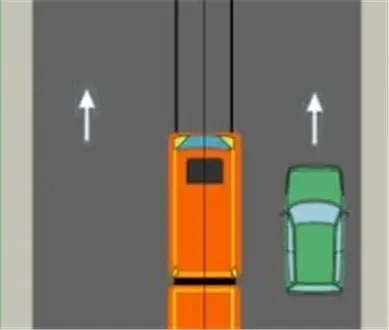
A la vista de la imagen, ¿es obligatorio adelantar al tranvía por la derecha?
Looking at the picture, must you overtake the tram on the right?
- ASí, en todo caso.Yes, in all cases.
- BNo, se le debe adelantar por la izquierda.No, you must overtake it on the left.
- CNo, se le puede adelantar por la derecha o por la izquierda.No, you can overtake it on the right or on the left.
ExplanationYou only have to overtake on the right trams travelling in the central area of a two-way road. On a one-way carriageway, like the one in the picture, you can overtake it on the left, which is the general rule, or on the right if there is enough space.
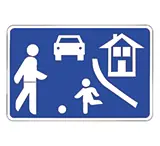
¿Está permitido estacionar en una zona de estancia y juego (señal S-28, antigua «calle residencial»)?
Is parking allowed in a stay and play zone (zona de estancia y juego, sign S-28, formerly 'residential street')?
- ASí, donde no se estorbe a los peatones.Yes, where it does not get in the way of pedestrians.
- BNo, está siempre prohibido.No, it is always prohibited.
- CNo, excepto en los lugares señalizados.No, except in the places marked for it.
ExplanationIn a stay and play zone (sign S-28, the former 'residential street'), vehicles may park only in the places designated by signs or road markings. It is not enough that the vehicle does not get in the way of pedestrians.
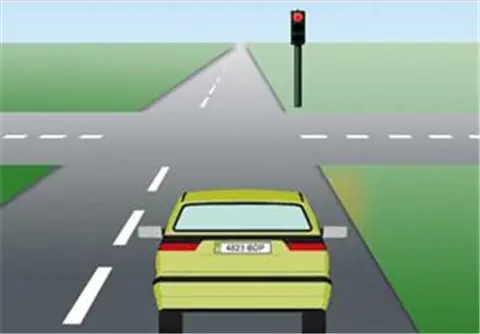
En esta situación, ¿qué debe hacer si pretende girar a la derecha?
In this situation, what must you do if you intend to turn right?
- AIgnorar el semáforo.Ignore the traffic light.
- BContinuar la marcha, cediendo el paso a los vehículos que circulen por la vía transversal.Carry on, giving way to vehicles on the crossing road.
- CDetenerse antes de entrar en la intersección.Stop before entering the junction.
ExplanationIf the traffic light is on the far side of the junction and it is red, you must stop before entering the junction or, if there is one, before the stop line (Annex I of the General Traffic Regulations). Intending to turn right does not free you from obeying the red light.
¿Dónde debe colocarse un ciclomotor para girar a la izquierda en una carretera interurbana?
Where should a moped position itself to turn left on a road outside built-up areas?
- AEn el centro del carril.In the centre of the lane.
- BSi no existe un carril acondicionado para el giro, a la derecha, fuera de la calzada siempre que sea posible.If there is no lane specially designed for turning, on the right, off the carriageway whenever possible.
- CEn el eje de la calzada si la vía es de doble sentido.On the centre line of the carriageway if the road is two-way.
ExplanationOn roads outside built-up areas, two-wheeled cycles and mopeds that do not have a lane specially designed for turning left must move to the right, off the carriageway whenever possible, and start the turn from there (Article 76.2 of the General Traffic Regulations).
¿Está permitido estacionar una motocicleta en la acera?
Is it allowed to park a motorcycle on the pavement?
- ASí, si no se entorpece la libre circulación de los peatones.Yes, if it does not get in the way of pedestrians.
- BNo, como norma general.No, as a general rule.
- CSí, si no hay otro lugar.Yes, if there is nowhere else.
ExplanationAs a general rule, parking on pavements is prohibited. However, according to Article 156.2 of the General Traffic Regulations (RGC) (as worded by RD 518/2026), local councils may, by by-law, regulate stopping and parking of two-wheeled vehicles on pavements, as long as this does not harm or get in the way of pedestrians.
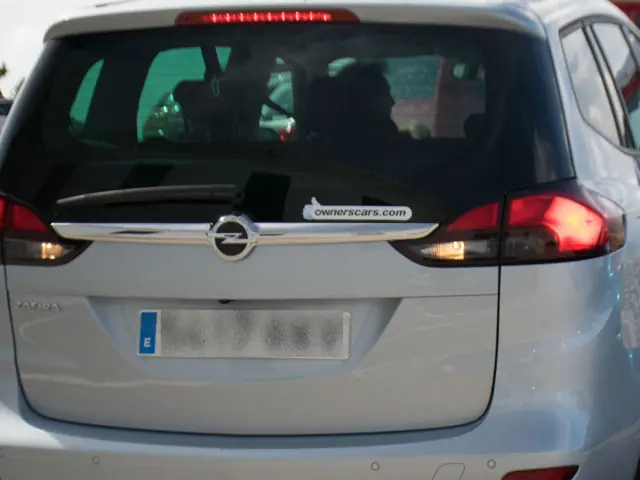
En una vía cortada, donde no puedes cambiar de dirección ni de sentido, ¿puedes salir marcha atrás?
On a closed road, where you cannot turn or make a U-turn, can you get out by reversing?
- ASí. Pero no puedes invadir ningún cruce.Yes, but you cannot enter any junction.
- BSí. Puedes recorrer 15 metros, como máximo.Yes, you can reverse 15 metres at most.
- CSí. Pero solo una distancia limitada.Yes, but only for a limited distance.
ExplanationArticle 80 of the General Traffic Regulations (RGC) allows reversing when it is not possible to continue forwards, turn or make a U-turn, but always for the shortest distance necessary. The 15-metre limit and the ban on entering a junction apply to reversing as an additional manoeuvre when stopping, parking or joining the traffic.
¿Se podrá realizar una parada en un carril reservado para el autobús?
Can you stop in a lane reserved for buses?
- ASí, pero solo para subir o bajar viajeros.Yes, but only to let passengers get in or out.
- BNo, en ningún caso.No, never.
- CNo, estos carriles están reservados para circular, ningún vehículo puede parar en ellos.No, these lanes are reserved for driving, no vehicle may stop in them.
ExplanationIn a lane reserved for buses, you may never stop or park.
All topics
- Definitions
- Documents and penalty points
- The driver's condition
- Duties of drivers and pedestrians
- Vehicle safety devices
- Vehicle controls and equipment
- Vehicle lights and horn
- Traffic signs, markings and signals
- The road and its lanes
- Speed and distances
- Right of way
- Carrying passengers and loads
- Driving safely in difficult conditions
- Vehicle mechanics and maintenance
- Road accidents and first aid
- Defensive and eco-driving
Independent app: not affiliated with or endorsed by the DGT (Spain's Directorate-General for Traffic) or the Ministry of the Interior. The official exam is booked with the DGT and taken at its test centres. The questions here are practice material; the DGT's official question bank is not public.
Basado en datos de la Agencia Estatal Boletín Oficial del Estado (https://www.boe.es). Textos consolidados de carácter meramente informativo. La AEBOE no patrocina ni respalda este sitio.
Parte de las preguntas procede de los tests de la revista «Tráfico y Seguridad Vial» de la DGT, reproducidos con indicación de la fuente.