
DGT test · 982 questions
Manoeuvres · Page 16 of 20
Joining traffic, overtaking, turning, U-turns, reversing, stopping and parking: how and where to do them and when they are forbidden.
Questions in this topic, with answers
982 questions, 50 per page, with the correct answer and the explanation. Page 16 of 20.
¿Dónde está prohibido estacionar en zona urbana?
Where is parking prohibited in an urban area?
- AEn vías con prioridad de paso.On roads with right of way.
- BEn el lado izquierdo de las calles de sentido único.On the left-hand side of one-way streets.
- CEn las aceras y en los paseos peatonales.On pavements and pedestrian walkways.
ExplanationParking on pavements, walkways and other areas for pedestrians is prohibited (Article 94.2.e of the RGC). On the other hand, in one-way streets you may also park on the left-hand side.
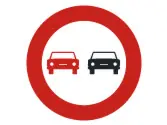
¿Está permitido en una carretera convencional así señalizada efectuar un cambio de sentido?
On a conventional road with this sign, is it allowed to make a U-turn?
- ASí, porque la señal solamente prohíbe el adelantamiento.Yes, because the sign only prohibits overtaking.
- BNo.No.
- CNo, en una carretera convencional siempre está prohibido efectuar un cambio de sentido.No, making a U-turn on a conventional road is always prohibited.
ExplanationAs a general rule, on stretches of road where overtaking is prohibited, making a U-turn is also prohibited, unless it is expressly allowed.
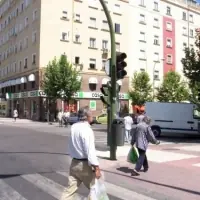
¿Puede un conductor parar en un paso de peatones?
Can a driver stop on a pedestrian crossing?
- ASi, y también estacionar si hay espacioYes, and also park if there is space.
- BNo, nuncaNo, never.
- CSi, siempre que la parada sea inferior a 1 minutoYes, as long as the stop lasts less than 1 minute.
ExplanationA driver is never allowed to stop or park in the middle of a pedestrian crossing, even if the stop lasts less than a minute or the driver does not leave the vehicle. This is because a vehicle in the way prevents pedestrians from moving freely across the crossing.
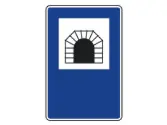
A la vista de la señal, ¿está permitido hacer un cambio de sentido?
Given the sign, is it allowed to make a U-turn?
- ANo.No.
- BSí.Yes.
- CSí, si no invado el sentido contrario.Yes, if I do not enter the opposite side of the road.
ExplanationThe 'Tunnel' sign (S-5) applies to the whole stretch, and in tunnels, underpasses and stretches covered by this sign, U-turns are prohibited (Article 79.1 of the General Traffic Regulations, RGC), even if you do not enter the opposite side of the road.
¿Podemos invadir un cruce de vías al incorporarnos marcha atrás a la circulación?
Can we enter a road junction when reversing to join the traffic?
- ANo.No.
- BSí, siempre que no se recorran más de 15 metros.Yes, as long as you do not travel more than 15 metres.
- CSí, siguiendo las indicaciones de otra persona.Yes, following another person's directions.
ExplanationYou may reverse as an additional manoeuvre in traffic as long as you do not travel more than 15 metres or enter a road junction.
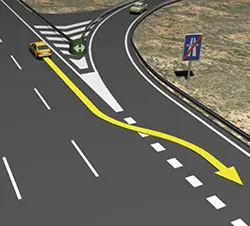
Circulando por una autopista observa que se ha pasado una salida, ¿puede volver a ella circulando marcha atrás?
While driving on a motorway (autopista), you notice you have missed an exit. Can you go back to it by reversing?
- ANo.No.
- BSí, cuando el recorrido no supere los 15 metros.Yes, when the distance is not more than 15 metres.
- CSí, comprobando que no existe peligro para otros usuarios.Yes, after checking that there is no danger to other road users.
ExplanationOn motorways (autopistas) and dual carriageways (autovías) reversing is prohibited, even to go back a few metres to an exit: you must continue to the next one. Reversing is only allowed as an additional manoeuvre.
Si la vía tiene una raqueta u otro elemento similar, ¿debe usarlo para girar?
If the road has a raqueta (turning loop) or a similar feature, must you use it to turn?
- ANo, no es necesario usarla.No, you do not need to use it.
- BSí, debe usarse aunque no haya una señal que lo indique.Yes, you must use it even if there is no sign saying so.
- CSí, pero sólo si lo indica una señal.Yes, but only if a sign says so.
ExplanationArticle 75.1.b of the General Traffic Regulations sets out how to position yourself to turn 'unless the road is designed or signed for it to be done in another way'. A raqueta is exactly that kind of design: if there is one, you turn using it even if there is no sign.
Como norma general, en los tramos de vía donde está prohibido el adelantamiento también está prohibido...
As a general rule, on stretches of road where overtaking is prohibited, it is also prohibited to...
- ACambiar de dirección.Turn.
- BCambiar de sentido.Make a U-turn.
- CCambiar de dirección y de sentido.Turn and make a U-turn.
ExplanationAs a general rule, on all stretches of road where overtaking is prohibited, with or without signs, making a U-turn is also prohibited.
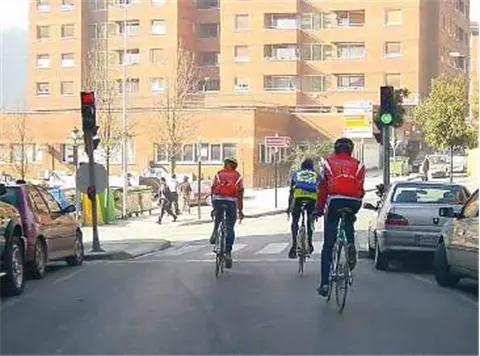
En esta situación, ¿qué debe hacer si va a girar a la izquierda?
In this situation, what must you do if you are going to turn left?
- AContinuar obedeciendo al semáforo de la derecha.Carry on, obeying the traffic light on the right.
- BDetenerse, obedeciendo al semáforo situado a la izquierda.Stop, obeying the traffic light on the left.
- CDetenerse, pero sólo si hay peatones cruzando.Stop, but only if pedestrians are crossing.
ExplanationWhen there are traffic lights on the right and on the left showing different signals, drivers going straight on or turning left obey the traffic light on the left. If it is red, you must stop, even if the one on the right is green.
¿Se podrá estacionar en un carril bus si se conocen los horarios del transporte?
Can you park in a bus lane if you know the public transport timetable?
- ASí.Yes.
- BNo.No.
- CSí, si se dejan encendidas las luces de emergencia.Yes, if you leave the hazard warning lights on.
ExplanationYou may not stop or park in a bus lane.
¿Está permitido adelantar en los pasos de peatones?
Is overtaking allowed on pedestrian crossings?
- ASí, si se circula tan despacio que permita detenerse a tiempo si aparece un peatón.Yes, if you drive slowly enough to stop in time if a pedestrian appears.
- BSí, pero solo en vías urbanas.Yes, but only on urban roads.
- CNo, está prohibido.No, it is prohibited.
ExplanationAccording to Article 87.1.b of the General Traffic Regulations (RGC) (as worded by RD 518/2026), overtaking is prohibited on marked pedestrian crossings and near them; the exception that allowed overtaking at a very low speed has been removed.
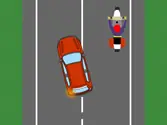
En esta situación, ¿es correcto el adelantamiento que está realizando el turismo?
In this situation, is the car overtaking correctly?
- ANo, porque invade completamente el sentido contrario.No, because it moves completely into the opposite direction.
- BSí, porque no hay señal vertical que lo prohíba.Yes, because there is no road sign prohibiting it.
- CSí, porque deja la separación adecuada y adelanta a un vehículo de dos ruedas.Yes, because it leaves an adequate side gap and is overtaking a two-wheeled vehicle.
ExplanationA solid longitudinal line that separates lanes or directions of traffic prevents overtaking when you would have to cross it or drive on it. When it separates the two directions of traffic, it also prohibits driving to the left of it. Even where overtaking is prohibited, you may move into the part reserved for the opposite direction to: - Overtake slow and vulnerable users (bicycles, mopeds, pedestrians, animals and animal-drawn vehicles), when their speed allows the manoeuvre to be done without risk. - Pass obstacles or immobilised vehicles (broken down, in an accident, etc.), after making sure there is no danger (if the vehicle is stopped because of traffic needs, you may not pass it and must stay behind it). In the case in the question, you can see from its size that it is a motorcycle, and crossing the solid line to overtake it is prohibited.
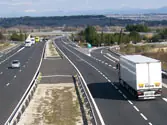
En una autopista, ¿se podrá realizar un cambio de sentido?
On a motorway (autopista), may a U-turn be made?
- ANo, en ningún caso.No, under no circumstances.
- BSí, cuando la mediana esté abierta.Yes, when there is a gap in the central reservation.
- CEn los lugares habilitados mediante la señalización.At the places enabled for it by signs.
ExplanationOn motorways (autopistas) and dual carriageways (autovías), making a U-turn is prohibited, except at places provided for that purpose (Article 79.1 of the General Traffic Regulations). A gap in the central reservation is not enough to allow it.
En una vía urbana con un solo sentido de circulación, ¿en qué lado de la calzada podemos estacionar?
On a one-way urban road, on which side of the carriageway can we park?
- AEn la calzada no se puede estacionar.You cannot park on the carriageway.
- BEn el lado derecho únicamente.Only on the right-hand side.
- CTanto en el lado derecho como en el izquierdo.On either the right-hand or the left-hand side.
ExplanationOn a one-way urban road, you may park on either the right-hand or the left-hand side.
Fuera de poblado, ¿cómo advertiremos nuestra intención de adelantar al vehículo que nos precede?
Outside built-up areas, how will we warn the vehicle in front that we intend to overtake it?
- ACon el indicador de dirección de la izquierda.With the left indicator.
- BCon señales ópticas, únicamente.With visual signals only.
- CCon señales acústicas o luminosas.With sound or light signals.
ExplanationWhen we need to warn the vehicle in front that we are going to overtake it, we will do so with light or sound signals if we are outside built-up areas. In built-up areas, only with light signals.
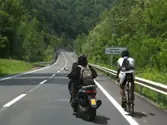
¿Cuánto durará como máximo un adelantamiento realizado por un ciclomotor?
What is the maximum length of an overtaking manoeuvre by a moped?
- AEl tiempo mínimo indispensable.The shortest time necessary.
- B15 segundos o 200 metros de circulación en paralelo con el vehículo adelantado.15 seconds or 200 metres travelling side by side with the overtaken vehicle.
- C30 segundos o 300 metros de circulación en paralelo con el vehículo adelantado.30 seconds or 300 metres travelling side by side with the overtaken vehicle.
ExplanationWhen vehicles that must travel on the hard shoulder, such as mopeds, overtake others, they may travel side by side for a maximum of 15 seconds or 200 metres.
¿Se puede parar en el borde izquierdo de una calzada, por lo general?
As a general rule, may you stop on the left-hand edge of a carriageway?
- ASí, siempre que no obstaculice el tráfico.Yes, provided you do not obstruct traffic.
- BNo, en ningún caso.No, under no circumstances.
- CSí, en vías urbanas de sentido único.Yes, on one-way urban roads.
ExplanationUnder Article 90.2 of the RGC, on urban roads a vehicle stops or parks as close as possible to the right-hand edge, except on one-way roads, where it may also stand on the left-hand side. On interurban roads, always on the right.
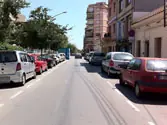
Para realizar una parada, ¿está permitido circular marcha atrás?
To stop, is it allowed to reverse?
- ASí, con ciertas condiciones.Yes, under certain conditions.
- BNo.No.
- CSí, siempre.Yes, always.
ExplanationAs a general rule, reversing is prohibited, except in the following cases, exceptionally and always for the shortest distance necessary: 1. As an additional manoeuvre when stopping, parking or joining the traffic. In this case you may not reverse more than 15 metres or enter a road junction. 2. When it is not possible to move forwards, turn or make a U-turn. In this case there is no limit on the reversing distance, and you may even enter a road junction if necessary. Reversing is prohibited on dual carriageways (autovías) and motorways (autopistas).
¿Cómo se debe incorporar un conductor a la vía pública?
How must a driver join the public road?
- ARápidamente, para no entorpecer la marcha de los otros usuarios.Quickly, so as not to get in the way of other road users.
- BCon lentitud, para poder detenerse en caso necesario y ceder el paso a peatones y vehículos.Slowly, so as to be able to stop if necessary and give way to pedestrians and vehicles.
- CSi no se acerca ningún vehículo por su derecha, podrá hacerlo ya que tiene prioridad.If no vehicle is approaching from the right, they can join, because they have priority.
ExplanationWe must join the traffic at a speed that lets us stop immediately to give way to pedestrians and to vehicles approaching us, whichever direction they are coming from.
En un tramo con carril de aceleración, ¿se considera adelantamiento si un vehículo en el carril de aceleración circula más rápido que otro que va por el carril normal?
On a stretch with an acceleration lane, is it considered overtaking if a vehicle in the acceleration lane goes faster than one in the normal lane?
- ANo.No.
- BSí, como cualquier otro adelantamiento.Yes, like any other overtaking.
- CNo, porque el carril de aceleración no es una vía interurbana.No, because the acceleration lane is not a road outside built-up areas.
ExplanationOn stretches with acceleration or deceleration lanes, or with lanes set aside for certain vehicles, going faster in those lanes than in the normal ones, or the other way round, is not considered overtaking (Article 83.3 of the General Traffic Regulations (RGC)).
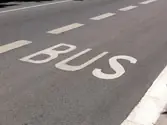
En un carril bus, ¿está permitido realizar una parada?
In a bus lane, is it allowed to stop?
- ANo.No.
- BSí, si no entorpezco el paso de autobuses y taxis.Yes, if I do not get in the way of buses and taxis.
- CSí, en todo caso.Yes, in all cases.
ExplanationIn a bus lane you may make manoeuvres other than stopping, parking, making a U-turn or overtaking. For example, you may turn, as long as the lane is marked by a broken line. If we stop in a bus lane, we will block the normal route of these vehicles, so you may never stop in this lane.
¿Está permitido adelantar en el interior de un túnel que dispone de un carril para cada sentido?
Is it allowed to overtake inside a tunnel with one lane in each direction?
- ASí, cuando al hacerlo no se invada el sentido contrario.Yes, when doing so does not mean moving into the opposite direction.
- BNo, está prohibido.No, it is prohibited.
- CSí, siempre que se disponga de visibilidad suficiente y no se aproximen vehículos en sentido contrario.Yes, as long as there is enough visibility and no vehicles are coming from the opposite direction.
ExplanationIn tunnels and underpasses with only one lane in each direction overtaking is prohibited, even if there is visibility and no vehicles are coming from the other direction. It is only allowed if there is more than one lane in your own direction, and without moving into the opposite direction.
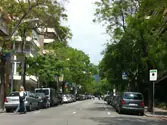
Se considera que una parada obstaculiza la circulación, si la distancia entre el vehículo y el borde opuesto de la calzada es inferior a...
A stop is considered to obstruct traffic if the distance between the vehicle and the opposite edge of the carriageway is less than...
- A3 metros.3 metres.
- B3,5 metros.3.5 metres.
- C4 metros.4 metres.
ExplanationA stop is considered to obstruct traffic if the distance between the vehicle and the opposite edge of the carriageway is less than 3 metres, or if there is less than 3 metres to a solid longitudinal marking.
Los conductores de camiones de hasta 3500 kg, ¿podrán circular por el tercer carril dentro de poblado?
Can drivers of lorries of up to 3,500 kg drive in the third lane in a built-up area?
- ASí.Yes.
- BNo.No.
- CSí, pero solo para adelantar.Yes, but only to overtake.
ExplanationIn built-up areas, if the lanes are marked out by longitudinal markings, you may use the lane that best suits your destination. Outside built-up areas you will normally drive in the right-hand lane, using the other lanes to overtake or when road conditions make it advisable.
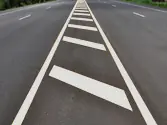
¿Es correcto realizar una parada en una isleta?
Is it correct to stop on a traffic island?
- ASí, si no supera los dos minutos.Yes, if it is for no more than two minutes.
- BSí, en una isleta se podrá parar pero no estacionar.Yes, you may stop on a traffic island but not park.
- CNo, y además se considera que se obstaculiza gravemente la circulación.No, and it is also considered to seriously obstruct traffic.
ExplanationWhen you stop or park on central reservations, dividers, traffic islands or channelling features, it is considered to be in a dangerous place or to seriously obstruct traffic. Both stopping and parking are voluntary stops by the driver and must be done correctly.
¿Está permitido rebasar una línea continua para adelantar a un ciclista?
May you cross a solid line to overtake a cyclist?
- ASí.Yes.
- BNo.No.
- CNo, salvo que el ciclista circule por el arcén.No, unless the cyclist is riding on the hard shoulder.
ExplanationYou may overtake bicycles, pedestrians, animals and animal-drawn vehicles by crossing a solid line and partly or fully using the next lane of the carriageway, under the safety conditions set by the rules, leaving a side gap of at least 1.50 metres.
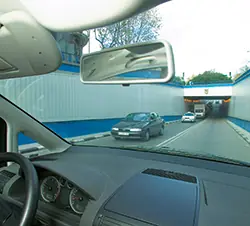
En un túnel con un solo carril para cada sentido, ¿está permitido el adelantamiento?
In a tunnel with only one lane in each direction, is overtaking allowed?
- ANo.No.
- BSí.Yes.
- CSolo si la calzada dispone de arcén practicable.Only if the carriageway has a usable hard shoulder.
ExplanationThe Regulations prohibit overtaking in tunnels and underpasses with only one lane in each direction, because the manoeuvre would mean moving into the opposite direction in an enclosed place with no escape route.
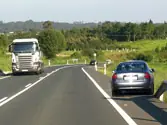
¿Se encuentra correctamente inmovilizado por una emergencia este vehículo que está situado en un arcén transitable?
Is this vehicle, which is on a usable hard shoulder, correctly immobilised because of an emergency?
- ASí.Yes.
- BNo, por ser arcén transitable.No, because it is a usable hard shoulder.
- CSí, si se trata de una parada, no, si se trata de un estacionamiento.Yes if it is stopping, no if it is parking.
ExplanationIf the vehicle is immobilised because of an emergency, a breakdown for example, it is an emergency stop, so it is correct for it to be stopped on the hard shoulder even though the hard shoulder is usable. If it were voluntary stopping or parking, it would be prohibited.
¿El freno de estacionamiento se puede utilizar para disminuir velocidad del vehículo?
Can the parking brake be used to reduce the vehicle's speed?
- ASí, pero únicamente en casos de emergencia.Yes, but only in emergencies.
- BSí, siempre que se desee, cuando la velocidad no supere los 50 km/h.Yes, whenever you like, when the speed is not over 50 km/h.
- CNo, en ningún caso.No, never.
ExplanationThe parking brake, also known as the handbrake, is mainly designed to hold the vehicle still when it is parked. However, in emergencies where the vehicle must be stopped quickly and the main brake (pedal) is not working properly or is not enough to stop the vehicle, the parking brake can be used as an extra resource to help stop the vehicle safely. Using the parking brake to reduce speed in an emergency must be done with extreme care and only as a last resort. It is not recommended for stopping the vehicle in normal driving, because it can suddenly lock the rear wheels and cause a dangerous skid.
Al estacionar el vehículo en una cuesta hacia arriba, es obligatorio dejar...
When parking the vehicle on an uphill slope, you must leave...
- ASolo el freno de estacionamiento puesto.only the parking brake applied.
- BEl freno de estacionamiento accionado y la primera marcha puesta.the parking brake applied and first gear engaged.
- CLa marcha atrás puesta y el freno de estacionamiento accionado.reverse gear engaged and the parking brake applied.
ExplanationWhen parking on an uphill slope you must leave the parking brake applied and first gear engaged, or the park position in an automatic (Article 92.3 of the General Traffic Regulations). Reverse gear is what you leave engaged on downhill slopes.
¿Se permite estacionar en doble fila?
Is double parking allowed?
- ASí, si no hay sitio libre cerca.Yes, if there is no free space nearby.
- BNo, en ningún caso.No, under no circumstances.
- CSí, si el conductor no deja el vehículo.Yes, if the driver does not leave the vehicle.
ExplanationArticle 94.2 of the RGC prohibits double parking, with no exception for lack of space. If the vehicle is also left without its driver, Article 91 considers it parking that seriously obstructs traffic.
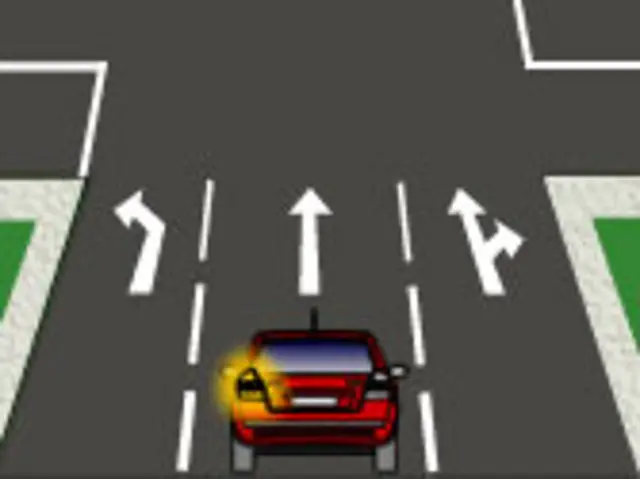
¿Está bien colocado el coche para girar a la izquierda?
Is the car correctly positioned to turn left?
- ASí.Yes.
- BSí, porque circula dentro de un núcleo urbano.Yes, because it is driving in a built-up area.
- CNo.No.
ExplanationThe car is in the centre lane, whose arrow only allows you to go straight on; to turn left it must be in the left-hand lane. Arrows show the movements allowed or required in each lane (Article 147.2.c of the General Traffic Regulations), and you must move into position in good time (Article 75.1.b).
¿En qué caso, para girar a la izquierda, nos ceñiremos al borde izquierdo de la calzada?
In which case do we keep close to the left-hand edge of the carriageway to turn left?
- AEn calzadas de 2 sentidos.On two-way carriageways.
- BEn calzadas de 1 sentido.On one-way carriageways.
- CSiempre.Always.
ExplanationWe must keep close to the left-hand edge of the carriageway on one-way roads when we are about to turn left. If the road is two-way, we will keep close to the centre line of the carriageway.
Al estacionar, con el fin de no perturbar la circulación, dejaremos una distancia libre en relación al bordillo contrario de al menos,...
When parking, so as not to disrupt traffic, we will leave a free distance from the opposite kerb of at least...
- A5 metros.5 metres.
- B3 metros.3 metres.
- C4 metros.4 metres.
ExplanationIf the distance between the vehicle and the opposite edge of the carriageway is less than 3 metres, the parking is considered to seriously obstruct traffic.
¿Cómo debe inmovilizar los vehículos accidentados?
How must you immobilise vehicles involved in an accident?
- ACon el freno de mano y cortando el contacto.With the handbrake and switching off the ignition.
- BCon unos calzos o cualquier elemento que sirva como tal.With wheel chocks or anything that can be used as one.
- CQuitando el contacto de la batería.By disconnecting the battery.
ExplanationWe will try to immobilise vehicles involved in an accident in a safe place, with the handbrake on and the engine switched off.
En defecto del indicador de dirección, advertiremos un desplazamiento hacia la izquierda...
Without an indicator, we will signal a move to the left...
- ACon el brazo izquierdo doblado hacia arriba.With the left arm bent upwards.
- BCon el brazo izquierdo extendido.With the left arm stretched out.
- CCon el brazo izquierdo moviéndolo de arriba a abajo.By moving the left arm up and down.
ExplanationWithout the indicator, we will warn of a manoeuvre to the left by stretching out the left arm with the palm of the hand facing downwards.
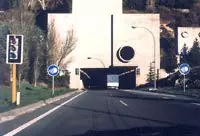
En túneles.¿está permitido adelantar?
Is overtaking allowed in tunnels?
- ASí, siempre.Yes, always.
- BSí, si hay más de un carril de circulación para mi sentido de circulación.Yes, if there is more than one lane in my direction of travel.
- CNo.No.
ExplanationIn tunnels and underpasses with two-way traffic, overtaking is prohibited unless there is more than one lane in your own direction, and in that case you must not move into the opposite direction (Article 95 of the General Traffic Regulations).
Para adelantar a un vehículo con la calzada mojada, ¿qué debe hacer usted?
When overtaking a vehicle on a wet carriageway, what should you do?
- AEs obligatorio esperar a que la calzada esté seca.You must wait until the carriageway is dry.
- BHay que tener especial cuidado, porque las salpicaduras pueden reducir la visibilidad.You must take special care, because spray can reduce visibility.
- CNo es necesario tomar precauciones especiales.No special precautions are needed.
ExplanationWhen you overtake a vehicle on a wet carriageway, especially a large one, the water thrown up by its wheels can dirty your windscreen and suddenly reduce visibility. You must take extra care, but you are not required to wait for the carriageway to dry.
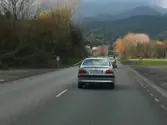
¿Cómo puede advertir fuera de poblado la intención de adelantar?
Outside built-up areas, how can you warn that you intend to overtake?
- ACon las luces de corto o de largo alcance, únicamente.Only with dipped headlights or main beam.
- BCon señales ópticas y acústicas.With light signals and sound signals.
- CCon las señales acústicas, exclusivamente.Only with sound signals.
ExplanationYou can warn the driver in front that you intend to overtake with light signals, using dipped headlights, main beam or both alternately, at very short intervals and in a way that avoids dazzling, and with sound signals (the horn). Depending on where we are, we can use one or the other: - On roads outside built-up areas: sound signals (horn) or light signals (flashes). - On urban roads: light signals (flashes). The horn is prohibited.
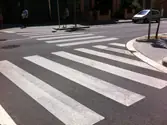
¿Se podrá adelantar en un paso para peatones?
Can you overtake on a pedestrian crossing?
- ANo, está prohibido.No, it is prohibited.
- BSí, si la vía es de sentido único.Yes, if the road is one-way.
- CSí, cuando el adelantamiento se realice a velocidad tan reducida que permita detenerme a tiempo si surge un peligro.Yes, when overtaking at a speed low enough to let me stop in time if danger arises.
ExplanationAccording to Article 87.1.b of the General Traffic Regulations (RGC) (as worded by RD 518/2026), overtaking is prohibited on marked pedestrian crossings and near them; the exception that allowed overtaking at a very low speed has been removed.
¿Cuándo se podrá estacionar en doble fila?
When may you double-park?
- ACuando no haya sitio en las proximidades para hacerlo junto al bordillo.When there is no room nearby to park next to the kerb.
- BCuando el conductor permanezca dentro del vehículo.When the driver stays inside the vehicle.
- CNunca.Never.
ExplanationDouble parking is always prohibited. You may stop in a double line if this does not obstruct traffic and there is no place nearby to leave the vehicle at the edge of the road.
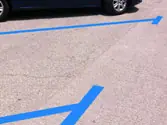
En una zona azul podemos estacionar...
In a blue zone we may park...
- APor un tiempo limitado.For a limited time.
- BSólo teniendo una autorización especial.Only with a special permit.
- CSin restricción de tiempo.With no time limit.
ExplanationBlue markings mark out places where parking is permitted, but only for a limited time.
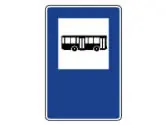
En una parada de transporte público urbano, ¿está permitido parar o estacionar?
At an urban public transport stop, is it allowed to stop or park?
- ANo, en ningún caso.No, never.
- BSí, únicamente para subir o bajar pasajeros.Yes, only to let passengers get in or out.
- CSí, está permitido parar, pero no estacionar.Yes, stopping is allowed, but parking is not.
ExplanationIn areas set aside for parking and stopping for the exclusive use of urban public transport, stopping and parking are prohibited, even if there is no specific sign saying so.
¿Podrá usted adelantar en un túnel que dispone de un carril para cada sentido de la marcha?
May you overtake in a tunnel that has one lane for each direction of travel?
- ASí, si no hay señal que lo prohíba.Yes, if there is no sign prohibiting it.
- BNo.No.
- CSí, si el túnel mide menos de 500 metros.Yes, if the tunnel is less than 500 metres long.
ExplanationOvertaking is prohibited in tunnels, underpasses and stretches with the tunnel sign where there is only one lane in the direction of travel of the vehicle that wants to overtake.
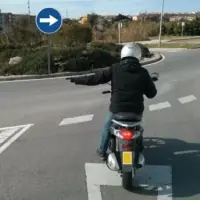
El conductor de una motocicleta que quiere girar a la izquierda, ¿cómo debe señalizar la maniobra?
How must a motorcyclist who wants to turn left signal the manoeuvre?
- ACon el brazo izquierdo doblado hacia arriba.With the left arm bent upwards.
- BCon el brazo izquierdo hacia abajo y la palma de la mano hacia atrás.With the left arm pointing down and the palm of the hand facing backwards.
- CCon el brazo izquierdo estirado horizontalmente y la palma de la mano hacia abajo.With the left arm stretched out horizontally and the palm of the hand facing down.
ExplanationUnder Article 109 of the General Traffic Regulations (RGC), moving to the left is indicated with the left arm held out horizontally and the palm facing down. The left arm bent upwards indicates moving to the right.
¿Podemos estacionar en un carril reservado para autobuses?
May we park in a lane reserved for buses?
- ANo.No.
- BSí, se puede parar, pero no estacionar.Yes, you may stop, but not park.
- CSe puede parar, pero por menos de 2 minutos.You may stop, but for less than 2 minutes.
ExplanationIn lanes reserved exclusively for urban public transport, stopping is prohibited (Article 94.1.h of the General Traffic Regulations) and therefore so is parking (Article 94.2.a). Not even a brief stop is allowed.
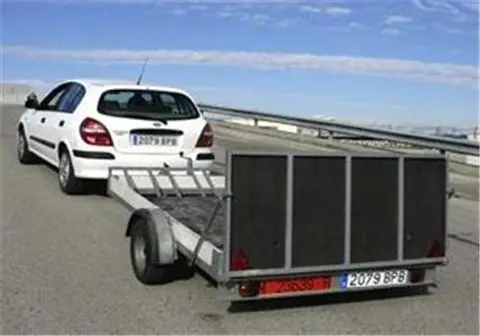
Al estacionar un vehículo con remolque en una pendiente ascendente, si no dispone de calzos, ¿qué debe hacer?
When parking a vehicle with a trailer on an uphill slope, if you have no wheel chocks, what must you do?
- AUtilizar como calzos elementos naturales como piedras, maderos, etc.Use natural objects such as stones, pieces of wood, etc. as chocks.
- BEs suficiente que deje engranada la marcha atrás o la primera velocidad.It is enough to leave it in reverse gear or first gear.
- CApoyar una de las ruedas delanteras en el bordillo, orientada hacia el centro de la calzada.Rest one of the front wheels against the kerb, turned towards the centre of the carriageway.
ExplanationA vehicle combination parked on a noticeable slope must be secured with wheel chocks or by resting a steering wheel against the kerb, turned towards the centre of the carriageway if the slope is uphill (Article 92 of the General Traffic Regulations). Stones may not be used as chocks, and leaving the vehicle in gear is not enough.
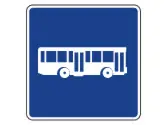
¿Está permitido parar o estacionar, en un carril bus?
Is it allowed to stop or park in a bus lane?
- ANo.No.
- BSí, pero solo parar por un tiempo inferior a 2 minutos.Yes, but only to stop for less than 2 minutes.
- CSí, si utiliza la señal de emergencia.Yes, if you use the hazard warning lights.
ExplanationStopping, and therefore parking, is prohibited in lanes for the exclusive use of urban public transport (article 94.1 of the General Traffic Regulations). There is no exception for a short time or for switching on the hazard warning lights.
Al estacionar un vehículo con remolque en una cuesta hacia arriba, si no tiene calzos para las ruedas, ¿qué debe hacer?
When parking a vehicle with a trailer on an uphill slope, if you do not have wheel chocks, what must you do?
- AApoyar una de las ruedas delanteras en el bordillo, girándola hacia el centro de la calzada.Rest one of the front wheels against the kerb, turned towards the centre of the carriageway.
- BApoyar una de las ruedas delanteras en el bordillo, girándola hacia fuera de la calzada.Rest one of the front wheels against the kerb, turned away from the carriageway.
- CUtilizar piedras o troncos como calzos.Use stones or logs as chocks.
ExplanationUnder Article 92.3 of the General Traffic Regulations, a vehicle combination parked on a steep slope must be secured with wheel chocks, without using stones or other items not meant for this, or by resting a steering wheel against the kerb, turned towards the centre of the carriageway on uphill slopes.
Si al realizar un cambio de sentido se obstaculiza la marcha de los vehículos que circulan detrás, deberá...
If, when making a U-turn, you hold up vehicles behind you, you must...
- Ano hacerlo y seguir circulando.not make it and carry on driving.
- Bsalir de la calzada por la derecha y esperar hasta que las condiciones permitan hacer la maniobra.leave the carriageway on the right and wait until conditions allow you to make the manoeuvre.
- Cusar las luces de freno para advertir sobre su maniobra.use your brake lights to warn of your manoeuvre.
ExplanationIf, while you wait to make a U-turn, staying on the carriageway prevents vehicles behind from continuing, you must leave it on the right-hand side, if possible, until traffic allows you to make the manoeuvre (Article 78.1 of the General Traffic Regulations (RGC)).
All topics
- Definitions
- Documents and penalty points
- The driver's condition
- Duties of drivers and pedestrians
- Vehicle safety devices
- Vehicle controls and equipment
- Vehicle lights and horn
- Traffic signs, markings and signals
- The road and its lanes
- Speed and distances
- Right of way
- Carrying passengers and loads
- Driving safely in difficult conditions
- Vehicle mechanics and maintenance
- Road accidents and first aid
- Defensive and eco-driving
Independent app: not affiliated with or endorsed by the DGT (Spain's Directorate-General for Traffic) or the Ministry of the Interior. The official exam is booked with the DGT and taken at its test centres. The questions here are practice material; the DGT's official question bank is not public.
Basado en datos de la Agencia Estatal Boletín Oficial del Estado (https://www.boe.es). Textos consolidados de carácter meramente informativo. La AEBOE no patrocina ni respalda este sitio.
Parte de las preguntas procede de los tests de la revista «Tráfico y Seguridad Vial» de la DGT, reproducidos con indicación de la fuente.