
DGT test · 982 questions
Manoeuvres · Page 11 of 20
Joining traffic, overtaking, turning, U-turns, reversing, stopping and parking: how and where to do them and when they are forbidden.
Questions in this topic, with answers
982 questions, 50 per page, with the correct answer and the explanation. Page 11 of 20.
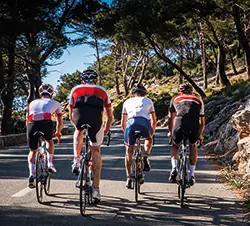
¿Es recomendable tener especial cuidado al adelantar a un grupo de ciclistas en los ascensos prolongados?
Is it advisable to take special care when overtaking a group of cyclists on long climbs?
- ANo; los adelantamientos a ciclistas no implican riesgo alguno.No; overtaking cyclists involves no risk at all.
- BSolo si algún ciclista va bebiendo algún líquido o tomando alimentos sólidos.Only if a cyclist is drinking something or eating solid food.
- CSí, porque debido al esfuerzo y pedaleo pueden realizar cambios bruscos de trayectoria.Yes, because the effort of pedalling can make them change course suddenly.
ExplanationOn long climbs cyclists pedal standing up and with effort, which makes them zigzag and change course suddenly: you must overtake with special care and keep the minimum side gap of 1.5 metres.
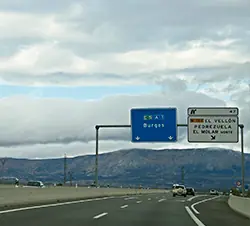
¿Está permitido realizar una parada en una autovía o autopista?
Is it allowed to stop on a dual carriageway (autovía) or motorway (autopista)?
- ASí, en la mediana o en el arcén, indistintamente.Yes, either on the central reservation or on the hard shoulder.
- BSólo si el arcén es transitable y su anchura es superior a 1,5 metros.Only if the hard shoulder is usable and more than 1.5 metres wide.
- CNo, excepto en las zonas habilitadas.No, except in the areas provided for it.
ExplanationOn motorways (autopistas) and dual carriageways (autovías) stopping and parking are prohibited except in the areas provided for this purpose (rest areas or service areas): these are high-speed roads where any stopped vehicle is a serious danger.
El conductor de un ciclomotor pretende incorporarse a la circulación desde una vía sin pavimentar. ¿Debe ceder el paso a un turismo que circula por la carretera a la que se incorpora?
A moped rider wants to join the traffic from an unpaved road. Must they give way to a car travelling along the road they are joining?
- ASí.Yes.
- BNo, porque ya ha señalizado su maniobra con el intermitente.No, because they have already signalled the manoeuvre with the indicator.
- CNo.No.
ExplanationThe moped rider, coming from an unpaved road, must give way to the car travelling on a paved road. Under the rules, vehicles on a paved road have right of way over those coming from an unpaved road. So in this situation the moped rider must give way to the car.
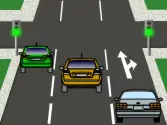
En esta vía, de un solo sentido de circulación, ¿está bien situado el vehículo amarillo para girar a la izquierda?
On this one-way road, is the yellow vehicle correctly positioned to turn left?
- ASí, ya que este es el carril adecuado para girar a la izquierda.Yes, because this is the correct lane for turning left.
- BNo, debe colocarse en el carril de la izquierda.No, it must move into the left-hand lane.
- CSí, puesto que se encuentra en carril central.Yes, because it is in the centre lane.
ExplanationIf we are driving on a one-way road with three lanes, to turn left we must move into the left-hand lane, unless the turn has been designed or signed to be made in a different way.
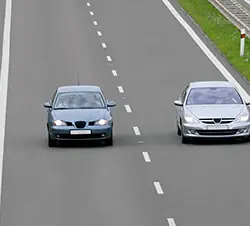
La obligación de dejar espacio suficiente para permitir el adelantamiento no será aplicable...
The obligation to leave enough space to allow overtaking does not apply...
- Adonde esté prohibido el adelantamiento.where overtaking is prohibited.
- Ben carreteras convencionales.on conventional roads.
- Cen vías con un único carril para cada sentido.on roads with only one lane in each direction.
ExplanationA driver who is driving behind another vehicle with no intention of overtaking it must leave enough space so that the vehicle following them can overtake them safely. This obligation does not apply where overtaking is prohibited, in built-up areas, when there is more than one lane in the same direction, or in very dense traffic.
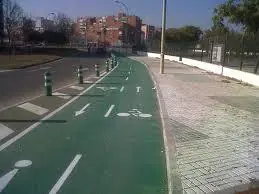
En una intersección con una vía ciclista, ¿está permitido adelantar?
Is overtaking allowed at a junction with a cycle path?
- ANo, está prohibido.No, it is prohibited.
- BSí, a velocidad tan reducida que permita detenerse para evitar un atropello.Yes, at a speed low enough to stop to avoid hitting someone.
- CEn la intersección no, pero sí en sus proximidades.Not at the junction itself, but it is allowed near it.
ExplanationAccording to Article 87 of the General Traffic Regulations (RGC), overtaking is prohibited at junctions with cycle paths and near them, as it is on pedestrian crossings and level crossings. Driving very slowly does not make the overtaking allowed.
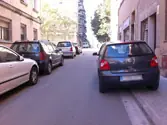
En una calzada estrecha,¿está permitido realizar una parada encima de la acera?
On a narrow carriageway, is it allowed to stop on the pavement?
- ASí,ya que la vía es estrecha.Yes, because the road is narrow.
- BSí, siempre que no molestemos a los peatones.Yes, as long as we do not disturb pedestrians.
- CNo.No.
ExplanationStopping or parking is considered to be in a dangerous place, or to seriously obstruct traffic, when it creates a risk or an obstacle to traffic in the following cases: - When the distance between the vehicle and the opposite edge of the carriageway, or a longitudinal marking on it that must not be crossed, is less than 3 metres or, in any case, when it does not let other vehicles pass. - When it prevents another vehicle that is properly stopped or parked from joining the traffic. - When it blocks the normal use of a properly marked entrance or exit of a property for vehicles, people or animals. - When it blocks the normal use of lowered kerbs for people with disabilities. - When it is done on central reservations, separators, traffic islands or other features that channel traffic. - When it prevents a turn allowed by the corresponding sign. - Stopping or parking that, even if not included in the points above, is a danger or seriously obstructs the movement of pedestrians, vehicles or animals.
En una intersección está prohibido adelantar excepto...
Overtaking at a junction is prohibited except...
- ASi tenemos la prioridad señalizada.If our right of way is marked by signs.
- BSi tenemos la prioridad aún sin señalizar.If we have right of way, even if it is not marked.
- CSi lo hacemos muy lentamente.If we do it very slowly.
ExplanationOvertaking at junctions is prohibited unless we have right of way at the junction and it is properly marked by signs, among other exceptions.
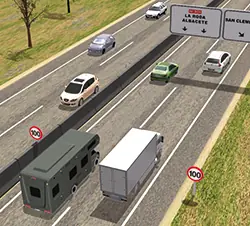
Fuera de poblado, una autocaravana va a adelantar a un vehículo pesado. ¿Puede producirse una situación de riesgo cuando circulen en paralelo si sopla fuerte viento lateral por la izquierda?
Outside built-up areas, a motorhome is about to overtake a heavy vehicle. Can a risky situation arise when they are side by side if there is a strong crosswind from the left?
- ANo, si ambos vehículos tienen el mismo volumen y peso.No, if both vehicles have the same size and weight.
- BSí, porque se produciría un empuje brusco de los dos vehículos hacia la izquierda.Yes, because both vehicles would be suddenly pushed to the left.
- CSí, puede producirse el efecto pantalla y aproximarse de forma brusca al vehículo pesado.Yes, the screen effect can occur and the motorhome can suddenly move closer to the heavy vehicle.
ExplanationWhen you are side by side with a heavy vehicle in a strong crosswind, the screen effect occurs: the air pressure between the two changes suddenly, and the motorhome, which is tall and very sensitive to wind, can be pushed suddenly towards the lorry. You should hold the steering wheel firmly and increase the gap.
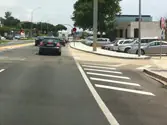
Para realizar operaciones de carga y descarga, ¿se deberá parar el motor del vehículo?
When loading and unloading, must the vehicle's engine be switched off?
- ASí, siempre.Yes, always.
- BSí, cuando el conductor tenga que dejar su puesto.Yes, when the driver has to leave the driver's seat.
- CNo.No.
ExplanationWhen the driver has to leave the driver's seat, they must switch off the engine and disconnect the starting system, leave the parking brake on and, if on a slope, also leave a gear engaged.
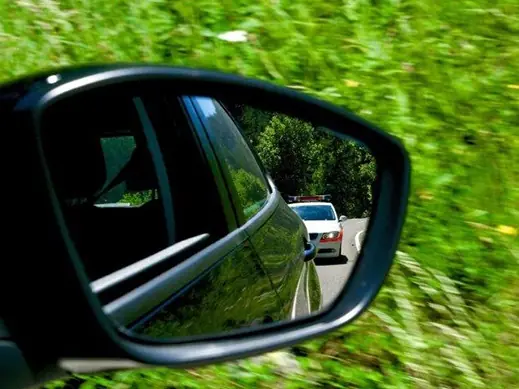
¿Qué obligación tiene si observa que otro vehículo tiene el propósito de adelantarle utilizando el carril izquierdo contiguo al suyo?
What must you do if you see that another vehicle intends to overtake you using the left-hand lane next to yours?
- AIndicarle con el intermitente derecho que puede adelantar con seguridad.Use the right indicator to show them that they can overtake safely.
- BDisminuir la velocidad.Slow down.
- CCeñirse al borde derecho de la calzada.Keep close to the right-hand edge of the carriageway.
ExplanationWhen we are about to be overtaken, we must keep close to the right-hand edge of the carriageway, without moving onto the hard shoulder, and we do not have to change our speed. However, we must slow down if a dangerous situation arises, unless the overtaking driver reduces their speed, and we must make it easy for them to return to their lane. The driver of the vehicle being overtaken is prohibited from speeding up or making manoeuvres that prevent or hinder the overtaking.
¿Se podrá efectuar una parada en doble fila habiendo sitio en las inmediaciones para efectuarla próxima a la acera?
Can you stop double-parked when there is space nearby to stop next to the pavement?
- ANo.No.
- BSí, siempre que dure menos de 2 minutos.Yes, as long as it lasts less than 2 minutes.
- CSí, cuando no obstaculice la circulación.Yes, when it does not obstruct traffic.
ExplanationStopping double-parked is only allowed when there is no space nearby to stop with the vehicle next to the pavement and it does not obstruct traffic.
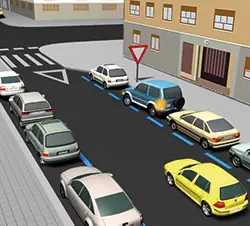
Si un vehículo estacionado se incorpora a la circulación, ¿tiene prioridad para realizar la maniobra?
If a parked vehicle pulls out into the traffic, does it have priority to make the manoeuvre?
- ASí, en cualquier caso.Yes, in all cases.
- BSí, si lo ha señalizado previamente.Yes, if it has signalled first.
- CNo.No.
ExplanationPulling out into the traffic from a parking space is a manoeuvre: you must give way to vehicles that are already moving. Using the indicator warns others of your intention, but it does not give you priority.
Si un vehículo se incorpora desde un camino privado a la vía pública, cederá el paso a...
If a vehicle joins the public road from a private track, it will give way to...
- ASolamente a los vehículos que se aproximen por su derecha.Only vehicles approaching from its right.
- BSolamente a los vehículos que se aproximen por su izquierda.Only vehicles approaching from its left.
- CA todos los vehículos que se aproximen, tanto por la derecha, como por la izquierda.All approaching vehicles, whether from the right or from the left.
ExplanationWhen a vehicle joins the traffic, it must give way to other vehicles, whichever side they are approaching from.
Está adelantando y ve que hay peligro; ¿qué debe hacer?
You are overtaking and see that there is danger. What must you do?
- AAumentar la velocidad y adelantar rápidamente.Speed up and overtake quickly.
- BReducir la velocidad, señalizar y volver a mi carril.Slow down, signal and return to my lane.
- CPedir ayuda al vehículo que estoy adelantando.Ask the vehicle I am overtaking for help.
ExplanationIf danger arises while overtaking, you must give up the manoeuvre: slow down, signal and return to your own lane behind the vehicle. Speeding up to finish quickly increases the risk of a head-on collision.
Como norma general, ¿Está permitido estacionar una motocicleta en la acera?
As a general rule, is it allowed to park a motorcycle on the pavement?
- ANo.No.
- BSí, los días laborables.Yes, on working days.
- CSí, sólo los días festivos.Yes, only on public holidays.
ExplanationArticle 94.2 of the General Traffic Regulations prohibits parking on pavements, promenades and other areas intended for pedestrians. Only if a local by-law expressly regulates it may two-wheeled vehicles park there, and without obstructing pedestrians.
Si su vehículo tiene caja de cambios manual y está en una calle en subida, ¿cómo debe aparcar?
If your vehicle has a manual gearbox and you are on an uphill street, how should you park?
- APoner el freno de mano y la primera marcha.Apply the handbrake and engage first gear.
- BPoner el freno de mano y la marcha atrás.Apply the handbrake and engage reverse gear.
- CSolo poner el freno de mano.Only apply the handbrake.
ExplanationAccording to the General Traffic Regulations (RGC), the section on parking says that when a vehicle with a manual gearbox is stopped on an uphill slope, it must be left in first gear with the parking brake on. First gear works as a mechanical brake, stopping the car from rolling downhill if the brake is released; this meets the road safety rule and prevents collisions.
¿Se podrá adelantar en un túnel con 3 carriles para el mismo sentido?
May you overtake in a tunnel with 3 lanes in the same direction?
- ASí, pero solo por el carril central.Yes, but only in the middle lane.
- BNo, en los túneles está prohibido adelantar.No, overtaking is prohibited in tunnels.
- CSí.Yes.
ExplanationOvertaking is prohibited in tunnels where there is only one lane in the direction of travel of the vehicle that wants to overtake. In this question there are 3 lanes, so overtaking is allowed.
¿Puede adelantar un ciclomotor a un tractor que circula por el arcén?
May a moped overtake a tractor travelling on the hard shoulder?
- ANo, no puede adelantar.No, it may not overtake.
- BSí, si el adelantamiento se realiza en 15 segundos o 200 metros, como máximo.Yes, if the overtaking takes no more than 15 seconds or 200 metres.
- CSí, si el adelantamiento se realiza en 30 segundos o 500 metros, como máximo.Yes, if the overtaking takes no more than 30 seconds or 500 metres.
ExplanationVehicles that are required to use the hard shoulder may overtake as long as the overtaking does not take more than 15 seconds or 200 metres.
¿Se puede adelantar en un túnel?
Can you overtake in a tunnel?
- ANo, en ningún caso.No, never.
- BSí, cuando exista más de un carril para el sentido de circulación del vehículo que pretenda adelantar.Yes, when there is more than one lane in the direction of the vehicle that wants to overtake.
- CSí, cuando se pueda invadir el sentido contrario con seguridad.Yes, when you can move into the opposite direction safely.
ExplanationOvertaking is prohibited in tunnels, underpasses and sections of road covered by the tunnel sign where there is only one lane in the direction of the vehicle that wants to overtake. When there is more than one lane, overtaking is allowed.
En una carretera con un carril para cada sentido, un camión está adelantando y no le deja ver. ¿Puede adelantar detrás del camión?
On a road with one lane in each direction, a lorry is overtaking and blocks your view. Can you overtake behind the lorry?
- ASí, porque el camión me protege.Yes, because the lorry protects me.
- BNo, porque no hay visibilidad.No, because there is no visibility.
- CSí, cuando no hay señal de prohibición de adelantar.Yes, when there is no sign prohibiting overtaking.
ExplanationOvertaking is prohibited when visibility is insufficient and, specifically, behind a vehicle that is also overtaking and whose size prevents you from seeing the road ahead (Article 87.1.a of the General Traffic Regulations). The lorry blocks the view, so you cannot overtake.
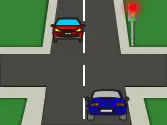
Si el vehículo azul quiere cambiar de dirección hacia la derecha, ¿podrá hacerlo en este momento?
If the blue vehicle wants to turn right, may it do so now?
- ASí, porque el semáforo se encuentra al otro lado de la intersección.Yes, because the traffic light is on the other side of the junction.
- BNo.No.
- CSí, con cuidado y cediendo el paso.Yes, carefully and giving way.
ExplanationEven if the traffic light is on the other side of the junction, you must act as if it were placed before the junction. That is why the blue vehicle must wait for the light to change, without entering the junction, whether to go straight on or to turn right or left.
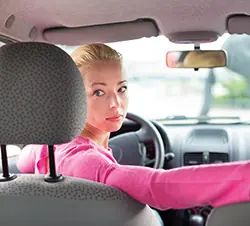
Cuando no se puede circular hacia adelante ni cambiar de dirección o sentido de la marcha, ¿se permite circular marcha atrás?
When you cannot drive forwards, turn or make a U-turn, is reversing allowed?
- ASí, pero solo con el recorrido mínimo indispensable.Yes, but only for the shortest distance necessary.
- BSí, pero el recorrido hacia atrás no puede ser superior a 15 metros ni se puede invadir un cruce de vías.Yes, but you may not reverse more than 15 metres or enter a road junction.
- CNo.No.
ExplanationWhen it is impossible to move forwards or make a U-turn, you may reverse, but only for the shortest distance necessary; the 15-metre limit applies to reversing as an additional manoeuvre (for example, when parking).
En la cima de una cuesta, ¿está prohibido parar y estacionar?
At the top of a hill, is stopping and parking prohibited?
- ANo, salvo en los tramos con visibilidad reducida.No, except on stretches with reduced visibility.
- BSí.Yes.
- CProhibido parar, pero permitido estacionar.Stopping is prohibited, but parking is allowed.
ExplanationAt a brow of a hill, specifically one with reduced visibility, stopping and parking are prohibited according to Article 94 of the General Traffic Regulations (RGC). However, if the brow of the hill allows adequate visibility, stopping is allowed, which means the correct answer is that stopping is not prohibited except where visibility is reduced. This is meant to ensure road safety, because stopping at a brow of a hill with poor visibility can create danger both for the driver and for other road users.
Un ciclomotor que circula por una carretera convencional, ¿dónde se situará para cambiar de dirección hacia la izquierda?
Where will a moped on a conventional road position itself to turn left?
- AA la izquierda de la calzada.On the left of the carriageway.
- BEn el centro de la calzada.In the centre of the carriageway.
- CA la derecha, fuera de la calzada siempre que sea posible.On the right, off the carriageway whenever possible.
ExplanationBicycles and mopeds on roads outside built-up areas with no lane specially set up for turning left must position themselves on the right, off the carriageway whenever possible, and start the turn from there.
¿Se permite parar o estacionar en una curva con poca visibilidad?
Is stopping or parking allowed on a bend with poor visibility?
- ASí, si es en el arcén.Yes, if it is on the hard shoulder.
- BNo.No.
- CSí, porque no hay ninguna señal que lo prohíba.Yes, because there is no sign prohibiting it.
ExplanationStopping is prohibited on bends with reduced visibility and near them (Article 94.1.a of the General Traffic Regulations) and, where you may not stop, you may not park either (Article 94.2.a). The ban applies even without a sign and also covers the hard shoulder.
Si, una vez iniciado el adelantamiento, surgen circunstancias que hacen difícil terminarlo sin provocar riesgos, ¿qué debe hacer el conductor?
If, after starting to overtake, circumstances arise that make it difficult to finish without creating risks, what must the driver do?
- AAcelerar para terminar el adelantamiento.Speed up to finish overtaking.
- BIndicar el riesgo al vehículo al que pretende adelantar, pero no esperar que se detenga.Warn the vehicle they intend to overtake of the risk, but not expect it to stop.
- CReducir la velocidad y regresar a su carril sin obstaculizar.Slow down and return to their lane without getting in the way.
ExplanationAccording to Article 85 of the General Traffic Regulations (RGC), once overtaking has started, if the driver meets circumstances that make it hard to finish the manoeuvre without risk, they must slow down and return to their lane. This requirement keeps the driver and the other vehicles on the road safe and prevents collisions. Speeding up or making other manoeuvres can cause dangerous situations and goes against the rules.
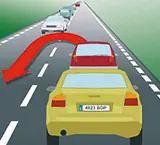
Cuando para realizar un cambio de sentido obstaculiza la marcha de los vehículos que circulan detrás, deberá...
When, in order to make a U-turn, you block the vehicles travelling behind you, you must...
- AHacer señales con la luz de freno para advertir su maniobra.Signal with the brake light to warn of your manoeuvre.
- BEsperar hasta que pueda realizar la maniobra.Wait until you can make the manoeuvre.
- CSalir de la calzada por la derecha, si fuera posible, y esperar hasta que las condiciones de la circulación le permitan hacer la maniobra.Leave the carriageway on the right, if possible, and wait until traffic conditions allow you to make the manoeuvre.
ExplanationAccording to Article 78 of the General Traffic Regulations (RGC), if waiting to make a U-turn stops the vehicles behind you from continuing, you must leave the carriageway on the right, if possible, and wait until the traffic allows you to make the manoeuvre safely.
¿En algún caso se podrá adelantar por la derecha?
Can you ever overtake on the right?
- ANo, en ningún caso.No, never.
- BSí, en poblado cuando el vehículo que nos preceda circule más lentamente.Yes, in built-up areas when the vehicle in front is going more slowly.
- CSí, en poblado si existen al menos dos carriles delimitados en el mismo sentido.Yes, in built-up areas if there are at least two marked lanes in the same direction.
ExplanationAmong other cases, we may overtake on the right on roads in built-up areas as long as there are several lanes in our direction and they are separated by longitudinal road markings.
Su vehículo se ha averiado y está parado en el arcén. ¿Debe señalizarlo?
Your vehicle has broken down and is stopped on the hard shoulder. Must you signal it?
- ASí, con la señal de emergencia y el dispositivo luminoso V-16.Yes, with the hazard warning lights and the V-16 light device.
- BNo, en el arcén no es necesario.No, it is not necessary on the hard shoulder.
- CSí, únicamente con el dispositivo luminoso V-16.Yes, only with the V-16 light device.
ExplanationAccording to Article 130 of the General Traffic Regulations (RGC), a vehicle immobilised by a breakdown, including on the hard shoulder, must be signalled with the hazard warning lights and with the official hazard warning device, which since 1 January 2026 is the V-16 (flashing warning beacon).
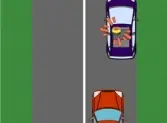
En esta situación, ¿el vehículo rojo puede adelantar al vehículo inmovilizado?
In this situation, can the red vehicle overtake the broken-down vehicle?
- ASí, siempre.Yes, always.
- BSí, después de asegurarse de que puede realizarse sin peligro.Yes, after making sure it can be done without danger.
- CNo, porque la marca longitudinal lo prohíbe.No, because the longitudinal marking prohibits it.
ExplanationWhen, on a stretch of road where overtaking is prohibited, there is an obstacle or a vehicle immobilised for reasons unrelated to traffic (breakdown, accident or other emergency) blocking the lane in your direction, you may pass it even if you need to use part of the lane for the opposite direction, always after making sure that you can pass without danger. Going past an immobilised vehicle or an obstacle is not considered overtaking but passing.
¿Para qué sirven los intermitentes?
What are indicators for?
- ASolo para indicar la maniobra por la noche.Only to signal a manoeuvre at night.
- BPara ser visto durante la noche.To be seen at night.
- CPara indicar la maniobra tanto de día como de noche.To signal a manoeuvre both by day and by night.
ExplanationIndicators, or direction indicator lights, are used to warn of sideways movements, such as a turn or a lane change (Article 109 of the RGC). They are always used, by day and by night; they are not lights for making yourself seen.
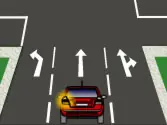
El turismo, ¿está bien situado para girar a la izquierda?
Is the car in the right position to turn left?
- ASí.Yes.
- BSí, porque circula dentro de poblado.Yes, because it is in a built-up area.
- CNo.No.
ExplanationAn arrow in a lane marked by longitudinal lines means that every driver must follow the direction, or one of the directions, shown by the arrow in the lane where it is, or, if the markings allow it, change lane. In the case in the question, to turn left the vehicle must move into the left-hand lane.
Después de adelantar al camión, ¿puede seguir circulando por el carril izquierdo?
After overtaking the lorry, may you carry on driving in the left-hand lane?
- ANo, debe volver al carril derecho.No, you must return to the right-hand lane.
- BNo, porque el carril izquierdo sólo puede usarse para adelantar.No, because the left-hand lane may only be used for overtaking.
- CSí, porque en autopista se puede circular por cualquier carril.Yes, because on a motorway (autopista) you may drive in any lane.
ExplanationAfter overtaking you must return to your lane as soon as possible and gradually (Article 85.3 of the General Traffic Regulations). Outside built-up areas you normally drive in the right-hand lane; the others may be used when traffic makes it advisable, not only to overtake (Article 31.1).
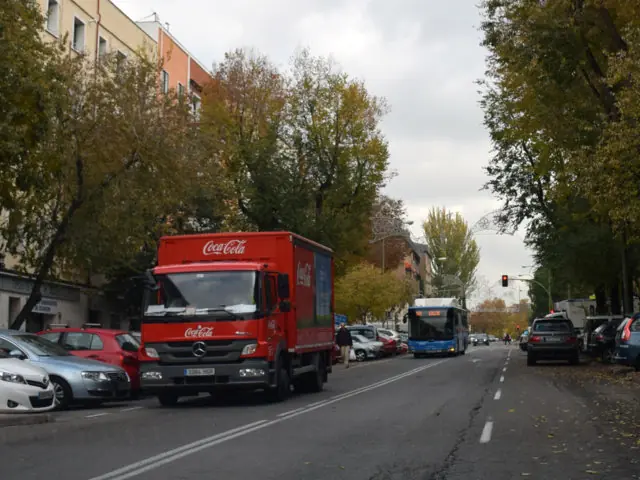
Se considera que un estacionamiento obstaculiza gravemente la circulación cuando se realiza en...
Parking is considered to seriously obstruct traffic when it is done...
- Alas proximidades de un paso de peatones.near a pedestrian crossing.
- Bdoble fila, con o sin conductor, por tiempo superior a dos minutos.double-parked, with or without the driver, for more than two minutes.
- Cdoble fila sin conductor.double-parked without the driver.
ExplanationWhen parking is done in the middle of the carriageway, it is considered parking (not stopping) in a dangerous place or that seriously obstructs traffic, and it is a risk or obstacle to traffic.
Si estacionamos nuestro vehículo en una vía urbana de sentido único, ¿en qué lado de la vía lo haremos?
If we park our vehicle on a one-way urban road, on which side of the road will we do it?
- ASolo en el lado derecho.Only on the right-hand side.
- BSe podrá realizar tanto en el lado derecho como en el izquierdo.It can be done on either the right-hand or the left-hand side.
- CDentro de poblado está prohibido estacionar en la calzada.In built-up areas, parking on the carriageway is prohibited.
ExplanationIf the road is one-way, you may park on either the right-hand or the left-hand side of the carriageway.
¿Podemos parar en un carril de autobús con nuestro coche?
Can we stop our car in a bus lane?
- ASí, siempre que sea menos de 2 minutos.Yes, as long as it is for less than 2 minutes.
- BNo, está prohibido.No, it is prohibited.
- CSí, para bajar pasajeros.Yes, to let passengers out.
ExplanationThe General Traffic Regulations (RGC) say that in lanes reserved exclusively for urban public transport, no other vehicles may stop. So the correct option is 'No'. Parking or stopping in a bus lane, however short, is prohibited, because these lanes are designed to keep public transport moving and passengers safe.
Queremos realizar un cambio de sentido, ¿podemos realizar la marcha atrás para llevarlo a cabo?
We want to make a U-turn. Can we reverse to do it?
- ASí, hasta un recorrido máximo de 15 metros.Yes, for a maximum of 15 metres.
- BSí, sin restricción de metros.Yes, with no limit in metres.
- CNo.No.
ExplanationA U-turn must be made so that the road is blocked for as short a time as possible, without reversing, because that is prohibited. We will position ourselves next to the right-hand edge of the carriageway when we cannot make the U-turn from the centre of it as described above.
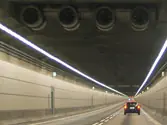
¿Se podrá adelantar dentro de un túnel?
Can you overtake inside a tunnel?
- ASí, siempre que los dos sentidos estén delimitados.Yes, as long as the two directions of traffic are marked out.
- BNo.No.
- CSí, cuando exista más de un carril en el mismo sentido de la circulación del vehículo que pretenda adelantar.Yes, when there is more than one lane in the direction of the vehicle that wants to overtake.
ExplanationAs a general rule, overtaking is prohibited in tunnels if they have only one lane in the direction of the vehicle that wants to overtake.
Junto a una línea amarilla discontinua en el borde de la calzada, ¿se puede parar para bajar y recoger una carga abandonada, dejando el vehículo?
Next to a broken yellow line at the edge of the carriageway, may you stop to get out and pick up an abandoned load, leaving the vehicle?
- ASí, siempre que la duración sea inferior a dos minutos.Yes, as long as it takes less than two minutes.
- BNo, porque se considera estacionamiento y está prohibido.No, because it counts as parking, which is prohibited.
- CSí, porque es una zona donde se permite la parada.Yes, because stopping is allowed in this area.
ExplanationA broken yellow line next to the edge of the carriageway (marking M-7.7) prohibits parking, but not stopping. Stopping means bringing the vehicle to a standstill for less than two minutes without the driver leaving it; if the driver gets out and leaves it to pick up the load, it is already parking, and that is prohibited.
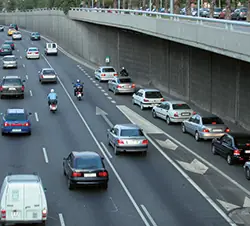
Si observa que un vehículo quiere incorporarse por el carril de aceleración, ¿qué debe hacer?
If you see that a vehicle wants to join from the acceleration lane, what must you do?
- ANada, porque tengo preferencia.Nothing, because I have priority.
- BCederle el paso.Give way to it.
- CFacilitarle la incorporación en la medida de lo posible.Make it easier for it to join, as far as possible.
ExplanationAnyone driving on the main road keeps priority, but the Regulations ask them to make it easier, as far as possible, for vehicles coming from the acceleration lane to join, for example by adjusting their speed or changing lanes.
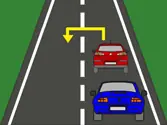
En esta situación, ¿el vehículo rojo podrá realizar un cambio de sentido?
In this situation, can the red vehicle make a U-turn?
- ASí, porque lo puede hacer en un solo giro.Yes, because it can do it in a single turn.
- BSí, porque no está prohibido.Yes, because it is not prohibited.
- CNo, porque entorpece al resto de usuarios.No, because it gets in the way of other road users.
ExplanationIn the situation in the picture, the red vehicle cannot make the U-turn, because it would block the vehicles following it, so it must not make the manoeuvre and must wait for the right moment to do it.
¿Dónde se colocará un ciclomotor para girar a la izquierda en una vía interurbana?
Where will a moped position itself to turn left on a road outside built-up areas?
- AEn la parte central de su carril.In the centre of its lane.
- BSi no existe carril específico para realizar el giro, se situará en la derecha, fuera de la calzada.If there is no specific lane for the turn, on the right, off the carriageway.
- CEn el eje de la calzada si la vía es de doble sentido.On the centre line of the carriageway if the road is two-way.
ExplanationOn roads outside built-up areas, if there is no lane specially set up for turning left, two-wheeled bicycles and mopeds must position themselves on the right, off the carriageway whenever possible, and start the turn from there.

¿Se podrá adelantar por la derecha en una autovía?
Can you overtake on the right on a dual carriageway (autovía)?
- ASí, si está dentro de poblado.Yes, if it is in a built-up area.
- BNo, porque está prohibido.No, because it is prohibited.
- CSí, si los carriles están delimitados.Yes, if the lanes are marked out.
ExplanationOn roads outside built-up areas, as a general rule, you overtake on the left. Even if the dual carriageway (autovía) runs through a built-up area, the traffic rules for roads outside built-up areas apply to it.
Si estacionamos nuestro turismo con remolque en una pendiente...
If you park your car with a trailer on a slope, you must...
- APoner una piedra para sujetar el vehículo.Put a stone under a wheel to hold the vehicle.
- BUsar un calzo.Use a wheel chock.
- CPoner el freno de mano y la 1.ª velocidad.Apply the handbrake and engage first gear.
ExplanationA vehicle combination, such as a car with a trailer, parked on a noticeable slope must be chocked with wheel chocks, never with stones, or have one of its steering wheels resting against the kerb (Article 92.3.d of the General Traffic Regulations). The brake and the gear are not enough in this case.
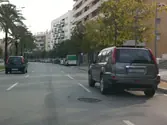
¿Cómo advertirá su propósito de efectuar una parada en el carril derecho a los conductores de los vehículos que circulan detrás de usted?
How will you warn the drivers of the vehicles behind you that you intend to stop in the right-hand lane?
- AUtilizando la señal de emergencia.By using the hazard warning lights.
- BUtilizando el intermitente derecho.By using the right indicator.
- CUtilizando el intermitente izquierdo.By using the left indicator.
ExplanationTo signal that we are going to stop, we must use the indicator on the side where we are going to bring the vehicle to a halt. The hazard warning lights are used to signal and warn of the danger temporarily posed by a vehicle affected by a breakdown, an accident, a fallen load or any other emergency, on urban and interurban roads, by day and by night, whether the vehicle is stationary or moving, but not to signal stopping or parking.
Si al cambiar de dirección encontramos a un peatón cruzando la calzada,...
If, when turning, you find a pedestrian crossing the carriageway,...
- ALe dejaremos cruzar pues tiene prioridad.You let them cross, because they have right of way.
- BLe dejaremos cruzar, pero no tiene prioridad.You let them cross, but they do not have right of way.
- CPasaremos nosotros pues no tiene prioridad.You go first, because they do not have right of way.
ExplanationIf, when turning, you find pedestrians crossing the carriageway, they have right of way.
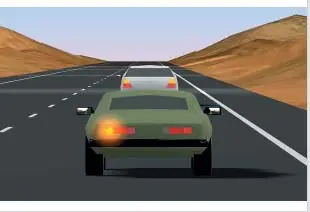
Para facilitar el adelantamiento, ¿qué debe hacer el vehículo adelantado?
To make overtaking easier, what must the vehicle being overtaken do?
- AApartarse al arcén.Move onto the hard shoulder.
- BCeñirse al borde derecho de la calzada.Keep close to the right-hand edge of the carriageway.
- CCircular por el centro de su carril.Drive in the centre of its lane.
ExplanationWhen we are about to be overtaken, we must keep close to the right-hand edge of the carriageway, without moving onto the hard shoulder, and we do not have to change our speed. However, we must slow down if a dangerous situation arises, unless the overtaking driver reduces their speed, and we must make it easy for them to return to their lane. The driver of the vehicle being overtaken is prohibited from speeding up or making manoeuvres that prevent or hinder the overtaking. Drivers of heavy vehicles, large vehicles or vehicles that must keep to a specific speed limit must slow down or move onto the hard shoulder as soon as possible, if it is usable, to let the vehicles behind them pass, when oncoming traffic, a carriageway that is too narrow, or its layout or condition do not allow them to be overtaken easily and without danger. If these drivers cannot keep fully to the right-hand edge of the carriageway, but overtaking can still be done safely, they will show this to the approaching driver by holding out their arm horizontally and moving it back and forth several times, or with the right indicator.
En las vías del tranvía, ¿qué está prohibido?
On tram tracks, what is prohibited?
- ADetenerse y estacionar.Stopping and parking.
- BSolo estacionar.Only parking.
- CCircular.Driving.
ExplanationAccording to Article 94 of the General Traffic Regulations (RGC), it is prohibited to stop 'on tram rails or so close to them that tram traffic could be hindered'. The text covers both stopping and parking in that space, so the prohibition applies to both. Driving (going over them) is legal as long as it does not get in the way of the tram.
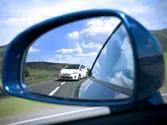
El conductor que aprecia que va a ser adelantado, ¿tiene alguna obligación?
Does a driver who sees that they are about to be overtaken have any obligation?
- ASi, poner el intermitente del lado derecho.Yes, to switch on the right indicator.
- BSi, disminuir la velocidad.Yes, to slow down.
- CSi, aproximarse el máximo posible al borde derecho de la calzada.Yes, to move as close as possible to the right-hand edge of the carriageway.
ExplanationWhen a driver sees that they are about to be overtaken, they must not speed up and must keep close to the right-hand edge of the carriageway.
All topics
- Definitions
- Documents and penalty points
- The driver's condition
- Duties of drivers and pedestrians
- Vehicle safety devices
- Vehicle controls and equipment
- Vehicle lights and horn
- Traffic signs, markings and signals
- The road and its lanes
- Speed and distances
- Right of way
- Carrying passengers and loads
- Driving safely in difficult conditions
- Vehicle mechanics and maintenance
- Road accidents and first aid
- Defensive and eco-driving
Independent app: not affiliated with or endorsed by the DGT (Spain's Directorate-General for Traffic) or the Ministry of the Interior. The official exam is booked with the DGT and taken at its test centres. The questions here are practice material; the DGT's official question bank is not public.
Basado en datos de la Agencia Estatal Boletín Oficial del Estado (https://www.boe.es). Textos consolidados de carácter meramente informativo. La AEBOE no patrocina ni respalda este sitio.
Parte de las preguntas procede de los tests de la revista «Tráfico y Seguridad Vial» de la DGT, reproducidos con indicación de la fuente.