
DGT test · 982 questions
Manoeuvres · Page 3 of 20
Joining traffic, overtaking, turning, U-turns, reversing, stopping and parking: how and where to do them and when they are forbidden.
Questions in this topic, with answers
982 questions, 50 per page, with the correct answer and the explanation. Page 3 of 20.
Los conductores están obligados a advertir mediante señales ópticas...
Drivers are obliged to signal with visual signals…
- Aúnicamente las maniobras que impliquen un desplazamiento lateral.only manoeuvres that involve a sideways movement.
- Bsólo las maniobras que no impliquen un desplazamiento lateral.only manoeuvres that do not involve a sideways movement.
- Ctoda maniobra que implique un desplazamiento lateral o hacia atrás.every manoeuvre that involves a sideways or backward movement.
ExplanationDrivers are obliged to signal, sufficiently in advance, any manoeuvre they are going to make that involves a sideways or backward movement, using the vehicle's lights or their arm. Signalling a manoeuvre does not give you priority to carry it out.
¿Está prohibido parar y estacionar en una intersección?
Is stopping and parking prohibited at a junction?
- ASí, siempre.Yes, always.
- BSí, si dificulta el giro.Yes, if it makes turning difficult.
- CNo.No.
ExplanationStopping and parking at a junction are prohibited if they make it difficult for other vehicles to turn.
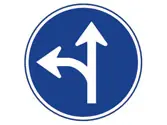
¿Podremos efectuar un cambio de dirección en una intersección así señalizada?
May we turn at a junction marked like this?
- ASí.Yes.
- BNo.No.
- CSí, pero solo hacia la derecha.Yes, but only to the right.
ExplanationThe arrows show the only directions vehicles may take. At a junction marked like this, we may turn left. We are not allowed to turn right or make a U-turn.
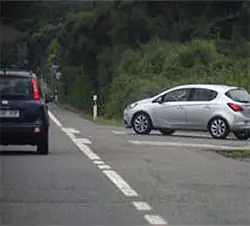
El conductor de un turismo, ¿qué debe hacer para incorporarse a la circulación?
What must a car driver do to join the traffic?
- ASolo señalizar la maniobra, porque los demás tienen que ceder el paso.Only signal the manoeuvre, because others must give way.
- BSeguir siempre las indicaciones de otra persona.Always follow another person's directions.
- CAsegurarse de que puede hacerlo sin peligro para los demás usuarios.Make sure they can do so without danger to other road users.
ExplanationAnyone joining the traffic must first make sure that they can do so without danger to other road users, giving way to them: priority belongs to those already travelling on the road. Signalling the manoeuvre is not enough on its own.
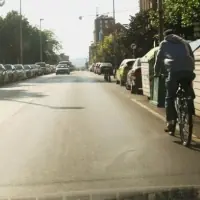
¿Se puede invadir el carril contrario de la calzada al adelantar a una bicicleta?
Can you enter the opposite lane of the carriageway when overtaking a bicycle?
- ASolo fuera de poblado y si la bicicleta rebasa los 40km/horaOnly outside built-up areas and if the bicycle is going faster than 40 km/h
- BSi, si es necesario siempre que no se infrinja ninguna normaYes, if necessary, as long as no rule is broken
- CNo, está prohibido invadir el carril contrario en todos los casosNo, entering the opposite lane is prohibited in all cases
ExplanationTo overtake a cyclist or a group of cyclists, you will occupy part or all of the opposite lane of the carriageway, even where overtaking is prohibited, as long as the manoeuvre can be done without danger and no rule is broken.
En una carretera estrecha, desea dar la vuelta. ¿Dónde debe colocarse para no molestar a otros vehículos?
You want to make a U-turn on a narrow road. Where should you position yourself so as not to hinder other vehicles?
- AEn el carril contrario, para iniciar el giro desde allí.In the opposite lane, to start the turn from there.
- BEn el centro de la calzada, sin ocupar el carril contrario.In the middle of the carriageway, without occupying the opposite lane.
- CLo más a la derecha y esperar hasta poder hacerlo con seguridad.As far to the right as possible, and wait until you can do it safely.
ExplanationUnder Article 78 of the General Traffic Regulations (RGC), a driver who is going to make a U-turn must choose a suitable place and, if waiting on the carriageway blocks the vehicles behind, must leave it on the right-hand side until the manoeuvre can be made without danger.
Si pretende adelantar a un ciclista en una via provista de dos carriles para cada sentido, ¿deberá desplazarse lateralmente hasta invadir completamente el carril contiguo?
If you intend to overtake a cyclist on a road with two lanes in each direction, must you move sideways until you are completely in the adjacent lane?
- ASi, pero solo en vías interurbanas.Yes, but only on interurban roads.
- BSi, cuando se trate de un carril para nuestro sentido.Yes, when it is a lane for our direction.
- CNo, solo debo mantener 1,5m de separación lateral e invadir en parte el carril contiguo.No, I only need to keep a 1.5 m side gap and partly enter the adjacent lane.
ExplanationWhen overtaking a cycle on roads with more than one lane in our direction, we must move our vehicle completely into the adjacent lane.
¿Se puede parar en una autovía?
Can you stop on a dual carriageway (autovía)?
- ANo, porque está prohibido.No, because it is prohibited.
- BNo, sólo en lugares especialmente acondicionados para ello.No, only in places specially set up for this.
- CEn una autovía no, en autopista sí.Not on a dual carriageway (autovía), but yes on a motorway (autopista).
ExplanationOn a dual carriageway, stopping is prohibited on both the carriageway and the hard shoulder; you may only stop in places set up for this.
Debe abstenerse de cambiar de dirección cuando...
You must refrain from turning when...
- Ano tiene prioridad.you do not have priority.
- Bla velocidad y la distancia de los vehículos que vienen en sentido contrario no permiten realizar la maniobra con seguridad.the speed and distance of oncoming vehicles do not allow you to carry out the manoeuvre safely.
- Cla vía es de sentido único.the road is one-way.
ExplanationUnder Article 74.1 of the RGC, before turning you must make sure that the speed and distance of vehicles approaching from the opposite direction allow you to do so without danger, and refrain from the manoeuvre if not; the same applies when turning left without sufficient visibility.
Para evitar la fatiga, debe parar y descansar durante 20 o 30 minutos...
To avoid fatigue, you should stop and rest for 20 or 30 minutes...
- Acada 2 horas o cada 200 kilómetros de conducción continua.every 2 hours or every 200 kilometres of continuous driving.
- Bcada 4 horas o cada 400 kilómetros de conducción continua.every 4 hours or every 400 kilometres of continuous driving.
- Cen la mitad del trayecto.halfway through the journey.
ExplanationThe DGT recommends stopping to rest for about 20 or 30 minutes every 2 hours or every 200 kilometres of continuous driving, even if you do not feel tired. It is safety advice, not a rule in the Regulations, and at the first signs of fatigue you must stop sooner.
Si debes parar en el interior de un túnel por una emergencia, es obligatorio...
If you have to stop inside a tunnel because of an emergency, you must…
- Adejar el motor encendido y la llave en el contacto.leave the engine running and the key in the ignition.
- Bmantener a todos los ocupantes dentro del vehículo.keep all occupants inside the vehicle.
- Capagar el motor, encender las luces de emergencia y dejar puestas las luces de posición.switch off the engine, switch on the hazard warning lights and leave the sidelights on.
ExplanationWhen a vehicle stops in a tunnel because of an emergency, it is compulsory to switch off the engine, switch on the hazard warning lights and keep the sidelights on. This rule is set out in the Traffic and Road Safety Code, specifically in the article on stopping in tunnels. This is done to avoid the risk of fire and make it easier for other vehicles to pass, as well as to ensure visibility in emergencies.
Si el intermitente del vehículo no funciona, ¿cómo indicará que va a girar a la izquierda?
If the vehicle's indicator does not work, how will you show that you are going to turn left?
- ACon el brazo izquierdo en posición horizontal y la palma de la mano extendida hacia abajo.With your left arm horizontal and the palm of your hand stretched out facing down.
- BExtendiendo el brazo izquierdo horizontalmente, con la palma de la mano hacia atrás.Stretching your left arm out horizontally, with the palm of your hand facing backwards.
- CDoblando el brazo izquierdo hacia arriba, con la palma de la mano extendida.Bending your left arm upwards, with the palm of your hand open.
ExplanationThe manoeuvres we make with our vehicles must be signalled to other road users. To do this we will use the indicators or, failing that, our arm: - The left indicator or the left arm stretched out, to turn left, move sideways to that side or stop on the left-hand side. - The right indicator or the left arm bent upwards, to turn right, move sideways to that side or stop on the right-hand side. - The reversing light or the arm stretched out horizontally with the palm facing backwards, to reverse.
¿Puede girar a la izquierda en una curva con poca visibilidad?
May you turn left on a bend with poor visibility?
- ASí, porque no hay una línea discontinua que lo impida.Yes, because there is no broken line preventing it.
- BNo, porque no hay suficiente visibilidad.No, because there is not enough visibility.
- CSí, si no veo vehículos que vengan en sentido contrario.Yes, if I cannot see any vehicles coming the other way.
ExplanationUnder Article 74.1 of the RGC, you must not turn left when there is not enough visibility, even if there is no continuous line and no vehicles can be seen at that moment: on a blind bend, an oncoming vehicle can appear when you are already crossing.
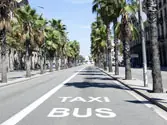
¿Se podrá parar en un carril BUS?
May you stop in a BUS lane?
- ASí, entrando por la línea discontinua.Yes, entering at the broken line.
- BNo, está prohibido.No, it is prohibited.
- CSí, siempre que estemos menos de 2 minutos y solo para cargar o descargar cosas.Yes, as long as we are there less than 2 minutes and only to load or unload things.
ExplanationStopping, and therefore parking, is prohibited in lanes for the exclusive use of urban public transport, even if you enter at the broken line or it is only for a moment. You may enter at the broken line only for manoeuvres such as turning.
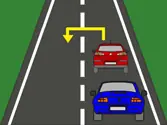
¿Qué consideraciones ha de tener en cuenta al realizar un cambio de sentido?
What must you bear in mind when making a U-turn?
- AEvitar poner en riesgo u obstruir a otros usuarios.Avoid endangering or obstructing other road users.
- BMantener una distancia de más de 100 metros con el vehículo que va adelante.Keep a distance of more than 100 metres from the vehicle in front.
- CQue siempre debe existir un lugar acondicionado en la vía para realizar la maniobra.That there must always be a place set up on the road for the manoeuvre.
ExplanationA driver who intends to turn round and go in the opposite direction must choose a suitable place for the manoeuvre, so that the road is blocked for as short a time as possible, signal their intention with the required signals sufficiently in advance, and make sure they will not endanger or obstruct other road users. Otherwise, they must not make the manoeuvre and must wait for the right moment to do it.
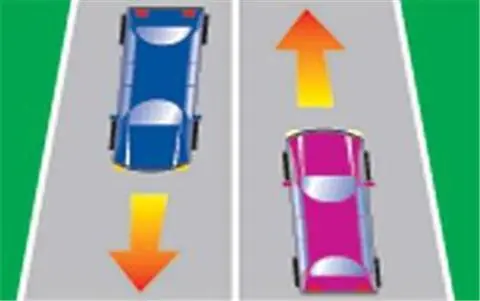
En una vía interurbana de doble sentido de circulación, ¿está permitido realizar una parada o estacionamiento en el lado izquierdo?
On a two-way road outside built-up areas, is it allowed to stop or park on the left-hand side?
- ASolo cuando la línea de separación de ambos sentidos es discontinua.Only when the line separating the two directions is broken.
- BNo, en ningún caso.No, never.
- CSí, siempre que el vehículo quede fuera de la calzada.Yes, as long as the vehicle is off the carriageway.
ExplanationOn roads outside built-up areas, stopping and parking must always be done off the carriageway, on the right-hand side, leaving the usable part of the hard shoulder free (Article 90 of the General Traffic Regulations). On two-way carriageways you may never stop or park on the left-hand side.
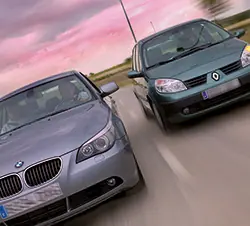
No deberá iniciar un adelantamiento sin comprobar previamente que...
You must not start overtaking without first checking that…
- Aexiste espacio suficiente para volver al carril derecho cuando termine la maniobra.there is enough space to return to the right-hand lane when you finish the manoeuvre.
- Blos vehículos que circulan detrás mantienen la distancia de seguridad.the vehicles behind are keeping a safe distance.
- Cel vehículo de delante reduce su velocidad para facilitar la maniobra.the vehicle in front is reducing its speed to make the manoeuvre easier.
ExplanationBefore overtaking, you must check that you will be able to return to the right-hand lane when you finish, that is, that there is enough space in front of the vehicle being overtaken to move back in without forcing it to manoeuvre.
¿Se podrá efectuar una parada en el carril Bus?
Can you stop in a bus lane?
- ASí, menor de 2 minutos.Yes, for less than 2 minutes.
- BNo.No.
- CSí, para dejar o recoger pasajeros.Yes, to drop off or pick up passengers.
ExplanationBoth stopping and parking are prohibited in a bus lane.
¿Podrá una bicicleta adelantar a un ciclomotor que circula por el arcén?
Can a bicycle overtake a moped that is travelling on the hard shoulder?
- ASí.Yes.
- BSí, siempre que el recorrido en paralelo no supere 200 m o 15 seg.Yes, as long as the side-by-side stretch does not exceed 200 m or 15 seconds.
- CNo, los vehículos que circulan por el arcén no se pueden adelantar.No, vehicles travelling on the hard shoulder cannot be overtaken.
ExplanationYes. The limit of not riding side by side for more than 15 seconds or more than 200 metres when overtaking applies to vehicles travelling on the hard shoulder, but it expressly does not apply to bicycles (Article 36 of the General Traffic Regulations). So a bicycle can overtake a moped that is travelling on the hard shoulder.
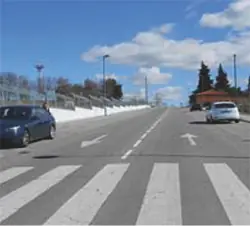
En vías urbanas de doble sentido de circulación, ¿en qué lado de la calzada puede estacionar un turismo?
On two-way urban roads, on which side of the carriageway can a car park?
- AA ambos lados cuando la línea de separación de los sentidos sea discontinua.On both sides when the line separating the two directions is broken.
- BEn el lado izquierdo de la calzada en el sentido de la marcha.On the left-hand side of the carriageway in the direction of travel.
- CEn el lado derecho de la calzada en el sentido de la marcha.On the right-hand side of the carriageway in the direction of travel.
ExplanationOn two-way urban roads you may only park on the right-hand side in the direction of travel: parking on the left would mean crossing the opposite direction and would leave the vehicle facing the wrong way.
¿Le está permitido parar el ciclomotor en el arcén transitable de una vía interurbana?
May you stop your moped on the usable hard shoulder of a road outside built-up areas?
- ASí.Yes.
- BNo.No.
- CSí, si la parada no supera los dos minutos.Yes, if the stop does not last more than two minutes.
ExplanationNo, you may not stop your moped on the usable hard shoulder of a road outside built-up areas. The usable hard shoulder on roads outside built-up areas may not be used for stopping or parking, because it is for vehicles that must travel on the hard shoulder, such as cycles and mopeds, among others.
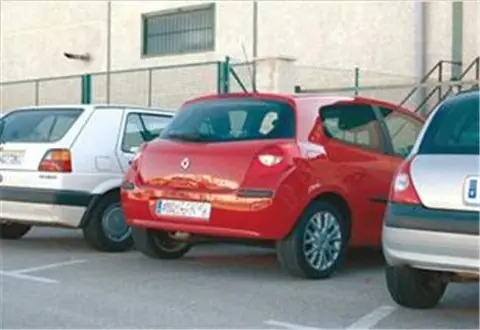
Antes de circular marcha atrás, siempre deberá comprobar que...
Before reversing, you must always check that…
- Ael recorrido va a ser inferior a 15 metros.the distance will be less than 15 metres.
- Blleva encendidas las luces de emergencia.your hazard warning lights are on.
- Cpuede hacerlo sin ocasionar peligro a otros usuarios de la vía.you can do it without causing danger to other road users.
ExplanationAs a general rule, reversing is prohibited, except: if you cannot move forwards, change direction or make a U-turn (there is no limit on the reversing distance for this manoeuvre); and to stop, park or join the traffic, without entering a junction and for a maximum of 15 metres.
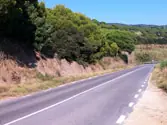
¿Qué haremos si circulamos por una carretera convencional y al cambiar de dirección a la derecha para entrar en un camino de tierra nos encontramos peatones circulando por el arcén?
What should we do if, on a conventional road, we turn right into a dirt track and find pedestrians walking on the hard shoulder?
- ACederles el paso porque el vehículo cruza un arcén por el que estén circulando peatones que no disponen de zona peatonal.Give way to them, because the vehicle is crossing a hard shoulder used by pedestrians who have no pedestrian area.
- BAdvertirles con el claxon y continuar la maniobra.Warn them with the horn and carry on with the manoeuvre.
- CPasaremos primero porque los peatones no están pasando por un paso de peatones y no tienen preferencia.Go first, because the pedestrians are not on a pedestrian crossing and do not have right of way.
ExplanationUnder Article 65 of the General Traffic Regulations (RGC) (as worded by RD 518/2026), the driver must give way to pedestrians when their vehicle crosses a hard shoulder used by pedestrians who have no pedestrian area, even if there is no pedestrian crossing.
La detención de un vehículo es ...
A halt (detención) of a vehicle is…
- AUn estacionamiento sin bajarse del vehículo.Parking without getting out of the vehicle.
- BLa inmovilización del vehículo por necesidades de la circulación.Bringing the vehicle to a standstill because of traffic needs.
- CUna parada que dura más de 2 minutos.A stop that lasts more than 2 minutes.
ExplanationA halt (detención) is the accidental or momentary immobilisation of a vehicle because of an emergency, because of traffic needs or to comply with a rule. Both stopping (parada) and parking are voluntary immobilisations, meaning that the driver chooses to make them. Stopping must be done without leaving the vehicle and for less than 2 minutes. Parking, on the other hand, is when the driver leaves the vehicle or the 2-minute limit is exceeded.
¿Se podrá efectuar un cambio de sentido utilizando para ello una glorieta?
Can a U-turn be made using a roundabout?
- ANo, porque siempre tengo que entrar por la derecha.No, because I always have to enter on the right.
- BSí, siguiendo su sentido giratorio.Yes, following its direction of rotation.
- CSí, entrando por su lado izquierdo.Yes, entering on its left-hand side.
ExplanationA roundabout is a suitable place to make a U-turn, and it is recommended for this.
Si al cambiar de dirección encontramos un peatón cruzando la calzada...
If, when turning, we find a pedestrian crossing the carriageway…
- Ano tendrá prioridad si no hay paso para peatones.they will not have priority if there is no pedestrian crossing.
- Bdebemos cederle el paso.we must give way to them.
- Cpararemos, pero no tiene prioridad.we will stop, but they do not have priority.
ExplanationWhen we turn and find a pedestrian crossing the carriageway, that pedestrian has right of way over the vehicle.
El adelantamiento se efectuará por la derecha y adoptando las máximas precauciones...
Overtaking will be done on the right, taking the greatest care…
- Aen vías con más de un carril en el mismo sentido.on roads with more than one lane in the same direction.
- Bcuando el conductor del vehículo al que se pretende adelantar está indicando claramente su propósito de girar a la izquierda.when the driver of the vehicle you intend to overtake is clearly signalling their intention to turn left.
- Csiempre que se adelante a un vehículo articulado.whenever you are overtaking an articulated vehicle.
ExplanationOvertaking must be done on the left. As an exception, we may do it on the right: - When the driver of the vehicle we intend to overtake is clearly signalling their intention to stop or turn left, if there is enough space to do so. - On two-way roads, when overtaking trams running in the centre of the carriageway. - On urban roads with more than one lane in the same direction, marked by longitudinal markings.
En un túnel con un carril por sentido, ¿puedes adelantar?
In a tunnel with one lane in each direction, can you overtake?
- ASí, si hay visibilidadYes, if there is visibility
- BNo, está prohibidoNo, it is prohibited
- CSolo si no hay línea continuaOnly if there is no solid line
ExplanationIn tunnels with only one lane in each direction, overtaking is prohibited. In tunnels with more lanes, the general rules apply.
Al cambiar de dirección, ¿qué debe tener en cuenta?
When turning, what must you take into account?
- AQue no ponga en peligro ni obstaculice a los demás usuarios.That you do not endanger or obstruct other road users.
- BQue exista un lugar adecuado en la vía para realizar la maniobra.That there is a suitable place on the road to carry out the manoeuvre.
- CQue deje una distancia superior a 100 metros respecto del vehículo que circula delante.That you leave more than 100 metres from the vehicle in front.
ExplanationBefore turning you must signal in advance and make sure that the speed and distance of other vehicles allow you to do so without danger; if not, you must refrain (Article 74.1 of the RGC). Choosing a suitable place is a requirement for U-turns, and there is no fixed distance of 100 metres.
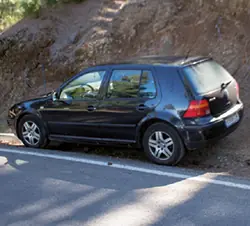
Esta carretera no tiene arcén; ¿puede estacionar a la derecha, fuera de la vía?
This road has no hard shoulder. Can you park on the right, off the road?
- ASí, porque estoy fuera de la calzada.Yes, because I am off the carriageway.
- BNo, porque es una vía interurbana.No, because it is an interurban road.
- CSolo si hay una señal que permita expresamente el estacionamiento.Only if there is a sign that expressly allows parking.
ExplanationYou can stop and park off the public road. In this case, as there is no hard shoulder, you can park off the carriageway. (On interurban roads, stopping or parking on the hard shoulder is prohibited.) Halting on the hard shoulder is only allowed because of a breakdown or because the driver or passengers are unwell.
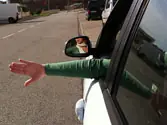
Advertir a otros usuarios de que se va a realizar una maniobra, ¿es obligatorio?
Is it compulsory to warn other road users that you are going to make a manoeuvre?
- ANo, sólo es obligatorio advertir a los conductores.No, it is only compulsory to warn drivers.
- BNo, pero es siempre muy aconsejable.No, but it is always highly advisable.
- CSí, siempre.Yes, always.
ExplanationManoeuvres can change the normal driving conditions of other vehicles, and their drivers may be affected or surprised, so a driver who wants to make a manoeuvre must warn other road users of their intention sufficiently in advance. We will use the vehicle's lights or, failing that, our arm to signal it. Signalling the manoeuvre does not give you priority to carry it out.
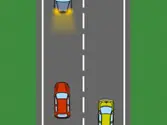
El vehículo amarillo disminuye la velocidad porque el adelantamiento que está haciendo el vehículo rojo es peligroso, ¿es correcto?
The yellow vehicle slows down because the overtaking being done by the red vehicle is dangerous. Is this correct?
- ANo, el vehículo amarillo no debe variar de velocidad.No, the yellow vehicle must not change its speed.
- BNo, porque el vehículo que se aproxima en sentido contrario ya le advierte del peligro con las luces.No, because the vehicle approaching from the opposite direction is already warning it of the danger with its lights.
- CSí, con el fin de que el vehículo rojo vuelva cuanto antes a la derecha.Yes, so that the red vehicle can return to the right as soon as possible.
ExplanationDuring overtaking, the driver of the vehicle being overtaken must continue to make the manoeuvre easier. This requires them to: - Not increase speed. - Not make any manoeuvre that prevents or hinders the overtaking. - Reduce speed when, once the overtaking has started, a situation arises that is dangerous for their own vehicle, for the overtaking vehicle, for oncoming traffic or for any other road user.
Si va a efectuar un giro en una intersección, ¿cómo debe avisar a los demás conductores?
If you are going to turn at a junction, how must you warn other drivers?
- AÚnicamente con los indicadores de dirección.Only with the indicators.
- BCon los indicadores de dirección o con el brazo.With the indicators or with your arm.
- CCon el brazo o con el claxon.With your arm or with the horn.
ExplanationA sideways movement will be signalled using the indicator on the side towards which you are going to move, or with the arm held horizontally with the palm stretched out facing down if you are moving towards the side the hand is pointing to, or bent upwards, also with the palm stretched out, if you are moving towards the opposite side.
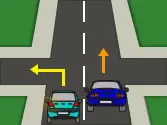
¿Está bien situado el turismo azul claro para girar a la izquierda en una vía de doble sentido de circulación?
Is the light blue car correctly positioned to turn left on a two-way road?
- ASí, ya que está colocado junto al borde izquierdo.Yes, because it is next to the left-hand edge.
- BNo, ya que está invadiendo el sentido contrario.No, because it is entering the opposite direction.
- CSi, porque no invade el sentido contrario.Yes, because it is not entering the opposite direction.
ExplanationWhen you intend to turn left on a two-way road, you will keep close to the longitudinal marking that separates the directions or, if there is none, to the centre line of the carriageway, without entering the area meant for the opposite direction.
Para adelantar a un ciclista en una vía de poblado, el conductor de una furgoneta invade el carril contrario, ¿es correcto?
To overtake a cyclist on a road in a built-up area, the driver of a van enters the opposite lane. Is this correct?
- ASí.Yes.
- BNo, tendría que adelantar sin invadir el carril contrario, aunque eso suponga no respetar la distancia de seguridad con el ciclista.No, they should overtake without entering the opposite lane, even if that means not keeping a safe distance from the cyclist.
- CNo, no se puede adelantar a ciclistas.No, cyclists cannot be overtaken.
ExplanationArticle 85 of the General Traffic Regulations (RGC) requires cyclists to be overtaken, also in built-up areas, by occupying part or all of the adjacent or opposite lane and leaving a gap of at least 1.5 metres. Entering the opposite lane, if it is clear, is the correct thing to do.
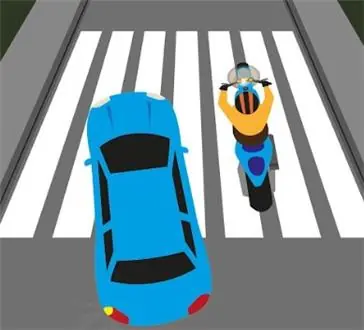
¿Está permitido adelantar en un paso para peatones señalizado?
Is overtaking permitted at a marked pedestrian crossing?
- ANo, está prohibido.No, it is prohibited.
- BSí, siempre que se circule a mayor velocidad que el vehículo adelantado.Yes, as long as you are going faster than the vehicle being overtaken.
- CSí, a velocidad tan reducida que permita detenerse a tiempo en caso de peligro de atropello.Yes, at a speed low enough to stop in time if there is a risk of hitting a pedestrian.
ExplanationUnder Article 87.1.b of the General Traffic Regulations (RGC), as worded by RD 518/2026, overtaking is prohibited at and near marked pedestrian crossings; the exception that allowed overtaking at very low speed has been removed.
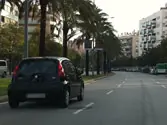
En esta vía circula por el carril que mejor conviene a su destino, ¿cuándo puede abandonarlo?
On this road you are driving in the lane that best suits your destination. When can you leave it?
- AAl prepararse para cambiar de dirección, adelantar, parar o estacionar.When preparing to change direction, overtake, stop or park.
- BÚnicamente cuando pretenda parar o estacionar.Only when you intend to stop or park.
- CCuando quiera cambiar de dirección o de sentido.When you want to change direction or make a U-turn.
ExplanationIn built-up areas, on carriageways with at least two lanes for the same direction marked by longitudinal markings, drivers of motor vehicles and special vehicles may use the lane that best suits their destination, but they will only leave it to prepare to change direction, overtake, stop or park.
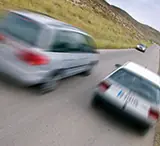
Antes de iniciar un adelantamiento, ¿qué debe comprobar?
Before starting to overtake, what must you check?
- AQue los vehículos que circulan por el mismo carril no llevan encendidos los intermitentes.That the vehicles in the same lane do not have their indicators on.
- BQue ningún conductor ha iniciado la maniobra de adelantar a su vehículo.That no driver has started to overtake your vehicle.
- CQue los vehículos que circulan detrás mantienen la distancia de seguridad.That the vehicles behind are keeping a safe distance.
ExplanationBefore overtaking, you must look in your mirrors and make sure that no driver behind has already started to overtake; if they had, moving into their path would cause a serious risk of collision.
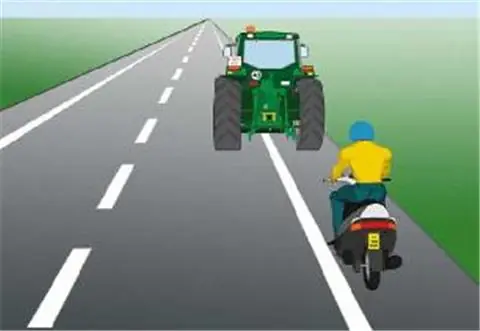
En una vía interurbana, el conductor de un ciclomotor, ¿puede adelantar a un tractor agrícola que circula por el arcén?
On an interurban road, can a moped rider overtake an agricultural tractor travelling on the hard shoulder?
- ANo, los vehículos que circulan por el arcén no se pueden adelantar.No, vehicles travelling on the hard shoulder cannot be overtaken.
- BSí, en todo caso.Yes, in all cases.
- CSolo si el recorrido en paralelo no supere los 200 metros o los 15 segundos.Only if travelling side by side does not exceed 200 metres or 15 seconds.
ExplanationArticle 36 of the General Traffic Regulations (RGC) prohibits vehicles travelling on the hard shoulder, such as mopeds or tractors, from overtaking each other if travelling side by side lasts more than 15 seconds or covers more than 200 metres. This limit does not apply to bicycles.
Si el vehículo gira hacia la izquierda, ¿deberá respetar el STOP?
If the vehicle turns left, must it obey the STOP sign?
- ASí.Yes.
- BNo.No.
- CNo, solo si va a girar a la derecha.No, only if it is going to turn right.
ExplanationA sign placed on the right of the carriageway applies to all vehicles, whatever direction they are going to take.
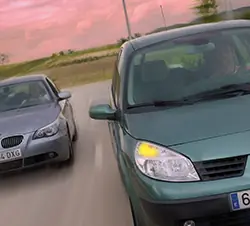
En carretera, ¿cuándo puede adelantar por la derecha?
On an interurban road, when can you overtake on the right?
- ACuando esté libre el carril de la derecha.When the right-hand lane is clear.
- BCuando el vehículo de delante vaya a girar a la izquierda y exista espacio libre en la calzada.When the vehicle in front is going to turn left and there is free space on the carriageway.
- CCuando conduzca por una calzada con más de dos carriles.When driving on a carriageway with more than two lanes.
ExplanationOn interurban roads, overtaking on the right is only allowed when the vehicle in front has clearly signalled that it is turning left and there is enough space on the carriageway to pass safely.
En una vía urbana con varios carriles en el mismo sentido, usted circula por el carril que mejor conviene a su destino. ¿Cuándo puede abandonarlo?
On an urban road with several lanes in the same direction, you are driving in the lane that best suits your destination. When may you leave it?
- ACuando vaya a cambiar de dirección, adelantar, detenerse o aparcar.When you are going to change direction, overtake, stop or park.
- BSolo cuando vaya a detenerse o aparcar.Only when you are going to stop or park.
- CCuando vaya a cambiar de dirección o de sentido.When you are going to change direction or make a U-turn.
ExplanationAccording to Article 33 of the General Traffic Regulations, in built-up areas, on carriageways with at least two lanes in the same direction marked by lines, you may use the lane that best suits your destination, but you should not leave it except to get ready to change direction, overtake, stop or park.
¿Qué prohíbe una marca vial amarilla discontinua?
What does a broken yellow road marking prohibit?
- AEstacionar.Parking.
- BParar.Stopping.
- CParar y estacionar.Stopping and parking.
ExplanationA broken yellow line next to the kerb prohibits parking on that side but allows stopping. If the yellow line were solid, both stopping and parking would be prohibited.

¿Se podrá cambiar el sentido de la marcha en una carretera convencional?
Can you make a U-turn on a conventional road?
- ANo, en ningún caso.No, never.
- BSí, si no hay señal que lo prohíba.Yes, if there is no sign prohibiting it.
- CNo como norma general.Not as a general rule.
ExplanationYou can make a U-turn on a conventional road, as it has a single carriageway for both directions, as long as there are no road signs or road markings that expressly prohibit it and the circumstances are suitable.
Los vehículos que incorporan LEDs de última generación, ¿cómo pueden evitar deslumbrar a otros usuarios de la vía entre la puesta y la salida del sol?
How can vehicles with the latest-generation LEDs avoid dazzling other road users between sunset and sunrise?
- ADirigiendo las luces hacia la derecha cuando haya otros usuarios en la vía que puedan quedar deslumbrados.By pointing the lights to the right when there are other road users who could be dazzled.
- BReduciendo la velocidad del vehículo, incluso hasta detenerse.By reducing the vehicle's speed, even to the point of stopping.
- CReduciendo la intensidad de la luz que incide directamente en otros usuarios, permitiendo al conductor mantener la máxima visibilidad del resto de la vía.By reducing the intensity of the light that falls directly on other road users, while letting the driver keep maximum visibility of the rest of the road.
ExplanationMatrix or adaptive LED headlights switch off or dim only the parts of the beam that would light up other road users, and keep the rest of the road lit. In this way they meet the duty to avoid dazzling (Article 102.1 of the General Traffic Regulations (RGC)) without losing visibility.
En una carretera con un carril para cada sentido con arcén, si queremos adelantar, ¿qué deberá hacer el vehículo adelantado?
On a road with one lane in each direction and a hard shoulder, if we want to overtake, what must the vehicle being overtaken do?
- ADeberá colocarse en el arcén para facilitar el adelantamiento.It must move onto the hard shoulder to make the overtaking easier.
- BNo deberá cambiar la velocidad a la que circula.It must not change the speed it is travelling at.
- CDeberá disminuir la velocidad.It must reduce its speed.
ExplanationThe driver being overtaken must keep to the right-hand edge of the carriageway but without entering the hard shoulder, and is prohibited from increasing speed or making manoeuvres that prevent or hinder the overtaking. They will be obliged to reduce speed if a risky situation arises during the overtaking, to help the overtaking vehicle finish the manoeuvre.
¿Se puede cruzar la fila de conos para cambiar de carril?
May you cross the row of cones to change lanes?
- ASí, para detenerse.Yes, to stop.
- BSí, para adelantar a otro vehículo.Yes, to overtake another vehicle.
- CNo, está prohibido.No, it is prohibited.
ExplanationCones, temporary edge markers and similar devices prohibit passing through the real or imaginary line joining them (Annex I, section 3.1.1, of the General Traffic Regulations). They may not be crossed either to overtake or to stop.
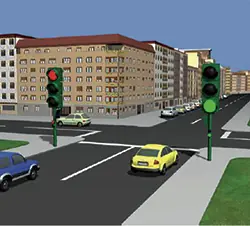
Si conduce el turismo amarillo y quiere girar a la derecha, ¿qué debe hacer?
If you are driving the yellow car and want to turn right, what must you do?
- AContinuar de frente.Continue straight on.
- BEsperar a que el semáforo de la izquierda se ponga verde.Wait for the traffic light on the left to turn green.
- CGirar a la derecha porque lo permite el semáforo.Turn right, because the traffic light allows it.
ExplanationUnder Article 132 of the General Traffic Regulations (RGC), if the traffic lights on the right and on the left show different indications, drivers going straight on or turning left obey the one on the left, and drivers turning right obey the one on the right. As the right one is green, the yellow car can turn right.
¿Un camión de 3500 kg podrá utilizar el tercer carril en una autopista para adelantar?
Can a 3,500 kg lorry use the third lane on a motorway (autopista) to overtake?
- ASi, en todo caso.Yes, in all cases.
- BNo, en ningún caso.No, never.
- CSí, si no entorpece a otros vehículos.Yes, if it does not obstruct other vehicles.
ExplanationWhen a lorry has a maximum authorised mass (MAM) of more than 3,500 kg it cannot use the third lane, but in this case, as it does not exceed that maximum, it can use it.
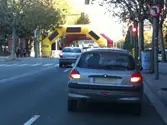
¿Qué está indicando un vehículo con dos luces blancas encendidas en la parte posterior?
What is a vehicle showing when it has two white lights on at the rear?
- AQue está parado.That it is stopped.
- BQue está estacionado.That it is parked.
- CQue circula marcha hacia atrás.That it is reversing.
ExplanationTwo white lights at the rear of a vehicle show that it is going to reverse.
All topics
- Definitions
- Documents and penalty points
- The driver's condition
- Duties of drivers and pedestrians
- Vehicle safety devices
- Vehicle controls and equipment
- Vehicle lights and horn
- Traffic signs, markings and signals
- The road and its lanes
- Speed and distances
- Right of way
- Carrying passengers and loads
- Driving safely in difficult conditions
- Vehicle mechanics and maintenance
- Road accidents and first aid
- Defensive and eco-driving
Independent app: not affiliated with or endorsed by the DGT (Spain's Directorate-General for Traffic) or the Ministry of the Interior. The official exam is booked with the DGT and taken at its test centres. The questions here are practice material; the DGT's official question bank is not public.
Basado en datos de la Agencia Estatal Boletín Oficial del Estado (https://www.boe.es). Textos consolidados de carácter meramente informativo. La AEBOE no patrocina ni respalda este sitio.
Parte de las preguntas procede de los tests de la revista «Tráfico y Seguridad Vial» de la DGT, reproducidos con indicación de la fuente.