
DGT test · 982 questions
Manoeuvres · Page 4 of 20
Joining traffic, overtaking, turning, U-turns, reversing, stopping and parking: how and where to do them and when they are forbidden.
Questions in this topic, with answers
982 questions, 50 per page, with the correct answer and the explanation. Page 4 of 20.
¿Está permitido adelantar en la cresta de una cuesta si la línea central es discontinua?
Are you allowed to overtake at the top of a hill if the centre line is broken?
- ANo, porque la visibilidad es limitada.No, because visibility is limited.
- BSí, en el menor tiempo posible.Yes, as quickly as possible.
- CSí, porque la línea central discontinua lo permite.Yes, because the broken centre line allows it.
ExplanationOvertaking is prohibited at the brow of a hill with reduced visibility and, in general, wherever visibility is not enough to carry out the manoeuvre or abandon it (Article 87.1.a of the General Traffic Regulations). A broken line does not allow overtaking if there is not enough visibility.
¿Se puede estacionar una motocicleta en la acera,como norma general?
As a general rule, can a motorcycle be parked on the pavement?
- ASí, si su cilindrada no supera los 125 cm³.Yes, if its engine capacity does not exceed 125 cm³.
- BSí, siempre.Yes, always.
- CNo, por estar prohibido.No, because it is prohibited.
ExplanationAs a general rule, parking on pavements, promenades and other areas intended for pedestrians is prohibited. Only a local by-law can allow two-wheeled vehicles to park there, as long as this does not harm or obstruct pedestrians (Article 156.2, as worded by RD 518/2026).
¿Está prohibido cambiar el sentido en los pasos a nivel y sus proximidades?
Is making a U-turn prohibited on level crossings and near them?
- ASí.Yes.
- BEstá prohibido en los pasos a nivel pero no en sus proximidades.It is prohibited on level crossings but not near them.
- CNo.No.
ExplanationUnder article 79.1 of the RGC, U-turns are prohibited on level crossings and, in general, on all stretches where overtaking is prohibited. As article 87.1.b) prohibits overtaking on level crossings and near them, you cannot make a U-turn near them either.
Los agentes de la autoridad encargados de la vigilancia del tráfico, ¿cuándo podrán proceder a la inmovilización de una motocicleta?
When may police officers responsible for traffic enforcement immobilise a motorcycle?
- ACuando su conductor no lleve puesto el casco de protección.When its rider is not wearing a protective helmet.
- BSiempre que su conductor sea menor de 18 años.Whenever its rider is under 18.
- CCuando la carga sobresalga por su parte trasera más de 0,1 metros.When the load projects more than 0.1 metres at the rear.
ExplanationOfficers may immobilise a motorcycle or moped when its rider or passenger is not wearing the compulsory helmet. The immobilisation lasts until the cause disappears: until the rider has a helmet or, if it is the passenger who is not wearing one, until the passenger gets off.
¿En qué tipo de curvas está prohibido adelantar?
On what type of bends is overtaking prohibited?
- AEn todas las curvas.On all bends.
- BEn las curvas de visibilidad reducida.On bends with reduced visibility.
- CEn las curvas hacia la izquierda.On left-hand bends.
ExplanationOvertaking is prohibited on bends and brows of hills with reduced visibility. On a bend with enough visibility, you can overtake.
¿Se puede circular marcha atrás en cualquier vía?
May you reverse on any road?
- ANo, solo está permitido en vías interurbanas.No, it is only allowed on interurban roads.
- BNo, está siempre prohibido en autopistas y autovías.No, it is always prohibited on motorways (autopistas) and dual carriageways (autovías).
- CSí, el tipo de vía no influye.Yes, the type of road makes no difference.
ExplanationUnder Article 80.3 of the RGC, reversing is prohibited on motorways (autopistas) and dual carriageways (autovías). On other roads it is only allowed when it is not possible to go forward or to change direction, or as a complementary manoeuvre, over the minimum distance necessary.
Conduciendo un turismo, ¿es correcto rebasar un semáforo para vehículos estando en fase verde, si previsiblemente puede quedar detenido sobre un paso de peatones obstruyéndoles el paso?
When driving a car, is it correct to go past a traffic light showing green if you are likely to end up stopped on a pedestrian crossing, blocking pedestrians?
- ASí, porque es la dirección que deseo tomar.Yes, because it is the direction I want to take.
- BSí, porque la señal esta en verde.Yes, because the light is green.
- CNo.No.
ExplanationEven if the traffic light is green, you must not enter a junction or a pedestrian crossing if it is likely that the vehicle will end up stopped there, blocking crossing traffic or pedestrians. You must wait until there is space to get out.
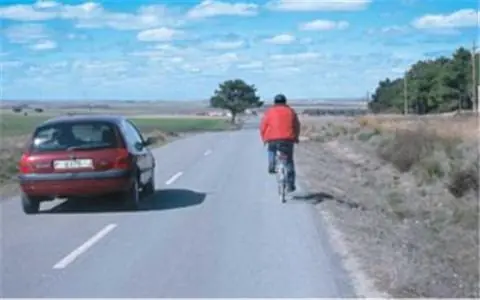
Para adelantar a la bicicleta, ¿debe encender el intermitente?
To overtake the bicycle, must you switch on your indicator?
- ANo, porque no es obligatorio.No, because it is not compulsory.
- BSí, porque para adelantar es necesario cambiar de carril.Yes, because overtaking requires changing lanes.
- CNo es necesario, porque la marca vial me permite adelantar.It is not necessary, because the road marking allows me to overtake.
ExplanationOvertaking a cyclist involves a sideways movement, because you have to move partly or fully into the adjacent lane, and every sideways movement must be signalled with the indicator. The fact that the road marking allows overtaking does not mean you do not have to signal the manoeuvre.
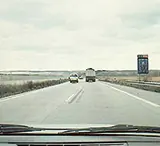
En el arcén de esta vía, ¿puede inmovilizar su vehículo para ver el paisaje?
On the hard shoulder of this road, can you stop your vehicle to look at the scenery?
- ASí, porque el arcén es ancho.Yes, because the hard shoulder is wide.
- BNo, porque está prohibido.No, because it is prohibited.
- CSí, porque no hay señales que lo prohíben.Yes, because there are no signs prohibiting it.
ExplanationOutside built-up areas, stopping and parking must be done off the carriageway, leaving the usable part of the hard shoulder clear. Occupying it is only justified by an emergency or a breakdown, not to admire the scenery.
Si va a adelantar y el vehículo que circula delante ha encendido el intermitente izquierdo, manifestando su intención de adelantar, ¿quién tiene preferencia en el adelantamiento?
If you are going to overtake and the vehicle in front has switched on its left indicator, showing its intention to overtake, who has priority to overtake?
- AEl que inicie antes el desplazamiento lateral.Whoever starts moving sideways first.
- BEl que circule a mayor velocidad.Whoever is travelling faster.
- CEl conductor del vehículo que ya ha encendido el intermitente.The driver of the vehicle that has already switched on its indicator.
ExplanationBefore overtaking, you must look ahead to check that the driver of the vehicle in front in the same lane has not signalled or started moving to the same side; if they have, you must respect their priority. However, if after a reasonable time they have not started to move, you may overtake them, first warning them with audible or light signals. The vehicle behind will have priority to overtake us if it has already started overtaking.
En una vía con un carril para cada sentido de la circulación, un vehículo inmovilizado debido a una avería ocupa la calzada de su carril de circulación en un tramo de vía en el que está prohibido el adelantamiento. Los conductores que circulen por su mismo carril, ¿podrán ocupar totalmente la parte de la calzada reservada al sentido contrario para rebasarle?
On a road with one lane in each direction, a vehicle immobilised because of a breakdown is occupying its lane on a stretch of road where overtaking is prohibited. Can drivers in the same lane fully occupy the part of the carriageway reserved for the opposite direction to pass it?
- ASí, después de cerciorarse de que se puede realizar la maniobra sin peligro.Yes, after making sure that the manoeuvre can be done without danger.
- BNo, ya que está prohibido el adelantamiento.No, because overtaking is prohibited.
- CSí, pero solo si un agente de tráfico se encuentra en el lugar regulando el paso de vehículos.Yes, but only if a traffic officer is there directing traffic.
ExplanationUnder Article 88 of the General Traffic Regulations (RGC), an immobilised vehicle occupying the lane may be passed even where overtaking is prohibited, by occupying the opposite direction after checking that there is no danger. Since October 2026, you must leave 1.5 metres and reduce your speed by at least 20 km/h.
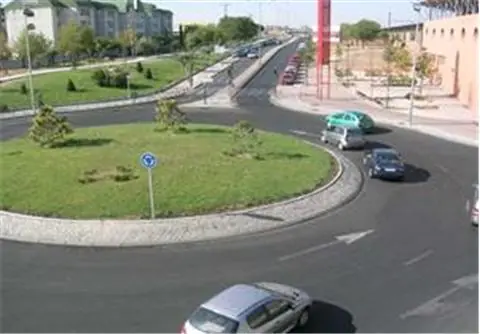
¿Está permitido adelantar en una glorieta?
Is overtaking allowed on a roundabout?
- ANo.No.
- BSí.Yes.
- CSí, pero solo por el carril derecho.Yes, but only in the right-hand lane.
ExplanationAlthough overtaking is forbidden at and near junctions, Article 87 of the General Traffic Regulations makes an exception for roundabouts. Inside a roundabout you may overtake, following the general rules for overtaking.
¿Dónde deberán realizarse las paradas y estacionamientos en vías urbanas?
Where must stopping and parking be done on urban roads?
- ASiempre en el lado derecho.Always on the right-hand side.
- BIndistintamente en el lado derecho o izquierdo si son vías de sentido único.On either the right-hand or the left-hand side if they are one-way roads.
- CEn cualquier lugar siempre que no se obstaculice la circulación.Anywhere, as long as traffic is not obstructed.
ExplanationOn urban roads, stopping and parking will be done at the right-hand edge on two-way roads, and at either the right-hand or the left-hand edge on one-way roads.
Se podrá adelantar excepcionalmente en una intersección cuando,...
Overtaking at a junction will be allowed as an exception when…
- ASe tenga prioridad de paso.You have right of way.
- BSe tenga prioridad de paso y esté señalizado.You have right of way and it is signposted.
- CCuando no se acerquen otros vehículos de frente.No other vehicles are approaching from the front.
ExplanationUnder Article 87 of the General Traffic Regulations (RGC), overtaking at and near junctions is prohibited. One of the exceptions is when you are travelling on a road that has priority at the junction and there is a specific sign showing this; having priority without a sign is not enough.
¿Cómo debe avisar antes de cambiar de carril?
How should you signal before changing lanes?
- AUsando los intermitentes.Using the indicators.
- BCon la bocina.With the horn.
- CCon las luces de freno.With the brake lights.
ExplanationUnder Article 109 of the RGC, any sideways movement, such as a lane change, must be signalled in advance with the direction indicator on the side you are moving towards, or by arm. The horn and brake lights are not for this.
En una calzada de doble sentido y tres carriles, ¿dónde debe situarse para cambiar de dirección a la izquierda?
On a two-way carriageway with three lanes, where must you position yourself to turn left?
- AEn el carril situado más a la izquierda.In the far-left lane.
- BEn el carril central.In the centre lane.
- CEn el eje de la calzada que separa los sentidos, sin invadir el sentido contrario.On the centre line of the carriageway that separates the directions, without entering the opposite direction.
ExplanationOn a two-way carriageway with three lanes, you must move into the centre lane to turn left. This is because the centre lane is specifically designated for this kind of manoeuvre. Remember that you must position the vehicle in the right place sufficiently in advance and safely, keeping the space and time of the manoeuvre to a minimum.
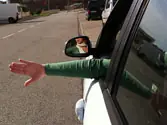
Si el conductor de un vehículo tiene el brazo izquierdo extendido con la palma de la mano hacia atrás, ¿qué indica?
If a driver has their left arm stretched out with the palm of the hand facing backwards, what does it mean?
- AQue va a girar a la izquierda.That they are going to turn left.
- BQue va a iniciar la marcha atrás.That they are going to start reversing.
- CQue va a girar a la derecha.That they are going to turn right.
ExplanationIn this case the driver is showing their intention to reverse. If the palm were facing down, it would show an intention to turn left.
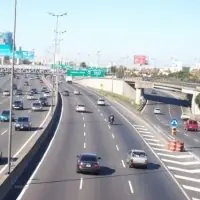
¿Se puede circular marcha atrás en una autopista?
Can you reverse on a motorway (autopista)?
- ASí, porque está dentro de poblado.Yes, because it is inside a built-up area.
- BSí, pero sin obstaculizar.Yes, but without obstructing anyone.
- CNo.No.
ExplanationOn motorways and dual carriageways it is prohibited to: - Make a U-turn, except at places provided for this. - Reverse. - Enter the central reservation or the crossings through it.
En una vía de doble sentido, sin señales ni marcas que lo prohíban, ¿cuándo está permitido cambiar de sentido?
On a two-way road with no signs or markings prohibiting it, when may you make a U-turn?
- ANunca.Never.
- BEn cualquier momento, porque siempre está permitido.At any time, because it is always allowed.
- CCuando no ponga en peligro a otros usuarios.When it does not endanger other road users.
ExplanationUnder Article 78.1 of the General Traffic Regulations (RGC), a driver who wants to make a U-turn must choose a suitable place, signal in good time and make sure they will not endanger or obstruct other road users; otherwise they must wait for a suitable moment. It is neither always allowed nor always prohibited.
Invadir marcha atrás una intersección para incorporarse a la circulación, ¿está permitido?
Is it permitted to reverse into a junction in order to join the traffic?
- ASí, si no obstaculiza la circulación a otros vehículos.Yes, if it does not obstruct other vehicles.
- BNo, porque está prohibido invadir un cruce de vías.No, because entering a junction is prohibited.
- CSí, si no recorre marcha atrás más de 15 metros.Yes, if you do not reverse more than 15 metres.
ExplanationAs a general rule, reversing is prohibited, except in the following cases, as an exception and always over the minimum distance necessary: 1. As a manoeuvre that complements stopping, parking or joining traffic. In this case, you may not reverse more than 15 metres or enter a junction. 2. When it is not possible to move forwards or to change direction or make a U-turn. In this case there is no limit on the reversing distance, and you may even enter a junction if necessary. Reversing is prohibited on dual carriageways (autovías) and motorways (autopistas).
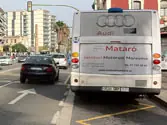
El autobús se incorpora desde la parada. ¿Es obligatorio facilitarle el paso?
The bus is pulling out from the stop. Is it compulsory to make this easier for it?
- ASólo si se dedica al transporte escolar.Only if it is used for school transport.
- BNo.No.
- CSí.Yes.
ExplanationIn built-up areas, to help public passenger transport vehicles move, drivers of other vehicles must move sideways whenever possible, or reduce their speed as long as they can do so without risk and not abruptly, signalling it with the required signals, and even stop if necessary, so that public transport vehicles can make the manoeuvre needed to continue their journey when leaving marked stops.
¿Podemos parar en un paso para peatones?
May we stop on a pedestrian crossing?
- ASí, menos de 2 minutos.Yes, for less than 2 minutes.
- BSí, el tiempo imprescindible.Yes, for the time strictly necessary.
- CNo.No.
ExplanationStopping, and therefore parking, on pedestrian crossings is prohibited, however short the time (article 94.1 of the General Traffic Regulations). In addition, so that pedestrians can be seen, parking is not allowed in the metres before the crossing either: at least 6 or 3 metres, depending on how the pavement is aligned.
¿En qué caso se permite adelantar en un túnel?
In what case is overtaking allowed in a tunnel?
- ASolo si hay más de un carril en el mismo sentidoOnly if there is more than one lane in the same direction
- BNuncaNever
- CSolo si hay buena visibilidadOnly if visibility is good
ExplanationIn tunnels you may only overtake if there is more than one lane in the same direction.
Es recomendable parar el motor:
It is advisable to switch off the engine:
- AEn inmovilizaciones prolongadas (más de 60 segundos).When stopped for a long time (more than 60 seconds).
- BSólo cuando la inmovilización dure más de 5 minutos.Only when stopped for more than 5 minutes.
- CEn todos los semáforos.At all traffic lights.
ExplanationIt is advisable to switch off the engine when stopped for a long time (more than 60 seconds), to avoid using fuel while idling (the minimum engine speed needed to keep the engine running when we are not accelerating).
En una carretera convencional, ¿se puede parar o estacionar fuera de la calzada y de la zona transitable del arcén?
On a conventional road, may you stop or park off the carriageway and off the usable part of the hard shoulder?
- ASí, en el lado derecho y dejando libre la parte transitable del arcén.Yes, on the right-hand side, leaving the usable part of the hard shoulder clear.
- BSe puede parar, pero no estacionar fuera de la calzada.You may stop, but not park, off the carriageway.
- CSe puede estacionar, pero no parar fuera de la calzada.You may park, but not stop, off the carriageway.
ExplanationOutside built-up areas, stopping and parking must always be done off the carriageway, on its right-hand side, leaving the usable part of the hard shoulder clear (Article 90.1 of the General Traffic Regulations (RGC)). Both are allowed under these conditions.
Como norma general, ¿se podrá adelantar en un túnel?
As a general rule, may you overtake in a tunnel?
- ASí, si el túnel está bien iluminado.Yes, if the tunnel is well lit.
- BSí.Yes.
- CNo.No.
ExplanationAs a general rule, overtaking is prohibited in tunnels, underpasses and stretches of road covered by the tunnel sign. As an exception, it may be done if there is more than one lane in the direction of travel.
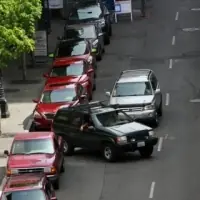
¿En qué caso el estacionamiento perturba gravemente la circulación?
In which case does parking seriously disrupt traffic?
- AEn una zona reservada a carga y descarga, fuera de las horas de uso.In an area reserved for loading and unloading, outside its hours of use.
- BCuando se efectúa en las medianas, isletas u otros elementos de canalización del tráfico.When it is done on central reservations, traffic islands or other traffic channelling features.
- CCuando la distancia entre el vehículo y el borde opuesto de la calzada sea inferior a 5 metros.When the distance between the vehicle and the opposite edge of the carriageway is less than 5 metres.
ExplanationParking will seriously disrupt traffic when it is done in a loading and unloading area during its hours of use, when it is done double-parked without the driver present, when it is done on central reservations, separators, traffic islands or other traffic channelling features, when the distance between the vehicle and the opposite edge of the carriageway or a solid longitudinal marking is less than 3 metres, or when it does not allow other vehicles to pass, among other places.
Un vehículo con remolque va a estacionar en una pendiente descendente y no lleva calzos, ¿qué debe hacer?
A vehicle with a trailer is going to park on a downhill slope and has no chocks. What must it do?
- ADejar las ruedas directrices pegadas al bordillo.Leave the steering wheels right up against the kerb.
- BDejar accionada la primera velocidad y el freno de estacionamiento.Leave it in first gear with the parking brake on.
- CDejar accionada la marcha atrás y el freno de estacionamiento, y apoyar las ruedas directrices en el bordillo de la acera.Leave it in reverse gear with the parking brake on, and rest the steering wheels against the kerb.
ExplanationWhen parking on a downhill slope, you must leave the vehicle in reverse gear with the parking brake on. If it is a combination with a trailer and there are no chocks, you must also rest a steering wheel against the kerb, turned towards the outside of the carriageway.
¿Podemos realizar una parada en una zona de la vía reservada para el uso exclusivo del autobús?
Can we stop in a part of the road reserved exclusively for buses?
- ASí, si dura menos de 2 minutos.Yes, if it lasts less than 2 minutes.
- BNo.No.
- CSí, si no abandonamos el vehículo.Yes, if we do not leave the vehicle.
ExplanationStopping and parking are prohibited in areas reserved exclusively for the parking and stopping of public and urban transport.
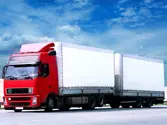
¿Se puede parar en un paso para peatones?
Can you stop on a pedestrian crossing?
- ASí, el tiempo imprescindible.Yes, for the time strictly necessary.
- BSí, si no molestamos a ningún peatón.Yes, if we do not bother any pedestrian.
- CNo.No.
ExplanationStopping is prohibited on pedestrian crossings, level crossings and cycle crossings.
Ante un ciclista al que vamos a rebasar en una carretera estrecha, debemos:
When we are about to pass a cyclist on a narrow road, we must:
- AModerar la velocidad y dejar al menos 1,5 m de separación lateralReduce speed and leave a side gap of at least 1.5 m
- BAdelantar a la máxima velocidad posibleOvertake as fast as possible
- CPitar y no reducir la velocidadSound the horn and not reduce speed
ExplanationWhen passing cyclists, you must reduce speed and leave a minimum side gap of 1.5 metres.
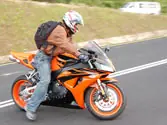
¿Es correcto el cambio de sentido realizado por esta motocicleta?
Is the U-turn made by this motorcycle correct?
- ASí, por tener visibilidad suficiente.Yes, because it has enough visibility.
- BNo, por prohibirlo las señales.No, because the signs prohibit it.
- CNo, el cambio de sentido está siempre prohibido.No, U-turns are always prohibited.
ExplanationA road marking made up of two solid lines side by side means that no driver may cross them or drive on them, or drive to the left of them when they separate the two directions of traffic.
¿Cuándo debe dar señales para realizar una maniobra?
When must you signal to make a manoeuvre?
- AJusto antes de iniciar la maniobra.Just before starting the manoeuvre.
- BCuando la maniobra ya haya empezado.When the manoeuvre has already started.
- CCon suficiente antelación antes de iniciar la maniobra.Sufficiently in advance before starting the manoeuvre.
ExplanationUnder Article 109 of the General Traffic Regulations (RGC), the driver is obliged to signal with visual signals any manoeuvre that involves a sideways or backward movement. These signals must be given sufficiently in advance before starting the manoeuvre, to give other drivers and pedestrians time to react properly. Therefore, the correct answer is 'sufficiently in advance of starting the manoeuvre'. This keeps the road safe and prevents accidents.
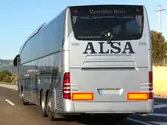
Si su intención es adelantar al vehículo de la imagen tendrá en cuenta que...
If you intend to overtake the vehicle in the picture, you will bear in mind that…
- AMide más de 12 metros.It is more than 12 metres long.
- BTransporta mercancías peligrosas.It is carrying dangerous goods.
- CSe trata de un vehículo especial.It is a special vehicle.
ExplanationThe rectangular plate we can see at the rear of the bus tells us that it is more than 12 metres long. It is important to bear this in mind when overtaking it, as the manoeuvre will take longer than overtaking a smaller vehicle.
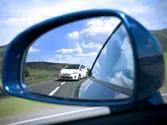
¿Es necesario disminuir la velocidad para facilitar un adelantamiento?
Is it necessary to reduce speed to make overtaking easier?
- ANo, nunca.No, never.
- BNo, quien debe reducir la velocidad es quien conduce el vehículo que circula en sentido contrario.No, the one who must reduce speed is the driver of the oncoming vehicle.
- CSí, para facilitar la vuelta del vehículo que avanza en el carril derecho si el adelantamiento se vuelve peligroso.Yes, to make it easier for the overtaking vehicle to return to the right-hand lane if the overtaking becomes dangerous.
ExplanationWhen we are going to be overtaken, we are obliged to keep to the right-hand edge of the carriageway, without entering the hard shoulder, and we do not have to change our speed, although we must reduce it if a dangerous situation arises, unless the overtaking driver slows down, in which case we must make it easier for them to return to their lane. The driver of the vehicle being overtaken is prohibited from increasing speed or making manoeuvres that prevent or hinder the overtaking.
Al incorporarse al tráfico, debe...
When joining the traffic, you must…
- Aceder el paso a otros vehículos.give way to other vehicles.
- Bhacerlo lo más rápido posible.do it as quickly as possible.
- Cevitar hacerlo sin las luces de posición encendidas.avoid doing it without your sidelights on.
ExplanationWhen joining the traffic, the driver must give way to vehicles already travelling on the road. This rule prevents accidents and ensures a safe entry. The driver must assess the traffic, choose the right moment and use the indicators if necessary.
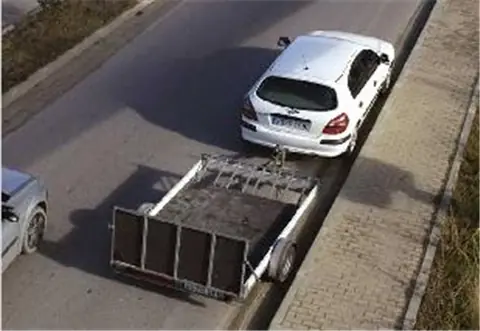
Para estacionar un turismo con remolque, ¿debe emplear calzos?
To park a car with a trailer, must you use chocks?
- ASí, siempre.Yes, always.
- BSi, cuando estacione en una pendiente.Yes, when parking on a slope.
- CNo, ya que los obligados a ello son los autobuses y vehículos de más de 3.500 kg. de masa máxima autorizada.No, because only buses and vehicles with a maximum authorised mass of more than 3,500 kg are required to do so.
ExplanationA car with a trailer is a combination of vehicles. Under Article 92 of the General Traffic Regulations (RGC), if it is parked on a noticeable slope it must be chocked, with chocks or by resting a steering wheel against the kerb. On level ground it is not compulsory.
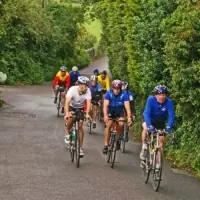
¿Se considera adelantamiento los realizados entre ellos por ciclistas que circulan en grupo?
Is it considered overtaking when cyclists riding in a group pass each other?
- ANoNo
- BSí.Yes.
- CPor lo general si aunque depende del número de integrantesGenerally yes, although it depends on the number of riders
ExplanationUnder Article 84 of the General Traffic Regulations (RGC), cyclists riding in a group passing each other is not considered overtaking. In addition, for someone overtaking them, the group is considered a single unit.
Los conductores cuando efectúen la maniobra de marcha atrás podrán circular sin cinturón de seguridad...
When reversing, drivers may drive without a seat belt…
- ASolo en vías dentro de poblado.Only on roads in built-up areas.
- BSolo en vías fuera de poblado.Only on roads outside built-up areas.
- CTantos si circulan en vías dentro de poblado como en vías fuera de poblado.Both on roads in built-up areas and on roads outside built-up areas.
ExplanationThe exemption from wearing a seat belt when reversing or parking applies both in and outside built-up areas.
¿Se puede adelantar en un túnel con un carril para cada sentido de circulación?
Can you overtake in a tunnel with one lane in each direction?
- ASí, si hay visibilidad suficiente.Yes, if there is enough visibility.
- BNo, está prohibido.No, it is prohibited.
- CSí, si no ocasiona ningún peligro.Yes, if it does not cause any danger.
ExplanationArticle 87 of the General Traffic Regulations (RGC) prohibits overtaking in tunnels, underpasses and stretches with the tunnel sign when there is only one lane in the direction of travel, even if there is visibility. With more than one lane in each direction, you can.
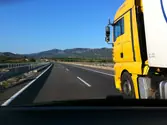
Una vez termine de adelantar al camión, ¿puede seguir circulando por el carril izquierdo?
Once you have finished overtaking the lorry, can you keep driving in the left-hand lane?
- ANo, debe circular por el carril derecho.No, you must drive in the right-hand lane.
- BNo, porque por el carril izquierdo sólo se puede utilizar para adelantar.No, because the left-hand lane can only be used for overtaking.
- CSí, porque en autopista se puede circular por cualquier carril.Yes, because on a motorway (autopista) you can drive in any lane.
ExplanationStaying in the left-hand lane unnecessarily can obstruct the flow of traffic and increase the risk of accidents, as it can prevent faster vehicles from overtaking safely. Therefore, the general rule is that after overtaking, if you are not going to continue overtaking, you must return to the right-hand lane to let other vehicles pass and keep traffic flowing safely and efficiently. The answer that the left-hand lane can only be used for overtaking is not correct, because the left-hand lane is not only used for overtaking; there are situations in which you can drive in it, such as to take an exit on that side or if the right-hand lane is blocked or there is an obstacle.
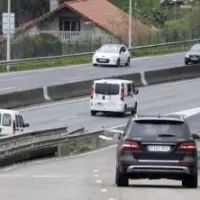
¿Qué tiene que hacer un vehículo para introducirse en la corriente de tráfico?
What must a vehicle do to enter the flow of traffic?
- ASeñalar la maniobra porque los demás tienen que conceder la prioridad de paso.Signal the manoeuvre, because the others must give it right of way.
- BAsegurarse de que lo puede hacer sin poner en peligro a los demás usuarios de la vía pública.Make sure it can do so without endangering other road users.
- CSiempre seguir las instrucciones de otra persona.Always follow another person's instructions.
ExplanationThe driver of a vehicle who intends to join the flow of traffic on a road must always first make sure, even by following another person's directions if necessary, that they can do so without danger to other road users, and must give way to all vehicles and road users, taking into account their position, path and speed.
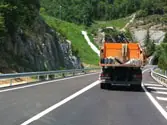
En esta vía de doble sentido, ¿está permitido adelantar al camión que circula muy lentamente y está obstaculizando la circulación?
On this two-way road, is it permitted to overtake the lorry that is travelling very slowly and obstructing traffic?
- AÚnicamente, si tengo suficiente visibilidad y no se aproxima ningún vehículo de frente.Only if I have enough visibility and no vehicle is approaching from the front.
- BSí, porque supone un obstáculo para el resto de vehículos.Yes, because it is an obstacle for other vehicles.
- CNo, porque circula por un tramo de vía en el que está prohibido adelantar.No, because it is on a stretch of road where overtaking is prohibited.
ExplanationIn the picture you can see a solid line that prohibits overtaking. It would be possible to pass it, but for this to count as passing, allowing you to go past the lorry even crossing the solid line, the lorry must be completely stationary. If the lorry is moving, even at an abnormally low speed, it will count as overtaking, which is not allowed in these circumstances.
¿Se puede adelantar en una curva sin visibilidad si los sentidos de circulación están claramente delimitados y no invadimos el carril contrario?
May you overtake on a bend without visibility if the two directions of traffic are clearly marked off and you do not enter the opposite lane?
- ASí, se puede.Yes, you may.
- BNo, porque no hay visibilidad.No, because there is no visibility.
- CSólo si se adelanta a un vehículo de dos ruedas.Only if you are overtaking a two-wheeled vehicle.
ExplanationUnder Article 87.1.a of the General Traffic Regulations (RGC), overtaking is prohibited on bends and brows of hills with reduced visibility, unless the two directions of traffic are clearly marked off and the manoeuvre can be made without entering the opposite side. In that case you may overtake any vehicle.
¿Cuándo debe iniciar las advertencias para realizar una maniobra?
When must you start signalling to make a manoeuvre?
- AJusto antes de iniciar la maniobra.Just before starting the manoeuvre.
- BCuando haya iniciado la maniobra.When you have started the manoeuvre.
- CCon antelación suficiente a la iniciación de la maniobra.Sufficiently in advance of starting the manoeuvre.
ExplanationWe must signal manoeuvres sufficiently in advance to give other road users time. Signalling a manoeuvre does not give us priority to carry it out. To make a manoeuvre, we will follow the steps of the RSM safety rule (Retrovisor – Señal – Maniobra: mirror – signal – manoeuvre), always in this order: - Mirror: we will observe the traffic in all directions, either directly or using the mirrors, to make sure we can make the manoeuvre without endangering other road users. - Signal: we will warn other road users of our intention to make the manoeuvre, clearly and sufficiently in advance, using the lights or, failing that, our arm. - Manoeuvre: we will carry out the manoeuvre following the specific rules for each one.
En una zona reservada para carga y descarga, ¿está permitido parar y estacionar?
In an area reserved for loading and unloading, are stopping and parking allowed?
- ASolo pueden parar y estacionar los camiones.Only lorries may stop and park there.
- BNo, ni parar ni estacionar.No, neither stopping nor parking.
- CSolo está permitido parar.Only stopping is allowed.
ExplanationIn areas signed for loading and unloading, Article 94.2 of the General Traffic Regulations prohibits parking but not stopping: you may stop the vehicle briefly, for example to let a passenger out, without leaving it. This applies to any vehicle, not only lorries.
Si desea estacionar su motocicleta en una vía urbana, lo hará...
If you want to park your motorcycle on an urban road, you will park it...
- APerpendicularmente, porque es la mejor forma que permite utilizar el resto del espacio disponible.At right angles to the edge of the carriageway, because this is the best way to leave the rest of the available space usable.
- BParalelamente al borde de la calzada.Parallel to the edge of the carriageway.
- CDe la forma que considere más conveniente.In whatever way you consider most convenient.
ExplanationUnder Article 92 of the General Traffic Regulations, stopping and parking are done by placing the vehicle parallel to the edge of the carriageway, and this also applies to motorcycles. Another position is allowed only when the features of the road or other circumstances make it advisable.
¿Podrá un taxi efectuar una parada junto a una marca vial discontinua de color amarillo?
May a taxi stop next to a broken yellow road marking?
- ANo, pues prohíbe tanto la parada como el estacionamiento.No, because it prohibits both stopping and parking.
- BNo, salvo que lleve encendida la señal de emergencia.No, unless it has its hazard warning lights on.
- CSí, está prohibido estacionar pero permitido parar.Yes, parking is forbidden but stopping is allowed.
ExplanationYes. Next to a broken yellow road marking, parking is forbidden but stopping is allowed. A broken yellow road marking means that parking is prohibited, but stopping is permitted. So a taxi may stop next to this marking.
¿Cuándo pueden los agentes de tráfico inmovilizar una motocicleta?
When can traffic officers immobilise a motorcycle?
- ASi el conductor no lleva un casco de seguridad.If the rider is not wearing a safety helmet.
- BÚnicamente cuando el pasajero no lleve casco de seguridad.Only when the passenger is not wearing a safety helmet.
- CNunca.Never.
ExplanationAmong the offences that can lead a traffic officer to immobilise a motorcycle are riding without a safety helmet on or with it badly fastened, exceeding the limits for gases, smoke and noise, or not having the compulsory insurance for the vehicle.
¿Qué marcha dejaremos puesta al estacionar nuestro vehículo en una pendiente?
Which gear will we leave engaged when parking our vehicle on a slope?
- ALa primera velocidad, si es una pendiente descendente.First gear, if it is a downhill slope.
- BLa primera velocidad, si es una pendiente ascendente.First gear, if it is an uphill slope.
- CLa marcha atrás, si es una pendiente ascendente.Reverse gear, if it is an uphill slope.
ExplanationIf our vehicle is parked on an uphill slope, it would roll backwards if the handbrake failed, which is why we will leave it in the lowest forward gear, first gear.
All topics
- Definitions
- Documents and penalty points
- The driver's condition
- Duties of drivers and pedestrians
- Vehicle safety devices
- Vehicle controls and equipment
- Vehicle lights and horn
- Traffic signs, markings and signals
- The road and its lanes
- Speed and distances
- Right of way
- Carrying passengers and loads
- Driving safely in difficult conditions
- Vehicle mechanics and maintenance
- Road accidents and first aid
- Defensive and eco-driving
Independent app: not affiliated with or endorsed by the DGT (Spain's Directorate-General for Traffic) or the Ministry of the Interior. The official exam is booked with the DGT and taken at its test centres. The questions here are practice material; the DGT's official question bank is not public.
Basado en datos de la Agencia Estatal Boletín Oficial del Estado (https://www.boe.es). Textos consolidados de carácter meramente informativo. La AEBOE no patrocina ni respalda este sitio.
Parte de las preguntas procede de los tests de la revista «Tráfico y Seguridad Vial» de la DGT, reproducidos con indicación de la fuente.