
DGT test · 982 questions
Manoeuvres · Page 19 of 20
Joining traffic, overtaking, turning, U-turns, reversing, stopping and parking: how and where to do them and when they are forbidden.
Questions in this topic, with answers
982 questions, 50 per page, with the correct answer and the explanation. Page 19 of 20.
Si estamos en una calle sin salida y no hay otra posibilidad, ¿cuántos metros podemos retroceder?
If you are in a dead-end street and there is no other option, how many metres may you reverse?
- AMenos de 15 metros.Less than 15 metres.
- BHasta la primera intersección, sin invadirla.As far as the first junction, without entering it.
- CLos metros necesarios para salir de la calle, aunque se invada un cruce de vías.As many metres as you need to get out of the street, even if you enter a junction.
ExplanationReversing is allowed when it is not possible to go forward or to change direction, and only for the minimum distance needed (Article 80.1 of the General Traffic Regulations (RGC)). The limit of 15 metres without entering a junction applies only when reversing is part of stopping, parking or joining traffic (Article 80.2).
Está prohibido estacionar un ciclomotor...
It is prohibited to park a moped...
- AEn las calles sin salida.In dead-end streets.
- BEn las salidas de los colegios.At school exits.
- CEn los pasos para peatones señalizados.On marked pedestrian crossings.
ExplanationStopping is prohibited on pedestrian crossings (Article 94.1.b of the General Traffic Regulations) and, wherever stopping is not allowed, parking is not allowed either (Article 94.2.a). The ban also applies to mopeds.
¿Cómo debe colocar su vehículo al detenerse o estacionarlo?
How must you position your vehicle when stopping or parking?
- ANo importa, siempre que apague el motor y ponga el freno de mano.It does not matter, as long as you switch off the engine and apply the handbrake.
- BSiempre coloque el vehículo paralelo a la vía.Always place the vehicle parallel to the road.
- CDe modo que se aproveche mejor el espacio disponible.So that the available space is used as well as possible.
ExplanationAccording to Article 92 of the General Traffic Regulations (RGC), when stopping or parking, the vehicle must be placed parallel to the edge of the carriageway and allow the best use of the space. The correct option highlights the importance of this rule, because it not only makes sure the vehicle is properly positioned but also helps traffic flow and keeps other road users safe.
Cuando estacionemos nuestro vehículo, ¿qué precauciones tenemos que adoptar?
When we park our vehicle, what precautions must we take?
- AAdoptar las precauciones necesarias para impedir su uso sin autorización.Take the necessary precautions to prevent it being used without permission.
- BPoner la marcha en posición de estacionamiento.Put the gear lever in the parking position.
- CDejar el vehículo siempre convenientemente calzado.Always leave the vehicle properly chocked.
ExplanationWhen we park our vehicle we must switch off the engine and disconnect the starting system and, if we move away from it, take the necessary precautions to prevent it being used without permission.
En una calzada con dos o más carriles en su sentido, después de adelantar a un camión, ¿debe volver inmediatamente al carril derecho si va a seguir adelantando?
On a carriageway with two or more lanes in your direction, after overtaking a lorry, must you return immediately to the right lane if you are going to keep overtaking?
- ASí, en cualquier caso.Yes, in all cases.
- BNo, no es obligatorio.No, it is not compulsory.
- CNo, excepto si por detrás viene un vehículo más rápido.No, unless a faster vehicle is coming from behind.
ExplanationOn carriageways with at least two lanes in the same direction, a driver who is going to overtake again may stay in the lane they used, provided they do not unduly hinder faster vehicles behind (Article 83.1 of the General Traffic Regulations (RGC)).
El conductor de un vehículo que pretende cambiar de dirección a la izquierda, ¿debe ceder el paso a los vehículos que se aproximen en sentido contrario?
Must the driver of a vehicle who wants to turn left give way to vehicles approaching from the opposite direction?
- ASí.Yes.
- BNo.No.
- CNo, ya que no se aproxima por la derecha.No, because they are not approaching from the right.
ExplanationA driver who wants to turn left, make a U-turn or overtake must have enough visibility and, where applicable, give way to those approaching from the opposite direction.
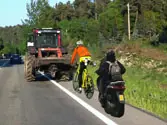
¿Podrá una bicicleta adelantar a un vehículo de tracción animal que circula por el arcén?
Can a bicycle overtake an animal-drawn vehicle travelling on the hard shoulder?
- ASí.Yes.
- BSí, siempre y cuando la circulación en paralelo no supere los 200 metros o los 15 segundos.Yes, as long as they do not travel side by side for more than 200 metres or 15 seconds.
- CNo, los vehículos obligados a ir por el arcén no se podrán adelantar entre ellos.No, vehicles that must travel on the hard shoulder cannot overtake each other.
ExplanationAs a general rule, vehicles that must travel on the hard shoulder may not travel side by side for more than 15 seconds or 200 metres, except bicycles, which are not subject to this restriction.
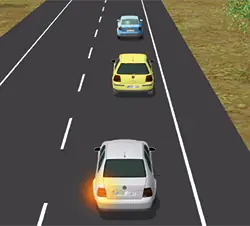
En una vía con un carril para cada sentido de la marcha, ¿está permitido que un conductor adelante a varios vehículos a la vez?
On a road with one lane in each direction, is a driver allowed to overtake several vehicles at once?
- ANo, en ningún caso.No, never.
- BSolo si puede volver a la derecha sin causar peligro en caso de encontrar vehículos de frente.Only if they can return to the right without causing danger if they meet oncoming vehicles.
- CSí, siempre que adelante a vehículos de grandes dimensiones.Yes, as long as they are overtaking large vehicles.
ExplanationOvertaking several vehicles at once is only allowed if, when oncoming traffic appears, the driver can return to the right-hand lane without danger; if a gap is not guaranteed, they must overtake one at a time.
Al incorporarse a la circulación, debe ceder el paso a...
When joining traffic, you must give way to...
- Alos taxis, pero solo en zonas urbanas.taxis, but only in urban areas.
- Btodos los vehículos.all vehicles.
- Clos vehículos de transporte público de viajeros, solo.public passenger transport vehicles only.
ExplanationA driver joining traffic from a stop, a parking place or an access road must make sure they can do so safely and give way to other vehicles, taking into account their position, path and speed (Article 72.1 of the General Traffic Regulations).
Se podrá circular marcha atrás siempre que el recorrido no supere los 15 metros ni se invada un cruce de vías...
You may reverse, as long as you do not travel more than 15 metres or enter a road junction...
- AComo maniobra complementaria del estacionamiento.As an additional manoeuvre when parking.
- BCuando no sea posible cambiar de dirección o de sentido.When it is not possible to turn or make a U-turn.
- CEn autopistas y autovías cuando sea necesario.On motorways (autopistas) and dual carriageways (autovías) when necessary.
ExplanationAs a general rule, reversing is prohibited, except in the following cases, exceptionally and always for the shortest distance necessary: 1. As an additional manoeuvre when stopping, parking or joining the traffic. In this case you may not reverse more than 15 metres or enter a road junction. 2. When it is not possible to move forwards, turn or make a U-turn. In this case there is no limit on the reversing distance, and you may even enter a road junction if necessary. Reversing is prohibited on dual carriageways (autovías) and motorways (autopistas).
Si estaciona su turismo, deberá...
If you park your car, you must...
- Adejar colocada la primera velocidad en pendientes descendentes.leave it in first gear on downhill slopes.
- Bdejar colocada la primera velocidad en pendientes ascendentes.leave it in first gear on uphill slopes.
- Capoyar una de las ruedas directrices en el bordillo de la acera.rest one of the steering wheels against the kerb.
ExplanationWhen parking a car on an uphill slope you must leave it in first gear, and on a downhill slope in reverse (Article 92.3.c of the General Traffic Regulations). Chocking a wheel or resting one against the kerb is only required for vehicles over 3,500 kg, buses and vehicle combinations.
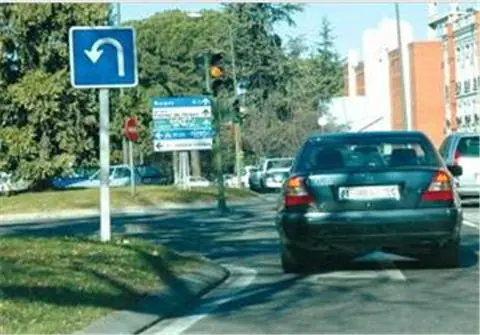
¿Es obligatorio advertir las maniobras?
Is it compulsory to signal manoeuvres?
- AÚnicamente con señales ópticas.Only with visual signals.
- BNo, pero sí recomendable.No, but it is advisable.
- CSí, con señales luminosas y en su defecto con el brazo.Yes, with light signals or, if that is not possible, with your arm.
ExplanationArticle 109 of the General Traffic Regulations requires you to signal in good time any manoeuvre that involves moving sideways or backwards, as well as braking considerably or stopping, using light signals or, if that is not possible, your arm.
¿Está prohibido dar marcha atrás?
Is reversing prohibited?
- ANo, excepto en autopistas y autovías.No, except on motorways (autopistas) and dual carriageways (autovías).
- BSí, si hay otros usuarios cerca.Yes, if there are other road users nearby.
- CSí, salvo que no pueda marchar hacia delante o cambiar de dirección o sentido.Yes, unless you cannot go forward or change direction.
ExplanationDriving backwards is prohibited, except when it is not possible to go forward or to change direction, and in manoeuvres that complement another manoeuvre requiring it (Article 80.1 of the RGC). On motorways (autopistas) and dual carriageways (autovías), reversing is always prohibited (Article 80.3).
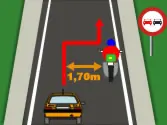
¿El turismo adelanta correctamente al ciclomotor?
Is the car overtaking the moped correctly?
- ANo, porque hay señal de prohibido adelantar.No, because there is a no-overtaking sign.
- BNo, porque debe dejar una separación mínima de 2 metros.No, because it must leave a minimum gap of 2 metres.
- CSí.Yes.
ExplanationSign R-305 «No overtaking» only prohibits overtaking motor vehicles when the manoeuvre means entering the part of the road for oncoming traffic. A moped may be overtaken even on that stretch if it can be done without risk, and the car is leaving more than 1.5 metres of sideways clearance.
¿Está permitido que un coche use un tramo de carril reservado para autobuses marcado con una línea discontinua?
Is a car allowed to use a stretch of bus lane marked with a broken line?
- ASí, para realizar cualquier maniobra excepto detenerse, estacionar, cambiar de sentido o adelantar.Yes, for any manoeuvre except stopping, parking, making a U-turn or overtaking.
- BNo, siempre está prohibido.No, it is always prohibited.
- CSí, pero sólo para girar a la derecha.Yes, but only to turn right.
ExplanationUnder the sign catalogue (RD 465/2025, sign S-51a), when the reserved lane is marked with a broken line, other vehicles may only use it for a manoeuvre other than stopping, parking, making a U-turn or overtaking, giving priority to the authorised vehicles.
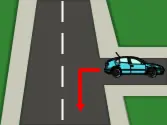
Este vehículo se está incorporando a la circulación, ¿lo hace correctamente?
This vehicle is joining the traffic. Is it doing it correctly?
- ASí, porque no recorre más de 15 metros.Yes, because it does not travel more than 15 metres.
- BNo, porque invade un cruce de vías.No, because it is entering a road junction.
- CNo, la marcha atrás siempre está prohibida.No, reversing is always prohibited.
ExplanationAs a general rule, reversing is prohibited, except in the following cases, exceptionally and always for the shortest distance necessary: 1. As an additional manoeuvre when stopping, parking or joining the traffic. In this case you may not reverse more than 15 metres or enter a road junction. 2. When it is not possible to move forwards, turn or make a U-turn. In this case there is no limit on the reversing distance, and you may even enter a road junction if necessary. Reversing is prohibited on dual carriageways (autovías) and motorways (autopistas). In the case in the question, because it is joining the traffic, it may not travel more than 15 m or enter a junction, so what the blue vehicle is doing is incorrect.
¿Podemos efectuar una parada en la zona marcada con una línea amarilla en zigzag?
Can we stop in an area marked with a yellow zigzag line?
- ANo, pero estacionar sí.No, but we can park.
- BSí y también estacionar.Yes, and we can also park.
- CSí, podremos parar pero no estacionar.Yes, we can stop but not park.
ExplanationIn an area marked with a yellow zigzag line you may stop, but parking is prohibited. The same applies if there is a broken yellow line next to the kerb.
En una autopista, ¿le está permitido efectuar una parada con su vehículo?
On a motorway (autopista), are you allowed to stop your vehicle?
- ASí, fuera de la calzada y de la parte transitable del arcén.Yes, off the carriageway and off the usable part of the hard shoulder.
- BSí, en la mediana.Yes, on the central reservation.
- CSí, en los lugares habilitados y adecuados para realizar las inmovilizaciones, por ejemplo un área de descanso.Yes, in places set up and suitable for stopping, for example a rest area.
ExplanationTo stop our vehicle on the motorway, we must wait until we find a place provided for this purpose.
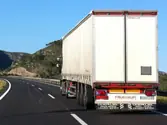
En esta situación de la fotografía, el conductor del camión, ¿está obligado a apartarse al arcén para facilitar el adelantamiento a otros vehículos?
In the situation in the photograph, must the lorry driver move onto the hard shoulder to make it easier for other vehicles to overtake?
- AComo norma general, no.As a general rule, no.
- BSí, cuando el camión circule a menos de 70 km/h.Yes, when the lorry is travelling at less than 70 km/h.
- CSí, cuando el camión es un vehículo pesado.Yes, when the lorry is a heavy vehicle.
ExplanationThe driver of any vehicle being overtaken must allow overtaking and make it easier. For this purpose, as soon as they notice that a vehicle behind intends to overtake, they must keep close to the right-hand edge of the carriageway, without moving onto walkways, pavements, platforms, hard shoulders, lanes or areas closed to them or reserved for other vehicles or users, so as to leave enough space to be passed comfortably. Drivers of heavy vehicles, large vehicles or vehicles that must keep to a specific speed limit must slow down or move onto the hard shoulder as soon as possible, if it is usable, to let the vehicles behind them pass, when oncoming traffic, a carriageway that is too narrow, or its layout or condition do not allow them to be overtaken easily and without danger. The road in the picture does not meet these conditions, so the lorry driver does not have to move onto the hard shoulder.
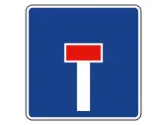
Para salir de una calle sin salida, ¿podrá efectuar marcha atrás más de 15 metros?
To get out of a dead-end street, can you reverse more than 15 metres?
- ANo, en ningún caso puedo recorrer más de 15 metros en marcha atrás.No, I can never reverse more than 15 metres.
- BSí.Yes.
- CNo, la marcha atrás es una maniobra prohibida.No, reversing is a prohibited manoeuvre.
ExplanationAs a general rule, reversing is prohibited, except in the following cases: - When it is not possible to move forwards, turn or make a U-turn. In this case there is no limit on the reversing distance, and you may even enter a road junction if necessary. - As an additional manoeuvre when stopping, parking or joining the traffic. In this case you may not reverse more than 15 metres or enter a road junction. Reversing is prohibited on dual carriageways (autovías) and motorways (autopistas). In the case in the question, if we cannot make a U-turn, we may reverse the distance needed to get out of the dead-end street.
En una vía urbana, ¿podremos realizar una parada en el lado izquierdo?
On an urban road, can we stop on the left-hand side?
- ANo, en ningún caso.No, never.
- BSí, siempre que no se entorpezca la circulación de los demás vehículos.Yes, as long as it does not get in the way of other vehicles.
- CSí, cuando la vía sea de sentido único.Yes, when the road is one-way.
ExplanationOn a one-way urban road or travesía (stretch of road through a town), you may stop or park on the left-hand side. On roads outside built-up areas, it must always be done on the right-hand side, off the carriageway and leaving the usable part of the hard shoulder free.
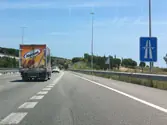
Al incorporarse a una autopista, ¿tendremos preferencia?
When joining a motorway (autopista), do we have right of way?
- ASí.Yes.
- BSí, si el carril de aceleración es suficientemente largo.Yes, if the acceleration lane is long enough.
- CNo.No.
ExplanationWhen joining a motorway we must give way to the vehicles already travelling on it, because they have right of way. The other vehicles must make it easier for us to join, by changing lanes or slowing down whenever possible, but this does not mean that we have priority.
Si circulamos por una vía urbana y observamos que un vehículo pretende incorporarse a la circulación saliendo de un estacionamiento, ¿debemos cederle el paso?
If you are driving in a built-up area and see a vehicle trying to join the traffic by pulling out of a parking space, must you give way to it?
- ASí, porque se incorpora por la derecha.Yes, because it is joining from the right.
- BNo.No.
- CNo debemos cederle el paso, pero le facilitaremos la incorporación en la medida de lo posible.You do not have to give way to it, but you should make it as easy as possible for it to join.
ExplanationA driver leaving a parking space must give way to vehicles already moving (Article 72.1 of the General Traffic Regulations), but other drivers must make it as easy as possible for them to join the traffic (Article 73.1).
En una carretera de doble sentido separada por una línea continua, ¿se permite girar a la izquierda?
On a two-way road divided by a solid line, are you allowed to turn left?
- ASí, cuando no comprometa la seguridad de ningún usuario de la vía.Yes, when it does not put any road user at risk.
- BNo.No.
- CSolo dentro de poblado.Only in built-up areas.
ExplanationA solid longitudinal line separating the two directions of traffic must not be crossed. To turn left you would have to cross it, so the turn is prohibited even if nobody is coming, both in and outside built-up areas (sign catalogue, RD 465/2025).
Cuando por la velocidad a la que circulan puedan ser adelantados sin riesgo y aunque la línea sea continua, un turismo puede invadir el sentido contrario para adelantar a...
When, because of the speed they are travelling at, they can be overtaken without risk, and even if the line is solid, a car may move into the opposite direction to overtake...
- Acamiones que circulan lentamente.lorries travelling slowly.
- Bbicicletas.bicycles.
- Cmotocicletas.motorcycles.
ExplanationAccording to Article 88.2 of the General Traffic Regulations (RGC) (as worded by RD 518/2026), on stretches where overtaking is prohibited you may overtake, using the part reserved for the opposite direction, cyclists and other cycles, mopeds, personal mobility vehicles (PMV, e-scooter), pedestrians, animals, animal-drawn vehicles and special agricultural vehicles, when their speed allows it to be done without risk. Motorcycles and lorries are not included.
¿Se puede realizar una parada en doble fila?
Can you stop double-parked?
- ASí, para subir o bajar pasajeros.Yes, to let passengers get in or out.
- BSí, si no dura más de 2 minutos.Yes, if it does not last more than 2 minutes.
- CSí, cuando no sea posible situarlo lo más cerca posible del borde de la calzada.Yes, when it is not possible to place the vehicle as close as possible to the edge of the carriageway.
ExplanationOn urban roads and travesías (stretches of road through a town), you may stop on the carriageway or on the hard shoulder, even if it is usable, always placing the vehicle as close as possible to the edge of the carriageway. When it is not possible to place it at the edge of the carriageway, we may stop double-parked if this does not get in the way of traffic.
En vías urbanas de doble sentido, ¿en qué lado de la calzada puede estacionar un coche?
On two-way urban roads, on which side of the carriageway may a car park?
- AA ambos lados, cuando la línea que separa los sentidos sea discontinua.On both sides, when the line separating the directions is broken.
- BEn el lado izquierdo de la calzada según el sentido de la marcha.On the left-hand side of the carriageway in the direction of travel.
- CEn el lado derecho de la calzada según el sentido de la marcha.On the right-hand side of the carriageway in the direction of travel.
ExplanationOn urban roads, when parking on the carriageway, the vehicle must be placed as close as possible to its right-hand edge; only on one-way roads is the left-hand side also allowed (Article 90.2 of the General Traffic Regulations). The type of centre line does not change this rule.
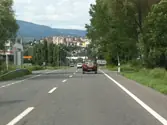
¿Podremos hacer un cambio de sentido en esta vía?
May we make a U-turn on this road?
- ANo, porque no está señalizado.No, because it is not signposted.
- BSí, si no entorpecemos la marcha de otros vehículos.Yes, if we do not hold up other vehicles.
- CNo, porque solo se permite en las intersecciones.No, because it is only allowed at junctions.
ExplanationOn this road, a U-turn may be made provided there is enough visibility, other vehicles are not held up, and the manoeuvre can be done without reversing.
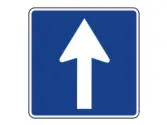
A la vista de esta señal, ¿podremos efectuar un cambio de dirección?
On seeing this sign, may we turn (change direction)?
- ASí.Yes.
- BNo.No.
- CSí, pero solo hacia la derecha.Yes, but only to the right.
ExplanationThis sign tells us that the carriageway is one-way and traffic is prohibited in the opposite direction. It does not prohibit turning.
¿Puede estacionar su vehículo en una zona delimitada por una línea amarilla en zig-zag?
Can you park your vehicle in an area marked by a yellow zigzag line?
- ASí, puedo estacionar pero no parar.Yes, I can park but not stop.
- BPuedo parar pero no estacionar.I can stop but not park.
- CNo puedo parar ni estacionar.I can neither stop nor park.
ExplanationA yellow zigzag line means that parking is prohibited in the area it marks, but we may stop there.
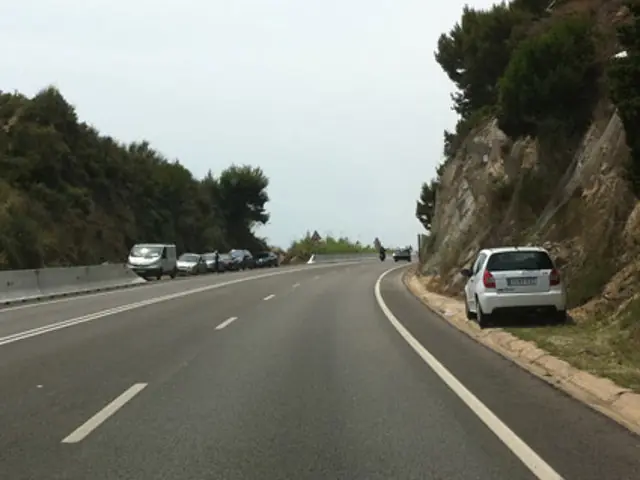
¿El vehículo que se ve a la derecha de la fotografía está bien estacionado?
Is the vehicle on the right of the photo correctly parked?
- ASí, siempre que el estacionamiento dure menos de dos minutos.Yes, as long as it is parked for less than two minutes.
- BSí, porque está fuera de la parte transitable del arcén.Yes, because it is outside the usable part of the hard shoulder.
- CNo, porque obstaculiza el paso.No, because it is blocking the way.
ExplanationOn interurban roads you must park off the carriageway, on the right-hand side, leaving the usable part of the hard shoulder free (Article 90.1 of the General Traffic Regulations). The white car is off the carriageway and does not occupy the usable part.
¿Está permitido parar la motocicleta en la parte transitable del arcén de una vía interurbana?
Is it allowed to stop a motorcycle on the usable part of the hard shoulder of a road outside built-up areas?
- ANo, salvo por razones de emergencia.No, except for emergency reasons.
- BSí, siempre que sea para tomar o dejar a una persona.Yes, as long as it is to pick up or drop off a person.
- CSí, pero sólo por tiempo inferior a dos minutos.Yes, but only for less than two minutes.
ExplanationOn roads outside built-up areas, stopping and parking must be done off the carriageway, leaving the usable part of the hard shoulder clear (Article 90.1 of the General Traffic Regulations). It may only be occupied in an emergency; not to drop someone off, nor for less than two minutes.
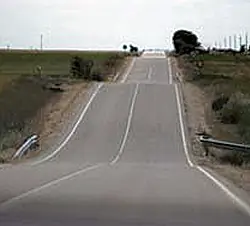
En esta carretera, ¿dónde se puede estacionar?
On this road, where can you park?
- ADentro de la vía, en el lado derecho.On the road, on the right-hand side.
- BEn ninguna parte; está prohibido estacionar dentro y fuera de la vía.Nowhere; parking is prohibited both on and off the road.
- CFuera de la vía, en el lado derecho.Off the road, on the right-hand side.
ExplanationOutside built-up areas, the general rule requires you to park off the carriageway and off the road, on the right-hand side: stopping on the road gets in the way of traffic and creates a risk of rear-end collisions.
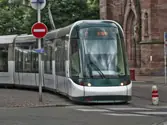
Podremos adelantar por la derecha a un tranvía...
We may overtake a tram on the right...
- ASolamente en vías dentro de poblado, cuando el tranvía circule por la zona central de la vía.Only on roads in built-up areas, when the tram runs in the central area of the road.
- BEn vías con dos sentidos de circulación, cuando el tranvía circule por la zona central de la vía.On two-way roads, when the tram runs in the central area of the road.
- CEn vías de un sólo sentido de circulación, cuando el tranvía circule por la zona central de la vía.On one-way roads, when the tram runs in the central area of the road.
ExplanationYou may overtake on the right on two-way roads when the tram runs in the central area of the road, both in and outside built-up areas.
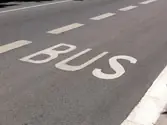
¿Podremos estacionar en un carril reservado para autobuses?
May we park in a lane reserved for buses?
- ANo.No.
- BSí, podremos parar pero no estacionar.Yes, we may stop but not park.
- CPodremos parar pero menos de 2 minutos.We may stop, but for less than 2 minutes.
ExplanationIn lanes for the exclusive use of urban public transport, stopping is prohibited (article 94.1.h of the General Traffic Regulations) and therefore so is parking (article 94.2.a). Not even a short stop is allowed.
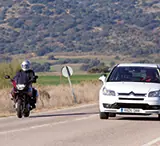
En vías interurbanas, los ciclos y ciclomotores de dos ruedas, ¿dónde deben situarse para girar a la izquierda?
On roads outside built-up areas, where must two-wheeled bicycles and mopeds position themselves to turn left?
- AEn el carril izquierdo.In the left-hand lane.
- BEn el centro, sin invadir el sentido contrario.In the centre, without moving into the opposite direction.
- CA la derecha, fuera de la calzada si es posible, e iniciarlo desde ese lugar.On the right, off the carriageway if possible, and start the turn from there.
ExplanationOn roads outside built-up areas, two-wheeled bicycles and mopeds turn left by positioning themselves on the right, off the carriageway if possible, and starting the turn from there: this way they avoid crossing fast traffic in the middle of the road.
¿Se puede circular marcha hacia atrás más de 15 metros?
Can you reverse more than 15 metres?
- ANo, en ningún caso.No, never.
- BSí, para salir de una calle cortada.Yes, to get out of a closed street.
- CSí, para estacionar.Yes, to park.
ExplanationTo get out of a closed street you may reverse as many metres as needed to make the manoeuvre, which may be more than 15 metres.
¿En una carretera convencional se podrá efectuar un cambio de sentido?
Can you make a U-turn on a conventional road?
- ANo, en ningún caso.No, never.
- BSí, pero solo en los lugares destinados para ello.Yes, but only in the places set aside for it.
- CSí, sin obstaculizar la marcha de los demás vehículos.Yes, without obstructing other vehicles.
ExplanationWe may make a U-turn as long as it is not prohibited, we do not obstruct other vehicles and we do not reverse.
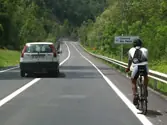
¿Es correcto el adelantamiento que efectúa el turismo a la bicicleta?
Is the car overtaking the bicycle correctly?
- ANo, porque al dejar demasiada separación tiene que ocupar el carril de sentido contrario.No, because by leaving too much space it has to use the lane for the opposite direction.
- BSí, porque deja la separación adecuada y ocupa el carril contiguo.Yes, because it leaves an adequate side gap and uses the next lane.
- CNo, porque está prohibido rebasar la línea continua para adelantar.No, because crossing the solid line to overtake is prohibited.
ExplanationAccording to Article 85.4 of the General Traffic Regulations (RGC) (as worded by RD 518/2026), to overtake a cyclist you must use part or all of the next lane or the opposite lane, keeping a safety gap of at least 1.5 metres. Even if there is a solid line, Article 88.2 allows overtaking cyclists when, because of their speed, it can be done without risk. Outside built-up areas, you must also reduce your speed by at least 20 km/h below the road's speed limit.
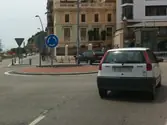
¿Está prohibido adelantar en las glorietas?
Is overtaking forbidden on roundabouts?
- ASí.Yes.
- BNo.No.
- CSí, salvo a los vehículos de dos ruedas.Yes, except two-wheeled vehicles.
ExplanationOn a roundabout, you may overtake if you take the necessary precautions.
¿Cómo procederemos si queremos incorporarnos a una autopista?
How should you join a motorway (autopista)?
- ANos detendremos al principio del carril de aceleración.Stop at the beginning of the acceleration lane.
- BNos detendremos al final del carril de aceleración.Stop at the end of the acceleration lane.
- CAceleraremos para incorporarnos al final del carril de aceleración.Accelerate to join at the end of the acceleration lane.
ExplanationWhen joining a motorway, use the acceleration lane: it lets you accelerate, match your speed to motorway traffic and join the motorway at the end of the acceleration lane.
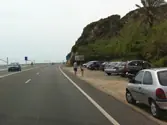
¿Dónde está permitido parar en una vía interurbana?
Where is stopping allowed on a road outside built-up areas?
- AEn el lado derecho, fuera de la calzada y de la parte transitable del arcén.On the right-hand side, off the carriageway and off the usable part of the hard shoulder.
- BEn cualquier lado, siempre fuera de la calzada y de la parte transitable del arcén.On either side, always off the carriageway and off the usable part of the hard shoulder.
- CSi es por necesidades del tráfico, en el arcén si es transitable.If traffic needs require it, on the hard shoulder if it is usable.
ExplanationOn roads outside built-up areas, stopping and parking must be done off the carriageway, on its right-hand side, leaving the usable part of the hard shoulder free (article 90.1 of the General Traffic Regulations). It is not allowed on either side or on the usable part of the hard shoulder.
¿Qué debe hacer un turismo que se incorpore por un carril de aceleración?
What must a car joining from an acceleration lane do?
- AFacilitar la incorporación en la medida posible.Make joining easier as far as possible.
- BCeder el paso.Give way.
- CAcelerar para incorporarse con prioridad.Speed up to join with priority.
ExplanationWhen a vehicle joins a road from an acceleration lane, it must give way, although the vehicles already in the main lane must make it easier for it to join as far as possible.
En un túnel, si no va a adelantar, debe mantener una distancia con el vehículo que va delante...
In a tunnel, if you are not going to overtake, you must keep a distance from the vehicle in front...
- Aque permita al vehículo que circula detrás adelantar con seguridad.that allows the vehicle behind to overtake safely.
- Bde al menos 100 metros.of at least 100 metres.
- Csuficiente para no colisionar con él en caso de frenada brusca.large enough not to hit it if it brakes sharply.
ExplanationIn tunnels, you must keep a minimum safe distance of 100 metres from the vehicle in front, unless you intend to overtake. This rule is in the General Traffic Regulations (RGC), which say that the safe distance must be enough to avoid collisions if the vehicle in front brakes sharply. The reason for this rule is to keep traffic safe in an enclosed and potentially dangerous place like a tunnel, where reaction and braking times can be different because of visibility and the number of other vehicles.
¿Podemos utilizar la señal acústica dentro de poblado para indicar nuestra intención de adelantar?
May we use the horn in a built-up area to show that we intend to overtake?
- ASí.Yes.
- BSí, pero solo durante el día.Yes, but only during the day.
- CNo.No.
ExplanationWe may use the horn to warn that we intend to overtake only on roads outside built-up areas.
Para efectuar un cambio de sentido, ¿podremos esperar en el arcén para realizarlo?
To make a U-turn, may you wait on the hard shoulder?
- ANo, en ningún caso.No, never.
- BSí, si es necesario por seguridad.Yes, if it is necessary for safety.
- CSí, siempre, como norma general.Yes, always, as a general rule.
ExplanationIf, while you wait on the carriageway to make the U-turn, you stop other vehicles from continuing, you must leave the carriageway; you may wait on the hard shoulder to make the U-turn.
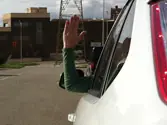
¿Qué está indicando este conductor?
What is this driver indicating?
- AQue va a girar a la derecha.That they are going to turn right.
- BQue va a girar a la izquierda.That they are going to turn left.
- CQue va a seguir de frente.That they are going to go straight ahead.
ExplanationThe left arm bent upwards, with the palm of the hand open, shows a move towards the side opposite that arm, that is, to the right (article 109.2.a of the General Traffic Regulations). Stretched out horizontally, it would show a move to the left.
En una vía dentro de poblado con dos sentidos de circulación, ¿a qué lado se podrá estacionar?
On a two-way road in a built-up area, on which side can you park?
- AEn cualquiera de los dos lados.On either side.
- BSólo en el lado derecho.Only on the right-hand side.
- CEn cualquier lado si hay línea discontinua.On either side if there is a broken line.
ExplanationIf the road is two-way, we may only stop or park on the right-hand side.
Los jóvenes suelen realizar más maniobras de riesgo...
Young people tend to make more risky manoeuvres...
- Acuando van solos.when they are alone.
- Bcuando van acompañados.when they have company.
- Ctanto cuando van solos como cuando van acompañados.both when they are alone and when they have company.
ExplanationYoung people tend to make more risky manoeuvres when they have company, because they have a more competitive attitude. This group of drivers often want to show off and prove themselves to their friends and acquaintances, which is why they tend to make dangerous manoeuvres when they are with others.
¿Es obligatorio terminar un adelantamiento...?
Is it compulsory to finish overtaking...?
- Aincorporándose al carril de forma gradual sin obstaculizar el tráfico.by moving back into the lane gradually, without obstructing traffic.
- Bsolo señalando el cambio de carril.only by signalling the lane change.
- Cincorporándose al carril derecho a la máxima velocidad posible.by moving into the right-hand lane at the highest possible speed.
ExplanationYou must finish overtaking by moving back into the lane gradually, without obstructing other road users. This is backed by Article 85.3 of the General Traffic Regulations (RGC), which says that the driver who has overtaken must return to their lane as soon as possible, gradually, and without forcing other road users to change their path or speed. Not doing so can put road safety at risk and cause accidents.
All topics
- Definitions
- Documents and penalty points
- The driver's condition
- Duties of drivers and pedestrians
- Vehicle safety devices
- Vehicle controls and equipment
- Vehicle lights and horn
- Traffic signs, markings and signals
- The road and its lanes
- Speed and distances
- Right of way
- Carrying passengers and loads
- Driving safely in difficult conditions
- Vehicle mechanics and maintenance
- Road accidents and first aid
- Defensive and eco-driving
Independent app: not affiliated with or endorsed by the DGT (Spain's Directorate-General for Traffic) or the Ministry of the Interior. The official exam is booked with the DGT and taken at its test centres. The questions here are practice material; the DGT's official question bank is not public.
Basado en datos de la Agencia Estatal Boletín Oficial del Estado (https://www.boe.es). Textos consolidados de carácter meramente informativo. La AEBOE no patrocina ni respalda este sitio.
Parte de las preguntas procede de los tests de la revista «Tráfico y Seguridad Vial» de la DGT, reproducidos con indicación de la fuente.