
DGT test · 982 questions
Manoeuvres · Page 14 of 20
Joining traffic, overtaking, turning, U-turns, reversing, stopping and parking: how and where to do them and when they are forbidden.
Questions in this topic, with answers
982 questions, 50 per page, with the correct answer and the explanation. Page 14 of 20.
¿Le está permitido realizar un adelantamiento en una intersección con una vía para ciclistas?
Are you allowed to overtake at a junction with a cycle path?
- ASí, porque los ciclos no son vehículos de motor.Yes, because bicycles are not motor vehicles.
- BSí, porque no es una intersección de vehículos automóviles.Yes, because it is not a junction for motor vehicles.
- CNo, porque está prohibido.No, because it is prohibited.
ExplanationAccording to Article 87.1.b of the General Traffic Regulations (RGC) (as worded by RD 518/2026), overtaking is prohibited at junctions with cycle paths and near them.
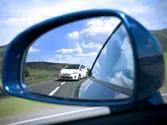
¿Los vehículos están obligados a facilitar el adelantamiento?
Must vehicles make overtaking easier?
- ANo.No.
- BSí, normalmente ciñéndose a la derecha.Yes, normally by keeping to the right.
- CSí, poniendo el indicador de dirección de la derecha o moviendo el brazo de atrás hacia delante.Yes, by switching on the right indicator or moving the arm back and forth.
ExplanationAs soon as we notice that the vehicle behind us wants to overtake, we must keep close to the right-hand edge of the carriageway, without moving onto the hard shoulder, and we do not have to change our speed. However, we must slow down if a dangerous situation arises, unless the overtaking driver reduces their speed, and we must make it easy for them to return to their lane. The driver of the vehicle being overtaken is prohibited from speeding up or making manoeuvres that prevent or hinder the overtaking. Drivers of heavy vehicles, large vehicles or vehicles that must keep to a specific speed limit must slow down or move onto the hard shoulder as soon as possible, if it is usable, to let the vehicles behind them pass, when oncoming traffic, a carriageway that is too narrow, or its layout or condition do not allow them to be overtaken easily and without danger. If these drivers cannot keep fully to the right-hand edge of the carriageway, but overtaking can still be done safely, they will show this to the approaching driver by holding out their arm horizontally and moving it back and forth several times, or with the right indicator.
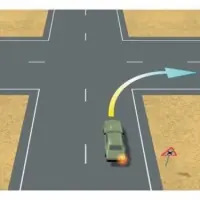
¿Este vehículo ha advertido correctamente la maniobra de cambio de dirección?
Has this vehicle signalled the turn correctly?
- ANo, debe advertirlo también con la mano.No, it must also signal with the hand.
- BSí.Yes.
- CNo, debe encender también las luces de emergencia.No, it must also switch on the hazard warning lights.
ExplanationThe Traffic Regulations say that all drivers on public roads must warn other road users of the manoeuvres they are going to make with their vehicles. As a general rule, these warnings are given with the vehicle's lights or, if that is not possible, with the arm. In this case, the vehicle signals its right turn with the right indicator, so we can say the manoeuvre has been signalled correctly.
Cuando, al estacionar su vehículo, el conductor tenga que abandonar el vehículo, deberá...
When the driver has to leave the vehicle after parking it, they must...
- ATomar las precauciones necesarias para evitar que el vehículo sea utilizado sin su autorización.take the necessary precautions to prevent the vehicle from being used without their permission.
- BDejarlo debidamente calzado.leave it properly chocked.
- CDejar la palanca de cambios en la posición de estacionamiento (P).leave the gear lever in the park position (P).
ExplanationUnder Article 92.3.a of the General Traffic Regulations, a driver who leaves their seat must stop the engine and, if they move away, take the necessary precautions to prevent the vehicle from being used without authorisation. Chocks are only required for heavy vehicles on slopes, and the P position only exists on some gearboxes.
Un coche sale de una gasolinera para incorporarse a la circulación. Si es necesario, ¿cuándo debe ceder el paso?
A car is leaving a petrol station to join traffic. When must it give way, if necessary?
- ACuando se incorpore por la derecha.When it joins from the right.
- BCuando se incorpore por la izquierda.When it joins from the left.
- CCuando se incorpore por la derecha o por la izquierda.When it joins from either the right or the left.
ExplanationA driver joining traffic from a service area, such as a petrol station, must make sure it is safe to do so and give way to vehicles on the road (Article 72.1 of the General Traffic Regulations (RGC)), whether joining from the right or from the left.
¿Qué conducta de un conductor puede poner en peligro a los peatones?
What driver behaviour can put pedestrians in danger?
- APrestar mucha atención al acercarse a un autobús.Paying close attention when approaching a bus.
- BEstacionar sobre la acera.Parking on the pavement.
- CNo dar señales para que crucen la calzada.Not signalling to pedestrians to cross the carriageway.
ExplanationAccording to Article 152.1 of the General Traffic Regulations (RGC) (as worded by RD 518/2026), pavements are the part of the road reserved for pedestrians to move and stay. Parking on the pavement forces them to step down onto the carriageway, where they risk being hit.
¿Se podrá parar en un paso rebajado para personas con movilidad reducida?
Can you stop at a dropped kerb for people with reduced mobility?
- ANo.No.
- BSí.Yes.
- CSí, si el conductor no abandona el vehículo.Yes, if the driver does not leave the vehicle.
ExplanationStopping and parking are prohibited where they obstruct the normal use of dropped kerbs for people with reduced mobility.
En una vía urbana de doble sentido de circulación, ¿en qué lado estacionará una motocicleta?
On a two-way urban road, on which side must a motorcycle park?
- AEn el lado derecho.On the right-hand side.
- BEn el lado izquierdo.On the left-hand side.
- CEn el lado derecho o izquierdo indistintamente.On either the right or the left side.
ExplanationOn two-way urban roads, any vehicle, including a motorcycle, stops or parks on the right-hand side, as close to the edge as possible. Only on one-way roads may you also park on the left (Article 90 of the General Traffic Regulations).
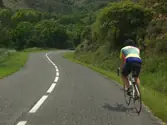
Si está conduciendo un vehículo y desea adelantar a un ciclista, ¿qué debe hacer?
If you are driving a vehicle and want to overtake a cyclist, what must you do?
- AAumentar la distancia frontal para evitar darle un golpe de aire.Increase the distance in front to avoid hitting them with a gust of air.
- BAumentar la distancia lateral para garantizar la seguridad del ciclista.Increase the side distance to keep the cyclist safe.
- CDisminuir la distancia lateral para no invadir el carril contrario.Reduce the side distance so as not to move into the opposite lane.
ExplanationWhen a driver wants to overtake a cyclist, they must increase the side distance between their vehicle and the cyclist to keep the cyclist safe. This is because cyclists are more vulnerable to changes in speed and to the 'gust of air' created by vehicles, which can knock them off balance. Keeping enough side distance is essential so as not to put the cyclist's life at risk. Increasing the distance in front is not relevant here, because it has no direct effect on the cyclist's safety during overtaking. Reducing the side distance is not advisable either, because it could put the cyclist at risk, especially if the vehicle moves into the opposite lane.
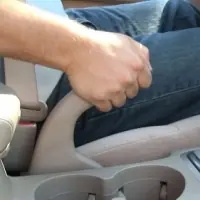
¿Se puede utilizar el freno de estacionamiento para disminuir velocidad?
May the parking brake (handbrake) be used to reduce speed?
- ASí, únicamente en casos de emergencia.Yes, only in emergencies.
- BNo, nunca.No, never.
- CSí, siempre que se desee cuando la velocidad no supere los 50 km/h.Yes, whenever you like, as long as your speed does not exceed 50 km/h.
ExplanationYou may use the parking brake to reduce speed only in emergencies where the service brake cannot be used, for example when it has failed and you are on a steep slope. In normal conditions you must always use the service brake.
En el interior de un túnel, ¿podremos efectuar un cambio de sentido?
Inside a tunnel, can we make a U-turn?
- ASí, si hay suficiente visibilidad.Yes, if there is enough visibility.
- BSí, si hay una línea discontinua.Yes, if there is a broken line.
- CNo.No.
ExplanationIn tunnels, underpasses and stretches covered by the tunnel sign, making a U-turn is prohibited.
Si hace un giro muy cerrado con su motocicleta a baja velocidad, ¿qué precaución debe tomar?
If you make a very tight turn on your motorcycle at low speed, what precaution must you take?
- AA esa baja velocidad no es necesario tomar ninguna precaución.At such a low speed no precaution is needed.
- BDebe compensar el efecto giroscópico con el peso del cuerpo.You must counter the gyroscopic effect with your body weight.
- CNo frenar con el freno delantero, ya que la rueda puede bloquearse y provocar una caída.Not brake with the front brake, because the wheel can lock and cause a fall.
ExplanationWhen making a tight turn at low speed on a motorcycle, it is essential not to brake with the front brake, because this can lock the wheel and cause a fall. According to the General Traffic Regulations (RGC), motorcyclists must be especially careful in these manoeuvres because motorcycles are naturally unstable and control of the vehicle is very important in critical situations.
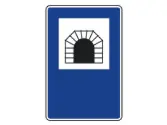
¿Se podrá cambiar de sentido en un tramo afectado por una señal de túnel?
Can you make a U-turn on a stretch covered by a tunnel sign?
- ANo, porque está prohibido.No, because it is prohibited.
- BSí, si no obstaculizamos la circulación.Yes, if we do not obstruct traffic.
- CNo, solo en el caso de que exista una línea continua.No, only if there is a solid line.
ExplanationIn a tunnel and on a stretch covered by the tunnel sign, making a U-turn is prohibited, whether or not we obstruct traffic.
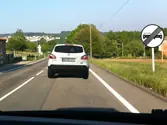
El conductor de un vehículo que observa que va a ser adelantado, debe...
A driver who notices that they are about to be overtaken must...
- Aacercarse al borde derecho de la calzada, para facilitar la maniobra.move close to the right-hand edge of the carriageway to make the manoeuvre easier.
- Baumentar la velocidad.increase speed.
- Cencender el indicador de dirección derecho para mostrar que va a permitir la maniobra.switch on the right indicator to show that they will allow the manoeuvre.
ExplanationA driver who notices that they are about to be overtaken must keep close to the right-hand edge of the carriageway to leave enough room, and must not increase speed or make manoeuvres that hinder the overtaking (Article 86 of the General Traffic Regulations).
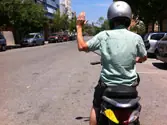
El conductor de este ciclomotor nos está indicando que pretende cambiar de dirección hacia...
The rider of this moped is signalling to us that they intend to turn...
- ALa derecha.right.
- BNinguna, está indicando que va a detenerse.neither way; they are signalling that they are going to stop.
- CLa izquierda.left.
ExplanationIf we signal a sideways movement with the arm held horizontally and the palm of the hand extended downwards, we are indicating that we want to move towards the side the hand is pointing to. If we bend the arm upwards, we are indicating that we want to move towards the opposite side.
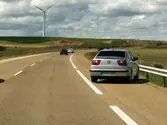
En esta vía interurbana, ¿en qué caso está permitido inmovilizar su vehículo en la zona transitable del arcén?
On this interurban road, in what case are you permitted to bring your vehicle to a halt on the usable part of the hard shoulder?
- APara descargar objetos, siempre que la parada dure menos de 2 minutos.To unload objects, provided the stop lasts less than 2 minutes.
- BPor razones de emergencia.For emergency reasons.
- CPara subir o bajar personas.To let people get in or out.
ExplanationOn interurban roads, stopping and parking must be done off the carriageway, on the right-hand side, leaving the usable part of the hard shoulder clear (Article 90.1 of the General Traffic Regulations). Only for emergency reasons may the vehicle be brought to a halt in that area.
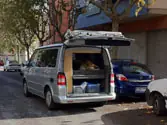
Si no hay sitio en las proximidades para estacionar el vehículo junto al borde de la calzada, ¿podrá hacerlo en doble fila?
If there is no room nearby to park your vehicle next to the edge of the carriageway, may you double-park?
- ASí, siempre que esté menos de 2 minutos.Yes, as long as it is for less than 2 minutes.
- BNo.No.
- CNo, si se interfiere la circulación.No, if it interferes with traffic.
ExplanationDouble parking is prohibited in all cases (Article 94.2.g of the General Traffic Regulations). Stopping in a double line is only allowed if there is no space nearby, for less than two minutes and without leaving the vehicle; otherwise it counts as parking.
¿Las motocicletas tienen permitido estacionar en la acera?
Are motorcycles allowed to park on the pavement?
- ANo, como norma general.No, as a general rule.
- BSólo los días festivos.Only on public holidays.
- CSólo los meses de verano.Only in the summer months.
ExplanationAs a general rule, motorcycles may not park on the pavement; they must park on the carriageway or in places specially set aside for them.
La incorporación desde una propiedad privada a la vía pública debe hacerse...
Joining the public road from private property must be done...
- Aa una velocidad que permita detenerse de inmediato y ceder el paso a peatones y vehículos.at a speed that allows you to stop immediately and give way to pedestrians and vehicles.
- Bavisando con la señal acústica o con las luces de emergencia.warning with the horn or with the hazard warning lights.
- Ccon rapidez para no entorpecer a peatones y vehículos.quickly, so as not to get in the way of pedestrians and vehicles.
ExplanationWhen joining a public road from private property, the driver must do so at a speed that allows them to stop at any moment and give way to pedestrians and vehicles. This rule is based on the priority of traffic on public roads, where drivers coming out of private property do not have right of way and must take the greatest care. Not following this rule can create danger, because other road users do not have to give way.
En un cruce con dos carriles por sentido, ¿se puede circular por el segundo carril para girar a la izquierda?
At a junction with two lanes in each direction, may you use the second lane to turn left?
- ASí, es el carril adecuado para girar a la izquierda.Yes, it is the correct lane for turning left.
- BNo, siempre hay que girar desde el carril derecho.No, you must always turn from the right-hand lane.
- CSolo si el cruce está regulado por semáforos.Only if the junction is controlled by traffic lights.
ExplanationTo turn left on a two-way carriageway, you must move in good time close to the longitudinal marking that separates the two directions (Article 75.1 of the General Traffic Regulations (RGC)). With two lanes in each direction, that means positioning yourself in the left lane, unless signs or markings indicate otherwise.
¿Cuándo debemos apagar el intermitente al adelantar?
When should we switch off the indicator when overtaking?
- AJusto después de rebasar al vehículo que adelantamos.Just after passing the vehicle we are overtaking.
- BAntes de volver al carril después de alcanzar la altura del vehículo adelantado.Before returning to the lane after drawing level with the vehicle being overtaken.
- CUna vez completado el desplazamiento lateral.Once the sideways movement has been completed.
ExplanationIn manoeuvres with sideways movement only that movement is signalled, and the signal ends when the vehicle has taken up its new path (Article 109.2.a of the RGC). That is why the indicator is switched off when each sideways movement is completed.
¿Debemos facilitar la maniobra al vehículo que se incorpora por la derecha?
Should we make the manoeuvre easier for a vehicle joining from the right?
- ASí, en la medida de lo posible.Yes, as far as possible.
- BNo.No.
- CSolo si se trata de un autobús.Only if it is a bus.
ExplanationAlthough the vehicle joining the traffic is the one that must give way, other drivers must make it as easy as possible for it to join.
El conductor que realice un adelantamiento...
A driver who is overtaking...
- Apuede rebasar la velocidad máxima fijada para las autopistas y autovías en 20 kilómetros por hora.may exceed the maximum speed set for motorways (autopistas) and dual carriageways (autovías) by 20 kilometres per hour.
- Bdebe mantener una velocidad moderada, sin importar el tiempo que emplee en el adelantamiento.must keep a moderate speed, regardless of how long the overtaking takes.
- Cdebe circular a una velocidad claramente superior a la del vehículo que va a adelantar.must drive at a speed clearly higher than that of the vehicle being overtaken.
ExplanationUnder Article 85.1 of the RGC, while overtaking you must travel at a speed noticeably higher than that of the vehicle being overtaken, to finish as soon as possible, but without exceeding the road's maximum speed: the 20 km/h margin no longer exists.
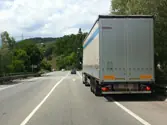
¿Qué debe hacer el conductor de un vehículo de grandes dimensiones para facilitar ser adelantado?
What must the driver of a large vehicle do to make it easier to be overtaken?
- ADisminuir la velocidad o apartarse al arcén si es practicable.Slow down or move onto the hard shoulder if it is usable.
- BNada, la responsabilidad en el adelantamiento la tiene siempre el que adelanta.Nothing, the overtaking driver is always responsible for overtaking.
- CDetenerse en el arcén obligatoriamente.Always stop on the hard shoulder.
ExplanationIf drivers of heavy vehicles, large vehicles or vehicles that must keep to a specific speed limit cannot keep to the right, but can still be overtaken safely, they must show this by moving the arm back and forth or switching on the right indicator. They must also slow down or move onto the hard shoulder as soon as possible, if it is usable, to make overtaking easier and let the vehicles behind them pass, when oncoming traffic, a carriageway that is too narrow, or its layout or condition do not allow them to be overtaken easily and without danger.
Si el conductor de un vehículo se quiere incorporar a la circulación saliendo de un estacionamiento, ¿deberá señalizarlo?
If a driver wants to join the traffic by pulling out of a parking space, must they signal it?
- ANo, la incorporación no se debe señalizar.No, joining the traffic must not be signalled.
- BSí.Yes.
- CSí, con el indicador de dirección del lado derecho.Yes, with the right indicator.
ExplanationYou must join the traffic giving way to other vehicles and signalling with the indicator on the side you are going to move towards.
¿Se permite parar o estacionar en un paso de peatones?
Is it allowed to stop or park on a pedestrian crossing?
- ANo.No.
- BSí.Yes.
- CSe permite parar, pero no estacionar.Stopping is allowed, but parking is not.
ExplanationAccording to Spain's General Traffic Regulations (RGC), pedestrian crossings are only for people on foot to cross safely and comfortably. Stopping or parking there is strictly prohibited, because it would block visibility and the proper flow of traffic, putting both pedestrians and other drivers in danger.
Circulando por una carretera convencional, ¿dónde se podrá parar o estacionar?
When driving on a conventional road, where can you stop or park?
- AEn el arcén izquierdo.On the left hard shoulder.
- BEn el arcén de la derecha.On the right hard shoulder.
- CFuera de la calzada y de la parte transitable del arcén, siempre en el lado derecho.Off the carriageway and off the usable part of the hard shoulder, always on the right-hand side.
ExplanationOn roads outside built-up areas, you must stop and park on the right-hand side of the road, off the carriageway and off the usable part of the hard shoulder. An emergency stop could be made on the hard shoulder, signalling the vehicle's presence in the official way.
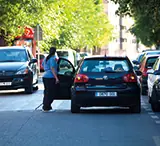
En doble fila, ¿qué está prohibido?
When double-parked, what is prohibited?
- AParar.Stopping.
- BParar y estacionar.Stopping and parking.
- CEstacionar.Parking.
ExplanationThe Regulations prohibit double parking in all cases; stopping (for a maximum of 2 minutes and without leaving the vehicle) may exceptionally be allowed if it does not obstruct traffic.
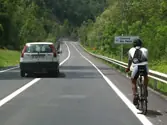
¿Este vehículo está adelantando correctamente al ciclista?
Is this vehicle overtaking the cyclist correctly?
- ANo, porque está pisando la línea continua.No, because it is driving on the solid line.
- BNo, porque está invadiendo el sentido contrario.No, because it is moving into the opposite direction.
- CSí.Yes.
ExplanationOvertaking a bicycle on roads outside built-up areas must be done by moving partly or completely into the next lane of the carriageway, leaving a side gap of at least 1.50 metres. You can overtake the cyclist even if there is a solid line.
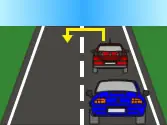
¿Es correcto el cambio de sentido que realiza el vehículo rojo?
Is the red vehicle making the U-turn correctly?
- ASí, porque lo realiza con una sola maniobra.Yes, because it does it in a single manoeuvre.
- BNo, porque obstaculiza a los vehículos que le siguen.No, because it is blocking the vehicles following it.
- CSí, por tener la línea discontinua.Yes, because it has a broken line.
ExplanationWhen making a U-turn, we must choose a suitable place so that we block the road for as short a time as possible, without obstructing other road users. If staying on the carriageway blocks the vehicles behind, the driver must leave it on the right-hand side, if possible, until they can make the U-turn, and if that is not possible, they must not make the U-turn and must look for a suitable place further on.
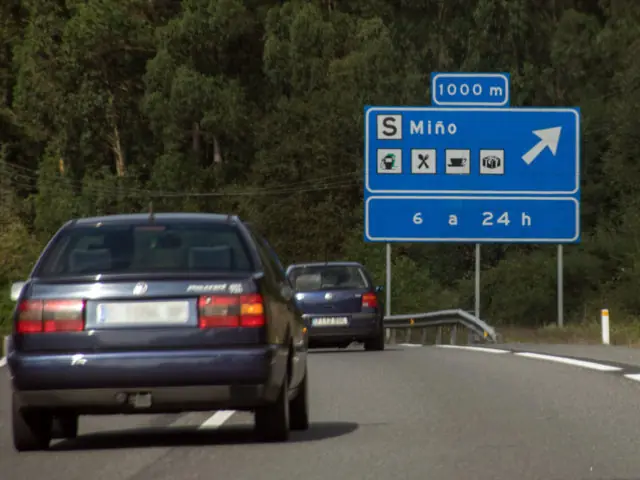
Un desplazamiento lateral, ¿cómo puede señalizarse?
How can a sideways movement be signalled?
- ACon las luces indicadoras de dirección o, en su defecto, con el brazo.With the indicators or, failing that, with the arm.
- BCon el brazo, preferentemente.Preferably with the arm.
- CSiempre con las luces indicadoras de dirección.Always with the indicators.
ExplanationAs a general rule, manoeuvres are signalled with the vehicle's light signals or, failing that, with the arm (Article 108.2 of the General Traffic Regulations, RGC). A sideways movement is signalled with the indicator on the relevant side or with the arm (Article 109.2.a).
¿Dónde debe aparcar en una autopista?
Where must you park on a motorway (autopista)?
- AEn la mediana (zona central).On the central reservation.
- BFuera de la calzada, en el arcén derecho.Off the carriageway, on the right hard shoulder.
- CEn los lugares señalizados para ese fin.In the places marked for that purpose.
ExplanationAccording to Article 94 of the General Traffic Regulations (RGC), on motorways (autopistas) and dual carriageways (autovías) stopping, and therefore parking, is prohibited, except in the areas provided for it. If the vehicle is immobilised by an emergency, you switch on the hazard warning lights and place the V-16 (flashing warning beacon).
¿Se podrá efectuar un estacionamiento en una vía interurbana?
Can you park on a road outside built-up areas?
- ANo, en ningún caso.No, never.
- BSí, en el arcén transitable.Yes, on the usable hard shoulder.
- CSí, fuera de la calzada dejando libre la parte transitable del arcén.Yes, off the carriageway, leaving the usable part of the hard shoulder free.
ExplanationOn a road outside built-up areas you may park, always off the carriageway, on the right-hand side and leaving the usable part of the hard shoulder free.
En una vía urbana, ¿está permitido parar en una intersección?
On an urban road, is it permitted to stop at a junction?
- ANo, en ningún caso.No, under no circumstances.
- BSí, en cualquier caso.Yes, in all cases.
- CSí, siempre que no se dificulte el giro a otros vehículos.Yes, provided that it does not make it difficult for other vehicles to turn.
ExplanationOn an urban road, stopping at a junction is permitted provided that it does not obstruct traffic or make it difficult for other vehicles to turn. On interurban roads, however, the restriction is stricter, because as well as possible obstruction, the lack of visibility and the greater risk created by stopping in a crossing area are also taken into account. In both cases, the main idea is to avoid dangerous situations or risky manoeuvres at junctions.
Como norma general, las maniobras deben indicarse...
As a general rule, manoeuvres should be signalled...
- Apreferiblemente con el brazo.preferably by arm.
- Bpreferiblemente con la señalización luminosa del vehículo.preferably with the vehicle's light signals.
- Cindistintamente con el brazo o con las señales luminosas.either by arm or with the light signals, without preference.
ExplanationUnder Article 108 of the General Traffic Regulations, drivers must warn other road users of the manoeuvres they are going to make. These warnings should preferably be given with the vehicle's light signals, which are more visible and effective in most situations. The arm should only be used when the light signals are not available. This rule lets other drivers and pedestrians anticipate what a vehicle is going to do, which improves road safety.
Si circula con su motocicleta por una vía urbana de sentido único y desea estacionar, ¿en qué lado debe hacerlo?
If you are riding your motorcycle on a one-way road in a built-up area and want to park, on which side must you do so?
- ASiempre en el lado derecho.Always on the right-hand side.
- BEn el lado derecho o en el izquierdo indistintamente.On either the right-hand or the left-hand side.
- CSólo en el lado izquierdo.Only on the left-hand side.
ExplanationOn one-way roads in built-up areas you may park on either the right-hand or the left-hand side (Article 90.2 of the General Traffic Regulations), always obeying the signs and without obstructing traffic.
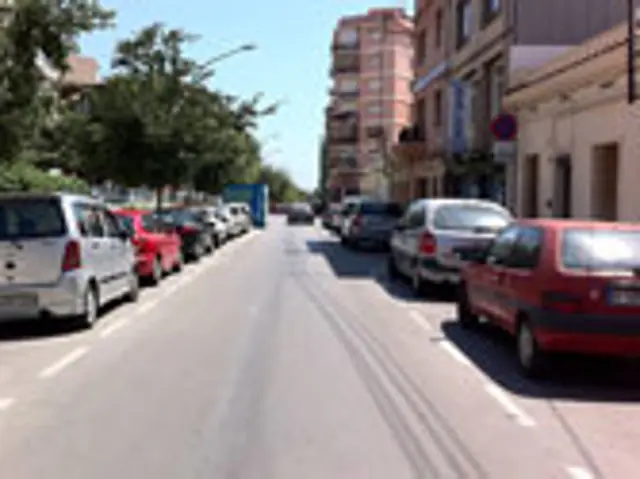
¿Está permitido ir marcha atrás para detenerse?
Is it permitted to reverse in order to stop?
- ASí, con ciertas condiciones.Yes, under certain conditions.
- BNo.No.
- CSí, siempre.Yes, always.
ExplanationYes, under conditions. Under Article 80.2 of the RGC, reversing as a manoeuvre that complements stopping or parking may not exceed 15 metres or go into a junction, and it must be done slowly, after signalling and without creating danger.
¿Se considera adelantamiento si un autobús que circula por el carril de autobuses va más rápido que los demás vehículos?
Is it considered overtaking if a bus in the bus lane is going faster than the other vehicles?
- ANo.No.
- BSí.Yes.
- CSí, porque en ciudad está permitido adelantar por la derecha.Yes, because overtaking on the right is allowed in towns.
ExplanationUnder Article 83.3 of the RGC, on stretches with lanes reserved exclusively for certain vehicles, such as a bus lane, moving faster in those lanes than in the normal lanes is not considered overtaking.
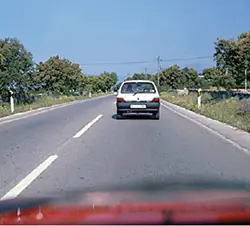
En esta vía de doble sentido, el conductor del turismo blanco, ¿dónde situará su vehículo para girar a la izquierda?
On this two-way road, where will the driver of the white car position the vehicle to turn left?
- ASobre la línea discontinua, invadiendo ligeramente el sentido contrario.On the broken line, moving slightly into the opposite direction.
- BJunto a la línea discontinua, sin invadir el sentido contrario.Next to the broken line, without moving into the opposite direction.
- CA la derecha, fuera de la calzada siempre que sea posible.On the right, off the carriageway whenever possible.
ExplanationTo turn left on a two-way road, the vehicle must position itself next to the longitudinal marking that separates the two directions, but without moving into the part for the opposite direction.
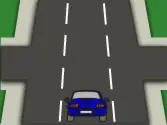
En esta calzada de doble sentido de circulación y tres carriles, ¿está bien situado el vehículo para realizar un cambio de dirección a la izquierda?
On this two-way carriageway with three lanes, is the vehicle in the right position to turn left?
- ASí, si no circulan otros vehículos.Yes, if no other vehicles are coming.
- BNo, porque debe colocarse en el carril izquierdo.No, because it must move into the left-hand lane.
- CSí, porque no hay flechas en el pavimento.Yes, because there are no arrows on the road surface.
ExplanationTo turn left on a one-way road, we must position ourselves in the lane nearest the left-hand side. If the road is two-way with 3 lanes, to turn left we must position ourselves in the centre lane, as long as it is not being used by traffic from the opposite direction.
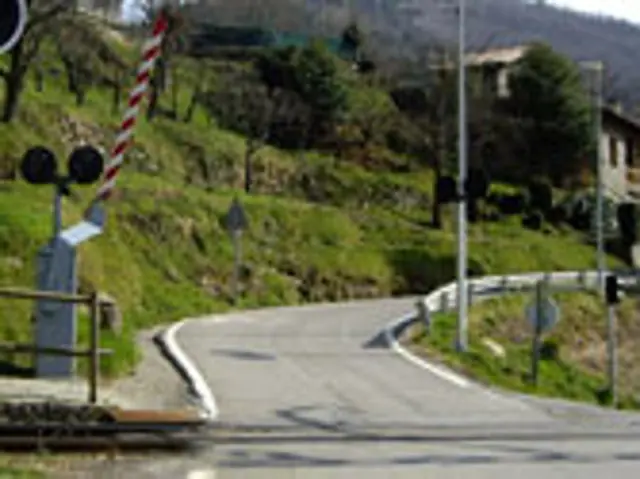
Como norma general, ¿está prohibido adelantar en los pasos peatonales o cerca de ellos?
As a general rule, is overtaking prohibited on pedestrian crossings or near them?
- ANo.No.
- BSí.Yes.
- CEn los pasos peatonales sí, pero no cerca de ellos.On pedestrian crossings yes, but not near them.
ExplanationAccording to Article 87.1.b of the General Traffic Regulations (RGC) (as worded by RD 518/2026), overtaking is prohibited on marked pedestrian crossings, at junctions with cycle paths and on level crossings, as well as near them. The ban covers both the crossing itself and the area near it.
Si en una vía interurbana un ciclomotor de dos ruedas quiere girar a la izquierda y no hay un carril específico para ello:
If, on a road outside built-up areas, a two-wheeled moped wants to turn left and there is no specific lane for it:
- ANo puede girar.It cannot turn.
- BDebe colocarse a la derecha e iniciar el giro desde el centro de la calzada.It must position itself on the right and start the turn from the centre of the carriageway.
- CDebe colocarse a la derecha e iniciar el giro fuera de la calzada siempre que sea posible.It must position itself on the right and start the turn off the carriageway whenever possible.
ExplanationOn roads outside built-up areas, if a two-wheeled moped wants to turn left and there is no lane set up for it, it must position itself on the right and, whenever possible, start the turn off the carriageway. This is based on Article 76 of the General Traffic Regulations (RGC), which says that, unless the road is set up or marked otherwise, the moped must follow these rules to avoid danger and make the manoeuvre safely.
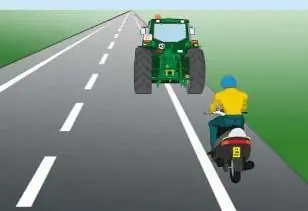
Si el conductor del ciclomotor decide adelantar al tractor, debe de tener en cuenta que...
If the moped rider decides to overtake the tractor, they must bear in mind that...
- ANo podrá adelantar mientras circulen vehículos en sentido contrario.They cannot overtake while vehicles are coming from the opposite direction.
- BDeberá realizar la maniobra sin salirse del arcén.They must make the manoeuvre without leaving the hard shoulder.
- CNo podrá circular en paralelo con el tractor más de 15 segundos o 200 metros.They cannot travel side by side with the tractor for more than 15 seconds or 200 metres.
ExplanationArticle 36 of the General Traffic Regulations (RGC) prohibits vehicles travelling on the hard shoulder, such as mopeds and tractors, from overtaking each other if they travel side by side for more than 15 seconds or more than 200 metres. The rider must also make sure it can be done safely.
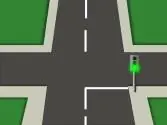
¿Está permitido realizar un cambio de sentido en esta intersección?
Is it allowed to make a U-turn at this junction?
- ASí, si no recorre más de 15 metros.Yes, if you do not travel more than 15 metres.
- BNo.No.
- CSí, con las debidas precauciones.Yes, with due care.
ExplanationAs a general rule, making a U-turn is prohibited where overtaking is prohibited, unless it is expressly allowed by the corresponding sign. At junctions and near them overtaking is prohibited, unless you have right of way and it is properly signalled. In this case, right of way is given by the green traffic light, so you may overtake or make a U-turn, always carefully and without putting any road user in danger. At roundabouts, although they are a special type of junction, making a U-turn is allowed.
¿Se debe tener especial cuidado al adelantar a un grupo de ciclistas en una subida larga?
Should you take special care when overtaking a group of cyclists on a long climb?
- ANo; los adelantamientos a ciclistas no implican riesgo alguno.No; overtaking cyclists involves no risk at all.
- BSolo si algún ciclista está bebiendo o comiendo.Only if a cyclist is drinking or eating.
- CSí, porque por el esfuerzo y el pedaleo pueden hacer cambios bruscos de dirección.Yes, because the effort of pedalling can make them change direction suddenly.
ExplanationAccording to Article 85.4 of the General Traffic Regulations (RGC) (as worded by RD 518/2026), when overtaking cyclists or a group of cyclists you must take special care with the manoeuvre; on long climbs the effort can make them change course suddenly.
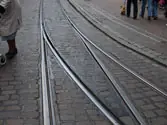
Sobre los raíles de tranvías está prohibido...
On tram rails it is prohibited to...
- ACircular.Drive.
- BSolamente estacionar.Only park.
- CParar y estacionar.Stop and park.
ExplanationStopping and parking are prohibited on tram rails or so close to them that tram traffic could be hindered.
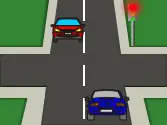
El vehículo de la imagen quiere cambiar de dirección a la derecha, ¿está obligado a detenerse?
The vehicle in the picture wants to turn right. Must it stop?
- ANo, las indicaciones del semáforo solo le afectan si pretende seguir de frente.No, the traffic light only applies to it if it wants to go straight on.
- BNo, puede continuar la marcha con precaución.No, it can continue carefully.
- CSí, debe obedecer las indicaciones del semáforo.Yes, it must obey the traffic light.
ExplanationEven though the traffic light is on the other side of the junction, it must be obeyed in the same way as if it were placed before the junction. So the vehicle must stop before entering the junction and wait until the traffic light lets it go.
¿Se puede hacer un cambio de sentido en un túnel?
Can you make a U-turn in a tunnel?
- ANo, está prohibido.No, it is prohibited.
- BSí, si no tengo que maniobrar.Yes, if I do not have to manoeuvre.
- CSí, si hay suficiente visibilidad.Yes, if there is enough visibility.
ExplanationIn tunnels, the General Traffic Regulations (RGC) expressly prohibit making a U-turn. This is because visibility and safety are limited in these enclosed spaces, which can put in danger both the driver trying to make the manoeuvre and other road users. Article 79 says that a U-turn is prohibited in situations where you cannot check the traffic, including in tunnels.
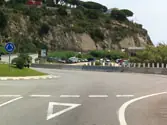
¿Podremos utilizar una glorieta para efectuar un cambio de sentido de la marcha?
May we use a roundabout to make a U-turn?
- ANo, las glorietas no las podemos usar para efectuar cambios de sentido.No, we may not use roundabouts to make U-turns.
- BSí, pero solo en las glorietas de más de dos carriles.Yes, but only on roundabouts with more than two lanes.
- CSí, las glorietas son un lugar adecuado.Yes, roundabouts are a suitable place.
ExplanationTo make a U-turn, we must choose a suitable place so that we block the road for as short a time as possible, so using a roundabout is a good option.
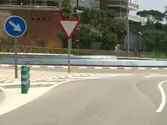
Al llegar a la intersección de la imagen, ¿podremos cambiar de dirección hacia la izquierda?
When we reach the junction in the picture, may we turn left?
- ASí.Yes.
- BNo.No.
- CNo, salvo que un agente lo autorice.No, unless a traffic officer allows it.
ExplanationThe circular sign shows the side on which vehicles must pass. Once past this sign, we may turn right or left if it is possible.
All topics
- Definitions
- Documents and penalty points
- The driver's condition
- Duties of drivers and pedestrians
- Vehicle safety devices
- Vehicle controls and equipment
- Vehicle lights and horn
- Traffic signs, markings and signals
- The road and its lanes
- Speed and distances
- Right of way
- Carrying passengers and loads
- Driving safely in difficult conditions
- Vehicle mechanics and maintenance
- Road accidents and first aid
- Defensive and eco-driving
Independent app: not affiliated with or endorsed by the DGT (Spain's Directorate-General for Traffic) or the Ministry of the Interior. The official exam is booked with the DGT and taken at its test centres. The questions here are practice material; the DGT's official question bank is not public.
Basado en datos de la Agencia Estatal Boletín Oficial del Estado (https://www.boe.es). Textos consolidados de carácter meramente informativo. La AEBOE no patrocina ni respalda este sitio.
Parte de las preguntas procede de los tests de la revista «Tráfico y Seguridad Vial» de la DGT, reproducidos con indicación de la fuente.