
DGT test · 1,397 questions
Traffic signs, markings and signals · Page 10 of 28
Road signs, road markings, traffic lights, police signals and temporary markings: what they mean and which one wins when they disagree. The topic with the most questions in the bank.
Questions in this topic, with answers
1,397 questions, 50 per page, with the correct answer and the explanation. Page 10 of 28.
Un conductor extiende el brazo horizontalmente con la palma hacia atrás. ¿Qué significa?
A driver holds their arm out horizontally with the palm facing backwards. What does this mean?
- AQue va a dar marcha atrás.That they are going to reverse.
- BQue va a girar a la izquierda.That they are going to turn left.
- CQue tiene intención de inmovilizar el vehículo o de frenar su marcha de modo considerable.That they intend to stop the vehicle or slow down considerably.
ExplanationHolding the arm out horizontally with the palm of the hand facing backwards shows that the driver intends to reverse. This is based on Article 109 of the General Traffic Regulations, which states that reversing must be signalled by holding the arm out horizontally with the palm facing backwards if the vehicle has no reversing light. It is therefore essential that other road users understand this signal, for the sake of road safety.
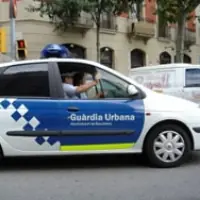
¿Qué se considera como señalización de la circulación?
What is considered to be traffic signalling?
- ALas señales verticales de circulación únicamenteOnly road signs.
- BLas señales de tráfico y las órdenes de los agentes de circulaciónTraffic signs and the orders of traffic officers.
- CLos semáforos y las marcas vialesTraffic lights and road markings.
ExplanationTraffic signalling is generally made up of traffic signs (road signs and road markings, among others) and the orders given by traffic officers in the course of their duties.
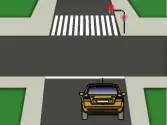
Para seguir de frente, ¿dónde hay que detenerse?
To go straight on, where must you stop?
- AAnte la línea de detención.At the stop line.
- BAnte la marca de paso para peatones.At the pedestrian crossing marking.
- CEn la intersección.In the junction.
ExplanationA continuous line across one or more lanes always means that no vehicle, animal or load may cross it in order to obey a traffic rule or sign. In the case in the question, that is a red traffic light on the opposite side of the junction.
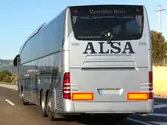
La señal colocada en la parte posterior del vehículo indica que...
The sign placed at the rear of the vehicle indicates that...
- ALa longitud del vehículo es la máxima establecida para los vehículos rígidos.The vehicle's length is the maximum allowed for rigid vehicles.
- BEl vehículo mide más de 12 metros.The vehicle is more than 12 metres long.
- CEl vehículo excede de las dimensiones máximas en cuanto a longitud, altura y anchura.The vehicle exceeds the maximum dimensions for length, height and width.
ExplanationThis sign tells us that the vehicle or combination of vehicles is more than 12 metres long.
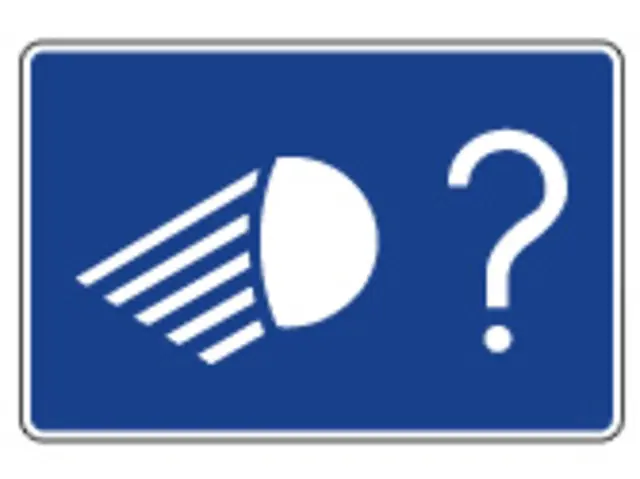
¿Qué debemos hacer al ver esta señal?
What should we do when we see this sign?
- AApagar las luces de cruce.Switch off the dipped headlights.
- BEncender obligatoriamente las luces de cruce o las de carretera.We must switch on the dipped headlights or main beam.
- CMantener encendidas las luces de cruce si las condiciones de visibilidad lo exigen.Keep the dipped headlights on if visibility conditions require it.
ExplanationThis is sign S-24, end of the obligation to use dipped headlights: the stretch where at least dipped headlights were compulsory ends here. You may switch them off, unless visibility, the time of day or the road lighting require them.
¿Dónde se detendrá el conductor de un vehículo que se aproxima de frente a un agente con el brazo levantado verticalmente?
Where must the driver of a vehicle stop when approaching head-on a traffic officer with an arm raised vertically?
- ASiempre inmediatamente antes del agente.Always immediately before the traffic officer.
- BAnte la línea de detención más cercana o, en su defecto, inmediatamente antes del agente.At the nearest stop line or, if there is none, immediately before the traffic officer.
- CEfectuará la detención donde crea conveniente.The driver will stop wherever they think best.
ExplanationA traffic officer with an arm raised vertically requires all road users approaching the officer to stop. They must stop at the nearest stop line or, if there is none, immediately before the officer.
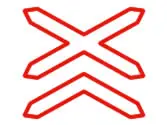
Esta señal de peligro, ¿qué indica?
What does this warning sign indicate?
- APaso a nivel con barreras con más de una vía férrea.A level crossing with barriers over more than one railway track.
- BPaso a nivel sin barreras con más de una vía férrea.A level crossing without barriers over more than one railway track.
- CPaso a nivel con barreras de una vía férrea.A level crossing with barriers over one railway track.
ExplanationThis sign indicates danger from a level crossing without barriers. As the sign has a double cross, it indicates that there is more than one railway track. Do not confuse the sign for a level crossing with barriers with the one for a level crossing without barriers.
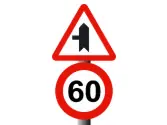
¿Hasta cuándo tendremos que respetar la señal de velocidad máxima?
Until when must we obey the maximum speed sign?
- AHasta encontrar otra señal de fin de prohibición.Until we find an end of prohibition sign.
- BHasta encontrar una señal de velocidad máxima distinta.Until we find a different maximum speed sign.
- CHasta pasada la intersección.Until we have passed the junction.
ExplanationWhen the maximum speed sign is on the same post as a danger warning sign, the limit applies only while the signalled danger lasts. Here the danger is the junction, so once you have passed it you no longer have to keep to that limit.
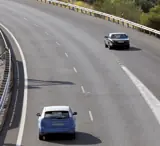
En el carril de entrada, ¿cómo debe circular?
How must you drive in the entry lane?
- ADeteniéndome antes de la señal.Stopping before the sign.
- BCediendo el paso a los vehículos que circulan por la autovía.Giving way to vehicles travelling on the dual carriageway (autovía).
- CAcelerando porque no estoy obligado a ceder el paso.Accelerating, because I do not have to give way.
ExplanationThe acceleration lane is for reaching a suitable speed, but anyone joining must give way to vehicles already travelling on the dual carriageway (autovía). You do not have to stop before the sign if it is not necessary, and accelerating does not give you priority.
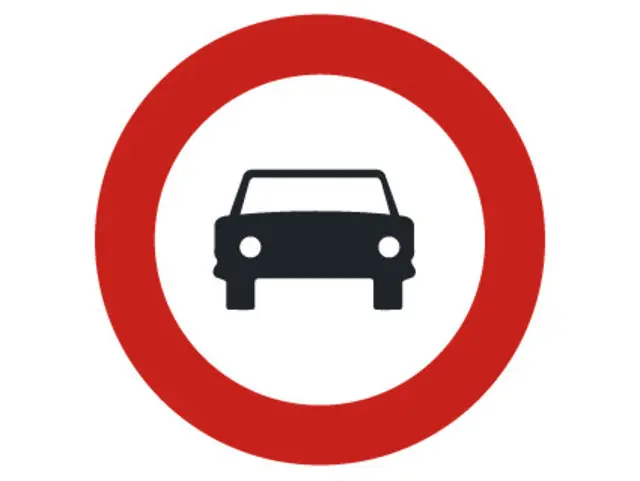
Esta señal indica que está prohibida la entrada a...
This sign indicates that entry is prohibited to...
- Aautomóviles.motor cars.
- Bvehículos de motor, excepto motocicletas de dos ruedas.motor vehicles, except two-wheeled motorcycles.
- Ccoches particulares.private cars.
ExplanationSign R-103 prohibits entry to motor vehicles, except two-wheeled motorcycles and three-wheeled vehicles treated as motorcycles. It applies to cars, lorries and vans, not only to private cars.
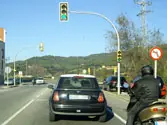
¿Cuál de las siguientes acciones es más apropiada al cambiar el semáforo a verde para indicar a un conductor distraído que avance?
When the traffic light turns green, which of the following is most appropriate to get a distracted driver to move off?
- ATocar el claxon para alertar al conductor.Sound the horn to alert the driver.
- BPermanecer en silencio y esperar pacientemente a que el conductor se dé cuenta por sí mismo.Stay quiet and wait patiently until the driver notices by themselves.
- CActivar las luces intermitentes del vehículo para llamar la atención del conductor.Switch on your vehicle's flashing lights to attract the driver's attention.
ExplanationDrivers of non-priority vehicles may only use sound signals or warnings: - To avoid a possible accident, especially on narrow roads with many bends. - Outside built-up areas, to warn the driver of another vehicle that they intend to overtake. - To warn other drivers and users of their presence when, as the driver of a non-priority vehicle, they are forced, with no other means available, to carry out a service normally reserved for priority vehicles.
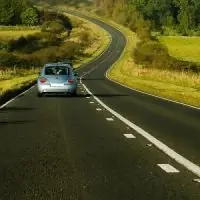
¿Por qué se caracteriza una línea discontinua que avisa de la proximidad de una línea continua?
What is characteristic of a broken line that warns that a continuous line is coming up?
- ALa separación entre los trazos de la línea es más cortaThe gaps between the dashes are shorter
- BPorque los trazos son de color amarillo y blanco alternoThe dashes are alternately yellow and white
- CLa separación entre los trazos de la línea es más largaThe gaps between the dashes are longer
ExplanationA broken line that warns of a continuous line (M-1.9 and M-1.10) has much shorter gaps between the dashes than a normal broken line: on a conventional road, 3.5 m dashes and 1.5 m gaps, compared with 4 m and 8.5 m. It announces that soon you will not be allowed to cross.
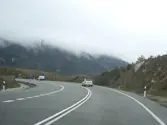
¿Qué indica una doble línea continua en el centro de la calzada?
What does a double continuous line in the centre of the carriageway indicate?
- AQue hay un carril especial.That there is a special lane.
- BQue no se puede atravesar, ni circular por encima de la línea.That you may not cross it or drive on the line.
- CQue es una calzada muy peligrosa.That the carriageway is very dangerous.
ExplanationA longitudinal marking made up of two parallel continuous lines means the same as a single continuous line. This means that no driver, whether of a vehicle or an animal, may cross it or drive on it. In addition, when this marking separates the two directions of traffic, driving to its left is prohibited.
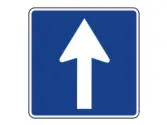
Con esta señal, ¿se podrá efectuar un cambio de dirección a la derecha?
With this sign, may you turn right?
- ANo, solo permite seguir de frente.No, it only allows going straight on.
- BSí.Yes.
- CNo.No.
ExplanationThe sign indicates that on the carriageway continuing in the direction of the arrow, vehicles must travel in the direction of the arrow and traffic in the opposite direction is prohibited; so you may turn both right and left.
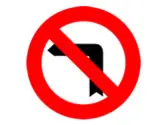
¿Esta señal prohíbe efectuar un cambio de sentido de la marcha?
Does this sign prohibit making a U-turn?
- ANo, solo prohíbe girar a la izquierda.No, it only prohibits turning left.
- BSí.Yes.
- CSí, pero solo en poblado.Yes, but only in built-up areas.
ExplanationThis sign prohibits turning left. It also includes a ban on making a U-turn.
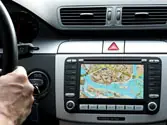
Si existe contradicción entre las indicaciones proporcionadas por el navegador GPS y las señales indicativas de tráfico, ¿qué acción es más correcta por parte del conductor?
If the directions from the GPS navigation system contradict the direction signs, what is the most correct thing for the driver to do?
- ASeguir exclusivamente las indicaciones del navegador GPS, ya que está diseñado para encontrar la ruta más eficiente.Follow only the GPS directions, because it is designed to find the most efficient route.
- BPriorizar las señales indicativas del tráfico y ajustar el recorrido según sea necesario.Give priority to the direction signs and adjust the route as needed.
- CReiniciar el dispositivo GPS en ese momento para corregir posibles errores.Restart the GPS device at that moment to correct possible errors.
ExplanationWhen the GPS directions and the traffic signs contradict each other, road safety must come first. Traffic signs are designed to regulate traffic and keep all road users safe. So the driver should pay attention to these signs and give them priority over the GPS directions. Restarting the GPS device may help with technical problems, but it does not deal with the contradiction between the traffic signs and the GPS directions. Also, it is prohibited to handle it while the vehicle is moving.
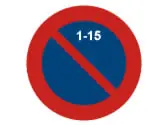
Hoy es día 10, ¿se podrá parar a partir de esta señal?
Today is the 10th. Can you stop beyond this sign?
- AParar sí, estacionar no.Stopping yes, parking no.
- BNo se puede parar, pero sí estacionar.You cannot stop, but you can park.
- CNo se puede parar ni estacionar.You can neither stop nor park.
ExplanationThe sign in the picture prohibits parking from the 1st to the 15th of the month on the side of the carriageway where it is placed. Today is the 10th, so you cannot park, but stopping is permitted, because the sign does not prohibit it.
¿Qué significa una línea continua amarilla junto al borde de la calzada?
What does a continuous yellow line along the edge of the carriageway mean?
- AProhíbe estacionar.It prohibits parking.
- BProhíbe sólo parar.It prohibits only stopping.
- CProhíbe parar y estacionar.It prohibits stopping and parking.
ExplanationIt means that both stopping and parking are prohibited.
Si un agente te da una orden que contradice un semáforo:
If an officer gives you an instruction that contradicts a traffic light:
- AObedezco al semáforoI obey the traffic light
- BObedezco al agenteI obey the officer
- CEspero a que se pongan de acuerdoI wait for them to agree
ExplanationOfficers' instructions take precedence over any other sign. The order of precedence is: 1st officers, 2nd temporary signs, 3rd traffic lights, 4th road signs, 5th road markings.
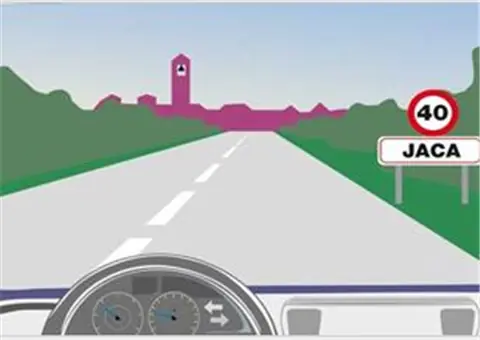
¿Qué indican estas señales?
What do these signs indicate?
- AProhíben circular a más de 40 km/h en toda la población.They prohibit driving faster than 40 km/h in the whole town.
- BAconsejan no circular a más de 40 km/h en toda población.They advise not driving faster than 40 km/h in the whole town.
- CObligan a circular a menos de 40 km/h en la travesía solamente.They require you to drive at less than 40 km/h only on the travesía (stretch of road through the town).
ExplanationA maximum speed sign placed next to or above the sign marking the entrance to a built-up area indicates that the limit applies to the whole built-up area, not just the travesía. If it were placed before or after it, it would only apply to that stretch until another sign.
Una señal triangular con niños jugando indica…
A triangular sign with children playing indicates…
- AProhibición de circularNo driving
- BPeligro por proximidad a una zona escolarDanger because a school area is near
- CVía reservada para peatonesA road reserved for pedestrians
ExplanationIt warns that a place frequented by children, such as a school, is near, and requires you to take extreme care.
¿Qué debe hacer Ud. ante la luz amarilla no intermitente del semáforo?
What must you do at a non-flashing amber traffic light?
- ADetenerme en todo caso en la próxima intersección.Stop at the next junction in all cases.
- BDetenerme a la altura del semáforo, si puedo hacerlo en condiciones de seguridad suficiente.Stop level with the traffic light, if I can do so with sufficient safety.
- CPuedo pasar extremando la precaución.I may go through, taking extreme care.
ExplanationThis is the correct answer because a non-flashing amber light means that you must get ready to stop. If you can do so safely, that is what you must do. This keeps traffic flowing in an orderly way and avoids dangerous situations.
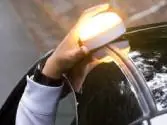
Colocaremos la señal luminosa de preseñalización de peligro ...
We will place the hazard warning light...
- Aen la parte más alta posible del vehículo inmovilizado garantizado su máxima visibilidadon the highest possible part of the broken-down vehicle, ensuring maximum visibility.
- Ben la parte más baja posible del vehículo inmovilizado.on the lowest possible part of the broken-down vehicle.
- C100 m de distancia del vehículo inmovilizado.100 m away from the broken-down vehicle.
ExplanationThe V-16 hazard warning device is an approved amber light with geolocation that runs on its own power supply (battery). It must be placed on the highest part of the broken-down vehicle, ensuring maximum visibility. The V-16 is now the only legal way to signal a broken-down vehicle or an obstacle on the road, and warning triangles are no longer used.
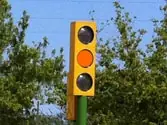
Si al circular observamos que el semáforo cambia de verde a amarillo, ¿cómo actuaremos?
If, while driving, you see the traffic light change from green to amber, what should you do?
- ANos detendremos en las mismas condiciones como si de una luz roja se tratase, siempre.Always stop, under the same conditions as for a red light.
- BContinuaremos si no podemos detenernos en condiciones de seguridad suficientes, por estar el vehículo muy cerca del lugar de detención.Continue if you cannot stop safely because your vehicle is very close to the stopping point.
- CPasaremos si circulamos a mucha velocidad.Go through if you are driving very fast.
ExplanationA steady (non-flashing) amber light means that vehicles must stop under the same conditions as for a steady red light, unless, when it comes on, the vehicle is so close to the stopping point that it cannot stop before it safely. Answer a) is not correct because it says “always”: if you cannot stop safely, it is better not to.
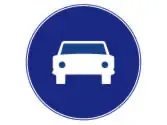
Con una motocicleta, ¿podrá circular por la calzada así señalizada?
On a motorcycle, may you use the carriageway with this sign?
- ASí.Yes.
- BNo, salvo en caso de emergencia.No, except in an emergency.
- CNo.No.
ExplanationThe sign requires, rather than prohibits, drivers of motor cars, except motorcycles, to use the carriageway marked in this way, so a motorcyclist may use it, although they are not required to.
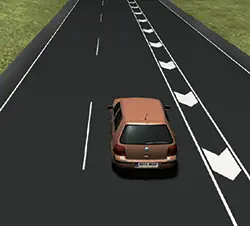
¿Está permitido atravesar la marca vial de la derecha para cambiar de carril?
Is it allowed to cross the road marking on the right to change lanes?
- ASí, pero con precaución.Yes, but with caution.
- BNo.No.
- CNo, porque solamente está permitido estacionar.No, because only parking is allowed.
ExplanationThe marking separating your lane from the one on the right is a solid line, and solid lines must not be crossed: changing into that lane is not allowed.
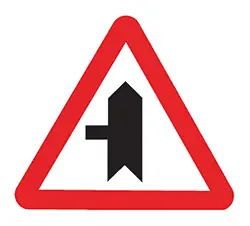
Esta señal indica que se acerca a un cruce...
This sign indicates that you are approaching a junction...
- ASin preferencia de paso.where you do not have right of way.
- BCon preferencia de paso.where you have right of way.
- CCon una vía estrecha.with a narrow road.
ExplanationIn this warning sign the thick line represents the road you are on: it warns of a junction where you have right of way over the minor road joining it.
¿Las señales horizontales pintadas en la calzada tienen el mismo significado que sus homólogas verticales?
Do horizontal signs painted on the carriageway have the same meaning as their vertical equivalents?
- ASí.Yes.
- BNo, en general no.No, generally not.
- CNo, excepto las de «ceda el paso» y «STOP».No, except 'Give way' and 'STOP'.
ExplanationUnder Article 147.2.e of the RGC, horizontal signs are signs painted on the carriageway with the same meaning as their vertical equivalents, such as STOP, give way or speed limits. In a lane marked out by longitudinal lines they only apply to those driving in that lane.

Si vemos esta señal sabremos que...
If you see this sign, you will know that...
- AEstamos obligados a llevar cadenas u otros dispositivos antideslizantes autorizados, o neumáticos especiales de nieve.You must have chains or other approved anti-skid devices, or special snow tyres.
- BEstá prohibido circular con cadenas para nieve.Driving with snow chains is prohibited.
- CEs aconsejable que usemos cadenas para nieve.It is advisable to use snow chains.
ExplanationSign R-412 “Snow chains” means you must not continue without snow chains or other approved anti-skid devices acting on at least one wheel on each side of the same driving axle, or without special snow tyres.
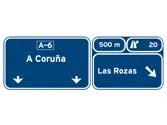
¿Qué indicaciones nos dan estas señales?
What information do these signs give us?
- APreseñalización sobre la calzada en la autopista o autovía hacia cualquier carretera y dirección propia.Advance direction signs above the carriageway on an autopista (motorway) or autovía (dual carriageway) towards any road, and the road's own direction.
- BPreseñalización sobre la calzada en carretera convencional hacia autopista o autovía y dirección propia.Advance direction signs above the carriageway on a conventional road towards an autopista (motorway) or autovía (dual carriageway), and the road's own direction.
- CPreseñalización sobre la calzada en carretera convencional hacia carretera convencional y dirección propia.Advance direction signs above the carriageway on a conventional road towards a conventional road, and the road's own direction.
ExplanationThe signs in the question show the directions of the slip road for the next exit, how far away it is and the junction number. They also show the direction of the autopista or autovía itself.
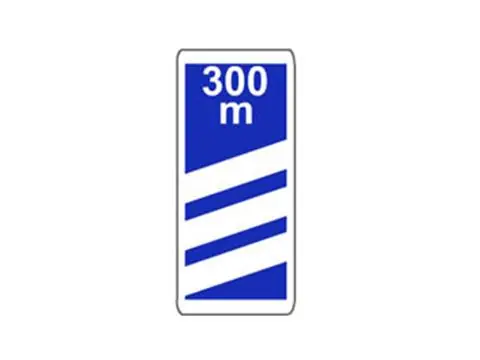
¿Dónde se puede encontrar esta señal?
Where can you find this sign?
- AEn carreteras convencionales.On conventional roads.
- BEn cualquier vía.On any road.
- CEn autopistas y autovías.On motorways (autopistas) and dual carriageways (autovías).
ExplanationThese are the S-26 exit countdown panels: three stripes indicate that the next exit is about 300 m away, two stripes 200 m and one stripe 100 m. According to the sign catalogue, they are placed on motorways and dual carriageways.
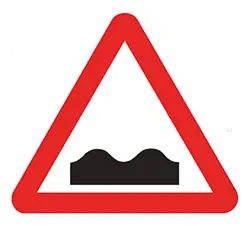
Esta señal indica peligro por la proximidad de...
This sign warns of danger because you are approaching...
- Aun tramo de vía con posible obstrucción en la calzada.a stretch of road where the carriageway may be obstructed.
- Bun resalto o badén en la vía o pavimento en mal estado.a hump or dip in the road, or a poor road surface.
- Cun tramo de vía con pendientes ascendentes y descendentes.a stretch of road with uphill and downhill slopes.
ExplanationThe hump symbol in the triangle warns of a dip, a hump or a poor road surface: you should reduce speed so as not to lose control of the vehicle or damage the suspension.
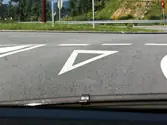
Este triangulo blanco pintado en la calzada...
This white triangle painted on the carriageway...
- Aobliga a detenerme.requires me to stop.
- Bobliga a ceder el paso a los vehículos que se acerquen por mi derecha.requires me to give way to vehicles approaching from my right.
- Cobliga a ceder el paso.requires me to give way.
ExplanationA white triangle painted on the carriageway means that we must give way both to vehicles approaching from the right and to those approaching from the left.
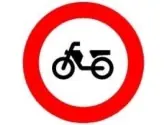
A la vista de esta señal, ¿una bicicleta tendrá el acceso permitido?
Given this sign, may a bicycle enter?
- ANo, por estar prohibido.No, because it is prohibited.
- BSí, pero solo si el ciclista la lleva a pie.Yes, but only if the cyclist pushes it.
- CSí.Yes.
ExplanationThis sign prohibits entry to two- and three-wheeled mopeds, light quadricycles and vehicles for people with reduced mobility, so bicycles are allowed to enter.
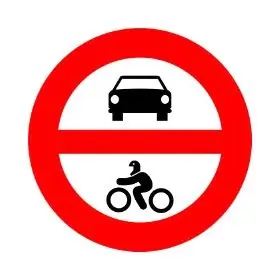
¿Puede entrar con su motocicleta por la calzada a cuya entrada se encuentra esta señal?
May you ride your motorcycle onto a carriageway with this sign at its entrance?
- ASí, si conduzco una motocicleta sin sidecar.Yes, if I am riding a motorcycle without a sidecar.
- BNo, porque esta señal prohíbe el acceso a todos los vehículos de motor.No, because this sign prohibits access to all motor vehicles.
- CSí, porque sólo afecta a turismos y ciclomotores.Yes, because it only applies to cars and mopeds.
ExplanationThis sign prohibits entry to motor vehicles: both motor cars and motorcycles, with or without a sidecar. It does not apply to mopeds, which are not legally considered motor vehicles, or to bicycles.
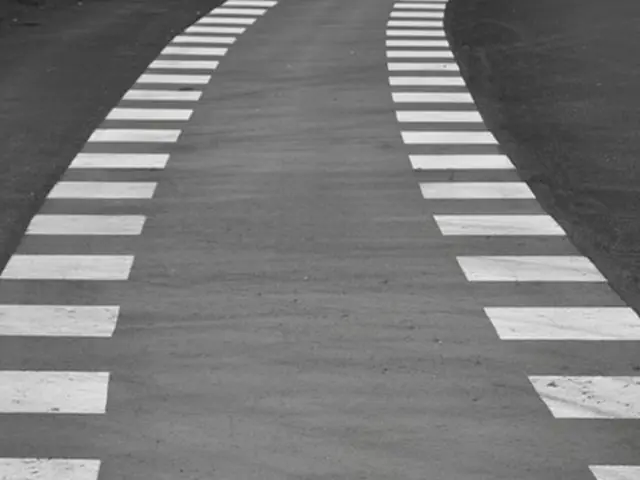
¿Qué indican estas marcas en la carretera?
What do these road markings indicate?
- APaso para peatones y ciclistas.A pedestrian and cycle crossing.
- BPaso para ciclistas.A cycle crossing.
- CPaso obligatorio para vehículos de dos ruedas.A compulsory crossing for two-wheeled vehicles.
ExplanationTwo parallel, broken transverse lines form marking M-4.4, cycle crossing: vehicles on the carriageway must let cyclists cross. To make it more visible, the surface of the crossing may be painted, preferably red.
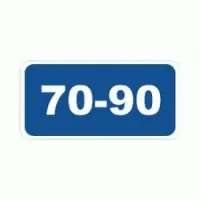
¿Qué indica la señal vertical de intervalo aconsejado de velocidades?
What does the recommended speed range sign indicate?
- ADos velocidades, la mínima de las cuales nunca deberemos rebasarTwo speeds, the lower of which you must never exceed.
- BDos velocidades entre las que está recomendado circularTwo speeds between which it is recommended to drive.
- CDos velocidades, la mayor de las cuales se debe superar en 20 km/horaTwo speeds, the higher of which must be exceeded by 20 km/h.
ExplanationThe recommended speed range sign recommends keeping your speed between the values shown, provided the weather, road and traffic conditions are favourable.
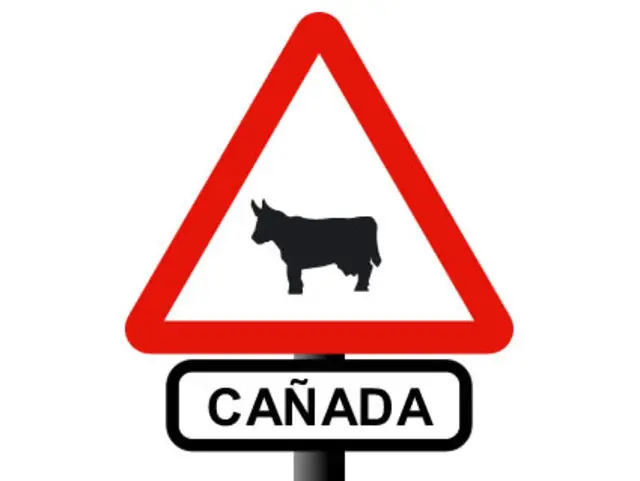
En una carretera con la señal de paso de animales domésticos y el panel «Cañada», si se encuentra con un rebaño, ¿debe ceder el paso a los animales?
On a road with the ‘domestic animals crossing’ sign and a ‘Cañada’ panel, if you meet a flock, must you give way to the animals?
- ANo. Los animales en la calzada nunca tienen prioridad.No. Animals on the carriageway never have right of way.
- BSí. En las cañadas señalizadas los animales tienen prioridad de paso.Yes. On signposted cañadas (livestock routes), animals have right of way.
- CSolo cuando ya estén cruzando la calzada.Only when they are already crossing the carriageway.
ExplanationUnder Article 66.1.a of the General Traffic Regulations (RGC), drivers have right of way over animals except on duly signposted cañadas (livestock droving routes), which are marked with the ‘Cañada’ panel under the domestic animals crossing sign (P-23). There you must give way to the livestock.
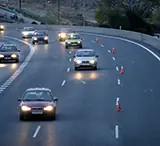
¿Qué indican los conos en la calzada?
What do the cones on the carriageway indicate?
- ARefuerzan el significado de las líneas discontinuas del carril.They reinforce the meaning of the lane's broken lines.
- BNada, no son señales de circulación.Nothing; they are not traffic signs.
- CLa prohibición de rebasar la línea imaginaria que los une.That you must not cross the imaginary line joining them.
ExplanationCones are traffic markers: they prohibit crossing the imaginary line joining them, with the same effect as a solid line, to mark out areas of the carriageway.
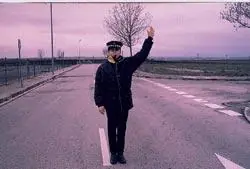
Un agente con el brazo levantado verticalmente obliga a los usuarios que se aproximan de frente a...
A traffic officer with an arm raised vertically requires road users approaching from the front to...
- ADetenerse.Stop.
- BContinuar la marcha.Continue.
- CReducir la velocidad.Reduce speed.
ExplanationAn arm raised vertically requires all road users approaching the officer, including those coming from the front, to stop, except those who cannot do so safely; at a junction it does not apply to those already inside it (Annex I of the RGC).
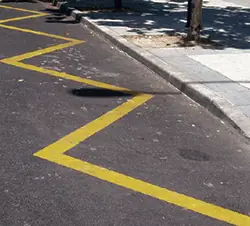
En esta zona con línea amarilla en zig-zag, ¿qué está prohibido?
In this area with a yellow zigzag line, what is prohibited?
- AEstacionar.Parking.
- BParar.Stopping.
- CParar y estacionar.Stopping and parking.
ExplanationAccording to the road marking catalogue in Annex I of the General Traffic Regulations (RGC), a yellow zigzag marking means parking is prohibited, because that stretch is reserved for a special use that does not involve vehicles staying for long, such as a loading and unloading area or a bus stop.
¿Se podrá cambiar de dirección a la izquierda a la vista de esta señal?
May you turn left when you see this sign?
- ASí, pero solo en las intersecciones con semáforo.Yes, but only at junctions with traffic lights.
- BSí.Yes.
- CNo.No.
ExplanationThe sign shows us that the carriageway is one-way, so there is no problem turning either right or left, unless another sign prohibits it.
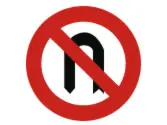
A la vista de esta señal, ¿podremos realizar un cambio de dirección?
Given this sign, may we turn off into another direction?
- ANo, por prohibirlo la señal.No, because the sign prohibits it.
- BSí.Yes.
- CSolo si existe un lugar debidamente acondicionado para efectuarlo.Only if there is a place specially set up for it.
ExplanationThe sign in the question prohibits making a U-turn, but it does not prohibit turning off into another direction.
¿Cómo actuaremos al observar un semáforo con una luz amarilla no intermitente?
What should you do when you see a traffic light with a steady (non-flashing) amber light?
- APasaremos con precaución, cediendo el paso a derecha e izquierda.Go through with care, giving way to the right and left.
- BNos detendremos como si de rojo fijo se tratase.Stop as if it were a steady red light.
- CExtremaremos las precauciones.Take extra care.
ExplanationA steady amber light requires you to stop as if it were a steady red light, unless, when it comes on, the vehicle is so close to the stopping point that it cannot stop safely. A flashing amber light, or two alternately flashing amber lights, would require drivers to take extra care and, where appropriate, give way. These also do not exempt drivers from obeying other signs that require them to stop.
Un agente de tráfico le indica que se detenga en una intersección donde también hay un semáforo y una señal de STOP. ¿Qué debe hacer?
A traffic officer signals you to stop at a junction where there are also traffic lights and a STOP sign. What must you do?
- AObedecer la señal del agente.Obey the officer's signal.
- BPasar porque el semáforo le da prioridad.Go through, because the traffic light gives you priority.
- CObedecer la señal de 'STOP'.Obey the STOP sign.
ExplanationAccording to Article 133.1 of the General Traffic Regulations, signals and orders from traffic officers come first in the order of precedence, ahead of traffic lights and road signs such as STOP. If the officer orders you to stop, you must do so even if the traffic light allows you through, and then follow their instructions.
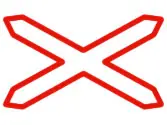
Esta señal nos advierte de un peligro por...
This sign warns us of danger because of...
- AUn paso a nivel con barreras.A level crossing with barriers.
- BUn paso a nivel sin barreras.A level crossing without barriers.
- CUna intersección peligrosa.A dangerous junction.
ExplanationThis sign indicates the location of a level crossing without barriers.
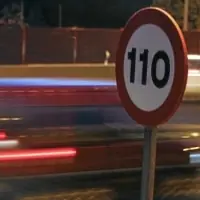
¿Cuándo terminará la limitación impuesta por una señal de limitación de velocidad?
When does the restriction imposed by a speed limit sign end?
- ACuando se encuentre una señal de fin de prohibición o velocidad máxima diferenteWhen you come to an end-of-restriction sign or a different maximum speed sign
- BCuando el conductor considere adecuado aumentar o reducir la velocidadWhen the driver thinks it is appropriate to speed up or slow down
- CCuando lleguemos al siguiente tramo de vía aunque no hayan señales de por medioWhen you reach the next stretch of road, even if there are no signs in between
ExplanationA speed limit imposed by a sign or by a road marking painted on the carriageway ends when you come to an end-of-restriction sign or a sign with a different maximum speed. The driver's wishes, or when the driver thinks it is appropriate to slow down or speed up, do not count.
¿Se puede hacer un cambio de dirección a la izquierda a partir de esta señal?
Can you turn left after this sign?
- ASí.Yes.
- BNo, salvo en poblado.No, except in built-up areas.
- CNo.No.
ExplanationThe sign prohibits U-turns but allows turning left: you may turn left, but you may not turn back. By contrast, the “No left turn” sign prohibits both turning left and making a U-turn.

¿A qué obliga esta señal al aproximarse a un peaje?
What does this sign require when approaching a toll?
- AA efectuar el pago del peaje mediante el sistema del telepeaje.Paying the toll with the electronic toll system.
- BA efectuar el pago del peaje mediante el sistema del telepeaje o a través de otros medios.Paying the toll with the electronic toll system or by other means.
- CA circular por el carril o carriles así señalizados a todos los vehículos que circulen por la vía.All vehicles on the road to use the lane or lanes signed like this.
ExplanationThis sign requires you to pay the toll with the dynamic toll or electronic toll system. A vehicle using the lane or lanes signed like this must carry the device that makes this possible, in working order.
Cuando la separación entre los trazos de las líneas discontinuas es sensiblemente más corta que en el caso general, indica que...
When the gaps between the dashes of broken lines are noticeably shorter than normal, this indicates that...
- AEs un carril especial.It is a special lane.
- BEs un carril de aceleración para entrar en la autopista.It is an acceleration lane for joining the motorway (autopista).
- CNos aproximamos a un tramo de vía que presenta un riesgo especial.We are approaching a stretch of road with a special risk.
ExplanationWhen the gaps between the dashes of a broken line are shorter than normal, this can indicate two things: that we are approaching a solid longitudinal line, or that we are approaching a stretch of road with a special risk.
All topics
- Definitions
- Documents and penalty points
- The driver's condition
- Duties of drivers and pedestrians
- Vehicle safety devices
- Vehicle controls and equipment
- Vehicle lights and horn
- The road and its lanes
- Speed and distances
- Manoeuvres
- Right of way
- Carrying passengers and loads
- Driving safely in difficult conditions
- Vehicle mechanics and maintenance
- Road accidents and first aid
- Defensive and eco-driving
Independent app: not affiliated with or endorsed by the DGT (Spain's Directorate-General for Traffic) or the Ministry of the Interior. The official exam is booked with the DGT and taken at its test centres. The questions here are practice material; the DGT's official question bank is not public.
Basado en datos de la Agencia Estatal Boletín Oficial del Estado (https://www.boe.es). Textos consolidados de carácter meramente informativo. La AEBOE no patrocina ni respalda este sitio.
Parte de las preguntas procede de los tests de la revista «Tráfico y Seguridad Vial» de la DGT, reproducidos con indicación de la fuente.