
DGT test · 1,397 questions
Traffic signs, markings and signals · Page 18 of 28
Road signs, road markings, traffic lights, police signals and temporary markings: what they mean and which one wins when they disagree. The topic with the most questions in the bank.
Questions in this topic, with answers
1,397 questions, 50 per page, with the correct answer and the explanation. Page 18 of 28.
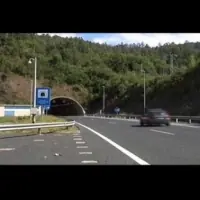
¿De qué tipo es la señal vertical de túnel, situada al inicio de éstos?
What type of sign is the tunnel road sign placed at the start of tunnels?
- ASeñal de prohibición de pasoA no-passing sign
- BSeñal de entrada prohibidaA no-entry sign
- CSeñal de indicación generalA general information sign
ExplanationThe S-5 tunnel sign is one of the general information road signs, and it indicates the start of a tunnel, underpass or stretch of road treated as a tunnel.
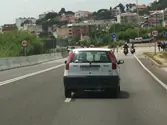
¿Se puede circular pisando las líneas discontinuas del centro de la calzada en algún caso?
May you ever drive on the broken lines in the centre of the carriageway?
- ASí, si es un tramo recto con visibilidad y siempre que no vengan vehículos circulando en sentido contrario.Yes, if it is a straight stretch with visibility and as long as no vehicles are coming the other way.
- BSí, en calzadas con carriles estrechos.Yes, on carriageways with narrow lanes.
- CSí, siempre que no moleste.Yes, as long as it does not bother anyone.
ExplanationAccording to the catalogue of road markings (RD 465/2025), no driver should drive on a broken longitudinal marking, except when, because of the width of the lanes, it is necessary and traffic safety allows it. In other words, only where lanes are narrow.
El semáforo cuadrado muestra una flecha verde y el semáforo circular está en rojo. ¿Qué debe hacer?
The square lane signal shows a green arrow and the round traffic light is red. What must you do?
- ACircular sin detenerse.Carry on without stopping.
- BDetener el vehículo antes del semáforo circular en rojo.Stop before the red round traffic light.
- CDetener el vehículo delante del semáforo cuadrado con la flecha verde.Stop in front of the square signal with the green arrow.
ExplanationIn this case, you must stop at the red round traffic light, because under the General Traffic Regulations a steady red light prohibits vehicles from passing. Although the green arrow on the square signal shows that you may use that lane, it does not exempt drivers from stopping at a red traffic light, which takes priority. So the correct option is to stop before the red round traffic light.
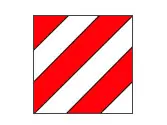
Este panel en un vehículo, ¿qué nos indica?
What does this panel on a vehicle tell us?
- AQue sobresale su carga por la parte trasera.That its load sticks out at the rear.
- BQue su longitud es superior a 12 metros.That it is more than 12 metres long.
- CQue transporta mercancías peligrosas.That it is carrying dangerous goods.
ExplanationThis panel is used to signal a load that sticks out at the rear of the vehicle. When the load sticks out along the whole width of the rear of the vehicle, we will fit 2 panels, and their stripes will form an inverted 'V'. If we are driving at night, we will also use a red light. The long vehicle sign indicates that the vehicle or combination of vehicles is more than 12 metres long.
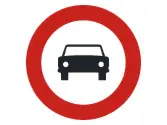
Esta señal ¿permite entrar a un turismo en la vía en la que esté colocada?
Does this sign allow a car to enter the road where it is placed?
- ASí, siempre.Yes, always.
- BNo.No.
- CSí, solo afecta a motocicletas y ciclomotores.Yes, it only affects motorcycles and mopeds.
ExplanationSign R-103 prohibits entry to motor vehicles, except two-wheeled motorcycles and three-wheeled vehicles treated as motorcycles. A car is a motor vehicle, so it may not enter.
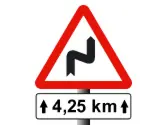
¿Que indica el panel de la imagen?
What does the panel in the picture show?
- Ala distancia entre la señal y el comienzo del peligro.The distance between the sign and the start of the danger.
- Bla longitud del tramo con dos carriles en el mismo sentido.The length of the stretch with two lanes in the same direction.
- Cla longitud del tramo de vía afectado por el peligro.The length of the stretch of road affected by the danger.
ExplanationPanel S-810 «Length of the dangerous stretch or stretch subject to a rule», with arrows on both sides of the figure, shows the length over which the danger exists. Here it warns of 4.25 km of dangerous bends close to each other (P-14a), the first to the right.
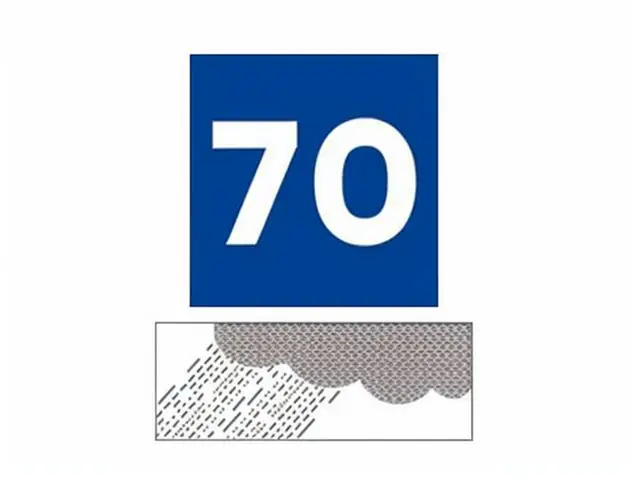
Esta señal recomienda conducir a 70 kilómetros por hora...
This sign recommends driving at 70 kilometres per hour...
- Aen cualquier caso.in all cases.
- Bsolo cuando está lloviendo.only when it is raining.
- Csolo cuando las condiciones meteorológicas y ambientales sean favorables.only when weather and environmental conditions are favourable.
ExplanationThe blue square sign with the number 70 advises you not to exceed that speed, and the additional panel with a cloud and rain limits it to when it is raining. In good weather the recommendation does not apply and the general limit for the road applies.
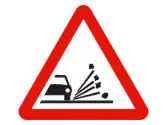
Debe saber que a partir de la señal hay peligro por la proximidad de...
You should know that beyond this sign there is danger because you are approaching...
- Agrandes charcos de agua que obligan a reducir la velocidad.large puddles of water that require you to reduce speed.
- Buna zona con desprendimientos frecuentes.an area with frequent rockfalls.
- Cun tramo de vía donde existe el riesgo de que se proyecte la gravilla al pasar los vehículos.a stretch of road where there is a risk of gravel being thrown up by passing vehicles.
ExplanationThe sign in the picture warns that you are approaching a stretch where there is a risk of gravel being thrown up by passing vehicles. It is advisable to reduce speed and increase the safe distance. Frequent rockfalls are warned of by a different sign, showing falling rocks.
En vías dentro de poblado, ¿un camión con remolque puede circular por el carril que mejor convenga a su destino?
On roads in built-up areas, may a lorry with a trailer drive in whichever lane best suits its destination?
- ASí, siempre.Yes, always.
- BSí, cuando los carriles estén delimitados por marcas longitudinales.Yes, when the lanes are marked by longitudinal lines.
- CNo, puesto que lleva remolque.No, because it is towing a trailer.
ExplanationOn carriageways in built-up areas, drivers of lorries with trailers must drive in the lane that best suits their destination, provided that the lanes are marked by longitudinal lines. This is because road markings give clear guidance on how traffic is distributed and allow more orderly and safer traffic flow.
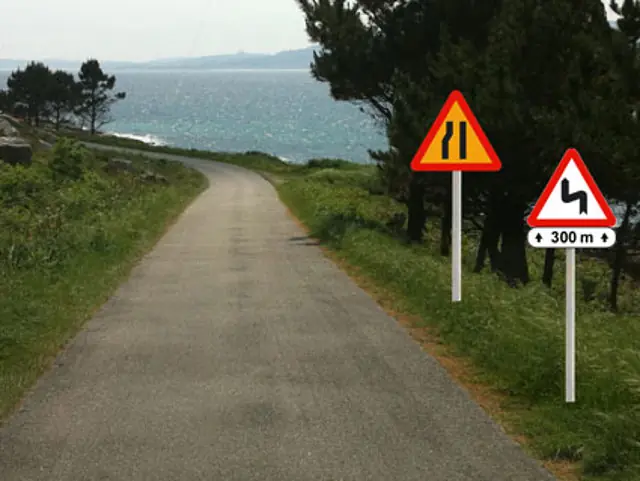
Las señales en la fotografía indican...
The signs in the photograph indicate...
- Aobras a 300 metros.roadworks in 300 metres.
- Bcurvas y cruce a la derecha.bends and a junction on the right.
- Ccurvas y estrechamiento por obras.bends and a narrowing due to roadworks.
ExplanationThe sign with a yellow background warns of a road narrowing (P-17): on roadworks sections, warning signs have a yellow background instead of a white one. The sign with a white background warns of dangerous bends (P-14). Together they indicate bends and a narrowing due to roadworks.
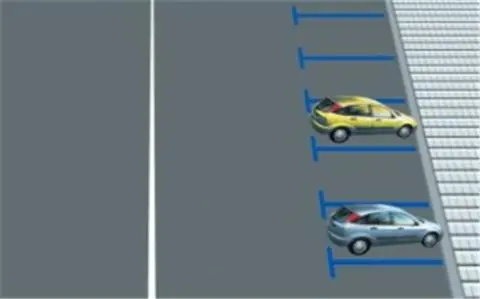
En esta zona de la calzada con marcas azules...
In this area of the carriageway with blue markings...
- Aestá prohibido el estacionamiento pero no la parada.parking is prohibited but stopping is not.
- Bestá permitido el estacionamiento pero con tiempo limitado.parking is allowed but for a limited time.
- Cestá prohibido tanto la parada como el estacionamiento.both stopping and parking are prohibited.
ExplanationBlue road markings mark out parking areas with time limits, such as regulated parking zones. You may park for the time allowed and with the permit or ticket required by the local bylaw.
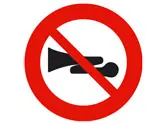
Ante esta señal de prohibición, ¿puede realizar una advertencia acústica?
Given this prohibition sign, may you use your horn?
- ANo, excepto para impedir un accidente.No, except to prevent an accident.
- BSí.Yes.
- CNo, excepto para adelantar.No, except to overtake.
ExplanationThis is sign R-310, no sound signals: it is a reminder of the general ban on sound signals, except to avoid an accident. There is no exception for overtaking.
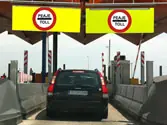
La señal circular con borde rojo, ¿qué indica?
What does the round sign with a red border indicate?
- AProhíbe circular a todos los vehículos y por todos los carriles.It prohibits all vehicles from using all lanes.
- BProhíbe circular por el carril.It prohibits driving in the lane.
- CObliga a detener el vehículo.It requires you to stop the vehicle.
ExplanationThe sign shown in the picture indicates that passing without stopping is prohibited. It marks the place where you must stop because, according to its inscription, a customs, police, toll or other control point is close, and mechanical means of stopping may be installed beyond it (you may not move off again until you have complied with what the sign requires). At a toll, this stop is usually so that we pay the charge for using the road. We may also find this sign at a customs post or a police checkpoint.
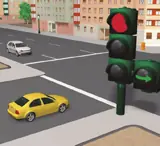
La flecha verde está iluminada. Si quiere girar a la derecha, ¿tiene preferencia de paso?
The green arrow is lit. If you want to turn right, do you have right of way?
- ASí, porque la flecha verde me obliga a girar.Yes, because the green arrow requires me to turn.
- BNo, porque la flecha verde me permite pasar pero debo ceder el paso al vehículo que se aproxima.No, because the green arrow allows me to go but I must give way to the approaching vehicle.
- CNo, porque la luz roja me prohíbe girar.No, because the red light prohibits me from turning.
ExplanationThe green arrow allows you to move in the direction it shows even when the red light is on, but with caution: you must let vehicles in the lane you are joining go past and not endanger anyone crossing the carriageway. It does not give right of way.
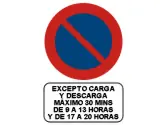
Esta señal le prohíbe...
This sign prohibits you from...
- AEstacionar, excepto a los camiones a cualquier hora.Parking, except for lorries at any time.
- BEstacionar, excepto de 9 a 13 y de 17 a 20 horas para la carga y descarga.Parking, except from 9:00 to 13:00 and from 17:00 to 20:00 for loading and unloading.
- CEstacionar y parar, excepto para carga y descarga todo el día.Parking and stopping, except for loading and unloading all day.
ExplanationThe sign prohibits parking but allows stopping. The additional panel sets out the exception: from 9:00 to 13:00 and from 17:00 to 20:00 you may park to load and unload. Outside those hours, parking is prohibited.
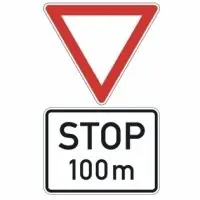
Esta señalización, le indica la distancia...
These signs tell you the distance...
- Aa la que se encuentra la señal de detención obligatoria de la próxima intersección.to the STOP sign at the next junction.
- Bal lugar donde tiene que ceder el paso en la próxima intersección.to the place where you must give way at the next junction.
- Cal lugar donde tiene que detenerse en la próxima intersección.to the place where you must stop at the next junction.
ExplanationBefore a STOP sign there may be an advance warning sign, ‘Advance warning of STOP’. It is a give way sign with an additional panel underneath showing the distance to the STOP sign (‘Detención obligatoria’) at the next junction.
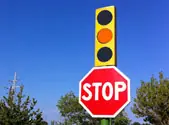
Con el semáforo amarillo intermitente y la señal de STOP, ¿qué haremos?
With a flashing amber traffic light and a STOP sign, what will we do?
- APasaremos extremando la precaución.We will go through taking extra care.
- BRespetaremos la señal de STOP.We will obey the STOP sign.
- CEntenderemos que el semáforo está estropeado y pasaremos cediendo el paso a derecha e izquierda.We will assume that the traffic light is broken and go through, giving way to the right and left.
ExplanationOne flashing amber light, or two amber lights flashing alternately, require drivers to take extra care and, where appropriate, give way. In addition, they do not exempt you from obeying other signs that require you to stop. So in this situation we must obey the STOP sign.
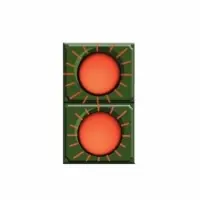
Un semáforo con una o dos luces rojas, prohíbe temporalmente el paso de vehículos por…
A traffic light with one or two red lights temporarily prohibits vehicles from passing at…
- ASalida de vehículos de extinción de incendios.An exit used by fire-fighting vehicles.
- BAccidente.An accident.
- CObras.Roadworks.
ExplanationThe General Traffic Regulations (RGC) state that a flashing red light, or two alternately flashing red lights, on a circular traffic light for vehicles temporarily prohibit vehicles from passing at a level crossing, at the entrance to a movable bridge or a ferry, near an exit used by fire-fighting vehicles, or when an aircraft is approaching at low altitude.
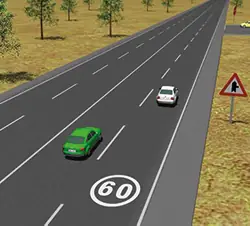
La señal de velocidad máxima pintada sobre un carril, ¿qué indica?
What does a maximum speed sign painted on a lane indicate?
- AProhibido circular a más de 60 kilómetros por hora en todos los carriles.Driving faster than 60 kilometres per hour is prohibited in all lanes.
- BProhibido circular a más de 60 kilómetros por hora en ese carril.Driving faster than 60 kilometres per hour is prohibited in that lane.
- CProhibido circular a más de 60 kilómetros por hora para los vehículos que van a girar a la derecha.Driving faster than 60 kilometres per hour is prohibited for vehicles that are going to turn right.
ExplanationSigns painted on a lane only apply within that lane: the 60 limits the speed only for those driving in it, not in the other lanes of the carriageway.
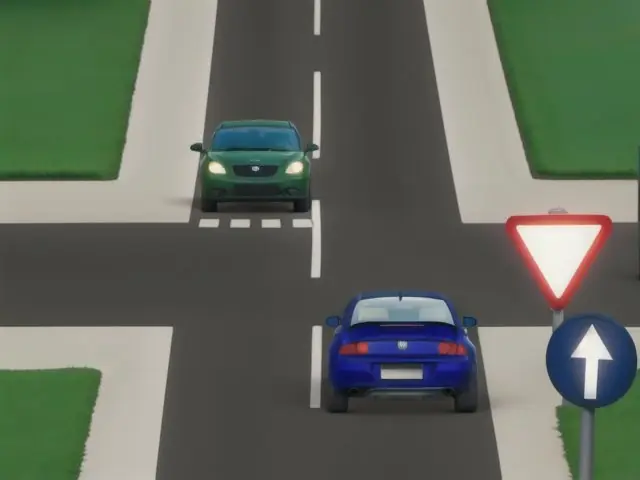
En la próxima intersección, ¿hacia dónde debe ir?
At the next junction, which way must you go?
- AGirar a la derechaTurn right.
- BSeguir rectoGo straight on.
- CGirar a la izquierdaTurn left.
ExplanationThe round blue sign with an upward arrow is a compulsory direction sign (R-400): it requires you to go straight on at the next junction. The give-way sign also requires you to let vehicles on the road you are approaching pass.
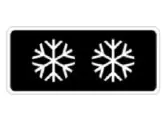
¿Qué significa este panel complementario?
What does this additional panel mean?
- ANieve.Snow.
- BLluvia.Rain.
- CNiebla.Fog.
ExplanationThis additional panel, placed below another road sign, shows that the sign refers to the conditions shown on the panel, in this case snow.
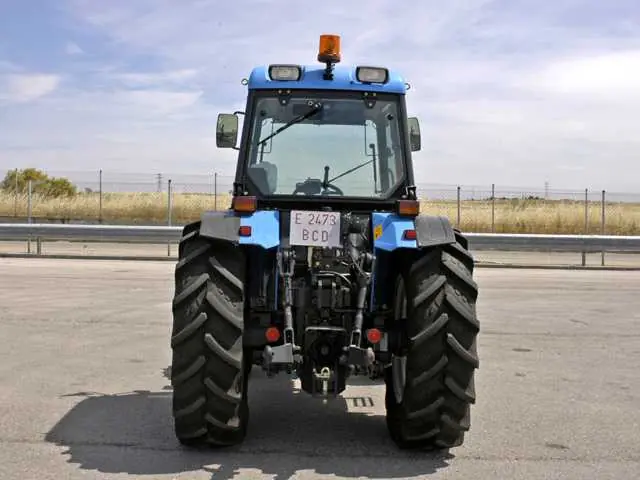
¿De qué advierte la señal luminosa de color amarillo auto, visible desde todas las direcciones, que lleva el tractor agrícola en su parte superior?
What does the amber light, visible from all directions, on top of the agricultural tractor warn of?
- ADe su presencia en la vía o en sus inmediaciones.Its presence on the road or near it.
- BDe que no puede circular a una velocidad superior a 30 Km/h.That it cannot travel faster than 30 km/h.
- CDe que circula en servicio urgente.That it is on an emergency call.
ExplanationSignal V-2 (vehicle-obstacle on the road) is an amber light visible in all directions. It shows the position, on the road or near it, of a vehicle doing a service or work that is stopped, parked or travelling at no more than 40 km/h.
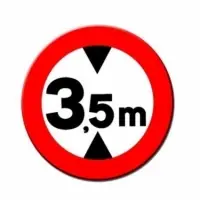
¿A qué vehículos les prohíbe esta señal pasar?
Which vehicles does this sign prohibit from passing?
- AA los vehículos de altura mayor que la expresado en la señal, incluida la altura de la carga.Vehicles taller than the height shown on the sign, including the height of the load.
- BA los vehículos de largura mayor que la expresado en la señal, incluida la largura de la carga.Vehicles longer than the length shown on the sign, including the length of the load.
- CA los vehículos de anchura mayor que la expresado en la señal, incluida la anchura de la carga.Vehicles wider than the width shown on the sign, including the width of the load.
ExplanationThe restriction sign R-205 in the picture prohibits all vehicles taller than the height shown on the sign, in this case 3.50 metres, including the height of the load, from using the road where the sign is placed.
Cuando una marca longitudinal discontinua es sensiblemente más ancha que en el caso general...
When a broken longitudinal marking is noticeably wider than normal...
- AIndica un carril reversible.It indicates a reversible lane.
- BIndica la proximidad de una línea continua.It indicates that a solid line is close.
- CIndica un carril especial.It indicates a special lane.
ExplanationBroken markings wider than normal (M-1.6 and M-1.7) separate special lanes: speed-change tapers, weaving lanes, lanes reserved for certain vehicles or additional lanes. An approaching solid line is announced by dashes that are closer together, not wider.
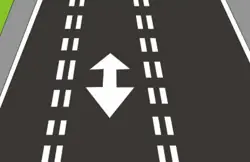
Cuando las líneas discontinuas dobles, delimitan un carril por ambos lados...
When double broken lines mark out a lane on both sides...
- AEs un carril reversible.It is a reversible lane.
- BEs un carril adicional.It is an additional lane.
- CEs un carril VAO.It is an HOV lane (VAO).
ExplanationA lane marked out on both sides with double broken lines is a reversible lane: its direction can change and it is controlled by lane-control signals or other means. Anyone driving in it must have at least dipped headlights on, by day and by night.
La luz amarilla intermitente del semáforo indica...
A flashing amber traffic light indicates...
- ADetenerse.Stop.
- BExtremar la precaución.Take extreme care.
- CPasar cediendo el paso solo a la derecha.Go through, giving way only to the right.
ExplanationAccording to Annex I of the RGC (section 4.2), a flashing amber light requires you to take extreme care and, where necessary, give way according to the right-of-way rules. It does not exempt you from obeying other signs that require you to stop, such as a STOP sign.
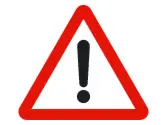
¿Qué nos indica esta señal?
What does this sign tell us?
- AOtros peligros.Other dangers.
- BPeligro por desprendimientos.Danger of falling rocks.
- CPeligro por hielo o nieve en la calzada.Danger of ice or snow on the carriageway.
ExplanationThe triangular sign with an exclamation mark warns that you are approaching a danger other than those shown by the other warning signs. It usually comes with an additional panel saying what the danger is.
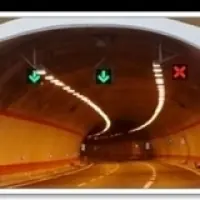
¿Qué significado tiene una luz roja en forma de aspa dentro de un semáforo cuadrado?
What does a red X-shaped light in a square traffic light mean?
- AObligación de detenerse ante el semáforoYou must stop at the traffic light
- BPermitido el paso únicamente a turismosOnly cars may go through
- CProhibición de ocupar ese carrilYou must not use that lane
ExplanationIf, while driving, you come across a square lane-control light with a red X lit inside it, it means that you are completely prohibited from using the lane over which that light is placed.
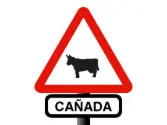
En una vía con esta señalización se encuentra con un rebaño, ¿debe ceder el paso a los animales?
On a road with these signs you come across a flock of animals. Must you give way to the animals?
- ANo, los animales en la calzada no tienen prioridad de paso nunca.No, animals on the carriageway never have right of way.
- BSí, es un paso de animales domésticos y se debe ceder el paso.Yes, it is a crossing for domestic animals and you must give way.
- CSólo cuando ya estén cruzando.Only when they are already crossing.
ExplanationAs a general rule, drivers have right of way over animals, except in the following cases: on properly signed livestock routes (cañadas); when they are turning to enter another road and there are animals crossing it, even if there is no crossing for them; when the vehicle crosses a hard shoulder along which animals are moving that have no livestock route. General livestock routes or crossings are signed with additional panels bearing the word CAÑADA placed under the domestic animals crossing sign.
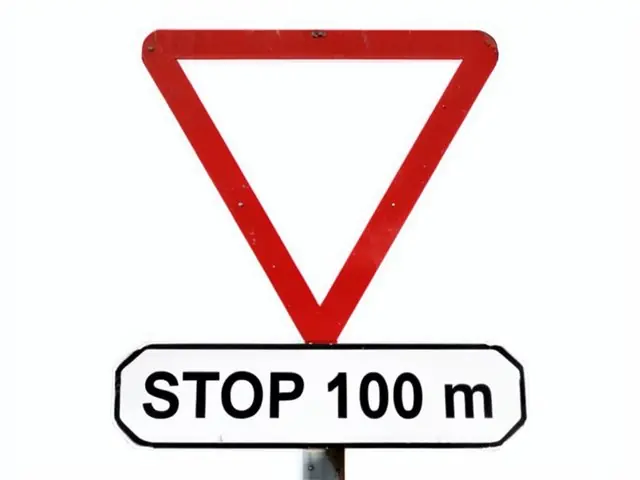
Esta señal indica la distancia...
This sign shows the distance...
- Aal lugar donde debe ceder el paso en la próxima intersección.to the place where you must give way at the next junction.
- Bhasta la señal de parada obligatoria en la próxima intersección.to the compulsory stop sign at the next junction.
- Cal lugar donde debe detenerse en la próxima intersección.to the place where you must stop at the next junction.
ExplanationPanel S-840, placed under the give-way sign, shows the distance to the compulsory stop (STOP) sign at the next junction. So the driver knows that further on they will have to stop completely.
¿Qué indica la luz amarilla, visible desde todas las direcciones, que lleva el tractor agrícola en la parte superior?
What does the yellow light on top of an agricultural tractor, visible from all directions, indicate?
- AQue está presente en la vía o en sus cercanías.That it is on the road or nearby.
- BQue no puede circular a una velocidad superior a 30 km/h.That it cannot travel faster than 30 km/h.
- CQue circula en servicio urgente.That it is on an emergency call.
ExplanationThe yellow light visible from all directions is the V-2 sign. Under Annex XI of the General Vehicle Regulations (Reglamento General de Vehículos), it shows the position on or near the road of a vehicle that is doing a service or work, is stopped or is travelling at no more than 40 km/h.
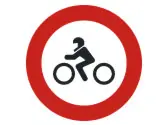
Esta señal prohíbe el acceso a...
This sign prohibits access to...
- Alas motocicletas de más de 125 cc.motorcycles over 125 cc.
- Btodas las motocicletas.all motorcycles.
- Csolo a las motocicletas con sidecar.only motorcycles with a sidecar.
ExplanationThe sign prohibits entry to all types of motorcycles.
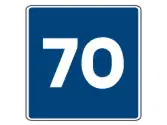
Si al circular encontramos la señal de la imagen, debemos saber que ...
If you find the sign in the picture while driving, you should know that...
- Aes obligatorio circular como mínimo a la velocidad que indica la señal.it is compulsory to drive at no less than the speed shown on the sign.
- Bes recomendable circular como máximo a la velocidad que indica la señal.it is recommended to drive at no more than the speed shown on the sign.
- Ces recomendable circular como mínimo a la velocidad que indica la señal.it is recommended to drive at no less than the speed shown on the sign.
ExplanationThe sign in the picture, “Recommended maximum speed”, recommends an approximate speed, in kilometres per hour, that you are advised not to exceed, even when weather, environmental, road and traffic conditions are favourable. When it is placed under a danger warning sign, the recommendation applies to the stretch where that danger lasts. Do not confuse it with the “compulsory minimum speed” sign, which requires you to drive at no less than the speed shown on the sign.
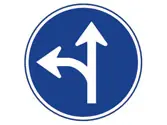
¿Esta señal nos permite realizar un cambio de sentido?
Does this sign allow us to make a U-turn?
- ASí.Yes.
- BNo.No.
- CSí, pero solo en la intersección siguiente.Yes, but only at the next junction.
ExplanationThis sign shows the only directions that vehicles may take, in this case only going straight ahead or turning left.
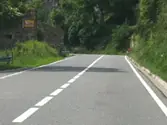
Cuando la separación entre los trazos de una línea longitudinal discontinua es sensiblemente más corta que en el caso general, ¿qué indica?
When the gaps between the dashes of a broken longitudinal line are noticeably shorter than normal, what does this indicate?
- AQue se trata de un carril especial, reservado a determinados vehículos.That it is a special lane, reserved for certain vehicles.
- BQue nos aproximamos a un tramo de vía con un riesgo especial.That we are approaching a stretch of road with a special risk.
- CQue se trata de un carril reversible.That it is a reversible lane.
ExplanationWhen the gaps between the dashes of a broken longitudinal line are noticeably shorter than normal, this may indicate that we are approaching a stretch of road with a special risk. In some cases, the line may then become a solid line.
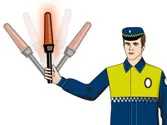
Un agente balancea una luz roja o amarilla, ¿a qué obliga?
A traffic officer swings a red or yellow light. What does this require?
- AA pasar por el lado correspondiente al brazo con el que realiza la señal.You must pass on the side of the arm the officer uses for the signal.
- BA detenerse a los vehículos hacia los que dirige la luz.The vehicles towards which the light is directed must stop.
- CA disminuir la velocidad.You must slow down.
ExplanationWhen an officer swings a red or yellow light, the road users towards whom the light is directed must stop, according to the officers' signals in Annex I of the General Traffic Regulations. The signal that requires you to slow down is the arm held out and moved up and down.
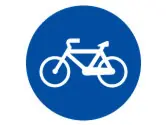
Esta señal afecta...
This sign applies...
- ASólo a los ciclomotores.Only to mopeds.
- BSólo a los ciclos.Only to cycles.
- CTanto a los ciclos como a los ciclomotores.To both cycles and mopeds.
ExplanationThe sign requires cycle riders to use this route and prohibits other road users from using it.
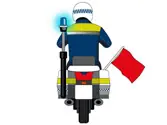
¿Qué indica un agente mediante una bandera roja?
What does a traffic officer indicate with a red flag?
- AExtremar la precaución por la proximidad de un peligro.Take extreme care because a danger is near.
- BCalzada temporalmente cerrada al tráfico a todos los vehículos y usuarios.Carriageway temporarily closed to all vehicles and road users.
- CObligación de detenerse en el lado derecho.You must stop on the right-hand side.
ExplanationA red flag shown by a traffic officer means that, once the vehicle carrying it has passed, the carriageway is temporarily closed to all vehicles and road users. A green flag means that it is open again, and a yellow flag asks you to pay extreme attention.
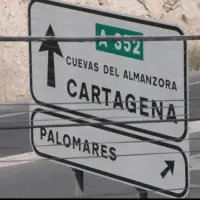
¿Cuál de éstas no es una señal de orientación dentro de las señales de indicación?
Which of these is not an orientation sign within the group of information signs?
- ALocalizaciónLocation
- BPreidentificaciónPre-identification
- CIdentificación en carreterasRoad identification
ExplanationThe orientation signs, which are part of the information signs, include location signs, road identification signs, advance direction signs, direction signs, confirmation signs and signs for specific use in built-up areas. Pre-identification signs do not exist.
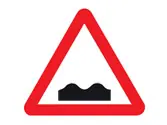
Esta señal advierte de la proximidad de...
This sign warns that you are approaching...
- Auna calzada con pavimento en mal estado.a carriageway with a road surface in poor condition.
- Bun cambio de rasante.the brow of a hill.
- Cun paso para peatones elevado.a raised pedestrian crossing.
ExplanationThe sign in the question warns of danger because you are approaching a hump or dip in the road, or a road surface in poor condition.
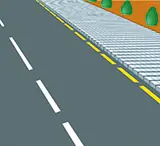
¿Qué prohíbe la marca longitudinal discontinua amarilla?
What does the broken yellow longitudinal marking prohibit?
- ALa parada.Stopping.
- BEl estacionamiento.Parking.
- CAmbos.Both.
ExplanationA broken yellow line next to the kerb prohibits parking along its whole length on that side of the carriageway, but allows stopping. If the yellow line is solid, it prohibits both stopping and parking.
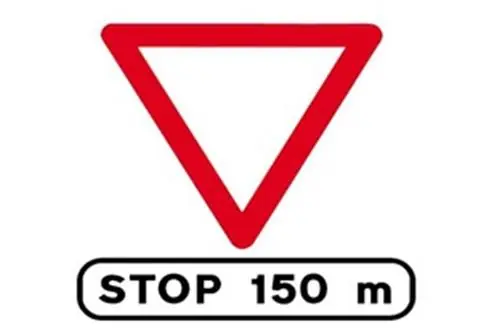
¿Qué indica este panel bajo la señal de ceda el paso?
What does this panel under the give-way sign indicate?
- ALa distancia a la que se encuentra la señal de stop en la próxima intersección.The distance to the stop sign at the next junction.
- BEl lugar en el que hay que detenerse en la próxima intersección.The place where you must stop at the next junction.
- CEl sitio exacto donde hay que ceder el paso en la próxima intersección.The exact spot where you must give way at the next junction.
ExplanationThis panel, placed under the give-way sign, shows the distance to the compulsory stop (STOP) sign at the next junction.
¿Qué indica una luz roja intermitente en un semáforo?
What does a flashing red light on a traffic light indicate?
- APrecauciónCaution
- BAlto obligatorioYou must stop
- CPaso con precauciónGo with caution
ExplanationUnder Annex I of the General Traffic Regulations (RGC), one flashing red light, or two alternately flashing red lights, temporarily prohibit passing, for example before a level crossing, a movable bridge or an exit used by fire-fighting vehicles.
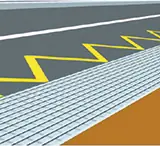
La marca amarilla en zig-zag indica el lugar de la calzada...
A yellow zigzag marking shows the place on the carriageway...
- Adonde no se puede estacionar, pero sí se puede parar.where you may not park, but you may stop.
- Breservado para el estacionamiento de autobuses.reserved for parking buses.
- Creservado para parada de autobús, no pudiendo parar otros vehículos.reserved as a bus stop, where other vehicles may not stop.
ExplanationThe yellow zigzag marking prohibits parking because that stretch is reserved for a special use, such as a bus stop. Stopping (a halt of less than 2 minutes without leaving the vehicle) is allowed.
Esta señal advierte de un peligro...
This sign warns of a danger...
- Apor la proximidad de congestiones de tráfico.caused by traffic congestion ahead.
- Bdistinto a los advertidos por otras señales.other than those warned of by other signs.
- Cpor circulación en dos sentidos.caused by two-way traffic.
ExplanationThis sign indicates that you are approaching a danger other than those warned of by the other signs.
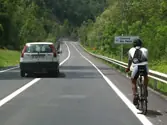
¿Es correcto rebasar la línea longitudinal continua para adelantar a un ciclista?
Is it correct to cross the continuous longitudinal line to overtake a cyclist?
- ASí.Yes.
- BNo, salvo que el ciclista esté detenido.No, unless the cyclist has stopped.
- CNo.No.
ExplanationUnder article 88.2 of the General Traffic Regulations (as worded by RD 518/2026), even where overtaking is prohibited, cyclists may be overtaken by using the part of the carriageway for oncoming traffic, even crossing the continuous line, when their speed allows it to be done without risk. Article 85.4 requires you to use part or all of the adjacent or opposite lane, leaving at least 1.5 metres, both inside and outside built-up areas; if there is more than one lane in each direction, the lane change must be complete.
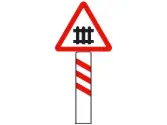
Estas señales indican peligro por...
These signs indicate danger due to...
- Aaproximación de un paso a nivel sin barreras.the approach to a level crossing without barriers.
- Baproximación de un paso a nivel con barreras.the approach to a level crossing with barriers.
- Csituación inmediata de un paso a nivel sin barreras.the immediate location of a level crossing without barriers.
ExplanationLevel crossing with barriers: danger because you are approaching a level crossing fitted with barriers or half-barriers.
¿Qué debemos hacer si encontramos un semáforo rojo en la entrada de un túnel?
What should we do if we find a red traffic light at the entrance to a tunnel?
- APasar con precaución.Go through with care.
- BEntrar despacio y con las luces de cruce encendidas.Enter slowly with dipped headlights on.
- CEsperar hasta que la luz roja se apague.Wait until the red light goes off.
ExplanationUnder Article 96.3 of the General Traffic Regulations, no road user may enter a tunnel or underpass if a traffic light at its entrance does not allow them through. When the red light is on, you must stop and wait for it to go off before you can enter.
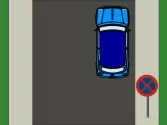
¿Qué le indica la señal en esta vía de sentido único?
What does the sign on this one-way road tell you?
- AQue está prohibida la parada y el estacionamiento en el lado derecho.That stopping and parking are prohibited on the right-hand side.
- BQue está prohibida la parada y el estacionamiento en ambos lados de la calzada.That stopping and parking are prohibited on both sides of the carriageway.
- CQue está prohibida la parada en el lado derecho de la calzada.That stopping is prohibited on the right-hand side of the carriageway.
ExplanationThis sign prohibits stopping or parking on the side of the carriageway where the sign is placed, up to the nearest junction. As the sign is on the right-hand side of the carriageway, the ban will only apply to the right-hand side.
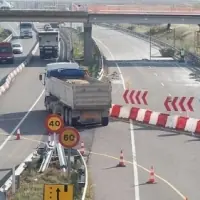
¿De qué color es el fondo de las señales que reglamentan las zonas de obras?
What is the background colour of signs regulating roadworks areas?
- ARojoRed.
- BBlancoWhite.
- CAmarilloYellow.
ExplanationRoadworks signs are the normal signs, but with a yellow background.
All topics
- Definitions
- Documents and penalty points
- The driver's condition
- Duties of drivers and pedestrians
- Vehicle safety devices
- Vehicle controls and equipment
- Vehicle lights and horn
- The road and its lanes
- Speed and distances
- Manoeuvres
- Right of way
- Carrying passengers and loads
- Driving safely in difficult conditions
- Vehicle mechanics and maintenance
- Road accidents and first aid
- Defensive and eco-driving
Independent app: not affiliated with or endorsed by the DGT (Spain's Directorate-General for Traffic) or the Ministry of the Interior. The official exam is booked with the DGT and taken at its test centres. The questions here are practice material; the DGT's official question bank is not public.
Basado en datos de la Agencia Estatal Boletín Oficial del Estado (https://www.boe.es). Textos consolidados de carácter meramente informativo. La AEBOE no patrocina ni respalda este sitio.
Parte de las preguntas procede de los tests de la revista «Tráfico y Seguridad Vial» de la DGT, reproducidos con indicación de la fuente.