
DGT test · 1,397 questions
Traffic signs, markings and signals · Page 2 of 28
Road signs, road markings, traffic lights, police signals and temporary markings: what they mean and which one wins when they disagree. The topic with the most questions in the bank.
Questions in this topic, with answers
1,397 questions, 50 per page, with the correct answer and the explanation. Page 2 of 28.
Una señal con una bicicleta dentro de un círculo azul indica:
A sign with a bicycle inside a blue circle indicates:
- ACarril bici de uso obligatorioCompulsory cycle lane
- BProhibido bicicletasNo bicycles
- CAparcamiento para bicisBicycle parking
ExplanationIt is sign R-407a “Road reserved for cycles, use compulsory”: it requires cyclists to use that road and prohibits other road users from using it. The no-entry sign for cycles is a different sign, round with a red border.
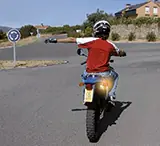
El conductor indica con el brazo que va a girar a la izquierda y lleva encendido el intermitente derecho; ¿qué señal tiene validez?
The driver signals with their arm that they are going to turn left but has the right indicator on. Which signal is valid?
- ANinguna.Neither.
- BLa del brazo.The arm signal.
- CLa del intermitente.The indicator.
ExplanationUnder Article 108.2 of the General Traffic Regulations (RGC), arm signals, if they can be seen and are made correctly, cancel any other visual signal that contradicts them. So the arm signal is valid, not the indicator.
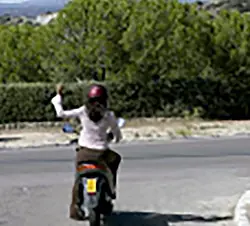
El conductor de este vehículo está indicando que va a...
The driver of this vehicle is signalling that they are going to...
- Adesplazarse a la derecha.move to the right.
- Bdesplazarse a la izquierda.move to the left.
- Cfrenar.brake.
ExplanationThe driver has their left arm bent upwards at a right angle: this signal means moving or turning to the RIGHT when the indicators cannot be used (or are not used). It can also be signalled by stretching the right arm out horizontally. (Tip: left arm horizontal = left; left arm bent upwards = right.)
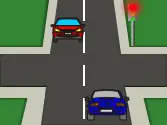
¿Dónde deberá detenerse el vehículo azul para respetar el semáforo?
Where must the blue vehicle stop to obey the traffic light?
- AJusto antes del semáforo, sin rebasarlo.Just before the traffic light, without passing it.
- BJusto antes de rebasar la intersección.Just before crossing the junction.
- CSi se dispone a cambiar de dirección hacia la derecha, podrá continuar sin respetar el semáforo.If it is going to turn right, it may continue without obeying the traffic light.
ExplanationWhen the red traffic light is inside the junction or on its far side, vehicles must not enter the junction or, if there is a stop line, they must stop before it.
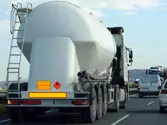
Las señales y placas de la parte trasera del camión, ¿qué indican?
What do the signs and plates on the back of the lorry indicate?
- AQue transporta mercancías peligrosas y que mide más de 12 metros.That it is carrying dangerous goods and is more than 12 metres long.
- BQue su peso y dimensiones son mayores que los normales.That its weight and dimensions are larger than normal.
- CQue transporta productos alimenticios.That it is carrying food products.
ExplanationAll vehicles and vehicle combinations longer than 12 metres must carry at the rear, centred on the vehicle's axis, a rectangular plate (V-6) with a reflective yellow background and a fluorescent red border. Where this makes it easier to fit, this plate can be replaced by two smaller ones placed symmetrically on each side of the vehicle's axis. You can also see that the lorry carries plate V-11, which shows that it is transporting dangerous goods. This plate may carry numbers: in its upper half, showing the type of danger, and in its lower half, showing the goods being transported.
Si un agente nos obliga a detenernos, ¿dónde lo haremos?
If a traffic officer requires you to stop, where do you stop?
- AAnte la línea de detención más cercana.At the nearest stop line.
- BInmediatamente antes del agente.Immediately before the officer.
- CEn cuanto veamos la señal del agente.As soon as you see the officer's signal.
ExplanationUnder section 1.1 of Annex I of the General Traffic Regulations (RGC), a stop ordered by an officer must be made at the nearest stop line or, if there is none, immediately before the officer. At a junction, you must stop before entering it.
Si el conductor de un vehículo extiende el brazo horizontalmente con la palma de la mano hacia atrás, ¿qué nos está indicando?
If the driver of a vehicle holds their arm out horizontally with the palm facing backwards, what are they telling you?
- AQue va a efectuar un cambio de dirección a la izquierda.That they are going to turn left.
- BQue va a efectuar marcha hacia atrás.That they are going to reverse.
- CQue se va a detener.That they are going to stop.
ExplanationA driver who holds their arm out horizontally with the palm facing backwards is showing that they are going to reverse.
Las marcas viales que delimitan las zonas o plazas de estacionamiento, además de blancas, pueden ser de otros colores. ¿Para qué?
Road markings that mark out parking areas or spaces can be other colours besides white. What for?
- APara indicar limitaciones temporales, por tipo de usuario o para un fin concreto.To show time limits, limits by type of user or a specific purpose.
- BPara indicar que en esa zona está prohibido estacionar.To show that parking is prohibited in that area.
- CSolo con fines decorativos, sin ningún significado.Only for decoration, with no meaning.
ExplanationUnder the 2025 road marking catalogue (M-7.3 and M-7.4), parking markings can be other colours or contain pictograms to show time limits, limits by type of user or a specific purpose, such as spaces reserved for people with reduced mobility.
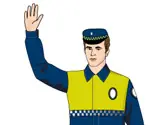
Nos encontramos a un agente con el brazo levantado que nos obliga a detener, ¿dónde efectuaremos la detención?
A traffic officer with a raised arm requires you to stop. Where should you stop?
- AInmediatamente antes del agente.Immediately before the officer.
- BAnte la línea de detención.At the stop line.
- CDespués de la línea de detención.After the stop line.
ExplanationYou must stop at the stop line or, if there is none, before the officer.
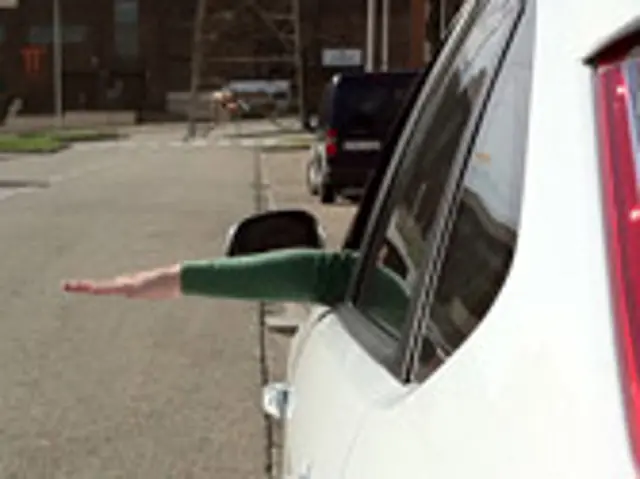
El conductor del vehículo en la foto indica que va a...
The driver of the vehicle in the photo is signalling that they are going to...
- Amoverse hacia la izquierda.move to the left.
- Bmoverse hacia la derecha.move to the right.
- Cfrenar.brake.
ExplanationUnder Article 109.2.a of the General Traffic Regulations, an arm held out horizontally with the palm of the hand facing down signals a move towards the side the hand is on. The driver is holding their left arm out of the window, so they are going to move to the left.
En una intersección con un semáforo en verde, ¿se le permite cambiar el sentido de la marcha?
At a junction with a green traffic light, are you allowed to make a U-turn?
- ASí, si no está prohibido mediante señal vertical o marca vial y las circunstancias lo permiten.Yes, if it is not prohibited by a road sign or road marking and the circumstances allow it.
- BSí, en todo caso porque tengo prioridad.Yes, in all cases, because I have priority.
- CNo, porque en las intersecciones nunca se permite realizar un cambio de sentido de la marcha.No, because U-turns are never allowed at junctions.
ExplanationAt a junction controlled by traffic lights you may make a U-turn if no road sign or road marking prohibits it and you can do it safely, without hindering others. A green light does not give absolute priority for any manoeuvre.
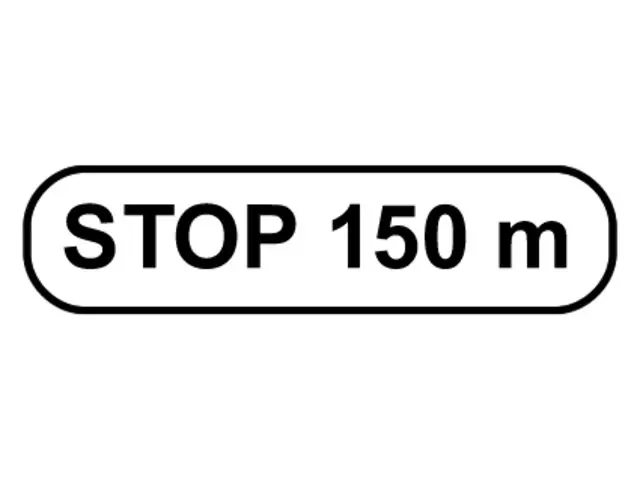
Este panel, colocado debajo de la señal de 'Ceda el paso', indica la distancia...
This panel, placed under the 'Give way' sign, indicates the distance...
- Ahasta el final de la indicación.to the end of the indication.
- Bhasta la señal de 'Ceda el paso' en la intersección siguiente.to the 'Give way' sign at the next junction.
- Chasta la señal de 'Stop' o de parada obligatoria en la intersección siguiente.to the 'Stop' sign or compulsory stop at the next junction.
ExplanationPanel S-840 'Advance warning of compulsory stop', placed under the give way sign, indicates the distance to the compulsory stop or STOP sign at the next junction, in this case 150 metres.
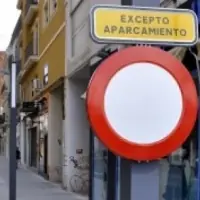
La señal, ¿permite circular con un ciclomotor?
Does this sign allow you to ride a moped?
- ASí, porque la vía es para peatones.Yes, because the road is for pedestrians.
- BSí, porque no es un vehículo a motor.Yes, because it is not a motor vehicle.
- CNo.No.
ExplanationThe round white sign with a red border prohibits all types of vehicles in both directions, and a moped is a vehicle. The sign does not turn the road into a pedestrian street. The additional panel only exempts those going to the car park.
¿Se puede pasar sobre las líneas discontinuas del centro de la calzada en algún caso?
May you ever drive over the broken lines in the centre of the carriageway?
- ASí, en un tramo recto con buena visibilidad y si no vienen vehículos en sentido contrario.Yes, on a straight stretch with good visibility and if no vehicles are coming the other way.
- BNo, nunca se pueden atravesar.No, they must never be crossed.
- CSolo en vías urbanas con carriles estrechos.Only on roads in built-up areas with narrow lanes.
ExplanationUnder the road-marking catalogue in Annex I of the RGC, a broken longitudinal line may be crossed to carry out permitted manoeuvres, such as overtaking, turning or changing lanes, as long as it is safe. With good visibility and no oncoming traffic, you may drive over it.
El agente agita una luz amarilla; ¿qué significa?
A traffic officer is waving a yellow light. What does it mean?
- APrecaución al circular.Drive with care.
- BEl carril por el que debe circularse.The lane you must use.
- COrdena detenerse a los conductores hacia los que se dirige la luz.It orders the drivers towards whom the light is pointed to stop.
ExplanationUnder section 1.1 of Annex I of the General Traffic Regulations, when a traffic officer swings a red or yellow light, the road users towards whom the officer points the light must stop. It is not just a warning to take care.
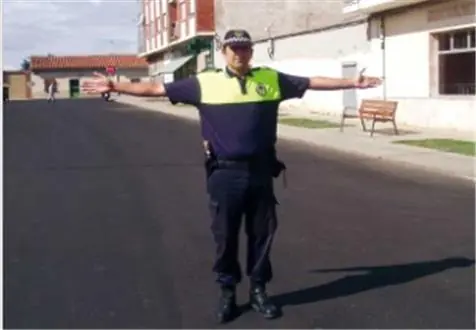
El Agente de la fotografía le ha ordenado detenerse, volverá a reanudar la marcha...
The officer in the picture has ordered you to stop. You will move off again...
- Acuando el agente efectúe otra señal, únicamente.only when the officer gives another signal.
- Bcuando el agente baje el brazo.when the officer lowers their arm.
- Ccuando el agente cambie de posición o efectúe otra señal.when the officer changes position or gives another signal.
ExplanationThe officer's signal with the arms held out horizontally remains in force even if they lower their arms, as long as they do not change position or give another signal. So you may only move off again when the officer changes position or indicates something else.
¿Está permitido circular por la izquierda de una línea continua?
Is it permitted to drive to the left of a continuous line?
- ASí, únicamente para realizar un adelantamiento.Yes, only to overtake.
- BSí, cuando la marca no separe los dos sentidos de circulación.Yes, when the marking does not separate the two directions of traffic.
- CNo, en ningún caso.No, under no circumstances.
ExplanationA continuous line must not be crossed or driven on, and when it separates the two directions of traffic you must not drive to its left either. If the line does not separate directions, for example between two lanes in the same direction, you may drive to its left.
¿Pueden los paneles de mensaje variable dar instrucciones que hay que cumplir?
Can variable message signs give instructions that must be obeyed?
- ANo, sólo sirven para informar.No, they are only for information.
- BNo, sólo pueden utilizarse para advertir de peligros.No, they can only be used to warn of dangers.
- CSí, pueden dar instrucciones obligatorias, además de otros usos.Yes, they can give compulsory instructions, as well as having other uses.
ExplanationVariable message signs are part of temporary signalling, which under Article 142.1 of the RGC is used to inform, warn of dangers and give recommendations or compulsory instructions. Their orders take precedence over road signs and road markings.
Si circulamos por una carretera donde hay una línea continua junto a una línea discontinua...
If we are driving on a road where there is a solid line next to a broken line…
- Adebemos fijarnos solo en la línea más cercana al carril por el que circulamos.we must only pay attention to the line closest to the lane we are driving in.
- Bindica que es un carril reversible.it means it is a reversible lane.
- Cno se puede cruzar en ningún caso.it may not be crossed under any circumstances.
ExplanationUnder the road-marking catalogue (RD 465/2025), when a solid line runs next to a broken line, drivers must only take into account the line on the side they are driving on: if it is the broken line, they may cross it; if it is the solid line, they may not.
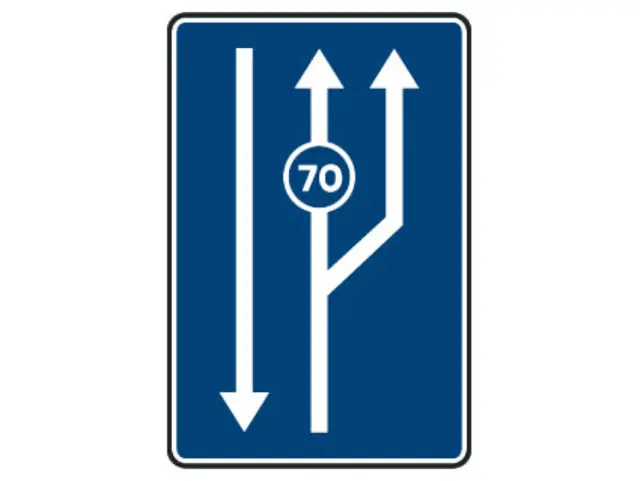
¿En qué carril debe circular, según la señalización, si va a 90 km/h y no piensa adelantar?
According to the signs, which lane should you drive in if you are travelling at 90 km/h and do not intend to overtake?
- APor el carril derecho; tiene prohibido usar el carril central porque circula a más de 70 km/h.In the right-hand lane; you are prohibited from using the centre lane because you are driving at more than 70 km/h.
- BPor el carril central, porque circulamos a más de 70 km/h.In the centre lane, because we are driving at more than 70 km/h.
- CPor el carril derecho; puede usar el carril central cuando las circunstancias lo requieran.In the right-hand lane; you may use the centre lane when circumstances require it.
ExplanationThe sign reserves the centre lane for those driving at 70 km/h or more, but it does not require you to use it. Under Article 31.1 of the RGC, outside built-up areas and with more than one lane in your direction, you normally drive in the right-hand lane and use the others when traffic or road conditions make it advisable.
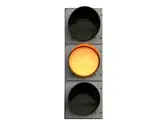
¿Qué significado tiene una luz amarilla no intermitente en un semáforo?
What does a steady (non-flashing) amber light on a traffic light mean?
- AObliga a extremar la precaución.You must take extreme care.
- BObliga a detenerse como si se tratase de una luz roja fija.You must stop as if it were a steady red light.
- CObliga a ceder el paso.You must give way.
ExplanationA steady (non-flashing) amber light means that vehicles must stop in the same way as for a steady red light, unless, when it comes on, the vehicle is so close to the stopping point that it cannot stop before it safely enough.
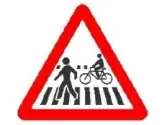
A la vista de la señal, debe tener en cuenta:
Given the sign, you must bear in mind:
- Aque se aproxima un paso para peatones y ciclistas, por lo que debe reducir la velocidad y extremar la precaución.that you are approaching a pedestrian and cycle crossing, so you must reduce speed and take extra care.
- Bque se aproxima a un lugar donde los ciclistas tienen preferencia de paso frente a los peatones.that you are approaching a place where cyclists have right of way over pedestrians.
- Cque el paso está destinado únicamente a peatones, y los ciclistas deben bajarse de la bicicleta antes de cruzar.that the crossing is only for pedestrians, and cyclists must get off their bicycles before crossing.
ExplanationThe sign in the picture means 'Pedestrian and cycle crossings'. It warns of danger because you are approaching a pedestrian crossing next to, or shared with, a cycle crossing.
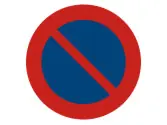
¿Se podrá efectuar una parada a partir de la señal?
May you stop after this sign?
- ANo, por estar prohibido.No, because it is prohibited.
- BSí.Yes.
- CNo, la señal prohíbe tanto parar como estacionar.No, the sign prohibits both stopping and parking.
ExplanationThe sign prohibits parking on the side of the carriageway where it is placed, but it allows stopping.
Una marca vial discontinua junto a otra continua significa:
A broken road marking next to a continuous one means:
- AAmbos lados pueden adelantarVehicles on both sides may overtake
- BSolo pueden adelantar los vehículos del lado de la discontinuaOnly vehicles on the side of the broken line may overtake
- CNadie puede adelantarNo one may overtake
ExplanationOn a carriageway with a continuous line and a broken line side by side, vehicles on the side of the broken line may overtake; those on the side of the continuous line may not.
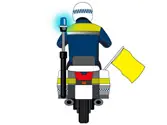
Un agente circula delante nuestro con una bandera de color amarillo, ¿qué nos está indicando?
A traffic officer is travelling in front of you with a yellow flag. What is the officer telling you?
- AQue la calzada está totalmente cerrada al tráfico.That the carriageway is completely closed to traffic.
- BQue la calzada está abierta normalmente al tráfico.That the carriageway is open to traffic as normal.
- CQue se debe extremar la precaución.That you must take extra care.
ExplanationAn officer with a yellow flag shows that you must take extra care or that there is a danger ahead.
¿Qué indica la flecha verde en el semáforo del carril?
What does the green arrow on a lane control signal mean?
- AQue el carril está abierto, pero hay que respetar las señales y las normas de prioridad.That the lane is open, but you must obey the signs and the right-of-way rules.
- BQue el carril está abierto y tiene preferencia sobre los demás vehículos.That the lane is open and has priority over other vehicles.
- CQue el carril está abierto, excepto para vehículos pesados.That the lane is open, except for heavy vehicles.
ExplanationUnder Annex I of the General Traffic Regulations, a downward-pointing green arrow on a lane control signal allows you to use that lane, but it does not exempt you from stopping at a round red light, from obeying other signs that require you to stop or give way, or from the right-of-way rules.
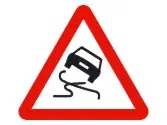
La señal indica peligro por deslizamiento...
This sign warns of the danger of skidding...
- AEn caso de lluvia.When it rains.
- BEn caso de nieve o hielo.When there is snow or ice.
- CSin especificar el motivo.Without saying what causes it.
ExplanationThe sign in the picture warns of a stretch where the road surface may be very slippery, without saying what causes it. The danger of skidding because of ice or snow has its own sign, with a snowflake inside the triangle.
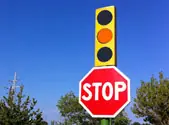
¿Qué indica la luz amarilla no intermitente de un semáforo?
What does a steady amber traffic light mean?
- APasar con precaución.Go through carefully.
- BAcelerar para pasar antes de que se encienda la roja.Speed up to get through before the red light comes on.
- CDetenerme como si se tratase de la luz roja fija.Stop as if it were a steady red light.
ExplanationA steady (non-flashing) amber light means that vehicles must stop in the same way as for a steady red light, unless, when it comes on, the vehicle is so close to the stopping point that it cannot stop before it safely enough. A flashing amber light, or two amber lights flashing alternately, require drivers to take extreme care and, where necessary, give way. They do not exempt drivers from obeying other signs that require them to stop.
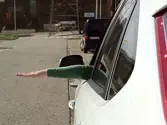
¿Qué está indicando este conductor con el brazo?
What is this driver indicating with their arm?
- AQue va a girar a la izquierda.That they are going to turn left.
- BQue va a empezar a circular.That they are going to move off.
- CQue va a ir marcha atrás.That they are going to reverse.
ExplanationAn arm stretched out horizontally with the palm facing down warns of a sideways move towards the side the hand points to (article 109.2 of the RGC). With the left arm, as in the picture, it announces a left turn.
Ud. circula con su turismo por una vía fuera de poblado que tiene tres carriles separados por marcas longitudinales discontinuas, reservados para cada sentido de la marcha. ¿Por cuál de ellos debe circular normalmente?
You are driving your car on a road outside built-up areas that has three lanes in each direction, separated by broken longitudinal markings. In which lane should you normally drive?
- APor el de la derecha, aunque podré utilizar el resto de los carriles cuando las circunstancias del tráfico o de la vía lo aconsejen, siempre que no entorpezca a otros vehículos que me sigan.In the right-hand lane, although I may use the other lanes when traffic or road conditions make it advisable, as long as I do not hinder other vehicles following me.
- BPor los dos carriles más próximos a la derecha, dejando libre el carril izquierdo para efectuar adelantamientos.In the two lanes closest to the right, leaving the left-hand lane free for overtaking.
- CPor el carril que más convenga a mi destino.In the lane that best suits my destination.
ExplanationIt is correct to drive in the right-hand lane because, in general, you must use the lane closest to the right-hand edge of the road. This helps keep traffic organised and lets vehicles that want to overtake do so safely. In addition, you may use the other lanes if circumstances allow, as long as you do not obstruct other vehicles coming behind.
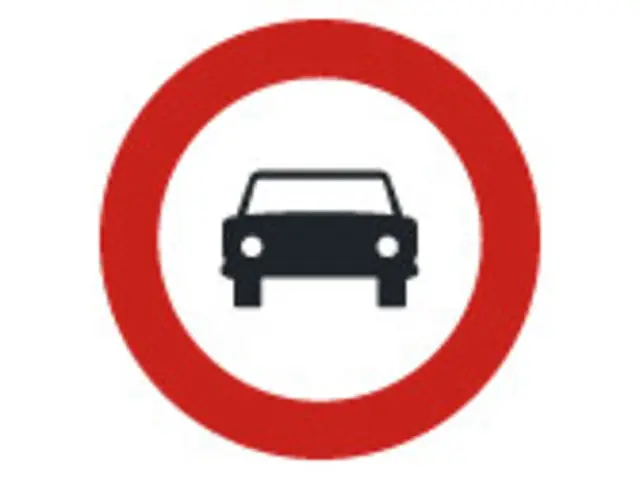
¿Esta señal permite que un coche entre en la vía donde está colocada?
Does this sign allow a car to enter the road where it is placed?
- ASí, siempre.Yes, always.
- BNo.No.
- CSí, solo afecta a motocicletas y ciclomotores.Yes, it only applies to motorcycles and mopeds.
ExplanationThe sign with a car inside a red-bordered circle is R-103 'No entry for motor vehicles, except two-wheeled motorcycles': it prohibits access to motor vehicles, except two-wheeled motorcycles and three-wheeled vehicles treated as motorcycles. A car may not enter.
Si la calzada tiene doble línea continua en el centro:
If the carriageway has a double continuous line in the centre:
- ASe puede adelantarYou may overtake
- BNo se puede atravesar ni circular sobre ellas, como norma generalAs a general rule, you must not cross or drive on them
- CSolo pueden adelantar vehículos de emergenciaOnly emergency vehicles may overtake
ExplanationUnder the road-marking catalogue (RD 465/2025), two parallel continuous lines have the same meaning as a single one: they must not be crossed or driven on. The only exceptions are those in the RGC, such as safely passing a cyclist or a broken-down vehicle.
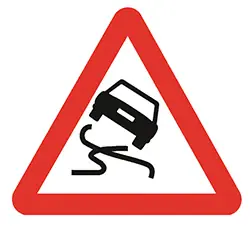
¿De qué peligro advierte esta señal?
What danger does this sign warn of?
- AProximidad de un escalón lateral o desnivel a lo largo de un tramo de vía.A drop or difference in level at the edge along a stretch of road ahead.
- BProximidad de pavimento deslizante por hielo o nieve.A road surface ahead made slippery by ice or snow.
- CProximidad de una zona de la calzada cuyo pavimento puede resultar muy deslizante.An area of carriageway ahead whose surface may be very slippery.
ExplanationThe triangle with a skidding car warns that you are approaching an area of carriageway whose surface may be very slippery, for any reason, and requires you to adapt your speed.
Una línea longitudinal continua en el centro de la calzada significa que:
A continuous longitudinal line in the centre of the carriageway means that:
- ASe puede adelantar con precaución.You may overtake with caution.
- BNo se debe traspasar ni circular sobre ella; prohíbe el adelantamiento.You must not cross it or drive on it; it prohibits overtaking.
- CSolo separa carriles del mismo sentido.It only separates lanes going in the same direction.
ExplanationA continuous line must not be crossed; it separates directions of traffic or lanes and prohibits overtaking across it.
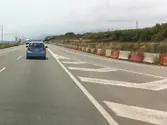
¿Se podrá circular por una zona marcada como cebreado?
May you drive on an area marked as a hatched area?
- ANo, en ningún caso.No, never.
- BSolamente los vehículos obligados a ir por el arcén.Only vehicles that must use the hard shoulder.
- CSí, cualquier tipo de vehículo cuando lo crea conveniente.Yes, any type of vehicle, when the driver thinks fit.
ExplanationOnly vehicles that must use the hard shoulder may drive on the hatched area, when the hatched area is a continuation of the hard shoulder.
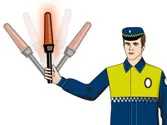
Un agente balanceando una luz roja...
A traffic officer swinging a red light...
- AIndica continuar la marcha con precaución.Tells you to continue with care.
- BObliga a detenerse a los usuarios a los que dirige la luz.Requires the road users towards whom the light is directed to stop.
- CIndica que la calzada está totalmente cortada al tráfico.Shows that the carriageway is completely closed to traffic.
ExplanationA yellow or red light swung by an officer tells the road users towards whom the light is directed that they must stop.
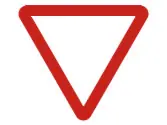
Esta señal, ¿qué le indica?
What does this sign tell you?
- AQue tenemos que detenernos siempre.That we must always stop.
- BQue tenemos que ceder el paso a todos los vehículos.That we must give way to all vehicles.
- CQue tenemos que ceder el paso a los vehículos que se acerquen por la derecha.That we must give way to vehicles approaching from the right.
ExplanationThe sign indicates that you must give way to all vehicles at the next junction.
Un agente balanceando una luz roja o amarilla, ¿qué significado tiene?
What does it mean when a traffic officer swings a red or yellow light?
- AObliga a detenerse a los usuarios de la vía hacia los que el agente dirija la luz.The road users towards whom the officer directs the light must stop.
- BObliga a disminuir la velocidad.You must slow down.
- CObliga a pasar extremando la precaución.You must go through, taking extra care.
ExplanationWhen an officer swings a red or yellow light, the road users towards whom the officer directs the light must stop.
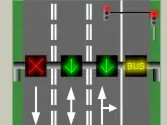
El semáforo cuadrado tiene la flecha verde encendida y el semáforo circular está rojo. ¿Qué debe hacer?
The square traffic light shows a lit green arrow and the round traffic light is red. What must you do?
- ACircular sin detenerme.Drive on without stopping.
- BDetener el vehículo antes del semáforo circular en rojo.Stop the vehicle before the round red traffic light.
- CDetener el vehículo antes del semáforo cuadrado con flecha verde.Stop the vehicle before the square traffic light with the green arrow.
ExplanationA green light in the shape of an arrow pointing downwards indicates that you may drive in the lane over which it is lit. This permission to use the lane does not remove the obligation to stop at a round red light or, as an exception to the rules on the order of precedence, to obey any other sign or road marking that requires you to stop or give way, or, where there is none, to comply with the general rules on right of way.
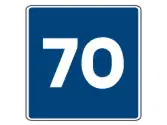
Si al ir conduciendo se encuentra con la señal que se muestra en la imagen, debe saber que se trata de una señal de ...
If you find the sign shown in the picture while driving, you should know that it is a sign for...
- Avelocidad mínima obligatoria.compulsory minimum speed.
- Bvelocidad máxima obligatoria.compulsory maximum speed.
- Cvelocidad máxima aconsejada.recommended maximum speed.
ExplanationThis sign recommends an approximate speed, in kilometres per hour, that you are advised not to exceed, even when weather, environmental, road and traffic conditions are favourable. As it is a recommendation, exceeding it is not prohibited. When it is placed under a danger warning sign, the recommendation applies to the stretch where that danger lasts.
¿Podemos entrar en un túnel si hay un semáforo en rojo a su entrada?
May we enter a tunnel if there is a red traffic light at its entrance?
- ASí, porque no es una intersección.Yes, because it is not a junction.
- BSí, hasta el final del túnel, donde nos detendremos.Yes, as far as the end of the tunnel, where we will stop.
- CNo.No.
ExplanationA traffic light showing a steady (non-flashing) red light prohibits passing, so vehicles must not go past the traffic light, or past the stop line if there is one.
Desea cambiar de sentido en una vía urbana de doble sentido con línea discontinua y sin prohibición. ¿Es correcto?
You want to make a U-turn on a two-way road in a built-up area with a broken line and no prohibition. Is this correct?
- ANo, el cambio de sentido está siempre prohibido en ciudad.No, U-turns are always prohibited in towns.
- BSí, si lo hace donde está permitido, señalizando y sin crear peligro ni obstáculo.Yes, if you do it where it is allowed, signalling and without creating danger or obstruction.
- CSí, aunque obligue a frenar bruscamente a otros.Yes, even if it forces others to brake sharply.
ExplanationA U-turn is lawful where it is not prohibited, as long as you signal it and do not create danger or obstruction.
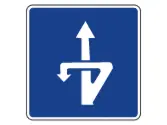
Esta señal indica un cambio de sentido...
This sign indicates a U-turn...
- AAl mismo nivel.At the same level.
- BA distinto nivel.At a different level.
- CEn una autopista o autovía.On a motorway (autopista) or dual carriageway (autovía).
ExplanationThis sign indicates that you are approaching an exit, on any road, through which you can make a U-turn at a different level.
En un cruce sin semáforos, un agente de la autoridad te indica con el brazo extendido horizontalmente que te detengas, pero una señal vertical de la vía te da prioridad de paso. ¿Cómo debes actuar?
At a junction without traffic lights, a police officer signals with an arm held out horizontally for you to stop, but a road sign gives you priority. What should you do?
- AElegir libremente, porque tienen el mismo rangoChoose freely, because they have the same rank
- BContinuar según la señal vertical, porque prevalece sobre las indicaciones del agenteContinue according to the road sign, because it takes precedence over the officer's instructions
- CObedecer al agente y detenerme, porque sus órdenes tienen prioridad sobre las señales verticalesObey the officer and stop, because their instructions take precedence over road signs
ExplanationOfficers' instructions come first in the order of precedence, above road signs.
Un semáforo consistente en la silueta de una bicicleta en color rojo sobre fondo oscuro, ¿a qué vehículos afecta?
Which vehicles does a traffic light showing a red bicycle silhouette on a dark background apply to?
- AExclusivamente a los ciclistas.Exclusively to cyclists.
- BExclusivamente a los ciclistas y ciclomotores.Exclusively to cyclists and mopeds.
- CExclusivamente a todos los vehículos de dos ruedas.Exclusively to all two-wheeled vehicles.
ExplanationUnder Annex I of the RGC, when the lights of a traffic light show the silhouette of a cycle, they apply only to cycles. Mopeds and other vehicles obey ordinary traffic lights.
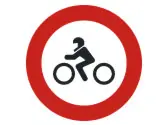
¿Esta señal prohíbe la entrada a los ciclomotores?
Does this sign prohibit entry to mopeds?
- ASí.Yes.
- BSí, salvo a los de tres ruedas.Yes, except three-wheeled ones.
- CNo.No.
ExplanationThis is sign R-104 «No entry for motorcycles»: it prohibits entry to motorcycles and to three-wheeled vehicles treated as motorcycles. It does not apply to mopeds, whose entry is prohibited by a different sign, R-105.
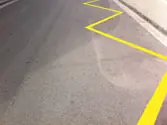
Esta línea amarilla en zig-zag, ¿qué significa?
What does this yellow zigzag line mean?
- AQue la parada y el estacionamiento están prohibidos.That stopping and parking are prohibited.
- BQue la parada está prohibida.That stopping is prohibited.
- CQue el estacionamiento está prohibido.That parking is prohibited.
ExplanationA yellow zigzag line prohibits parking but allows stopping. If the line were solid, both stopping and parking would be prohibited.
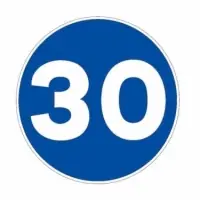
Esta señal de tráfico...
This traffic sign...
- AObliga a los vehículos que pesan más de 30 toneladas a conducir en la carretera marcada.Requires vehicles weighing more than 30 tonnes to use the marked road.
- BPermite exceder el límite de velocidad en 30km/h.Allows you to exceed the speed limit by 30 km/h.
- CObliga a conducir a una velocidad mínima de 30km/h.Requires you to drive at a minimum speed of 30 km/h.
ExplanationSign R-411, a blue circle with a number, requires you to drive at least at the speed shown, here 30 km/h. It applies until the end-of-minimum-speed sign or another minimum speed sign with a different value; it does not allow you to exceed maximum limits.
Los vehículos prioritarios que circulen en servicio urgente avisarán de su presencia...
Priority vehicles on an emergency call will warn of their presence...
- Amediante el uso simultáneo de la señal luminosa y la señal acústica.by using the light signal and the audible signal at the same time.
- Bsolo con la señal acústica.only with the audible signal.
- Cmediante el uso simultáneo de la señal de emergencia y la señal acústica.by using the hazard warning lights and the audible signal at the same time.
ExplanationUnder Article 68.2 of the RGC, priority vehicles on an emergency call warn of their presence by using the light signal and the special audible warning device at the same time. They only use the light signal on its own when leaving out the audible one does not create danger.
¿Qué harás al encontrar una señal de STOP?
What will you do when you find a STOP sign?
- ADetener el vehículo antes de la señal.Stop the vehicle before the sign.
- BDetener el vehículo antes de la intersección.Stop the vehicle before the junction.
- CDetener el vehículo ante la próxima línea de detención.Stop the vehicle at the next stop line.
ExplanationThe STOP sign requires you to stop the vehicle at the next stop line or, if there is none, immediately before the junction, and then give way to vehicles travelling on the road you are approaching. Stopping level with the sign is not enough.
All topics
- Definitions
- Documents and penalty points
- The driver's condition
- Duties of drivers and pedestrians
- Vehicle safety devices
- Vehicle controls and equipment
- Vehicle lights and horn
- The road and its lanes
- Speed and distances
- Manoeuvres
- Right of way
- Carrying passengers and loads
- Driving safely in difficult conditions
- Vehicle mechanics and maintenance
- Road accidents and first aid
- Defensive and eco-driving
Independent app: not affiliated with or endorsed by the DGT (Spain's Directorate-General for Traffic) or the Ministry of the Interior. The official exam is booked with the DGT and taken at its test centres. The questions here are practice material; the DGT's official question bank is not public.
Basado en datos de la Agencia Estatal Boletín Oficial del Estado (https://www.boe.es). Textos consolidados de carácter meramente informativo. La AEBOE no patrocina ni respalda este sitio.
Parte de las preguntas procede de los tests de la revista «Tráfico y Seguridad Vial» de la DGT, reproducidos con indicación de la fuente.