
DGT test · 1,397 questions
Traffic signs, markings and signals · Page 22 of 28
Road signs, road markings, traffic lights, police signals and temporary markings: what they mean and which one wins when they disagree. The topic with the most questions in the bank.
Questions in this topic, with answers
1,397 questions, 50 per page, with the correct answer and the explanation. Page 22 of 28.
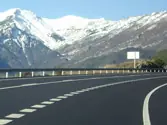
¿Qué indica una marca longitudinal discontinua, de mayor grosor que en el caso general?
What does a broken longitudinal marking that is thicker than usual indicate?
- ALa existencia de un carril especial.That there is a special lane.
- BLa proximidad de una línea continua.That a continuous line is coming up.
- CLa existencia de un carril reversible.That there is a reversible lane.
ExplanationAs in the picture in the question, a special lane will usually be marked on its outer side by a continuous or broken white line that is noticeably wider than usual.
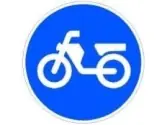
Esta señal, ¿a qué vehículos obliga?
Which vehicles does this sign place an obligation on?
- AA los ciclos y a los ciclomotores.Cycles and mopeds.
- BSolo a los ciclomotores.Mopeds only.
- CA todos los vehículos de dos ruedas.All two-wheeled vehicles.
ExplanationThe sign requires moped riders to use the route signed in this way; it applies only to mopeds.
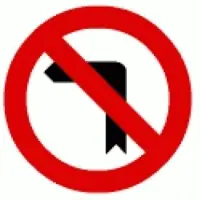
¿Prohibe la señal de giro a la izquierda prohibido el cambiar el sentido de la marcha?
Does the "No left turn" sign prohibit U-turns?
- ANoNo
- BSíYes
- CSí, pero únicamente en travesíasYes, but only on travesías (stretches of road through a town)
ExplanationYes. According to the sign catalogue, R-303 "No left turn" prohibits turning left and also includes a ban on U-turns, on any type of road.

A partir de la señal, ¿qué debe tener en cuenta el conductor?
After this sign, what must the driver bear in mind?
- AQue se recomienda utilizar neumáticos de invierno en condiciones meteorológicas adversas.That using winter tyres is recommended in adverse weather conditions.
- BQue está obligado a no proseguir la marcha sin neumáticos especiales de invierno en el tramo indicado.That they must not continue without special winter tyres on the stretch shown.
- CQue en las proximidades hay un taller donde se realizan cambios de neumáticos.That there is a garage nearby where tyres are changed.
ExplanationThis is sign R-412b, winter tyres: it means you must not continue without special winter tyres on the signposted stretch. It is an obligation, not a recommendation. The obligation to use chains or other anti-skid devices is shown by another sign, R-412.
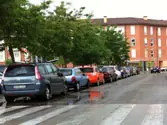
Si en la calzada no hay marcas viales longitudinales, ¿cuántos carriles tendrá?
If there are no longitudinal road markings on the carriageway, how many lanes does it have?
- AUno para cada sentido.One for each direction.
- BTantos como vehículos automóviles que no sean motocicletas quepan en paralelo.As many as the number of motor vehicles, other than motorcycles, that fit side by side.
- CLos que creamos convenientes.As many as you think appropriate.
ExplanationLanes do not need to be marked out by road markings to exist. If they are not marked, there are as many lanes as the number of motor vehicles, other than motorcycles, that fit side by side.
Circula por un carril que se acaba y tiene que pasar al carril de su derecha. ¿Qué indica el triángulo blanco pintado en su carril?
You are driving in a lane that is ending and you have to move into the lane on your right. What does the white triangle painted in your lane mean?
- AQue los conductores tienen prioridad al cambiar de carril.That drivers have priority when changing lanes.
- BQue, al cambiar de carril, debe ceder el paso a los vehículos que circulan por el carril de la derecha.That, when changing lanes, you must give way to vehicles travelling in the right lane.
- CQue el conductor debe detener el vehículo en cualquier caso.That the driver must stop the vehicle in all cases.
ExplanationThe white triangle painted on the road is the give way marking (M-6.5). It requires you to give way to vehicles on the carriageway or in the lane you are joining, stopping only if necessary. In addition, every lane change must respect the priority of vehicles already in that lane (Article 74.2 of the RGC).
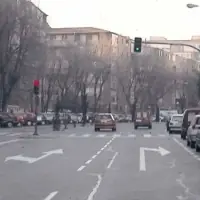
Si va a seguir recto y hay un semáforo rojo a la izquierda, y otro verde a la derecha, debe obedecer al semáforo que se encuentra…
If you are going straight on and there is a red traffic light on the left and a green one on the right, you must obey the traffic light that is…
- AEn verde, porqué está a la derecha.Green, because it is on the right.
- BEn verde, porqué permite el paso.Green, because it allows you to go.
- CEn rojo, porqué está a la izquierda y usted quiere seguir de frente.Red, because it is on the left and you want to go straight on.
ExplanationUnder Article 132 of the General Traffic Regulations (RGC), when the traffic lights on the right and on the left show different signals, those who intend to go straight on or turn left must obey only the one on the left. As it is red, you must stop even though the one on the right is green.
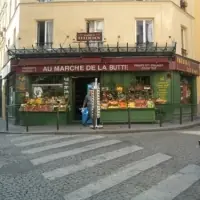
¿De qué colores son las líneas de los pasos para peatones?
What colour are the lines of pedestrian crossings?
- ABlanco y amarillo alternasAlternating white and yellow.
- BBlancoWhite.
- CBlanco y rojoWhite and red.
ExplanationThe pedestrian crossing road marking is made up of a series of wide white lines parallel to the centre line of the carriageway, marking a crossing where vehicles and animals must let pedestrians pass. Lines of other colours alternating with the white ones may not be used.
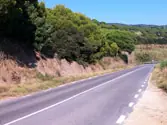
Circulando por un carril estrecho de menos de 3 metros de ancho, ¿puede con su vehículo transitar sobre la línea longitudinal continua que lo delimita?
When driving in a narrow lane less than 3 metres wide, may your vehicle drive on the solid longitudinal line marking it?
- ASí.Yes.
- BSí, si no circula ningún vehículo por el carril contiguo.Yes, if no vehicle is using the next lane.
- CNo.No.
ExplanationA solid longitudinal marking means that no driver may cross it or drive on it, even if the lane is narrow. The only exception is solid edge lines, which can be crossed to use the hard shoulder in an emergency.
Ante las marcas viales que delimitan un paso para ciclistas, ¿está obligado a detenerse si hay ciclistas cruzando?
At the road markings of a cyclist crossing, must you stop if there are cyclists crossing?
- ASí, siempre para ceder el pasoYes, always, to give way
- BNo, porque no es un paso de peatones ni una señal de paradaNo, because it is not a pedestrian crossing or a stop sign
- CSí, si pasa algún ciclista porque tiene prioridad en este cruceYes, if a cyclist is crossing, because cyclists have priority at this crossing
ExplanationUnder Article 64.2 of the General Traffic Regulations (as worded by RD 518/2026), cyclists have priority over other vehicles when they are riding on a properly marked cyclist crossing. You do not always have to stop, but you must give way to cyclists who are crossing.
Luz amarilla fija de un semáforo significa:
A steady amber traffic light means:
- APuedes pasar si acelerasYou may go through if you speed up
- BDebes detenerte como si estuviera rojo, salvo que no puedas hacerlo con seguridadYou must stop as if it were red, unless you cannot do so safely
- CPuedes pasar con precauciónYou may go through with caution
ExplanationA steady amber light requires you to stop under the same conditions as a red light. You may only continue if, when it comes on, you are so close that braking would be dangerous.
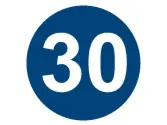
Esta señal nos obliga a circular...
This sign requires us to drive...
- AComo máximo a 30 km/h.At no more than 30 km/h.
- BComo mínimo a 30 km/h.At no less than 30 km/h.
- CRecomienda no sobrepasar los 30 km/h.It recommends not exceeding 30 km/h.
ExplanationThis sign requires you to drive at a minimum of 30 km/h.
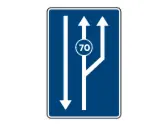
¿Por qué carril deberá circular, a la vista de la señalización, si transita a 90 km/h y no pretende adelantar?
Given the signs, which lane should you use if you are travelling at 90 km/h and do not intend to overtake?
- APor el carril derecho, teniendo prohibido utilizar el carril central ya que circulo a más de 70km/h.The right-hand lane; you are prohibited from using the centre lane because you are going faster than 70 km/h.
- BPor el carril central, ya que circulamos a más de 70km/h.The centre lane, because you are going faster than 70 km/h.
- CPor el carril de la derecha, pudiendo utilizar el central cuando las circunstancias lo precisen.The right-hand lane, and you may use the centre lane when circumstances require it.
ExplanationThe sign in the question, a lane reserved according to the signed speed, means that the lane above which the minimum speed sign is placed may only be used by vehicles travelling at or above the speed shown. However, if circumstances allow, you must drive in the right-hand lane.
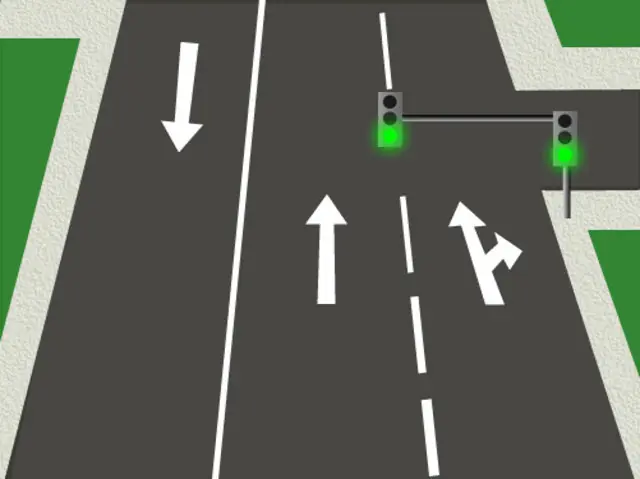
Está en el carril derecho y el semáforo está en verde. ¿Qué debe hacer?
You are in the right-hand lane and the traffic light is green. What must you do?
- AGirar a la derecha o a la izquierda.Turn right or left.
- BGirar a la izquierda o seguir recto.Turn left or go straight on.
- CGirar a la derecha o seguir recto.Turn right or go straight on.
ExplanationArrows painted in a lane show the movements allowed or required for those driving in it. In the right-hand lane in the picture the arrow points straight ahead and to the right, so when the light is green you may go straight on or turn right.
Hay una línea longitudinal continua junto a otra discontinua. ¿Cuál de las dos hay que tener en cuenta?
There is a solid longitudinal line next to a broken one. Which of the two must you take into account?
- ALa línea situada en el lado contrario al sentido de la circulación.The line on the side opposite to your direction of travel.
- BLa línea situada en el lado por el que se circula.The line on the side you are driving on.
- CNinguna de las dos.Neither of them.
ExplanationUnder the road-marking catalogue in Annex I of the RGC, when a solid line runs next to a broken line, you must only take into account the line on the side you are driving on. If the broken line is on your side, you may cross it; if it is the solid line, you may not.
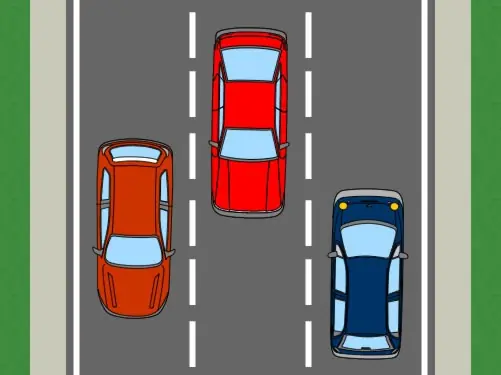
En una vía de doble sentido de circulación y tres carriles separados por marcas longitudinales discontinuas, ¿qué carril se utilizará para girar a la izquierda?
On a two-way road with three lanes separated by broken longitudinal markings, which lane will be used to turn left?
- AEl carril izquierdo.The left-hand lane.
- BEl carril derecho.The right-hand lane.
- CEl carril central.The centre lane.
ExplanationUnder Article 75 of the General Traffic Regulations (RGC), on a two-way carriageway with three lanes separated by broken lines, to turn left you must move into the centre lane in good time. The left-hand lane is for the opposite direction.
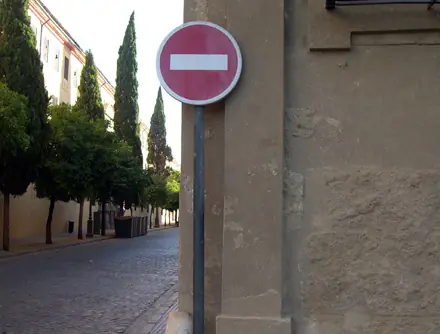
Por una necesidad, llevas en tu vehículo particular a un accidentado. ¿Puedes circular sin respetar las normas de circulación?
Out of necessity, you are carrying an injured person in your private vehicle. May you drive without obeying the traffic rules?
- ASí. Solo es obligatorio respetar las señales de los agentes de tráfico.Yes. You only have to obey the signals of traffic officers.
- BNo. Debo respetar las normas, pero no hace falta respetar la preferencia de paso en los cruces.No. I must obey the rules, but I do not need to respect right of way at junctions.
- CNo. Debo respetar las normas, sobre todo en los cruces.No. I must obey the rules, especially at junctions.
ExplanationAnyone who, because of a serious emergency, carries an injured person in a vehicle that is not a priority vehicle must warn others by sounding the horn intermittently and switching on the hazard warning lights, but under Article 70 of the General Traffic Regulations (RGC) they must obey the traffic rules, especially at junctions. They do not gain right of way.
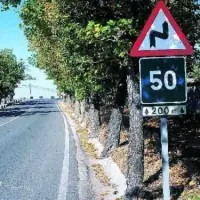
Las señales, ¿qué indican?
What do these signs indicate?
- AProhíben circular a más de 50 km/h en las curvas.They prohibit driving at more than 50 km/h on the bends.
- BAconsejan no circular a más de 50 km/hora en las curvas.They advise against driving at more than 50 km/h on the bends.
- CObligan a circular a 50 km/h en las curvas.They require driving at 50 km/h on the bends.
ExplanationThe square sign with the number 50 under the dangerous bends sign is S-7, Recommended maximum speed. When it is placed under a danger warning sign, it recommends not exceeding 50 km/h along the stretch where the danger continues, that is, on the bends. It is a recommendation, not a prohibition.
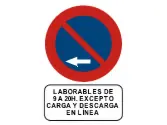
El lunes a las 9 de la mañana, a partir del lugar donde se encuentra situada esta señal...
On Monday at 9 in the morning, from the point where this sign is placed...
- Asólo se puede estacionar para dejar un paquete.you may only park to drop off a parcel.
- Bestá prohibido parar y estacionar.stopping and parking are prohibited.
- Cse puede parar pero no estacionar.you may stop but not park.
ExplanationThe no-parking sign (R-308) with an arrow prohibits parking on that side of the carriageway, but it does not prohibit stopping. The panel limits the prohibition to working days from 9:00 to 20:00, so on Monday at 9 you may stop, but not park.
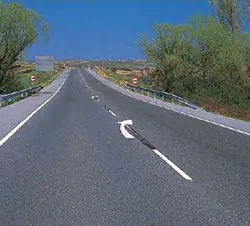
Circula por el carril izquierdo; ¿qué le indica la flecha?
You are driving in the left lane. What does the arrow tell you?
- AQue está cerca la próxima salida.That the next exit is close.
- BQue se permite la circulación en paralelo.That driving side by side is allowed.
- CQue debe incorporarse cuanto antes al carril derecho.That you must move into the right lane as soon as possible.
ExplanationThis is a return arrow (M-5.5): it warns that a solid line prohibiting driving to its left is coming up. Anyone in the left lane must give up overtaking or finish it as soon as possible and return to the right lane.
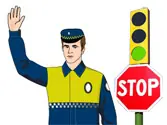
El semáforo está verde y un agente le manda detenerse. ¿Qué debe hacer?
The traffic light is green and a traffic officer orders you to stop. What must you do?
- ADetenerse, porque la señal del agente tiene prioridad.Stop, because the officer's signal has priority.
- BContinuar circulando, porque lo permite el semáforo.Carry on driving, because the traffic light allows it.
- CContinuar la marcha, pero debe ceder el paso a todos los vehículos.Carry on, but give way to all vehicles.
ExplanationSignals and orders from traffic officers are always immediately binding and must therefore be obeyed at once by drivers and other road users. They prevail over any other sign and over the traffic rules, even if they contradict those rules and signs. So, even though the traffic light is green, we must stop.
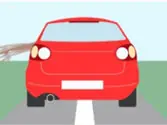
Si el conductor que le precede mueve el brazo alternativamente de arriba a abajo con movimientos cortos y rápidos, ¿qué le indica?
If the driver in front moves their arm up and down with short, quick movements, what are they telling you?
- AQue pretende disminuir la velocidad considerablemente.That they intend to slow down considerably.
- BLa intención de inmovilizar el vehículo, en cualquier caso.That they intend to stop the vehicle, in all cases.
- CQue va a efectuar marcha hacia atrás.That they are going to reverse.
ExplanationThe intention to stop the vehicle or to slow down considerably, even when traffic conditions force this, must be signalled whenever possible with the brake lights or with the arm, moving the extended left arm up and down with the palm facing down.
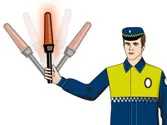
¿Qué indica un agente balanceando una luz roja o amarilla?
What does a traffic officer swinging a red or yellow light indicate?
- AQue debemos disminuir la velocidad.That we must slow down.
- BObliga a detenerse a los usuarios hacia los que el agente dirige la luz.Road users towards whom the officer points the light must stop.
- CQue debemos reanudar la marcha.That we must move off again.
ExplanationSwinging a red or yellow light requires road users towards whom the officer points the light to stop.
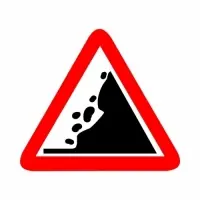
¿Qué significado tienen las señales de tráfico triangulares?
What do triangular traffic signs mean?
- ARestricciónRestriction.
- BPeligroDanger.
- CObligaciónObligation.
ExplanationTriangular road signs on a white or yellow background are used for warning signs: they warn the driver that they are approaching a hazard that may affect driving if precautions are not taken.

Esta señal, en un carril de entrada a un peaje, obliga a quienes circulen por él a...
This sign, on a lane leading into a toll station, requires those using the lane to...
- Apagar mediante el sistema de telepeaje o con otros medios.pay using the electronic toll system or by other means.
- Butilizarlo, aunque el vehículo no esté equipado con el sistema de telepeaje operativo.use it, even if the vehicle is not fitted with a working electronic toll system.
- Cpagar, exclusivamente, mediante el sistema de peaje dinámico o telepeaje.pay exclusively using the dynamic toll or electronic toll system.
ExplanationThe sign in the question indicates that vehicles using a lane signed in this way must pay the toll exclusively with the electronic toll system. The vehicle must therefore be fitted with a working electronic toll system. Do not confuse it with the same sign in square form, which indicates that you can pay using the electronic toll but that it is not compulsory, that is, you can also pay using other systems.
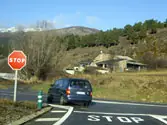
Cuando una señal imponga la obligación de detenerse, ¿hasta cuándo no se podrá reanudar la marcha?
When a sign requires you to stop, when may you move off again?
- AHasta que no se cumpla la obligación establecida por la señal.Not until the obligation set by the sign has been fulfilled.
- BHasta pasado un tiempo prudencial, que no será inferior a diez segundos.Not until a reasonable time has passed, which must be at least ten seconds.
- CHasta que no estén detenidos los vehículos que se acerquen por detrás.Not until the vehicles approaching from behind have stopped.
ExplanationWhen we find a sign that requires us to stop, we may not move off again until we have complied with what the sign instructs. In the case of a STOP sign, we must stop (even if no vehicles are coming) and give way at the junction.
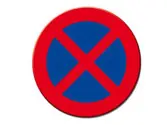
¿Podrá efectuar una parada en el lado de calzada en el que está situada esta señal?
May you stop on the side of the carriageway where this sign is placed?
- ANo, podré estacionar pero no parar.No, I may park but not stop.
- BSí, podré parar pero no estacionar.Yes, I may stop but not park.
- CNo podré ni parar ni estacionar.I may neither stop nor park.
ExplanationThe sign prohibits stopping and parking on the side of the carriageway where it is placed. Unless shown otherwise, the ban starts level with the sign and ends at the nearest junction.
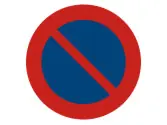
En el lado de la calzada en el que se encuentra esta señal, ¿podemos efectuar una parada?
On the side of the carriageway where this sign is, can we stop?
- ASí.Yes.
- BNo.No.
- CSí, pero como máximo un minuto.Yes, but for one minute at most.
ExplanationThis sign prohibits parking, but it does not prohibit stopping.
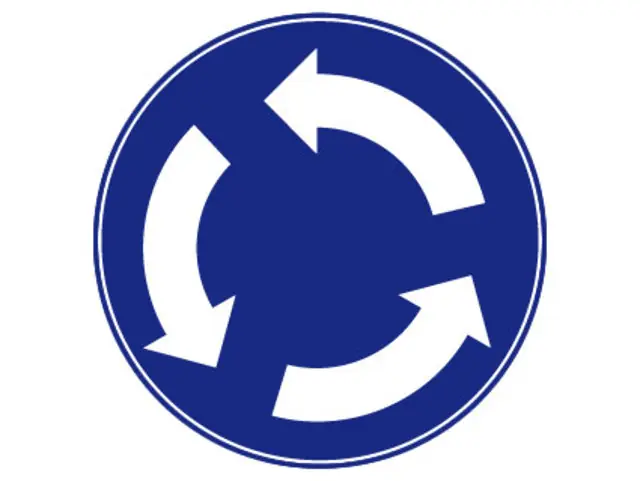
Al llegar a una plaza, ve esta señal. ¿Puede cambiar de sentido?
On arriving at a square, you see this sign. May you make a U-turn?
- ANo, la señal prohíbe cambiar de sentido.No, the sign prohibits U-turns.
- BNo, sólo puede cambiar de sentido hacia la izquierda.No, you may only make a U-turn to the left.
- CSí, siguiendo la dirección y el sentido de las flechas.Yes, following the direction of the arrows.
ExplanationThe round blue sign with arrows in a circle is R-402, compulsory direction at a roundabout: it shows the direction of rotation you must follow. By going round the roundabout in that direction you may turn back the way you came.
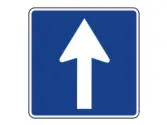
A la vista de esta señal, ¿podemos cambiar de dirección a la izquierda?
Given this sign, may we turn left?
- ANo, por prohibirlo la señal.No, because the sign prohibits it.
- BSí.Yes.
- CA la izquierda no pero sí a la derecha.Not left, but right.
ExplanationThis sign indicates that on the carriageway continuing in the direction of the arrow, vehicles must travel in the direction the arrow shows, and traffic in the opposite direction is prohibited. Turning is allowed.
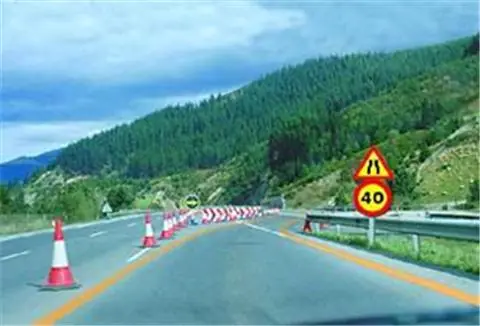
El color amarillo de las marcas viales, ¿qué indican?
What does the yellow colour of road markings indicate?
- AQue empieza un carril reversible.That a reversible lane begins.
- BQue se están realizando obras en la vía.That there are roadworks on the road.
- CQue hay un estrechamiento.That the road narrows.
ExplanationYellow road markings on the carriageway indicate that there are roadworks, and they take precedence over white markings while the work lasts. You must follow them even if they contradict the permanent white markings.
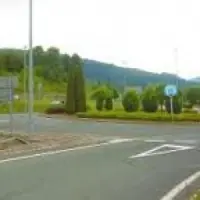
¿De qué color suele ser la marca vial de ceda el paso?
What colour is the give way road marking usually?
- ABlanco y rojoWhite and red.
- BBlancoWhite.
- CBlanco y amarilloWhite and yellow.
ExplanationThe give way road marking is a white triangle painted on the carriageway, with the point opposite its short side facing approaching vehicles.
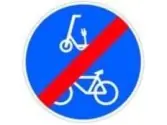
A partir de esta señal, ciclos y vehículos de movilidad personal:
From this sign onwards, cycles and personal mobility vehicles:
- ADeben circular obligatoriamente por la vía reservada.must use the reserved road.
- BYa no tienen la obligación de circular por la vía reservada.no longer have to use the reserved road.
- CSe recomienda utilizar otra vía alternativa.are advised to use another, alternative road.
ExplanationThe sign shown marks the end of the road reserved for, and compulsory for, cycles and personal mobility vehicles.
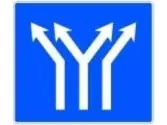
A la vista de la señal, ¿qué sucede con la circulación?
Given the sign, what happens to the traffic?
- ATodos los carriles continúan rectos sin bifurcarse.All lanes continue straight on without splitting.
- BEl carril central se bifurca, generando cuatro carriles: dos hacia la izquierda y dos hacia la derecha.The centre lane splits, giving four lanes: two to the left and two to the right.
- CLos carriles de los extremos se cierran y solo se mantiene el central.The outer lanes close and only the centre lane remains.
ExplanationSign S-63b indicates that, on a carriageway with three lanes in the same direction, the centre lane splits and there are four lanes: two to the left and two to the right. It allows you to get into the right lane in advance for the direction you are going to take.
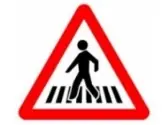
¿De qué peligro advierte la señal?
What danger does the sign warn of?
- ADe uno o varios pasos para peatones.One or more pedestrian crossings.
- BDe la proximidad de un lugar frecuentado por niños, como escuelas, zonas de juego, etc.Nearness of a place often used by children, such as schools, play areas, etc.
- CDe la proximidad de una zona reservada para los peatones.Nearness of an area reserved for pedestrians.
ExplanationThis is sign P-20a «Pedestrian crossing»: it warns of danger because you are approaching one or more pedestrian crossings. Do not confuse it with P-21a «Children», which warns of places often used by children, such as schools or play areas.
Cuando exista contradicción entre dos señales, ¿a cuál tendremos que obedecer?
When two signs contradict each other, which one must we obey?
- ASi son del mismo tipo a la más restrictiva.If they are of the same type, the more restrictive one.
- BSi son del mismo tipo a la menos restrictiva.If they are of the same type, the less restrictive one.
- CSi son del mismo tipo a la menos prioritaria.If they are of the same type, the one with lower priority.
ExplanationIf the signs are of different types, we follow the order of priority between signs; but if the contradiction is between signs of the same type, we obey the more restrictive one.
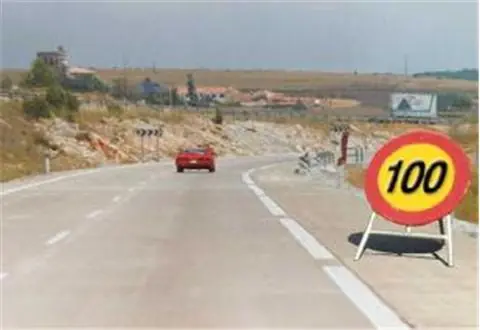
¿Es obligatorio obedecer esta señal con fondo amarillo?
Must you obey this sign with a yellow background?
- ANo.No.
- BSí, pero sólo cuando haya obreros trabajando.Yes, but only when workers are present.
- CSí, haya o no obreros trabajando.Yes, whether or not workers are present.
ExplanationRoadworks signs have exactly the same meaning as the equivalent signs used when there are no roadworks, with the same shape, design, symbols and size. The only difference is the yellow background, which shows that the signs are there because of roadworks.
¿Podrá efectuar un cambio de dirección a la izquierda en una intersección así señalizada?
May you turn left at a junction with this sign?
- ASí.Yes.
- BNo.No.
- CNo, solo permite seguir de frente.No, it only allows going straight ahead.
ExplanationThe sign in the question shows that on the carriageway continuing in the direction of the arrow, vehicles must travel in the direction it shows, and travelling in the opposite direction is prohibited. This sign does not prohibit turning. Do not confuse it with the mandatory «Compulsory direction» sign (a round sign), which prohibits turning and making a U-turn.
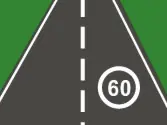
La señal horizontal de limitación de velocidad situada en un carril, afecta ...
The speed limit road marking placed in a lane applies...
- Aúnicamente a vehículos pesados.only to heavy vehicles.
- Bsolamente a los vehículos que circulen por el carril en el que está situada la señal.only to vehicles travelling in the lane where the marking is placed.
- Ca todos y cada uno de los carriles que tenga la calzada.to each and every lane of the carriageway.
ExplanationIf the figure is placed in a lane bounded by longitudinal lines, solid or broken, the prohibition applies only to vehicles travelling in that lane. If the lanes were not marked out, the limit would apply to the whole carriageway.
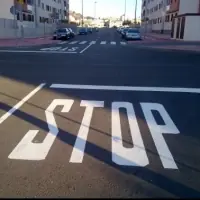
¿Qué indica una línea continua dispuesta a lo ancho de un carril?
What does a solid line across a lane indicate?
- ACeda el pasoGive way
- BDetenciónStop
- CPaso permitidoPassing allowed
ExplanationA solid line across one or more lanes is a stop line: you must not cross it when you are required to stop, for example by a stop sign, a pedestrian crossing or a traffic light.
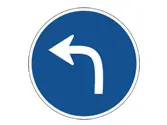
¿Con esta señal puedo realizar un cambio de sentido de la marcha?
With this sign, may I make a U-turn?
- ASí.Yes.
- BNo.No.
- CSí, si no circulan vehículos en sentido contrario.Yes, if no vehicles are coming the other way.
ExplanationMandatory direction signs require you to follow the direction shown by the arrow. So you may not make a U-turn.
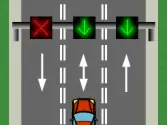
Una luz verde en forma de flecha apuntando hacia abajo en un semáforo cuadrado de carril indica que...
A green arrow pointing downwards on a square lane signal means that...
- AEstá permitido circular por el carril sobre el que está encendida.You may drive in the lane above which it is lit.
- BTenemos prioridad de paso.You have right of way.
- CTenemos que abandonar el carril con la mayor brevedad posible.You must leave the lane as soon as possible.
ExplanationThis square traffic light with the green arrow shows that you may drive in the lane above which it is lit. This permission does not exempt you from stopping at a red circular light or from obeying a sign or road marking that requires you to stop or give way.
¿Qué debe hacer el conductor si al llegar a una intersección regulada por semáforo, que presenta una luz roja fija encendida, hay un agente que le indica con el brazo que continúe la marcha?
What must a driver do if, on reaching a junction controlled by a traffic light showing a steady red light, a traffic officer signals with their arm to continue?
- ARespetará el semáforo rojo por ser la señal más restrictiva.Obey the red light, as it is the most restrictive signal.
- BHará caso al agente y no se detendrá en el semáforo rojo.Follow the officer and not stop at the red light.
- CSe detendrá en el semáforo rojo y, una vez detenido, reanudará la marcha inmediatamente para respetar las indicaciones del agente.Stop at the red light and, once stopped, move off immediately to follow the officer's instructions.
ExplanationTraffic officers' instructions take precedence over any other signal, including traffic lights. If the officer orders you to continue, you must do so even if the light is red, without stopping.
Un semáforo con luz amarilla intermitente indica que…
A traffic light with a flashing amber light indicates that…
- ADebe detenerse siempreYou must always stop
- BPuede continuar, cediendo el paso si es necesarioYou may continue, giving way if necessary
- CEl semáforo está averiado y debe ignorarloThe traffic light is broken and you should ignore it
ExplanationA flashing amber light means caution: you may continue, respecting the priority of other road users.
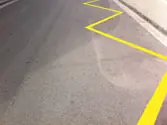
La marca en zigzag...
The zigzag marking...
- Aindica sólo la parte de la vía reservada para otros usuarios.only indicates the part of the road reserved for other users.
- Bindica un lugar de la vía donde no se puede parar ni estacionar.indicates a place on the road where you may neither stop nor park.
- Cindica un lugar de la vía donde no se puede estacionar, pero sí parar.indicates a place on the road where you may not park, but you may stop.
ExplanationA yellow zigzag road marking at the edge of the carriageway marks a place where parking is prohibited for vehicles in general because it is reserved for a special use, such as a bus stop or a loading and unloading area. Stopping is permitted.
Un semáforo con una flecha verde sobre fondo negro:
A traffic light with a green arrow on a black background:
- AProhíbe el paso en la dirección de la flechaProhibits going in the direction of the arrow
- BPermite el paso solo en la dirección indicadaAllows you to go only in the direction shown
- CObliga a girar en esa direcciónRequires you to turn in that direction
ExplanationUnder Annex I of the General Traffic Regulations (RGC), a green arrow on a black background allows you to go in the direction shown, whatever other light is on at the same time. You must go forward with caution, letting through the vehicles in the lane you are moving into.
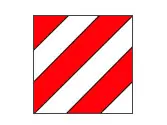
Este panel deberá colocarse...
This panel must be placed...
- Asolamente en la parte trasera de los vehículos destinados exclusivamente al transporte de mercancías.only at the rear of vehicles used exclusively for carrying goods.
- Ben la parte trasera de la carga que sobresalga de cualquier vehículo, excepto en los de anchura inferior a 1 metro.at the rear of any load sticking out from any vehicle, except vehicles less than 1 metre wide.
- Cen la parte delantera y trasera en los vehículos destinados exclusivamente al transporte de mercancías.at the front and rear of vehicles used exclusively for carrying goods.
ExplanationIn all cases, a load that sticks out behind a vehicle, except on vehicles less than 1 metre wide, must be signalled with a 50 x 50 cm panel with alternating red and white diagonal stripes, placed at the rear end of the load and perpendicular to the vehicle's axis. When the load sticks out along the whole width of the rear of the vehicle, we will fit 2 panels, and their stripes will form an inverted 'V'.
Si Ud. circula por el carril sobre el que está situado el semáforo con luz amarilla fija en forma de flecha y apuntada hacia abajo en forma oblicua, ¿qué debe hacer?
If you are driving in the lane above which there is a traffic light showing a steady amber arrow pointing diagonally downwards, what must you do?
- AIncorporarme al carril hacia el que apunta la flecha, porque el carril por el que circulo va a quedar cerrado.Move into the lane the arrow points to, because the lane I am in is going to be closed.
- BReducir considerablemente la velocidad porque me está anunciando la proximidad de un semáforo circular encendido en luz roja.Reduce speed considerably, because it is warning me of a circular traffic light ahead showing red.
- CCeder el paso a los vehículos que deseen incorporarse al carril por el que circulo, ya que tienen prioridad de paso.Give way to vehicles wanting to move into my lane, because they have priority.
ExplanationThis is correct because a steady amber arrow pointing downwards means that the lane you are in is going to be closed. So you must move into the lane the arrow points to, in order to continue your journey safely and avoid a possible accident.

¿De qué tipo es la señal vertical de cadenas para nieve?
What type of sign is the snow chains sign?
- ASeñal de prioridadA priority sign.
- BSeñal de entrada prohibidaA no entry sign.
- CSeñal de obligaciónA mandatory sign.
ExplanationSign R-412, ‘Snow chains’, is a mandatory sign: it means you must not continue without snow chains or other approved anti-skid devices, or without special snow tyres.
La línea transversal continua pintada ante un STOP indica:
The continuous transverse line painted before a STOP sign indicates:
- AEl lugar donde hay que detenerse por completo.The place where you must come to a complete stop.
- BQue se puede seguir sin parar.That you may carry on without stopping.
- CUna zona de aparcamiento.A parking area.
ExplanationThe stop line marks the exact point where the vehicle must stop at a STOP sign.
All topics
- Definitions
- Documents and penalty points
- The driver's condition
- Duties of drivers and pedestrians
- Vehicle safety devices
- Vehicle controls and equipment
- Vehicle lights and horn
- The road and its lanes
- Speed and distances
- Manoeuvres
- Right of way
- Carrying passengers and loads
- Driving safely in difficult conditions
- Vehicle mechanics and maintenance
- Road accidents and first aid
- Defensive and eco-driving
Independent app: not affiliated with or endorsed by the DGT (Spain's Directorate-General for Traffic) or the Ministry of the Interior. The official exam is booked with the DGT and taken at its test centres. The questions here are practice material; the DGT's official question bank is not public.
Basado en datos de la Agencia Estatal Boletín Oficial del Estado (https://www.boe.es). Textos consolidados de carácter meramente informativo. La AEBOE no patrocina ni respalda este sitio.
Parte de las preguntas procede de los tests de la revista «Tráfico y Seguridad Vial» de la DGT, reproducidos con indicación de la fuente.