
DGT test · 1,397 questions
Traffic signs, markings and signals · Page 12 of 28
Road signs, road markings, traffic lights, police signals and temporary markings: what they mean and which one wins when they disagree. The topic with the most questions in the bank.
Questions in this topic, with answers
1,397 questions, 50 per page, with the correct answer and the explanation. Page 12 of 28.
¿Le está permitido rebasar la línea longitudinal continua para adelantar a un grupo de ciclistas?
Are you allowed to cross the continuous longitudinal line to overtake a group of cyclists?
- ANo, porque el adelantamiento está prohibido en ese tramoNo, because overtaking is prohibited on that stretch
- BSolo si no hay señal vertical que lo prohíbaOnly if there is no road sign prohibiting it
- CSí, si se guarda al menos 1,5 metros de separación lateralYes, if you leave at least 1.5 metres of lateral clearance
ExplanationAs a general rule, crossing a continuous line is prohibited. However, there is a legal exception intended to protect the most vulnerable road users. To overtake cyclists, mopeds, pedestrians, animals and animal-drawn vehicles, you may cross the continuous line (moving fully or partly into the opposite lane), provided that two essential requirements are met: 1. The manoeuvre is carried out without danger or hindrance to vehicles coming in the opposite direction. 2. A minimum lateral clearance of 1.5 metres is kept. This exception applies even if there is a no-overtaking road sign, unless the manoeuvre puts other road users at risk.
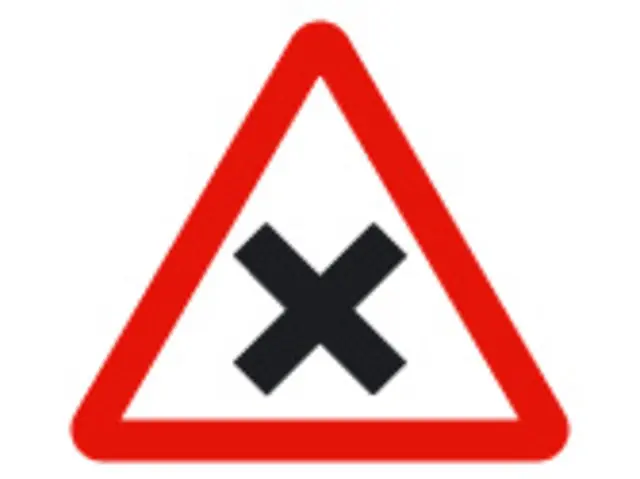
Si un conductor ve esta señal, debe saber que en la próxima intersección...
If a driver sees this sign, they should know that at the next junction...
- Atiene prioridad sobre los vehículos que vienen por la derecha y por la izquierda.they have priority over vehicles coming from the right and from the left.
- Bse aplica la norma general de prioridad de paso.the general rule of right of way applies.
- Cdebe ceder el paso a los vehículos que vienen por la derecha y por la izquierda.they must give way to vehicles coming from the right and from the left.
ExplanationThe sign in the picture, a triangle with a black cross, warns of a junction where the general priority rule applies: you must give way to vehicles approaching from the right. It does not give you priority over anyone, nor does it require you to give way to those coming from the left.
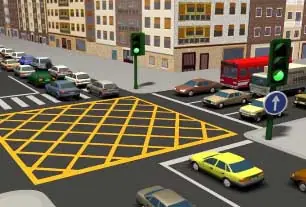
El semáforo está en verde, pero la intersección está saturada.¿qué debe hacer?
The traffic light is green, but the junction is congested. What should you do?
- AEntrar en la intersección porque el semáforo me lo permite.Enter the junction because the traffic light allows me to.
- BEsperar hasta que haya espacio para cruzar.Wait until there is space to cross.
- CAceleraré para pasar rápidamente.Speed up to get through quickly.
ExplanationEven if the light is green, no driver should enter a junction if they are likely to be stopped in it and block cross traffic (Article 59 of the RGC). The yellow criss-cross marking on the road surface is a reminder of exactly this prohibition.
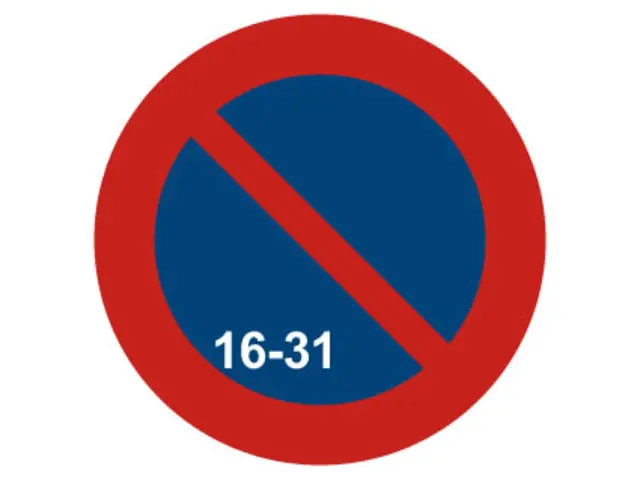
¿Cuándo puede aparcar ante esta señal?
When may you park at this sign?
- ANunca; esta señal prohíbe aparcar en ese lugar.Never; this sign prohibits parking there.
- BDesde las 9:00 del día 16 hasta las 9:00 del día 1.From 9:00 on the 16th to 9:00 on the 1st.
- CDesde las 9:00 del día 1 hasta las 9:00 del día 16.From 9:00 on the 1st to 9:00 on the 16th.
ExplanationThe sign in the picture prohibits parking on that side of the carriageway during the second half of the month, from 9:00 on the 16th to 9:00 on the 1st of the following month. So you may park from 9:00 on the 1st to 9:00 on the 16th.
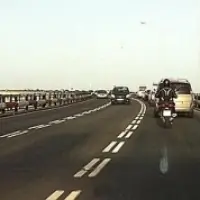
¿De qué advierten las líneas discontinuas dobles?
What do double broken lines warn of?
- ADe un carril para ciclos únicamenteA lane for cycles only
- BDe un carril reversibleA reversible lane
- CDe un carril especialA special lane
ExplanationTwo broken lines side by side with a gap between them indicate that the lane is reversible, and that traffic in it may be directed in one direction or the other by lane control signals.
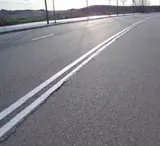
Una marca longitudinal formada por dos líneas continuas adosadas...
A longitudinal marking made up of two solid lines side by side...
- ATiene el mismo significado que una marca longitudinal continua.has the same meaning as a solid longitudinal marking.
- BIndica que circulamos por un carril reversible.indicates that we are driving in a reversible lane.
- CIndica que circulamos por un carril adicional circunstancial.indicates that we are driving in a temporary additional lane.
ExplanationTwo solid lines side by side have the same meaning as a single solid line: no vehicle may cross them or drive on them. A reversible lane is marked with a double broken line, not with solid lines.
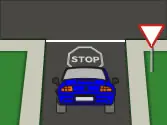
Ante esta situación el conductor del vehículo azul...
In this situation, the driver of the blue vehicle...
- ARespetará el STOP, por ser el más restrictivo.will obey the STOP, because it is the most restrictive.
- BRespetará el CEDA EL PASO por ser una señal vertical y estar por delante en orden de prioridad a una marca vial.will obey the GIVE WAY sign, because it is a road sign and comes before a road marking in the order of priority.
- CRespetará el CEDA EL PASO si gira a la derecha y el STOP si sigue de frente o gira a la izquierda.will obey the GIVE WAY if turning right and the STOP if going straight on or turning left.
ExplanationIf signs seem to contradict each other and are of different types, the order in Article 133 of the General Traffic Regulations (RGC) applies: traffic officers, temporary signs, traffic lights, road signs and road markings. The give way road sign prevails over the STOP road marking.
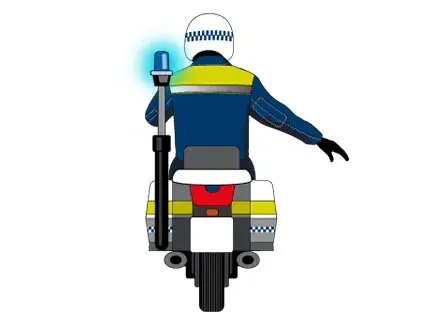
Este Agente de circulación le ha adelantado, ¿qué le está indicando con el brazo?
This traffic officer has overtaken you. What is the officer telling you with their arm?
- AQue disminuya la velocidad.To slow down.
- BQue en el próximo cruce gire a la derecha.To turn right at the next junction.
- CQue me detenga en el lado derecho de la calzada.To stop on the right-hand side of the carriageway.
ExplanationThe traffic officer is telling you to stop on the right-hand side of the carriageway, with the arm held out, angled downwards and kept still. This signal requires you to stop on the right-hand side of the road.
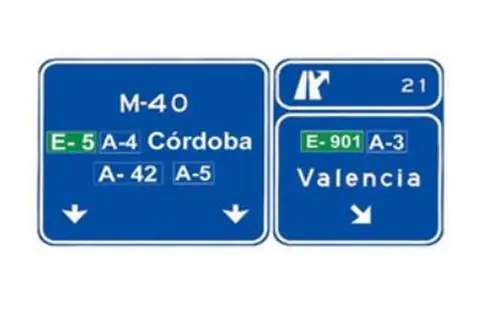
Estas señales, sobre autopista o autovía, indican salida inmediata hacia...
On a motorway (autopista) or dual carriageway (autovía), these signs indicate an immediate exit towards...
- Ala población indicadathe town shown.
- Buna autopista o autovía.a motorway (autopista) or dual carriageway (autovía).
- Cuna carretera convencional.a conventional road.
ExplanationOn direction signs, the destination road is identified by its code and colour: the A-3 is a dual carriageway (autovía). The signed exit therefore leads to a motorway or dual carriageway, not to a town or a conventional road.
Un semáforo cuadrado o de carril afecta…
A square traffic light, or lane control signal, applies...
- ASólo a los turismos que circulan por el carril sobre el que está situado.only to cars travelling in the lane above which it is placed.
- BA los vehículos que circulan por el carril sobre el que está situado.to vehicles travelling in the lane above which it is placed.
- CA los vehículos que circulan por la calzada sobre la que está situado.to vehicles travelling on the carriageway above which it is placed.
ExplanationThe General Traffic Regulations (RGC) state that square traffic lights, or lane control signals, apply only to vehicles travelling in the lane above which they are placed, whatever type of vehicle they are. A red cross prohibits using that lane and a green downward arrow allows it.
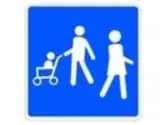
A partir de la señal que se muestra en la imagen, si circulas con un vehículo de movilidad personal (VMP), ¿puedes pasar?
After the sign shown in the picture, if you are riding a personal mobility vehicle (PMV), may you go through?
- ASí, los VMP pueden circular libremente por la zona peatonal.Yes, PMVs may ride freely in the pedestrian zone.
- BÚnicamente si se circula a velocidad inferior a 25 km/h.Only if you ride at less than 25 km/h.
- CNo, salvo que una ordenanza municipal lo autorice.No, unless a local bylaw allows it.
ExplanationUnder Article 152.1 of the General Traffic Regulations (RGC), as worded by RD 518/2026, all vehicles are prohibited from using pavements; in other pedestrian areas the local authority may allow, by bylaw, pedestrians to share the space with users of personal mobility vehicles, respecting pedestrians' priority.
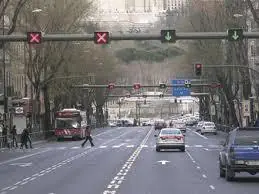
Una flecha verde apuntando hacia abajo en un semáforo de carril…
A green arrow pointing downwards on a lane-control signal…
- AObliga a no abandonar el carril sobre el que está colocada.Requires you not to leave the lane above which it is placed.
- BNo exime de tener que cumplir las normas generales sobre prioridad de paso.Does not exempt you from the general right-of-way rules.
- CIndica la proximidad de un túnel.Indicates that a tunnel is near.
ExplanationA green downward arrow on a lane-control signal means you may drive in that lane, but it does not exempt you from stopping at a red traffic light or from following the right-of-way rules (Annex I of the RGC). It does not require you to stay in the lane and does not announce a tunnel.
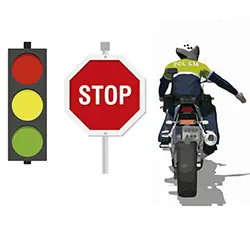
Entre los siguientes tipos de señales, ¿cuál es el orden de prioridad?
What is the order of priority between the following types of signs?
- ASeñales verticales, agentes y semáforos.Road signs, traffic officers and traffic lights.
- BAgentes, semáforos y señales verticales.Traffic officers, traffic lights and road signs.
- CSemáforos, agentes y señales verticales.Traffic lights, traffic officers and road signs.
ExplanationIn the order of priority of signs, traffic officers come first, then traffic lights and finally road signs; a traffic officer's instructions prevail over any other sign.
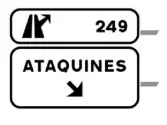
Observando la señal en la imagen, puedes deducir que:
Looking at the sign in the picture, you can tell that:
- AEstás circulando por una carretera convencional o multicarril y la señal indica la salida inmediata hacia otra carretera convencional o multicarrilYou are driving on a conventional or multi-lane road and the sign shows the immediate exit to another conventional or multi-lane road.
- BEstás circulando por una autopista o autovía y la señal indica la salida inmediata hacia una carretera convencional o multicarril, incluyendo el número y letra de la salida.You are driving on a motorway (autopista) or dual carriageway (autovía) and the sign shows the immediate exit to a conventional or multi-lane road, including the exit number and letter.
- CEstás circulando por una autopista y la señal indica únicamente destinos locales sin especificar número de salida.You are driving on a motorway (autopista) and the sign shows only local destinations, without giving an exit number.
ExplanationThis sign is used above the carriageway on motorways (autopistas) or dual carriageways (autovías) to show the destinations of the next exit when it leads to a conventional or multi-lane road. It also shows the exit number and, where applicable, the letter that identifies it. Unlike advance direction signs, which include the distance and may change colour depending on the road they lead to, immediate exit signs take the colour of the road you are heading to: - White if the exit leads to a conventional or multi-lane road. - Blue if the exit leads to a motorway or dual carriageway. The pictogram lets the driver quickly recognise that they are driving on a motorway or dual carriageway.
Si se encuentra parado ante una señal de stop, ¿puede utilizar su teléfono móvil?
If you are stopped at a stop sign, may you use your mobile phone?
- ANo.No.
- BSí, lo puede utilizar, porque el vehículo está parado.Yes, you may, because the vehicle is stationary.
- CSí, siempre que emplee un dispositivo de manos libres y no use cascos o auriculares.Yes, provided you use a hands-free device and do not use a headset or earphones.
ExplanationWhen stopped at a stop sign you are still driving. The RGC prohibits using a mobile phone while driving, unless the communication takes place without using your hands or wearing a headset or earphones, as with a built-in hands-free system.
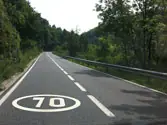
¿Qué vehículos tienen que obedecer esta señal?
Which vehicles must obey this sign?
- ATodos los que circulen por esa vía.All vehicles travelling on that road.
- BExclusivamente los vehículos que circulen por el carril donde esté la señal.Only vehicles travelling in the lane where the sign is.
- CSolo los turismos y las motocicletas.Only cars and motorcycles.
ExplanationAs the sign is placed over a lane marked by longitudinal lines, it refers only to vehicles travelling in that lane.
¿Qué significa esta aspa pintada en el suelo con las letras P y N una a cada lado?
What does this X painted on the road, with the letters P and N one on each side, mean?
- APaso a nivel con barreras.Level crossing with barriers.
- BPaso a nivel sin barreras.Level crossing without barriers.
- CPaso a nivel sin especificar si es con o sin barreras.Level crossing, without specifying whether it has barriers or not.
ExplanationThe level crossing road marking (M-7.5) shows that you are approaching a railway or tram level crossing, where you must give way when a train or tram is approaching. The marking does not show whether the crossing has barriers or not.
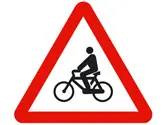
Esta señal de que peligro nos advierte...
What danger does this sign warn us of?
- ADe una calzada obligatoria para ciclistas.A carriageway that cyclists must use.
- BDe la proximidad de un tramo con circulación frecuente de ciclistas.The proximity of a stretch with frequent cyclist traffic.
- CDe la prohibición de que los ciclistas crucen la vía.That cyclists are prohibited from crossing the road.
ExplanationThis is sign P-22b 'Cyclists': it warns of danger because you are approaching a stretch where cyclists frequently ride. A cycle crossing is warned of by a different sign, P-22a, in which the cyclist appears on top of the crossing markings.
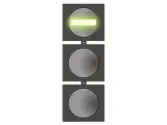
Este semáforo...
This traffic light...
- AProhíbe el paso.Prohibits passing.
- BPermite el paso de frente.Allows you to go straight on.
- CPermite girar a la derecha.Allows you to turn right.
ExplanationThis traffic light, with a horizontal white bar, prohibits passing in the same conditions as a steady red light. When it is placed on a lane reserved for buses, taxis and other vehicles, it applies only to the vehicles using that lane.
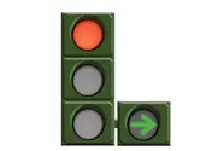
Si la luz del semáforo está roja, pero la flecha verde adicional está encendida,¿qué nos indica?
If the traffic light is red but the additional green arrow is lit, what does it indicate?
- AQue debo detenerme cualquiera sea la dirección que vaya a seguir.That I must stop, whatever direction I am going to take.
- BQue debo girar a la derecha si estoy colocado en el carril de la derecha, que es el que debe utilizar ese giro.That I must turn right if I am in the right-hand lane, which is the one to use for that turn.
- CQue puedo girar a la derecha si estoy colocado en el carril de la derecha, pero no estoy obligado a hacerlo.That I may turn right if I am in the right-hand lane, but I am not obliged to.
ExplanationAccording to section 4.2 of Annex I of the RGC, the green arrow allows you to proceed in its direction even if the red light is lit, and a vehicle in the lane reserved for that movement, or in the lane that must be used for it, must proceed in that direction, taking care with pedestrians and vehicles.
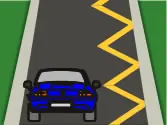
Estas marcas amarillas en forma de zig-zag...
These yellow zigzag markings...
- Aprohíben parar y estacionar.prohibit stopping and parking.
- Bprohíben parar pero no estacionar.prohibit stopping but not parking.
- Cprohíben estacionar pero no parar.prohibit parking but not stopping.
ExplanationThese markings indicate a place where parking is prohibited but stopping is permitted.
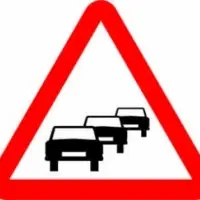
¿De qué previene la señal vertical de congestión?
What does the congestion warning sign warn you about?
- AProximidad de zona prohibida al tráfico de vehículosAn area closed to vehicle traffic ahead.
- BProximidad de zona de vigilancia u observanciaA surveillance or monitoring area ahead.
- CProximidad de zona detenida por exceso de tráfico de vehículosAn area ahead where traffic is at a standstill because of too many vehicles.
ExplanationThe congestion warning sign on a public road warns that we are approaching an area where we may be brought to a standstill by too much traffic.
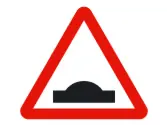
Esta señal le indica la existencia de un...
This sign tells you that there is a...
- ABadén.Dip.
- BResalto.Hump.
- CPaso a nivel.Level crossing.
ExplanationThis warning sign warns of a hump, that is, a raised strip across the carriageway that forces you to slow down. A dip is the opposite, a sunken section of the carriageway, and it has its own warning sign.
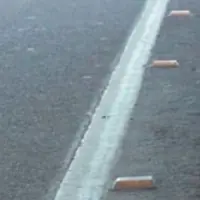
¿Qué otro nombre reciben los captafaros horizontales?
What is another name for horizontal reflectors (road studs)?
- AOjos de bueyBull's eyes.
- BOjos de gatoCat's eyes.
- COjos de buhoOwl's eyes.
ExplanationHorizontal reflectors (road studs), popularly known as ‘cat's eyes’, are guidance devices fixed to the road surface with retroreflective elements that help drivers see the course of the road, especially at night or in poor light (Annex I of the RGC).
¿Qué tipo de señales prevalecen sobre el resto?
Which type of signals take precedence over the rest?
- ALas señales circunstanciales o de balizamiento fijo.Temporary signs or fixed marker beacons.
- BLas señales y órdenes de los agentes de circulación.Signals and orders from traffic officers.
- CLas señales de los semáforos.Traffic light signals.
ExplanationThe order of priority between the different types of signs that seem to contradict each other is as follows: 1. Signals and orders from traffic officers. 2. Temporary signs that change the normal use of the road, and fixed marker beacons. 3. Traffic lights. 4. Road signs. 5. Road markings.
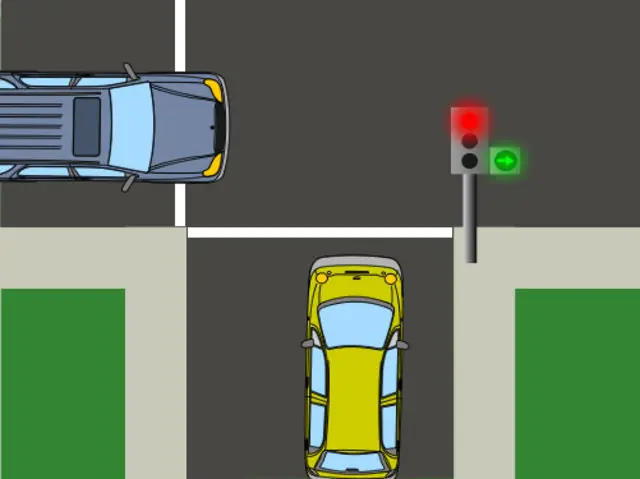
La flecha verde está encendida. Si quiere girar a la derecha, ¿tiene prioridad?
The green arrow is lit. If you want to turn right, do you have priority?
- ANo. La flecha verde me permite pasar, pero debo ceder el paso al vehículo que viene.No. The green arrow lets me go, but I must give way to the vehicle that is coming.
- BNo. La luz roja me prohíbe girar.No. The red light prohibits me from turning.
- CSí. La flecha verde me obliga a girar.Yes. The green arrow requires me to turn.
ExplanationThe green arrow means you may move forward or turn in the direction it points, but this does not exempt the driver from giving way to other vehicles already in the lane they are joining. Under the General Traffic Regulations, vehicles must do this carefully and let those in the lane go first, to keep the road safe. So when turning right, the driver must give way to any vehicle approaching from that direction.
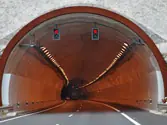
Si encontramos un semáforo en rojo a la entrada de un túnel, ¿qué haremos?
If you find a red traffic light at the entrance to a tunnel, what should you do?
- APasar con precaución.Go through with care.
- BPasar cediendo el paso.Go through, giving way.
- CDetenernos.Stop.
ExplanationAt a red traffic light, wherever it is, you must stop and wait for it to change colour before you can continue.
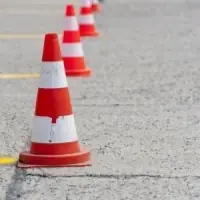
¿Cuál es la función de los conos como dispositivo delimitador?
What is the function of cones as delineating devices?
- AAdvertir de un accidente con heridosTo warn of an accident with injuries.
- BProhibir el paso a través de la línea que los uneTo prohibit crossing the line that joins them.
- CProhibir temporalmente el pasoTo prohibit passage temporarily.
ExplanationAccording to Annex I of the General Traffic Regulations (RGC), temporary edge markers, cones and similar devices are delineating devices that prohibit crossing the real or imaginary line joining them. No vehicle may drive through a line of cones.
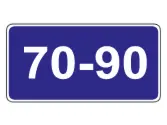
Esta señal aconseja...
This sign advises...
- Acircular entre 70 y 90 km/h cuando las condiciones meteorológicas sean favorables.driving at between 70 and 90 km/h when weather conditions are favourable.
- Bcircular entre 70 y 90 km/h cuando las condiciones meteorológicas sean favorables o desfavorables.driving at between 70 and 90 km/h whether weather conditions are favourable or unfavourable.
- Ccircular a un mínimo de 70 km/h y un máximo de 90 km/h en cualquier circunstancia.driving at a minimum of 70 km/h and a maximum of 90 km/h in all circumstances.
ExplanationThe sign recommends keeping your speed between 70 and 90 km/h provided that road conditions are favourable.
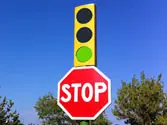
Si las indicaciones de dos señales se contradicen, ¿a cuál tenemos que obedecer?
If the instructions of two signs contradict each other, which one must you obey?
- AA la más restrictiva.The most restrictive one.
- BA la más prioritaria.The one with the highest precedence.
- CA la menos restrictiva.The least restrictive one.
ExplanationIf two signs appear to contradict each other, you must obey the one with the highest precedence. If they have the same level of precedence, you obey the most restrictive one.
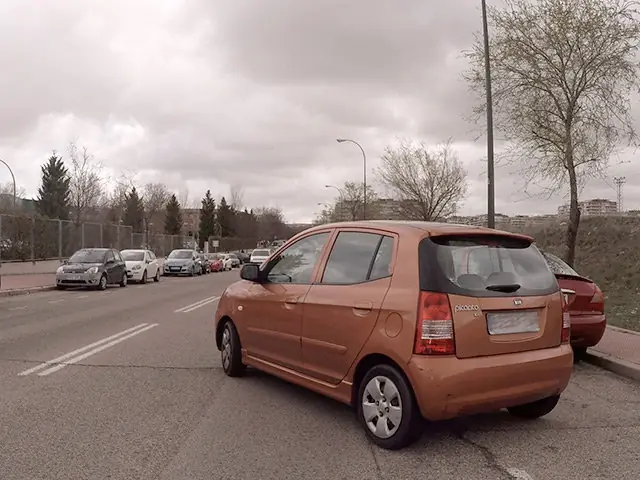
La intención de efectuar una maniobra debe indicarse...
The intention to carry out a manoeuvre must be signalled...
- Acon las señales luminosas y, en su defecto, con el brazo.with the vehicle's light signals and, failing that, with the arm.
- Bsiempre con el brazo.always with the arm.
- Csiempre con las señales luminosas.always with the vehicle's light signals.
ExplanationUnder Article 108.2 of the General Traffic Regulations (RGC), as a general rule manoeuvres are signalled with the vehicle's light signals or, failing that, with the arm. If the two contradict each other, the arm signal prevails.
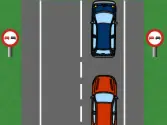
¿Puede adelantar a partir de la señal vertical?
May you overtake after the road sign?
- ANo, porque está prohibido.No, because it is prohibited.
- BSí, por la parte izquierda de la calzada.Yes, on the left-hand side of the carriageway.
- CSí, por el arcén derecho.Yes, on the right-hand hard shoulder.
ExplanationThe sign in the question prohibits all vehicles from overtaking motor vehicles travelling on the carriageway when this means entering the part reserved for oncoming traffic. The ban applies from where the sign is placed until the next «End of no overtaking» or «End of all prohibitions» sign. When placed where overtaking is already prohibited by the rules, it is a general reminder that this manoeuvre is prohibited. In the picture, besides the road sign, there is a continuous longitudinal line in the centre of the carriageway. This line prohibits drivers from crossing it or driving on it. Therefore, overtaking is prohibited.
Si circulamos por una vía urbana en una vía de 3 carriles delimitados por líneas discontinuas para nuestro sentido, podremos utilizar el carril…
If we are driving on an urban road with 3 lanes in our direction marked out by broken lines, we may use the lane…
- Amás cercano a la calzadaclosest to the carriageway.
- Bque más convenga a nuestro destinothat best suits our destination.
- Cel de la derechaon the right.
ExplanationIn built-up areas, on carriageways with at least two lanes in each direction marked out by longitudinal lines, you may use the lane that best suits your destination, as long as you do not obstruct others (Article 33 of the RGC). There is no obligation to use the right-hand lane.
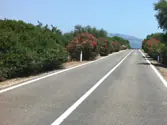
Por la izquierda de una línea continua, ¿se puede circular?
May you drive to the left of a continuous line?
- ANo, en ningún caso.No, never.
- BSí, para adelantar.Yes, to overtake.
- CSí, si la vía es de sentido único.Yes, if the road is one-way.
ExplanationA continuous longitudinal line means that no driver may cross it or drive on it, nor, when it separates the two directions of traffic, drive to its left. If the road is one-way, you may drive to its left, but without crossing it to change lanes.
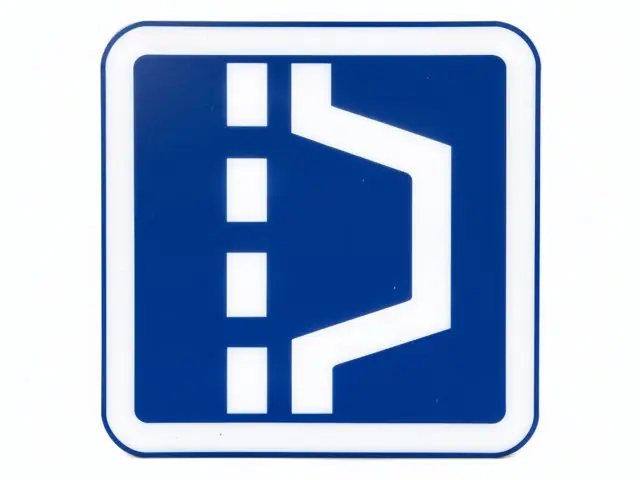
Esta señal indica dónde está...
This sign shows where there is...
- Aun lugar de interés paisajístico.a place of scenic interest.
- Bun apartadero, donde apartar el vehículo en caso de emergencia.a lay-by, where you can pull over in an emergency.
- Cun lugar desde el que se puede realizar un cambio de sentido.a place where you can make a U-turn.
ExplanationThis is sign S-34, lay-by: it shows a place where you can pull the vehicle over in an emergency to leave the way clear. In tunnels, a lay-by that also has an emergency telephone is signed with S-34a.
¿Para qué sirven las guías sonoras situadas en el borde derecho de la calzada, normalmente en el arcén junto a la marca que delimita el carril derecho?
What are rumble strips on the right-hand edge of the carriageway for, usually on the hard shoulder next to the marking of the right-hand lane?
- ASeñalar el borde de la calzada, especialmente en condiciones de baja visibilidad.To mark the edge of the carriageway, especially in poor visibility.
- BAvisar al conductor si se sale de su carril.To warn the driver if they leave their lane.
- CIndicar la existencia de un carril especial o reservado para determinados vehículos.To show that there is a special lane or a lane reserved for certain vehicles.
ExplanationAccording to Annex I of the General Traffic Regulations (RGC), longitudinal rumble strips are small grooves in the road surface or raised ridges on the road marking that produce vibration or noise when driven over, to warn the driver that they are unintentionally drifting off course.
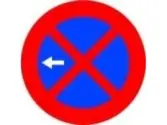
¿Está permitido parar a la vista de la señal en el sentido que indica la flecha?
Is stopping allowed, when you see this sign, in the direction shown by the arrow?
- ASí, solamente prohíbe el estacionamiento en el sentido de la flecha.Yes, it only prohibits parking in the direction of the arrow.
- BNo, se prohíbe tanto la parada como el estacionamiento.No, both stopping and parking are prohibited.
- CSí, porque esta señal no hace referencia a la parada.Yes, because this sign does not refer to stopping.
ExplanationStopping and parking are prohibited on the side of the carriageway where the sign is placed, on the stretch between the sign and the junction or the nearest R-307b sign in the direction shown by the sign.
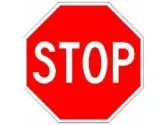
Si una vez efectuada la detención para cumplir con una señal de STOP observamos que la visibilidad no es suficiente, ¿cómo actuaremos?
If, after stopping to obey a STOP sign, you see that visibility is not enough, what should you do?
- ANos asomaremos con mucha precaución y, si no se acercan vehículos por la vía transversal, continuaremos la marcha sin volver a detenernos.Edge forward very carefully and, if no vehicles are coming on the crossing road, continue without stopping again.
- BContinuaremos hasta tener visibilidad suficiente sobre la vía transversal y nos detendremos de nuevo.Move forward until you have enough visibility of the crossing road and stop again.
- CContinuaremos sin necesidad de detenernos ya que lo hemos hecho anteriormente.Continue without having to stop, because you have already stopped.
ExplanationIf there is not enough visibility from the place where you stopped, the driver must stop again where there is visibility, so they will have made two compulsory stops.
Una línea longitudinal continua en el centro de la calzada indica…
A continuous longitudinal line in the centre of the carriageway indicates…
- AProhibido cambiar de carrilNo changing lanes
- BProhibido adelantar o invadir el sentido contrarioNo overtaking or moving into the opposite direction of traffic
- CCarril reversibleA reversible lane
ExplanationA continuous line must not be crossed and you must not drive to the left of it, so you cannot overtake by moving into the opposite lane.
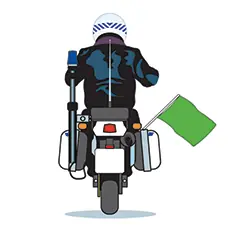
Un agente circula en una moto portando una bandera verde; ¿qué indica?
A traffic officer on a motorcycle is carrying a green flag. What does it mean?
- ALa calzada está abierta, pero hay que extremar la atención.The carriageway is open, but you must pay extra attention.
- BLa calzada queda de nuevo abierta al tráfico a partir de su paso.The carriageway is open to traffic again once the officer has passed.
- CSe está desarrollando en la calzada una actividad deportiva.A sporting event is taking place on the carriageway.
ExplanationA green flag carried by a traffic officer or a vehicle means that, once it has passed, the carriageway is open to traffic again. A red flag means the carriageway is closed, and a yellow flag means you must pay extra attention or that there is a danger ahead.
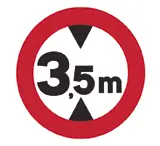
¿Qué indica la señal?
What does the sign indicate?
- AProhibido el paso a vehículos con altura (incluida la carga) mayor a 3,5 metros.No entry for vehicles more than 3.5 metres high (including the load).
- BObliga a circular por el arcén a los vehículos con altura superior a 3,5 metros.Vehicles more than 3.5 metres high must drive on the hard shoulder.
- CVía obligatoria para vehículos con altura igual o mayor a 3,5 metros.Compulsory route for vehicles 3.5 metres high or more.
ExplanationThis sign prohibits entry to vehicles whose total height, including the load, exceeds the figure shown, in this case 3.5 metres. It is a prohibition sign, round with a red border, and it does not require you to use the hard shoulder or indicate a reserved road.
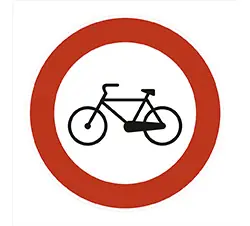
Esta señal prohíbe la entrada a...
This sign prohibits entry to...
- Aciclos y ciclomotores.cycles and mopeds.
- Bciclos.cycles.
- Ctodos los vehículos de dos ruedas.all two-wheeled vehicles.
ExplanationThe round sign with a red border and a bicycle prohibits entry to cycles. If the symbol were a moped, the ban would apply to mopeds, and if it were a motorcycle, to motorcycles; this sign does not affect other two-wheeled vehicles.
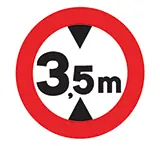
¿A qué vehículos prohíbe pasar esta señal?
Which vehicles does this sign prohibit from passing?
- AA los vehículos que tienen más de 3,5 metros de anchura.Vehicles more than 3.5 metres wide.
- BA los vehículos que tienen más de 3.500 kilogramos de peso.Vehicles weighing more than 3,500 kilograms.
- CA los vehículos que tienen más de 3,5 metros de altura.Vehicles more than 3.5 metres high.
ExplanationThis is the height limit sign: the triangles pointing at the figure from above and below indicate vertical clearance. It prohibits vehicles whose height, including the load, exceeds 3.5 metres.
¿Qué debe hacer el conductor ante un agente que se encuentra de espaldas y tiene el brazo derecho levantado verticalmente?
What must a driver do when a traffic officer has their back to them and their right arm raised vertically?
- ADetenerse.Stop.
- BReducir la velocidad y ceder el paso.Reduce speed and give way.
- CContinuar la marcha con precaución.Continue with caution.
ExplanationAn arm raised vertically requires all road users approaching the officer to stop, whether they see the officer from the front or from behind, except drivers who cannot do so safely enough or who have already entered the junction.
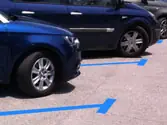
¿Qué indican las marcas azules de estacionamiento?
What do blue parking markings indicate?
- AQue en ciertos periodos del día la duración del estacionamiento está limitada.That at certain times of day the length of parking is limited.
- BQue el estacionamiento está reservado solamente a turismos.That parking is reserved only for cars.
- CIndican lo mismo que las de color blanco.They mean the same as white ones.
ExplanationBlue markings mark out parking places where, at certain times of day, the length of stay may be limited.
¿Cómo actuaremos al encontrar un semáforo rojo a la entrada de un túnel?
What should you do on finding a red traffic light at the entrance to a tunnel?
- APasaremos extremando la precaución.Go through, taking extra care.
- BNos detendremos y esperaremos a que se apague o cambie a verde o amarillo intermitente.Stop and wait until it goes off or changes to green or flashing amber.
- CPasaremos cediendo el paso a la derecha y la izquierda.Go through, giving way to the right and the left.
ExplanationAt a red traffic light, wherever it is, you stop and wait until it is no longer red before continuing.
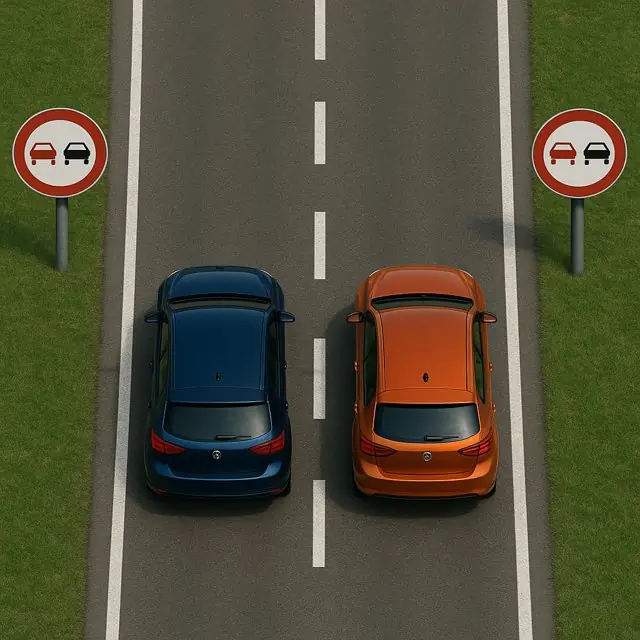
¿Se puede adelantar a partir de la señal vertical?
May you overtake after the road sign?
- ANo, está prohibido.No, it is prohibited.
- BSí, por la izquierda de la calzada.Yes, on the left of the carriageway.
- CSí, por el arcén derecho.Yes, on the right-hand hard shoulder.
ExplanationSign R-305 prohibits all vehicles from overtaking motor vehicles on the carriageway when the manoeuvre involves moving into the area for the opposite direction. It applies from the sign until the end-of-no-overtaking sign or the end-of-all-restrictions sign.
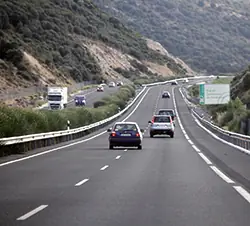
La línea de borde de la calzada es discontinua; ¿está permitido estacionar en la parte transitable del arcén?
The edge line of the carriageway is broken. Is parking allowed on the usable part of the hard shoulder?
- ASí, porque la línea es discontinua.Yes, because the line is broken.
- BNo, está prohibido.No, it is prohibited.
- CSolo para cargar o descargar mercancías.Only to load or unload goods.
ExplanationOutside built-up areas, stopping and parking must be done off the carriageway, leaving the usable part of the hard shoulder clear. A broken edge line only allows you to enter or leave the carriageway; it does not allow you to park on the hard shoulder, not even to load or unload.
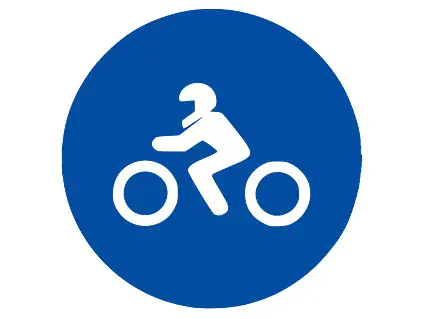
Si conducimos una motocicleta sin sidecar, ¿estamos obligados a circular por la calzada si en su entrada está situada la señal de la imagen?
If we are riding a motorcycle without a sidecar, must we use a carriageway that has the sign in the picture at its entrance?
- ANo.No.
- BSí, pero sólo si la motocicleta tiene una cilindrada no superior a 125 cm³.Yes, but only if the motorcycle's engine capacity is no more than 125 cm³.
- CSí.Yes.
ExplanationSign R-405 “Carriageway compulsory for two-wheeled motorcycles” requires two-wheeled motorcycles, and three-wheeled vehicles treated as motorcycles, to use the carriageway at whose entrance it is placed, whatever their engine capacity.
¿Se puede, en alguna situación, conducir por el lado izquierdo de una línea continua?
Is it ever possible to drive on the left-hand side of a solid line?
- ANo, en ningún caso.No, never.
- BSí, si la vía es de sentido único.Yes, if the road is one-way.
- CSí, cuando el tráfico sea escaso.Yes, when there is little traffic.
ExplanationUnder the road-marking catalogue in Annex I of the RGC, a solid line must not be crossed, and driving to its left is prohibited when it separates the two directions of traffic. On a one-way road that ban does not exist, so you may drive to its left, without crossing it.
All topics
- Definitions
- Documents and penalty points
- The driver's condition
- Duties of drivers and pedestrians
- Vehicle safety devices
- Vehicle controls and equipment
- Vehicle lights and horn
- The road and its lanes
- Speed and distances
- Manoeuvres
- Right of way
- Carrying passengers and loads
- Driving safely in difficult conditions
- Vehicle mechanics and maintenance
- Road accidents and first aid
- Defensive and eco-driving
Independent app: not affiliated with or endorsed by the DGT (Spain's Directorate-General for Traffic) or the Ministry of the Interior. The official exam is booked with the DGT and taken at its test centres. The questions here are practice material; the DGT's official question bank is not public.
Basado en datos de la Agencia Estatal Boletín Oficial del Estado (https://www.boe.es). Textos consolidados de carácter meramente informativo. La AEBOE no patrocina ni respalda este sitio.
Parte de las preguntas procede de los tests de la revista «Tráfico y Seguridad Vial» de la DGT, reproducidos con indicación de la fuente.