
DGT test · 1,397 questions
Traffic signs, markings and signals · Page 23 of 28
Road signs, road markings, traffic lights, police signals and temporary markings: what they mean and which one wins when they disagree. The topic with the most questions in the bank.
Questions in this topic, with answers
1,397 questions, 50 per page, with the correct answer and the explanation. Page 23 of 28.
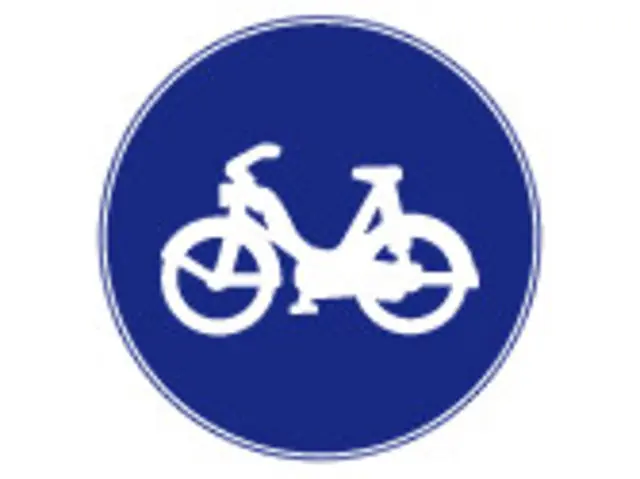
¿Puede una motocicleta circular por la vía señalizada con esta señal?
Can a motorcycle use the road marked with this sign?
- ASí, porque la vía está reservada a vehículos de dos ruedas con motor.Yes, because the road is reserved for motorised two-wheelers.
- BNo, porque la vía está reservada exclusivamente a ciclomotores.No, because the road is reserved only for mopeds.
- CSí, si la motocicleta no lleva sidecar.Yes, if the motorcycle does not have a sidecar.
ExplanationThe sign in the picture, round and blue with a moped symbol, indicates a road reserved for mopeds: it requires moped riders to use it and prohibits all other vehicles from using it, including motorcycles, with or without a sidecar.
La señal afecta a...
The sign applies to...
- Atodos los vehículos cuya masa máxima en carga supere la indicada.all vehicles whose maximum laden mass exceeds the figure shown.
- Blos vehículos de transporte de mercancías, exclusivamente.goods vehicles only.
- Clos vehículos automóviles, exclusivamente.motor cars only.
ExplanationSign R-201 'Mass limit' prohibits the passage of all vehicles whose laden mass, that is, what they weigh at that moment, exceeds the figure shown in tonnes. It must not be confused with R-107, which applies only to goods vehicles according to their maximum authorised mass, even if they are travelling empty.
Salvo circunstancias especiales, todos los usuarios de la vía deben respetar las señales de tráfico...
Except in special circumstances, all road users must obey traffic signs...
- Aincluso cuando parecen contradecir las normas.even when they seem to contradict the rules.
- Bincluso si no están colocadas en la vía por la que circulan.even if they are not placed on the road they are using.
- Csólo cuando no contradicen la norma.only when they do not contradict the rules.
ExplanationUnder Article 132 of the RGC, all road users must obey traffic signs even if they seem to contradict other rules. This is essential for road safety, as signs are designed to regulate the flow of traffic and prevent accidents. The duty to obey signs has a leading place in traffic law, ensuring that the instructions of traffic officers and the various signs are respected at all times.
Si el conductor del vehículo que nos precede señaliza mediante el indicador de dirección que pretende girar a la izquierda pero con el brazo indica que quiere girar a la derecha, ¿a qué señalización atenderemos?
If the driver of the vehicle in front shows with the indicator that they want to turn left but shows with their arm that they want to turn right, which signal should you follow?
- AAl indicador de dirección.The indicator.
- BAl brazo.The arm.
- CA la que se haya efectuado en primer lugar.Whichever was given first.
ExplanationIf an arm signal and an indicator signal contradict each other, the signal given directly by the driver with their arm takes precedence, as long as it is visible.
¿Qué deben hacer los conductores que se acerquen a un agente de circulación que tiene levantado el brazo verticalmente?
What must drivers do when approaching a traffic officer who has one arm raised vertically?
- ADetenerse, salvo que ya hayan entrado en la intersección.Stop, unless they have already entered the junction.
- BDisminuir la velocidad y circular con mucha precaución.Slow down and drive with great care.
- CSeguir circulando si en la intersección no van a seguir de frente.Carry on if they are not going straight on at the junction.
ExplanationDrivers must stop when approaching a traffic officer who has one arm raised vertically, unless they have already entered the junction. This is because this signal requires all road users approaching the officer to stop, either before the nearest stop line or before entering the junction.
¿Podemos estacionar un ciclomotor en una zona de la calzada con una marca amarilla en zigzag pintada?
May we park a moped in an area of the carriageway with a yellow zigzag marking painted on it?
- ASí.Yes.
- BSí, porque esa marca solo prohíbe la parada.Yes, because that marking only prohibits stopping.
- CNo.No.
ExplanationNo, you may not park a moped in an area of the carriageway with a yellow zigzag marking. The yellow zigzag marking means that parking is prohibited, although stopping is allowed.
En un turismo, ¿dónde se coloca la señal de conductor novel?
On a car, where is the novice driver sign placed?
- AEn la parte posterior derecha.On the rear right-hand side.
- BEn la parte posterior izquierda.On the rear left-hand side.
- CDonde se crea conveniente.Wherever the driver thinks best.
ExplanationThe novice driver 'L' sign must be placed on the rear left-hand side, without reducing the driver's visibility.
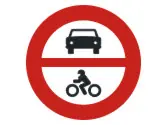
Esta señal, situada a la entrada de una vía, prohíbe el acceso exclusivamente a ...
This sign, placed at the entrance to a road, prohibits access only to...
- Alos turismos y motocicletas de dos ruedas sin sidecar.cars and two-wheeled motorcycles without a sidecar.
- Blos turismos y vehículos de dos ruedas, incluidos los ciclos.cars and two-wheeled vehicles, including cycles.
- Clos vehículos de motor.motor vehicles.
ExplanationThe sign shown in the picture, 'No entry for motor vehicles', prohibits access to motor vehicles (motor cars and special vehicles).
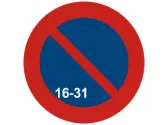
Si hoy es día 20, ¿podremos parar a partir de esta señal?
If today is the 20th, may you stop after this sign?
- ASí.Yes.
- BNo, porque estamos en la segunda quincena del mes.No, because it is the second half of the month.
- CNo.No.
ExplanationThis sign prohibits parking in the second half of the month, from 9:00 on the 16th until 9:00 on the 1st. The 20th is in the second half of the month, so parking would be prohibited. The question asks whether stopping is prohibited, so the correct answer is yes, you may stop, because the sign does not prohibit stopping, only parking.
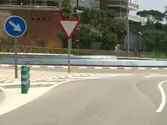
A la vista de la señalización que se muestra en la imagen, ¿tiene permitido realizar un cambio de dirección?
Given the signs shown in the picture, are you allowed to turn?
- ANo, está prohibido.No, it is prohibited.
- BSí, el cambio de dirección está permitido.Yes, turning is allowed.
- CSí, pero únicamente si el cambio de dirección es a la derecha.Yes, but only if you are turning right.
ExplanationThis is a compulsory passing side sign (R-401a): the arrow shows the side of the refuge, traffic island or obstacle on which vehicles must pass. It only regulates which way to go round the obstacle; it does not prohibit turning.
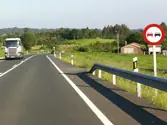
Como norma general las señales se aplican...
As a general rule, signs apply...
- Aa toda la vía.to the whole road.
- Bsólo al carril derecho.only to the right lane.
- Ca toda la anchura de la calzada.to the whole width of the carriageway.
ExplanationEvery sign applies to the whole width of the carriageway that the drivers it is aimed at are allowed to use. However, its application may be limited to one or more lanes by markings on the carriageway.
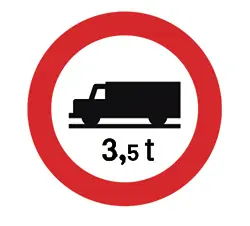
¿A qué vehículos de transporte de mercancías prohíbe pasar esta señal?
Which goods vehicles does this sign prohibit from entering?
- AA los de más de 3.500 kg. de M.M.A., solo cuando llevan carga.Those with a MAM of more than 3,500 kg, only when they are loaded.
- BA los de menos de 3.500 kg. de M.M.A.Those with a MAM of less than 3,500 kg.
- CA los de más de 3.500 kg. de M.M.A., con carga o sin carga.Those with a MAM of more than 3,500 kg, loaded or unloaded.
ExplanationThe sign prohibits entry to goods vehicles whose MAM exceeds 3,500 kg. The MAM is a fixed technical figure for the vehicle, so the ban applies whether it is loaded or empty.
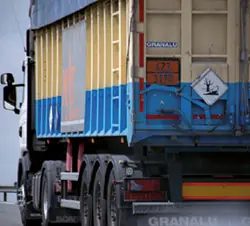
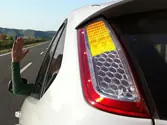
¿Qué indica la señal colocada en la parte trasera del vehículo compuesta por una lámina reflectante de color amarillo rodeada de una lámina fluorescente de color rojo?
What does the sign on the rear of the vehicle, made of a yellow reflective sheet surrounded by a red fluorescent sheet, indicate?
- AQue el vehículo o el conjunto de vehículos tiene una longitud superior a 12 metros.That the vehicle or combination of vehicles is more than 12 metres long.
- BQue el vehículo transporta mercancías peligrosas.That the vehicle is carrying dangerous goods.
- CQue el vehículo no podrá circular a una velocidad superior a 90 km/h.That the vehicle may not travel faster than 90 km/h.
ExplanationThe yellow reflective plate with a fluorescent red border is the V-6 long vehicle sign: it identifies vehicles or combinations longer than 12 metres, which take more space and time to overtake.
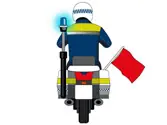
¿Qué indica el agente desde el vehículo?
What is the officer in the vehicle indicating?
- ACalzada temporalmente cerrada al tráfico.Carriageway temporarily closed to traffic.
- BCircular extremando la precaución.Drive taking extreme care.
- CQue el usuario al que se dirige la señal está obligado a detenerse en el lado derecho.That the road user the signal is aimed at must stop on the right-hand side.
ExplanationA red flag shows that, once the vehicle carrying it has passed, the carriageway is temporarily closed to all vehicles and road users, except those accompanied or escorted by officers of the authority responsible for regulating, managing and controlling traffic. A yellow flag tells other drivers and road users that they must take extreme care or that a danger is near. This flag may also be used by authorised auxiliary staff who carry out order, control or safety duties during cycling events or any other activity, sporting or not, on roads covered by traffic law. A green flag shows that, once the vehicle carrying it has passed, the carriageway is open to traffic again.
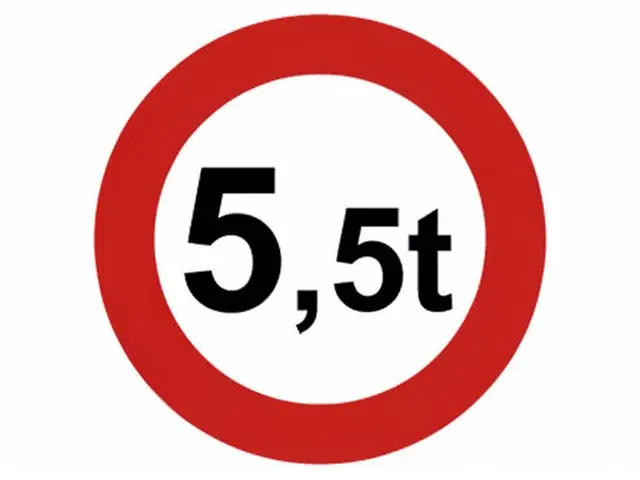
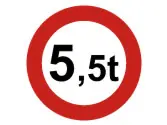
¿A qué vehículos afecta la señal?
Which vehicles does the sign apply to?
- Aa todos los vehículos cuya masa en carga supere la indicada.all vehicles whose laden mass exceeds the one shown.
- Bsolo a los vehículos destinados al transporte de mercancías.only goods vehicles.
- Csolo a los turismos.only cars.
ExplanationThe sign in the picture, round with a red border and the figure 5.5 t, limits mass: it prohibits the passage of all vehicles whose laden mass exceeds the one shown, whatever type they are. The sign that applies only to goods vehicles shows a lorry next to the figure.
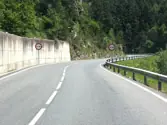
Esta carretera tiene más de 6 m de ancho. ¿Es correcto circular por encima de las líneas que separan los carriles?
This road is more than 6 m wide. Is it correct to drive on the lines separating the lanes?
- ANo, porque debo circular dentro de mi carril.No, because I must drive within my lane.
- BSí, porque hay dos carriles.Yes, because there are two lanes.
- CSí, cuando no vienen vehículos en sentido contrario.Yes, when no vehicles are coming in the opposite direction.
ExplanationAccording to the road-marking catalogue, no driver may drive on a broken lane-separation line except when, because of the width of the lanes, it is necessary and safety allows it. On a carriageway more than 6 m wide with two lanes this is not the case, so you must stay within the lane.
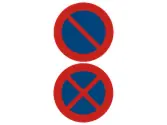
¿Que señal debe obedecer?
Which sign must you obey?
- ALa que prohíbe estacionar, por ser la más restrictiva.The one that prohibits parking, because it is the most restrictive.
- BLa que prohíbe parar y estacionar, por ser más restrictiva.The one that prohibits stopping and parking, because it is more restrictive.
- CLa que prohíbe estacionar, por ser la menos restrictiva.The one that prohibits parking, because it is the least restrictive.
ExplanationWhen there are two signs of the same group, in this case road signs, that contradict each other, we always obey the more restrictive one. In the case shown in the picture, we must obey the no stopping and no parking sign, as it is more restrictive than the no parking sign.
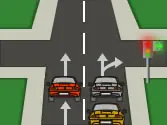
El semáforo está en rojo y la flecha verde encendida, ¿qué hará el vehículo gris que pretende seguir de frente si el vehículo amarillo que le sigue quiere cambiar de dirección a la derecha?
The traffic light is red and the green arrow is lit. What will the grey vehicle, which wants to go straight on, do if the yellow vehicle behind it wants to turn right?
- AEsperar a que el semáforo principal cambie a verde.Wait for the main traffic light to turn green.
- BPodrá seguir de frente en este momento ya que lo permiten las marcas viales.It may go straight on now, because the road markings allow it.
- CDeberá cambiar de dirección a la derecha porque entorpece al vehículo que le sigue.It must turn right, because it is holding up the vehicle behind it.
ExplanationAccording to Annex I of the RGC (section 4.2), any vehicle which, when the green arrow comes on, is in the lane that must be used by those going in the direction of the arrow must move off in that direction. As the yellow vehicle wants to turn right, the grey one is also obliged to turn.
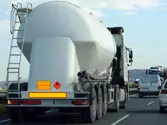
A la vista de la señalización del vehículo, deberá saber que se trata de un vehículo…
Given the markings on the vehicle, you should know that it is a vehicle...
- AQue transporta mercancías peligrosas y que mide más de 12 metros.that carries dangerous goods and is more than 12 metres long.
- BQue transporta productos alimenticios.that carries food products.
- CQue su peso y dimensiones son mayores que los normales.whose weight and dimensions are greater than normal.
ExplanationAll vehicles and combinations of vehicles longer than 12 metres must carry at the rear, centred on the vehicle's axis, a rectangular plate (V-6) with a reflective yellow background and a fluorescent red border. We can also see that the lorry carries the V-11 plate, which shows that it is carrying dangerous goods. This plate may have numbers showing the type of danger in its upper half and the goods being carried in its lower half.
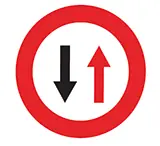
A la vista de la señal, ¿es obligatorio detenerse para dejar pasar a un vehículo que circula en sentido contrario?
Given this sign, must you stop to let a vehicle coming from the opposite direction go past?
- ANo, porque la señal otorga prioridad de paso.No, because the sign gives right of way.
- BNo, porque la señal no afecta a la prioridad de paso.No, because the sign does not affect right of way.
- CSí, mientras no se pueda continuar la marcha sin obligar a detenerse a los vehículos que circulen en sentido contrario.Yes, as long as you cannot continue without making vehicles coming from the opposite direction stop.
ExplanationThis is the 'priority to oncoming traffic' sign: it requires you to give way at the narrowing and to stop if necessary, as long as you cannot pass without making oncoming vehicles stop.
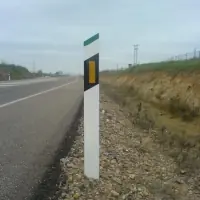
¿Cuál de éstos no es un dispositivo de guía?
Which of these is not a guidance device?
- ABalizas cilíndricasCylindrical markers.
- BHitos de aristaEdge marker posts.
- CHitos de circulaciónTraffic marker posts.
ExplanationAccording to Annex I of the General Traffic Regulations (RGC), guidance devices include, among others, apex and edge marker posts, permanent chevron boards, reflective road studs and cylindrical markers. ‘Traffic marker posts’ do not exist as a guidance device.
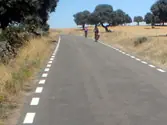
Una línea discontinua en el borde de la calzada...
A broken line at the edge of the carriageway...
- APermite parar pero no estacionar.Allows stopping but not parking.
- BPermite circular por el arcén.Allows driving on the hard shoulder.
- CEsta delimitando, para hacerlo más visible, el borde de la calzada.Marks the edge of the carriageway, to make it more visible.
ExplanationThe edge line of the carriageway can be broken or continuous, and it shows exactly where the carriageway ends, to make it more visible.
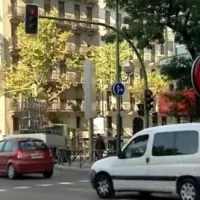
En un cruce, ¿Dónde deberás detener tu vehículo si el semáforo está en rojo?
At a junction, where must you stop your vehicle if the traffic light is red?
- AEn el cruce de las dos vías sin respetar el semáforo.In the junction of the two roads, ignoring the traffic light.
- BAntes de la línea de detención del semáforo, y si no la hubiera, a la altura del semáforo, siempre sin superarlo.Before the stop line for the traffic light or, if there is none, level with the traffic light, without ever passing it.
- C10 metros después de haber pasado el semáforo.10 metres after passing the traffic light.
ExplanationA steady red light on a traffic light for vehicles prohibits all vehicles from passing while it is lit. Vehicles must stop before the stop line without crossing it and, if there is no such line, level with the traffic light, without ever passing its position.
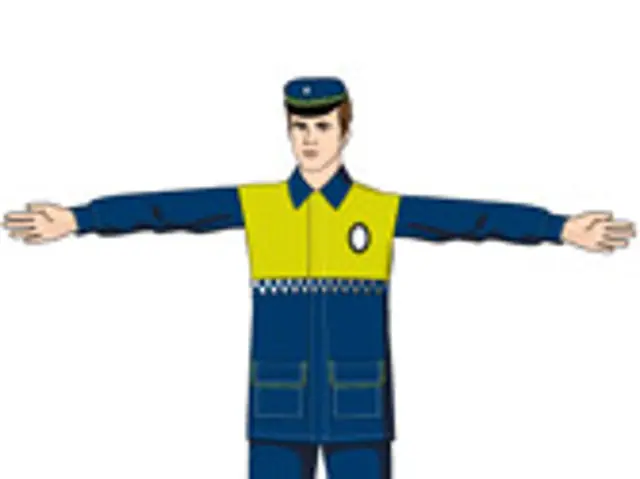
Al ver la señal del agente, ¿cuándo puede reanudar la marcha?
After seeing the officer's signal, when may you move off again?
- ACuando baje los brazos.When the officer lowers their arms.
- BSolo cuando lo indique con otra señal.Only when the officer indicates it with another signal.
- CSolo cuando cambie de posición o haga otra señal.Only when the officer changes position or makes another signal.
ExplanationUnder section 1.1 of Annex I of the General Traffic Regulations, the signal given with arms stretched out horizontally stays in force even if the officer lowers their arms, as long as they do not change position or make another signal. Only then may you move off again.
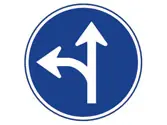
¿Podré cambiar de sentido a la vista de esta señal?
May I make a U-turn when I see this sign?
- ASí.Yes.
- BNo.No.
- CSí, pero solo en la intersección siguiente.Yes, but only at the next junction.
ExplanationThis sign shows us the only directions allowed, so it would only be possible to go straight ahead or turn left; making a U-turn is prohibited.
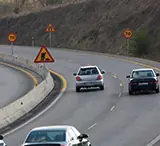
Las señales de obras...
Roadworks signs...
- Aestablecen para los tramos de obras una reducción de la velocidad máxima en 10 km/h.set a maximum speed 10 km/h lower on stretches with roadworks.
- Btienen distinto símbolo y tamaño que las usadas en tramos sin obras.have a different symbol and size from those used on stretches without roadworks.
- Ctienen el mismo significado que las usadas en tramos sin obras.have the same meaning as those used on stretches without roadworks.
ExplanationRoadworks signs only change the background, which is yellow to warn of the temporary situation; their symbol and meaning are identical to those of the signs used on stretches without roadworks, and they are just as binding.
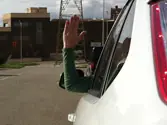
Un conductor mostrando su brazo izquierdo doblado hacia arriba con la palma de la mano extendida, ¿qué indica?
What does a driver showing their left arm bent upwards with the palm open indicate?
- AQue el vehículo se va a desplazar a la izquierda.That the vehicle is going to move to the left.
- BQue el vehículo se va a desplazar a la derecha.That the vehicle is going to move to the right.
- CQue el vehículo va a efectuar una detención.That the vehicle is going to stop.
ExplanationA driver showing their left arm bent upwards with the palm open is showing that their vehicle is going to move to the right. To show a move to the left, the driver holds the arm out horizontally with the palm facing down.

¿Podrán las patrullas escolares detener el paso de vehículos mediante señales verticales?
May school patrols stop vehicles by using road signs?
- AÚnicamente en caminos ruralesOnly on rural tracks
- BNoNo
- CSíYes
ExplanationUnder Article 141.4 of the General Traffic Regulations (RGC), school patrols may use signs from the official Catalogue mounted on a hand-held paddle to ask road users to stop. Drivers must follow this instruction.
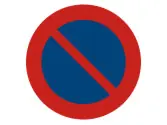
A partir de esta señal, ¿podemos realizar una parada?
From this sign onwards, may we stop?
- ANo.No.
- BSí.Yes.
- CSí, solo si es por necesidades de la circulación.Yes, but only if traffic conditions require it.
ExplanationThis sign prohibits parking from the point where the sign stands up to the nearest junction. It does not prohibit stopping.
El semáforo está en verde y un agente le pide que se detenga. ¿Qué debe hacer?
The traffic light is green and a traffic officer tells you to stop. What must you do?
- ADetenerse, porque la señal del agente tiene prioridad.Stop, because the officer's signal takes priority.
- BSeguir, porque el semáforo lo permite.Carry on, because the traffic light allows it.
- CContinuar la marcha, pero deberá ceder el paso a otros vehículos.Carry on, but give way to other vehicles.
ExplanationWhen a police officer orders you to stop, their signal takes priority over any traffic signal, including the traffic light. This is set out in the General Traffic Regulations, which recognise the officer's authority to direct traffic and keep the roads safe. So even though the light is green, the driver must stop when the officer signals.
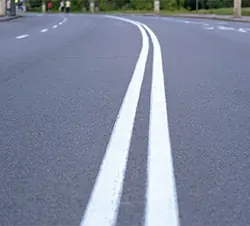
En el centro de la calzada hay doble línea continua; ¿qué indica?
There is a double solid line in the centre of the carriageway. What does it indicate?
- AQue la calzada es peligrosa.That the carriageway is dangerous.
- BQue hay un carril especial.That there is a special lane.
- CQue no se puede atravesar, ni pisar la línea.That you must not cross the line or drive on it.
ExplanationA double solid line works like an imaginary wall: you must not cross it or drive on it, in either direction, so it prevents overtaking and turning across it.
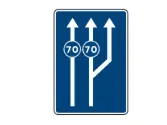
A la vista de la señal, ¿puede circular un turismo a más de 70 km/h por el carril de la derecha?
Given the sign, may a car drive faster than 70 km/h in the right lane?
- ANo, porque el carril derecho es para circulación lenta.No, because the right lane is for slow traffic.
- BSí, porque debo circular por la derecha siempre que sea posible.Yes, because I must keep to the right whenever possible.
- CSí, porque los carriles de la izquierda son para los vehículos que circulan a menos de 70 km/h.Yes, because the left lanes are for vehicles travelling at less than 70 km/h.
ExplanationThe sign in the question indicates that the lane or lanes above which the minimum speed sign is placed may only be used by vehicles travelling at or above the speed shown, but if circumstances allow, they must use the right lane.
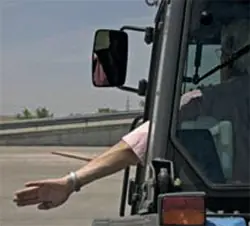
El conductor de un vehículo extiende el brazo horizontalmente con la palma de la mano hacia atrás, ¿qué indica?
The driver of a vehicle stretches their arm out horizontally with the palm of the hand facing backwards. What does this indicate?
- AQue va a girar a la izquierda.That they are going to turn left.
- BQue va a circular marcha atrás.That they are going to reverse.
- CQue tiene intención de inmovilizar el vehículo o de frenar su marcha de modo considerable.That they intend to stop the vehicle or slow down considerably.
ExplanationAn arm stretched out horizontally with the palm facing backwards is the visual signal warning of the intention to reverse. To signal braking, on the other hand, the arm is moved up and down repeatedly.
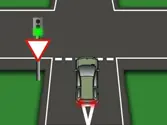
El vehículo de la fotografía, ¿puede continuar la marcha?
Can the vehicle in the photograph carry on?
- ANo, porque debe ceder el paso.No, because it must give way.
- BSí, pero sólo cuando no hay vehículos cerca.Yes, but only when there are no vehicles nearby.
- CSí, porque el semáforo está verde.Yes, because the traffic light is green.
ExplanationWhere the instructions given by different signs appear to contradict each other, the order of priority is as follows: signals and orders from traffic officers; temporary signs that change the normal use of the road, and fixed markers (beacons); traffic lights; road signs; road markings. Therefore the traffic light takes priority over the give way sign and the give way road marking.
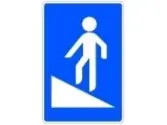
¿Qué indica la señal que se muestra?
What does the sign shown indicate?
- APaso superior para peatones con rampa.Pedestrian footbridge with a ramp.
- BPaso superior para peatones con escalera.Pedestrian footbridge with stairs.
- CPaso de peatones inferior.Pedestrian underpass.
ExplanationThe sign shows where there is a pedestrian footbridge fitted with a ramp, so that the road can be crossed safely without steps.
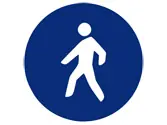
Un peatón a la vista de esta señal...
A pedestrian seeing this sign...
- ATendrá la obligación de transitar por el camino así señalizado.Must walk on the path signed like this.
- BTendrá la prohibición de transitar por el camino así señalizado.Is prohibited from walking on the path signed like this.
- CTendrá la recomendación de usar el camino así señalizado.Is advised to use the path signed like this.
ExplanationThe sign in the question requires pedestrians to walk on the path at whose entrance it stands and prohibits all other road users from using that path.
¿Por qué motivo debe un conductor fijarse si los semáforos de una intersección disponen de luces con flechas adicionales?
Why should a driver check whether the traffic lights at a junction have additional arrow lights?
- APara no tener que ceder el paso a los vehículos cuando no sea necesarioSo as not to have to give way to vehicles when it is not necessary
- BPara no ser amonestado por las autoridadesSo as not to be reprimanded by the authorities
- CPara no verse obligado a seguir una dirección que no conviene a su destinoSo as not to be forced to go in a direction that does not suit their destination
ExplanationThe driver should watch these signals in order to anticipate and choose the right lane for their destination. Additional arrows (usually green on a black background) allow you to go in the direction shown. If a driver gets into a lane controlled by one of these arrows and it lights up, they could be forced to turn in that direction (even if they do not want to) if they are blocking other vehicles behind them. So watching for them helps you avoid being forced to go in a direction that does not suit your destination.
Si circulando por una vía urbana pretendemos cambiar de dirección hacia la izquierda y nos encontramos un carril bus delimitado con línea continua, ¿podemos atravesar dicha línea para girar a la izquierda?
If, while driving in a built-up area, you want to turn left and find a bus lane marked out with a continuous line, may you cross that line to turn left?
- ASí, porque quiero cambiar de dirección a la izquierda.Yes, because I want to turn left.
- BSí, si no circula ningún autobús por él.Yes, if no bus is using it.
- CNo.No.
ExplanationTo turn left you must wait until the road marking of the bus lane becomes a broken line. If there is no broken section, you may not turn left.
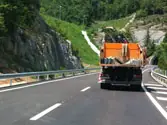
¿Un ciclomotor podrá circular sobre un cebreado?
Can a moped ride over a hatched area (diagonal white stripes)?
- ANo, en ningún caso.No, never.
- BSí, en caso que el cebreado sea continuación del arcén.Yes, if the hatched area is a continuation of the hard shoulder.
- CSolo cuando circule a velocidad anormalmente reducida.Only when it is travelling at an abnormally low speed.
ExplanationVehicles that are required to use the hard shoulder may ride over the hatched area, even if it is framed by a solid line, when it is an extension of the hard shoulder, so that they do not have to use the carriageway.
La luz amarilla intermitente de un semáforo circular para vehículos, ¿prohíbe pasar?
Does a flashing amber light on a circular traffic light for vehicles prohibit you from going?
- ASí, como si se tratar de una luz amarilla fija.Yes, as if it were a steady amber light.
- BNo, porque obliga a los conductores a extremar su precaución y ceder el paso a los vehículos que se aproximen por la vía transversal, cuando sea necesario.No, because it requires drivers to take extreme care and to give way to vehicles approaching on the crossing road when necessary.
- CNo, porque tiene el mismo significado que una luz verde.No, because it has the same meaning as a green light.
ExplanationUnder Annex I of the General Traffic Regulations (RGC), a flashing amber light does not prohibit you from going: it requires you to take extreme care and, where appropriate, to give way, and it does not exempt you from obeying other signs that require you to stop. It is not the same as a steady amber light or a green light.
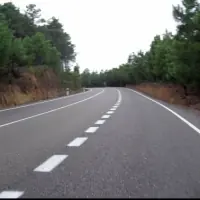
¿Cuál es la finalidad de la marca vial longitudinal discontinua?
What is the purpose of a broken longitudinal road marking?
- AAdvertir que no se puede circular por ese carrilTo warn that you may not drive in that lane
- BDelimitar los diferentes carrilesTo mark out the different lanes
- CAdvertir de que es un carril en obrasTo warn that there are roadworks in the lane
ExplanationUnder the road-marking catalogue (RD 465/2025), a broken longitudinal marking is used to mark out lanes and guide traffic. It may be crossed for permitted manoeuvres, such as changing lanes, but you should not drive on it unless the width of the lanes makes it necessary.
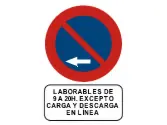
A la vista de la señalización, un miércoles a las 12 del medio día un turismo ...
Given the signs, on a Wednesday at 12 noon a car...
- Asolo puede estacionar para dejar un paquete.may only park to drop off a parcel.
- Bpuede realizar una parada.may stop.
- Cno puede parar ni estacionar.may neither stop nor park.
ExplanationThe sign prohibits parking on working days from 9:00 to 20:00, except for loading and unloading. On a Wednesday at 12:00 a car cannot park, but it can stop, because the no-parking sign does not prohibit stopping: halting for less than two minutes without leaving the vehicle.
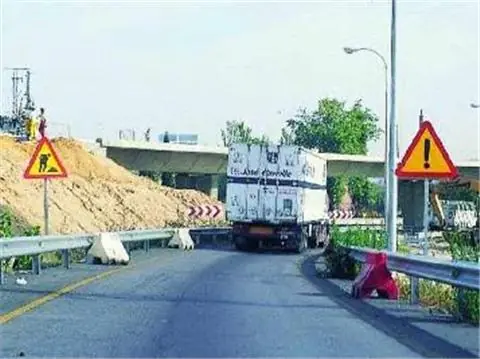
La señal de la derecha indica...
The sign on the right indicates...
- Apeligro por la proximidad de una vía en obras.danger because there are roadworks nearby.
- Bla proximidad de un peligro distinto de los advertidos por otras señales.a hazard nearby other than those warned of by other signs.
- Cpeligro por la proximidad de un estrechamiento de la calzada.danger because the carriageway narrows ahead.
ExplanationThe sign indicates a hazard nearby other than those warned of by other signs. Its yellow background also tells us that the hazard is in a roadworks area.
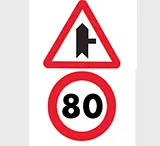
La señal prohíbe circular a más de 80 km/h. ¿Cuándo termina la prohibición?
The sign prohibits driving faster than 80 km/h. When does the prohibition end?
- ADespués de la intersección.After the junction.
- BCuando encuentre una señal de “fin de prohibido adelantar”.When you come to an 'end of no overtaking' sign.
- CInmediatamente antes de la intersección.Immediately before the junction.
ExplanationWhen a speed limit is on the same post as a warning sign, in this case a junction with priority, the limit applies only for as long as that danger lasts. So it ends once you have passed the junction, without any end-of-prohibition sign being needed.
Encuentra estas dos señales, ¿a cuál debe obedecer?
You find these two signs. Which one must you obey?
- AA la que sólo prohíbe estacionar.The one that only prohibits parking.
- BA la que prohíbe parar y estacionar.The one that prohibits stopping and parking.
- CA ninguna por estar en contradicción.Neither, because they contradict each other.
ExplanationWhere the instructions given by different signs appear to contradict each other, the one with priority according to the order of priority prevails or, if the signs are of the same type, the most restrictive one.
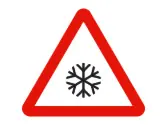
Esta señal advierte del peligro por la presencia de...
This sign warns of danger from the presence of...
- AHielo.Ice.
- BNieve.Snow.
- CHielo o nieve.Ice or snow.
ExplanationThis is sign P-34 'Ice or snow': it warns of a stretch where, in winter, ice or snow is frequently present, with the associated dangers, such as a slippery road surface.
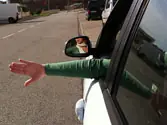
El brazo extendido con la palma de la mano hacia atrás indica...
An arm held out with the palm of the hand facing backwards indicates...
- AQue va a girar a la derecha.That the driver is going to turn right.
- BQue va a girar a la izquierda.That the driver is going to turn left.
- CQue va a realizar una marcha hacia atrás.That the driver is going to reverse.
ExplanationAn arm held out with the palm of the hand facing backwards indicates that the driver is going to reverse.
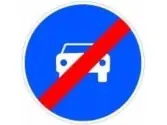
La señal de la imagen indica que:
The sign in the picture indicates:
- AComienza una calzada obligatoria para automóviles, excepto motocicletas de dos ruedas.The start of a compulsory carriageway for motor cars, except two-wheeled motorcycles.
- BFin de calzada obligatoria para automóviles, excepto motocicletas de dos ruedas.The end of a compulsory carriageway for motor cars, except two-wheeled motorcycles.
- CProhibido circular a automóviles, excepto motocicletas de dos ruedas.No driving for motor cars, except two-wheeled motorcycles.
ExplanationSign R-507, 'End of compulsory carriageway for motor cars, except two-wheeled motorcycles', marks the point from which an earlier compulsory carriageway for motor cars, except two-wheeled motorcycles and three-wheeled vehicles treated as motorcycles, no longer applies.
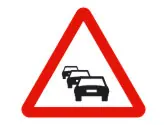
Esta señal indica un peligro por...
This sign indicates danger because of...
- AUn tramo con la circulación detenida o con congestión.A stretch where traffic is stopped or congested.
- BUn lugar donde hay vehículos que obstruyen la calzada.A place where vehicles are blocking the carriageway.
- CUn tramo de vía con la circulación ralentizada por pérdida de visibilidad.A stretch of road where traffic is slowed down by loss of visibility.
ExplanationThe sign indicates a stretch of road where traffic is stopped or slowed down by congestion.
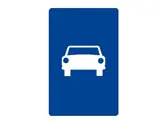
Esta señal indica el principio de...
This sign indicates the start of...
- Auna autopista.a motorway (autopista).
- Buna vía reservada a la circulación de automóviles.a road reserved for motor cars.
- Cuna autovía.a dual carriageway (autovía).
ExplanationThe sign in the picture indicates the start of a road reserved for motor cars, which pedestrians, cycles and other vehicles that are not motor cars may not use. Motorways and dual carriageways have their own start signs.
All topics
- Definitions
- Documents and penalty points
- The driver's condition
- Duties of drivers and pedestrians
- Vehicle safety devices
- Vehicle controls and equipment
- Vehicle lights and horn
- The road and its lanes
- Speed and distances
- Manoeuvres
- Right of way
- Carrying passengers and loads
- Driving safely in difficult conditions
- Vehicle mechanics and maintenance
- Road accidents and first aid
- Defensive and eco-driving
Independent app: not affiliated with or endorsed by the DGT (Spain's Directorate-General for Traffic) or the Ministry of the Interior. The official exam is booked with the DGT and taken at its test centres. The questions here are practice material; the DGT's official question bank is not public.
Basado en datos de la Agencia Estatal Boletín Oficial del Estado (https://www.boe.es). Textos consolidados de carácter meramente informativo. La AEBOE no patrocina ni respalda este sitio.
Parte de las preguntas procede de los tests de la revista «Tráfico y Seguridad Vial» de la DGT, reproducidos con indicación de la fuente.