
DGT test · 1,397 questions
Traffic signs, markings and signals · Page 5 of 28
Road signs, road markings, traffic lights, police signals and temporary markings: what they mean and which one wins when they disagree. The topic with the most questions in the bank.
Questions in this topic, with answers
1,397 questions, 50 per page, with the correct answer and the explanation. Page 5 of 28.
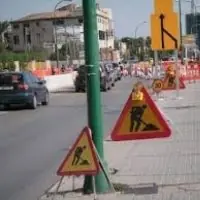
Estas marcas viales y señales amarillas, ¿que indican?
What do these yellow road markings and signs indicate?
- AQue es una zona de obras.That it is a roadworks area.
- BQue cambia el tipo de vía.That the type of road changes.
- CQue es un carril abierto en sentido contrario al normal.That it is a lane opened in the opposite direction to normal.
ExplanationYellow road markings on roads like the one in the picture are linked to roadworks, and they remain only for as long as the works last. They are removed once the work on the road is finished, and the usual markings are restored.
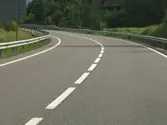
Una línea discontinua con trazos muy juntos, ¿qué indica?
What does a broken line with very closely spaced dashes indicate?
- ALa proximidad de un carril para tráfico lento.That a lane for slow traffic is coming up.
- BLa proximidad de un tramo peligroso.That a dangerous stretch is coming up.
- CUn carril especial.A special lane.
ExplanationA broken line with longer dashes and shorter gaps than normal is a warning marking: it announces that a continuous line or a stretch with a special risk is coming up. It is best not to start overtaking and to pay extra attention.
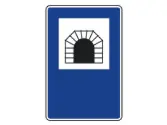
En un tramo de vía con la señal "túnel", ¿está permitido hacer un cambio de sentido?
On a stretch of road with the 'tunnel' sign, is it permitted to make a U-turn?
- ANo.No.
- BSí.Yes.
- CSí, si el túnel tiene dos carriles por sentido.Yes, if the tunnel has two lanes in each direction.
ExplanationIn tunnels or underpasses, stopping, parking, making a U-turn, reversing and overtaking are prohibited.
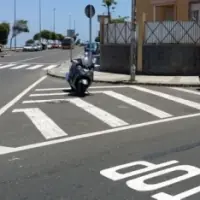
¿Cómo se llama la zona marcada por franjas oblicuas paralelas enmarcadas por una línea continua?
What is the area marked with parallel diagonal stripes framed by a continuous line called?
- ACebreadoHatched markings (cebreado)
- BMarcas de estacionamientoParking markings
- CMarca de paso a nivelLevel crossing marking
ExplanationIt is a hatched area (cebreado, M-7.1 and M-7.2), an area of the road surface excluded from traffic. Under Article 147 of the RGC, no driver may enter it with their vehicle or animal, except those required to drive on the hard shoulder.
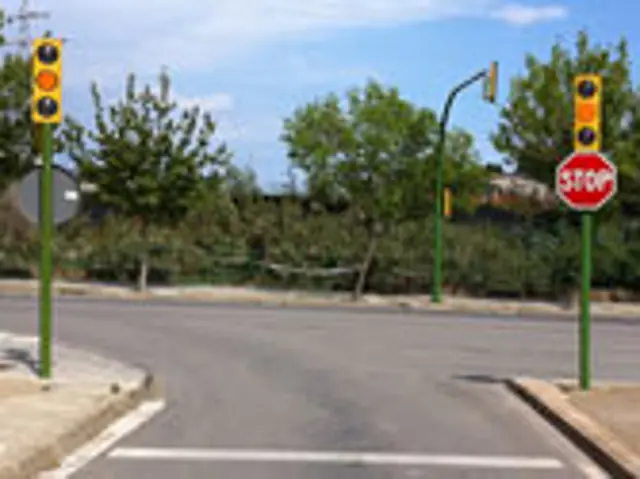
¿Cuál es el orden de preferencia entre estos tipos de señales, de mayor a menor?
What is the order of priority between these types of signals, from highest to lowest?
- ASemáforos, agentes (policías) y señales verticalesTraffic lights, traffic officers (police) and road signs
- BAgentes (policías), semáforos y señales verticalesTraffic officers (police), traffic lights and road signs
- CSeñales verticales, agentes (policías) y semáforosRoad signs, traffic officers (police) and traffic lights
ExplanationUnder Article 133.1 of the General Traffic Regulations, the order of priority is: signals and orders from traffic officers, temporary signs and fixed beacons, traffic lights, road signs and, last of all, road markings. Traffic officers come before traffic lights, and traffic lights before road signs.
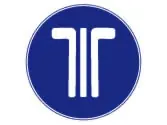
La señal que se muestra sobre un carril de un puesto de peaje indica que ...
This sign above a lane at a toll station means that...
- Asólo se puede abonar el peaje mediante tarjeta.you can only pay the toll by card.
- Bes obligatorio el pago del peaje mediante el sistema de peaje dinámico o telepeaje.you must pay the toll with the electronic toll (dynamic toll) system.
- Cse puede pagar mediante el sistema de peaje dinámico o telepeaje.you can pay with the electronic toll (dynamic toll) system.
ExplanationThe sign in the question means that vehicles using a lane marked this way must pay with the electronic toll system and cannot use any other way of paying. Do not confuse it with the same sign in square form: there you can pay with the electronic toll system, but it is not compulsory, and you can also use other payment methods (the signs will show which ones).
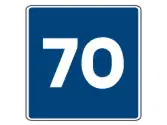
A la vista de la imagen ...
Looking at the picture...
- ANos aconsejan circular como máximo a 70 km/h.we are advised to drive at no more than 70 km/h.
- BNos obligan a circular como mínimo a 70 km/h.we are required to drive at a minimum of 70 km/h.
- CNos indican que hemos de circular a 70 km/h.we are told that we must drive at 70 km/h.
ExplanationThe sign recommends an approximate speed, in kilometres per hour, that you are advised not to exceed, even when weather, environmental, road and traffic conditions are favourable. When it is placed under a warning sign, the recommendation applies to the stretch where that danger continues. Do not confuse it with the 'compulsory minimum speed' sign, which requires us to drive at least at the speed shown on the sign.
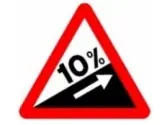
Si circulamos detrás de un camión de más 3.500 kg de MMA, ¿qué es lo que puede ocurrir a partir de esta señal?
If you are driving behind a lorry with an MAM of more than 3,500 kg, what may happen after this sign?
- AQue el camión acelere y aumente su velocidad.The lorry may accelerate and increase its speed.
- BQue el camión salpique gravilla.The lorry may throw up gravel.
- CQue el camión ralentice considerablemente su marcha.The lorry may slow down considerably.
ExplanationThe sign warns of the danger of a steep uphill gradient, a climb, so you can expect the lorry, being a heavy vehicle, to slow down. The figure on the sign shows the gradient as a percentage. Do not confuse the steep ascent and steep descent signs: on the ascent sign the numbers go up the slope, and on the descent sign they go down it.
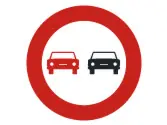
¿La señal permite realizar la maniobra de adelantamiento a un vehículo de motor?
Does the sign allow you to overtake a motor vehicle?
- ANo, salvo que no se invada el sentido contrario.No, unless you do not enter the side for oncoming traffic.
- BNo, en ningún caso.No, never.
- CNo, salvo que se adelante a un turismo.No, unless you are overtaking a car.
ExplanationThe sign in the question prohibits all vehicles from overtaking motor vehicles travelling on the carriageway when this means entering the part reserved for oncoming traffic. The ban applies from where the sign is placed until the next «End of no overtaking» or «End of all prohibitions» sign. When placed where overtaking is already prohibited by the rules, it is a general reminder that this manoeuvre is prohibited.
¿Se podrá circular por la izquierda de una línea continua?
May you drive to the left of a continuous line?
- ASí, para adelantar dentro de poblado.Yes, to overtake in built-up areas.
- BSí, en caso de carriles estrechos.Yes, where lanes are narrow.
- CSí, en caso de varios carriles en el mismo sentido.Yes, where there are several lanes in the same direction.
ExplanationIt is prohibited to cross a continuous line, to drive on it and to drive to its left when it separates the 2 directions of traffic.
Si un agente levanta el brazo verticalmente con la palma extendida:
If an officer raises one arm vertically with the palm open:
- APuedes pasar con precauciónYou may go with caution
- BObliga a detenerse a todos los usuariosAll road users must stop
- CSolo afecta a los vehículos que vienen de frenteIt only affects vehicles coming from the front
ExplanationAn arm raised vertically with the palm open requires all road users approaching the officer to stop, unless they cannot do so safely.
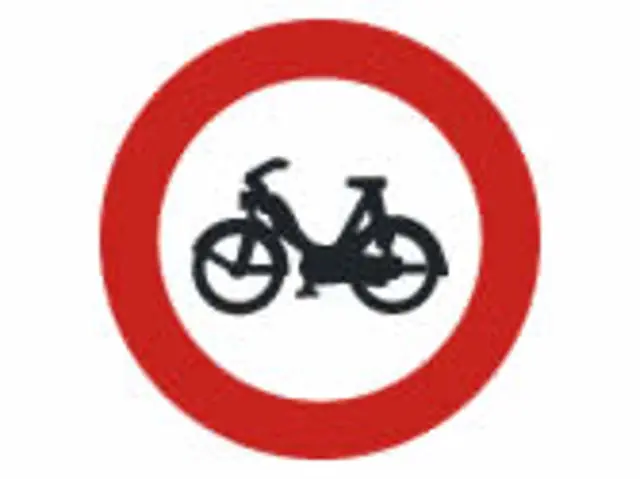
Esta señal prohíbe entrar a...
This sign prohibits entry to...
- ACiclomotoresMopeds.
- BBicicletasBicycles.
- CCualquier vehículo de dos ruedasAny two-wheeled vehicle.
ExplanationSign R-105, no entry for mopeds, prohibits access to mopeds and also to vehicles for people with reduced mobility. It does not apply to bicycles or other two-wheeled vehicles.

Ante esta señal, ¿qué se debe hacer?
What must you do at this sign?
- ADetenerse sólo si se aproximan vehículos por la derecha.Stop only if vehicles are approaching from the right.
- BDetenerse obligatoriamente y ceder el paso a los vehículos que circulen por la vía transversal.Stop, as it is compulsory, and give way to vehicles on the crossing road.
- CPasar sin detenerse cuando no circulan vehículos por la vía transversal.Go through without stopping when there are no vehicles on the crossing road.
ExplanationThe STOP sign requires every driver to stop the vehicle at the next stop line or, if there is none, immediately before the junction, and to give way there to vehicles on the road being approached. If, due to exceptional circumstances, there is not enough visibility from the place where you stopped, the driver must stop again at a place with visibility, without endangering any road user.
¿Está permitido bloquear un cruce aunque el semáforo esté en verde si hay atasco?
If there is a traffic jam, are you allowed to block a junction even if the light is green?
- ASí, el semáforo da prioridadYes, the traffic light gives priority
- BNo, no debe entrar si no puede despejarloNo, you must not enter it if you cannot clear it
- CSí, si se toca el claxonYes, if you sound the horn
ExplanationUnder Article 59.1 of the General Traffic Regulations (RGC), even if they have priority, no driver may enter a junction or a pedestrian or cyclist crossing if they are likely to end up stopped there, obstructing cross traffic.
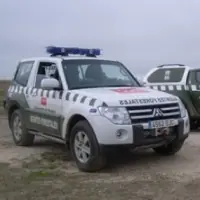
¿Qué significa la señal V-1 en los vehículos prioritarios?
What does the V-1 sign on priority vehicles mean?
- AQue circula en servicio urgenteThat the vehicle is on an emergency call.
- BQue se trata de un vehículo de policíaThat it is a police vehicle.
- CQue circula en servicio no urgenteThat the vehicle is not on an emergency call.
ExplanationThe V-1 sign on priority vehicles indicates that they are on an emergency call. These vehicles, such as ambulances, fire engines or police patrol cars, use this signal to tell other drivers that they are responding to an emergency and need a clear path and priority on the road. Drivers must recognise this signal and give way safely and quickly so that priority vehicles can reach their destination as fast as possible and help in emergencies.
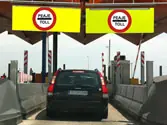
En un puesto de peaje, ¿qué se debe hacer?
At a toll booth, what must you do?
- APasar sin detenerse porque la flecha está verde.Go through without stopping, because the arrow is green.
- BPasar sin detenerse porque no hay barrera.Go through without stopping, because there is no barrier.
- CDetenerse en el puesto de control porque lo indica la señal.Stop at the control point, because the sign says so.
ExplanationSign R-200, no passing without stopping, indicates that you must stop because a customs, police, toll or other control point is close, in this case a toll. You may not move off again until you have complied with what the sign requires, even if there is no barrier.
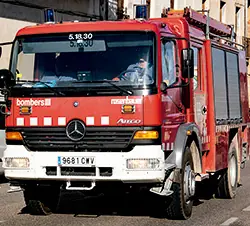
¿Está permitido que los vehículos prioritarios en servicio de urgencia utilicen únicamente la señal luminosa?
Are priority vehicles on an emergency call allowed to use only the light signal?
- ASí, cuando no suponga un peligro para los demás usuarios.Yes, when it does not pose a danger to other road users.
- BNo, tienen que utilizar simultáneamente la señal luminosa y la acústicaNo, they must use the light and the sound signal at the same time.
- CSólo en vías urbanas; en vías interurbanas deben usar siempre la señal acústicaOnly on urban roads; on interurban roads they must always use the sound signal.
ExplanationPriority vehicles on an emergency call use both the light and the sound signal, but they may do without the sound signal and use only the light when this does not pose a danger to other road users.
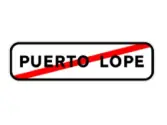
A partir de la señal, ¿podrá circular a más de 50 kilómetros por hora?
After this sign, may you drive faster than 50 kilometres per hour?
- ANo.No.
- BSí, en todo caso.Yes, in all cases.
- CSí, si las circunstancias lo permiten.Yes, if circumstances allow.
ExplanationThis is sign S-510, end of built-up area: from this point the traffic rules for built-up areas no longer apply, including their general limit of 50 km/h. You may go faster depending on the type of road and its signs, as long as traffic, road, vehicle and driver conditions allow.
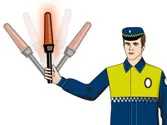
Un agente de la autoridad que balancea una luz amarilla...
A police officer who swings a yellow light...
- APermite continuar la marcha a los usuarios de la vía hacia los que el agente dirija la luz.Allows the road users towards whom the officer directs the light to continue.
- BObliga a detenerse a los usuarios de la vía hacia los que el agente dirija la luz.Requires the road users towards whom the officer directs the light to stop.
- CObliga a extremar la precaución de los usuarios de la vía hacia los que el agente dirija la luz.Requires the road users towards whom the officer directs the light to take extra care.
ExplanationAn officer swinging a red or yellow light requires the road users towards whom the light is directed to stop. When an officer holds out an arm and moves it up and down, you must slow down.
En caso de contradicción entre señales del mismo tipo...
If signs of the same type contradict each other...
- APrevalece la más restrictiva.The most restrictive one prevails.
- BPrevalece la prioritaria.The one with priority prevails.
- CLas señales de los semáforos prevalecerán siempre por encima de todas las demás.Traffic light signals will always prevail over all the others.
ExplanationWhen the signs are of the same type, the most restrictive one prevails. When the signs are of different types, the one with the highest priority prevails, following this order of priority: 1. Signals and orders from traffic officers. 2. Temporary signs that change the normal use of the road, and fixed markers (beacons). 3. Traffic lights. 4. Road signs. 5. Road markings.
Una línea blanca continua en la calzada, más ancha de lo normal...
A solid white line on the carriageway that is wider than normal…
- Aindica un carril especial.indicates a special lane.
- Bse usa solo para marcar los carriles de autobuses.is only used to mark bus lanes.
- Cindica el borde de la calzada.indicates the edge of the carriageway.
ExplanationUnder the road-marking catalogue (RD 465/2025), the wide solid line (M-2.4) separates a special lane, such as a slip lane for changing speed, a weaving lane or a lane reserved for buses or taxis, from the lanes next to it on stretches where changing lanes is not allowed.
En una intersección regulada por semáforo en verde para ti, pero con retención al otro lado:
At a junction where the traffic light is green for you, but traffic is backed up on the other side:
- ADebes entrar igualmente.You must enter anyway.
- BNo debes entrar en la intersección si vas a quedar detenido obstaculizándola.You must not enter the junction if you will end up stopped there, blocking it.
- CDebes tocar el claxon y entrar.You must sound the horn and enter.
ExplanationEven if the light is green, you must not enter the junction if you are likely to get stuck inside it.
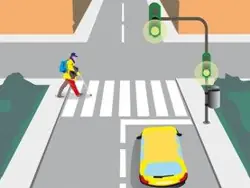
La línea transversal continua del paso para peatones, ¿Qué indica?
What does the continuous transverse line at a pedestrian crossing indicate?
- AQue empieza el paso para peatones.That the pedestrian crossing begins.
- BQue es un paso para peatones con semáforo.That it is a pedestrian crossing with traffic lights.
- CDonde debo detenerme cuando sea necesario.Where I must stop when necessary.
ExplanationThe continuous transverse line before a pedestrian crossing is a stop line: it marks where you must stop when a traffic light, a sign or the presence of pedestrians requires it. It does not mark the start of the crossing or show whether it has traffic lights.
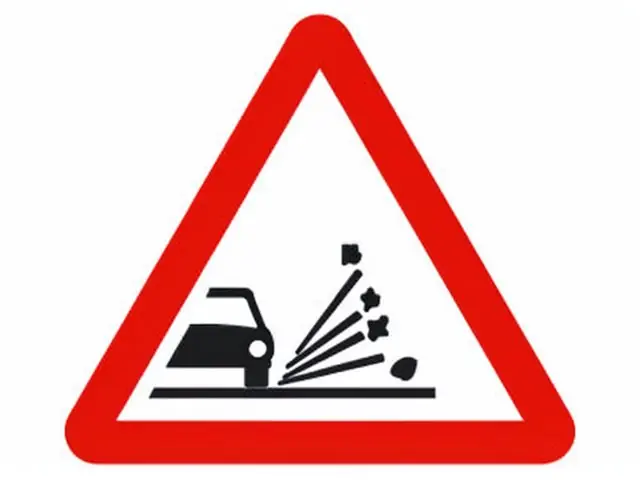
Debe saber que después de esta señal hay peligro por la proximidad de...
You should know that after this sign there is danger because you are approaching...
- Agrandes charcos de agua que obligan a reducir la velocidad.large puddles of water that make you slow down.
- Buna zona con desprendimientos frecuentes.an area with frequent rockfalls.
- Cun tramo de vía donde existe el riesgo de que salga gravilla al pasar los vehículos.a stretch of road where there is a risk of gravel being thrown up by passing vehicles.
ExplanationThe sign in the picture warns that you are approaching a stretch where there is a risk of gravel being thrown up when vehicles drive over the carriageway. You should reduce your speed and increase the distance from the vehicle in front to avoid being hit by stones.
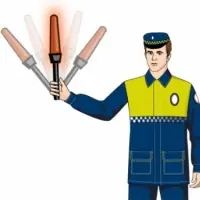
Si un agente de la autoridad balancea una luz roja dirigiéndose a su vehículo en un tramo dónde se realizan obras, ¿a qué obliga?
If a police officer swings a red light towards your vehicle on a stretch of road where there are roadworks, what must you do?
- AA extremar la precaución.Take extreme care.
- BA detenerse.Stop.
- CA realizar un cambio de sentido.Make a U-turn.
ExplanationIf, while driving, we find a traffic officer on the road swinging a red or yellow light on a stretch where roadworks are being carried out, this signal requires all road users towards whom the officer points the light to stop.
¿Qué señal utilizará un agente en su vehículo para señalizar que la calzada vuelve a estar abierta a la circulación?
What signal will a traffic officer in a vehicle use to show that the carriageway is open to traffic again?
- AUna bandera roja.A red flag.
- BUna bandera verde.A green flag.
- CUna luz roja.A red light.
ExplanationTo show that the carriageway is open to traffic again, the officer will use a green flag. A red flag shows that, once the vehicle carrying it has passed, the carriageway is temporarily closed to all vehicles and road users, except those accompanied or escorted by officers of the authority responsible for regulating, managing and controlling traffic. A yellow flag tells other drivers and road users that they must pay extreme attention or that a danger is near. This flag may also be used by authorised auxiliary staff who carry out order, control or safety duties during cycling events or any other activity, sporting or not, on roads covered by traffic law.
¿Qué significado tienen unas marcas longitudinales discontinuas dobles?
What do double broken longitudinal markings mean?
- AIndican que se trata de un carril especial de circulación.They show that it is a special traffic lane.
- BAnuncian una línea continua o un tramo de especial peligro.They announce a continuous line or a particularly dangerous stretch.
- CIndican que el carril que delimitan es reversible.They show that the lane they mark out is reversible.
ExplanationWhen double broken lines mark out a lane on both sides, it means that the lane is reversible.
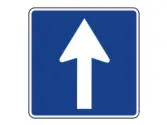
¿Podremos realizar un cambio de dirección a la vista de esta señal?
May we turn when we see this sign?
- ANo, sólo podemos continuar de frente.No, we may only continue straight ahead.
- BSí, tanto a la derecha como a la izquierda.Yes, both right and left.
- CSí, además de un cambio de sentido.Yes, and also make a U-turn.
ExplanationThis is sign S-11 «One-lane one-way carriageway»: on that carriageway you travel in the direction of the arrow and travelling in the opposite direction is prohibited. It does not stop you from turning right or left, but it does prohibit U-turns.
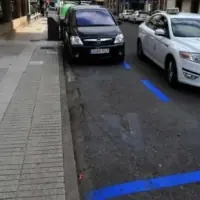
¿Qué indican las marcas azules discontinuas en un lugar de estacionamiento?
What do broken blue markings in a parking area indicate?
- AQue la duración del estacionamiento es limitadaThat parking time is limited
- BQue la duración del estacionamiento es ilimitadaThat parking time is unlimited
- CQue únicamente pueden aparcar vehículos de servicios públicosThat only public service vehicles may park
ExplanationAccording to the road-marking catalogue, parking markings may be in colours other than white to indicate time limits. Blue markings show a limited-time parking area, the so-called blue zone, with payment or a permit depending on the local by-law.
Un agente que balancea una luz roja o amarilla, ¿qué nos indica?
What does a traffic officer swinging a red or yellow light tell you?
- AQue conduzcamos con precaución.That you should drive with care.
- BQue existe un peligro.That there is a danger.
- CObliga a detenerse a todos los usuarios de la vía hacia los que dirija la luz.All road users towards whom the light is directed must stop.
ExplanationThe red or yellow light requires the road users towards whom it is directed to stop. Do not confuse it with the arm moving up and down, which means you must slow down.
Si detrás de nosotros circula un vehículo de policía en servicio de urgencia y activa un dispositivo de luz roja intermitente o destellante hacia delante, ¿qué haremos?
If a police vehicle on an emergency call is behind you and switches on a forward-facing flashing red light, what should you do?
- ADetenernos a la derecha, delante del vehículo policial, y no salir del vehículo.Stop on the right, in front of the police vehicle, and not get out of your vehicle.
- BFacilitar el paso al vehículo de policía arrimándonos a la derecha.Let the police vehicle pass by moving over to the right.
- CIncrementar la velocidad para no entorpecer al vehículo de la policía.Speed up so as not to obstruct the police vehicle.
ExplanationArticle 69.2 of the General Traffic Regulations (RGC) states that, if the police vehicle positions itself behind you and switches on a forward-facing flashing red light, the driver must stop carefully on the right-hand side, in front of the police vehicle, and stay inside, following the officer's instructions.
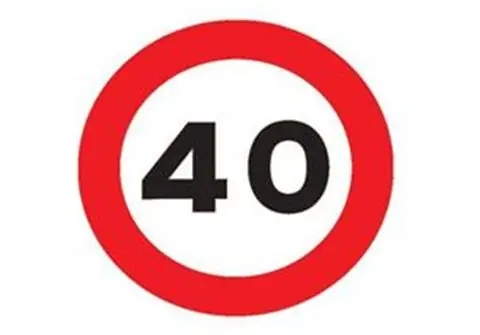
A partir de esta señal...
From this sign onwards...
- Aes recomendable no circular a más de 40 km/h.it is advisable not to drive faster than 40 km/h.
- Bestá prohibido circular a más de 40 km/h.it is prohibited to drive faster than 40 km/h.
- Ces obligatorio circular a 40 km/h.it is compulsory to drive at 40 km/h.
ExplanationThe round sign with a red border and the number 40 is a maximum speed sign: it prohibits driving faster than 40 km/h from where it is placed until an end-of-limit sign, an end-of-all-prohibitions sign or another maximum speed sign. It does not require you to drive at 40 and it is not a recommendation.
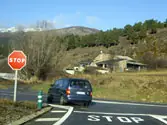
Las señales horizontales pintadas sobre la calzada (por ejemplo, STOP, ceda el paso o limitación de velocidad), ¿tienen el mismo significado que sus homólogas verticales?
Do the signs painted on the carriageway (for example STOP, give way or a speed limit) have the same meaning as the equivalent upright signs?
- ASí.Yes.
- BNo, en ningún caso.No, never.
- CNo, salvo las señales de «ceda el paso» y «stop».No, except the ‘give way’ and ‘stop’ signs.
ExplanationUnder Article 147.2.e) of the General Traffic Regulations (RGC), horizontal signs are signs painted on the carriageway with the same meaning as the equivalent upright signs. If they are in a lane marked out by longitudinal lines, they apply only to those driving in that lane.
Si un agente regula el tráfico con el brazo levantado verticalmente, ¿qué deben hacer los usuarios que se acerquen?
If an officer is directing traffic with one arm raised vertically, what must approaching road users do?
- ADetenerseStop
- BAcelerar para despejarSpeed up to clear the way
- CContinuar con precauciónContinue with caution
ExplanationAn arm raised vertically requires approaching road users to stop.
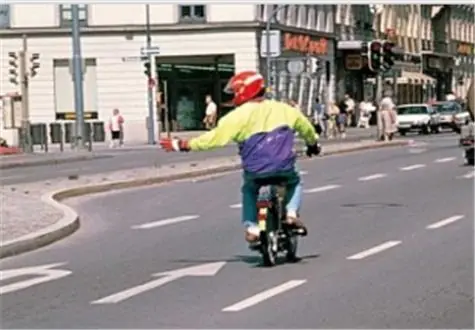
Las señales realizadas con el brazo para advertir las maniobras...
Arm signals used to warn of manoeuvres...
- Asolamente son válidas cuando se realizan en vía urbana.are only valid on urban roads.
- Bson validas siempre que se efectúen correctamente y sean visibles por los demás usuarios.are valid as long as they are given correctly and other road users can see them.
- Cno son validas en ningún caso.are never valid.
ExplanationArm signals are valid on any road as long as they are given correctly and other road users can see them. They are used when the vehicle has no indicators or they are not working, and they are also used by cyclists and riders of personal mobility vehicles (PMV, e-scooters).
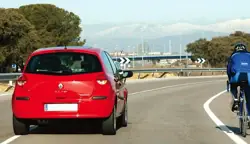
Para adelantar al ciclista de la imagen, si se dan las condiciones precisas para realizar la maniobra, ¿Es correcto rebasar la marca longitudinal continua?
To overtake the cyclist in the picture, if the conditions for the manoeuvre are met, is it correct to cross the continuous longitudinal marking?
- ANo, cuando se pueda dejar 1,50 metros de separación lateral.No, when a lateral gap of 1.50 metres can be left.
- BNo, porque es un tramo de vía con curvas.No, because it is a stretch of road with bends.
- CSí.Yes.
ExplanationArticle 88 of the RGC allows you to overtake a cyclist on a stretch where overtaking is prohibited, even if you have to cross the continuous line, provided you make sure it can be done without danger and you leave a gap of at least 1.5 metres.
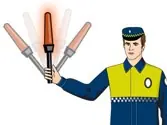
¿Qué está indicando la agente balanceando una luz roja?
What is the traffic officer indicating by swinging a red light?
- AEl lado por donde debemos pasar.The side on which we must pass.
- BPrecaución al pasar.Take care when passing.
- CObliga a detenerse a los usuarios hacia los que dirige la luz.Road users towards whom the light is directed must stop.
ExplanationWhen a traffic officer swings a red or amber light, road users towards whom the light is directed must stop. It does not show which side to pass on, and it is not just a warning to take care.
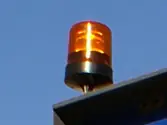
Los vehículos especiales obligados a utilizar la señal V-2 lo harán...
Special vehicles required to use signal V-2 must use it...
- ASolo durante el día.Only during the day.
- BSolo durante la noche.Only at night.
- CTanto de día como de noche.Both by day and at night.
ExplanationUnder Article 71.3 of the General Traffic Regulations (RGC), drivers of special vehicles or vehicles under special transport arrangements must use the V-2 light both by day and at night when driving on public roads at a speed of no more than 40 km/h.
¿Qué debe hacer si en una intersección con circulación saturada el semáforo está en verde?
What should you do if the traffic light is green at a junction where traffic is congested?
- AEntrar en la intersección porque el semáforo está en verde.Enter the junction because the light is green.
- BPasar rápidamente.Go through quickly.
- CEsperar hasta que haya espacio para cruzar sin obstaculizar el paso.Wait until there is space to cross without blocking the way.
ExplanationEven if the light is green, you must not enter a junction if traffic is so congested that the vehicle would be stopped inside it, blocking cross traffic. You must wait until there is space to cross it completely.
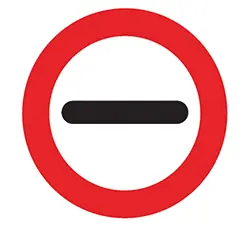
La señal indica que...
The sign indicates that...
- Aestá en un callejón sin salida y debe retroceder.you are in a dead end and must turn back.
- Bestá prohibido pasar sin detenerse.passing without stopping is prohibited.
- Cse aproxima a una elevación del terreno.you are approaching a rise in the ground.
ExplanationThis is the 'no passing without stopping' sign: it requires you to stop at the place indicated, usually for a customs, police or toll checkpoint, whose name usually appears on the sign itself. It does not indicate a dead end or the brow of a hill.
¿Qué indica un agente de circulación al balancear una luz roja o amarilla de un lado a otro?
What is a traffic officer indicating by swinging a red or yellow light from side to side?
- ADetenerse si la luz va dirigida hacia ustedStop if the light is directed at you
- BIndicar el carril por donde circularWhich lane to drive in
- CCircular con precauciónDrive with caution
ExplanationAn officer swinging a red or yellow light is a direct order to stop. This signal requires the road users at whom the officer directs the light to stop. Remember that officers' signals take precedence over all other signs (traffic lights, road signs, etc.). It is not a danger warning or a lane indication, but an immediate compulsory stop.
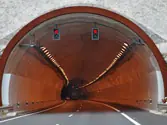
¿Qué haremos al encontrar un semáforo rojo en la entrada de un túnel?
What will we do if we find a red traffic light at the entrance to a tunnel?
- APasar con precaución.Go through carefully.
- BEsperar hasta que cambie a verde.Wait until it changes to green.
- CEsperar hasta que se apague la luz roja.Wait until the red light goes out.
ExplanationA steady (non-flashing) red light prohibits passing while it is on, including at the entrance to a tunnel. You must wait for it to go out: afterwards the green light may come on, or a flashing amber light, which allows you to pass taking extreme care.
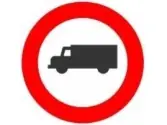
Esta señal, ¿prohíbe la entrada a todos los camiones?
Does this sign prohibit entry to all lorries?
- ASí.Yes.
- BNo, solo a los que transporten mercancías peligrosas.No, only to those carrying dangerous goods.
- CNo, solo a los de más de 3500 kg de MMA.No, only to those with a MAM over 3,500 kg.
ExplanationThis sign prohibits entry to all lorries and vans, regardless of their mass.
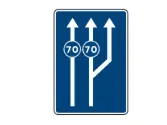
A la vista de la señal y teniendo en cuenta que circulamos a 90 km/h, ¿podremos utilizar el carril derecho?
Given the sign, and bearing in mind that we are driving at 90 km/h, may we use the right lane?
- ANo, porque está reservado para vehículos lentos.No, because it is reserved for slow vehicles.
- BSí, como norma general usaremos el derecho.Yes, as a general rule we will use the right lane.
- CUsaremos cualquier carril indistintamente.We will use any lane, it makes no difference.
ExplanationThe sign in the question indicates that the lane or lanes above which the minimum speed sign is placed may only be used by vehicles travelling at or above the speed shown, but if circumstances allow, they must use the right lane.
Si hay semáforos con indicaciones diferentes a la derecha y a la izquierda, ¿a cuál deben obedecer los que vayan a seguir recto?
If traffic lights on the right and on the left show different indications, which one should drivers going straight on obey?
- AAl situado inmediatamente a su izquierda.The one immediately to their left.
- BAl situado inmediatamente a su derecha.The one immediately to their right.
- CAl que se encuentre más cercano al vehículo.The one closest to the vehicle.
ExplanationUnder Article 132 of the General Traffic Regulations (RGC), if traffic lights on the right and on the left show different indications, drivers who intend to turn left or go straight on must obey the light on their left. This is because the rules set an order for obeying signals depending on where they are in relation to the vehicle. So they must obey the light on their left.
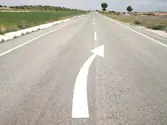
¿Qué indica la flecha pintada en la calzada?
What does the arrow painted on the carriageway show?
- AQue el carril en el que está situada termina próximamente.That the lane it is in will end soon.
- BLa dirección del ramal de la próxima salida.The direction of the slip road for the next exit.
- CLa proximidad de una línea continua.That a continuous line is coming up.
ExplanationAn arrow placed roughly on the centre line of a two-way carriageway and pointing to the right announces that you are approaching a continuous line that prohibits driving to its left, and therefore shows that every driver must move as soon as possible into the lane to the right of the arrow. Do not confuse it with the end-of-lane arrow.
Si el agente realiza una serie de toques cortos y frecuentes con el silbato, ¿qué está indicando a los conductores?
If the traffic officer gives a series of short, frequent blasts on the whistle, what is the officer telling drivers?
- AQue deben reanudar la marcha.That they must move off again.
- BQue deben acelerar la marcha.That they must speed up.
- CQue deben detener su vehículo.That they must stop their vehicle.
ExplanationUnder the General Traffic Regulations, a series of short, frequent whistle blasts from the officer orders vehicles to stop, while one long whistle blast orders them to move off again.
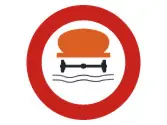
Esta señal, ¿a qué vehículos prohíbe la entrada?
Which vehicles does this sign prohibit from entering?
- AA los que transporten mercancías peligrosas.Those carrying dangerous goods.
- BA los que transporten productos contaminantes del agua.Those carrying products that pollute water.
- CA los que transporten productos explosivos o inflamables.Those carrying explosive or flammable products.
ExplanationThis sign prohibits entry to vehicles carrying more than 1,000 litres of products capable of polluting water.
¿Qué indica un agente de la circulación que balancea una luz roja o amarilla?
What does a traffic officer swinging a red or yellow light indicate?
- APermite continuar la marcha con precaución a los usuarios hacia los que el agente dirija la luz.Road users towards whom the officer points the light may continue carefully.
- BObliga a disminuir la velocidad a los conductores que se acerquen al agente por el lado correspondiente al brazo que ejecuta la señal.Drivers approaching the officer on the side of the arm giving the signal must slow down.
- CObliga a detenerse a todos los usuarios de la vía hacia los que el agente dirija la luz.All road users towards whom the officer points the light must stop.
ExplanationSwinging a red or yellow light requires all road users towards whom the officer points the light to stop. The signal telling us to slow down is given by stretching out the arm and moving it up and down.
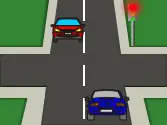
Si el vehículo azul pretende continuar la marcha cambiando de dirección hacia la derecha, ¿qué hará?
If the blue vehicle intends to continue by turning right, what should it do?
- APasar puesto que el semáforo se encuentra al otro lado de la intersección.Go, because the traffic light is on the other side of the junction.
- BEsperar a que el semáforo cambie a verde.Wait for the traffic light to turn green.
- CPara seguir de frente tendrá que esperar, pero si cambia de dirección hacia la derecha podrá pasar.To go straight on it will have to wait, but if it turns right it may go.
ExplanationA steady (non-flashing) red light prohibits passing. If the traffic light is inside the junction or on the opposite side of it, vehicles must not enter the junction or go past the stop line before it. That is why the blue vehicle must wait for the light to turn green, also in order to turn right.
All topics
- Definitions
- Documents and penalty points
- The driver's condition
- Duties of drivers and pedestrians
- Vehicle safety devices
- Vehicle controls and equipment
- Vehicle lights and horn
- The road and its lanes
- Speed and distances
- Manoeuvres
- Right of way
- Carrying passengers and loads
- Driving safely in difficult conditions
- Vehicle mechanics and maintenance
- Road accidents and first aid
- Defensive and eco-driving
Independent app: not affiliated with or endorsed by the DGT (Spain's Directorate-General for Traffic) or the Ministry of the Interior. The official exam is booked with the DGT and taken at its test centres. The questions here are practice material; the DGT's official question bank is not public.
Basado en datos de la Agencia Estatal Boletín Oficial del Estado (https://www.boe.es). Textos consolidados de carácter meramente informativo. La AEBOE no patrocina ni respalda este sitio.
Parte de las preguntas procede de los tests de la revista «Tráfico y Seguridad Vial» de la DGT, reproducidos con indicación de la fuente.