
DGT test · 1,397 questions
Traffic signs, markings and signals · Page 26 of 28
Road signs, road markings, traffic lights, police signals and temporary markings: what they mean and which one wins when they disagree. The topic with the most questions in the bank.
Questions in this topic, with answers
1,397 questions, 50 per page, with the correct answer and the explanation. Page 26 of 28.
Una línea transversal continua dispuesta a lo ancho de uno o varios carriles, ¿qué indica?
What does a continuous transverse line across one or more lanes indicate?
- AQue los vehículos no deben franquearla.That vehicles must not cross it.
- BQue, al detenerse en cumplimiento de una señal de detención obligatoria, ningún vehículo o animal ni su carga deben franquearla.That, when stopping in compliance with a compulsory stop signal, no vehicle or animal, nor its load, may cross it.
- CObligación de detenerse y ceder el paso a los vehículos que se aproximen por la izquierda y por la derecha.An obligation to stop and give way to vehicles approaching from the left and from the right.
ExplanationA continuous transverse line marks where to stop at a stop sign, a traffic light or a traffic officer: when stopping, neither the vehicle nor its load may go past it. On its own it does not require you to give way to everyone; it requires you not to cross it while the order to stop applies.
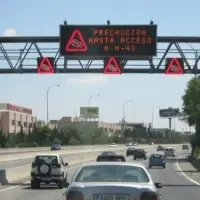
¿Cuál de éstos NO es un ejemplo de panel de mensaje variable?
Which of these is NOT a type of message shown on variable message signs?
- AMensajes de advertenciaWarning messages.
- BMensajes de guíaGuidance messages.
- CMensajes preceptivosMandatory messages.
ExplanationVariable message signs regulate traffic by giving drivers information, warning them of possible hazards on the road and giving recommendations or instructions. They may show warning and mandatory messages, but not guidance messages.
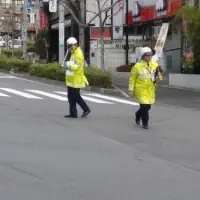
¿Son siempre ejecutivas las órdenes de los Agentes de Circulación?
Must traffic officers' orders always be obeyed immediately?
- ANo, nunca lo sónNo, never.
- BSí, siempreYes, always.
- CÚnicamente lo son las señales ópticas que realicenOnly their visual signals must.
ExplanationUnder Article 141.1 of the General Traffic Regulations (RGC), the signals and orders of officers directing traffic must be obeyed immediately by road users, and under Article 133 they take precedence over any other sign. Not obeying them is an offence that can be penalised.
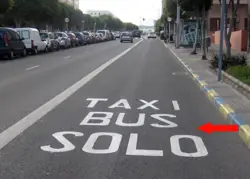
Una línea blanca continua sensiblemente más ancha...
A continuous white line that is noticeably wider...
- ASirve para delimitar únicamente los carriles bus.Is used to mark bus lanes only.
- BIndica la existencia de un carril especial.Indicates a special lane.
- CIndica el borde de la calzada.Indicates the edge of the carriageway.
ExplanationA continuous line noticeably wider than normal indicates a special lane, reserved for certain vehicles, such as a bus or taxi lane. It may not be crossed except in permitted cases.
Un turismo que lleve la señal de persona con discapacidad, ¿puede circular por un carril VAO?
May a car displaying the disabled person sign use an HOV lane (VAO)?
- ANo, salvo que tenga autorización especial del titular de la vía.No, unless it has special authorisation from the road authority.
- BSolo si está ocupado por dos o más personas.Only if there are two or more people in it.
- CSí, incluso si solo va ocupado por su conductor.Yes, even if the driver is the only occupant.
ExplanationUnder Article 35.2.a of the RGC, VAO lanes may be used, even when the driver is the only occupant, by authorised vehicles displaying the V-15 sign or the parking card for people with disabilities who have reduced mobility.
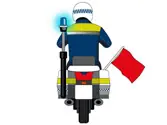
¿Qué está indicando un agente con una bandera roja en su vehículo?
What is a traffic officer indicating with a red flag on their vehicle?
- AQue los conductores deben extremar la precaución.That drivers must take extreme care.
- BQue la calzada queda temporalmente cerrada al tráfico.That the carriageway is temporarily closed to traffic.
- CQue a partir del paso del vehículo la calzada queda abierta el tráfico.That once the vehicle has passed, the carriageway is open to traffic.
ExplanationA traffic officer with a red flag on their vehicle shows that once they have passed, the carriageway is temporarily closed to all vehicles and road users, except those escorted by officers. You must wait for another officer with a green flag on their vehicle to pass, after which the carriageway will be open to traffic again.
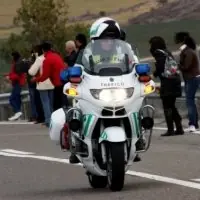
Si detrás de su vehículo se sitúa un agente en una motocicleta que lleva encendido el dispositivo que emite luz roja intermitente, ¿qué debe hacer?
If a police officer on a motorcycle with its flashing red light on moves in behind your vehicle, what must you do?
- AContinuar circulando hasta que el agente no emplee la megafonía.Keep driving until the officer uses the loudspeaker.
- BDetenerse cuando pueda y salir del vehículo inmediatamente.Stop when you can and get out of the vehicle immediately.
- CDetenerse en el lado derecho de la calzada, delante del vehículo policial.Stop on the right-hand side of the carriageway, in front of the police vehicle.
ExplanationA flashing red light on a police vehicle behind you orders you to stop. You must do so on the right-hand side of the carriageway, in front of the police vehicle, in a safe place, and wait inside your vehicle for the officer's instructions.
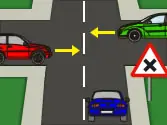
El vehículo que se encuentra la señal, ¿a quién tendrá que ceder el paso?
Who must the vehicle that finds this sign give way to?
- AA todos los vehículos que se acerquen por la vía transversal.To all vehicles approaching on the crossing road.
- BSólo al vehículo que se le acerca por la derecha.Only to the vehicle approaching from its right.
- CA ningún vehículo, tiene prioridad de paso.To no vehicle; it has right of way.
ExplanationThe sign indicates a junction with priority to the right. At this junction, therefore, the general right-of-way rule applies: priority must be given to the vehicle coming from the right.
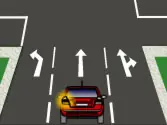
Las flechas de selección de carril...
Lane selection arrows...
- Aobligan a seguir las direcciones indicadas por las flechas, prohibiendo siempre el cambio de carril.require you to follow the directions shown by the arrows and always prohibit changing lanes.
- Baconsejan seguir las direcciones indicadas por las flechas.advise you to follow the directions shown by the arrows.
- Cobligan a seguir la dirección o las direcciones indicadas, pero si la señalización lo permite autorizan el cambio de carril.require you to follow the direction or directions shown, but allow you to change lanes if the road markings permit it.
ExplanationLane selection arrows are road markings, so road users must obey them. Depending on how they are drawn, these arrows require you to follow the direction or directions shown. If the markings allow it, for example with a broken line, you may change lanes; with a continuous line, you may not.
En una vía urbana de sentido único en la que no hay señalización que prohíba estacionar ni marcas viales en la calzada, ¿en qué lado está permitido el estacionamiento?
On a one-way urban road where there are no signs prohibiting parking and no road markings on the carriageway, on which side is parking permitted?
- AEn el lado derecho solamente.On the right-hand side only.
- BEn ambos lados, tanto en el derecho como en el izquierdo.On both sides, right and left.
- CEn el lado izquierdo solamente.On the left-hand side only.
ExplanationIn urban areas, parking is permitted both on the carriageway and on the hard shoulder, even if it is usable, provided that a clear space of at least 3 metres is left. On one-way roads, you may park on both sides. However, if the road is two-way, parking is permitted only on the right-hand side. On interurban roads, on the other hand, parking must be done off the carriageway and off the usable part of the hard shoulder. Even on one-way roads there, parking is limited to the right-hand side.
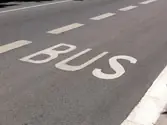
En el tramo del carril BUS en que la marca blanca longitudinal esté constituida por una línea discontinua se permite su utilización general exclusivamente para realizar alguna maniobra ...
On the section of a BUS lane where the white longitudinal marking is a broken line, general use is permitted only to carry out a manoeuvre...
- Aque no sea la de parar, estacionar, cambiar el sentido de la marcha o adelantar.other than stopping, parking, making a U-turn or overtaking.
- Bque no sea estacionar o cambiar el sentido, aunque se permite parar.other than parking or making a U-turn, although stopping is permitted.
- Cque sea parar, estacionar, cambiar el sentido de la marcha o adelantar.that consists of stopping, parking, making a U-turn or overtaking.
ExplanationOn the sections of these lanes where the white longitudinal marking is a broken line, general use is permitted only to carry out a manoeuvre other than stopping, parking, making a U-turn or overtaking, always giving priority to buses and, where applicable, taxis.
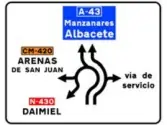
Esta señal indica que en la próxima glorieta:
This sign indicates that at the next roundabout:
- ASe muestran las direcciones de las salidas y el carril adecuado para cada movimiento.The directions of the exits and the correct lane for each movement are shown.
- BTodos los carriles de la glorieta son indistintos y se puede salir desde cualquiera.All the lanes of the roundabout are the same and you can exit from any of them.
- CLa glorieta tiene un solo carril y no requiere selección de carriles.The roundabout has only one lane and no lane selection is needed.
ExplanationThe sign warns of a roundabout ahead and shows the different exits and the lane each vehicle must use according to the direction it wants to take. This makes it possible to organise traffic before entering, reduce conflicts and avoid sudden lane changes inside the roundabout, improving safety and traffic flow.
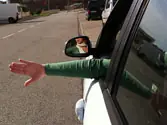
¿Qué está indicando este conductor con el brazo?
What is this driver indicating with their arm?
- AQue va a ir marcha atrás.That they are going to reverse.
- BQue va a empezar a circular.That they are going to move off.
- CQue va a girar a la izquierda.That they are going to turn left.
ExplanationWhen you are going to reverse, you must signal it with the reversing light or with the arm stretched out horizontally and the palm of the hand facing backwards, as shown in the photograph.
Una línea longitudinal discontinua en la calzada, ¿qué permite?
What does a broken longitudinal line on the carriageway allow?
- ARebasarla con precaución cuando la maniobra sea seguraCrossing it with caution when the manoeuvre is safe
- BRebasarla siempre sin ninguna precauciónAlways crossing it without any caution
- CNo rebasarla en ningún casoNever crossing it
ExplanationA broken line may be crossed when road safety allows; a continuous line, on the other hand, may not be crossed.
¿Qué indica un semáforo con una flecha negra sobre una luz amarilla fija?
What does a traffic light with a black arrow on a steady amber light indicate?
- ANada, porque la flecha negra sólo puede estar sobre fondo amarillo-intermitente.Nothing, because a black arrow can only be shown on a flashing amber background.
- BQue los vehículos que pretenden avanzar en la dirección de la flecha pueden hacerlo, pero con precaución.That vehicles intending to go in the direction of the arrow may do so, but with caution.
- CQue los vehículos que avancen en la dirección de la flecha deben detenerse, como si de una luz roja se tratase, a no ser que, cuando se encienda, el vehículo se encuentre tan cerca del lugar de detención que no pueda detenerse antes del mismo en condiciones de seguridad suficientes.That vehicles going in the direction of the arrow must stop, as if it were a red light, unless, when it comes on, the vehicle is so close to the stopping point that it cannot stop before it with sufficient safety.
ExplanationUnder Annex I of the General Traffic Regulations (RGC), a black arrow on an amber light does not change its meaning but limits it to the movement shown by the arrow: those going in that direction must stop as at a steady red light, unless they cannot do so safely.
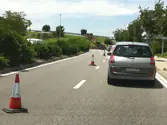
Los conos colocados en la calzada, ¿qué indican?
What do the cones placed on the carriageway indicate?
- AEl sentido de la circulación.The direction of traffic.
- BPermiten atravesar la línea real o imaginaria que los une, pero con precaución.You may cross the real or imaginary line joining them, but with care.
- CProhíben atravesar la línea real o imaginaria que los une.You must not cross the real or imaginary line joining them.
ExplanationCones or similar devices prohibit crossing the line, real or imaginary, that joins them. They are temporary signs and take precedence over all other signs, except orders from traffic officers.
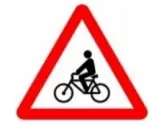
¿Qué indica esta señal de advertencia?
What does this warning sign show?
- ALa proximidad de un paso para ciclistas.That you are approaching a cyclist crossing.
- BLa proximidad de un tramo con circulación frecuente de ciclistas.That you are approaching a stretch where cyclists often ride.
- CLa obligación de circular por un carril bici.An obligation to use a cycle lane.
ExplanationThis sign warns the driver that they are going to drive through an area where cyclists are often on the carriageway. Its aim is for the driver to slow down, pay more attention and keep a safe distance when overtaking them. It does not refer to a cyclist crossing (a specific crossing point) or to a cycle lane (a lane reserved only for bicycles).
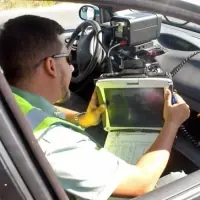
¿Pueden los Agentes de Circulación dar órdenes desde su vehículo?
May traffic officers give orders from their vehicle?
- ASi, pero solo podrán advertir a bicicletasYes, but they may only warn cyclists.
- BSíYes.
- CNoNo.
ExplanationTraffic officers may give orders to other road users from their vehicle when necessary. They can do so whether they are on a motorcycle or in any other type of vehicle.
Indica el orden de prioridad de los siguientes tipos de señales:
Indicate the order of priority of the following types of signs:
- AAgentes, semáforos, circunstancial.Traffic officers, traffic lights, temporary signs.
- BVerticales, semáforos, marcas viales.Road signs, traffic lights, road markings.
- CAgentes, circunstanciales, semáforos.Traffic officers, temporary signs, traffic lights.
ExplanationThe order of priority between the different types of signs is: traffic officers, temporary signs, traffic lights, road signs and road markings.
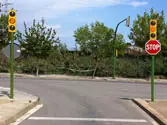
¿Dónde deberá detener su vehículo, en cumplimiento de la señalización?
Where must you stop your vehicle to comply with the signs?
- AAnte la línea transversal de detención.At the transverse stop line.
- BAl borde de la vía transversal.At the edge of the road you are crossing.
- CEn el primer lugar desde donde disponga de visibilidad.At the first place from which you have visibility.
ExplanationAt a stop sign you must stop at the transverse stop line and, if there is none, immediately before the carriageway you are going to cross. Then move forward carefully until you can see and give way to traffic on that road.
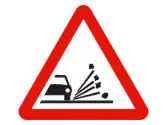
A la vista de esta señal, ¿cómo actuarás?
When you see this sign, what will you do?
- AExtremaré la precaución por congestión en la calzada.I will take extra care because of congestion on the carriageway.
- BAumentaré la distancia con el vehículo que me precede.I will increase the distance from the vehicle in front.
- CAumentaré la distancia con el vehículo que me sigue para no salpicarle gravilla.I will increase the distance from the vehicle behind so as not to spray it with gravel.
ExplanationThis is sign P-28, loose chippings: it warns of a stretch where there is a risk of gravel being thrown up as vehicles pass. You should increase the distance from the vehicle in front so that the gravel it throws up does not hit you.
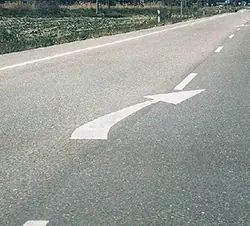
¿Qué indica la flecha?
What does the arrow indicate?
- AQue hay una curva a la derecha.That there is a bend to the right.
- BQue hay un carril de salida a la derecha.That there is an exit lane on the right.
- CQue me acerco a una línea continua.That I am approaching a solid line.
ExplanationThis is the return arrow: a road marking warning that a solid line is coming up, so anyone overtaking must return to their lane as soon as possible.
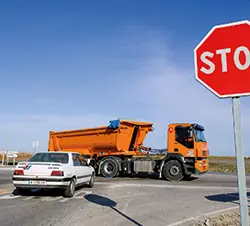
Si se encuentra detenido ante una señal de stop, ¿puede utilizar su teléfono móvil?
If you are stopped at a STOP sign, may you use your mobile phone?
- ANo, de ninguna manera.No, under no circumstances.
- BSolo con un dispositivo de manos libres y sin utilizar cascos o auriculares.Only with a hands-free device and without using a headset or earphones.
- CSí, ya que el vehículo está detenido.Yes, because the vehicle is stopped.
ExplanationBeing stopped at a STOP sign still counts as driving. The General Traffic Regulations (RGC) prohibit using a mobile phone while driving, unless the communication takes place without using your hands and without a headset or earphones, for example with a hands-free system built into the vehicle.
El carril por el que Ud. circula está delimitado, en su lado izquierdo, por una línea longitudinal discontinua de trazos más anchos que en el caso general. ¿Qué significa?
The lane you are driving in is marked on its left side by a broken longitudinal line with wider dashes than usual. What does this mean?
- AQue es un carril reversible.That it is a reversible lane.
- BQue está prohibido cambiar de carril.That changing lanes is prohibited.
- CQue circula por un carril especial.That you are driving in a special lane.
ExplanationUnder the road-marking catalogue in Annex I of the RGC, a broken line with wider dashes separates a special lane, such as a speed-change lane, a lane reserved for certain vehicles or an additional lane, from the normal lanes. It may be crossed for permitted manoeuvres.
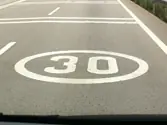
¿Cuándo termina la limitación de velocidad que impone esta señal?
When does the speed limit imposed by this sign end?
- ACuando salga de la travesía.When you leave the travesía (stretch of road through a town).
- BCuando encuentre una señal de fin de prohibiciones.When you find an end-of-all-restrictions sign.
- CAl rebasar el siguiente cruce.When you pass the next junction.
ExplanationMaximum speed. This prohibits driving faster than the speed shown on the sign, in kilometres per hour. It applies from where it is placed until the next “End of speed limit” sign, “End of all restrictions” sign or another “Maximum speed” sign. If it is placed on a non-priority road, it stops applying when you leave a junction with a priority road. If the sign painted on the road surface is in a lane marked out by lines, as in the photo in the question, that maximum speed applies only to that lane; if the lanes are not marked out, it applies to the whole carriageway.
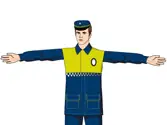
A la vista de la señal que realiza el agente, ¿cuándo podrá reanudar la marcha?
Given the signal the traffic officer is making, when may you move off again?
- ACuando baje los brazos.When the officer lowers their arms.
- BSólo cuando lo indique con otra señal.Only when the officer indicates it with another signal.
- CSólo cuando cambie de posición o efectúe otra señal.Only when the officer changes position or makes another signal.
ExplanationWith one or both arms stretched out horizontally, the traffic officer requires those approaching from directions that cross the one shown by the arms to stop. The signal remains in force even if the officer lowers their arms, as long as they do not change position or make another signal.
En caso de contradicción entre la indicación de un semáforo y la orden de los agentes de circulación, ¿qué haremos?
If a traffic light and the instructions of traffic officers contradict each other, what should we do?
- AObedecer las indicaciones del semáforo.Obey the traffic light.
- BObedecer siempre la orden del agente de circulación.Always obey the traffic officer's instructions.
- CAtender al mensaje más restrictivo.Follow whichever message is more restrictive.
ExplanationUnder Article 133.1 of the General Traffic Regulations (RGC), the signals and instructions of officers come first in the order of precedence, ahead of temporary signs, traffic lights, road signs and road markings. If they contradict each other, the officer's instructions apply.
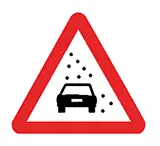
Esta señal indica peligro por...
This sign warns of danger due to...
- APavimento deslizante por nieve.a road surface made slippery by snow.
- BLa proximidad de un tramo de vía con visibilidad reducida por niebla, lluvia o nieve.an approaching stretch of road with reduced visibility due to fog, rain or snow.
- CLa proximidad de un tramo de la vía con desprendimientos frecuentes y la presencia de obstáculos en la calzada.an approaching stretch of road with frequent rockfalls and obstacles on the carriageway.
ExplanationThis is the reduced visibility warning sign: it warns of a stretch where fog, rain, snow or smoke can make it hard to see, so you should slow down and increase your distance.
Una señal de reglamentación colocada al lado de una señal que indique el nombre del poblado, será de aplicación...
A regulatory sign placed next to a sign showing the name of a town applies...
- AEn todo el poblado.Throughout the town.
- BSolo hasta la próxima intersección.Only up to the next junction.
- CSolo en la vía en la que la encontramos.Only on the road where you find it.
ExplanationA regulatory sign placed next to, or directly above or below, another sign showing the name of the town means that the rule applies throughout the town, except where a different rule is shown in the town.
Esta señal horizontal sobre el pavimento indica...
This marking on the road surface indicates...
- ALa velocidad máxima a la que se puede circular por este carril.The maximum speed at which you may drive in this lane.
- BLa velocidad máxima a la que se podrá circular por esta vía.The maximum speed at which you may drive on this road.
- CLa velocidad mínima a la que se tiene que circular por este carril.The minimum speed at which you must drive in this lane.
ExplanationAs the marking is in a lane bounded by longitudinal lines, the maximum speed limit applies only to vehicles travelling in that lane. If the lanes were not marked out, the maximum speed would apply to the whole carriageway.
En caso de contradicción entre señales, ¿a cuál tendremos que obedecer?
If signs contradict each other, which one will we have to obey?
- AA la más restrictiva.The most restrictive one.
- BA la más prioritaria.The one with the highest priority.
- CA la menos restrictiva.The least restrictive one.
ExplanationIf signs contradict each other, we will obey the one with the highest priority. If they have the same priority, we will obey the most restrictive one.
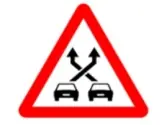
Esta señal se coloca habitualmente en:
This sign is usually placed on:
- ATramos de autopista o autovía donde existen incorporaciones y salidas próximas.Stretches of motorway (autopista) or dual carriageway (autovía) with entries and exits close together.
- BCalles urbanas de un solo sentido.One-way urban streets.
- CCruces regulados por semáforo en ciudad.Junctions controlled by traffic lights in town.
ExplanationThe risk stretch that is signed corresponds to weaving areas typical of motorways and dual carriageways, where entries and exits close together force many vehicles to change lanes in a short space. It is not a sign used on urban roads or at junctions with traffic lights.
Si en una intersección nos encontramos a un agente con el brazo levantado verticalmente, ¿qué debemos hacer?
If at a junction we find an officer with one arm raised vertically, what must we do?
- ADetenerse.Stop.
- BContinuar la marcha.Carry on.
- CDisminuir la velocidad.Slow down.
ExplanationUnder section 1.1 of Annex I of the General Traffic Regulations (RGC), an arm raised vertically requires all road users approaching the officer to stop. At a junction you must stop before entering it; only those who were already inside it may continue.
¿Qué indica un agente balanceando una luz roja?
What does a traffic officer swinging a red light indicate?
- AObliga a disminuir la velocidad.You must slow down.
- BObliga a detenerse a los usuarios de la vía a los que dirija la luz.Road users towards whom the officer points the light must stop.
- CObliga a extremar la precaución y ceder el paso.You must take extreme care and give way.
ExplanationWhen a police officer swings a red or yellow light, road users towards whom the light is pointed must stop. It is not just a warning to slow down: anyone receiving the signal must stop.
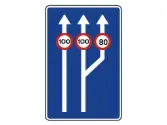
La señal indica el paso de dos a tres carriles de circulación y además...
This sign shows that two lanes become three and also...
- ALa velocidad máxima en cada uno de ellos.The maximum speed in each of them.
- BLa velocidad mínima en cada uno de ellos.The minimum speed in each of them.
- CLa velocidad máxima aconsejada en cada uno de ellos.The recommended maximum speed in each of them.
ExplanationThe sign in the picture shows that the carriageway goes from two to three lanes and, with the red-bordered circles, the maximum speed allowed in each of them. If they were minimum speeds, the numbers would appear in blue circles.
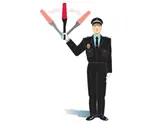
Respecto al orden correcto de prioridad de las señales será...
What is the correct order of priority of road signals?
- ASeñales de los agentes, semáforos, balizamiento, verticales y marcas viales.Traffic officers' signals, traffic lights, beacons, road signs and road markings.
- BSeñales de los agentes, semáforos, verticales, balizamiento y marcas viales.Traffic officers' signals, traffic lights, road signs, beacons and road markings.
- CSeñales de los agentes, señalización circunstancial, semáforos, verticales y marcas viales.Traffic officers' signals, temporary signs, traffic lights, road signs and road markings.
ExplanationUnder Article 133 of the RGC, the order of priority is: traffic officers, temporary signs and beacons, traffic lights, road signs and, lastly, road markings. Between signals of the same type, the most restrictive one prevails.
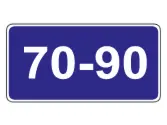
Esta señal significa intervalo...
This sign means a range of...
- Aaconsejado de velocidades, aunque las condiciones sean desfavorables.advisory speeds, even if conditions are unfavourable.
- Baconsejado de velocidades, siempre que las condiciones sean favorables.advisory speeds, provided that conditions are favourable.
- Cobligatorio de velocidades, siempre que las condiciones sean favorables.compulsory speeds, provided that conditions are favourable.
ExplanationThe sign recommends keeping your speed between the values shown, provided that weather, road and traffic conditions are favourable. When it is placed under a danger warning sign, the recommendation refers to the stretch where that danger exists.
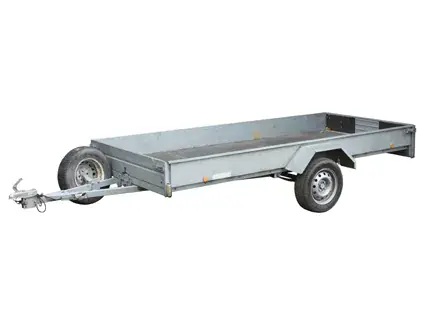
¿Qué remolques deben llevar señalización de frenado?
Which trailers must have brake lights?
- ATodos.All of them.
- BLos que tengan más de 1,50 metros de ancho.Those more than 1.50 metres wide.
- CÚnicamente los no ligeros.Only those that are not light trailers.
ExplanationAll trailers must have brake lights. This matters for road safety, because it lets other drivers know when the vehicle is braking.
Ante un Agente de Tráfico que balancea una luz roja o amarilla con su mano.¿ Qué nos indíca?
A traffic officer is swinging a red or amber light in their hand. What does this indicate?
- AIndica al resto de los conductores y usuarios la necesidad de extremar la atención o la proximidad de un peligro.It tells other drivers and road users to take extra care or that there is a danger nearby.
- BObliga a detenerse a los usuarios de la vía hacia los que el agente dirija la luz.Road users towards whom the officer directs the light must stop.
- CIndica que la calzada queda temporalmente cerrada al tráfico de todos los vehículos y usuarios.It indicates that the carriageway is temporarily closed to all vehicles and road users.
ExplanationAccording to the traffic officers' signals in Annex I of the RGC, swinging a red or amber light requires road users towards whom the officer directs the light to stop. A yellow flag indicates danger, and a red flag a closed carriageway.
¿Qué significa una marca longitudinal constituida por dos líneas continuas paralelas?
What does a longitudinal marking made up of two parallel continuous lines mean?
- AUn carril reversible.A reversible lane.
- BLo mismo que una línea continua.The same as a continuous line.
- CUn carril en sentido contrario al habitual.A lane running in the opposite direction to the usual one.
ExplanationAccording to the catalogue of road markings in annex I of the RGC, a marking made up of two parallel continuous lines means the same as a single continuous line: you may not cross it or drive on it, or drive to its left when it separates the directions of traffic.
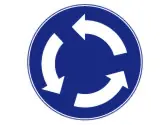
A la vista de esta señal, ¿qué podemos hacer?
Given this sign, what can we do?
- ACambiar de sentido o de dirección.Make a U-turn or turn off.
- BCambiar de sentido sólo.Only make a U-turn.
- CCambiar de dirección sólo.Only turn off.
ExplanationThe sign indicates a junction with compulsory circular traffic (a roundabout). At this junction you may turn off and also make a U-turn, as it is a suitable place to do so.
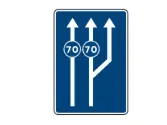
Si circulamos a velocidad superior a la indicada por la señal, ¿qué carril utilizaremos por norma general?
If you are driving faster than the speed shown on the sign, which lane should you use as a general rule?
- AIndistintamente por cualquier carril.Any lane.
- BPor el carril más próximo al lado derecho.The lane closest to the right-hand side.
- CPor el primer o segundo carril.The first or second lane.
ExplanationIf circumstances allow, you must drive in the right-hand lane; you may use the other two lanes to overtake or when traffic or road conditions make it advisable.
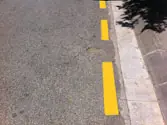
¿Qué significa una línea discontinua de color amarillo junto al borde de la calzada?
What does a broken yellow line along the edge of the carriageway mean?
- AQue está prohibida la parada.That stopping is prohibited.
- BQue está prohibido el estacionamiento.That parking is prohibited.
- CQue está prohibido rebasarla.That crossing it is prohibited.
ExplanationA broken yellow line prohibits parking but allows stopping.
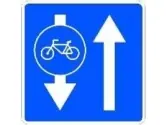
¿Quién puede circular por este carril en sentido opuesto al tráfico contiguo?
Who may use this lane in the opposite direction to the adjacent traffic?
- ASolo las bicicletas.Only bicycles.
- BBicicletas y ciclomotores.Bicycles and mopeds.
- CCualquier vehículo de dos ruedas.Any two-wheeled vehicle.
ExplanationThe sign in the picture shows a compulsory lane for cycles whose direction of travel is opposite to that of the adjacent lane. The round sign with a bicycle symbol shows that the lane is reserved only for cycles, and other road users are prohibited from using it.
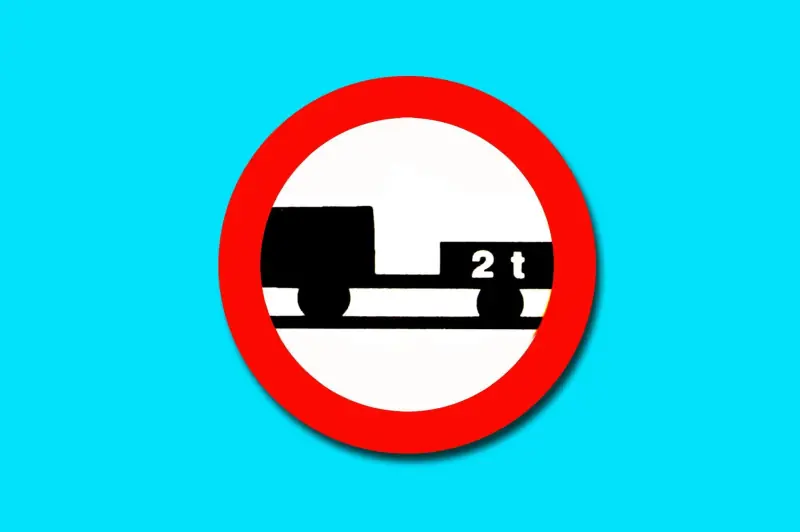
El conductor de un turismo con remolque, ¿puede entrar en una vía con esta señal?
May the driver of a car towing a trailer enter a road with this sign?
- ANo, con ningún vehículo que arrastre un remolque.No, not with any vehicle towing a trailer.
- BSí, cuando el remolque tenga un solo eje.Yes, when the trailer has a single axle.
- CSi, con cualquier conjunto de vehículos.Yes, with any combination of vehicles.
ExplanationSign R-112 prohibits entry to motor vehicles towing a trailer, except single-axle trailers, so you may enter with a single-axle trailer. The figure of 2 t also limits the prohibition to trailers whose maximum authorised mass exceeds that value.
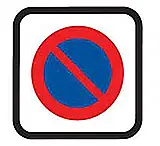
Esta señal vertical, ¿qué significa?
What does this road sign mean?
- AZona de estacionamiento limitado.Limited parking zone.
- BEstacionamiento prohibido en vado.No parking in front of a driveway entrance.
- CEstacionamiento prohibido.No parking.
ExplanationThis sign marks the entrance to a limited parking zone: there you may only park within the time limits set by the local bylaw, usually with a ticket or permit. The general parking ban is shown by the round sign without the white square panel.
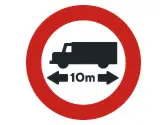
Si conducimos un conjunto de vehículos que mide 11 metros, ¿podremos pasar a partir de esta señal?
If you are driving a vehicle combination 11 metres long, may you go past this sign?
- ASí, si no conduzco un camión.Yes, if I am not driving a lorry.
- BNo.No.
- CSí, porque la señal solo afecta a los vehículos no a los conjuntos.Yes, because the sign only applies to vehicles, not to combinations.
ExplanationThe sign prohibits passage to vehicles or vehicle combinations, not only lorries, whose overall length is more than 10 metres. So an 11-metre vehicle combination may not go past this sign.
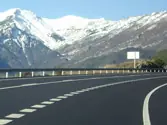
La línea longitudinal discontinua ancha, ¿qué indica?
What does a wide broken longitudinal line indicate?
- ALa existencia de un carril especial.That there is a special lane.
- BLa proximidad de una línea continua.That a solid line is close.
- CLa existencia de un carril reversible.That there is a reversible lane.
ExplanationA broken longitudinal line with dashes wider than normal separates a special lane, such as an acceleration or deceleration lane or an additional lane for slow vehicles, from the rest of the carriageway. It may be crossed, but it warns that this lane has a different use.
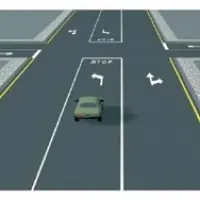
¿Qué debe realizar un vehículo ante una señal de stop marcada sobre la calzada?
What must a vehicle do at a STOP marking painted on the carriageway?
- ADetenerse y ceder el paso a los vehículos que se aproximan por la izquierdaStop and give way to vehicles approaching from the left
- BDetenerse y ceder el paso a los vehículos que se aproximan por la derechaStop and give way to vehicles approaching from the right
- CDetenerse y ceder el paso a ambos lados de la calzadaStop and give way to vehicles approaching from both sides
ExplanationThe STOP road marking tells drivers that they must stop at the next stop line or, if there is none, immediately before the carriageway they are approaching, and first give way to vehicles travelling on that carriageway from both sides.
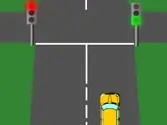
El semáforo de la derecha está verde y el de la izquierda está rojo. ¿Qué debe hacer para continuar de frente?
The traffic light on the right is green and the one on the left is red. What must you do to go straight on?
- AEsperar a que se ponga verde el de la izquierda.Wait for the one on the left to turn green.
- BEsperar a que se pongan los dos verdes.Wait for both of them to turn green.
- CSeguir de frente porque me lo permite el de la derecha.Go straight on, because the one on the right allows me to.
ExplanationAccording to Article 132.3 of the RGC, if there are traffic lights showing different signals on the right and on the left, anyone who intends to go straight on or turn left must only obey the one immediately to their left. That is why you must wait for the one on the left to turn green.
All topics
- Definitions
- Documents and penalty points
- The driver's condition
- Duties of drivers and pedestrians
- Vehicle safety devices
- Vehicle controls and equipment
- Vehicle lights and horn
- The road and its lanes
- Speed and distances
- Manoeuvres
- Right of way
- Carrying passengers and loads
- Driving safely in difficult conditions
- Vehicle mechanics and maintenance
- Road accidents and first aid
- Defensive and eco-driving
Independent app: not affiliated with or endorsed by the DGT (Spain's Directorate-General for Traffic) or the Ministry of the Interior. The official exam is booked with the DGT and taken at its test centres. The questions here are practice material; the DGT's official question bank is not public.
Basado en datos de la Agencia Estatal Boletín Oficial del Estado (https://www.boe.es). Textos consolidados de carácter meramente informativo. La AEBOE no patrocina ni respalda este sitio.
Parte de las preguntas procede de los tests de la revista «Tráfico y Seguridad Vial» de la DGT, reproducidos con indicación de la fuente.