
DGT test · 1,397 questions
Traffic signs, markings and signals · Page 16 of 28
Road signs, road markings, traffic lights, police signals and temporary markings: what they mean and which one wins when they disagree. The topic with the most questions in the bank.
Questions in this topic, with answers
1,397 questions, 50 per page, with the correct answer and the explanation. Page 16 of 28.
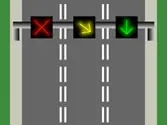
¿Qué indica la luz amarilla en forma de flecha colocada encima del carril y apuntando hacia abajo en forma oblicua?
What does an amber arrow-shaped light placed above the lane and pointing diagonally downwards show?
- AQue está prohibido ocupar el carril indicado por la flecha.That using the lane shown by the arrow is prohibited.
- BQue está permitido ocupar el carril indicado por la flecha.That using the lane shown by the arrow is allowed.
- CLa necesidad de irse incorporando al carril hacia el que apunta la flecha.That you need to start moving into the lane the arrow points to.
ExplanationA white or amber arrow-shaped light, flashing or steady, placed above a lane and pointing diagonally downwards tells road users that they need to start moving safely into the lane the arrow points to, because the lane they are in will close shortly.
Si el conductor que va delante indica con el intermitente que va a girar a la izquierda, pero con el brazo muestra que va a girar a la derecha, ¿a cuál señal prestaremos atención?
If the driver in front signals with the indicator that they are going to turn left but shows with their arm that they are going to turn right, which signal should we pay attention to?
- AA la que haya realizado en primer lugar.The one they gave first.
- BAl indicador de dirección.The indicator.
- CAl brazo.The arm signal.
ExplanationThe DGT manual states that arm signals carry more weight than light signals, as long as they are given properly and other drivers can see them. So if the indicator and the arm show different manoeuvres, follow the arm signal, with caution.
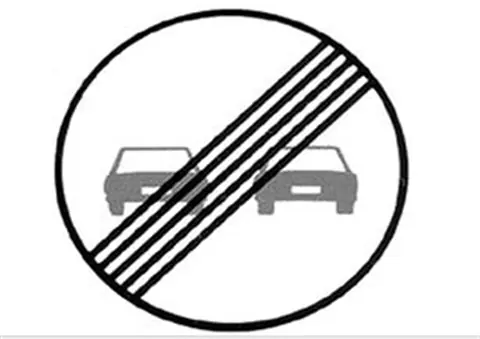
A partir de esta señal, ¿puede adelantar?
After this sign, may you overtake?
- ANo, sólo indica el fin de la prohibición de adelantamiento para camiones.No, it only indicates the end of the overtaking ban for lorries.
- BNo, sólo recuerda que la prohibición de adelantar sigue vigente.No, it only reminds you that the overtaking ban still applies.
- CSí, indica el fin de la prohibición de adelantamiento.Yes, it indicates the end of the overtaking ban.
ExplanationThe round white sign with two grey cars and black diagonal stripes indicates the end of the overtaking ban. After it you may overtake again, as long as you follow the other overtaking rules.
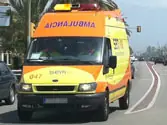
¿Está permitido que los vehículos prioritarios en servicio urgente hagan uso solamente de la señal luminosa?
Are priority (emergency) vehicles on an emergency call allowed to use only the light signal?
- ASí, cuando no suponga un peligro para los demás usuarios.Yes, when this does not create a danger for other road users.
- BNo, tienen que utilizar simultáneamente la señal luminosa y la acústica.No, they must use the light signal and the sound signal at the same time.
- CSólo en vías urbanas; en vías interurbanas deben usar siempre la señal acústica.Only on urban roads; on roads outside built-up areas they must always use the sound signal.
ExplanationPriority vehicles on an emergency call announce their presence with the light signal and the sound signal together, but they must use only the light signal when leaving out the sound signal is not dangerous for other road users (article 68.2 of the RGC). Even so, you must give way to them.
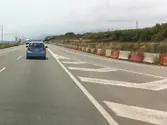
¿Se podrá circular sobre un cebreado?
May you drive on a hatched area?
- ANo, en ningún caso.No, never.
- BSí, como norma generalYes, as a general rule.
- CSí, los obligados a circular por el arcén.Yes, vehicles that must use the hard shoulder.
ExplanationVehicles travelling on the hard shoulder that find the hatched area as an extension of it may, as an exception, drive on it.
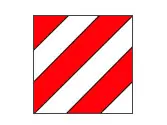
Si su turismo lleva carga que sobresale por la parte posterior, ¿tendrá que señalizarla con este panel?
If your car is carrying a load that sticks out beyond the rear, must you mark it with this panel?
- ANo, este panel sólo lo usarán los camiones.No, only lorries use this panel.
- BSí, es obligatorio.Yes, it is compulsory.
- CEl uso de este panel es aconsejable, no obligatorio.Using this panel is advisable, not compulsory.
ExplanationThe panel showing a load that sticks out beyond the rear of the vehicle is compulsory on all vehicles, except those less than 1 metre wide, and no other device can replace it. When the load sticks out along the whole width of the rear of the vehicle, two panels are fitted and their stripes form an inverted ‘V’. Between sunset and sunrise, or in weather or environmental conditions that noticeably reduce visibility, it must be marked with the panel and with a red light. So if a car is carrying a load that sticks out beyond the rear, it must be marked correctly with this panel.
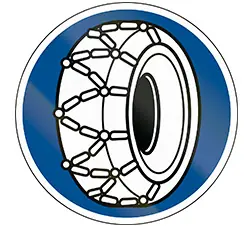
Esta señal, ¿prohíbe proseguir la marcha si no dispone de cadenas para nieve?
Does this sign prohibit you from continuing if you do not have snow chains?
- ASí, en cualquier caso.Yes, in all cases.
- BNo, ya que esta señal solo recomienda la utilización de cadenas.No, because this sign only recommends using chains.
- CSí, a no ser que disponga de otros dispositivos autorizados, igual de eficaces.Yes, unless you have other approved devices that are just as effective.
ExplanationThe snow chains sign means you must not continue without anti-skid devices: chains or other approved devices that are just as effective, such as approved snow socks or winter tyres.
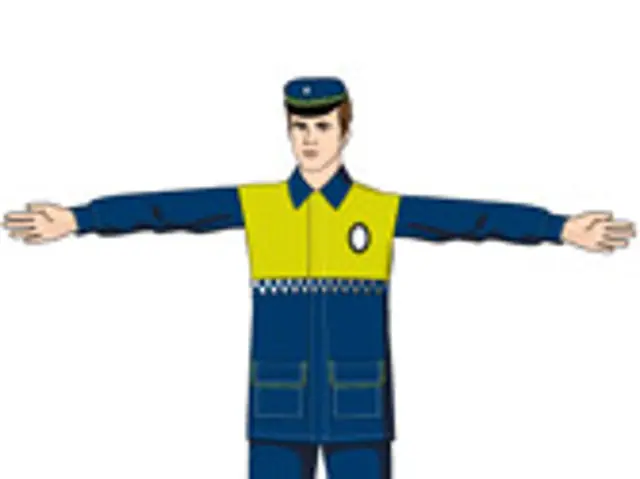
¿Qué indica un agente de tráfico con los brazos extendidos horizontalmente?
What does a traffic officer with arms stretched out horizontally indicate?
- ALos vehículos que se acerquen al agente, por delante o por detrás, deben detenerse.Vehicles approaching the officer from the front or from behind must stop.
- BPermite el paso a los vehículos que se aproximen de frente al agente.It allows vehicles approaching the officer from the front to pass.
- CProhíbe el paso a todos los usuarios de la vía.It prohibits all road users from passing.
ExplanationUnder section 1.1 of Annex I of the RGC, an officer with arms stretched out horizontally requires all road users approaching from directions that cross that of the arms to stop, that is, those arriving from in front of or behind the officer.
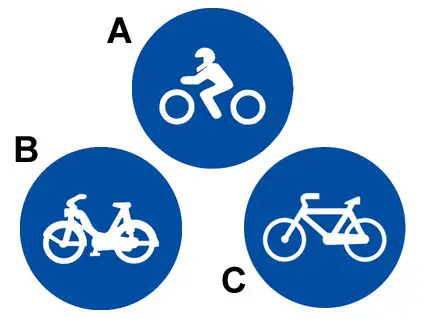
El conductor de un ciclomotor está obligado a circular por una vía indicada con...
A moped rider must ride on a road marked with...
- ALa señal a.Sign a.
- BLa señal b.Sign b.
- CLa señal c.Sign c.
ExplanationIn the picture, sign B, round and blue with a moped symbol, marks a road reserved for mopeds and requires moped riders to use it. The other two refer to motorcycles (A) and bicycles (C).
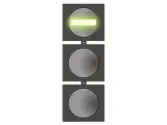
¿Qué significado tiene una franja blanca horizontal en un semáforo?
What does a horizontal white bar on a traffic light mean?
- APermite el paso a los tranvías y autobuses.It allows trams and buses to go through.
- BProhíbe el paso a los tranvías y autobuses.It prohibits trams and buses from going through.
- CPermite el paso a los tranvías y autobuses pero solamente si siguen de frente.It allows trams and buses to go through, but only if they go straight ahead.
ExplanationA traffic light consisting of a lit white bar on a round black background applies only to trams and scheduled buses, unless there is a lane reserved for buses, or for buses, taxis and other vehicles, in which case it refers only to those travelling in it. When the white bar is horizontal, it prohibits going through in the same way as a steady red light.
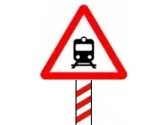
Estas señales de advertencia de peligro le indican...
These danger warning signs indicate...
- ALa aproximación a un paso a nivel con barreras, lado derecho.That you are approaching a level crossing with barriers, right-hand side.
- BLa aproximación a un paso a nivel sin barreras, lado izquierdo.That you are approaching a level crossing without barriers, left-hand side.
- CLa aproximación a un paso a nivel sin barreras, lado derecho.That you are approaching a level crossing without barriers, right-hand side.
ExplanationThe marker post with three red stripes (P-9a) indicates a level crossing, movable bridge or quay about 200 m ahead and is placed on the right-hand side; together with sign P-8, showing a locomotive, it is a level crossing without barriers. With the stripes slanting the other way (P-10a), it would be on the left-hand side.
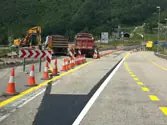
¿De qué color son las marcas viales en los tramos de obras?
What colour are road markings on stretches with roadworks?
- ANaranjas.Orange.
- BAmarillas.Yellow.
- CBlancas.White.
ExplanationOn stretches with roadworks, road markings are yellow and some road signs have a yellow background. They mean the same as the equivalent markings and signs used when there are no roadworks.
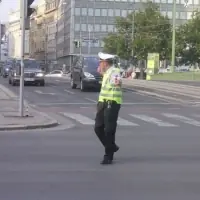
¿Qué característica de las siguientes tienen las señales de los Agentes de Circulación?
Which of the following is a feature of signals given by traffic officers?
- ASon siempre ejecutivasThey are always binding
- BNo es necesario obedecerlasThey do not have to be obeyed
- CSolo pueden ser de tipo ópticoThey can only be visual
ExplanationSignals given by traffic officers are executive, which means that all road users must comply with them. They take priority over road signs and traffic lights, and all drivers must obey them.
En caso de contradicción entre una señal vertical y una marca vial, ¿qué prevalece?
If a road sign and a road marking contradict each other, which takes precedence?
- ALa marca vial.The road marking.
- BLa señal vertical.The road sign.
- CLa que esté situada más cerca del conductor.Whichever is closer to the driver.
ExplanationUnder Article 133.1 of the General Traffic Regulations (RGC), the order of precedence is: officers, temporary signs, traffic lights, road signs and road markings. So if a road sign and a road marking contradict each other, the road sign takes precedence.
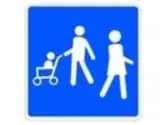
A partir de la señal que se muestra en la imagen, ¿qué indica?
What does the sign shown in the picture indicate?
- AUna zona reservada para el uso peatonal.An area reserved for pedestrian use.
- BUna calle donde solo pueden circular vehículos con prioridad.A street where only priority vehicles may drive.
- CEl inicio de un carril bici compartido con peatones.The start of a cycle lane shared with pedestrians.
ExplanationThe sign shown in the picture indicates that the area is reserved exclusively for pedestrian use, prohibiting motor vehicles inside it, except for authorised exceptions.
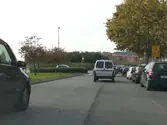
¿Por dónde está obligado a circular el conductor de un turismo, en una vía urbana de sentido único, si los carriles no están delimitados por marcas viales?
Where must the driver of a car drive on a one-way urban road if the lanes are not marked by road markings?
- APor el carril que mejor convenga a su destino.In the lane that best suits their destination.
- BPor el centro de la calzada.In the centre of the carriageway.
- CPor el carril derecho, pudiendo utilizar el resto cuando las circunstancias lo aconsejen.In the right-hand lane, and may use the others when circumstances make it advisable.
ExplanationWhen driving on a road where the lanes are not marked, we will drive only in the right-hand lane, and may use the others when circumstances make it advisable. If the road carries two-way traffic, we will never enter the half of the carriageway intended for oncoming traffic.
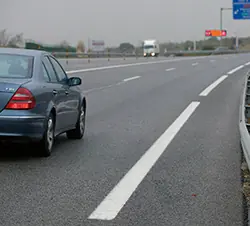
Salvo que exista señal que lo prohíba, por los arcenes de las autovías se permite circular…
Unless a sign prohibits it, the hard shoulder of dual carriageways (autovías) may be used by...
- AA peatones.pedestrians.
- BA vehículos de tracción animal.animal-drawn vehicles.
- CA conductores de bicicletas mayores de 14 años.cyclists over 14 years of age.
ExplanationThe Regulations allow cyclists over 14 to ride on the hard shoulder of dual carriageways (autovías) unless a sign prohibits it; pedestrians and animal-drawn vehicles are banned from these roads.
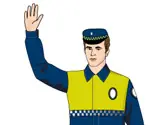
Si el agente levanta el brazo cuando ya hemos entrado en la intersección...
If the traffic officer raises an arm when you have already entered the junction...
- Anos obliga a detenernos en todo caso.you must stop in all cases.
- Bno obliga a detenernos.you do not have to stop.
- Cobliga solo a los vehículos que ven al agente de frente.it only applies to vehicles facing the officer.
ExplanationThe officer's signal does not apply to drivers who have already entered the junction; it only applies to vehicles that have not yet entered it.
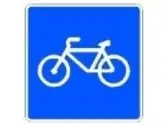
La señal que aparece en la imagen indica que la vía está destinada principalmente a:
The sign in the picture shows that the road is intended mainly for:
- ACiclistas, estando prohibida para cualquier otro vehículo.Cyclists, and it is prohibited for any other vehicle.
- BCiclistas y ciclomotores, mientras los turismos pueden usarla de forma ocasional.Cyclists and mopeds, while cars may use it occasionally.
- CTodos los usuarios de la vía, pero con preferencia para ciclistas.All road users, but with priority for cyclists.
ExplanationSign S-35 “Road reserved for cycles” tells you that the road is reserved only for cyclists and prohibits access to any other type of vehicle. This allows cyclists to ride safely. However, because it is a square information sign, it does not oblige cyclists to use it if they prefer to ride on the carriageway.
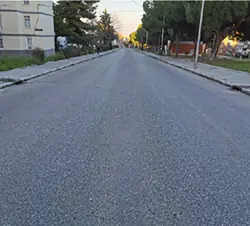
En esta calle de sentido único en la que no hay señalización que prohíba estacionar ni marcas viales en la calzada, ¿en qué lado está permitido el estacionamiento?
In this one-way street, where there are no signs prohibiting parking and no road markings on the carriageway, on which side is parking allowed?
- AEn el lado derecho solamente.On the right-hand side only.
- BEn ambos lados, tanto en el derecho como en el izquierdo.On both sides, right and left.
- CEn el lado izquierdo solamente.On the left-hand side only.
ExplanationIn one-way urban streets, parking is allowed on both sides of the carriageway, provided signs or markings do not prohibit it: as there is no oncoming traffic, the left-hand side can also be used.
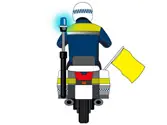
¿Qué significado tiene una bandera amarilla mostrada por un agente desde su vehículo?
What does a yellow flag shown by a traffic officer from their vehicle mean?
- AQue la calzada está temporalmente cerrada al tráfico.That the carriageway is temporarily closed to traffic.
- BExtremar la precaución.Take extreme care.
- CCalzada abierta al tráfico.Carriageway open to traffic.
ExplanationA yellow flag shown from a vehicle by traffic officers means that we must drive taking extreme care.
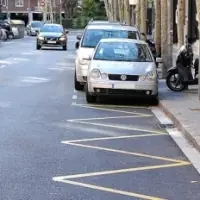
¿Qué prohíbe la marca vial de línea amarilla en zigzag junto al bordillo de la vía?
What does a yellow zigzag line marked next to the kerb prohibit?
- AEstacionamiento.Parking.
- BParada.Stopping.
- CParada y estacionamiento.Stopping and parking.
ExplanationA yellow zigzag line marked on the road next to the kerb shows the part of the carriageway where parking is prohibited because it is reserved for another purpose. It is generally used at bus stops and in loading and unloading areas.
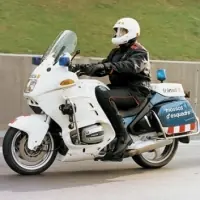
¿Dónde irán situadas la señal luminosa de vehículo prioritario en una motocicleta?
Where must the priority-vehicle warning light be placed on a motorcycle?
- ASobre un cabeza fijo situado en el lugar más bajoOn a fixed mount placed at the lowest point
- BSobre un cabezal fijo rotatorio situado en el lugar más altoOn a fixed rotating mount placed at the highest point
- CSobre un cabezal telescópico y situado en el lugar más altoOn a telescopic mount placed at the highest point
ExplanationOn motorcycles, the V-1 priority-vehicle warning light is placed at the rear, on a telescopic mount that allows it to be raised above the highest part of the motorcycle, or built into the front and rear of the motorcycle without sticking out beyond the fairing.
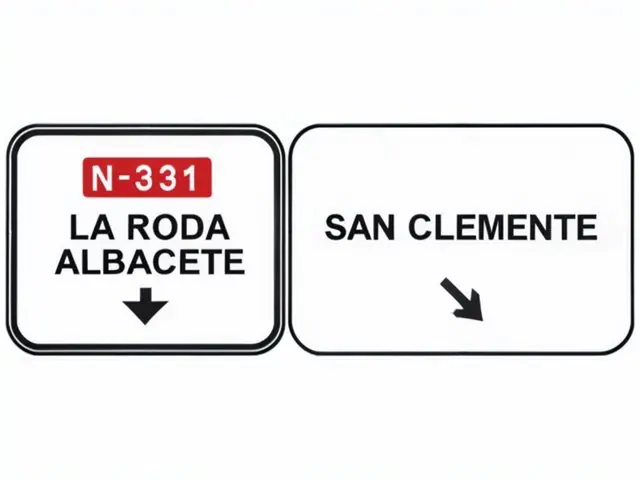
Estas señales, en una carretera convencional, indican un desvío hacia...
On a conventional road, these signs indicate a turn-off towards...
- Aotra carretera convencional.another conventional road.
- Buna autopista o autovía.a motorway (autopista) or dual carriageway (autovía).
- Cla población indicada.the town shown.
ExplanationOn conventional roads, direction signs have a white background. If the sign announcing the turn-off is also white, the exit leads to another conventional road; if it led to a motorway (autopista) or dual carriageway (autovía), the sign would have a blue background.
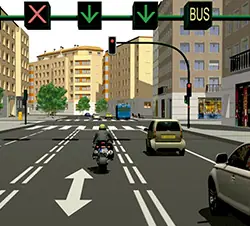
Una luz verde en forma de flecha apuntando hacia abajo en un semáforo de carril...
A green light in the shape of a downward-pointing arrow on a lane control signal...
- Aobliga a no abandonar el carril sobre el que está colocada.requires you not to leave the lane above which it is placed.
- Bexime de la obligación de detenerse ante una luz roja circular.exempts you from having to stop at a round red light.
- CNo exime de tener que cumplir las normas generales sobre prioridad de paso.does not exempt you from complying with the general rules on right of way.
ExplanationA green downward arrow on a lane control signal only indicates that you may use that lane. It does not require you to stay in it, and it does not exempt you from stopping at a round red traffic light or from obeying other signs or the general rules of right of way.
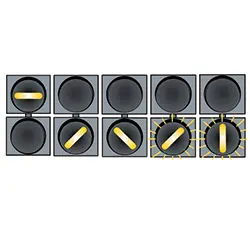
Un semáforo con línea blanca horizontal sobre fondo negro...
A traffic light with a horizontal white line on a black background...
- Apermite el paso a autobuses y tranvías.allows buses and trams to go.
- Bprohíbe el paso a autobuses de líneas regulares y tranvías.prohibits regular-service buses and trams from going.
- Cpermite girar a la derecha y a la izquierda a autobuses y tranvías.allows buses and trams to turn right and left.
ExplanationTraffic lights with a white bar on a black background apply to regular-service buses and trams: a horizontal bar is equivalent to a red light and prohibits them from going; a vertical bar allows them to go straight on.
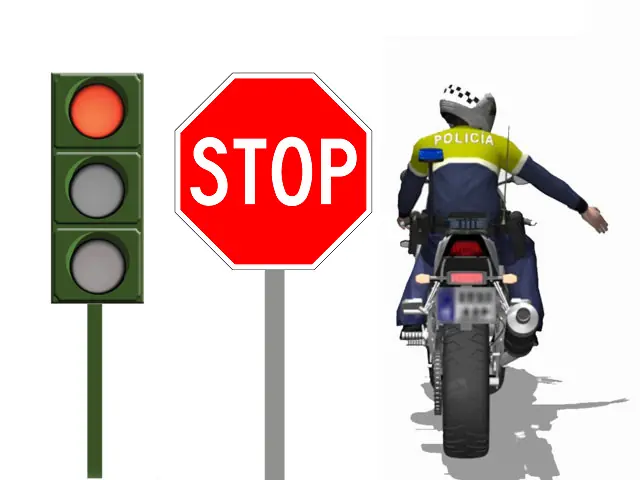
Entre estas señales, ¿cuál es el orden de prioridad?
What is the order of priority between these signs?
- A1. Agentes. 2. Semáforos. 3. Señales verticales.1. Traffic officers. 2. Traffic lights. 3. Road signs.
- B1. Señales verticales. 2. Agentes. 3. Semáforos.1. Road signs. 2. Traffic officers. 3. Traffic lights.
- C1. Semáforos. 2. Agentes. 3. Señales verticales.1. Traffic lights. 2. Traffic officers. 3. Road signs.
ExplanationThe order of priority between signs is: first the instructions of traffic officers, then traffic lights, then road signs, and finally road markings (Article 133 of the General Traffic Regulations, RGC). If a traffic officer tells you to go through a red light or a STOP sign, the officer's instruction prevails.
Un semáforo con luz roja fija obliga a:
A traffic light showing a steady red light requires you to:
- ACeder el pasoGive way
- BDetenerseStop
- CReducir la velocidadReduce speed
ExplanationUnder section 4.2 of Annex I of the RGC, a non-flashing red light prohibits passing: you must stop before the traffic light or its stop line. A steady amber light also requires you to stop, unless the vehicle is so close that it cannot do so safely.
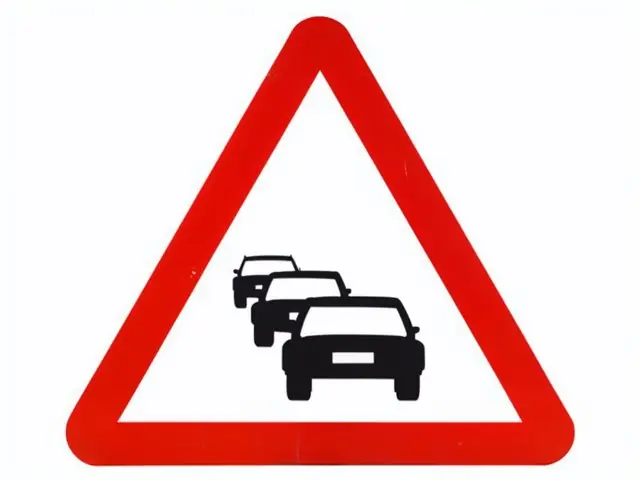
Esta señal indica peligro por la proximidad de un tramo de carretera...
This sign warns of danger because you are approaching a stretch of road...
- Adonde solo pueden circular coches.where only cars may travel.
- Bcon atascos o retenciones.with traffic jams or queues.
- Cdonde no es obligatorio mantener la distancia de seguridad.where you do not have to keep a safe distance.
ExplanationThe sign in the picture, showing several cars in a line, warns that you are approaching a stretch where traffic is often congested, with jams or queues. You must reduce your speed and pay extra attention so as not to run into stationary vehicles.
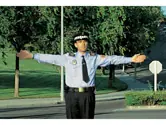
Un agente que tiene los brazos extendidos en mitad de una intersercción¿Qué indica?
A traffic officer stands in the middle of a junction with arms outstretched. What does this indicate?
- AObliga a disminuir la velocidad de su vehículo a los conductores que se acerquen al agente.Drivers approaching the officer must reduce their speed.
- BObliga a que reanudar la marcha a los vehículos.Vehicles must move off again.
- CObliga a detenerse a los usuarios que se acerquen al agente desde cualquier dirección que corte a la indicada por los brazos extendidosRoad users approaching the officer from any direction that crosses the one shown by the outstretched arms must stop.
ExplanationWith arms stretched out horizontally, the officer requires road users approaching from directions that cross the one shown by the arms to stop, whichever way they are travelling. Those travelling in the direction of the arms may pass.
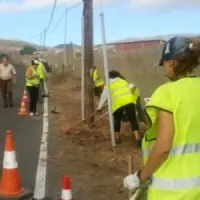
¿Podrá el personal de obras regular el paso de vehículos como los Agentes de Circulación?
May roadworks staff control the passage of vehicles in the same way as traffic officers?
- ASolo podrán regularlo en vías fuera de pobladoOnly on roads outside built-up areas
- BSíYes
- CNoNo
ExplanationUnder Article 141.4 of the General Traffic Regulations (RGC), when no officers are present or to assist them, roadworks staff may control the passage of vehicles with signs from the catalogue mounted on a hand-held paddle, and Article 60.5 requires road users to follow their instructions.
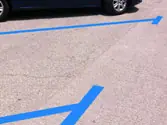
¿Qué indica una marca azul pintada en la calzada?
What does a blue marking painted on the carriageway indicate?
- ADelimita un lugar en el que el estacionamiento está prohibido.It marks out a place where parking is prohibited.
- BDelimita un lugar en el que el estacionamiento no está permitido.It marks out a place where parking is not allowed.
- CDelimitan un lugar en el que el estacionamiento está permitido.It marks out a place where parking is allowed.
ExplanationBlue markings mark out places where parking is allowed, showing that at certain times of day the length of time you may park will be limited.
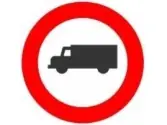
Esta señal prohíbe la entrada a los vehículos destinados al transporte de mercancías, entendiéndose como tales...
This sign prohibits entry to vehicles intended for the transport of goods, meaning...
- Acamiones y furgonetas, dependiendo de su masa.lorries and vans, depending on their mass.
- Bcamiones y furgonetas, independientemente de su masa.lorries and vans, regardless of their mass.
- Ccamiones y furgonetas de más de 3.500 kg.lorries and vans over 3,500 kg.
ExplanationThe sign prohibits access to vehicles intended for carrying goods, meaning lorries and vans, regardless of their mass.
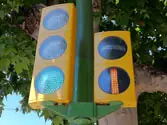
El semáforo de la derecha afecta a...
The traffic light on the right applies to...
- Atranvías, ciclos y ciclomotores.trams, cycles and mopeds.
- Blos autobuses de líneas regulares, exclusivamente.regular-service buses only.
- Clos tranvías y a los autobuses de líneas regulares.trams and regular-service buses.
ExplanationOf the two traffic lights in the picture, the one on the right consists of an illuminated bar on a round black background, and its signals apply only to trams and regular-service buses, unless there is a lane reserved for buses, or for taxis and other vehicles, in which case they apply only to the vehicles using that lane.
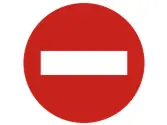
Si encontramos esta señal sabremos que...
If you find this sign, you will know that...
- ANo podremos entrar ni salir de la vía en donde esté colocada.You may neither enter nor leave the road where it is placed.
- BPodremos entrar pero no salir por la vía en donde esté colocada.You may enter but not leave by the road where it is placed.
- CLa entrada está prohibida.Entry is prohibited.
ExplanationSign R-101 “No entry” prohibits access to all types of vehicles from the place where it stands. The sign that prohibits all types of vehicles from travelling in both directions is a different one: R-100 “Closed to all vehicles”.
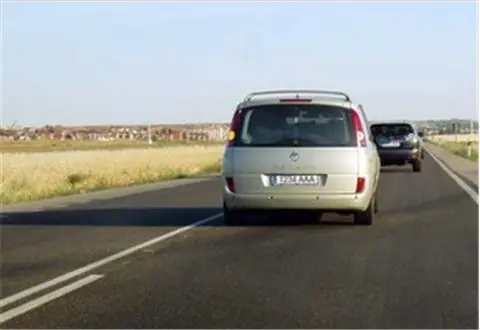
La señalización luminosa para indicar el cambio de carril, ¿cuándo deberá concluir?
When must the light signal indicating a lane change end?
- ACuando compruebe que los demás usuarios han percibido la señalización.When you have checked that other road users have noticed the signal.
- BUna vez haya rebasado al vehículo adelantado.Once you have passed the vehicle being overtaken.
- CCuando el vehículo haya adoptado la nueva trayectoria.When the vehicle has taken up its new path.
ExplanationUnder Article 109 of the General Traffic Regulations, in manoeuvres involving a sideways movement only that movement is signalled, so the indicator must be switched off as soon as the vehicle has taken up its new path, without waiting until you have passed anyone.
¿Qué indica un agente moviendo el brazo alternativamente de arriba a abajo?
What does a traffic officer moving an arm up and down indicate?
- AObliga a detenerse a todos los usuarios.All road users must stop.
- BObliga a detenerse a los usuarios que se acercan al agente.Road users approaching the officer must stop.
- CObliga a disminuir la velocidad a los conductores que se acerquen al agente por el lado correspondiente al brazo que ejecuta la señal.Drivers approaching the officer on the side of the arm giving the signal must slow down.
ExplanationMoving the arm up and down requires you to slow down. If the officer were swinging a red or yellow light, you would have to stop.
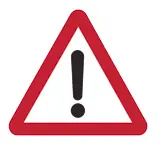
Esta señal indica...
This sign indicates...
- AUn peligro.a danger.
- BUna obligación.an obligation.
- CUna prohibición.a prohibition.
ExplanationIt is a triangular sign with a red border, so it warns of a danger. This triangle with an exclamation mark (P-50) warns of a danger other than those that have their own sign, which is usually specified on an additional panel. Mandatory signs are blue, and prohibition signs are round with a red border.
¿Qué indican las marcas blancas y rojas en la calzada?
What do red and white markings on the carriageway indicate?
- AZona reservada para la salida de carreras de coches.An area reserved for the start of car races.
- BZona reservada para aparcar camiones.An area reserved for parking lorries.
- CZona para frenado de emergencia: no se puede parar ni estacionar.An emergency braking area: you may not stop or park there.
ExplanationThe chequerboard of white and red squares is marking M-7.11, the entrance to an arrester bed: it shows where an emergency braking area begins, and stopping, parking and any other use of it are prohibited.
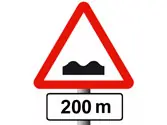
El panel bajo la señal indica...
The panel under the sign indicates...
- Ala distancia al comienzo del peligro o prescripción.the distance to the start of the hazard or restriction.
- Bla longitud del tramo peligroso o sujeto a prescripción.the length of the stretch that is dangerous or subject to the restriction.
- Cla extensión del peligro o prescripción a ambos lados de la calzada.that the hazard or restriction extends to both sides of the carriageway.
ExplanationThe additional panel S-800, under a warning sign, indicates the distance to the start of the hazard: here, a stretch with an uneven road surface (P-15) begins in 200 m. If the figure were accompanied by arrows on both sides (S-810), it would indicate the length of the dangerous stretch.
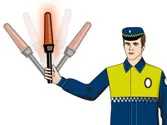
Un agente de la circulación que balancea una luz amarilla...
A traffic officer who swings a yellow light...
- AObliga a detenerse a los usuarios de la vía hacia los que el agente dirija la luz.Requires the road users towards whom the officer directs the light to stop.
- BObliga a extremar la precaución de los usuarios de la vía hacia los que el agente dirija la luz.Requires the road users towards whom the officer directs the light to take extra care.
- CPermite continuar la marcha a los usuarios de la vía hacia los que el agente dirija la luz.Allows the road users towards whom the officer directs the light to continue.
ExplanationUnder section 1.1 of Annex I of the General Traffic Regulations, when an officer swings a red or yellow light, the road users towards whom the officer directs the light must stop. It is not just a warning to take care.
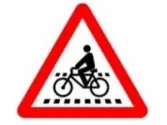
¿Qué advierte esta señal de peligro?
What does this danger sign warn of?
- ALa proximidad de un carril bici.That you are approaching a cycle lane.
- BLa proximidad de uno o varios pasos para ciclistas.That you are approaching one or more cyclist crossings.
- CLa proximidad de un tramo con circulación frecuente de ciclistas.That you are approaching a stretch where cyclists often ride.
ExplanationThis sign warns the driver that they are approaching one or more special crossings for cyclists, where cyclists have right of way.
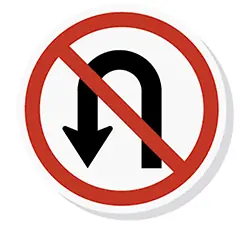
Esta señal, ¿prohíbe cambiar de dirección a la izquierda?
Does this sign prohibit turning left?
- ANo.No.
- BSí, pero no prohíbe girar a la derecha.Yes, but it does not prohibit turning right.
- CSí; prohíbe realizar cualquier giro.Yes; it prohibits any turn.
ExplanationThis is the no U-turn sign: it only prevents turning round (a U-turn). Turning left to take another road is still allowed, so the answer is no.
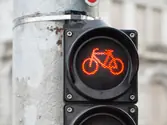
Cuando un semáforo presenta la silueta iluminada de un ciclo, sus indicaciones se refieren a...
When a traffic light shows the illuminated silhouette of a cycle, its signals apply to...
- ALos ciclomotores.Mopeds.
- BLos ciclos.Cycles.
- CLos ciclos y los peatones.Cycles and pedestrians.
ExplanationWhen a traffic light shows the illuminated silhouette of a cycle, its signals apply only to cycles.
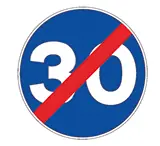
Esta señal indica el lugar a partir del cual...
This sign marks the point from which...
- Atermina la obligación de circular, al menos, a 30 km/h.the obligation to drive at a speed of at least 30 km/h ends.
- Bcomienza la obligación de circular a más de 30 km/h.the obligation to drive faster than 30 km/h begins.
- Ctermina la recomendación de circular a más de 30 km/h.the recommendation to drive faster than 30 km/h ends.
ExplanationThis is the end of minimum speed sign: from this sign onwards you are no longer required to drive at a speed of at least 30 km/h. Mandatory signs end with the same symbol crossed out in red.
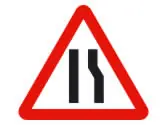
La señal, ¿qué indica?
What does this sign indicate?
- AQue a partir de la señal la circulación es de dos sentidos.That after the sign, traffic runs in both directions.
- BQue la calzada va a quedar reducida a un solo carril.That the carriageway will be reduced to a single lane.
- CQue la calzada se estrecha por el lado de la derecha.That the carriageway narrows on the right-hand side.
ExplanationThis is sign P-17a “Road narrows on the right”: it warns that you are approaching a part of the road where the carriageway narrows on the right-hand side. It can also be used when the right hard shoulder of the carriageway becomes narrower.
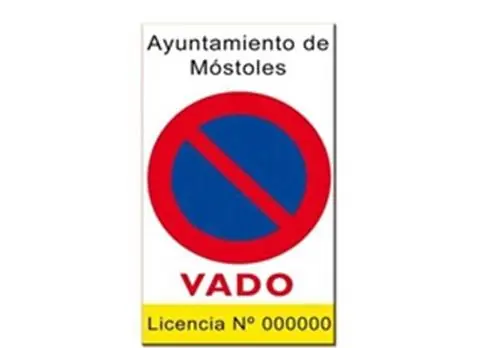
Esta señal le indica...
This sign tells you...
- Azona de estacionamiento de duración limitada.that there is a limited-time parking zone.
- Bprohibición de parar delante de un VADO.that stopping in front of a VADO (vehicle entrance) is prohibited.
- Cprohibición de estacionar delante de un VADO.that parking in front of a VADO (vehicle entrance) is prohibited.
ExplanationThe no parking sign with the word ‘Vado’ indicates that you may not park in front of that vehicle entrance. Stopping is allowed, as long as you do not block vehicles entering or leaving.
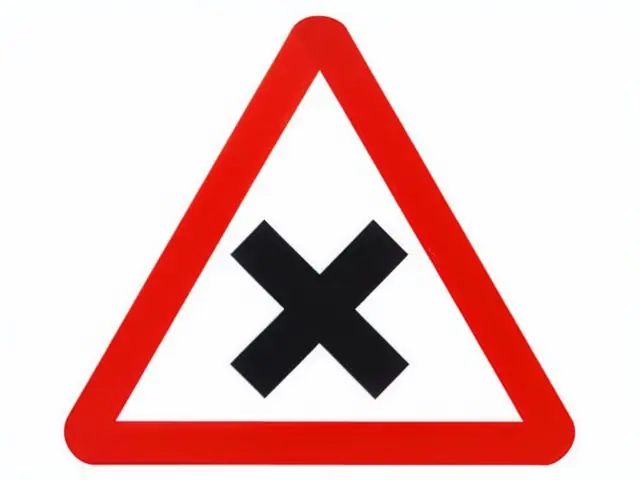
Esta señal indica la proximidad de una intersección...
This sign indicates a junction ahead...
- Asin prioridad de paso.without right of way.
- Bcon prioridad de paso.with right of way.
- Ccon prioridad de paso para los que se aproximan por la derecha.with right of way for those approaching from the right.
ExplanationThe sign in the picture, triangular with a black cross, warns of a junction where the general rule of Article 57.1 of the RGC applies: you must give way to vehicles approaching from the right, which are the ones with priority.
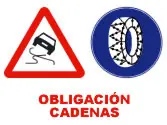
¿Qué nos indica este panel?
What does this panel tell us?
- ANos indica una información que podemos o no atender.It gives us information that we may or may not follow.
- BNos indica un peligro y la obligación de llevar cadenas.It shows us a danger and an obligation to fit chains.
- CNos indica una obligación.It shows us an obligation.
ExplanationThe panel combines P-19 «Slippery road surface» with R-412 «Snow chains»: it warns of the danger and prohibits continuing without chains or other authorised anti-skid devices on one wheel on each side of the driving axle, or without special snow tyres.
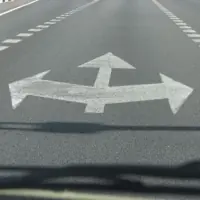
¿Cuál de éstas NO es una función de las marcas viales?
Which of these is NOT a function of road markings?
- ADelimitar las zonas excluidas al tráficoTo mark out areas closed to traffic.
- BContradecir a una señal vertical contiguaTo contradict a nearby road sign.
- CDelimitar carriles y separar sentidosTo mark out lanes and separate directions of traffic.
ExplanationRoad markings are used to regulate traffic and to warn or guide road users: they mark out lanes, separate directions of traffic or mark areas closed to traffic. They are not used to contradict a road sign; if they seem to, the road sign prevails (Article 133 of the General Traffic Regulations (RGC)).
All topics
- Definitions
- Documents and penalty points
- The driver's condition
- Duties of drivers and pedestrians
- Vehicle safety devices
- Vehicle controls and equipment
- Vehicle lights and horn
- The road and its lanes
- Speed and distances
- Manoeuvres
- Right of way
- Carrying passengers and loads
- Driving safely in difficult conditions
- Vehicle mechanics and maintenance
- Road accidents and first aid
- Defensive and eco-driving
Independent app: not affiliated with or endorsed by the DGT (Spain's Directorate-General for Traffic) or the Ministry of the Interior. The official exam is booked with the DGT and taken at its test centres. The questions here are practice material; the DGT's official question bank is not public.
Basado en datos de la Agencia Estatal Boletín Oficial del Estado (https://www.boe.es). Textos consolidados de carácter meramente informativo. La AEBOE no patrocina ni respalda este sitio.
Parte de las preguntas procede de los tests de la revista «Tráfico y Seguridad Vial» de la DGT, reproducidos con indicación de la fuente.