
DGT test · 1,397 questions
Traffic signs, markings and signals · Page 19 of 28
Road signs, road markings, traffic lights, police signals and temporary markings: what they mean and which one wins when they disagree. The topic with the most questions in the bank.
Questions in this topic, with answers
1,397 questions, 50 per page, with the correct answer and the explanation. Page 19 of 28.
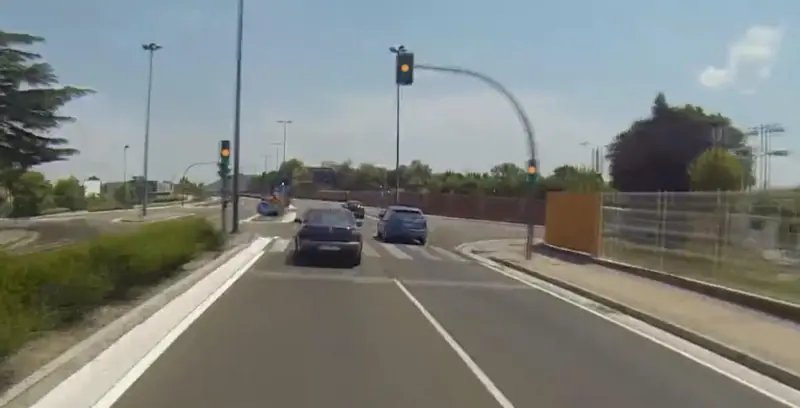
La luz amarilla intermitente del semáforo, ¿qué indica?
What does a flashing amber traffic light mean?
- ALo mismo que una luz roja.The same as a red light.
- BLo mismo que una luz amarilla fija.The same as a steady amber light.
- CExtremar la precaución, y en caso necesario, ceder el paso.Take extra care and, if necessary, give way.
ExplanationA flashing amber light requires you to take extra care and, where appropriate, to give way; it also does not exempt you from obeying other signs that require you to stop (Annex I of the General Traffic Regulations, RGC). It is not the same as a red light or a steady amber light, which require you to stop.
¿Qué indica una bandera de color rojo portada por un agente de la autoridad en motocicleta?
What does a red flag carried by a police officer on a motorcycle indicate?
- AQue debe parar a la derechaThat you must stop on the right
- BQue hay peligro próximoThat there is danger ahead
- CQue la calzada se cierra al tráfico tras su pasoThat the carriageway is closed to traffic after the officer passes
ExplanationA red flag carried by an officer on their vehicle indicates that, from the moment that vehicle passes, the carriageway is temporarily closed to all vehicles and road users. This signal is common in cycle races or official motorcades. No one may overtake the officer or drive behind them until an officer with a green flag passes, which indicates that the road is open again. A yellow flag, on the other hand, would indicate the need to take extreme care because of a nearby danger.
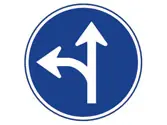
¿Se podrá efectuar un cambio de sentido a partir de esta señal?
May you make a U-turn after this sign?
- ASí, si no circulan vehículos en sentido contrario.Yes, if there are no vehicles coming the other way.
- BSí.Yes.
- CNo.No.
ExplanationThe sign shows that the only directions allowed are going straight ahead or turning left, so it prohibits making a U-turn.
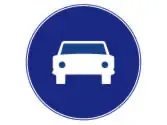
Conduciendo una motocicleta sin sidecar, ¿está obligado a circular por la calzada así señalizada?
Riding a motorcycle without a sidecar, are you required to use the carriageway with this sign?
- ASí, pues la obligación es para todos los vehículos automóviles.Yes, because the obligation applies to all motor cars.
- BNo.No.
- CNo, la señal solo obliga a los turismos.No, the sign only applies to cars.
ExplanationThis sign requires drivers of motor cars, except two-wheeled motorcycles without a sidecar, to use the carriageway at whose entrance it stands.
En una intersección regulada por semáforos, queda detenido con su turismo en ella obstaculizando la circulación, ¿que debe hacer?
At a junction controlled by traffic lights, you are stopped with your car inside it, blocking traffic. What must you do?
- AEsperar a que el semáforo se ponga verde, aunque obstaculice al resto de usuarios.Wait for the traffic light to turn green, even if you are blocking other road users.
- BCircular marcha atrás para dejar libre la intersección lo antes posible.Reverse to clear the junction as soon as possible.
- CSalir de la intersección lo antes posible, en condiciones de seguridad, sin esperar a que se permita la circulación en la dirección que se propone tomar.Leave the junction as soon as possible, safely, without waiting for traffic to be allowed in the direction you intend to take.
ExplanationEven when they have right of way, no driver may enter a junction or a pedestrian crossing if the traffic situation is such that they are likely to be stopped in a way that prevents or obstructs cross traffic. Any driver who is stopped in a junction controlled by traffic lights, and whose position obstructs traffic, must leave it without waiting for traffic to be allowed in the direction they intend to take, provided that in doing so they do not hinder other road users moving in the permitted direction.
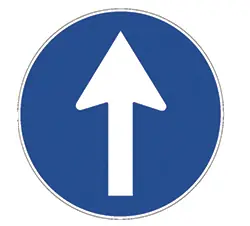
Esta señal, ¿prohíbe el cambio de dirección en la próxima intersección?
Does this sign prohibit turning at the next junction?
- ASí, ya que debo seguir la dirección y sentido que señala la flecha.Yes, because I must follow the direction shown by the arrow.
- BNo, solo prohíbe el cambio de sentido.No, it only prohibits U-turns.
- CNo, solo me indica que la vía es de sentido único.No, it only tells me that the road is one-way.
ExplanationThis compulsory direction sign requires you to follow the direction shown by the arrow, in this case straight on, at the next junction. So it prevents turning right or left there. It does not indicate that the road is one-way.
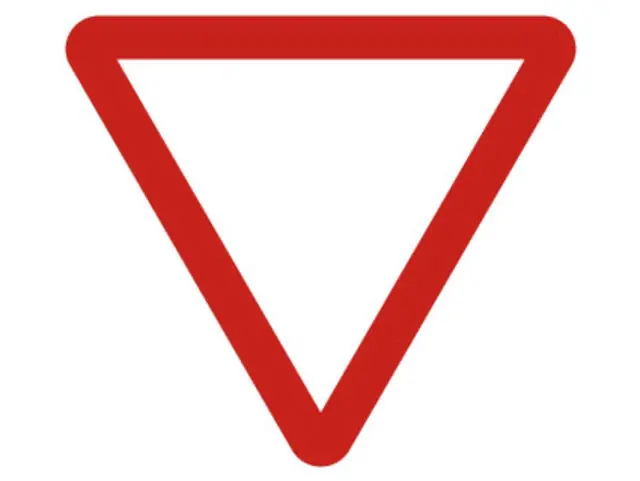
¿Qué obliga esta señal?
What does this sign require?
- ADetenerse.Stopping.
- BCeder el paso a todos los vehículos que circulen por la vía preferente.Giving way to all vehicles on the priority road.
- CCeder el paso a los vehículos que se acerquen por la derecha.Giving way to vehicles approaching from the right.
ExplanationThe sign in the picture is the give-way sign. Under Article 56.5 of the RGC, it requires you to give way to vehicles on the priority road, whichever side they approach from, stopping only when necessary.
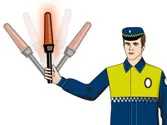
Si un agente balancea una luz de color amarillo, ¿qué indica?
If a traffic officer swings a yellow light, what does it indicate?
- ALe obliga a disminuir la velocidad.It requires you to slow down.
- BObliga a detenerse a los usuarios de la vía hacia los que dirija la luz.It requires the road users towards whom the light is directed to stop.
- CObliga a pasar por el lado del agente que indica con la luz.It requires you to pass on the side of the officer shown with the light.
ExplanationSwinging a yellow or red light requires the road users towards whom the officer directs the light to stop. If the officer holds out an arm and moves it up and down, drivers must slow down.
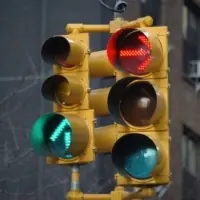
¿Cambia el significado de un semáforo con luz roja fija que tenga encima una flecha negra?
Does a steady red traffic light with a black arrow above it change its meaning?
- ASí, cambia totalmente el significado ya que lo anulaYes, it changes the meaning completely because it cancels it
- BNo, pero lo limita al movimiento indicado por la flechaNo, but it limits it to the movement shown by the arrow
- CSí, pero únicamente en vías muy transitadasYes, but only on very busy roads
ExplanationA black arrow on a steady or flashing red or amber light has the same meaning as the red or amber light, but it only applies to vehicles travelling in the direction shown by the arrow; in other words, it limits the traffic light to the movement shown by that arrow.
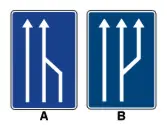
¿Alguna de estas señales indica que finaliza un carril destinado a la circulación?
Does either of these signs indicate that a traffic lane is ending?
- ASí, la señal A.Yes, sign A.
- BSí, la señal B.Yes, sign B.
- CNo, ninguna de las dos.No, neither of them.
ExplanationSign A shows that the right-hand lane is about to stop being usable and shows the lane change needed. Sign B shows that on a stretch with two lanes in the same direction, there will now be three.
Si encontramos dos señales verticales con indicaciones distintas, una en cada lado de la vía y queremos continuar de frente, ¿a qué señal de las dos obedeceremos?
If you find two upright signs with different instructions, one on each side of the road, and you want to go straight on, which of the two do you obey?
- AObedeceremos a la señal de la derecha.You obey the sign on the right.
- BObedeceremos a la señal de la izquierda.You obey the sign on the left.
- CComo continuamos de frente no deberemos obedecer a ninguna de las dos.As you are going straight on, you do not have to obey either of them.
ExplanationIf there are upright signs with different instructions on the right and on the left of the road, those who intend to turn left or go straight on must obey the sign on their left, while those turning right must obey the sign on their right.
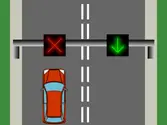
Circula por un carril y sobre él encuentra un semáforo con una luz roja en forma de aspa, ¿qué significa?
You are driving in a lane and above it you see a traffic light with a red light in the shape of a cross. What does it mean?
- AQue debe abandonarlo lo antes posible porque está prohibido ocupar ese carril.That you must leave it as soon as possible because using that lane is prohibited.
- BQue tiene que frenar a su altura como si fuera un semáforo con una luz roja circular.That you must stop level with it as if it were a traffic light with a round red light.
- CQue debe moderar la velocidad por circunstancias especiales de la circulación.That you must slow down because of special traffic circumstances.
ExplanationA red light in the shape of a cross indicates that using that lane is prohibited. Vehicles in a lane where a red light of this kind comes on must leave it as quickly as possible, always safely.
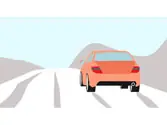
Cuando nieva, ¿es recomendable circular sobre las marcas de otros vehículos?
When it is snowing, is it advisable to drive in the tracks left by other vehicles?
- ASí, puesto que facilitará la adherencia.Yes, because it will improve grip.
- BNo, porque perjudicará la adherencia.No, because it will reduce grip.
- CEs indiferente, puesto que no influye en la adherencia.It makes no difference, because it does not affect grip.
ExplanationOn snow it is best to drive in the tracks left by other vehicles, because there the road surface offers more grip than untrodden snow. You should also drive slowly, in high gears, increase your safe distance and avoid sudden manoeuvres.
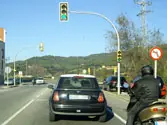
¿Qué vehículos deben obedecer el semáforo?
Which vehicles must obey the traffic light?
- ATodos los vehículos.All vehicles.
- BSolo los vehículos de motor.Only motor vehicles.
- CTodos los vehículos excepto bicicletas.All vehicles except bicycles.
ExplanationAll vehicles without exception must obey traffic light signals.
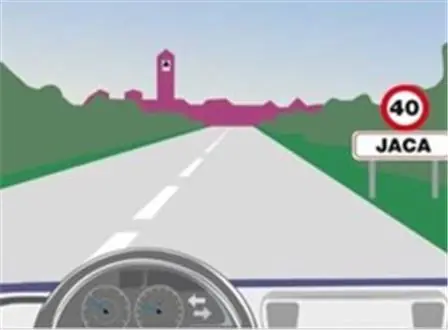
A la vista de la señalización, circulará a una velocidad máxima de...
Given these signs, the maximum speed you will drive at is...
- A50 Km/h en la travesía y 40 km/h en el resto de la población.50 km/h on the travesía (stretch of road through the town) and 40 km/h in the rest of the town.
- B40 km/h en toda la población.40 km/h in the whole town.
- C40 km/h en la travesía y 50 km/h en el resto de la población.40 km/h on the travesía and 50 km/h in the rest of the town.
ExplanationAs the 40 km/h sign is placed above the sign marking the entrance to the built-up area, that limit applies to the whole built-up area, not just the travesía. If it were on a separate post, it would only apply to the stretch ahead until another sign.
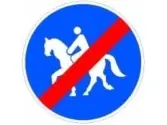
A partir de esta señal, los animales de montura:
From this sign onwards, ridden animals:
- ADeben continuar por el camino reservado y obligatorio.must continue along the reserved compulsory path.
- BYa no están obligados a circular por el camino reservado.are no longer required to use the reserved path.
- CSe prohíbe su circulación por cualquier camino.are prohibited from using any path.
ExplanationThe sign in the picture marks the end of the path reserved for, and compulsory for, ridden animals.
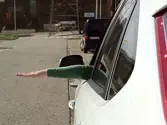
Si el conductor de un vehículo extiende el brazo izquierdo en posición horizontal con la palma de la mano hacia abajo, significa que...
If the driver of a vehicle holds their left arm out horizontally with the palm facing down, it means that...
- ASe va a desplazar hacia la derecha.They are going to move to the right.
- BSe va a desplazar hacia la izquierda.They are going to move to the left.
- CVa a efectuar marcha hacia atrás.They are going to reverse.
ExplanationThe left arm held out horizontally with the palm facing down shows that the driver is going to move to the left.
Una marca amarilla longitudinal continua pintada en el bordillo de la calzada, prohíbe...
A continuous yellow longitudinal line painted on the kerb prohibits...
- AParar, únicamente.Stopping only.
- BParar y estacionar.Stopping and parking.
- CEstacionar, únicamente.Parking only.
ExplanationA continuous yellow longitudinal line painted on the kerb prohibits both stopping and parking.
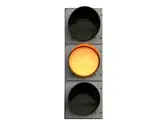
En un semáforo, ¿qué significa una luz amarilla no intermitente?
At a traffic light, what does a steady (non-flashing) amber light mean?
- AQue podemos pasar con precaución.That we may go through with caution.
- BQue debemos detenernos como si fuese una luz roja fija.That we must stop as if it were a steady red light.
- CQue podemos pasar cediendo el paso tanto a la derecha como a la izquierda.That we may go through, giving way both to the right and to the left.
ExplanationA non-flashing amber light, also called a steady amber light, means that vehicles must stop in the same conditions as if it were a steady red light, unless they cannot do so safely.
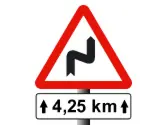
El peligro así señalizado...
The hazard signed in this way...
- ALo encontraremos a 4,25 km.Will be found in 4.25 km.
- BEstará presente durante los 4,25 km siguientes.Will be present for the next 4.25 km.
- CAfectará solo a los vehículos de más de 4,25 toneladas.Will only affect vehicles over 4.25 tonnes.
ExplanationThe additional panel shown in the question indicates the length over which the hazard or restriction exists. Do not confuse it with the panel that indicates the distance to the start of the hazard or restriction.
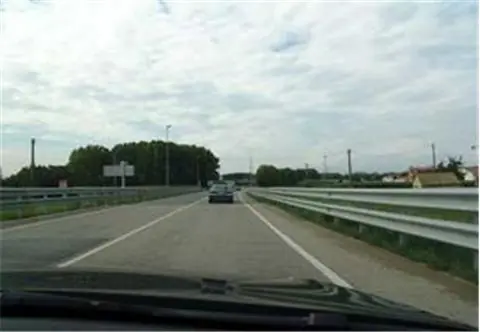
¿Puede sobrepasar la marca longitudinal continua central?
Can you cross the solid longitudinal line in the centre?
- ANo.No.
- BSí, para realizar un cambio de dirección.Yes, to turn.
- CSí, si se trata de una calzada de un solo sentido.Yes, if the carriageway is one-way.
ExplanationA solid longitudinal line must not be crossed or driven on, not even to turn. It also cannot be crossed on one-way carriageways, where it separates lanes going in the same direction.

¿A qué vehículos prohíbe la circulación esta señal?
Which vehicles does this sign prohibit from travelling?
- AA los vehículos de motor.Motor vehicles.
- BA las motocicletas y turismos.Motorcycles and cars.
- CA toda clase de vehículos.All types of vehicles.
ExplanationThe sign in the picture, a white circle with a red border, prohibits all types of vehicles from travelling in both directions. It must not be confused with the no-entry sign, which only prevents access, or with the signs that prohibit only motor vehicles.
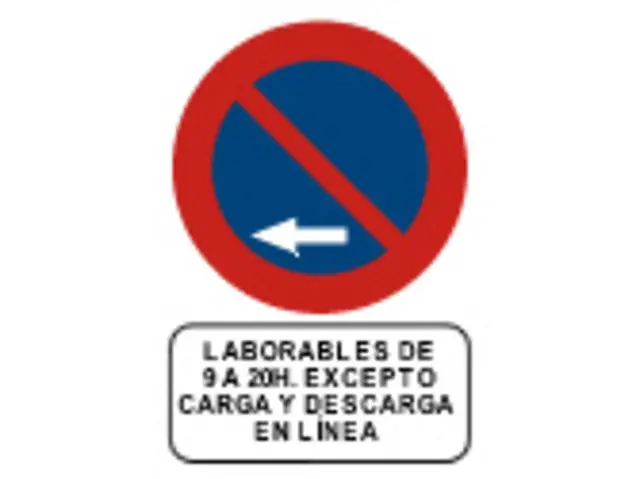
El lunes a las 9 de la mañana, desde el lugar donde está esta señal...
On Monday at 9 in the morning, from the place where this sign is...
- Asolo se puede estacionar para dejar un paquete.you may only park to drop off a parcel.
- Bestá prohibido parar y estacionar.stopping and parking are prohibited.
- Cse puede parar pero no estacionar.you may stop but not park.
ExplanationThe sign prohibits parking on that side of the carriageway from 9:00, but it does not prohibit stopping. That is why you may stop but not park. Under the General Traffic Regulations, this sign applies during the hours shown (from 9:00 to 20:00), but it allows vehicles to stop briefly, for example for loading and unloading.
Cuando un agente realiza toques cortos de silbato indica...
When a traffic officer gives short blasts on a whistle, this indicates...
- ALa detención de los vehículos.That vehicles must stop.
- BLa reanudación de la marcha.That vehicles must move off again.
- CLa disminución de la velocidad.That vehicles must reduce speed.
ExplanationA series of short, frequent whistle blasts from a traffic officer orders vehicles to stop. One long blast orders them to move off again.
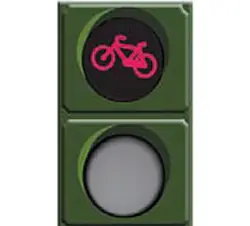
¿Qué usuarios deben obedecer el semáforo de la fotografía?
Which road users must obey the traffic light in the photo?
- ALos conductores de todos los vehículos de dos ruedas.Riders of all two-wheeled vehicles.
- BSolo los conductores de ciclos, como las bicicletas.Only riders of cycles, such as bicycles.
- CLos peatones y los conductores de bicicletas.Pedestrians and cyclists.
ExplanationAccording to section 4.4 of Annex I of the General Traffic Regulations (RGC), when the lights of a traffic light show the outline of a cycle, its signals apply only to cycles. They do not affect pedestrians, who have their own traffic lights, or motorcycles or mopeds.
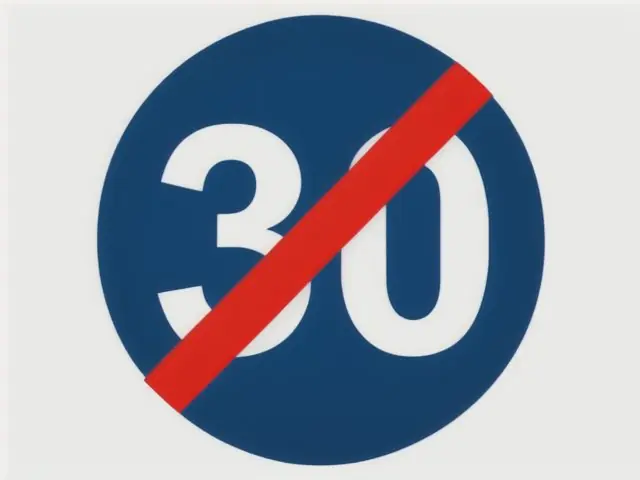
Esta señal indica el lugar donde...
This sign indicates the place where...
- ATermina la obligación de circular a una velocidad mínima de 30 km/h.The obligation to drive at a minimum speed of 30 km/h ends.
- BFinaliza la recomendación de circular a una velocidad superior a 30 km/h.The recommendation to drive at more than 30 km/h ends.
- CComienza la obligación de circular a más de 30 km/h.The obligation to drive at more than 30 km/h begins.
ExplanationThe round blue sign with the figure 30 crossed by a red band is R-506, end of minimum speed: from this point it is no longer compulsory to drive at 30 km/h or more. It does not refer to maximum or recommended speeds.
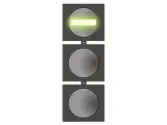
Un semáforo con una franja blanca horizontal, ¿a qué vehículos afecta?
Which vehicles does a traffic light with a horizontal white bar apply to?
- AA todos los que circulen por la vía.All those using the road.
- BA los tranvías y autobuses.Trams and buses.
- CSolo a los autobuses.Buses only.
ExplanationA traffic light made up of a white bar on a black circular background applies only to trams and buses, unless there is a lane reserved for buses or for buses, taxis and other vehicles; in that case it applies only to the vehicles using that lane.

¿Por qué lado de la señal hay que pasar?
On which side of the sign must you pass?
- APor la derecha o por la izquierda.On the right or on the left.
- BPor la derecha.On the right.
- CPor la izquierda.On the left.
ExplanationThe sign in the picture, round and blue with an arrow pointing diagonally down and to the left, is a compulsory passing sign: it shows the side on which you must pass the sign or the obstacle it is placed on. In this case, you must pass on the left.
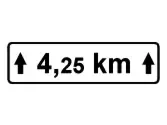
¿Qué significado tiene esta señal debajo de otra?
What does this sign mean when placed below another one?
- ALa anchura máxima permitida de los vehículos.The maximum permitted width of vehicles.
- BLa longitud de un tramo peligroso o sujeto a prescripción.The length of a dangerous stretch or a stretch subject to a rule.
- CDistancia al comienzo del peligro o prescripción.The distance to the start of the danger or rule.
ExplanationThis additional panel goes with another danger or regulatory sign and shows the length of the dangerous stretch or of the stretch where the rule applies. When the panel does not have the two side arrows, it shows the distance to the start of the danger or rule.
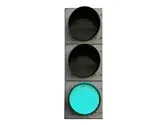
La luz verde del semáforo significa que...
A green traffic light means that...
- AEstá permitido el paso con prioridad.You may go through with priority.
- BEstá permitido pasar, pero cediendo el paso.You may go through, but you must give way.
- CEstá permitido pasar, extremando la precaución.You may go through, taking extreme care.
ExplanationA steady green light means that you may go through with priority, except if the traffic situation is such that you are likely to be stopped in a way that obstructs cross traffic in the junction.
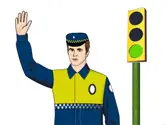
Las órdenes de los agentes de tráfico...
Orders given by traffic officers...
- Asolamente hay que cumplirlas cuando exista una situación de peligro.only have to be obeyed when there is a dangerous situation.
- Bhay que cumplirlas siempre.must always be obeyed.
- Csólo deben cumplirse en las intersecciones.only have to be obeyed at junctions.
ExplanationSignals and orders given by traffic officers must always be carried out, so drivers and other road users must obey them immediately, even when they contradict the traffic rules and other traffic signs.
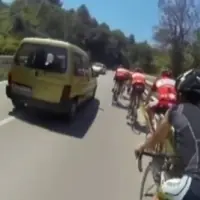
¿En qué tipo de vías está permitido pisar la línea discontinua si es necesario?
On which roads is it permitted to drive over a broken line if necessary?
- AEn vías con carriles de menos de 5 metros de anchoOn roads with lanes less than 5 metres wide
- BEn vías con carriles de menos de 3 metros de anchoOn roads with lanes less than 3 metres wide
- CEn vías con carriles de menos de 1 metro de anchoOn roads with lanes less than 1 metre wide
ExplanationUnder the road-marking catalogue (RD 465/2025), you must not drive on a broken line except when this is necessary because of the width of the lanes and it is safe to do so. The DGT manual specifies that this means lanes less than three metres wide.
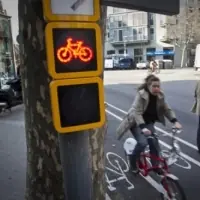
¿Existen semáforos cuyas indicaciones se refieren únicamente a los ciclos?
Are there traffic lights whose signals apply only to cycles?
- ASí, los que muestran la silueta iluminada de un ciclo.Yes, those showing the lit outline of a cycle.
- BNo, los ciclos obedecen siempre los semáforos generales.No, cycles always obey the general traffic lights.
- CSolo en vías interurbanas, nunca en poblado.Only on roads outside built-up areas, never in built-up areas.
ExplanationUnder section 4.4 of Annex I of the RGC, when the lights of a traffic light show the lit outline of a cycle, its signals apply only to cycles. They do not affect mopeds or other vehicles, which obey the ordinary traffic lights.
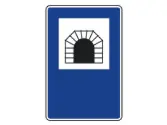
¿Se podrá realizar un cambio de sentido de la marcha en un tramo de la vía con la señal de túnel?
May you make a U-turn on a stretch of road with the tunnel sign?
- ANo.No.
- BSí.Yes.
- CSí, si el túnel tiene dos carriles por sentido.Yes, if the tunnel has two lanes in each direction.
ExplanationOn stretches of road covered by the tunnel sign, you may not make a U-turn.
El panel indica...
The panel indicates...
- Ala distancia entre la señal y el comienzo del peligro.the distance between the sign and the start of the hazard.
- Bla longitud del tramo con dos carriles en el mismo sentido.the length of the stretch with two lanes in the same direction.
- Cla longitud del tramo de vía afectado por el peligro.the length of the stretch of road affected by the hazard.
ExplanationThe panel in the question indicates the length of the dangerous stretch. In the picture, we are warned that for 4.25 kilometres there is a stretch of dangerous bends close to one another, the first of them to the right. On the other hand, when the panel does not show the two side arrows, it indicates the distance to the start of the hazard.
En una zona de obras, un operario le indica que debe detener su vehículo. ¿Está usted obligado a obedecer?
In a roadworks area, a worker signals to you to stop your vehicle. Must you obey?
- ANo, sólo los agentes de circulación están autorizados a regular la circulación.No, only traffic officers are authorised to direct traffic.
- BNo, el personal de obras en la vía sólo puede advertir de la necesidad de extremar la precaución.No, road workers can only warn you to take extra care.
- CSí, en ausencia de agentes de circulación, el personal de obras en la vía está autorizado a regular la circulación.Yes, when there are no traffic officers, road workers are authorised to direct traffic.
ExplanationUnder Article 141.4 of the General Traffic Regulations (RGC), when there are no traffic officers, or to assist them, roadworks staff may control the passage of vehicles using signs on a paddle, and Article 60.5 requires drivers to follow their instructions. You must stop.
Un semáforo con luz amarilla intermitente indica:
A traffic light showing a flashing amber light indicates:
- AVía cerrada.That the road is closed.
- BQue se puede pasar con precaución, respetando la prioridad que corresponda.That you may go with caution, respecting the relevant priority rules.
- CQue hay que detenerse obligatoriamente.That you must stop.
ExplanationFlashing amber allows you to go with caution, without giving you priority; the general rules apply.
¿Qué indica una marca vial amarilla en forma de zig-zag?
What does a yellow zigzag road marking indicate?
- AEl lugar de la calzada en el que está prohibido el estacionamiento y la parada.The place on the carriageway where parking and stopping are prohibited.
- BEl lugar de la calzada en el que está prohibido adelantar.The place on the carriageway where overtaking is prohibited.
- CEl lugar de la calzada en el que está prohibido el estacionamiento.The place on the carriageway where parking is prohibited.
ExplanationA continuous yellow line prohibits both stopping and parking; a zigzag line prohibits parking but not stopping.
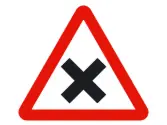
Si un conductor se encuentra con esta señal, debe saber que en la próxima intersección...
If a driver finds this sign, they should know that at the next junction...
- Atendrá prioridad sobre los vehículos que se acerquen por la derecha y por la izquierda.they will have priority over vehicles approaching from the right and from the left.
- Bse aplicará la regla general de prioridad de paso.the general right-of-way rule will apply.
- Cdeberá ceder el paso a los vehículos que se acerquen por la derecha y por la izquierda.they must give way to vehicles approaching from the right and from the left.
ExplanationThe sign in the question warns of the danger of an approaching junction where the general right-of-way rule applies, which means that vehicles approaching from your right have priority.
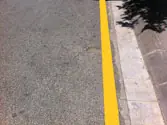
¿Podremos parar junto a un bordillo que presente una marca amarilla longitudinal continua?
May we stop next to a kerb with a continuous yellow longitudinal marking?
- AParar sí, estacionar no.Stopping, yes; parking, no.
- BNo podemos ni parar ni estacionar.We may neither stop nor park.
- CPodemos parar como máximo dos minutos.We may stop for two minutes at most.
ExplanationA continuous yellow line means that stopping and parking are prohibited.
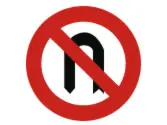
A la vista de la señalización, ¿se puede cambiar de dirección a la izquierda?
Given the signs, may you turn left?
- ASí.Yes.
- BÚnicamente los vehículos autorizados o en servicio urgente.Only authorised vehicles or vehicles on an emergency call.
- CNo, prohibiendo también el cambio de sentido.No, and U-turns are also prohibited.
ExplanationSign R-304, no U-turn, only prohibits making a U-turn; turning left is still allowed. On the other hand, sign R-303, no left turn, prohibits both turning left and making a U-turn.
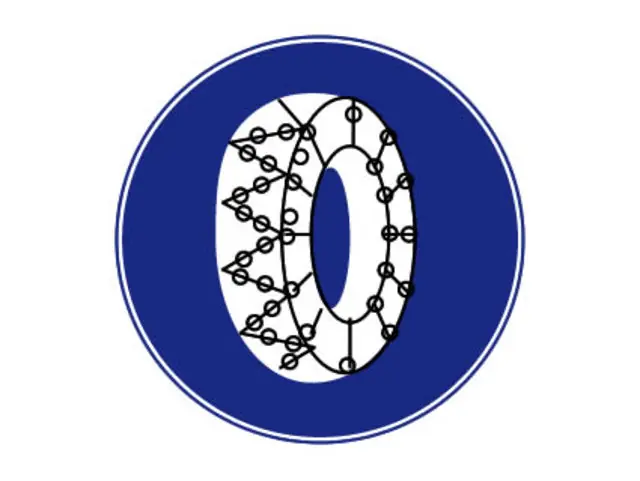
¿Prohíbe esta señal continuar si no tiene cadenas para la nieve?
Does this sign prohibit you from continuing if you do not have snow chains?
- ANo, porque esta señal solo recomienda usar cadenas.No, because this sign only recommends using chains.
- BSí, en todos los casos.Yes, in all cases.
- CSí, salvo que disponga de otros dispositivos autorizados igualmente eficaces.Yes, unless you have other authorised devices that are equally effective.
ExplanationSign R-412 'Snow chains' requires you not to continue without chains or other authorised anti-skid devices, or special snow tyres. So you may continue without chains if you have another authorised device that is equally effective.
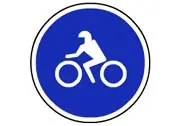
Si conduce una motocicleta sin sidecar…
If you are riding a motorcycle without a sidecar…
- AEstá obligado a circular por una calzada así señalizada.You must use a carriageway marked in this way.
- BPuede circular por una calzada así señalizada.You may use a carriageway marked in this way.
- CTiene prohibido circular por una calzada así señalizada.You are prohibited from using a carriageway marked in this way.
ExplanationSign R-405, carriageway compulsory for two-wheeled motorcycles, requires riders of these motorcycles, and of three-wheeled vehicles treated as motorcycles, to use the carriageway at whose entrance it is placed. A motorcycle without a sidecar has two wheels, so it must use that carriageway.
Los agentes de tráfico, ¿pueden hacer señales ópticas y acústicas?
Can traffic officers give visual and sound signals?
- ANo, sólo pueden hacer señales acústicas.No, they can only give sound signals.
- BNo, sólo pueden hacer señales ópticas.No, they can only give visual signals.
- CSí, pueden hacer señales ópticas y acústicas.Yes, they can give visual and sound signals.
ExplanationOfficers can give visual signals, with their arm or with lights, and sound signals, with a whistle, to direct traffic. Their signals and orders must be obeyed immediately and take precedence over any other sign, according to the order of precedence in Article 133 of the General Traffic Regulations (RGC).
¿Esta señal permite cambiar de dirección hacia la izquierda?
Does this sign allow turning left?
- ANo permite ni cambiar la dirección ni cambiar de sentido hacia la izquierda.It allows neither turning left nor making a U-turn to the left.
- BPermite cambiar de dirección pero no permite cambiar de sentido.It allows turning, but not making a U-turn.
- CPermite cambiar de dirección a la izquierda y cambiar de sentido.It allows turning left and making a U-turn.
ExplanationThis sign prohibits making a U-turn but allows turning.

Si no disponemos en nuestro vehículo de un sistema de telepeaje operativo, ¿podremos circular por el carril así señalizado?
If your vehicle does not have a working electronic toll system, may you drive in the lane signed like this?
- ASí, porque están admitidas otras formas de pago.Yes, because other payment methods are accepted.
- BNo, es obligatorio disponer de dicho sistema.No, you must have that system.
- CSí, la señal solo recuerda la forma de pago de la autopista.Yes, the sign only reminds you how to pay on the motorway.
ExplanationSign R-418 requires you to pay the toll with the dynamic toll or electronic toll system: a vehicle using a lane signed like this must carry the device that makes this possible, in working order. Without that equipment you may not use that lane.
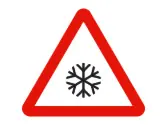
Esta señal nos advierte del peligro por...
This sign warns us of danger from...
- AHielo en la calzada.Ice on the carriageway.
- BNieve en la calzada.Snow on the carriageway.
- CHielo o nieve en la calzada.Ice or snow on the carriageway.
ExplanationThis is sign P-34 'Ice or snow': it warns that you are approaching a stretch where, in winter, there is frequently ice or snow on the carriageway, with the associated dangers.
¿Qué señales prevalecen sobre todas las demás?
Which signals take precedence over all others?
- ALas señales de los semáforos.Traffic light signals.
- BLas señales y órdenes de los agentes.Signals and orders from traffic officers.
- CLas señales circunstanciales y de balizamiento.Temporary signs and marker beacons.
ExplanationThe order of priority between the different types of signs is as follows: - Signals and orders from traffic officers. - Temporary signs and fixed marker beacons. - Traffic lights (round). - Road signs. - Road markings.
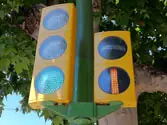
¿Qué indica la línea vertical de este semáforo?
What does the vertical line on this traffic light show?
- AQue deben detenerse los autobuses y los taxis.That buses and taxis must stop.
- BQue pueden pasar los autobuses y los taxis.That buses and taxis may go through.
- CQue deben detenerse todos los vehículos.That all vehicles must stop.
ExplanationThis traffic light applies only to trams and scheduled buses or, if there is a lane reserved for other vehicles, to those travelling in it.
El agente tenía los brazos en cruz y ha bajado los brazos. ¿Qué debe hacer?
The traffic officer had their arms stretched out sideways and has lowered them. What must you do?
- AContinuar circulandoContinue driving.
- BContinuar detenido hasta que realice otro tipo de señalRemain stopped until they give another kind of signal.
- CObedecer las señales o semáforosObey the signs or traffic lights.
ExplanationThe signal with arms stretched out sideways requires road users arriving from directions that cross that of the arms to stop, and it remains in force even if the officer lowers them, as long as they do not change position or give another signal.
All topics
- Definitions
- Documents and penalty points
- The driver's condition
- Duties of drivers and pedestrians
- Vehicle safety devices
- Vehicle controls and equipment
- Vehicle lights and horn
- The road and its lanes
- Speed and distances
- Manoeuvres
- Right of way
- Carrying passengers and loads
- Driving safely in difficult conditions
- Vehicle mechanics and maintenance
- Road accidents and first aid
- Defensive and eco-driving
Independent app: not affiliated with or endorsed by the DGT (Spain's Directorate-General for Traffic) or the Ministry of the Interior. The official exam is booked with the DGT and taken at its test centres. The questions here are practice material; the DGT's official question bank is not public.
Basado en datos de la Agencia Estatal Boletín Oficial del Estado (https://www.boe.es). Textos consolidados de carácter meramente informativo. La AEBOE no patrocina ni respalda este sitio.
Parte de las preguntas procede de los tests de la revista «Tráfico y Seguridad Vial» de la DGT, reproducidos con indicación de la fuente.